
College Dorm Bathroom Ideas That Start With Your Actual Bathroom
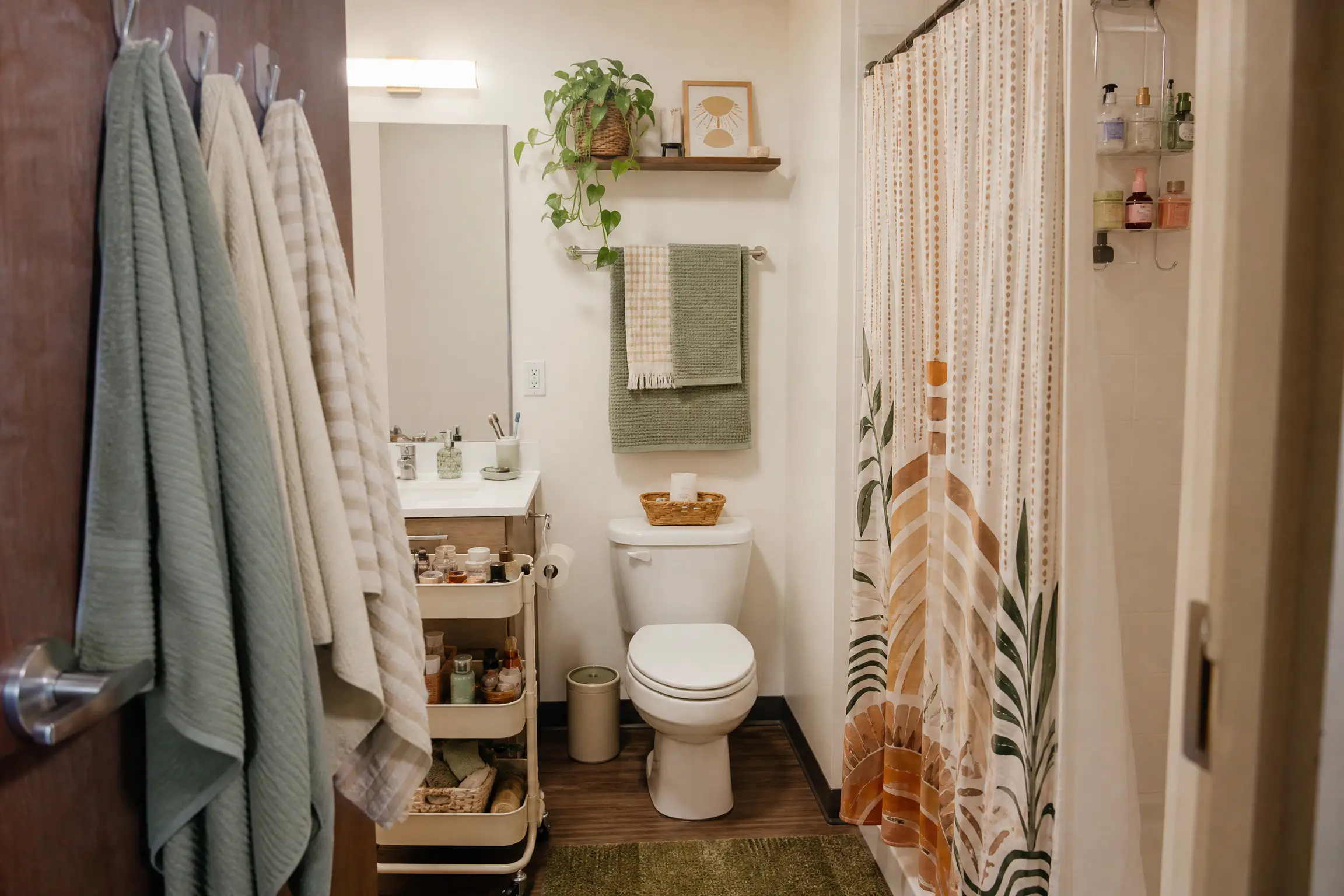
The first mistake most incoming college students make with their dorm bathroom is reading a list of ideas without knowing which type of bathroom they actually have. Advice about decorating a suite-style bathroom with coordinated towels and a shower curtain is completely useless if you are walking down a hall shared with forty other people. And advice about a portable shower caddy is only half the story if you have a private bathroom that you can genuinely make your own. The type of dorm bathroom you have determines everything: what to bring, what to buy, what you can actually improve, and what you need to just accept and work around.
This article is organized by bathroom type first. Find the section that matches your actual housing situation, read those ideas fully, and then check the Universal Ideas section at the end for improvements that work regardless of setup. Every idea here has been filtered through the real constraints of college dorm life: no permanent changes, limited budget, limited space, shared with other people who have different standards and schedules, and a daily routine that needs to happen efficiently whether you feel like it or not.
Communal Hall Bathroom: Shared With the Whole Floor
A communal hall bathroom is shared with anywhere from 15 to 40+ people on the same floor. You walk to it from your room, you share showers, sinks, and toilets with strangers, and you have essentially no storage in the bathroom itself. This is the most logistically challenging bathroom situation in college housing and the one where preparation matters most. Decoration is minimal here. Organization and hygiene are everything.
1. The Non-Negotiable Shower Caddy
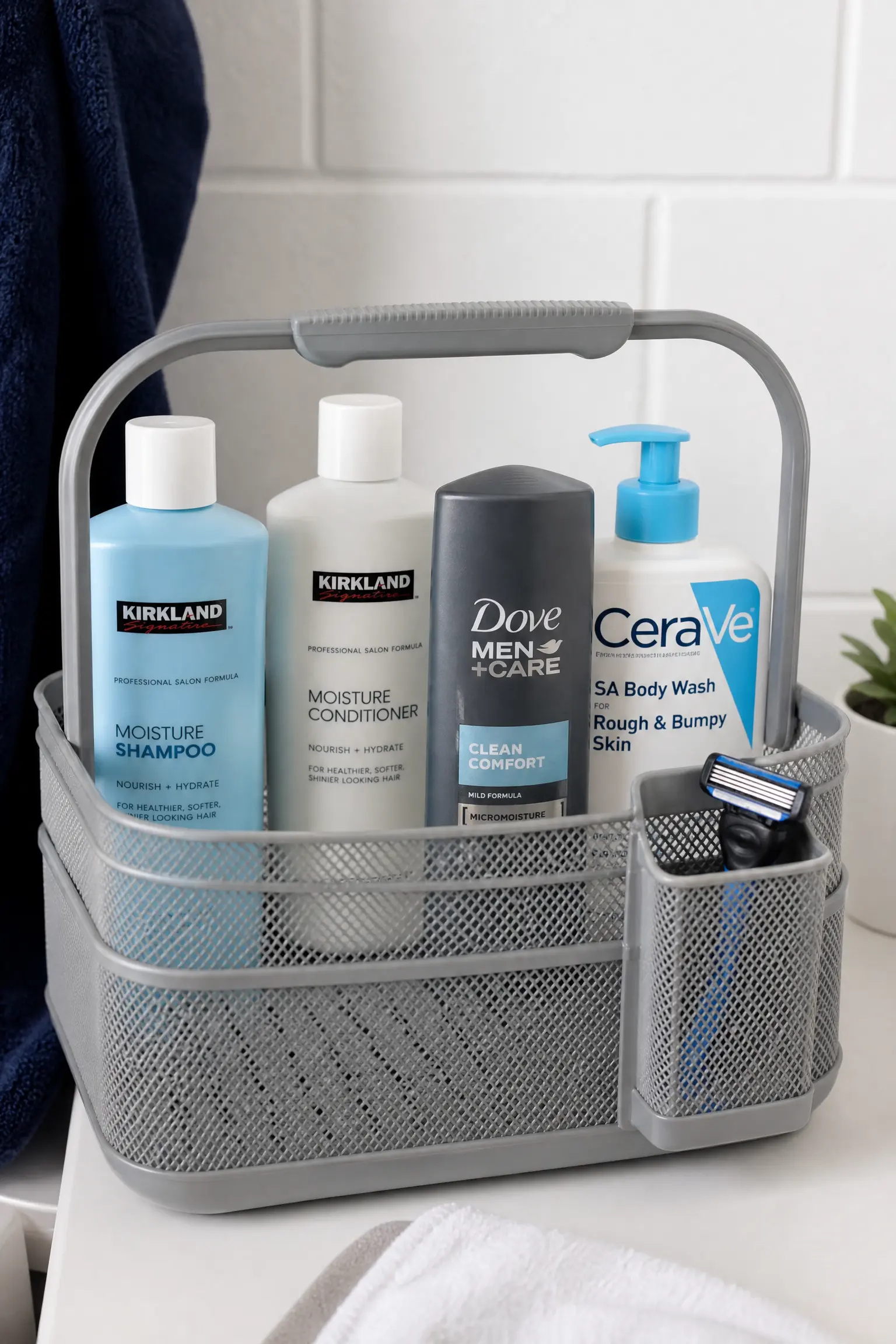
A quality shower caddy is not optional in a communal hall bathroom. It is the single piece of equipment that determines how functional and how stress-free your daily shower routine will be for the entire academic year. The caddy needs to hold every product you use in the shower, have drainage holes or mesh panels so it does not become a bacterial swamp between uses, be lightweight enough to carry comfortably when full, and dry quickly because it will be damp between every use. Mesh or open plastic caddies with a solid handle and defined compartments work better than fabric-sided totes that retain moisture and develop mildew over a semester. A caddy that tips over easily or does not hold your products securely is a source of daily frustration that compounds over months. Buy a good one before move-in, not a replacement halfway through the semester when the cheap one has let you down.
Pro Move: Caddy with a divided top rack for shampoo, conditioner, and body wash, and a lower section for a razor, face wash, and a small bar of soap in a soap dish, is more useful than a single open basket where everything shifts. The divided organization means you can reach in and find what you need without shifting everything else, which matters when you are half-awake at 7am.
2. Shower Shoes Are Non-Negotiable Too
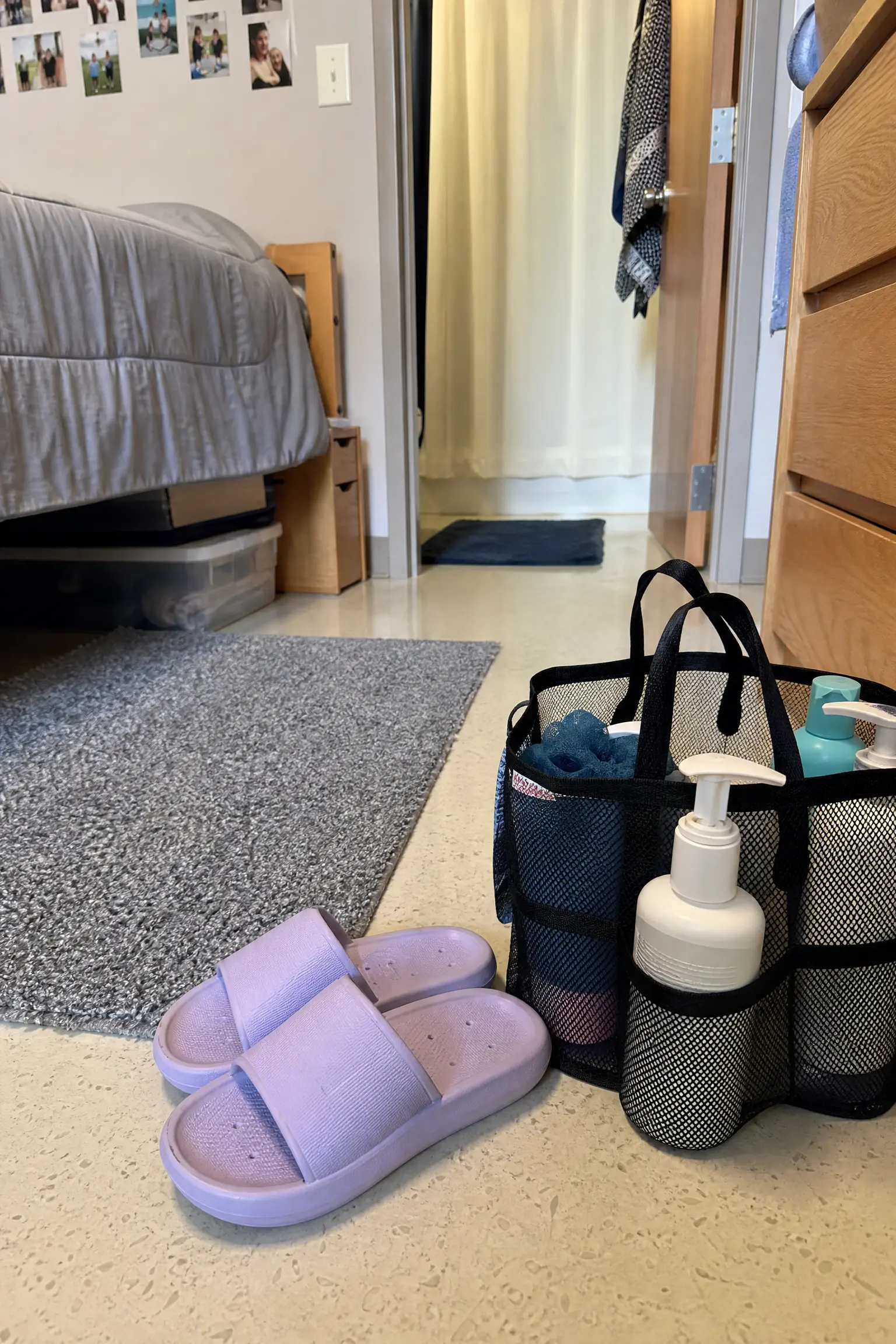
Communal shower floors are one of the highest-risk surfaces for fungal infections, plantar warts, and bacterial contact in any living environment. This is not alarmist: these are documented health risks in shared bathroom environments where warm, wet surfaces create ideal conditions for fungi and bacteria to survive between users. Shower shoes, whether rubber flip-flops, waterproof sandals, or purpose-designed shower slides, are the single most important hygiene decision you will make for your feet over the academic year. They need to be genuinely waterproof, easy to clean, and have a sole that grips a wet shower floor without slipping. Cheap rubber flip-flops from a dollar store work fine. The important thing is that you actually wear them every single time, not just when you think about it.
Heads Up: Shower shoes that are used in communal showers should be rinsed and air-dried outside the shower after every use rather than being stored in the shower room where they continue to be exposed to the same floor conditions you are trying to protect yourself from. A small hook on the back of your dorm room door or a mesh bag in your caddy is the right storage solution for communal bathroom shower shoes.
3. A Fast-Drying Microfibre or Turkish Towel

Walking from a communal bathroom back to your dorm room wrapped in a towel is a daily reality in hall bathroom living, and the towel you choose matters more than you might expect. A thick, heavy cotton bath towel takes significantly longer to dry between uses than a microfibre towel or a lightweight Turkish cotton towel, and in a dorm room where towels are typically hung over a door or draped over a chair rather than on a heated rail, a slow-drying thick towel can still be damp the next morning. A microfibre travel towel dries within an hour and is significantly lighter to carry to and from the bathroom. A Turkish cotton or peshtemal towel is similarly fast-drying, more absorbent than microfibre, and feels considerably better against the skin. Both are better choices for communal bathroom living than the standard department store bath towel that suits a home bathroom with a heated rail perfectly but is poorly suited to the dorm bathroom environment.
Quick Tip: Bring at least two towels to college so that you always have a dry option available even if the previous day’s towel has not fully dried. One towel in the wash and one in use is a recipe for a frustrating morning when the laundry cycle takes longer than expected.
4. A Tote Bag for the Walk to the Bathroom
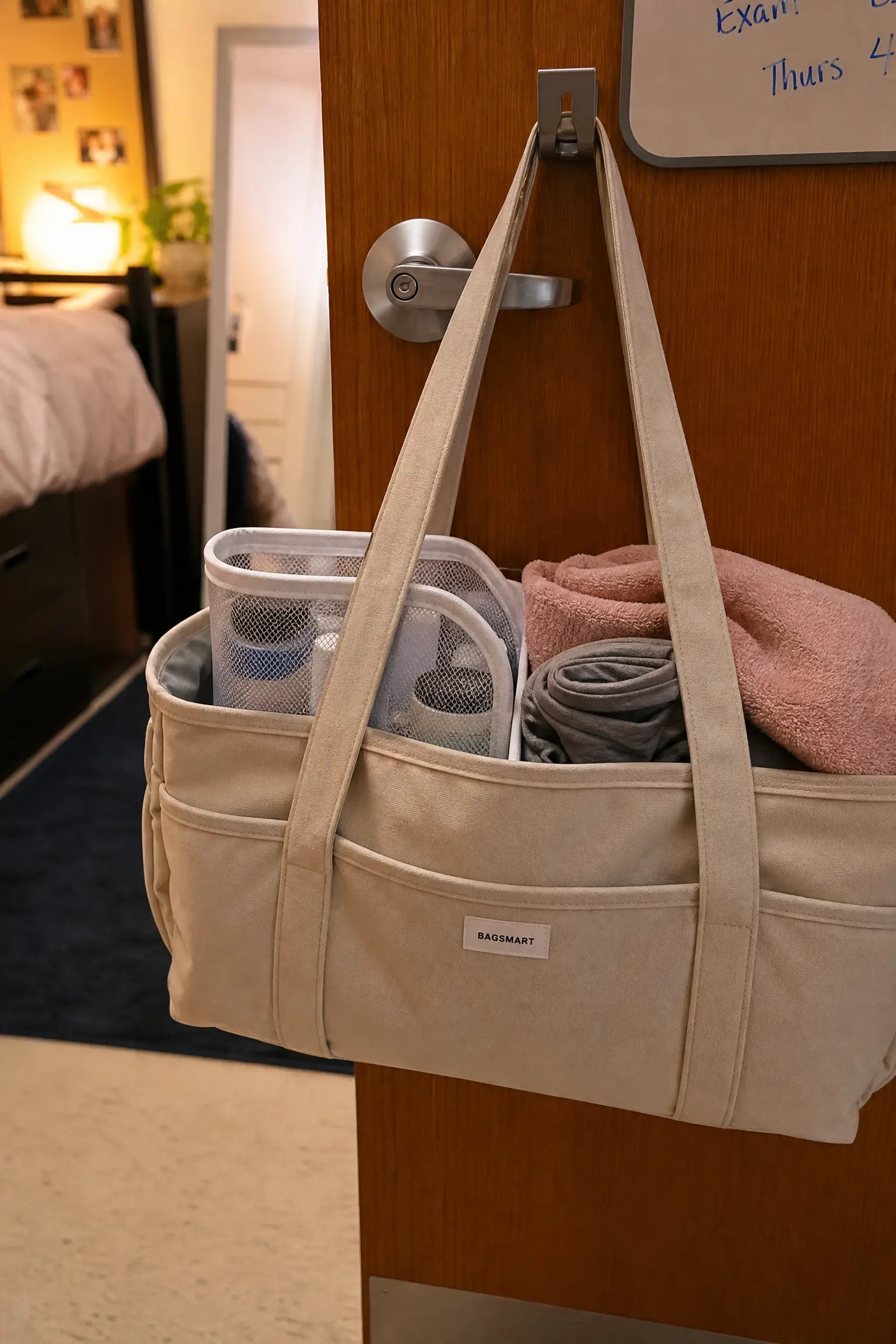
In a communal hall bathroom situation, the walk from your room to the bathroom and back needs to be organized and efficient, and a small structured tote bag or a waterproof bag provides the most practical way to carry your caddy, a change of clothes, your towel, and any additional items without juggling multiple loose objects through a shared corridor. A bag specifically designated for the bathroom run, hung on the back of the dorm room door, means you always know where your bathroom essentials are and the morning routine begins with one grab rather than a scattered search. It also provides a discrete way to carry a change of clothes to and from the communal bathroom without the specific awkwardness of walking down a floor corridor holding a pair of jeans and underwear.
Designer Advice: Choose a bag with a waterproof interior lining rather than a standard canvas tote for the bathroom run. Damp shower products and a wet towel placed inside a non-waterproof bag will transfer moisture to the bag lining and eventually create a mildew problem. A waterproof-lined bag can be wiped out or quickly rinsed if a product leaks or the towel goes in while still wet.
5. Peak-Hour Strategy and a Shower Schedule
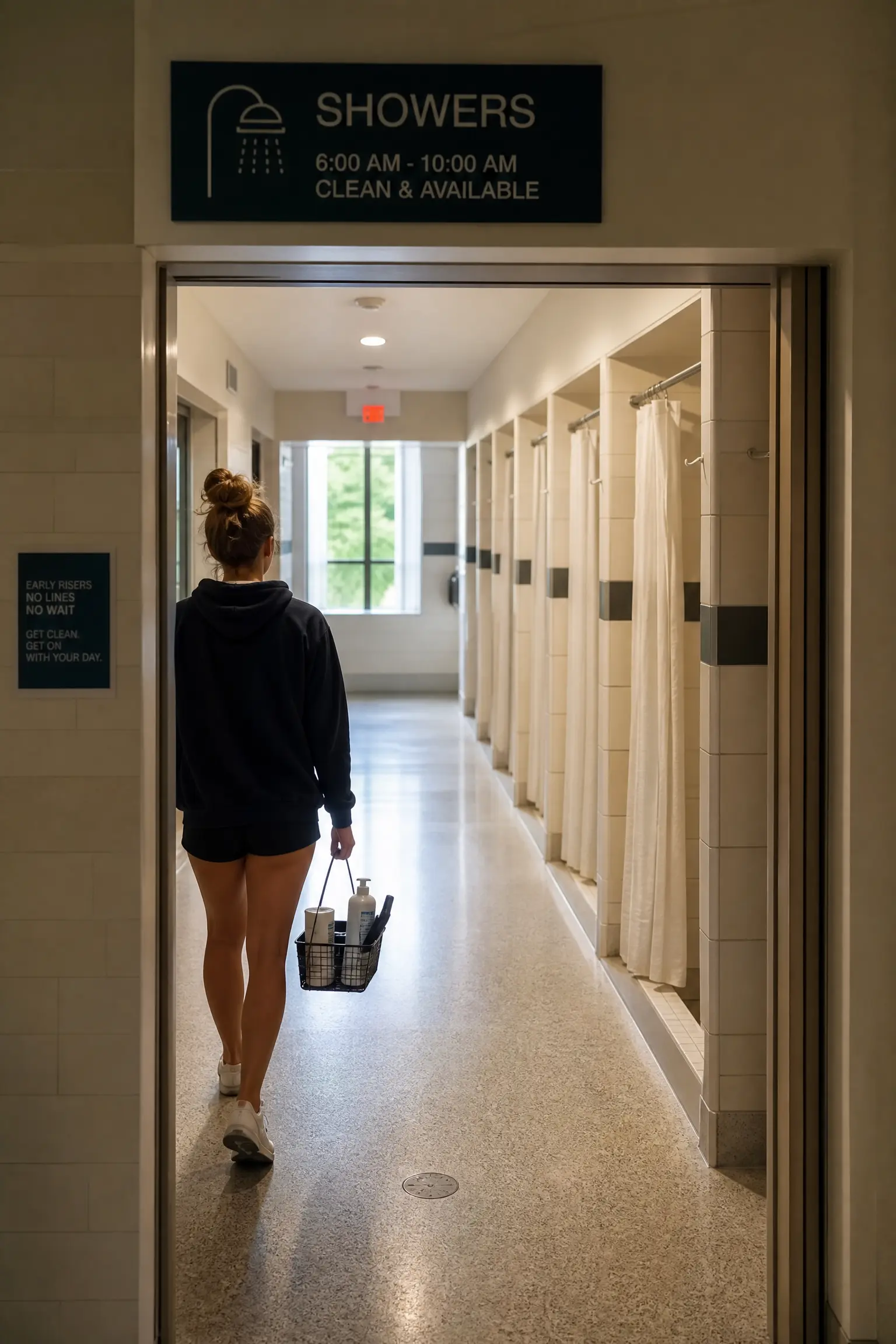
In a communal hall bathroom, time management is as important as any physical item. Peak hours in a hall bathroom are typically between 7am and 9am before morning classes, and between 10pm and midnight before sleep. Showering outside these windows, whether at 6am before the rush or at 8pm in the early evening, gives you access to a free shower stall without waiting and a bathroom that is significantly cleaner than it will be at 8am after twenty people have used it before you. The practical tip here is to identify the traffic patterns in your specific bathroom during the first week of the semester and then build your own routine around the windows of lower traffic. This is not a visible or purchasable change but it is consistently identified by students who have done communal bathroom living well as the single most impactful adjustment they made.
Reality Check: Peak bathroom hours at 8am will sometimes mean a wait regardless of your strategy, especially in the first weeks of semester when everyone is adjusting to new schedules simultaneously. Build five to ten extra minutes into your morning routine budget during the first month rather than assuming the shower will always be free when you arrive.
6. Your Dorm Room as the Actual Storage Space
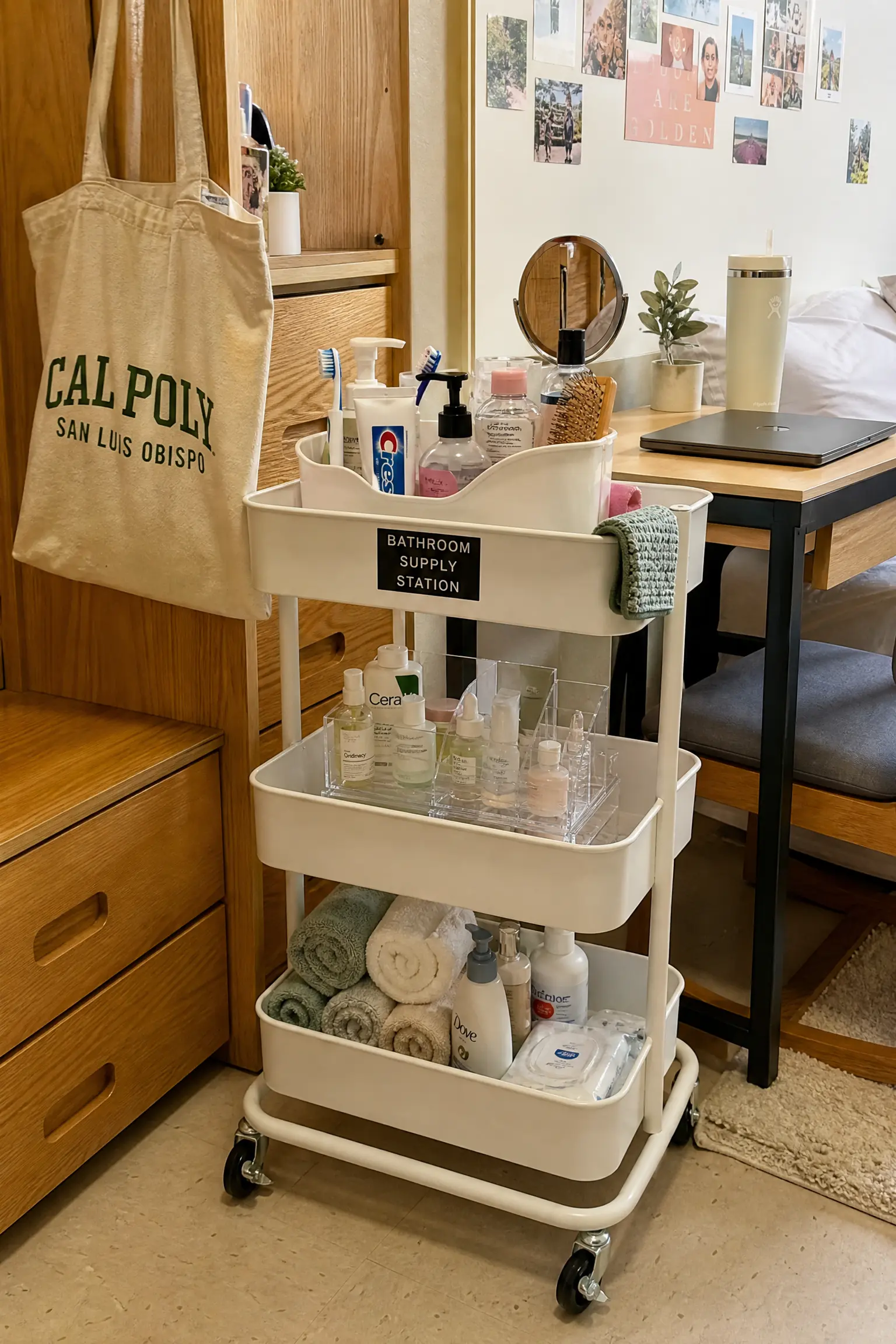
In a communal hall bathroom, the bathroom itself offers essentially no personal storage. The solution is to treat your dorm room as the storage space for your bathroom supplies and to build a dedicated bathroom supplies station in the room. A rolling cart with two or three tiers, positioned beside the desk or wardrobe, holds all your backup products, skincare, spare toiletries, and less-frequently-used items in an organized and accessible way that keeps them off the floor and out of any shared cabinet or counter space in the bathroom itself. The cart in the room also means you can see what you are running low on before you run out, which prevents the specific frustration of discovering you have finished your shampoo while standing in a communal shower with no replacement available.
Pro Move: Set up the rolling cart in your room before move-in day with all your bathroom supplies already organized on it. Having the system in place from day one means you build the right habits immediately rather than falling into the common pattern of leaving products scattered across the desk and windowsill and never quite knowing where everything is.
| Bathroom Type | Primary Challenge | Most Critical Item | Best Organization Approach |
| Communal hall | Hygiene, logistics, waiting | Quality shower caddy | Rolling cart in dorm room |
| Suite (2-5 people) | Shared storage, schedules | Clear personal caddy | Assigned shelf or drawer |
| Private dorm bathroom | Limited space, no permanent changes | Over-door organizer | Layered vertical storage |
| Semi-private pod | Hybrid challenges | Portable caddy + own supplies | Combination of above |
Suite Bathroom: Shared With 2 to 5 Suitemates
A suite bathroom shared with 2 to 5 suitemates is a significantly better situation than a communal hall bathroom but still requires clear organization, an honest suitemate conversation about shared vs personal products, and a storage system that gives everyone equal and accessible space. The suite bathroom can also be genuinely decorated, which neither the communal hall bathroom nor most students’ first instinct allows for.
7. Assign a Dedicated Shelf or Drawer to Each Person
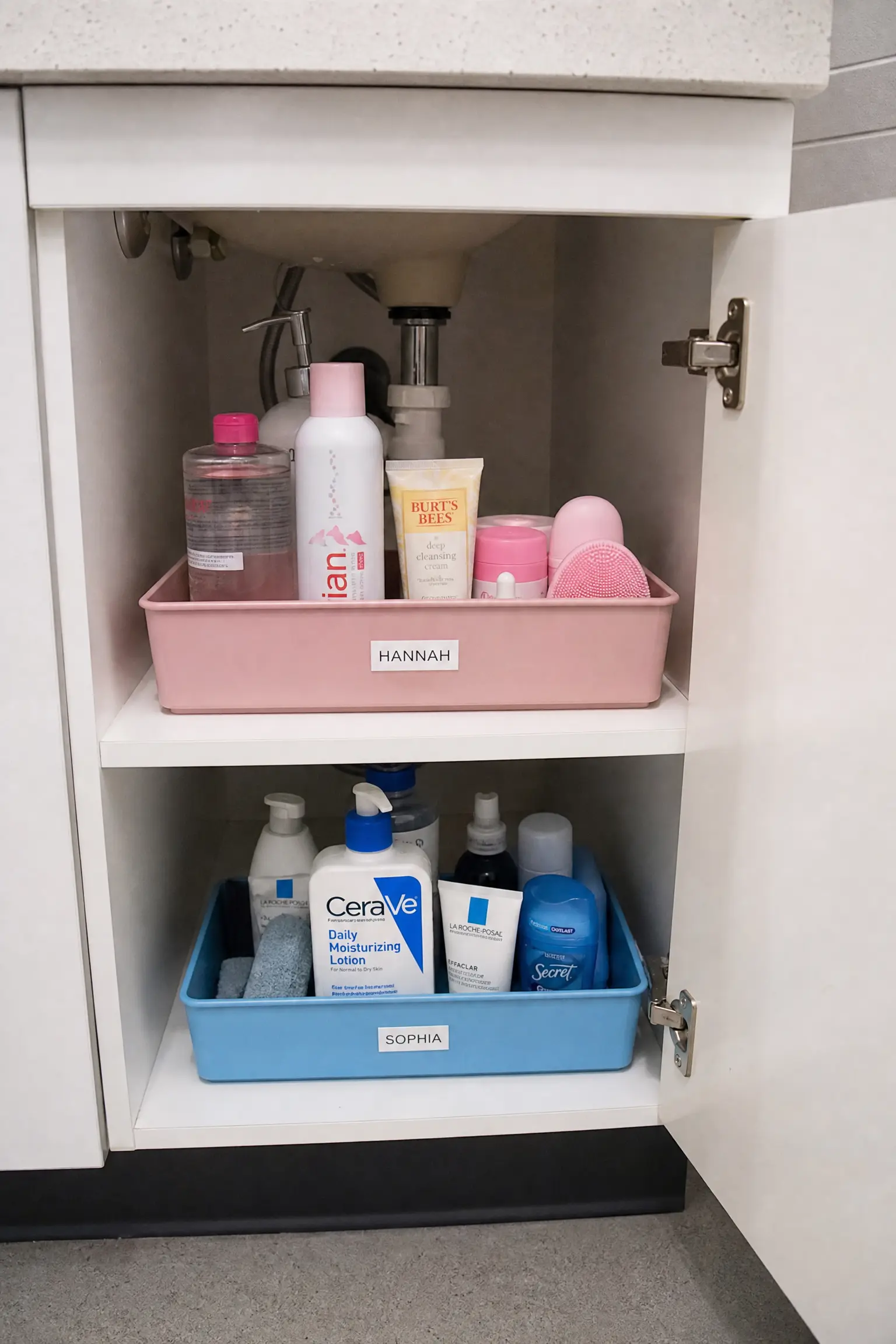
The fastest way to turn a suite bathroom into a source of suitemate friction is to leave storage unassigned and assume everyone will naturally find their own space. The fastest way to keep a suite bathroom functioning pleasantly for an entire year is to divide the available storage clearly and specifically on the first day, before any habits form around the existing space. If the bathroom has two shelves under the sink, one shelf per person per two occupants. If it has a medicine cabinet, assign specific shelves within it. If it has a small vanity counter, designate a specific zone for each person and keep personal items within that zone. The conversation about assigned storage is slightly awkward on day one and saves a semester of resentment. Every student who has successfully navigated shared suite bathrooms consistently identifies this as the single most important early decision.
Reality Check: Assigned storage zones only work if all suitemates actually use them consistently. If one person agrees to a storage arrangement and then perpetually leaves their products across the entire counter, the agreement is meaningless. Revisiting the arrangement with a direct conversation within the first two weeks, before the habit solidifies, is far easier than addressing it after a month of quiet frustration.
8. A Personal Shower Caddy Even in a Suite Bathroom
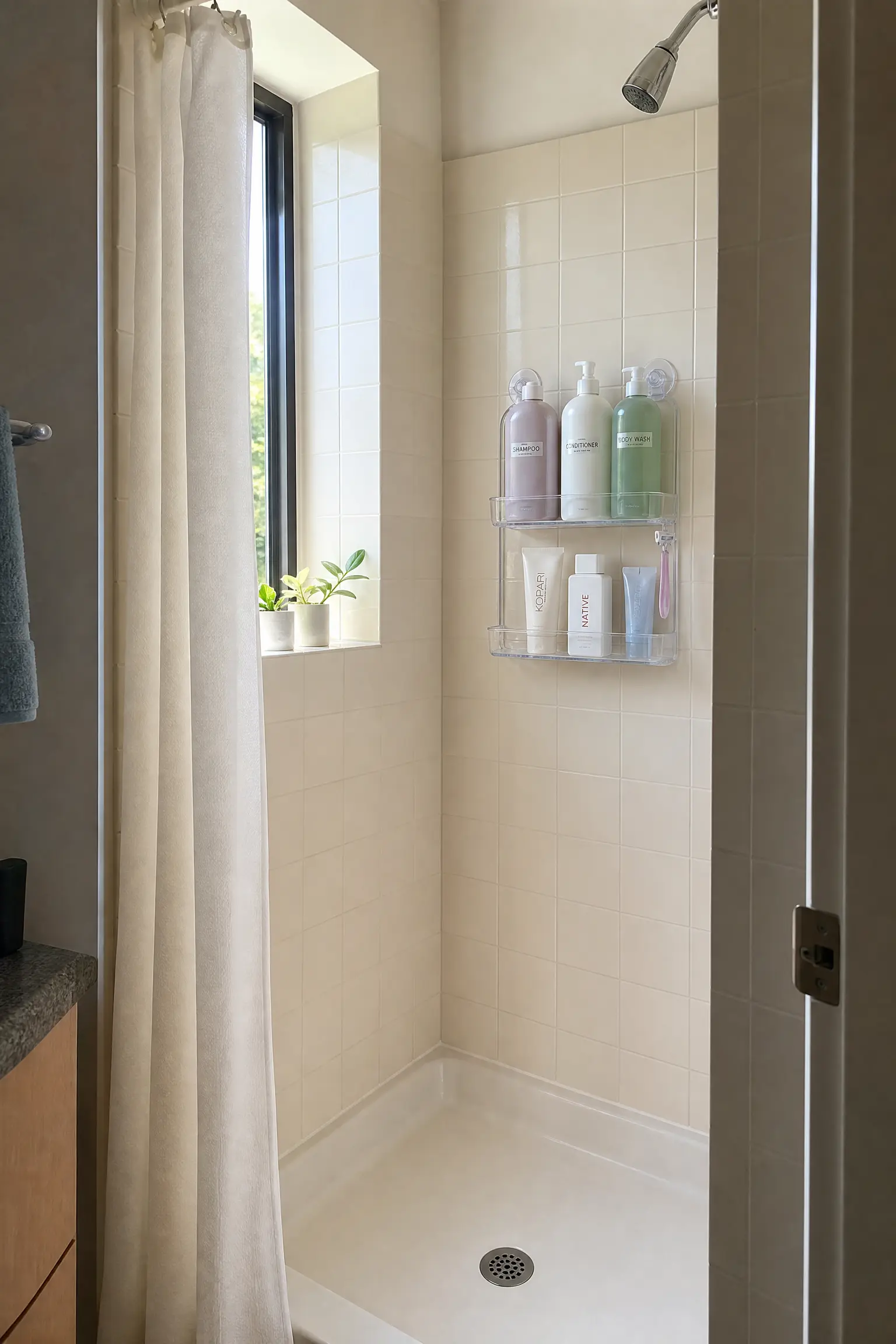
Even in a suite bathroom where you do not need to carry your products to and from a distant communal facility, a personal shower caddy assigned to a specific position in the bathroom, either hanging from the shower curtain rod, sitting on a dedicated shelf in the shower enclosure, or stored on your assigned shelf and brought to the shower for each use, keeps your products organized and contained rather than scattered across every available surface. A caddy in a suite bathroom also makes cleaning significantly easier: one lift of the caddy, a quick wipe of the shelf or shower ledge, and everything goes back. Without caddies, each suitemate products need to be moved individually to clean the surface beneath, which means cleaning either does not happen or creates friction about whose responsibility it is.
Heads Up: Choose a shower caddy with a suction cup attachment or a hanging hook for a suite bathroom so that it attaches directly to the shower wall rather than sitting loose on the floor or ledge. A caddy that attaches to the wall keeps the shower floor clear, is easier to clean around, and prevents the specific annoyance of a caddy being moved to clean the shower and not being returned to the right position.
9. A Coordinated Shower Curtain and Bath Mat for the Suite
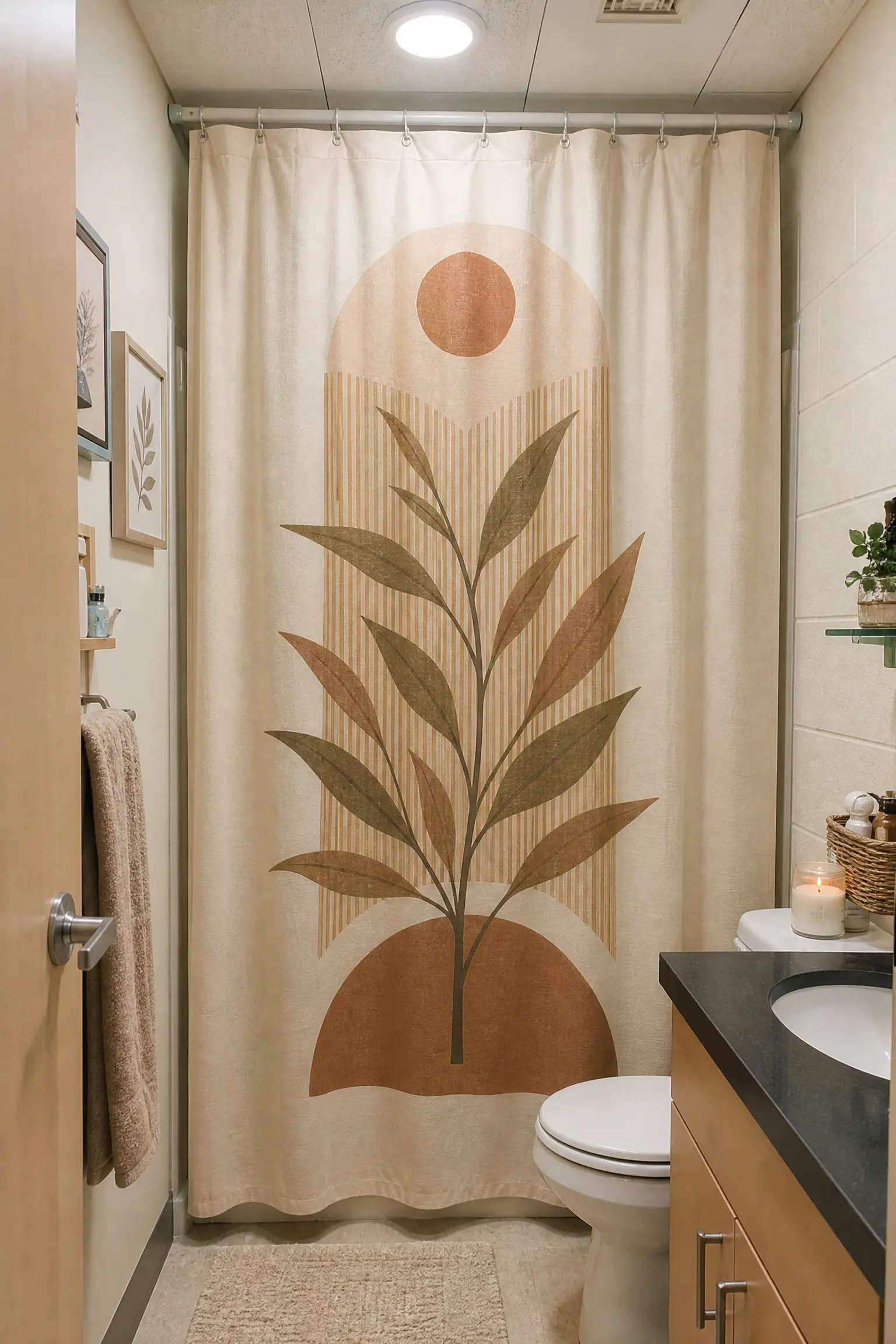
In a suite bathroom, you and your suitemates can make a genuine aesthetic decision together: choosing a shower curtain and bath mat that coordinate with each other and give the bathroom a coherent look rather than the institutional white of the standard dorm fitting. A shower curtain in a pattern both of you like, alongside a bath mat in a tone drawn from the curtain, costs very little and changes the feel of the bathroom from an institutional shared facility to something that feels genuinely chosen and personal. The practical guidance for a shared choice: abstract patterns with multiple colours are easier to agree on than a specific theme, and a curtain with some neutral in its pattern is easier to live with for a year than one with a very specific colour story that not everyone might feel the same way about in February as they did in September.
Designer Advice: Hang the shower curtain from a tension rod positioned as close to the ceiling as possible rather than at the standard mid-height dorm positioning. A curtain that falls from ceiling height to floor makes the bathroom feel significantly taller and more spa-like, and a tension rod requires no drilling or permanent fixtures. The standard positioning at about 180 centimetres from the floor cuts the bathroom visually and makes the space feel lower and smaller than it actually is.
10. A Tiered Rolling Cart as Shared Bathroom Storage
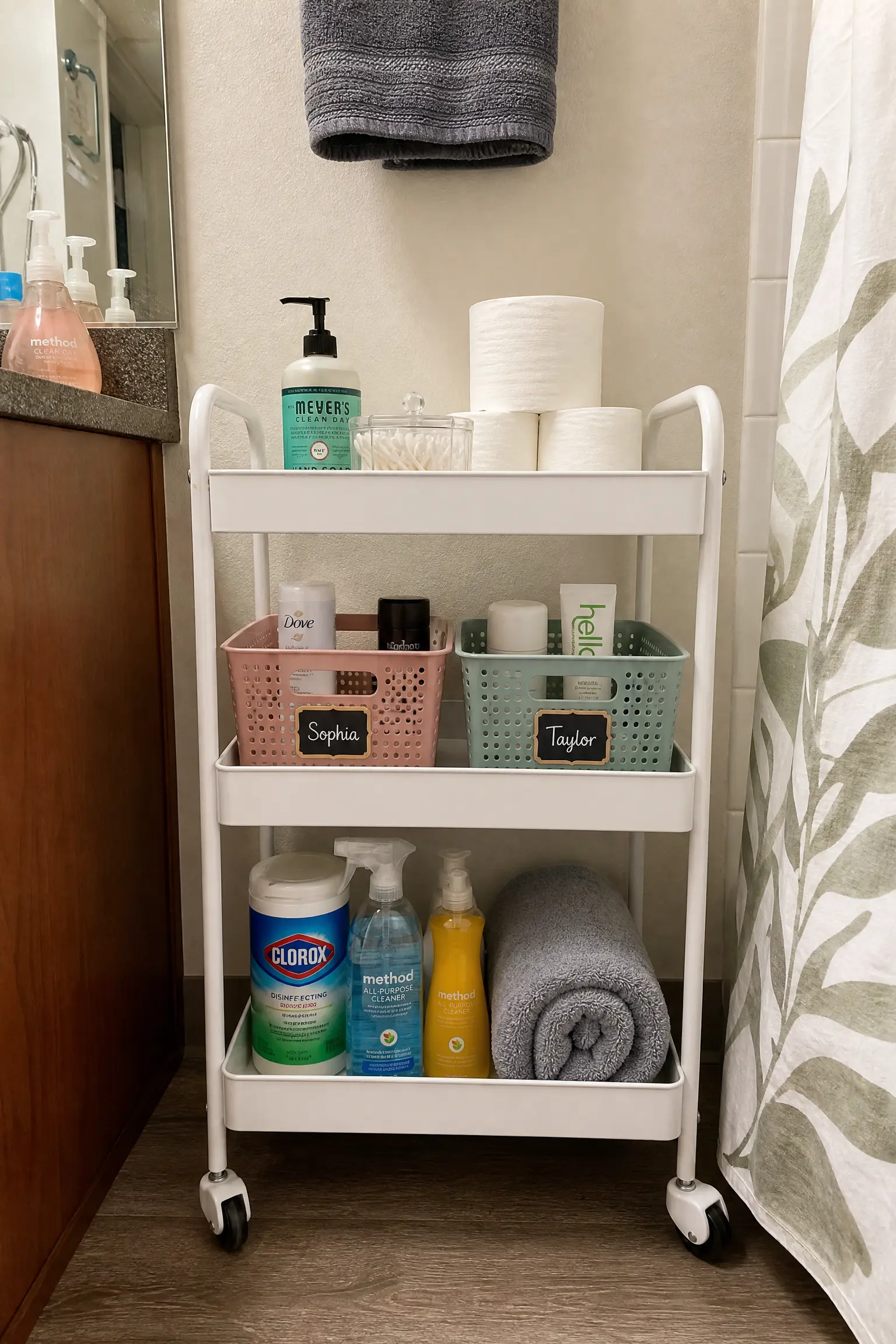
A two or three-tier rolling cart, placed in the suite bathroom rather than in individual dorm rooms, provides shared bathroom storage that everyone can access and that keeps the counter and floor clear of individual product scatter. The cart works best when each tier is assigned to a specific function rather than a specific person: top tier for daily use items that all suitemates share (spare toilet paper, hand soap refill, cleaning products), middle tier for individual personal product storage in separate small bins or baskets, lower tier for towels or less-frequently-used supplies. A rolling cart also makes cleaning considerably easier: roll it out of the bathroom, sweep or mop the floor, roll it back in. At around twenty to thirty dollars for a basic three-tier cart, it is one of the highest-return shared investments available for a suite bathroom.
Quick Tip: Buy the rolling cart before or on move-in day rather than waiting until the bathroom is already cluttered. A storage system installed before products arrive makes organization the default. A system installed after two weeks of counter clutter requires reorganizing existing habits as well as the physical products, which is significantly harder.
11. Adhesive Hooks for Towels and Robes
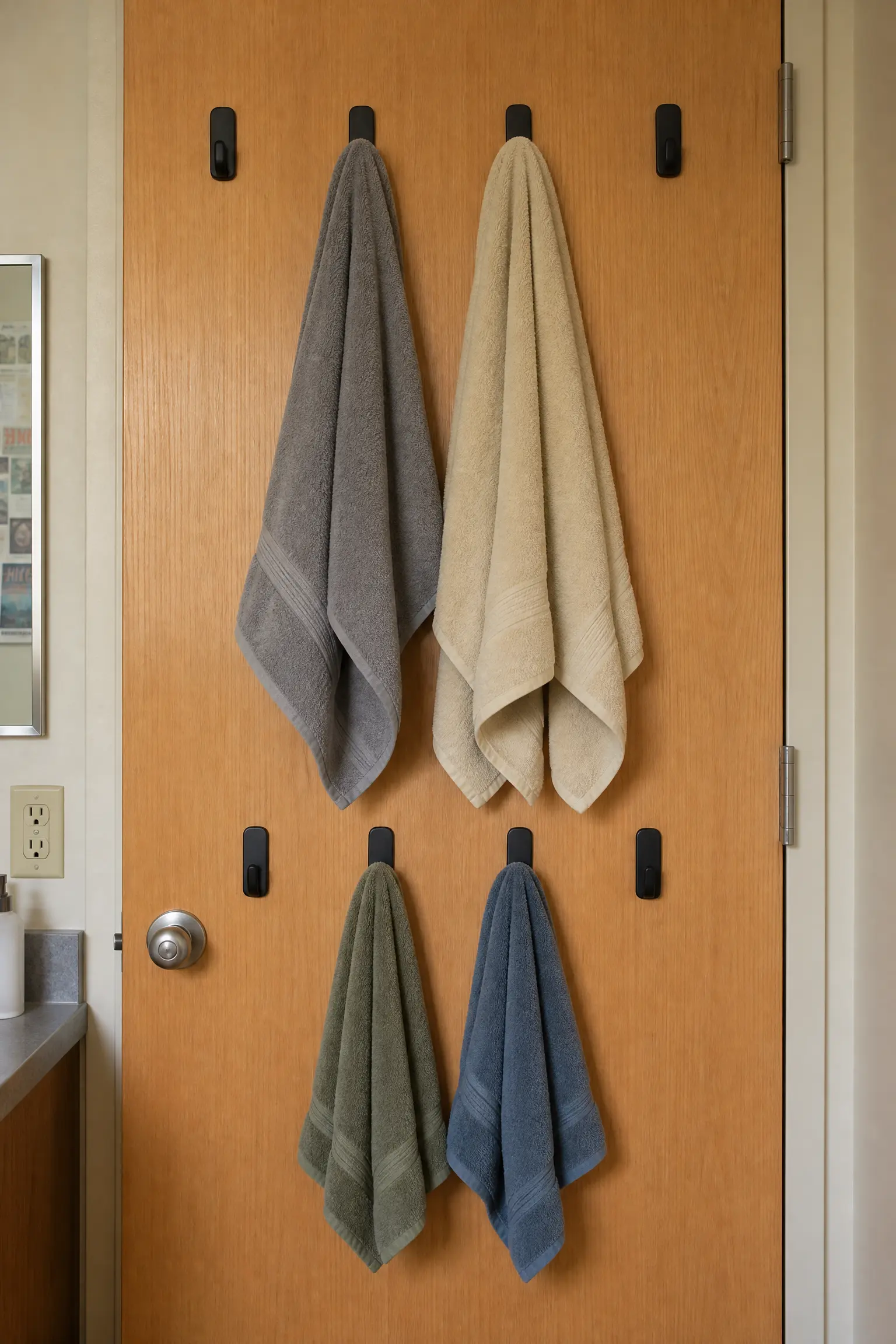
A suite bathroom rarely has enough hooks for all suitemates to hang their towels and robes within the bathroom itself. Adhesive command hooks, rated for the weight of a wet towel, installed on the back of the bathroom door, on the wall beside the shower, or on the inside of a cabinet door, multiply the hanging surface available in the bathroom without any drilling or permanent fixtures. Each suitemate should have at least two hooks: one for a bath towel and one for a hand towel or robe. Clearly associating specific hook positions with specific suitemates, whether by labelling them or simply by convention established in the first week, prevents the specific bathroom confusion of reaching for your towel and finding someone else has used it or moved it.
Pro Move: Install adhesive hooks at different heights on the same wall to create a visible organizational logic: robes and bath towels on the upper hooks, hand towels on the mid-level hooks, and a hook for a small hanging organizer at the lower level. The height differentiation makes it clear what belongs where and keeps the arrangement from looking like a cluttered row of random hanging items.
12. A Suitemate Cleaning Agreement in Writing
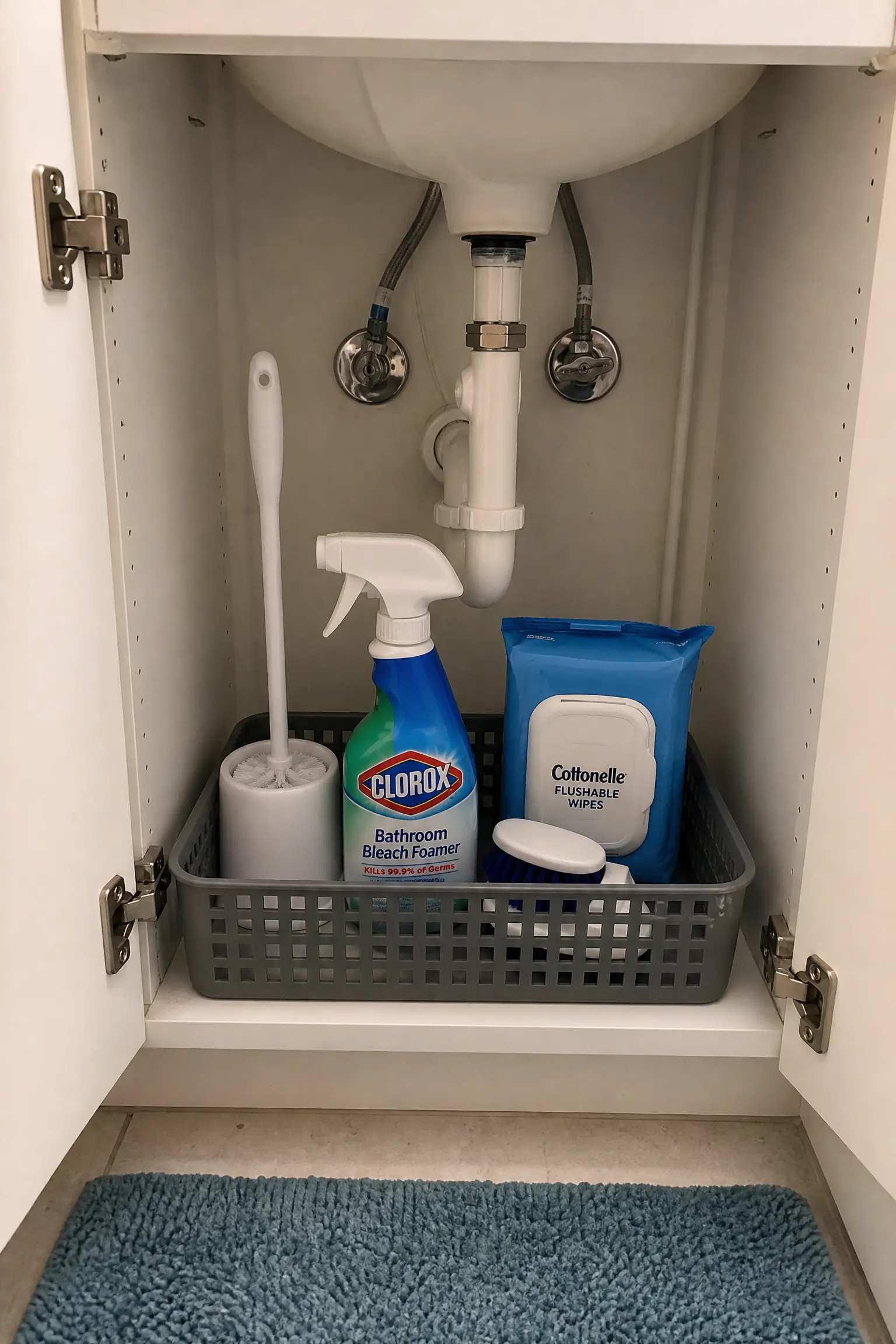
The suite bathroom cleaning question is one of the most common sources of suitemate conflict in college, and it is almost always caused by unspoken assumptions about whose responsibility it is and how often it needs to happen rather than by anyone actually being unreasonable. A simple written agreement, something as short as a shared notes document or a message pinned in the group chat, that specifies who is responsible for which cleaning tasks and on which days of the week, eliminates the need for either passive aggression or an uncomfortable conversation after the bathroom has reached an unacceptable state. The conversation about cleaning expectations is more comfortable on day two of the semester, before any standard has been established, than it is on day forty-five when it is already a pattern issue. Basic floor cleaning products, a toilet brush, and a surface spray shared between suitemates is a ten-dollar joint investment that prevents a semester of irritation.
Reality Check: A cleaning agreement only functions if the tasks are genuinely followed through on. If one suitemate is consistently not doing their assigned task, the agreement needs to be revisited and re-confirmed as a shared expectation rather than left to passive acknowledgement. This is an uncomfortable conversation but a significantly more manageable one than the alternative of cleaning the bathroom yourself every week for an entire year.
Private Dorm Bathroom: Your Own Space to Make Your Own
A private dorm bathroom is an unusual and genuinely fortunate college housing situation, most common in some upperclassman housing, newer residence halls with suite-style private rooms, and some specialty housing programs. If you have a private bathroom, the logistical concerns of the communal and suite situations do not apply, and you can make genuine design decisions about the space. The constraints that remain are that you cannot make permanent changes, the budget is a student budget, and the space is usually very compact.
13. Peel-and-Stick Tile or Wallpaper for Instant Personality
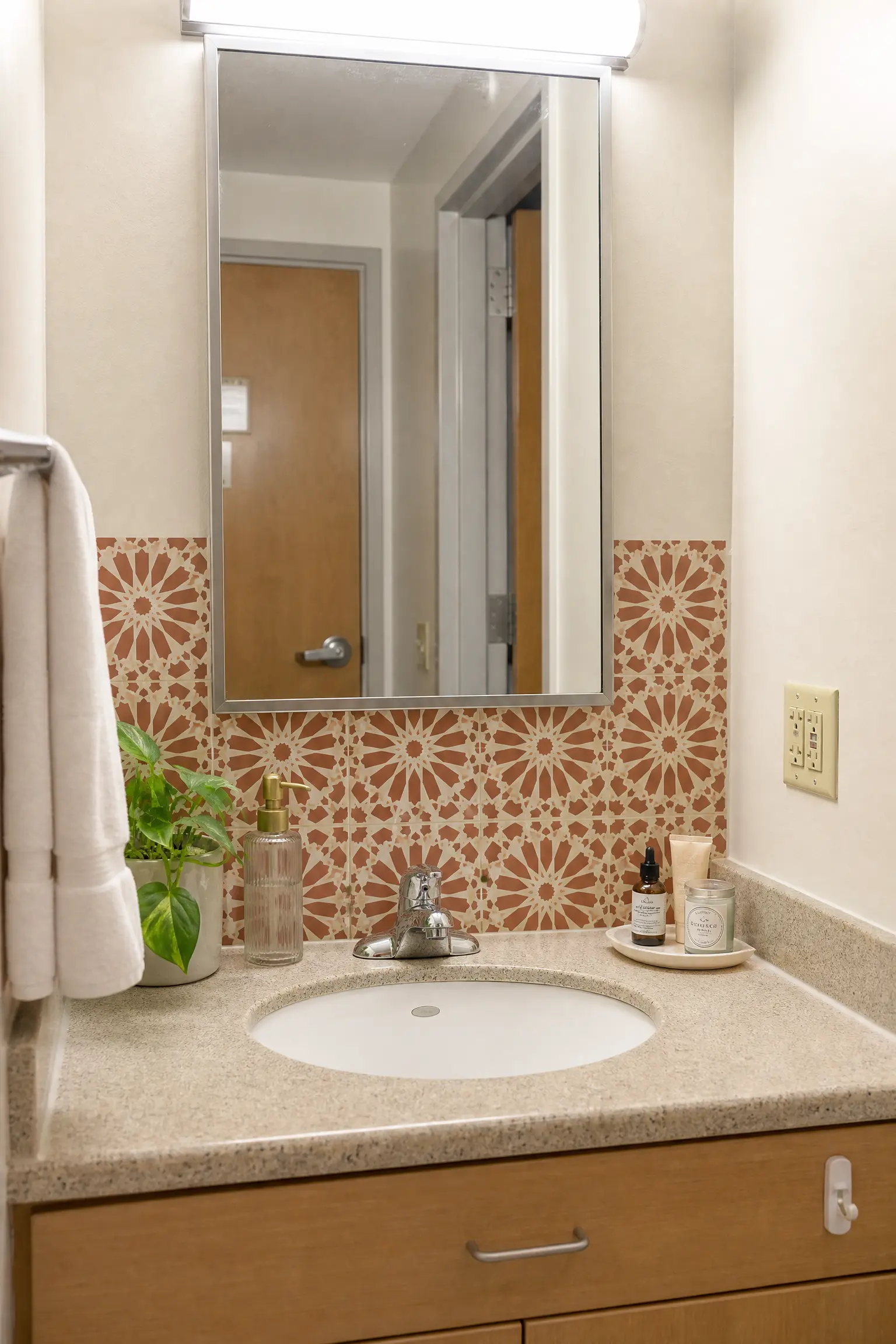
A private dorm bathroom that you have to yourself for the academic year can have a genuinely distinctive look through removable peel-and-stick products that require no permanent changes. Peel-and-stick wall tiles in a geometric or Moroccan pattern applied to the backsplash area behind the sink, or a removable wallpaper panel on the wall opposite the door, transform the institutional white of a standard dorm bathroom into something with a clear aesthetic identity. Both products are specifically manufactured to be removed without wall damage when applied to smooth, clean, fully cured surfaces. Always do a small test patch in an inconspicuous corner before applying to the full area, and follow the specific preparation guidelines for the product including the requirement for completely clean, dry walls.
Heads Up: Peel-and-stick products in a bathroom must be rated specifically for bathroom humidity and steam conditions. Standard removable wallpaper designed for bedroom use will lose adhesion in a bathroom environment within weeks, particularly if the room does not have adequate ventilation. Products specifically labelled as moisture-resistant or bathroom-appropriate are the practical choice for any wet room application.
14. A Custom Shower Curtain as a Style Statement
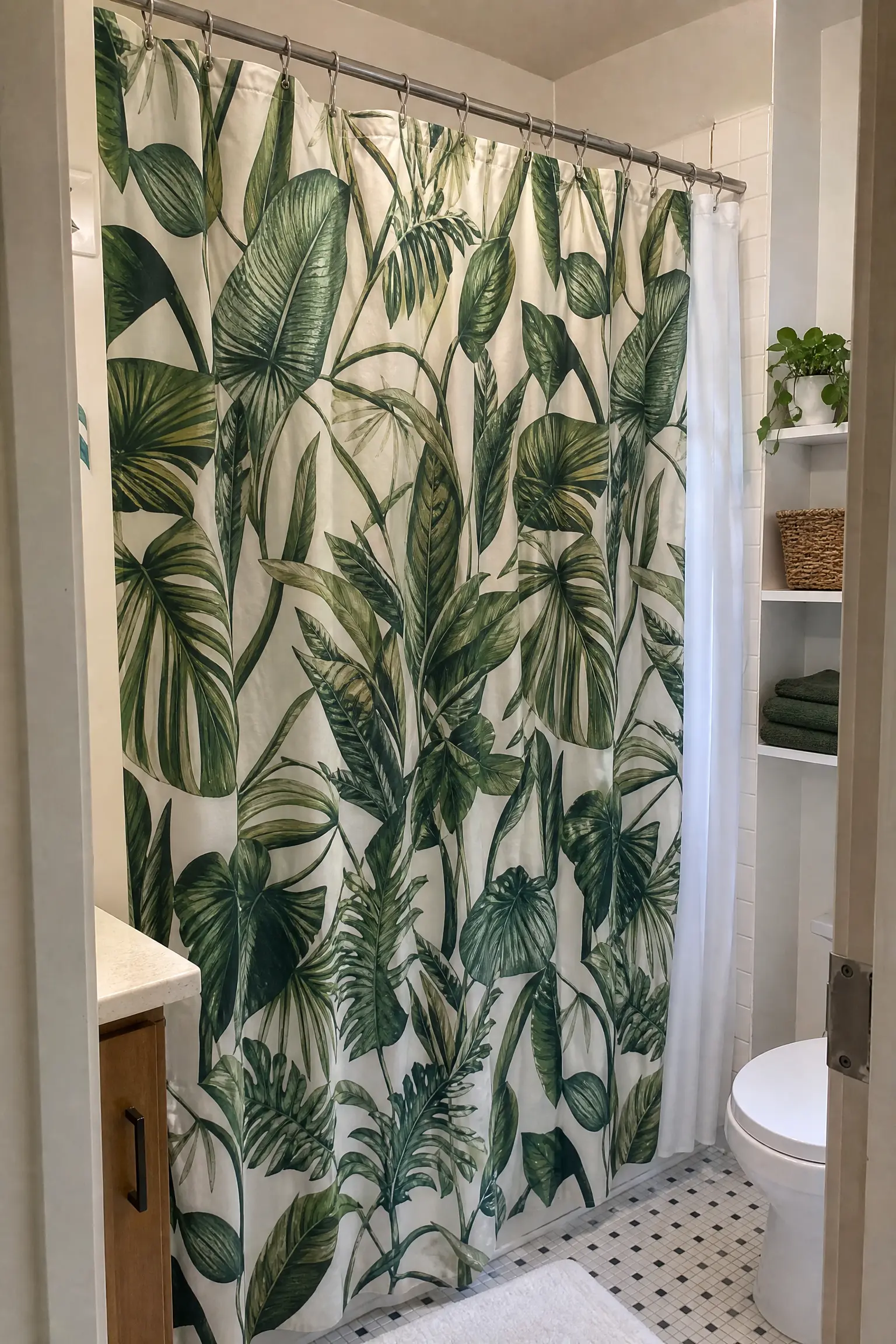
In a private bathroom, the shower curtain is the largest textile surface in the room and the most powerful single aesthetic decision available. A custom or specifically chosen shower curtain in a pattern, colour, or material that expresses your personal style makes the private dorm bathroom feel genuinely yours rather than institutional, and the change takes under five minutes to install on the existing tension rod. Linen-look shower curtains in warm neutrals or earth tones create a sophisticated, grown-up bathroom atmosphere. Bold geometric or botanical prints in vibrant colours create a dramatically different visual personality. A macrame or woven-effect curtain adds a boho, textural quality. The one practical note: pair any decorative curtain with a plain clear or white waterproof liner behind it to protect the decorative fabric from direct water contact and mildew development.
Designer Advice: Hang the shower curtain from a tension rod positioned within five centimetres of the ceiling rather than at the standard height. In a small private dorm bathroom, ceiling-height curtains are the single most impactful visual change available because they make the room feel dramatically taller and more intentional. A curtain hung at the same height as the shower fitting rather than as high as possible makes the bathroom feel lower and more confined than it actually is.
15. Over-Door Storage for Maximum Vertical Space
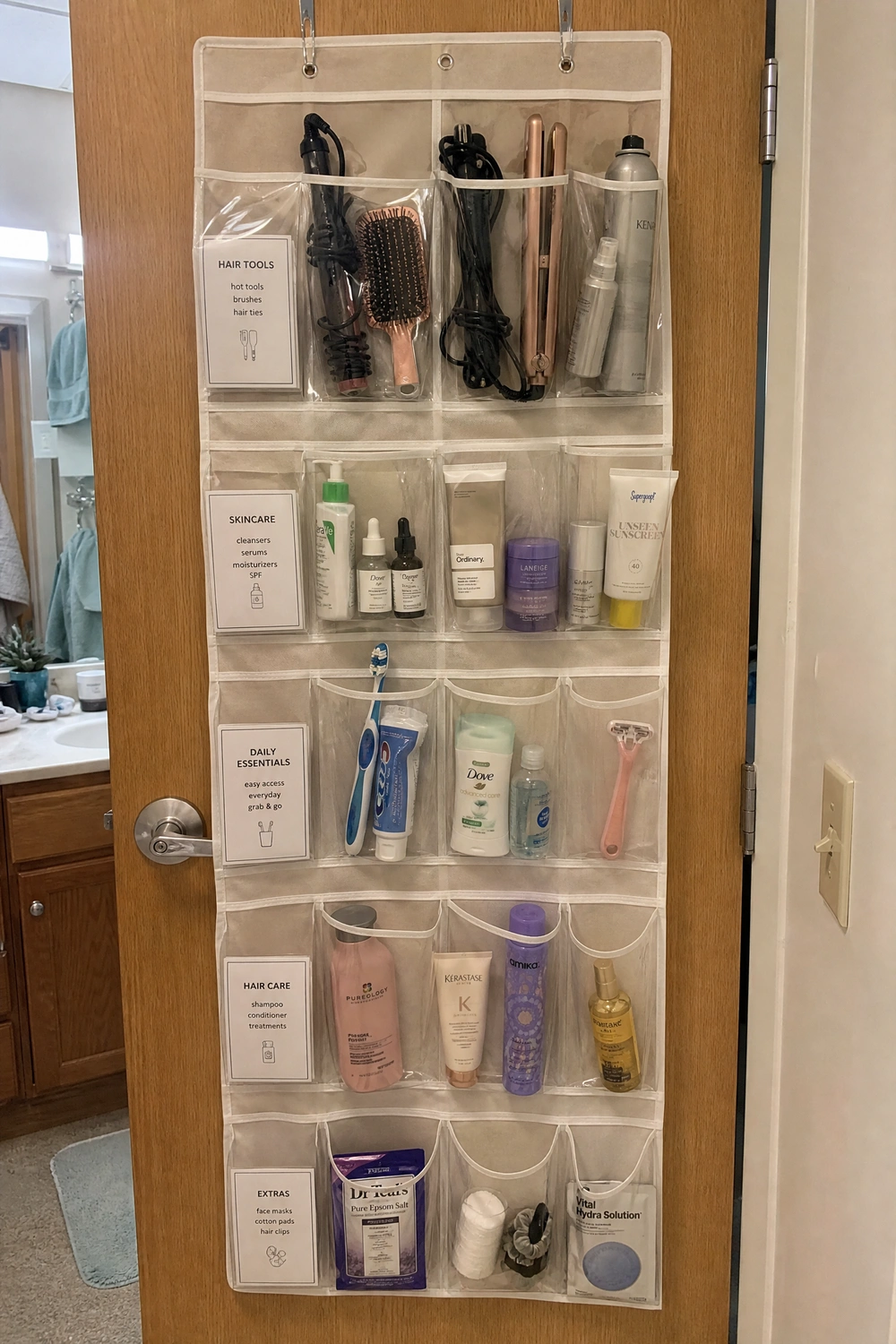
An over-door organizer hung on the back of the bathroom door uses the largest vertical surface in the room without any wall fixings and provides the most significant additional storage available in a compact private dorm bathroom. A clear-pocket over-door organizer allows you to see every item at a glance without opening pouches or containers. A hook-and-basket over-door system provides more accessible storage for larger items like hair tools, a hair dryer, and bottles of product. A tiered shelf over-door unit works best for grouped items in small containers. In a private bathroom with no medicine cabinet and a single small shelf, an over-door organizer on the bathroom door can hold more total product than all other storage surfaces in the room combined, simply by using the back of a surface that is otherwise doing nothing.
Pro Move: Dedicate specific pockets or sections of the over-door organizer to specific categories rather than filling it without an organizing logic. Hair tools and accessories in one section, skincare in another, makeup in a third, and daily essentials (toothbrush, face wash, deodorant) in the most accessible central position. The organizing logic means you can reach for what you need without scanning the full door, which makes the daily routine faster and less mentally demanding.
16. A Small Rolling Cart Under the Sink
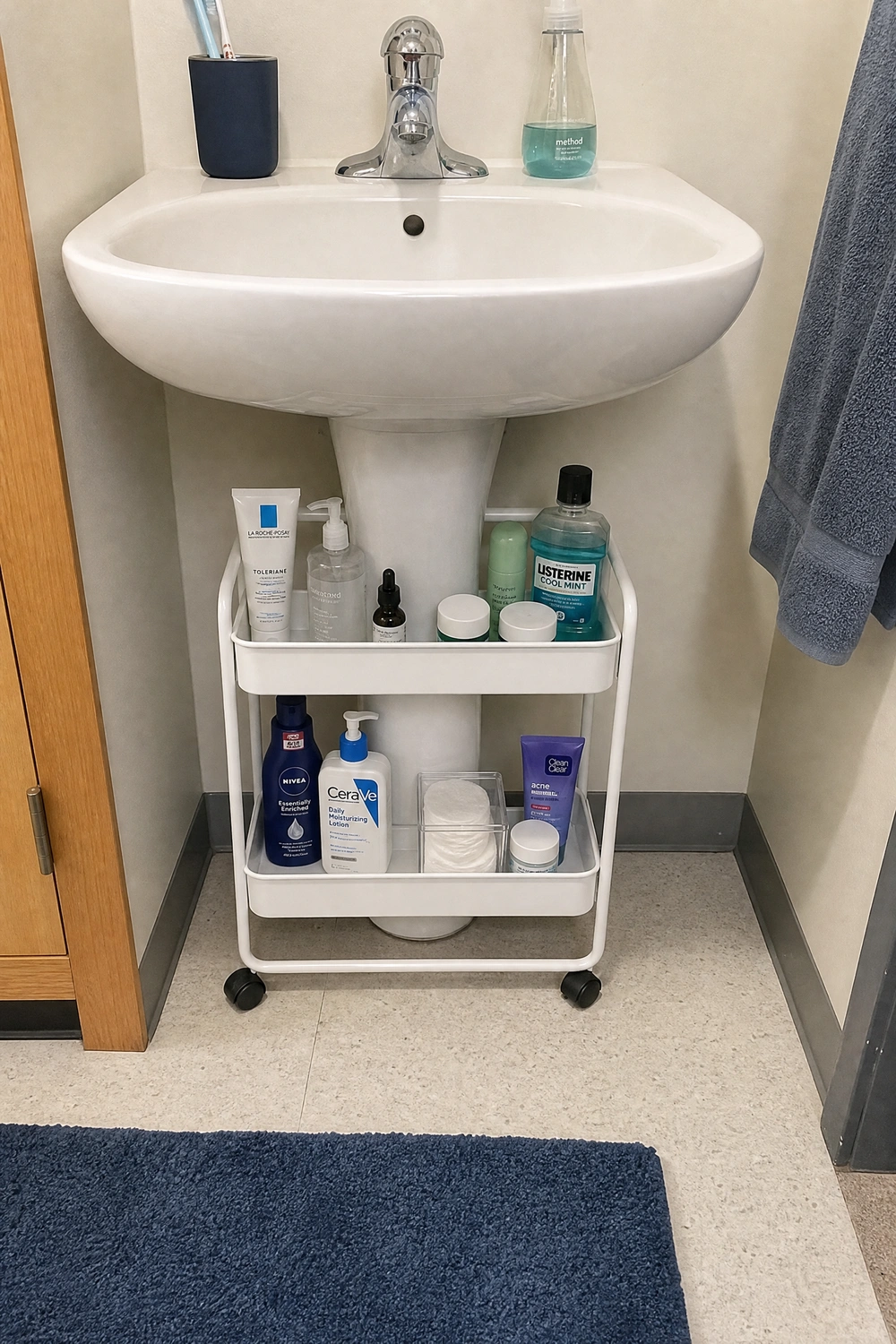
Most private dorm bathrooms have a pedestal sink or a small vanity with minimal under-sink storage. A small rolling cart with a low profile that fits under the sink basin, with two or three shelf levels for product storage, uses the dead space beneath the sink more efficiently than any alternative. At under-sink height, the cart needs to be slim enough to fit without blocking the plumbing connection points, which typically means choosing a cart no wider than about 30 centimetres and checking the clearance between the floor and the lowest pipe connection before purchasing. A cart in this position keeps products off the floor and off the counter simultaneously, which is the storage challenge that most small private bathrooms present.
Reality Check: Measure the under-sink clearance before purchasing any storage unit for that space. The distance from the floor to the first pipe connection varies significantly between dorm buildings and plumbing installations, and a cart that works in one bathroom may not fit in another. A tape measure and two minutes of measurement prevents a return trip.
17. Coordinated Towels, Mat, and Accessories in a Single Colour Story
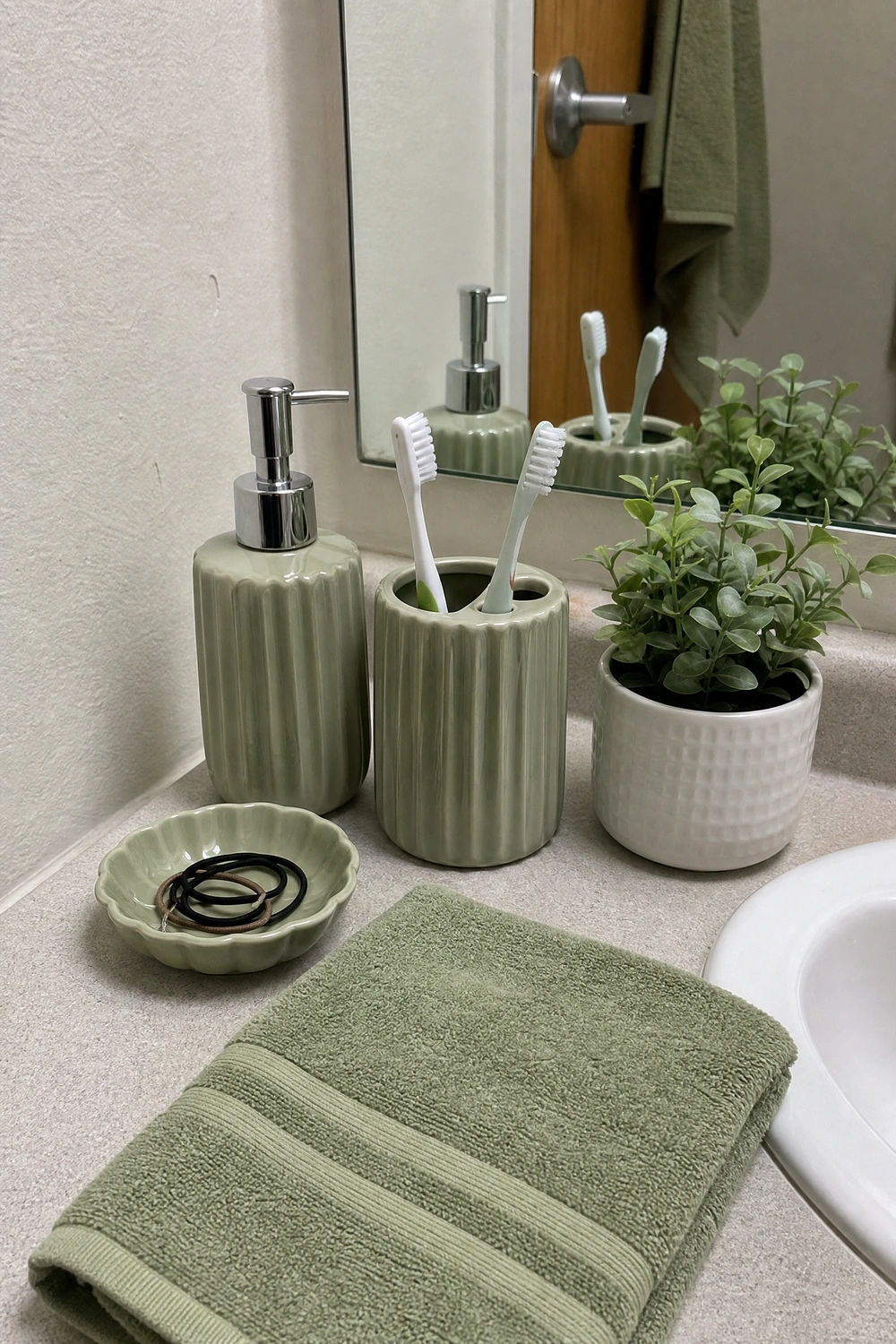
In a private dorm bathroom, you have the rare opportunity to make a fully cohesive aesthetic decision about the space without coordinating with anyone else. Choosing a towel set, bath mat, soap dispenser, toothbrush holder, and any storage containers in a single consistent colour palette, whether all white and warm linen, all sage green and natural materials, or all dusty blush and warm cream, gives the bathroom a coordinated and genuinely designed quality that transforms it from a standard college bathroom into something that looks and feels intentional. The cost of a coordinated bathroom set from a mid-range retailer is typically between thirty and sixty dollars for the full set and it is one of the most visible quality-of-life improvements available in a private dorm bathroom.
Quick Tip: Choose a colour story for the bathroom that connects to the colour palette of the dorm room itself. A bathroom in sage green that opens into a completely different-coloured dorm room creates a visual interruption every time the door opens. A bathroom palette that echoes or complements the dorm room palette makes the two spaces feel like part of the same home rather than two independent rooms.
“The dorm bathroom that works well is rarely the one that was most expensively decorated. It is the one where every decision was made with the specific constraints and conditions of that particular bathroom type in mind.”
Universal Ideas: Improvements That Work in Any Dorm Bathroom
These ideas apply regardless of whether you are in a communal hall bathroom, a suite setup, or a private dorm bathroom. They address the universal challenges of college bathroom life: limited budget, no permanent changes, hygiene in shared conditions, and the daily routine demands of a student schedule.
18. LED Mirror or Clip-On Vanity Mirror for Better Lighting
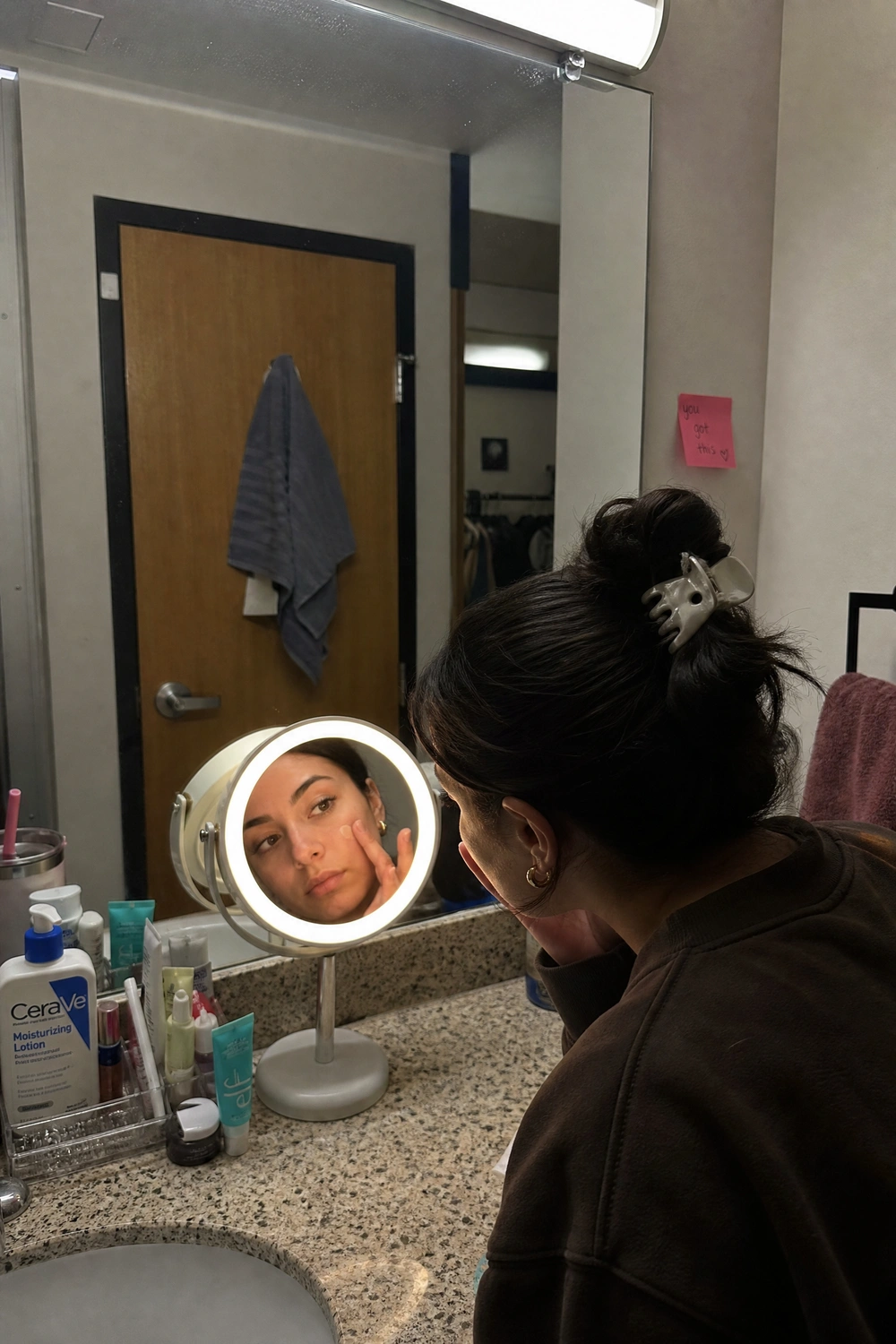
Dorm bathroom lighting is almost universally terrible for anything that requires close-up visibility: applying makeup, grooming, checking skin, or styling hair. A small LED vanity mirror with built-in warm lighting, either placed on the counter or clipped to the existing mirror frame, provides the close-up, well-lit view that overhead bathroom lighting never delivers. Rechargeable LED mirrors with a built-in battery last several days between charges and require no wall outlet access. Mirrors with adjustable magnification provide both a standard view and a close-up option for detailed grooming tasks. The improvement to the daily routine quality from having genuinely adequate light for face-level tasks is significant and consistently underestimated until you have experienced it.
Designer Advice: Choose an LED mirror with bulbs rated at 4000K to 5000K, which is closer to natural daylight than the warm yellow of most bathroom LED strips. For tasks like makeup application and skincare, a cooler, clearer light gives a more accurate representation of how you will look in natural outdoor light. Warm-toned vanity lights can make colour matching more difficult and skin tone assessment less reliable.
19. A Shower Speaker for Daily Routine Wellbeing
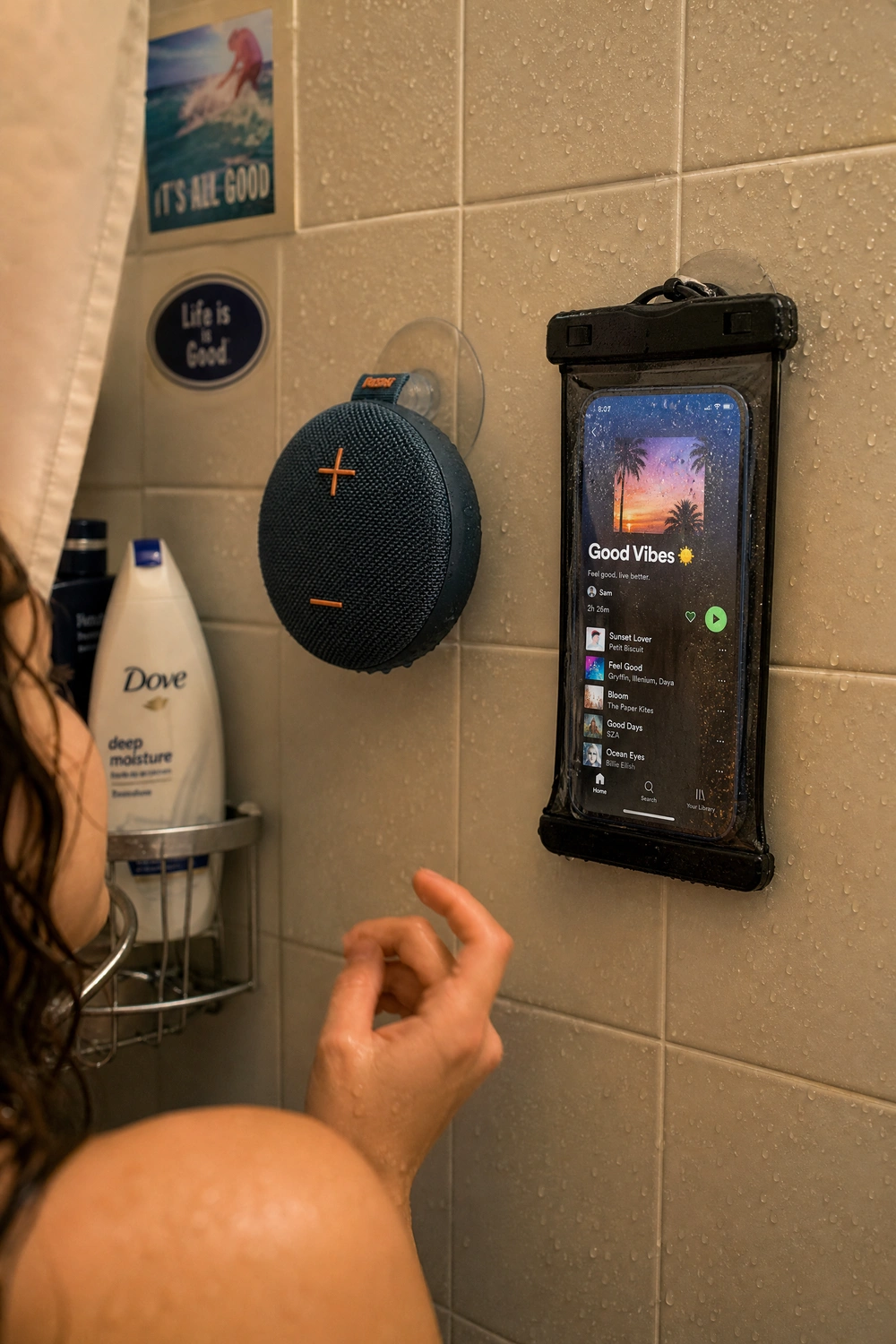
A waterproof Bluetooth shower speaker is one of the genuinely mood-improving additions to a college bathroom routine because it transforms the daily shower from a functional necessity into a deliberate moment of enjoyment in what can be an otherwise logistically demanding start to the day. In a communal hall bathroom, a small personal speaker carried in the caddy provides music during the walk to the bathroom and during the shower itself. In a suite or private bathroom, a speaker mounted on the wall with an adhesive strip or sitting on the counter brings music, podcasts, or ambient sound into the bathroom without any additional infrastructure. A ten to twenty dollar waterproof Bluetooth speaker is one of the most consistent wellbeing investments identified by college students across all bathroom types.
Heads Up: In a communal hall bathroom, use headphones or earbuds for the walk to the bathroom rather than a speaker, and keep speaker volume in the shower low enough that it is not audible from the corridor. Communal bathroom noise considerations are genuine in a shared living environment and a speaker played at full volume in a shared facility is a real irritation for anyone who is not your immediate neighbor.
20. A Waterproof Phone Holder for the Shower
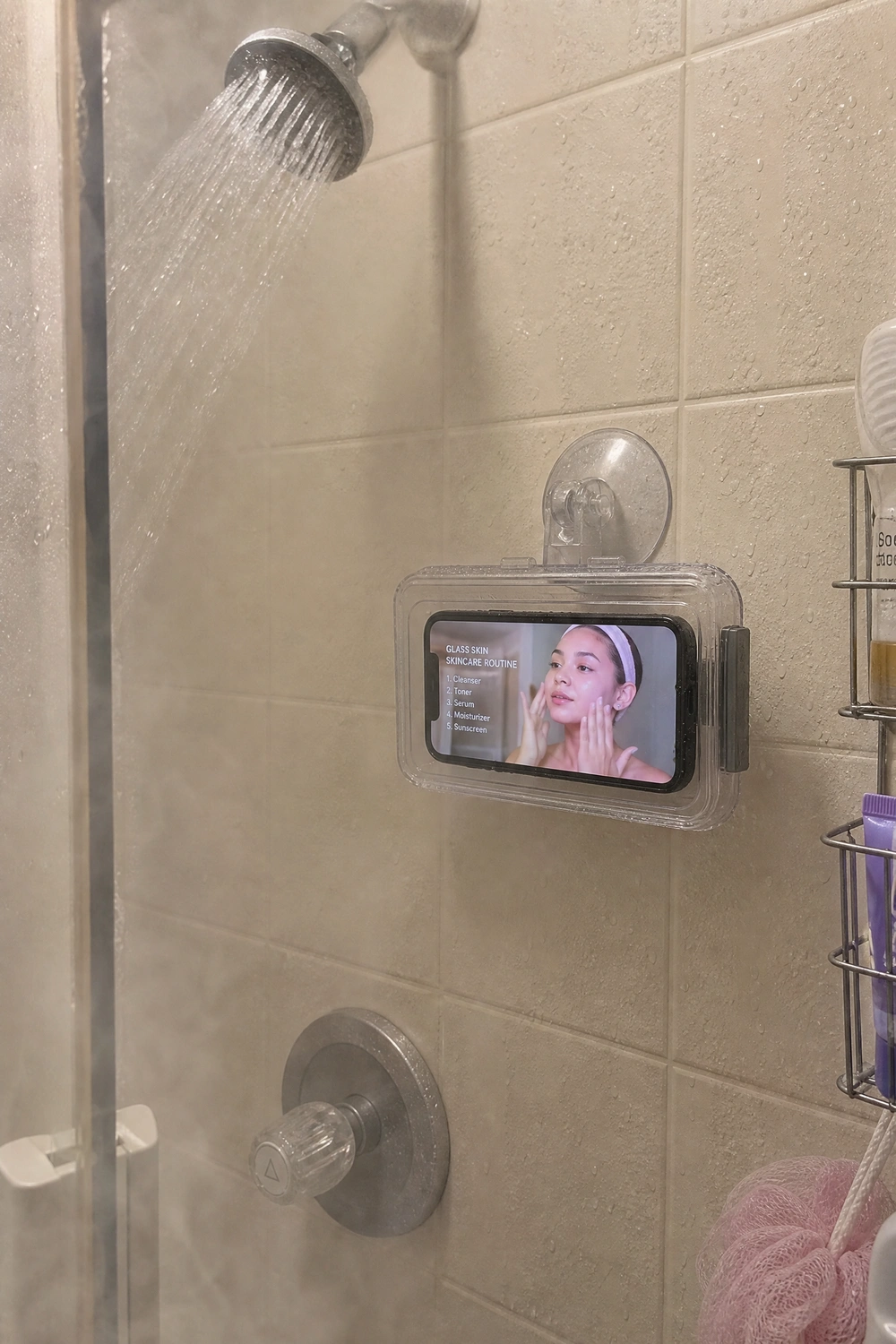
A suction-cup waterproof phone holder attached to the shower wall allows you to follow a skincare routine, watch a video tutorial, check a recipe, or simply use your phone hands-free while in the shower without holding the device directly under the water. For students whose morning shower is genuinely the only uninterrupted time in their day, a waterproof phone holder makes that time more productive without turning the shower into work. The practical requirement is a holder with a genuinely strong suction cup on a clean, smooth shower wall: a holder with a weak suction that fails mid-shower and drops the phone is an expensive learning experience. Test the suction on the specific shower wall material before placing the phone in the holder.
Reality Check: Suction cups do not grip textured, matte, or natural stone shower surfaces reliably. They work best on smooth glazed ceramic tile and smooth glass. If the shower has a textured finish, a different mounting solution, such as an adhesive hook or a shower caddy with a phone pocket, is a more reliable alternative.
21. Multi-Purpose Cleaning Products for Bathroom Hygiene
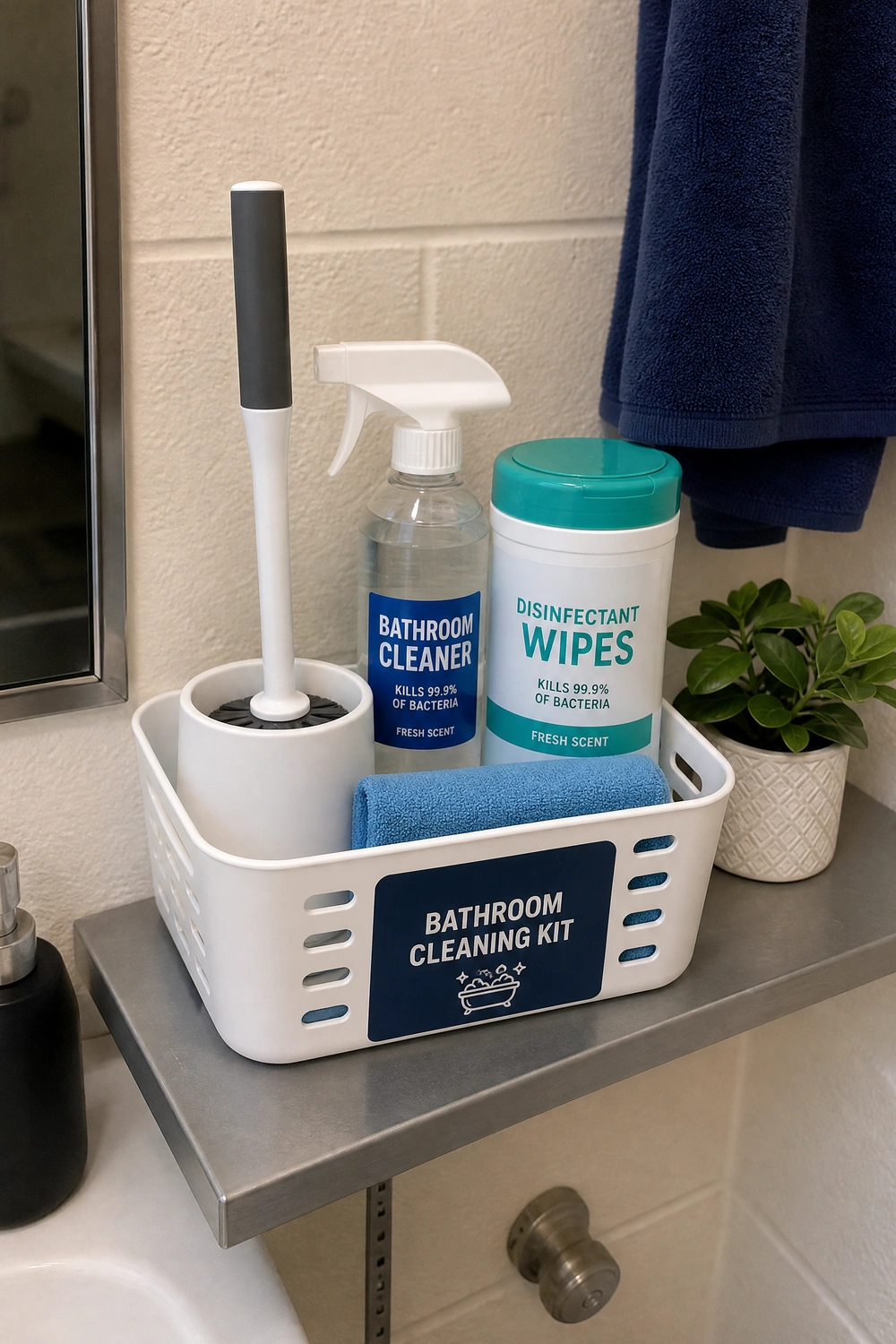
Regardless of bathroom type, having your own supply of cleaning products accessible in the dorm bathroom is an important hygiene and practical consideration. Communal hall bathrooms are cleaned by housing staff, but the frequency and thoroughness of that cleaning varies, and having a small spray bottle of bathroom surface cleaner and a package of disinfectant wipes in your caddy allows you to wipe down a toilet seat, sink edge, or counter before use. In a suite or private bathroom, a basic cleaning kit, a toilet brush in a holder, a surface spray for the sink and counter, a toilet cleaning solution, and a tile spray for the shower, covers all the routine maintenance cleaning that prevents the bathroom from becoming difficult to manage. The total cost of a basic cleaning kit is under fifteen dollars and the habit of weekly cleaning prevents the much more time-consuming deep clean that becomes necessary if maintenance is skipped.
Pro Move: Keep a small pack of disposable toilet seat covers or disinfectant toilet wipes in your communal bathroom caddy. In a shared facility with high traffic, a quick wipe of the seat before use takes fifteen seconds and provides a meaningfully cleaner baseline than the alternative. This is not about paranoia but about practical hygiene maintenance in an environment that you share with many people whose cleaning standards may differ from your own.
22. A Basket or Caddy for Skincare Products Separate From Shower Products
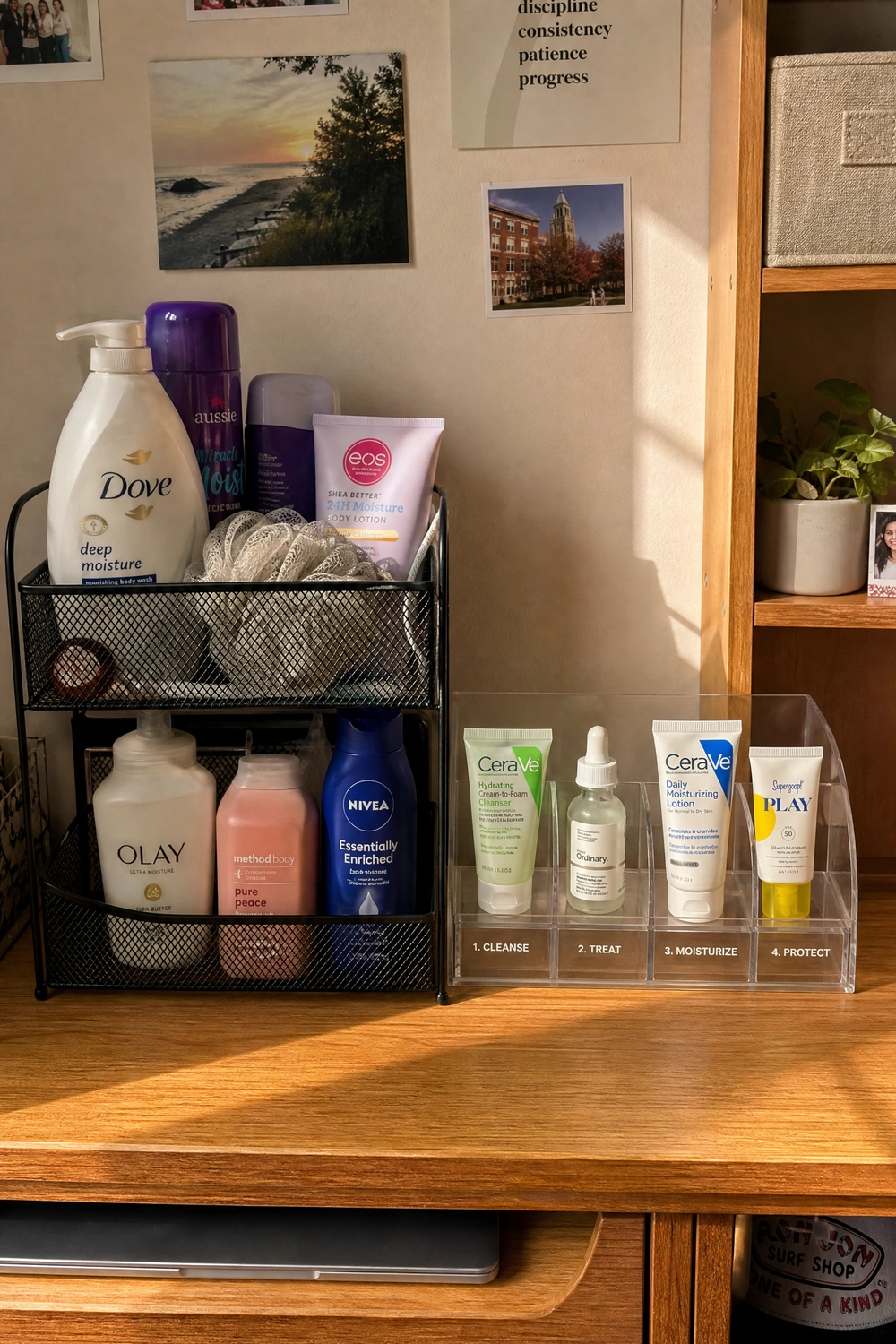
Most students keep all their bathroom products in one caddy or in a single organizational system, but separating shower products from skincare products into two distinct containers creates a meaningfully more organized and more efficient daily routine. The shower caddy holds only what goes into the shower: shampoo, conditioner, body wash, shaving cream, razor, and a face wash. A separate small basket, organizer, or acrylic tray holds skincare products for post-shower use: moisturizer, toner, serums, eye cream, SPF. This separation means the shower caddy is light and mobile for bathroom types where it needs to be carried, and the skincare products remain in the dorm room or on the bathroom counter where they are used in a specific post-shower sequence without competing with shower products for space in the same container.
Quick Tip: Decant large skincare products into smaller travel-size containers for the bathroom caddy or shelf rather than bringing the full-size bottles. Full-size products take up significant space in a small bathroom environment and most daily skincare routines require only a few millilitres of each product per use. A set of travel-size refillable bottles costs two to three dollars and reduces the counter footprint of a full skincare routine to a fraction of its original size.
23. Warm Lighting Through a Portable Lamp
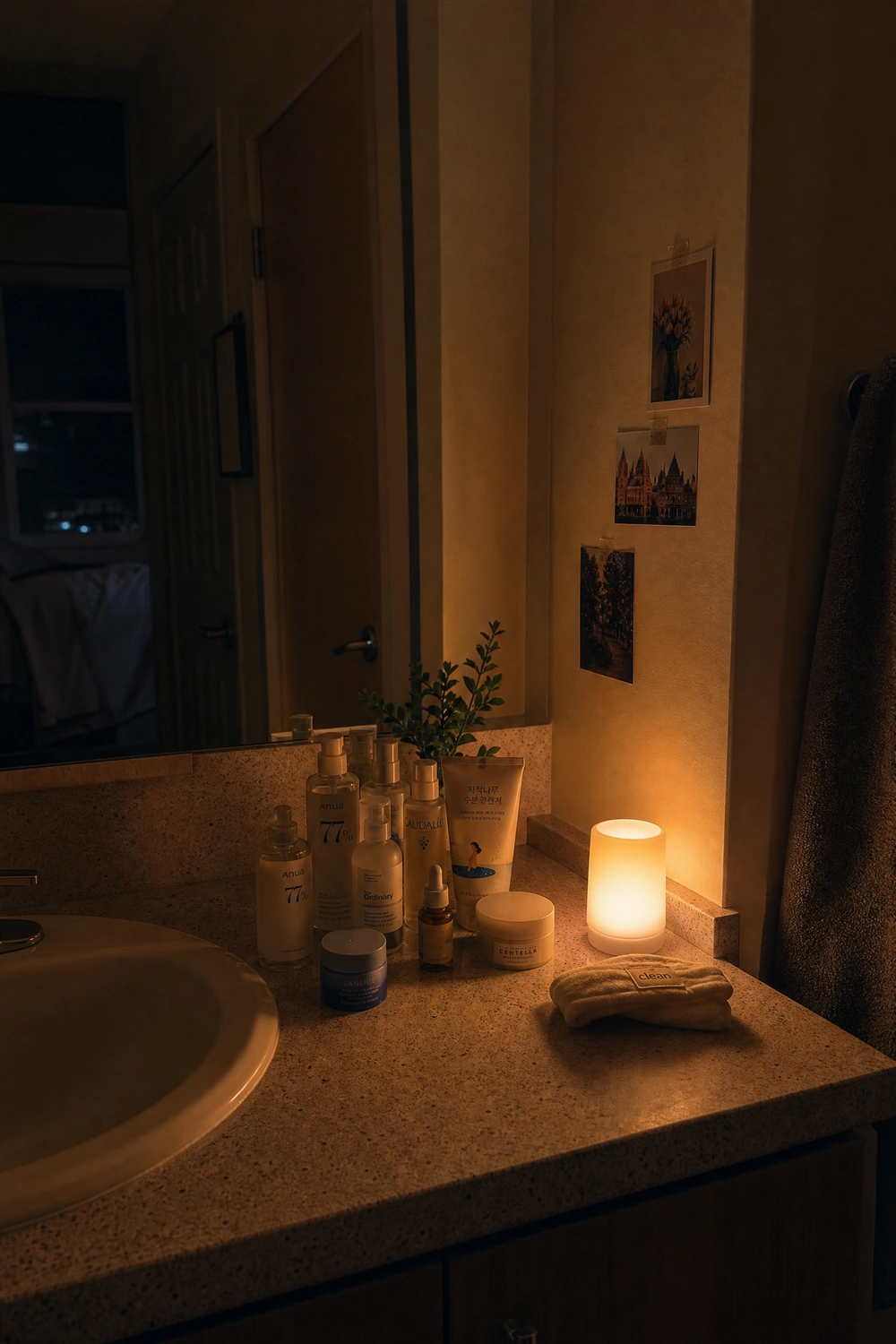
Dorm bathrooms almost universally use fluorescent or cool LED overhead lighting that is bright, flat, and the furthest thing possible from the warm, atmospheric quality of good bathroom lighting. In a private or suite bathroom, a small plug-in LED lamp or a battery-operated LED candle on the counter creates a secondary warm light source that can be used during evening wind-down routines when the harsh overhead light is actively counterproductive for relaxation. Switching to the warm lamp for evening skincare and teeth-brushing while leaving the overhead off creates a genuinely different quality of daily wind-down experience and is consistently noted by students who try it as one of the most effective simple improvements to their sleep preparation routine.
Designer Advice: Choose a portable lamp with a warm amber LED at 2700K rather than a standard white or daylight LED. At 2700K, the lamp creates the genuinely warm, flattering light of a good bedside lamp rather than the clinical cool of most bathroom installations. The warm light quality for the evening routine is meaningfully different from a slightly warmer version of the overhead, and the difference is visible in how you feel in the space.
24. A Non-Slip Mat in the Shower
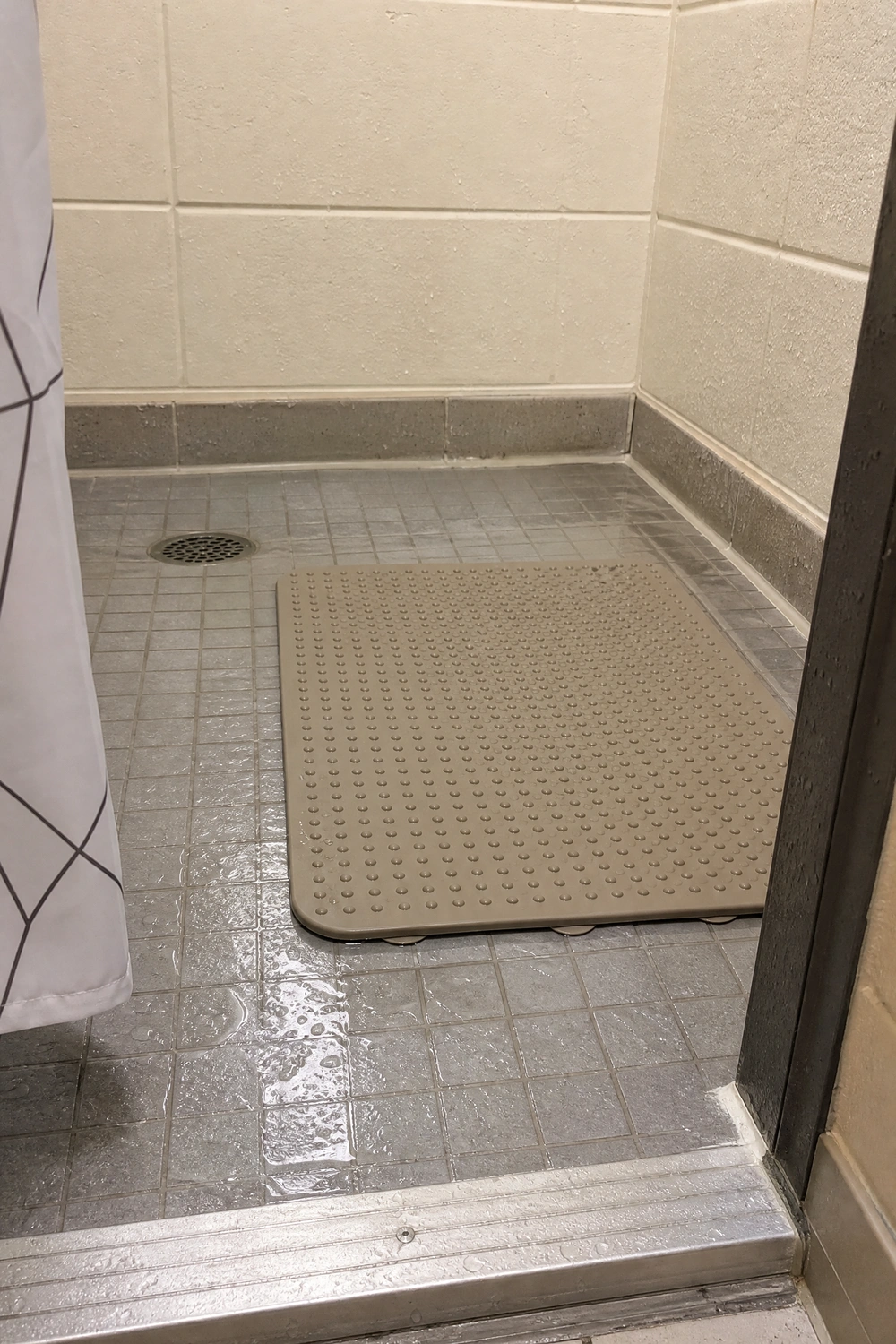
A non-slip shower mat or a set of adhesive non-slip strips on the shower floor is a safety item that is consistently overlooked in dorm bathroom packing lists until someone has their first slipping incident in a wet communal shower. Shower floors in dorm buildings become genuinely slippery when wet, particularly in older buildings where the original non-slip surface texture has worn smooth, and the risk of a fall in a shower is significant enough to warrant the two to five dollar cost of adhesive non-slip strips or a suction-backed shower mat. This is not a comfort or aesthetic item. It is a safety one. It belongs on every dorm bathroom packing list regardless of bathroom type.
Heads Up: In a communal hall bathroom, a portable silicone non-slip mat that you bring to and from the shower in your caddy is more practical than adhesive strips on the shower floor, which you cannot install in a shared facility and which maintenance staff would likely remove during cleaning. A silicone mat rolls or folds to a compact size, dries quickly, and can be rinsed at the showerhead before being returned to the caddy.
25. Shower Curtain Liner for a Mould-Free Season
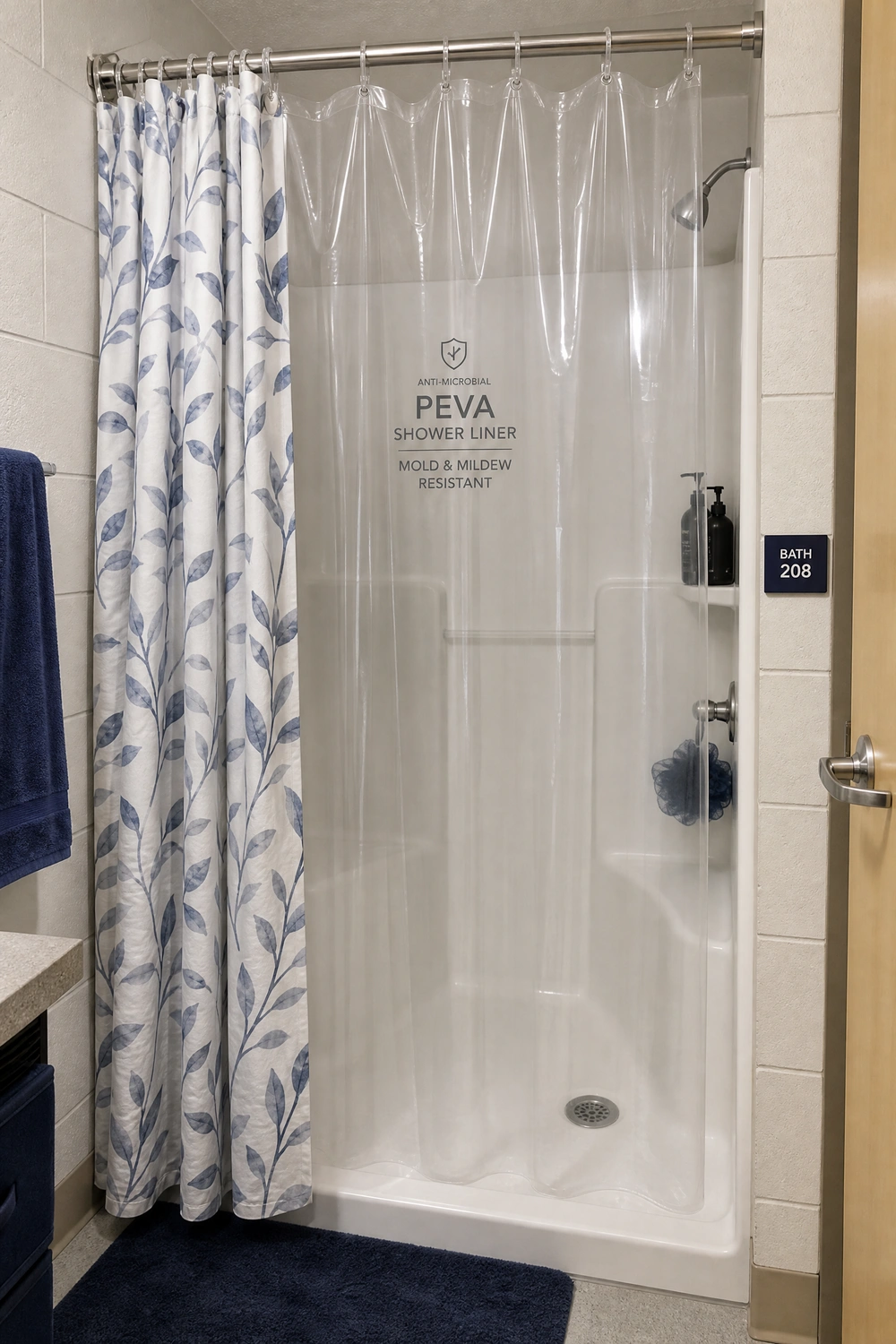
In any dorm bathroom with a shower curtain, the liner behind the decorative curtain needs to be specifically anti-microbial or mildew-resistant to prevent the black mould growth that develops on standard plastic liners within weeks of use in a bathroom with limited ventilation. An anti-microbial PEVA liner rather than a standard PVC liner resists mildew formation without off-gassing the chlorine-like smell of cheap PVC. It is also lighter, more flexible, and easier to wash in a dorm laundry machine when it does need cleaning. The liner needs to be washed or replaced at least once per semester: a liner that has been in use for nine months without cleaning is a genuine hygiene concern regardless of how it looks from the outside of the curtain.
Quick Tip: Buy a second liner at the start of the semester so that when the first one needs washing, the second one goes up immediately without any gap in the shower setup. A dorm laundry cycle can take several hours and the last thing you want is a day without a functional shower liner because the washing schedule did not align with your routine.
26. Over-Toilet Storage Shelf for Extra Counter Space
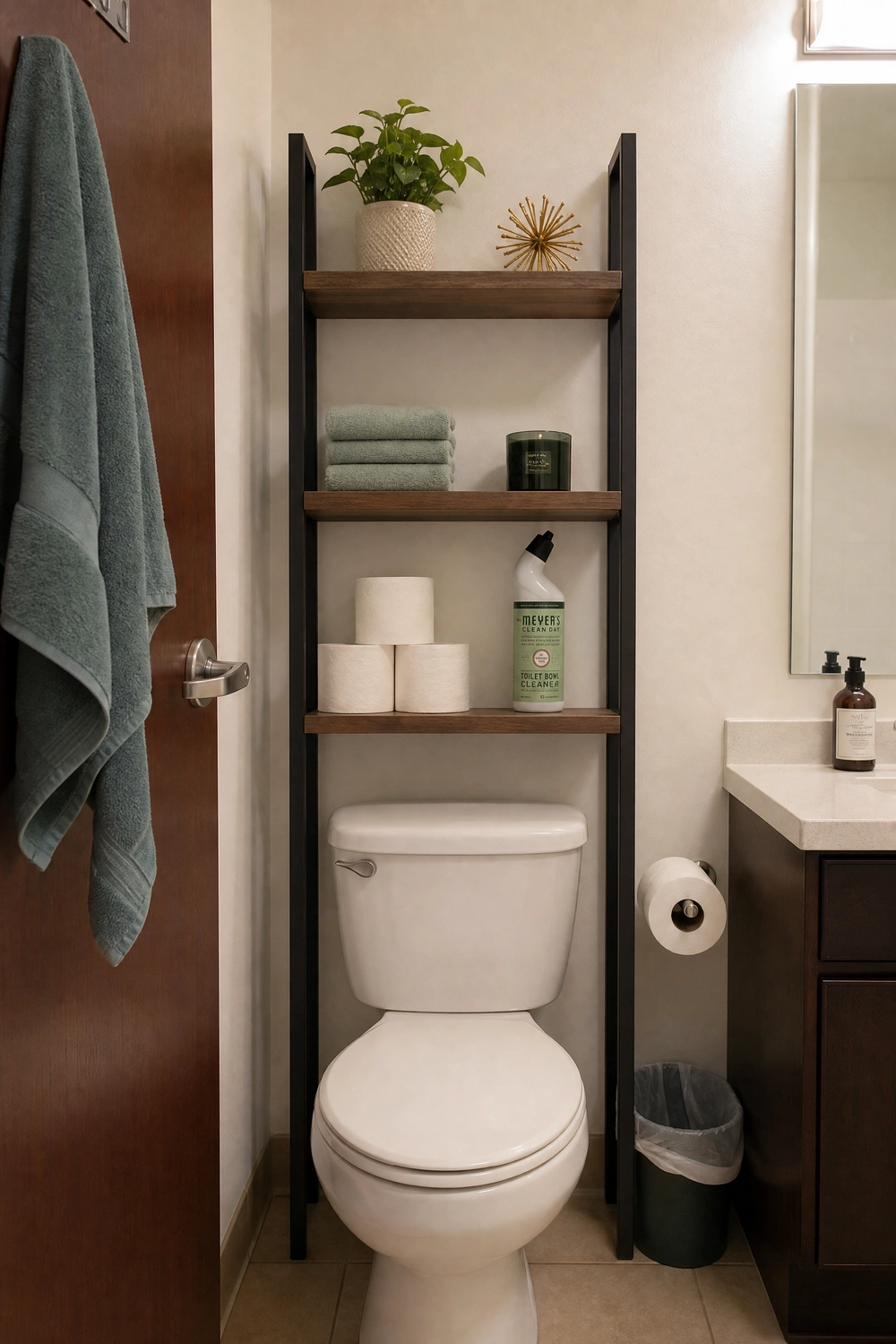
An over-toilet shelf unit, the freestanding tower design that stands over the toilet tank and provides two or three shelf levels above, is one of the most effective space-creating storage additions available in any private or suite dorm bathroom where floor space beside the toilet is available. The over-toilet unit uses vertical space that is otherwise completely dead, it requires no wall fixings, it can hold extra toilet rolls, cleaning products, folded washcloths, a plant, and bathroom accessories, and it moves out with you at the end of the year leaving no marks. In a small private bathroom where counter and cabinet space is essentially non-existent, an over-toilet shelf can double or triple the accessible storage area at a cost of twenty to forty dollars.
Reality Check: Over-toilet shelf units rely on the stability of the toilet tank for their back support and the bathroom floor for their front legs. In an older dorm bathroom where the toilet tank lid is not flat or the floor is slightly uneven, a standard over-toilet unit may rock or feel unstable. Check the stability of the specific unit on the specific toilet before loading it with heavy products.
27. Plants That Actually Survive in a Dorm Bathroom
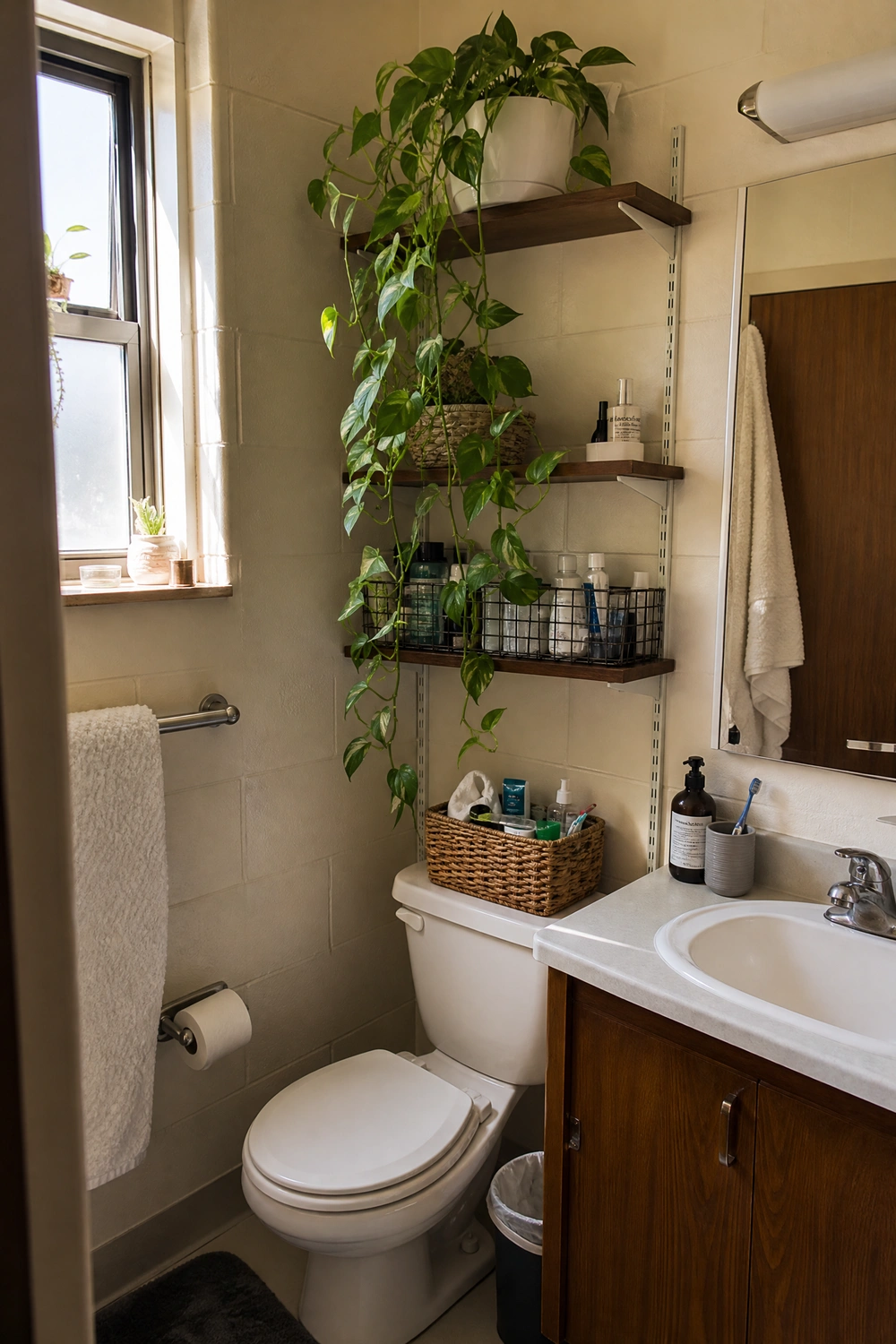
A small live plant in a dorm bathroom does more for the atmosphere of the space than any number of decorative accessories, but the specific plant matters enormously in a bathroom environment with limited natural light, unpredictable humidity, and the intermittent attention of a student schedule. Snake plants and ZZ plants tolerate very low light and periods of neglect between watering that suit a college student’s availability more honestly than most plants require. Pothos and heartleaf philodendron tolerate the humidity of a bathroom environment and low light, and trail attractively from a shelf edge. Small succulents look appealing but need more light than most dorm bathrooms provide and die quickly in high humidity. For a bathroom with genuinely no natural light, a high-quality artificial succulent or botanical stem in a ceramic pot provides the visual warmth of a plant without the maintenance requirement or the risk of a dying plant making the bathroom feel neglected.
Pro Move: Place the plant on the highest shelf available in the bathroom rather than on the counter. Plants at height, whether a trailing pothos at the top of the over-toilet shelf or a snake plant on the highest available shelf, create a vertical living element that makes the bathroom feel significantly more considered and more personal than the same plant placed at counter level among the products and accessories.
28. A Morning Routine Checklist on the Mirror
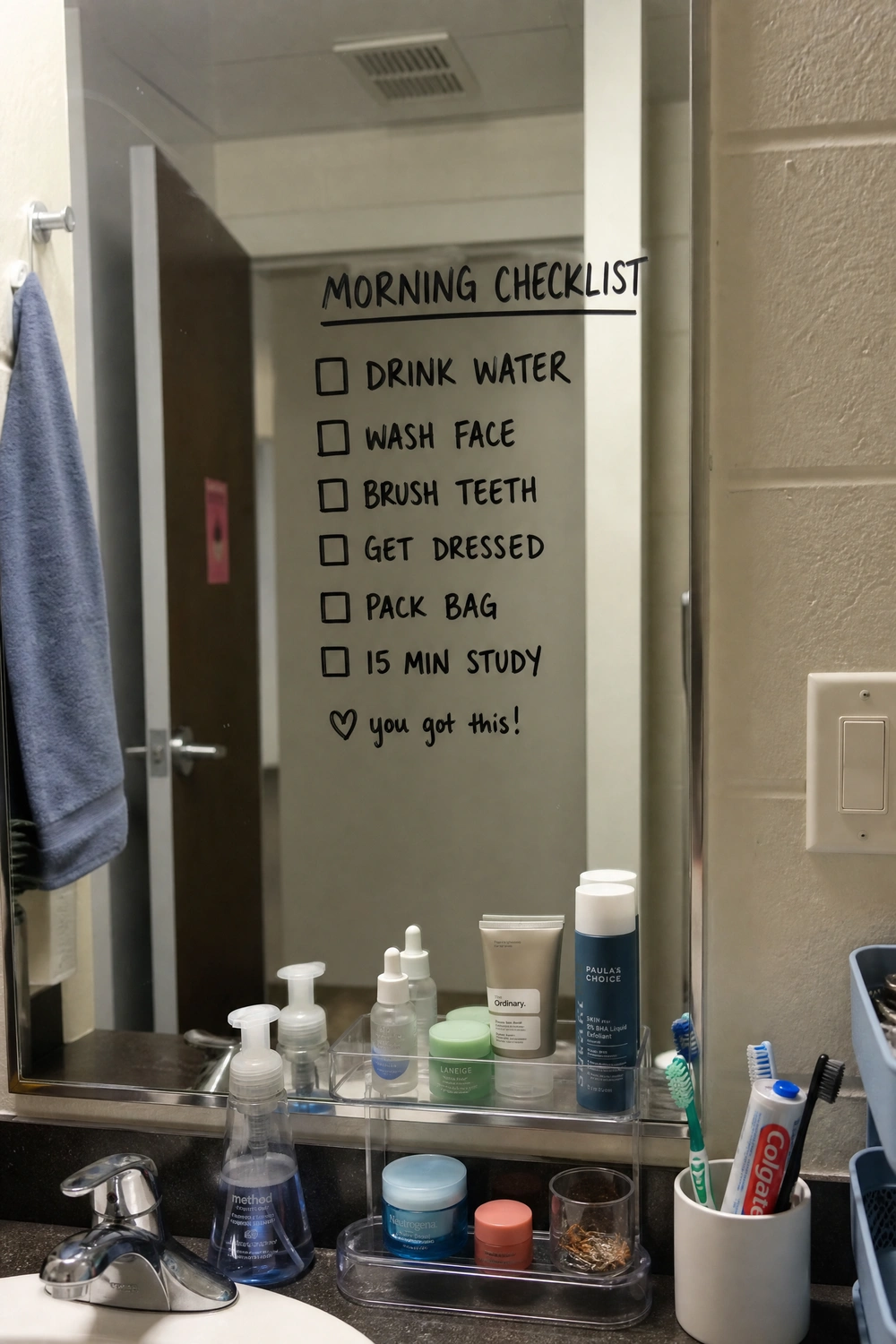
A small sticky note or a dry-erase marker message on the bathroom mirror with the checklist of morning routine steps is a practical productivity tool that is genuinely underappreciated in the dorm bathroom context. College morning routines happen under time pressure, often while tired, sometimes with class starting in twenty minutes after a late alarm. A visible checklist of the specific steps in order, face wash, moisturizer, SPF, brush teeth, contact lenses, deodorant, prevents the specific frustration of arriving at a lecture and realizing you forgot one of the steps you do every single day. The checklist is also a useful tool in the first weeks of a new skincare or grooming routine when the steps are not yet automatic and the sequence is still being learned. A dry-erase marker on a mirror wipes off completely with a tissue and leaves no marks.
Designer Advice: Keep the mirror checklist to five to seven items maximum. A full itemized list of every possible grooming step becomes visually overwhelming and gets ignored. A short list of the steps most likely to be forgotten under time pressure, or the steps of a new routine that are not yet automatic, is the version that actually gets read and followed.
Final Thoughts
The dorm bathroom that works well for an entire academic year is never the one that was most expensively decorated or most elaborately organized on move-in day. It is the one where the setup was genuinely suited to the specific type of bathroom available, the products chosen were the right ones for the actual conditions of that bathroom environment, the habits established in the first two weeks were honest about what the student would realistically maintain, and the relationship with suitemates, where applicable, was handled with directness and clarity early rather than left to assumption and hope.
The ideas in this article span the full range from the most essential hygiene items that belong on every dorm bathroom packing list to the decorative touches that make a private or suite bathroom feel genuinely personal and genuinely pleasant to be in every morning. Find the group that matches your situation, address the functional essentials first, and add the personal and aesthetic elements once the organizational foundation is in place. A bathroom that functions well for your daily routine is more valuable than one that photographs well but creates friction every morning.
“What type of dorm bathroom do you have, and what is the one thing you wish you had known before move-in? Drop it in the comments below.”
Frequently Asked Questions
What are the absolute essentials for a communal dorm bathroom?
A quality shower caddy with drainage holes and a solid handle, shower shoes worn every single time you use the communal shower, a fast-drying towel (microfibre or Turkish cotton), flip-flops or waterproof slides for the walk to and from the bathroom, and a small pack of disinfectant wipes for wiping surfaces before use. These five items address the hygiene and logistics of communal bathroom living before any organizational or decorative considerations. Everything else is optional. These are not.
How do I make my dorm bathroom feel more personal without losing my deposit?
A new shower curtain on the existing tension rod, adhesive command hooks for towel hanging, a coordinated set of towels and bath mat in a colour you genuinely like, a small plant on the highest available shelf, and a portable LED mirror for better lighting. None of these require any permanent changes and all are removed in minutes on move-out day. In a private or suite bathroom, removable peel-and-stick wall tiles or wallpaper on a small area like the backsplash adds the most visual impact for the least permanent commitment.
What is the best shower caddy for a college dorm?
The best shower caddy for a communal hall bathroom has mesh or open-slat construction for drainage and drying, a sturdy handle that can support the full weight of all your products without bending or breaking, compartments or sections that keep individual bottles upright and separate, and a material that can be rinsed clean and does not retain odours. Plastic caddies with open mesh sides and a solid handle are the most practical for communal use. For a suite or private bathroom where the caddy stays in the bathroom, a suction-cup wall caddy or a hanging shower caddy on the existing curtain rod keeps products off the floor and off the ledge without requiring any permanent fixing.
How do suitemates divide bathroom space fairly?
Assign specific shelves, drawers, or zones in the first week before any habits form around the existing space. If the bathroom has two under-sink shelves, one each. If it has a shared medicine cabinet, assign specific shelves within it. Keep the sink counter as a shared zone but with each person’s daily-use items in a defined section or a personal tray. Establish a cleaning schedule in writing, even if it is just in the group chat, before the first cleaning dispute arises. Review the arrangement at the four-week mark and adjust anything that is not working. The conversation is easier at four weeks than at fourteen.
What plants survive in a dorm bathroom?
Snake plants and ZZ plants are the most reliable choices because they tolerate very low light, irregular watering, and the humidity of a bathroom environment better than almost any other plant. Pothos and heartleaf philodendron trail attractively from a shelf and tolerate low light and bathroom humidity. Peace lilies can tolerate low light but need more consistent moisture than the ZZ plant. Avoid succulents and cacti in a bathroom with limited natural light, as both need significantly more light than a standard dorm bathroom provides. For bathrooms with genuinely no natural light, a high-quality artificial plant is a more honest and equally attractive option.
What is the most common dorm bathroom mistake?
Bringing too many products and having no organizational system to contain them. The second most common is not having a shower caddy and shower shoes in a communal bathroom, which creates both hygiene risks and daily logistical frustration. The third is not establishing clear storage assignments with suitemates early in the semester, which leads to storage conflict and counter clutter that compounds over the year. All three mistakes are fully preventable with ten minutes of planning before move-in day and a brief direct conversation with suitemates in the first week.