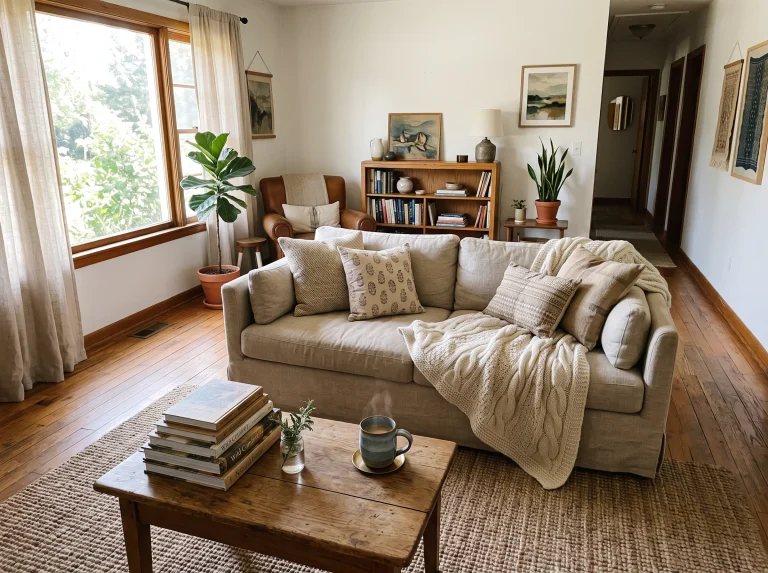
Coastal Living Room Looks That Actually Make You Feel Something
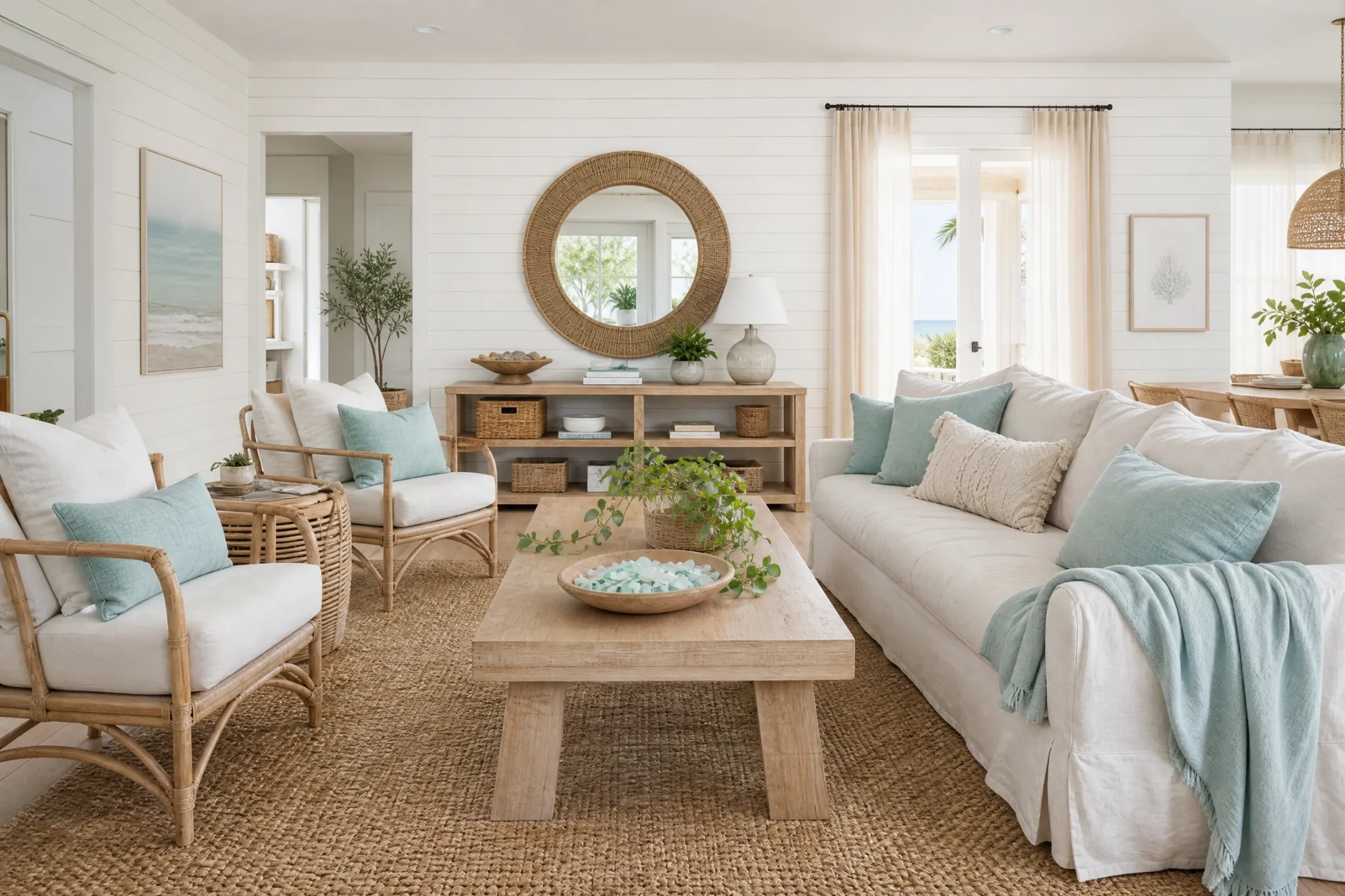
There is something about a coastal living room that stops you at the door. It is not just the color palette or the rattan chair in the corner. It is the feeling, that slow exhale you get when the room actually works, when everything in it seems to say slow down, sit, stay a while. That feeling is not accidental. It is the result of very deliberate choices about color, texture, light, and the kinds of pieces that carry weight without being heavy. Whether you live five minutes from the ocean or five hours from the nearest beach, you can build a living room that genuinely captures that spirit, not as a costume, but as a real way of living.
This collection of ideas covers a wide range of coastal directions, from the soft and sun-bleached to the bold and graphic, from budget-friendly updates to investment pieces worth every penny. Each one is grounded in how the idea actually plays out in a real room, including what works, what to watch for, and where the pitfalls tend to hide. Whether you are starting from scratch or just ready to finally make your living room feel like somewhere you actually want to be, something here will give you a useful place to start.
1. The Bleached Linen Sofa as Your Anchor Piece
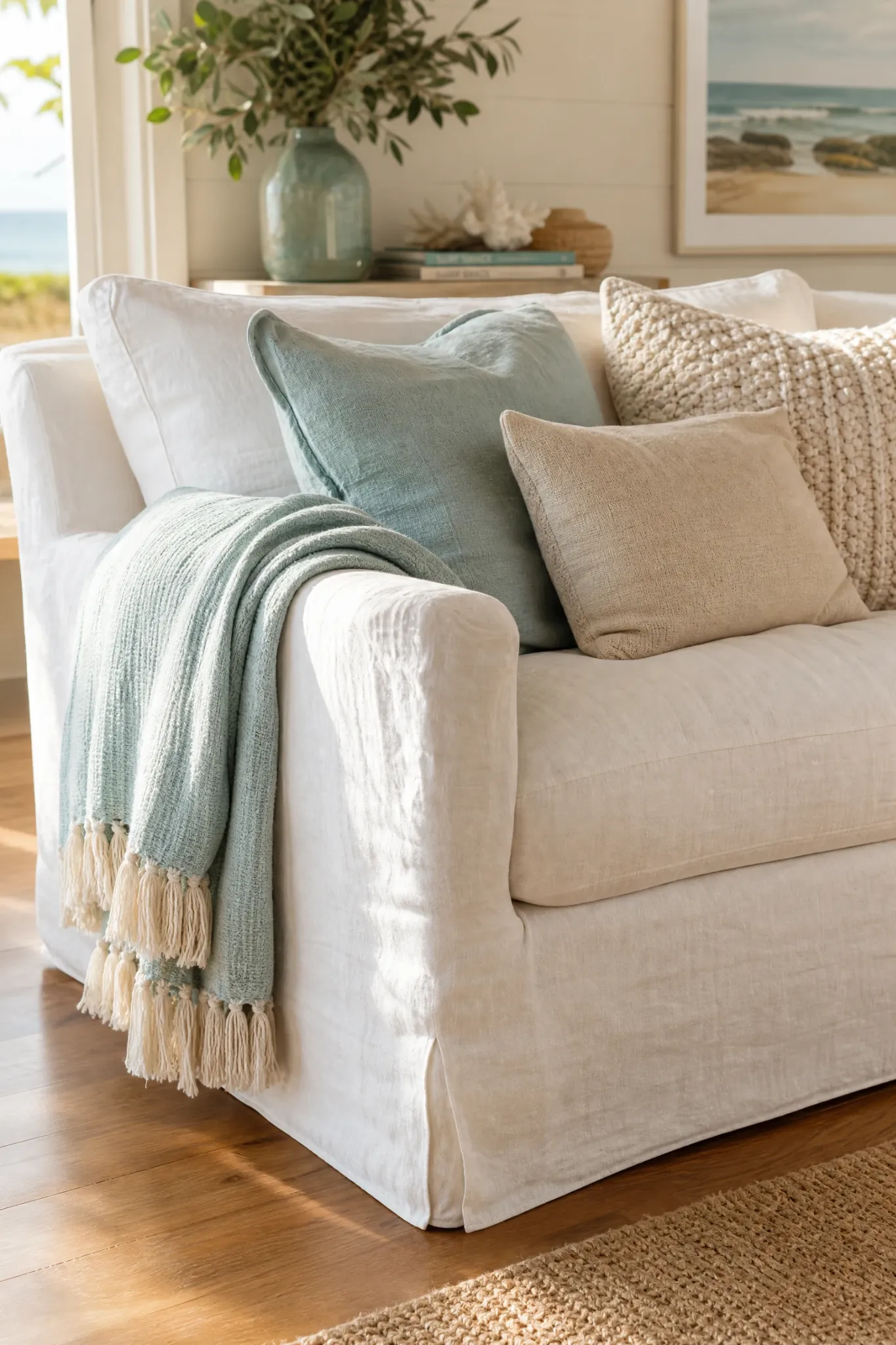
You walk into a living room and the sofa is a deep charcoal sectional that feels more boardroom than beach house. That is the first thing that has to go if you are serious about coastal style. The sofa is the visual anchor of any living room, and in a coastal space it should feel as though it has been kissed by sun and salt air for years. A linen sofa in warm white, natural oat, or very pale sand does this work better than almost any other single piece. The texture of linen is key here because it reads as casual and breathable in a way that velvet or microfiber simply cannot match. Look for a slope-arm or track-arm silhouette rather than anything overly ornate, as clean lines sit better against the organic shapes you will be layering in elsewhere. If you are worried about practicality, slipcover styles are genuinely worth it in a coastal room because they launder easily and develop a beautiful lived-in quality over time. Pair this sofa with a natural wood coffee table in a light honey or weathered finish, and the whole room immediately starts to find its direction.
Designer Note: Linen wrinkles, and in a coastal room that is a feature, not a flaw. Lean into the relaxed texture rather than fighting it with heavy steam pressing.
2. A Sandy Neutral Wall with One Watery Accent
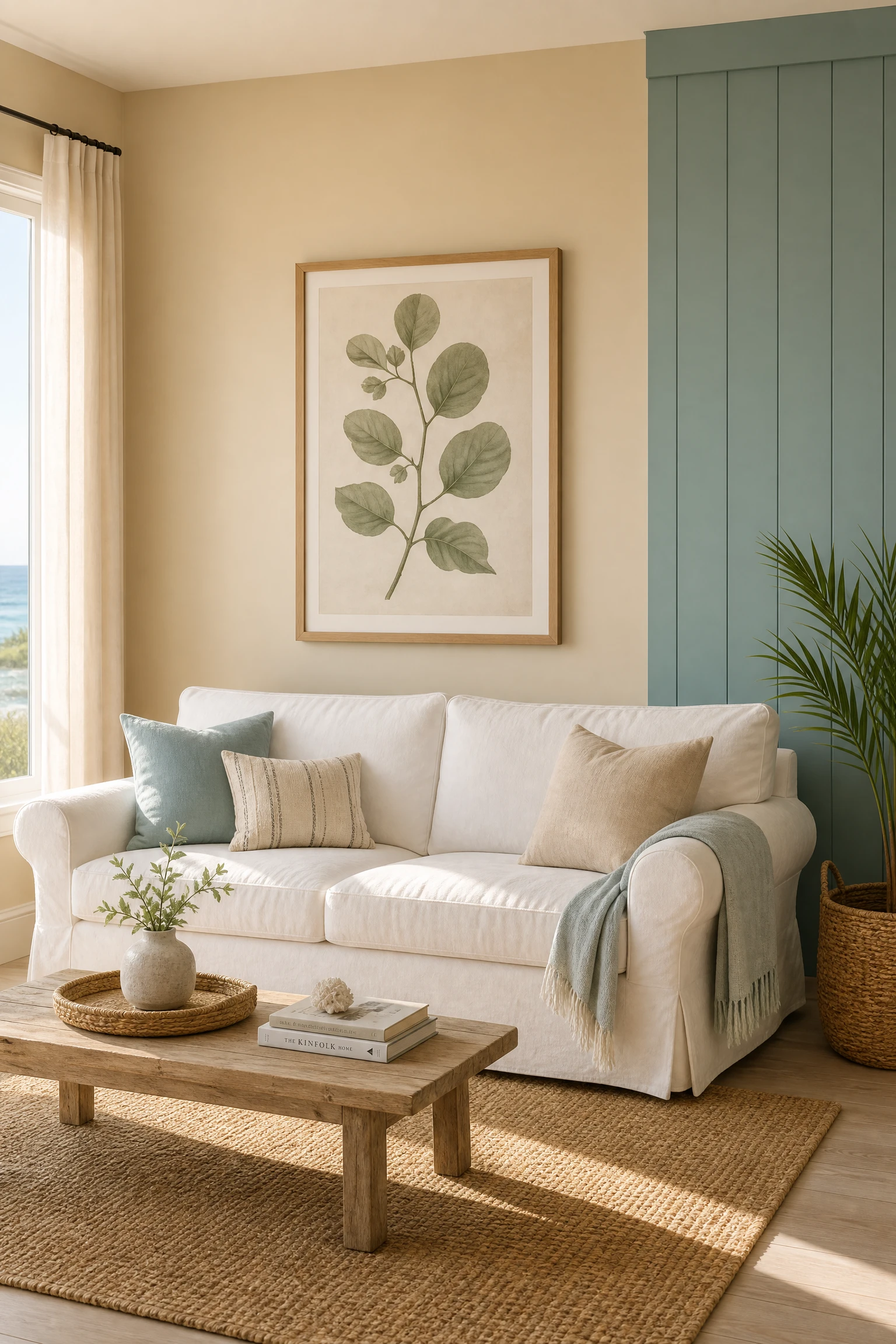
Picture the moment just before sunset on a quiet stretch of coast where the sand and the sky meet in a wash of warm and cool tones. That is the color story you are after when you go with a sandy neutral on the walls. Shades like Benjamin Moore Pale Oak, Sherwin-Williams Accessible Beige, or Farrow and Ball Elephant’s Breath all have that quality of being neither too warm nor too cool, sitting beautifully under natural light without flattening out into beige boredom. The trick to keeping this from feeling bland is introducing one genuinely watery accent, a single wall, a large piece of artwork, or a pair of curtains in a soft aqua, dusty teal, or pale sea-glass green. This contrast between the warm sandy ground tone and the cooler accent is what gives the palette its coastal energy without feeling like a theme park. Keep the rest of the room’s textiles in natural whites and warm creams so the accent reads cleanly.
Designer Note: Test your wall color at two different times of day before committing. Coastal neutrals can shift dramatically between morning light and evening lamplight.
3. Rattan and Wicker Furniture Done Without the Cliché
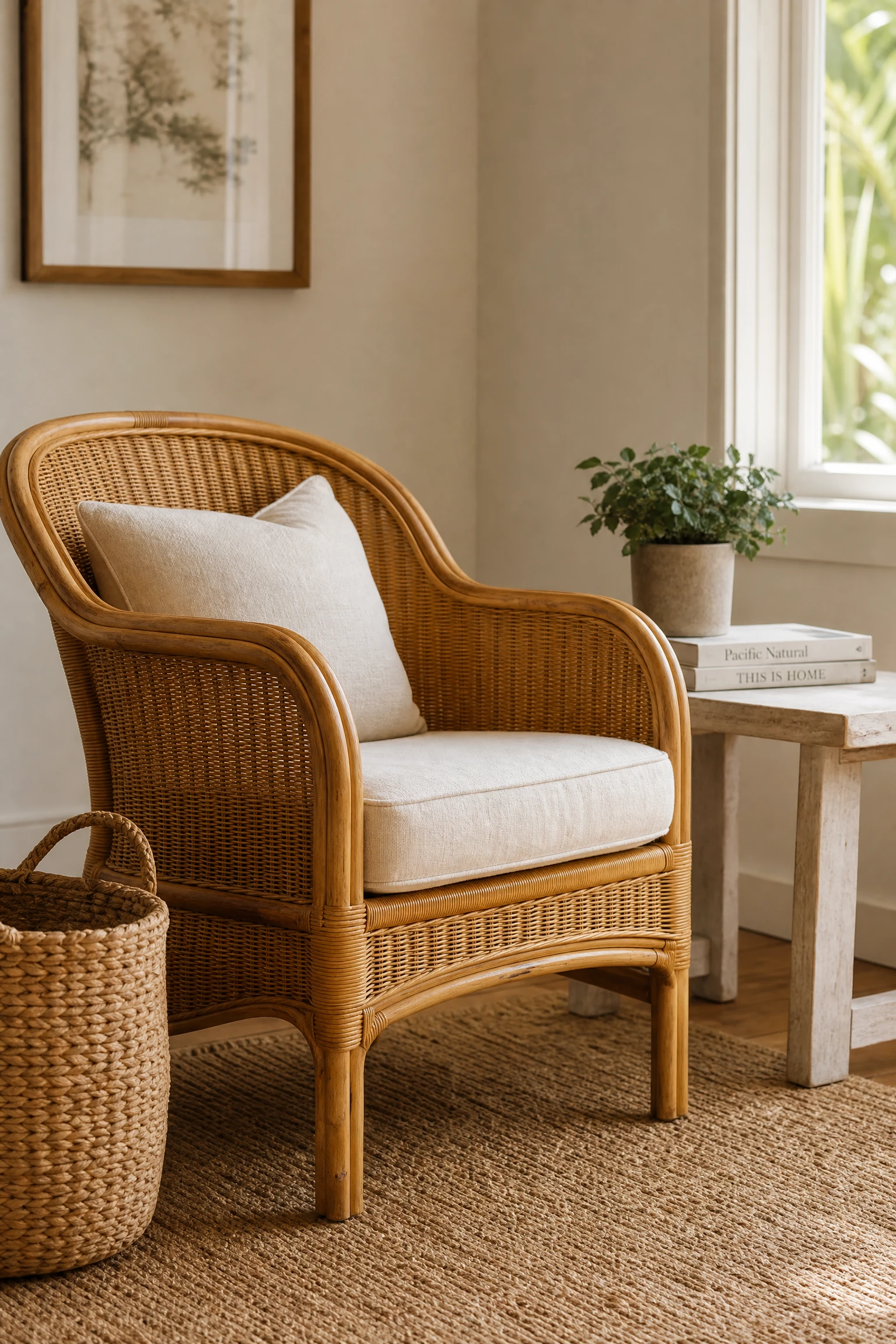
Rattan has had a long reputation for tipping into dated beach-house territory, and it is a fair concern if it is handled without care. The version that actually works in a modern coastal living room is rattan paired with something that grounds it, typically a solid, clean-lined piece in a contrasting material. A rattan accent chair with a simple linen cushion reads beautifully next to a white slipcovered sofa or a low, solid-wood media console. Wicker side tables or a rattan pendant light overhead both add texture without overwhelming the room, as long as they are not competing with five other rattan pieces at the same time. The key design principle here is visual weight balance. Rattan is light and airy, so it needs the counterpoint of something with more heft, such as a concrete or stone object, a solid wooden bookcase, or a substantial area rug. Budget-wise, rattan and wicker are generally accessible materials, and good-quality pieces can be found at mid-range price points without too much searching.
Designer Note: Avoid anything spray-painted gold or white over a rattan frame. The natural honey or dark walnut finishes age far better and feel more authentic in a coastal space.
4. Shiplap or Tongue-and-Groove on One Wall
You have probably walked into a beach house rental and immediately felt that certain ease, before you even registered why. Often it is the walls. Horizontal shiplap or tongue-and-groove paneling is one of the most effective single updates you can make in a coastal living room because it instantly adds texture, architectural interest, and that casual, slightly nautical quality that no amount of accessories can fully replicate. Painted in a bright white or a very soft off-white, paneled walls bounce light beautifully and make a room feel more spacious without any structural changes. One accent wall behind the sofa or fireplace is usually enough, as going wall-to-wall can start to feel overly rustic rather than coastal. If you are in a rental or on a tight budget, shiplap peel-and-stick panels have improved significantly in quality and are a workable alternative. The honest caveat here is that installation on a full wall does take time and some skill, so if you are doing it yourself, allow a full weekend and watch a few tutorials before you start.
Designer Note: Paint shiplap the same color as your ceiling for a continuous, light-expanding effect that makes the whole room feel taller and more open.
5. A Layered Rug Situation with Natural Fibers
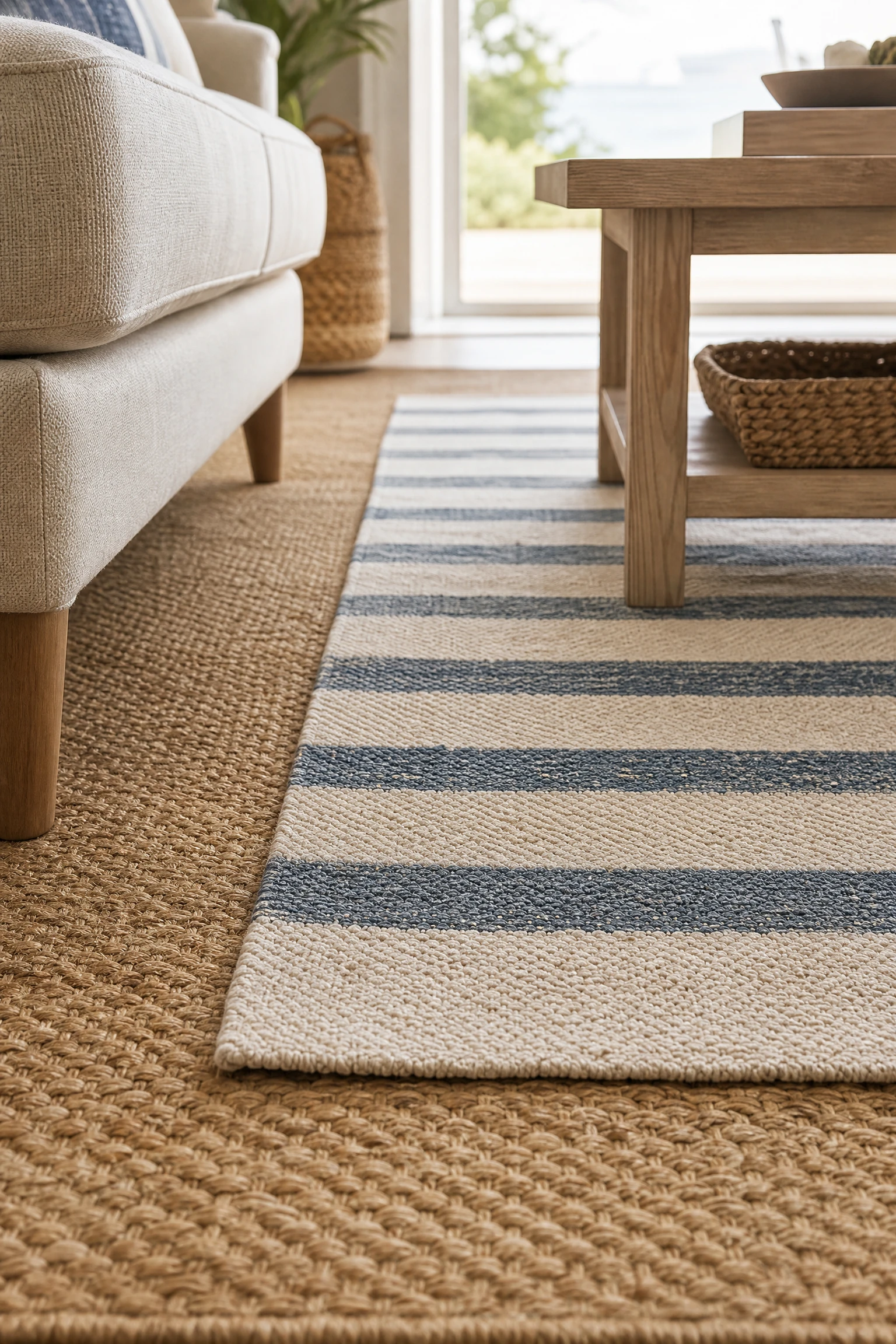
One of the most common mistakes in coastal living rooms is a single area rug that sits alone doing all the heavy lifting. What actually works better, and what you see in professionally decorated coastal interiors, is a layered approach. Start with a large, flat-weave jute or sisal rug that covers the main seating area fully. These natural fiber options add texture, warmth, and an organic quality that synthetic rugs cannot deliver. On top of that, layer a smaller woven cotton rug in a soft stripe or subtle geometric, positioned under the coffee table or centered in the seating group. The layered look adds visual depth and makes the space feel thoughtfully assembled rather than simply furnished. One thing to be honest about with jute rugs in particular: they are not the most forgiving underfoot, and they can shed in the first few months of use. If you have young children or pets who spend a lot of time on the floor, a cotton flatweave as the base layer with a softer piece on top may be the more practical call.
Designer Note: Keep rug edges at least 6 to 8 inches from the walls. A rug that floats too close to the wall makes the seating area feel cramped rather than grounded.
6. Driftwood Accents Without the Craft Store Energy
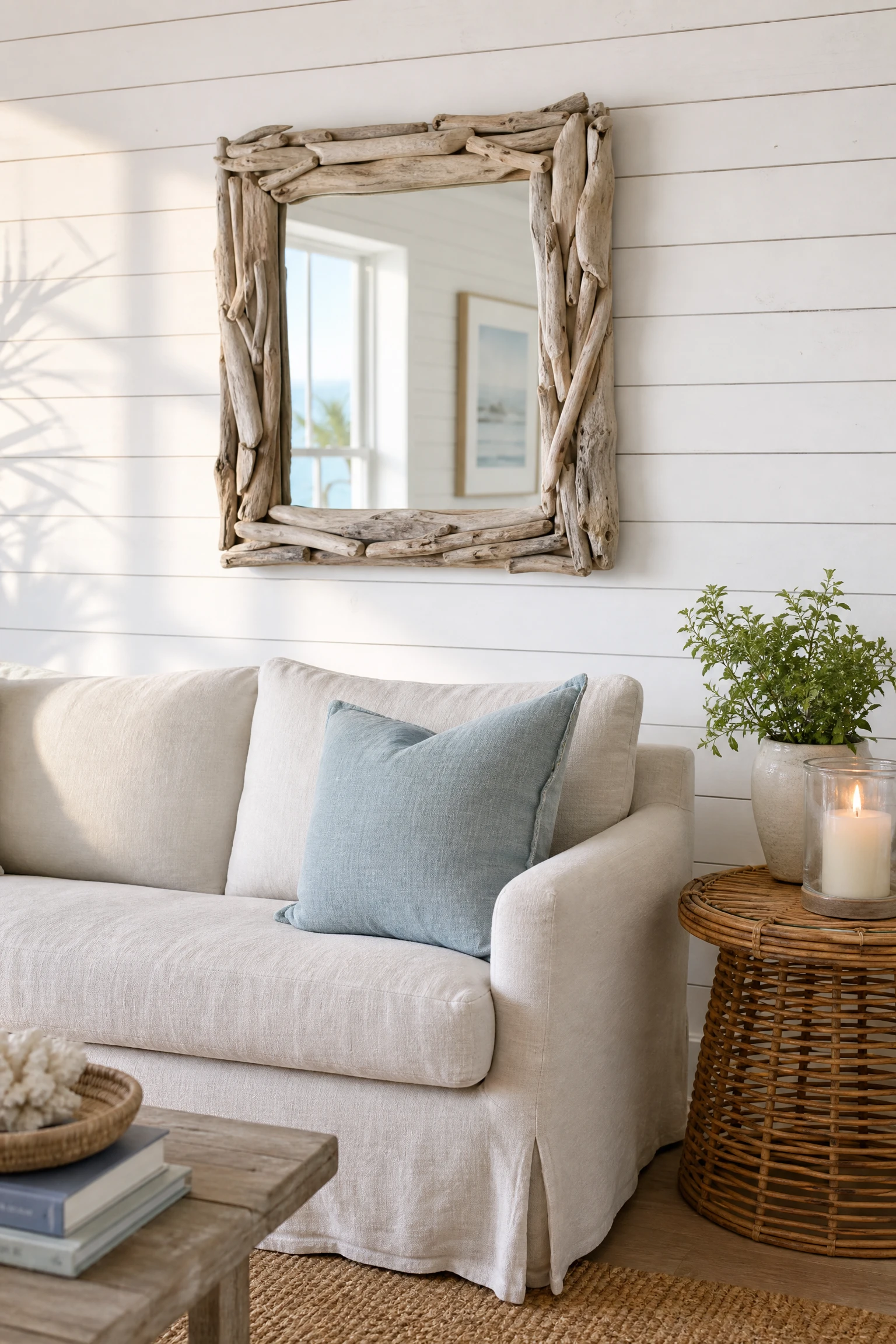
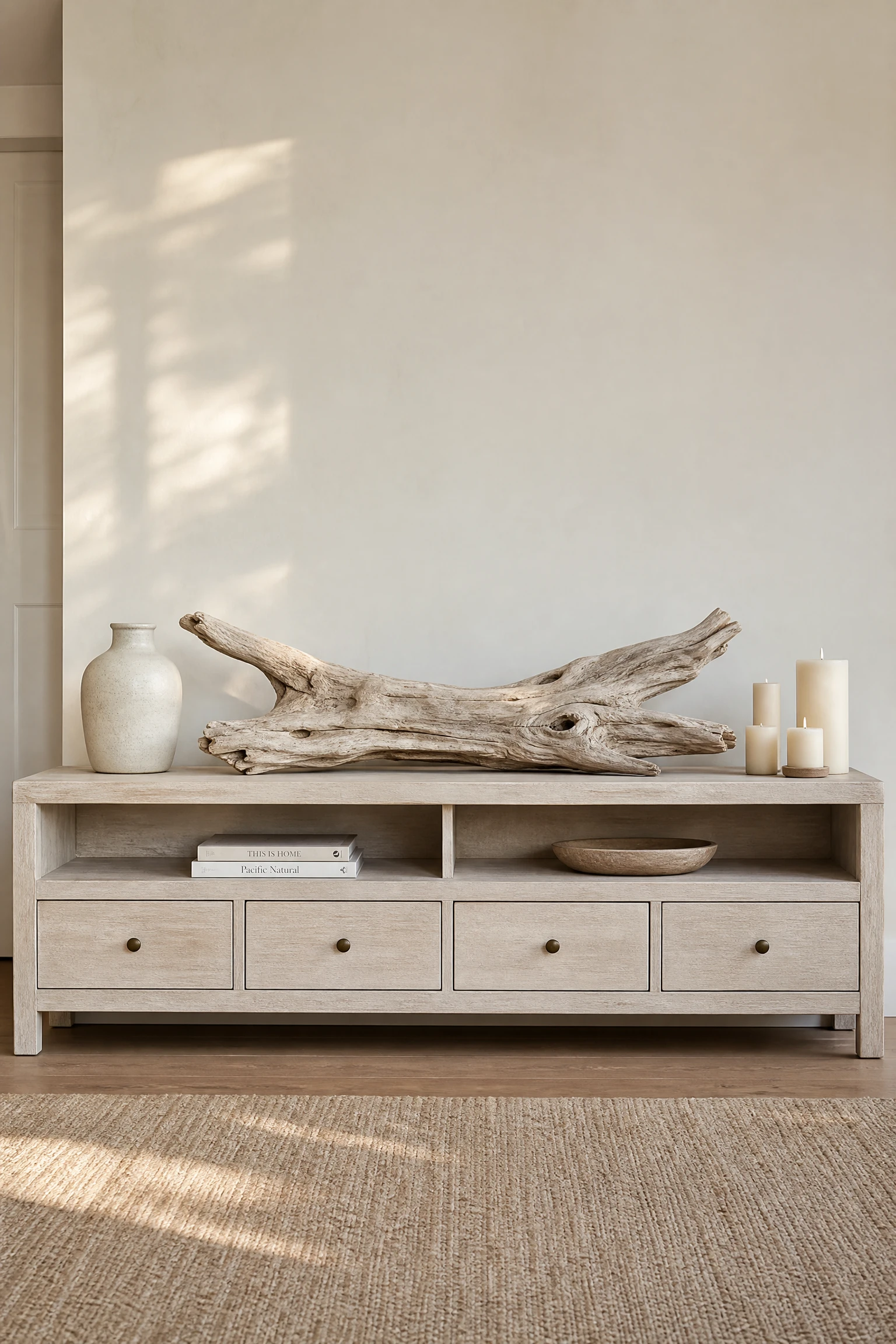
Driftwood is one of those coastal elements that can either feel genuinely beautiful or immediately kitschy, and the difference is almost entirely about restraint and scale. One large, sculptural piece of driftwood on a coffee table or a substantial driftwood lamp base on a side table carries far more weight than a shelf full of small driftwood figurines and signs. In practice, the best driftwood accents in a coastal living room tend to be things you could almost mistake for art: a wide, bleached piece displayed horizontally on a low console, a tall branching piece in a floor vase, or a driftwood mirror frame that becomes a focal point on the wall. The color of natural driftwood, that silvery grey-white with warm undertones, works harmoniously with sand, white, and ocean-inspired palettes without needing to match anything exactly. If you are collecting pieces yourself from beaches, make sure they are fully dried before bringing them indoors, as moisture inside natural wood can lead to mold over time.
Designer Note: Think of driftwood as sculpture, not decoration. Give it space to breathe and let it stand alone rather than crowding it with smaller coastal trinkets.
7. Soft Blues Through Cushions, Not Paint
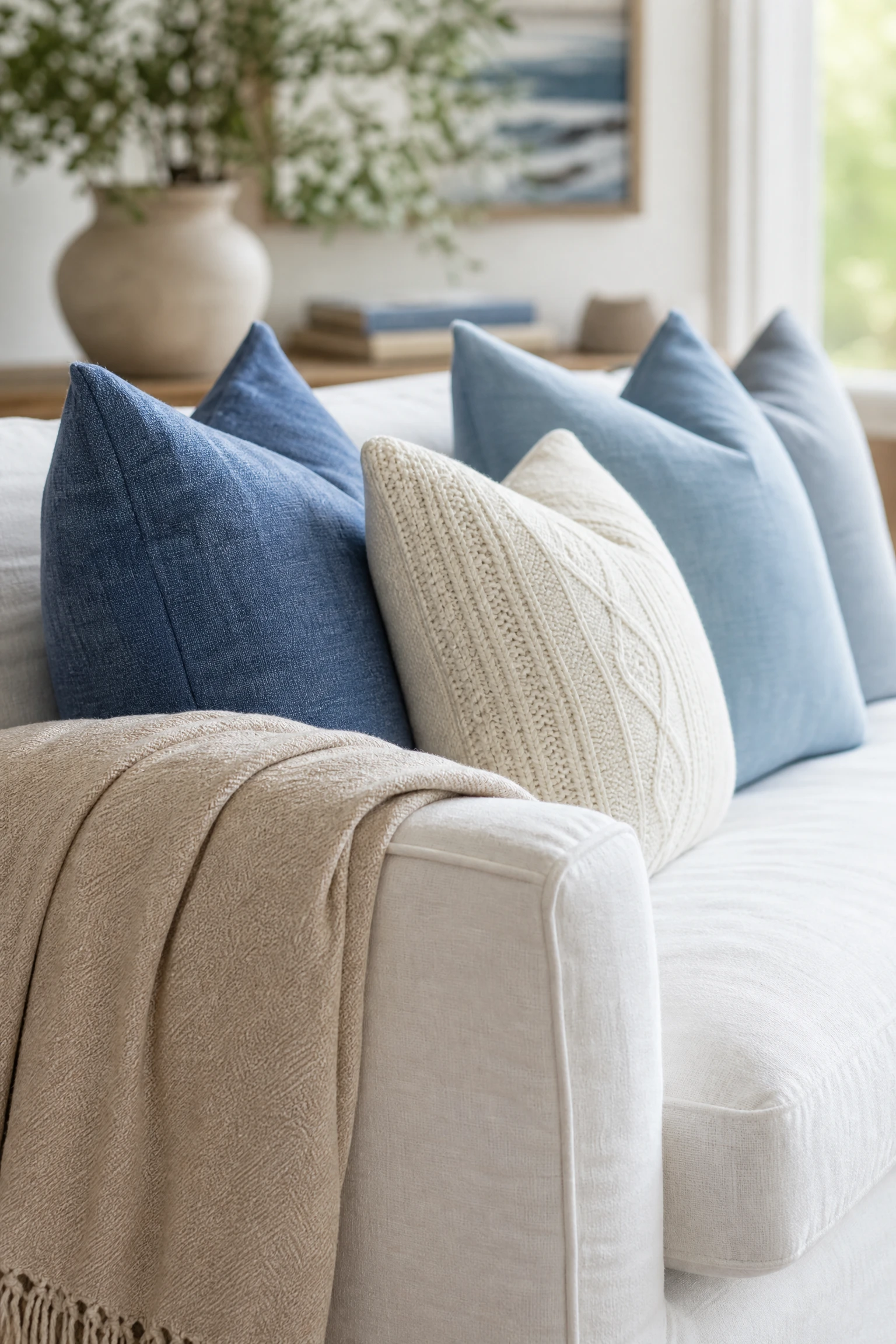
There is a very specific shade of blue that coastal designers come back to again and again, not the bright primary blue of a nautical flag, but something softer and more complex: a chalky cornflower, a dusty French blue, a muted aquamarine that reads almost like a pale teal in certain lights. The most workable way to bring this into a coastal living room without committing to a full repaint is through cushions and throw pillows. A sofa in a natural linen or warm white becomes genuinely beautiful when layered with three or four cushions in varying shades of soft blue, from a barely-there sky tone to a deeper washed denim, combined with a few natural-toned textured knits. This approach gives you the coastal color palette without locking you into it permanently, and it allows easy seasonal updates. Pair the blue cushions with a simple throw in a warm sand or cream to stop the palette from reading too cool, and finish with one or two cushions in an organic pattern like a watercolor stripe or a subtle leaf motif.
Designer Note: Odd numbers of cushions almost always look more natural than even ones. Three or five is the standard starting point for a sofa that reads as styled rather than arranged.
8. Indoor Plants That Actually Belong in a Coastal Room
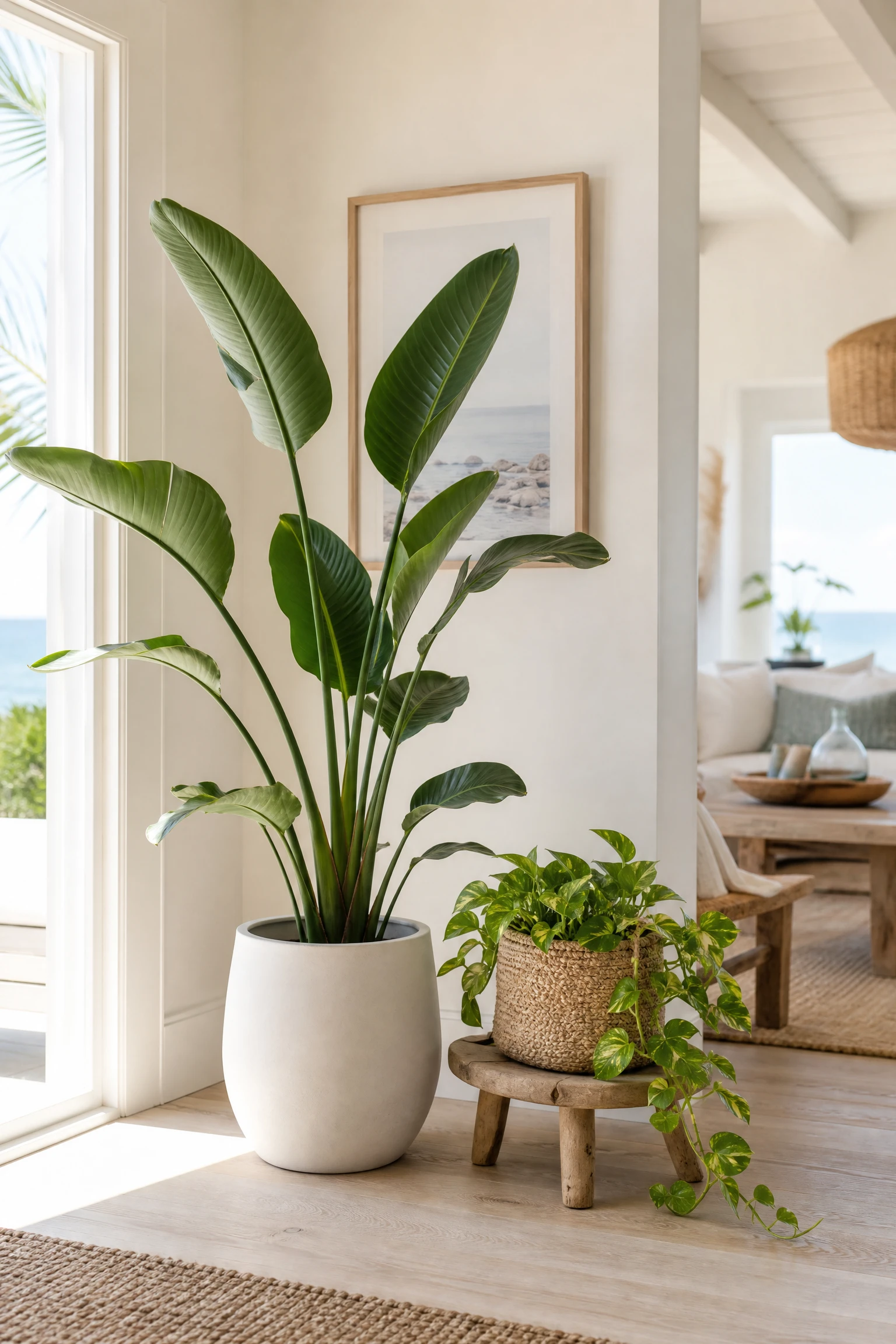
Not every indoor plant reads as coastal, and this matters more than people expect. A cactus belongs in a desert-inspired space. A fiddle-leaf fig, while beautiful, leans more toward a general contemporary interior. For a coastal living room, the plants that genuinely fit are ones that evoke the landscape of warm, breezy shorelines. Bird of paradise is probably the best choice for a large-scale statement plant because its bold, architectural leaves have a tropical quality that feels completely at home in a coastal interior. Smaller options include pothos in a woven rattan planter, a trailing string of pearls, a simple Norfolk Island pine, or a grouping of palm-style plants in varying heights. The planters matter as much as the plants: ceramic in matte white or soft terracotta, woven seagrass baskets, or simple clay pots all work far better than plastic or anything too contemporary and geometric. Keep plants near natural light sources, and be honest about your maintenance habits before committing to anything high-maintenance.
Designer Note: Group three plants of varying heights in one corner rather than scattering single plants around the room. The clustered approach reads as intentional and adds more visual presence.
9. Natural Wood Tones Over White-Painted Furniture
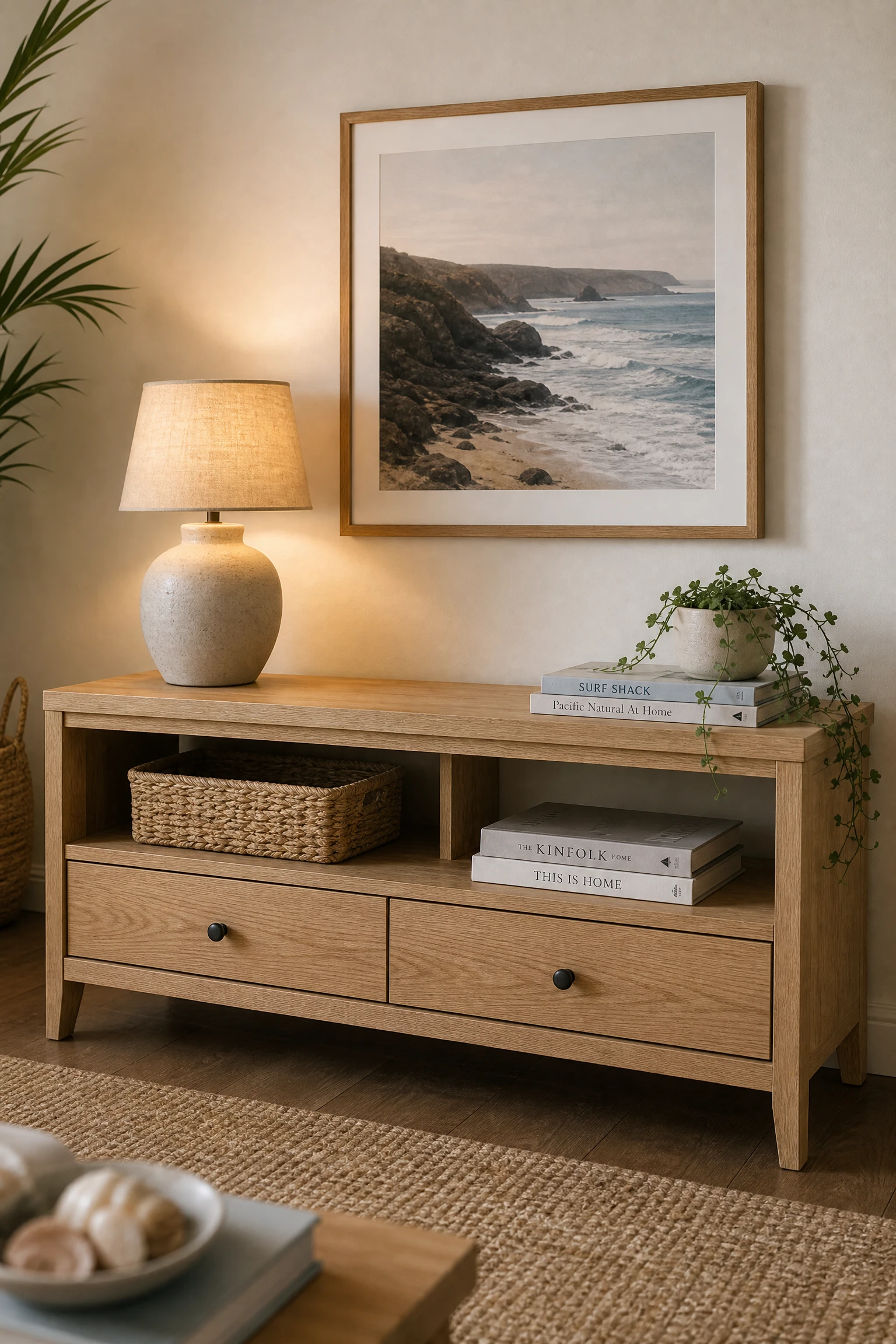
For years, the default coastal furniture finish was white-painted wood, and while it still has its place, the more current and honestly more interesting approach is to lean into natural wood tones that reflect the bleached and weathered quality of coastal environments. Light oak, pine in a whitewash or natural finish, and reclaimed wood with a clear matte seal all bring warmth and authenticity that white-painted pieces can sometimes feel too polished to deliver. A natural wood media console or bookcase grounds the room and prevents the white-on-white effect that can sometimes make a coastal space feel clinical rather than warm. Coffee tables in light oak or a live-edge slab in a honey or driftwood stain are currently very popular in coastal interiors, and for good reason: they add that organic, slightly imperfect quality that the style depends on. If your budget is limited, secondhand pine furniture with a light sand and a coat of clear matte varnish can get you very close to the same effect.
Designer Note: Mix two different wood tones in the room rather than matching everything exactly. Slight variation in tone reads as collected and intentional rather than mismatched.
10. Jute Pendant Lighting as a Soft Focal Point
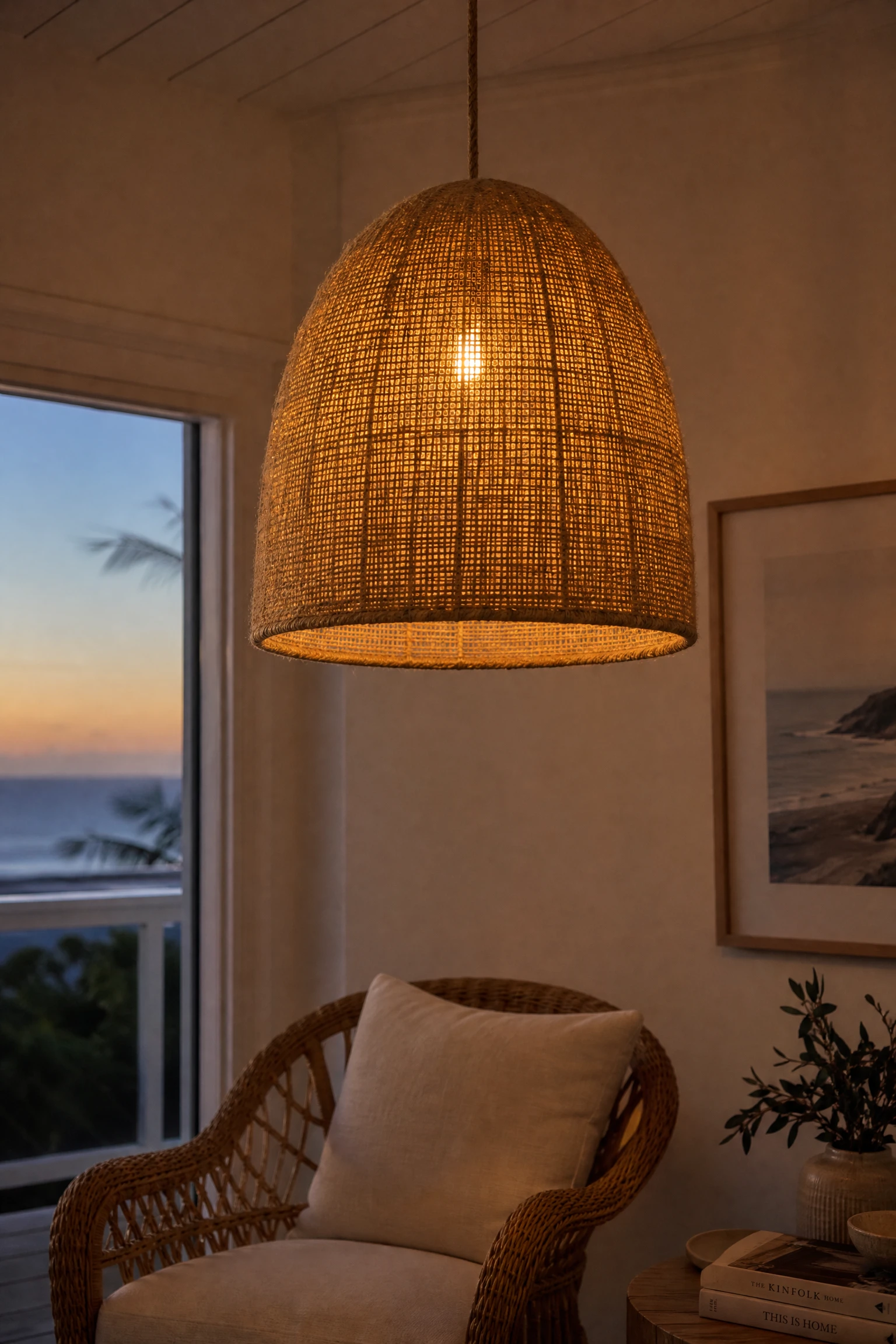
Lighting is one of the most underused tools in a coastal living room, and the type of fixture you choose changes the mood of the room entirely. A jute or woven seagrass pendant, hung low over a reading nook or a side table grouping, creates a warm, diffused glow that feels genuinely beachy without requiring any other nautical gestures to make sense. The natural material softens what might otherwise be a sharp architectural feature, and the warm light it casts is particularly flattering in the evening. For a living room that lacks a central overhead fixture, a pair of matching jute pendants flanking a sofa or hung at different heights in a corner can create a layered lighting effect without requiring any rewiring in most cases. Combine this with table lamps using natural linen or woven shades, and you have a room that is warm and well-lit in the evening without any harsh overhead lights. Budget-friendly jute pendants are widely available and this is one of the easiest coastal updates you can make without a large investment.
Designer Note: Always use warm-toned bulbs in coastal spaces. Cool white light works against the warm, sandy palette and makes the room feel colder than it should.
11. A Gallery Wall Built Around Ocean Photography
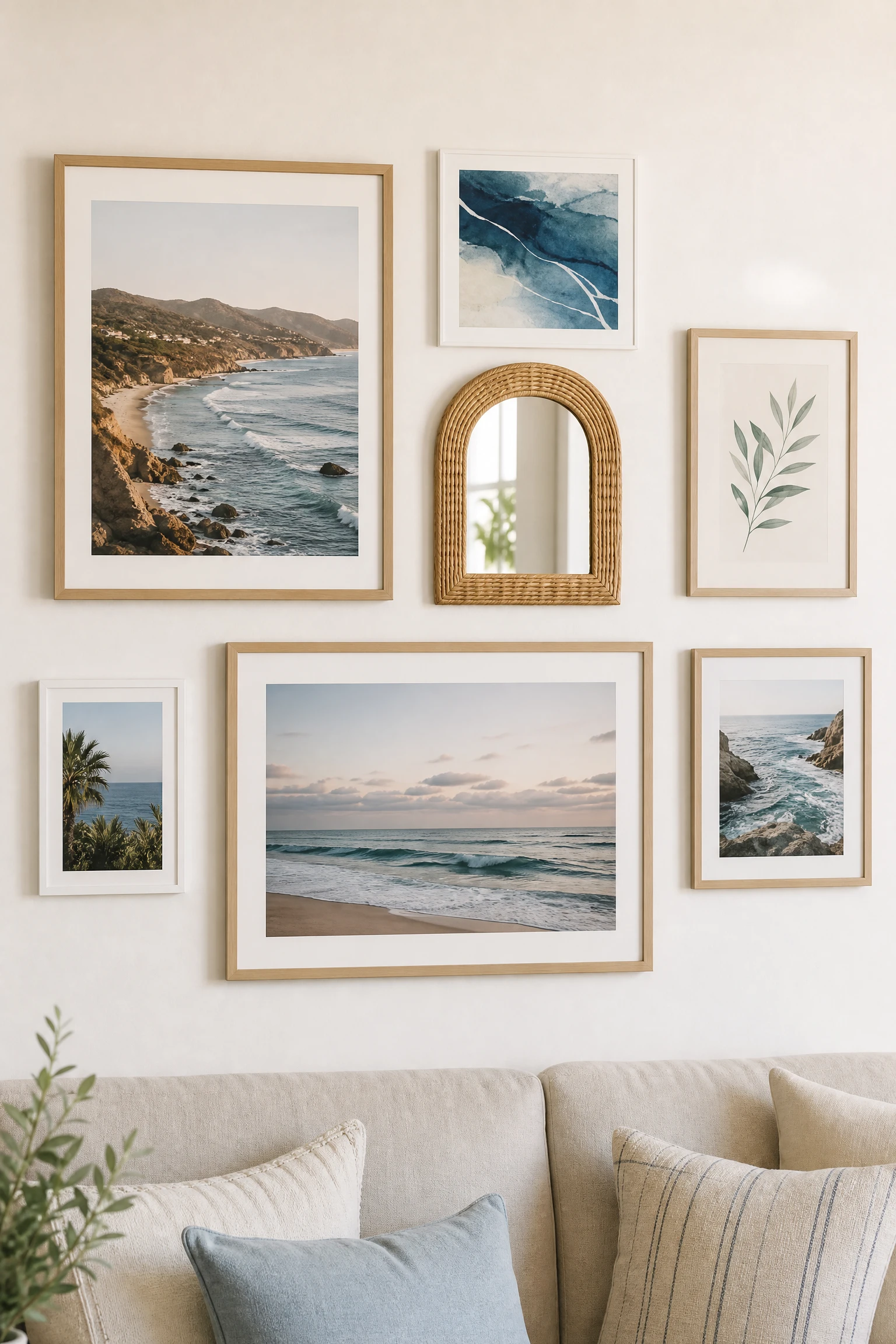
The classic coastal gallery wall is a collection of mismatched seashells and driftwood art, and while that approach has its fans, there is a version that feels far more considered and genuinely beautiful. Start with two or three large-format photographs of the ocean, coastline, or beach landscapes in a soft, slightly overexposed editorial style. These do not need to be expensive prints. Many online print shops allow you to order large custom prints from your own photographs or from high-quality stock sources for a fraction of gallery prices. Frame them in simple natural wood or thin black frames for contrast, and arrange them as the anchoring pieces. Around those, build with smaller pieces: a piece of abstract art in ocean blues and sandy whites, a simple botanical print, a small mirror in a rattan frame. The mix of photography and art keeps the wall from feeling like a single-theme project and instead reads as something assembled thoughtfully over time. Keep the spacing between frames consistent for a clean result.
Designer Note: Lay your gallery wall arrangement on the floor before anything goes on the wall. Spending 20 minutes adjusting the layout on the floor saves hours of repositioning nail holes.
12. Sea Glass and Shell Accents Used with Real Restraint
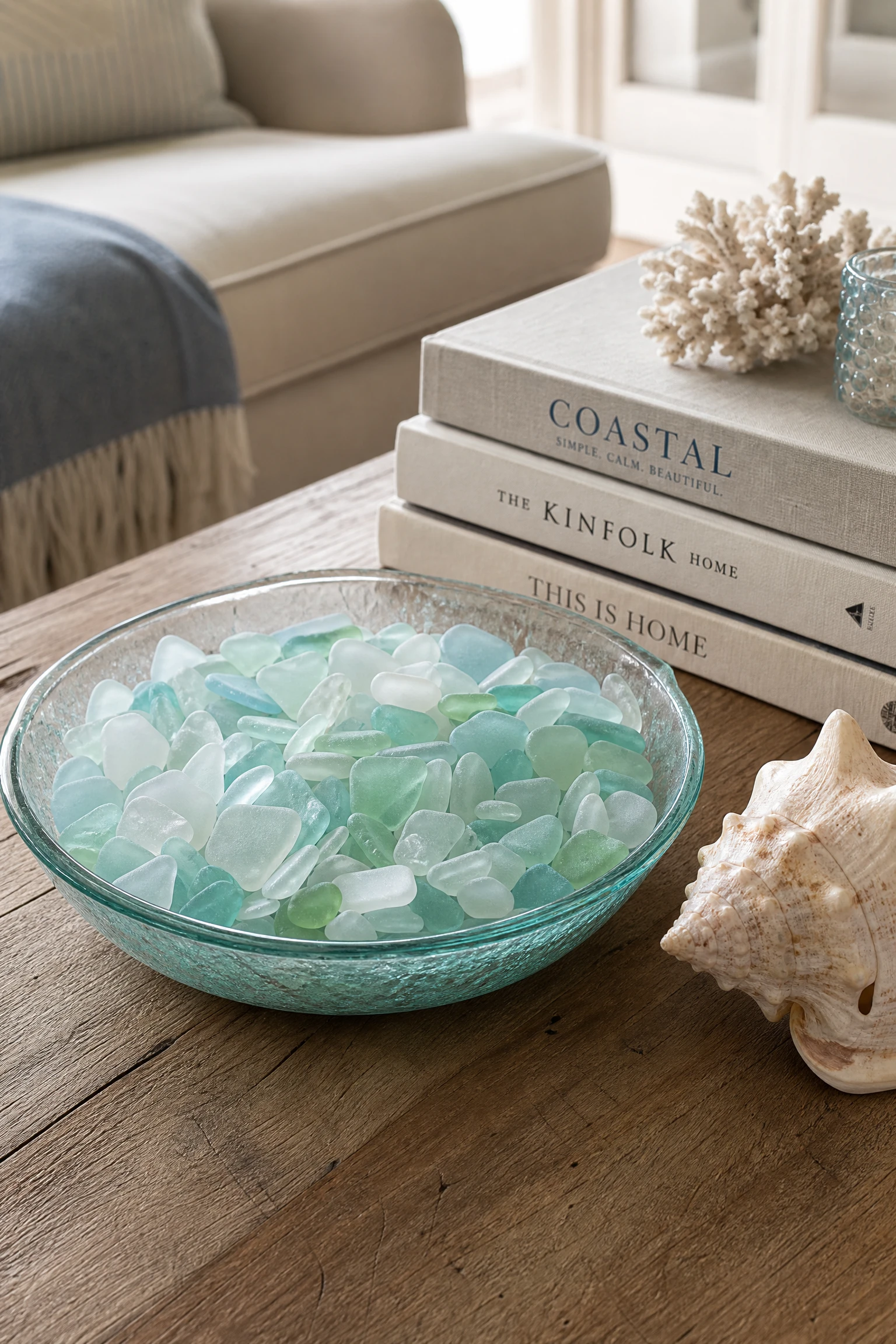
Sea glass and shells are the most over-used elements in coastal decor, and the reason they so often feel cheap is not the objects themselves but the sheer quantity and randomness in which they tend to appear. A bowl of beautiful sea glass on a coffee table, a single large conch shell on a shelf, or a small glass jar of mixed shells and sea glass as a lamp base filler are all genuinely lovely. The moment the shells start appearing on every surface in every room in every possible form, the effect collapses. In a coastal living room, one or two carefully chosen shell or sea glass moments are enough to nod to the theme without beating the viewer over the head with it. Real sea glass, collected from actual beaches, has a softness and color variation that the manufactured versions cannot replicate. If you are displaying it, a clear glass bowl or vase shows off the layered colors beautifully and the light catches them in a way that is genuinely worth the effort.
Designer Note: Edit your coastal accessories down by at least half from what feels right at first. Restraint is almost always the better call in a style that depends on a sense of ease.
13. A Coastal Color Palette That Skips the Navy and White Formula
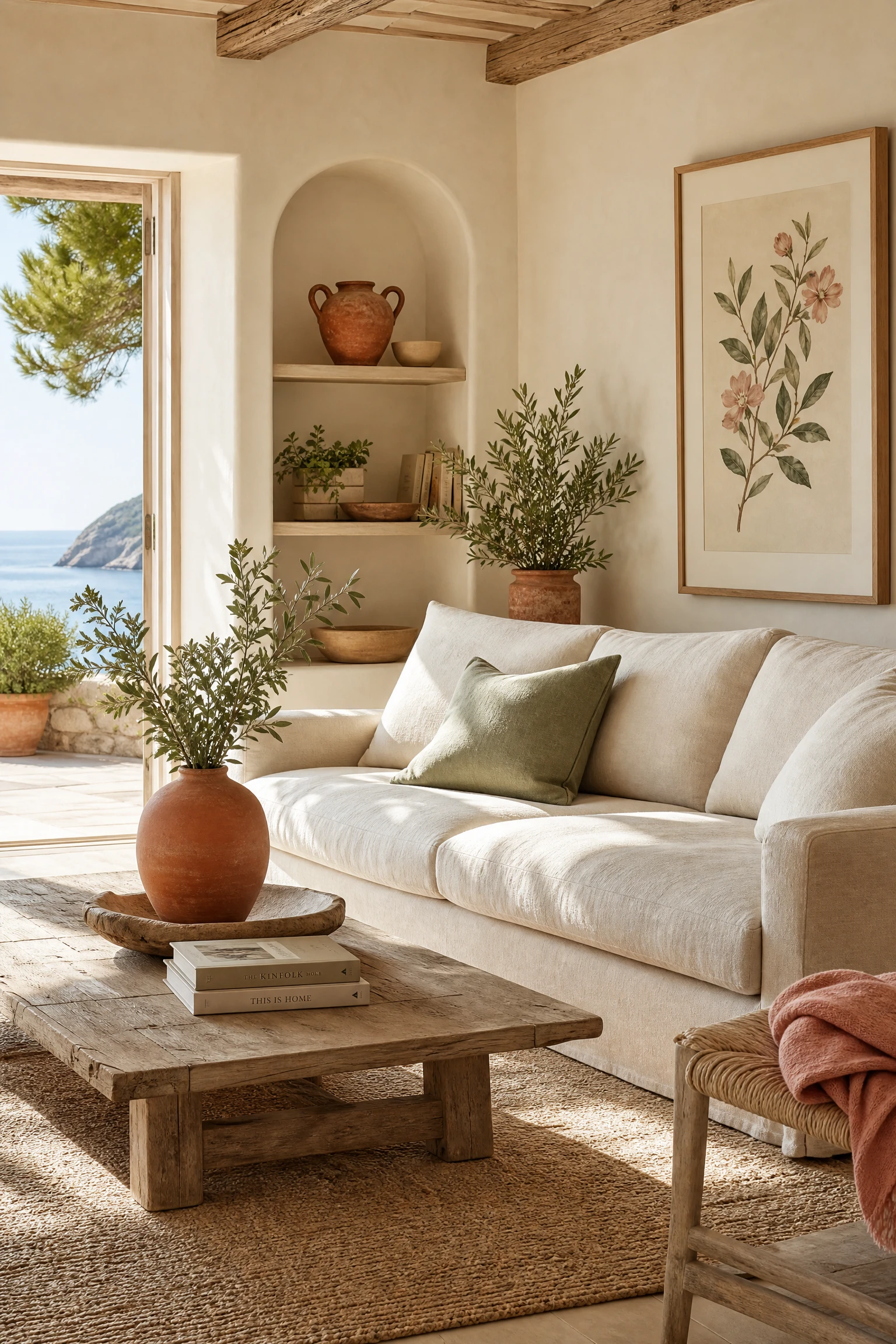
Navy and white is the nautical palette. It is graphic, bold, and classic, but it is not the only coastal option, and in many living rooms it actually works against the relaxed, atmospheric quality that makes coastal style so appealing. A palette built around warm sage green, soft terracotta, bleached linen, and pale sand reads as coastal in a completely different way, evoking the Mediterranean or the California coast rather than a New England sailing club. This direction is particularly good if you want a coastal feel without the room reading as obviously beach-themed. The sage and terracotta combination has been appearing consistently in well-regarded interior design publications and among designers working in coastal and relaxed-contemporary styles, and it holds up beautifully in rooms that get both warm morning and cooler afternoon light. Use the sage on an accent wall or in upholstery, bring in terracotta through ceramics and small accessories, and keep the larger pieces in linen, sand, and pale wood.
Designer Note: This palette skews warmer than a classic coastal scheme, which makes it particularly successful in rooms that do not get a lot of direct natural light.
14. Woven Baskets as Both Storage and Decor
Woven baskets are one of those functional objects that coastal interiors have always done well, and for good reason. A large, handled seagrass basket next to the sofa holds throw blankets in a way that looks deliberate rather than just practical. A row of smaller woven baskets on open shelving corrals remotes, books, and small objects without requiring any cabinetry. Tall, cylindrical baskets can serve as plant holders, umbrella stands, or simple floor accents in corners that feel too empty. The beauty of baskets in a coastal room is that they add texture, warmth, and storage all at once, and they are generally very affordable. Look for pieces in seagrass, water hyacinth, or jute in their natural tones or with simple black or white detail. Baskets with tight, even weaves tend to look more polished, while looser weaves lean more rustic. Either can work depending on the overall direction of the room, but it is worth being consistent across the pieces you choose.
Designer Note: Stack two baskets of slightly different sizes together when you only need one for function. The visual layering is more interesting than a single basket sitting alone.
15. Curtains That Move and Let the Light In
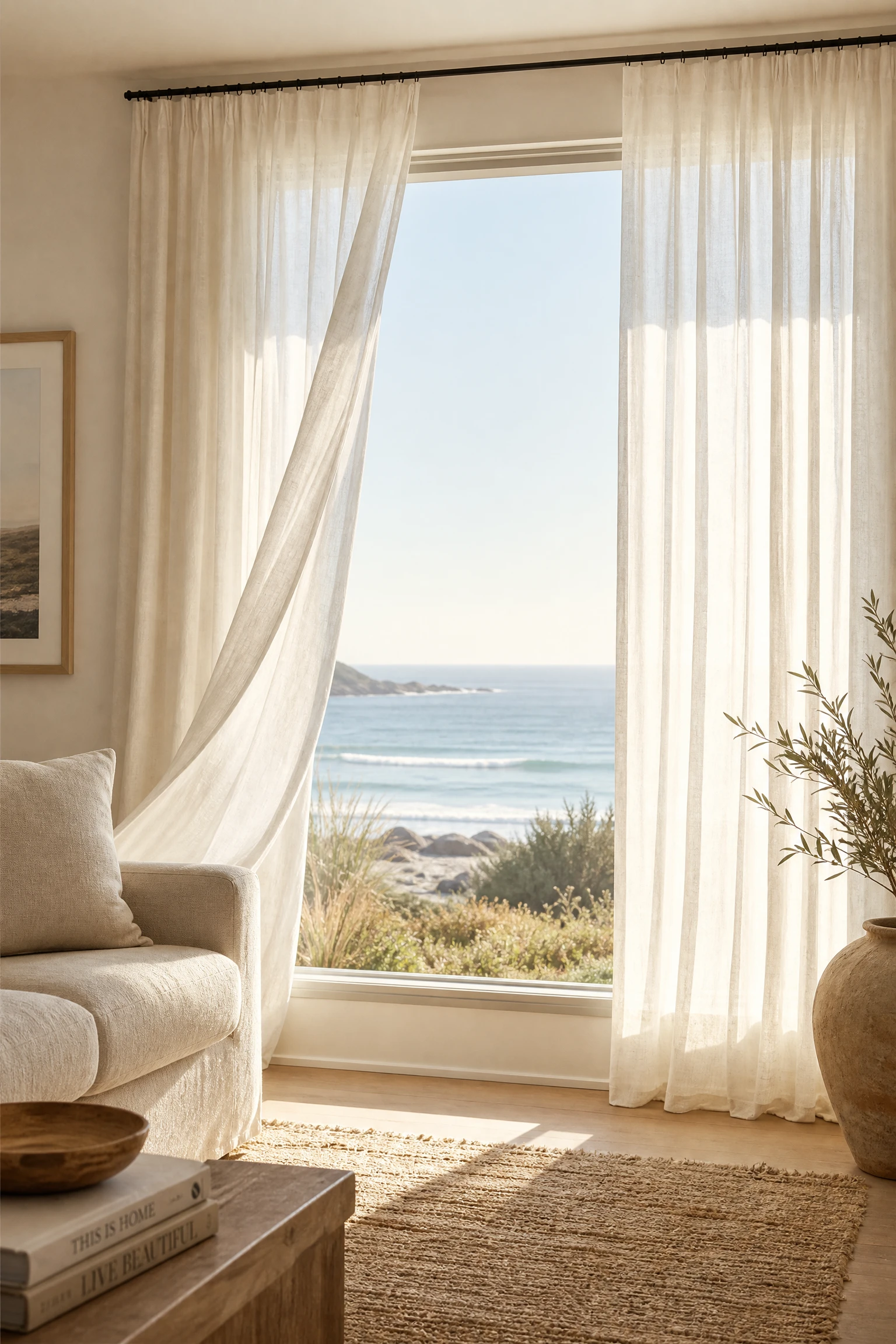
Window treatments in a coastal living room should feel like the room is breathing. That is the standard to hold everything to. Heavy, lined drapes in a dark fabric work against everything a coastal space is trying to do, blocking light and adding visual weight that the palette and furniture are working hard to counteract. What actually serves a coastal room best is floor-length curtains in a light, unstructured fabric: sheer linen, cotton voile, or a loosely woven natural material that filters light gently rather than blocking it. The panels should be hung high and wide, above the window frame and extending well past it on both sides, so that when open they do not cover any of the glass at all. White or undyed natural linen are the safest choices and they go with virtually any coastal palette. If you need some privacy without losing light, a simple sheer Roman blind inside the window frame paired with the floor-length curtains outside gives you full control over both.
Designer Note: Always hang curtain rods at least 4 to 6 inches above the window frame, ideally closer to the ceiling. It makes the ceilings read as taller and the windows as larger, both of which serve a coastal aesthetic well.
16. A Coastal Bookcase That Tells a Story
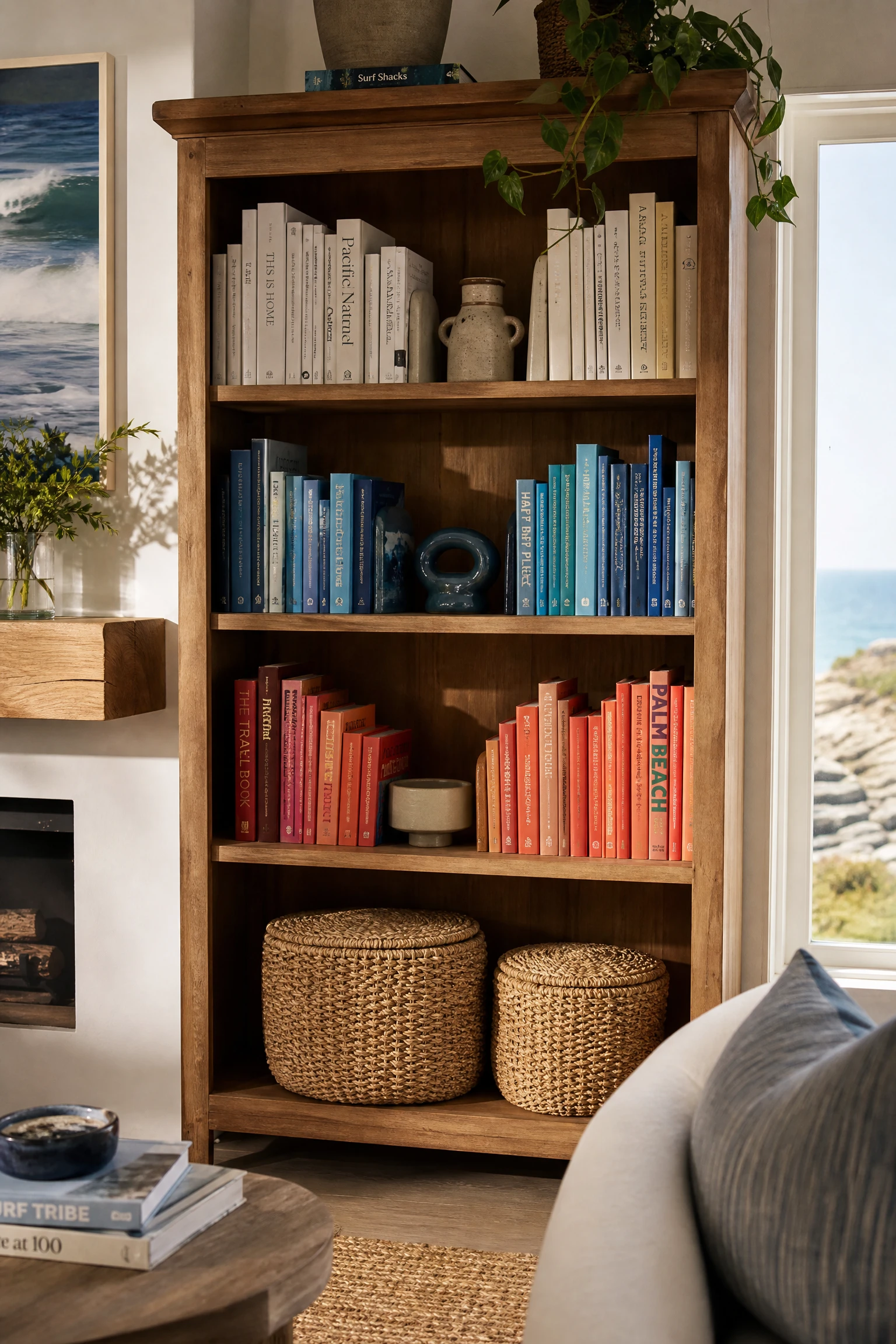
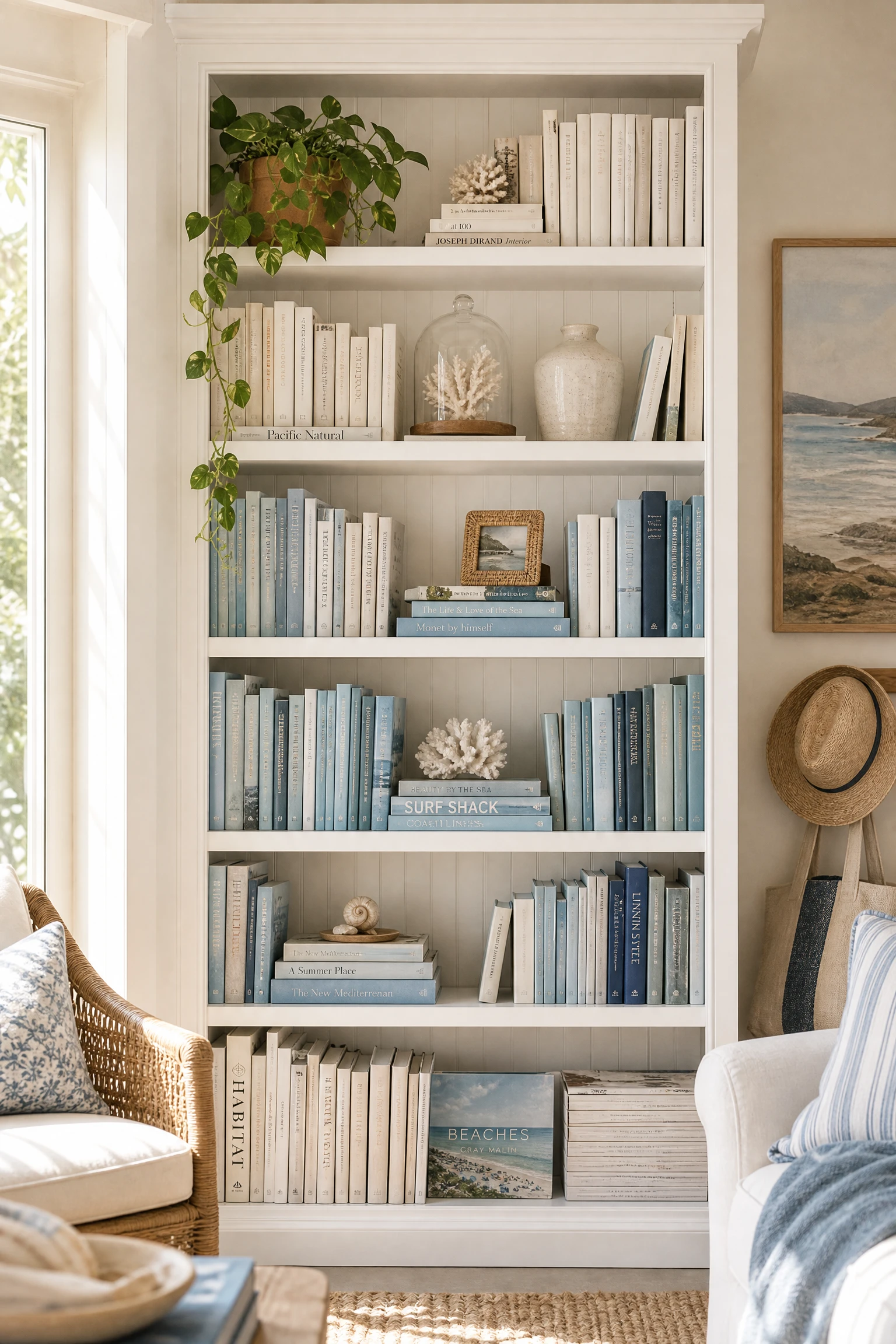
Open shelving and bookcases are an opportunity that most coastal living rooms miss. The typical approach is to line a bookcase with books and then scatter a few shells between them, which rarely looks intentional. What works better is treating the bookcase as a styled vignette that happens to include books. Start by grouping books by color, keeping whites, creams, pale blues, and natural linen spines together in clusters. Between the book clusters, introduce objects that have genuine visual weight: a piece of coral or sea glass in a glass dome, a small framed coastal photograph, a ceramic bowl in a sandy glaze, a short stack of design or travel books with visually appealing covers. Add one or two small plants at varying heights and a simple woven basket for a lower shelf. The result feels like something you built gradually rather than styled in an afternoon, which is exactly the quality a coastal interior depends on.
Designer Note: Leave some shelves partially empty. Negative space in a bookcase reads as confident and considered, and it prevents the whole thing from feeling overstuffed.
17. Organic Shapes in Furniture and Mirrors
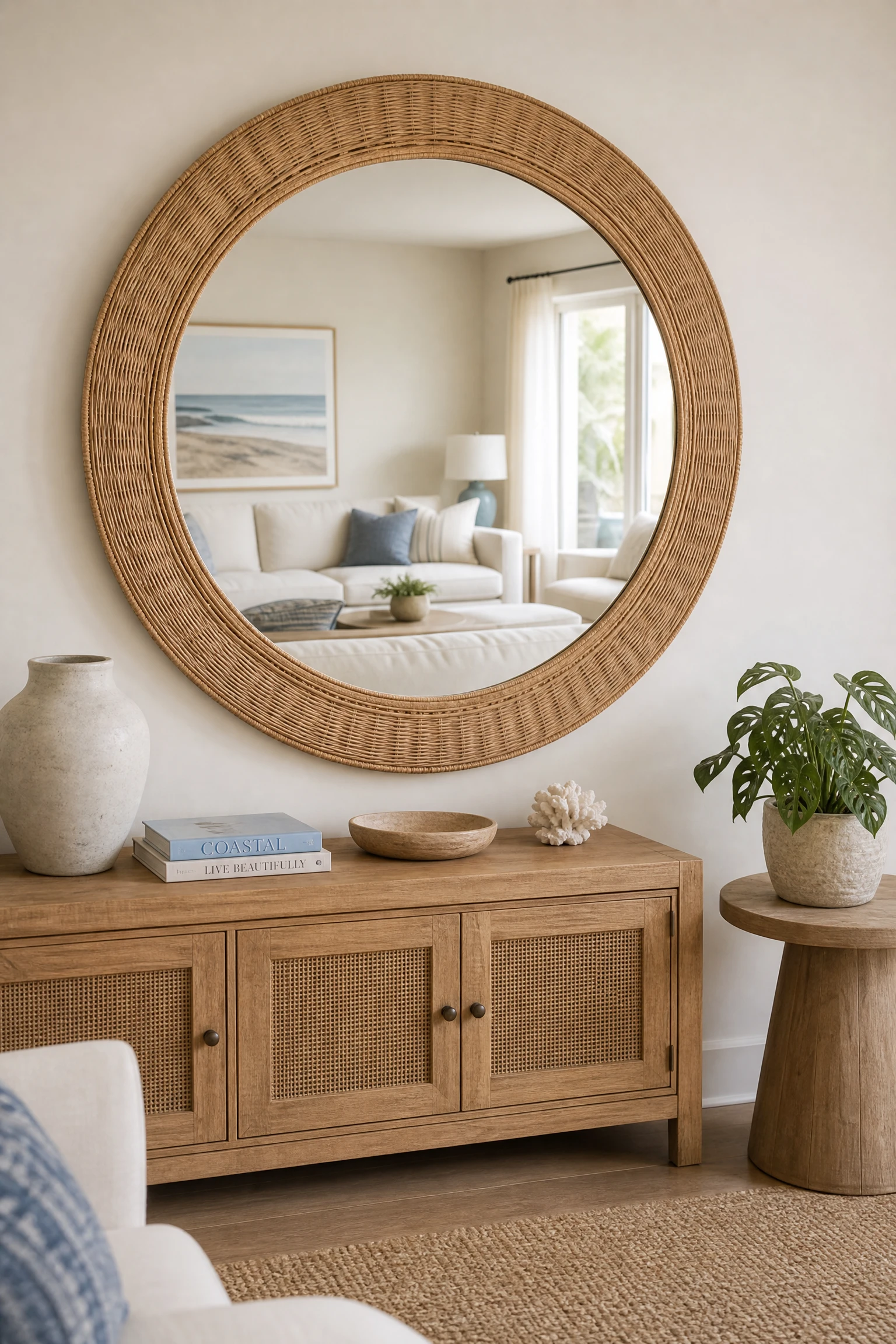
One of the clearest shifts in coastal interior design over the past few years is a move away from hard, rectangular shapes toward organic, curved silhouettes that feel more fluid and natural. Round and oval mirrors are probably the most accessible entry point into this trend. A large round mirror in a rattan or driftwood frame above a console or fireplace immediately softens a room and adds the kind of reflective light play that makes coastal spaces feel luminous. Beyond mirrors, look for furniture with curved edges: a kidney-shaped coffee table, a sofa with a gently arched back, an oval side table, or a scallop-edged accent chair. These organic shapes echo the natural forms of the coastal environment, waves, pebbles, shells, sand dunes, in a way that feels subconscious and right rather than on-the-nose. This direction also happens to align well with Japandi and wabi-sabi influences, making it a particularly good choice if you want a coastal space that does not lean too obviously toward the nautical.
Designer Note: A single large round mirror can do more for the light and spatial quality of a coastal living room than almost any other single purchase. It is worth prioritizing.
18. The Coastal Fireplace Surround That Changes Everything
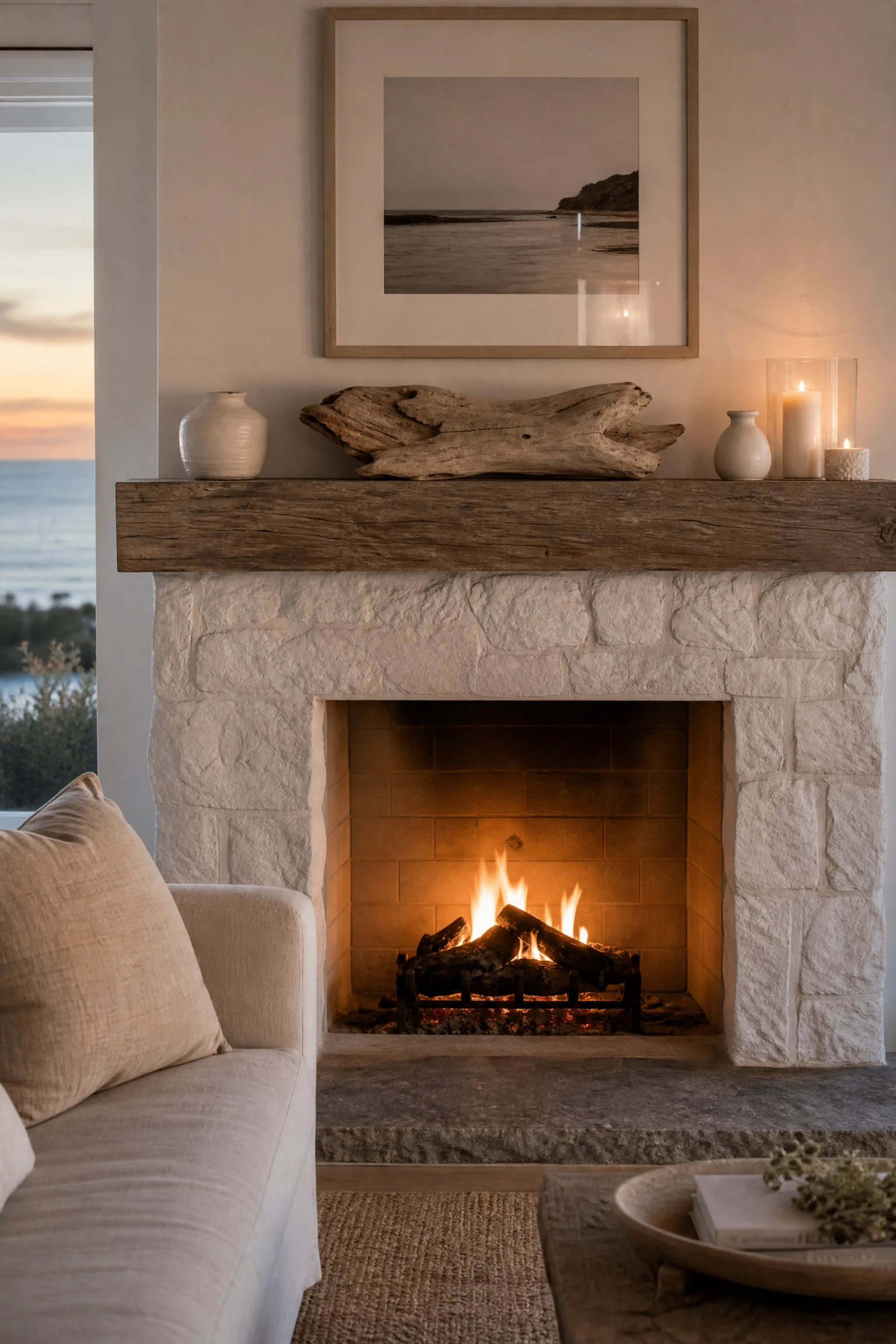
If your living room has a fireplace, the surround is one of the most powerful focal points you have access to, and the right treatment can anchor the entire coastal story of the room. A fireplace surround in whitewashed brick, stacked white stone, or painted a warm matte white with a simple wooden mantle in a light or driftwood-stained finish gives you exactly the kind of casual, slightly weathered elegance that coastal style requires. On the mantle, keep the styling simple: one large piece of driftwood or a sculptural ceramic vase as a central element, flanked by two or three smaller pieces of varying heights, a candle grouping, and perhaps a small plant. Avoid cluttering the mantle with too many small objects, as this is one of the spots in a coastal living room where restraint makes the most difference. If a full surround renovation is not in the budget, painting an existing mantle in a soft white or warm cream and adding simple shiplap detail to the surround above it can get you most of the way there for significantly less.
Designer Note: A mantle with five or fewer objects almost always looks better than one with eight or more. The fireplace is meant to be a focal point, so let it breathe.
19. Coastal Art That Earns Its Place on the Wall
Art is where many coastal living rooms either succeed completely or collapse into theme-park territory, and the line between the two is not always obvious. The art that earns its place in a thoughtfully decorated coastal room is not a painted pelican or a ‘Life is Better at the Beach’ sign. It is work that captures the light, movement, color, or atmosphere of a coastal environment in a way that could hold its own in a serious space. Abstract art in ocean blues, sandy whites, and deep sea greens, large-format editorial photography of seascapes or coastlines, a simple botanical print of a coastal plant, or a hand-drawn map of a favorite stretch of coastline are all options that read as coastal without being literal about it. The size of the art matters enormously. In a living room, one or two large pieces are almost always more successful than a wall covered in small prints. If budget is a concern, many artists sell high-quality digital prints that you can have printed locally at a significant saving.
Designer Note: When hanging a single large piece of art above a sofa, aim for the center of the artwork to sit at eye level, roughly 57 to 60 inches from the floor. Art hung too high is one of the most common decorating mistakes in living rooms.
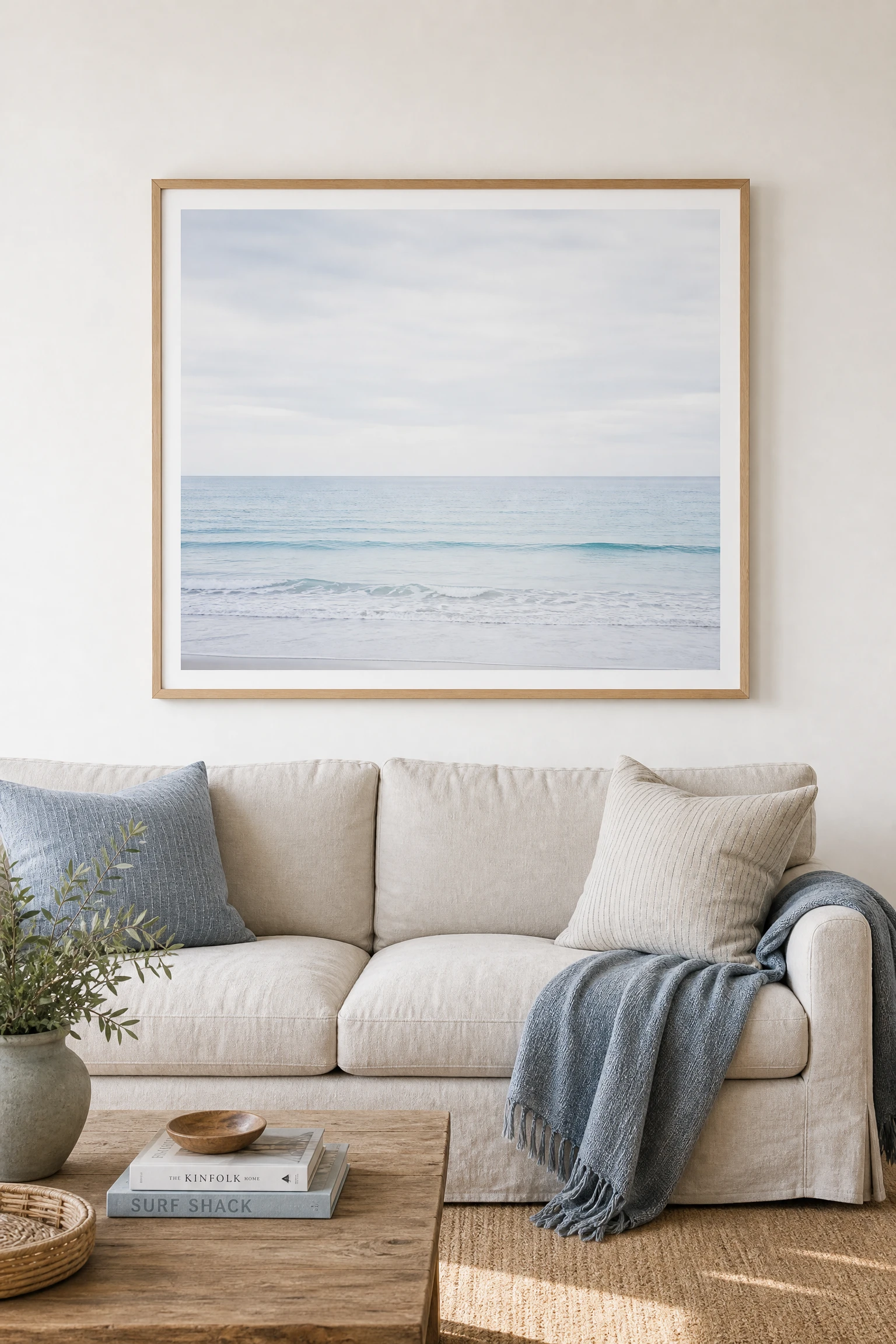
20. A Reading Nook with Coastal Character
Not every living room has the space for a dedicated reading nook, but even a corner with enough room for a single chair and a floor lamp can be treated as one, and doing so adds enormous character to a coastal space. A rattan armchair or a simple slip-covered occasional chair in a pale linen is the natural starting point. Beside it, a small side table in natural wood or a wicker piece holds a table lamp, a stack of two or three books, and perhaps a small plant or a single candle. A floor lamp with a woven shade adds layered light that makes the corner feel intentional. The floor underneath the chair benefits from a small accent rug, even just a simple jute or cotton flatweave, that marks the nook as its own territory within the larger room. This kind of defined corner has a warmth and functionality that makes a coastal living room feel genuinely liveable rather than purely decorative, which is ultimately the whole point of the style.
Designer Note: A reading nook needs a practical light source, not just an atmospheric one. Position a table or floor lamp so the light actually falls on a book held at a natural reading angle.
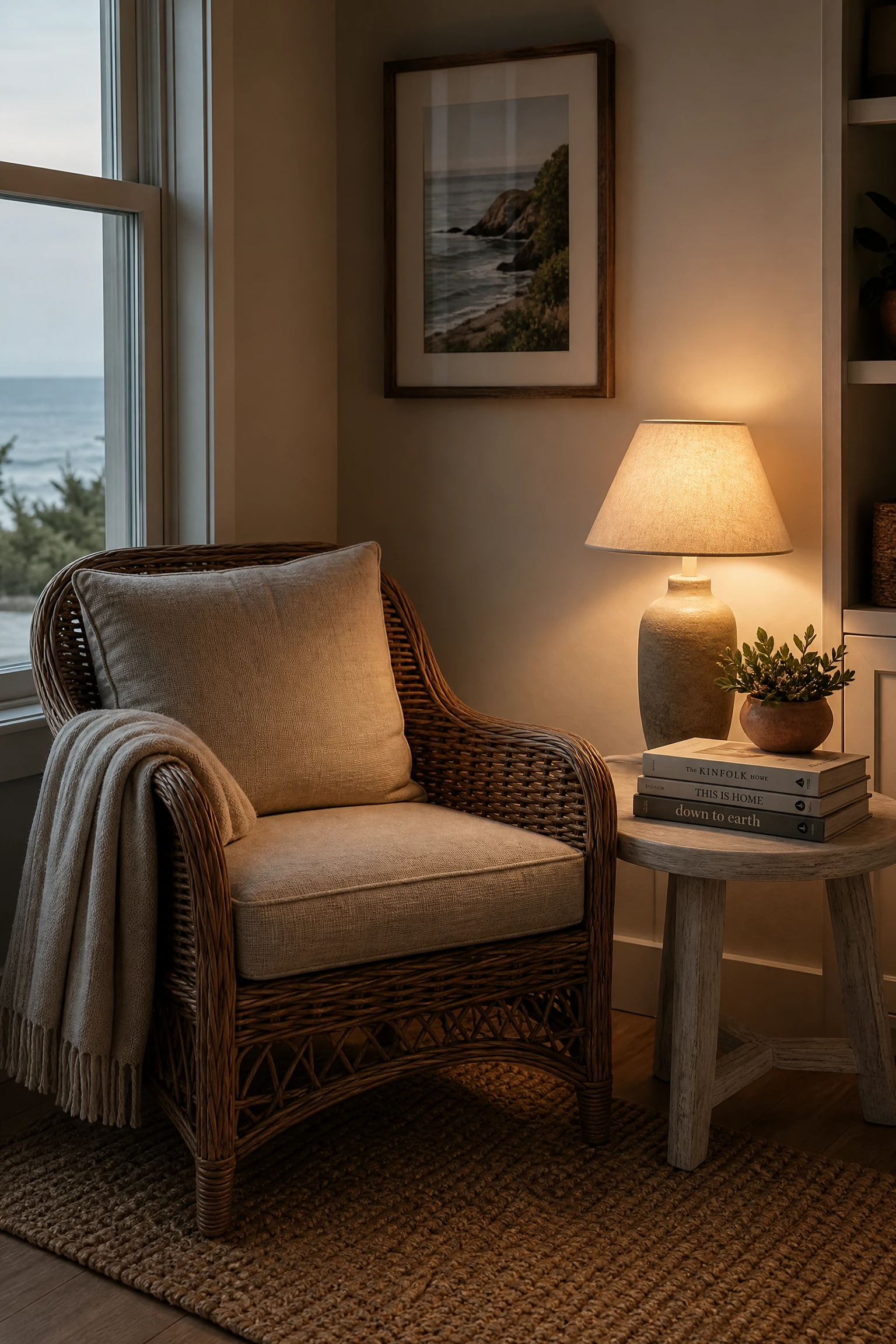
21. A Coastal Console Table That Works Harder Than It Looks
A console table behind the sofa or against a wall is one of those pieces that can either sit quietly and do nothing much for the room or become a genuinely useful design moment. In a coastal living room, the console itself should be in a natural wood finish, a whitewash, or a pale-painted tone that sits lightly in the space. On top, the styling follows the same principles as any coastal vignette: one central anchor piece such as a tall ceramic lamp or a sculptural vase, a few books or objects of varying height, and something living like a small plant or a sprig of dried pampas grass in a small vessel. Below, if the console has a lower shelf, woven baskets or a couple of stacked art books add function. The console table works particularly well in open-plan spaces because it creates a visual boundary for the living room seating area without any physical barrier, which keeps the breezy, open quality that coastal interiors depend on.
Designer Note: Avoid styling a console table with too many pieces at the same height. Vary the heights dramatically, from something tall at one end to something low and flat at the other, for the most visually interesting result.
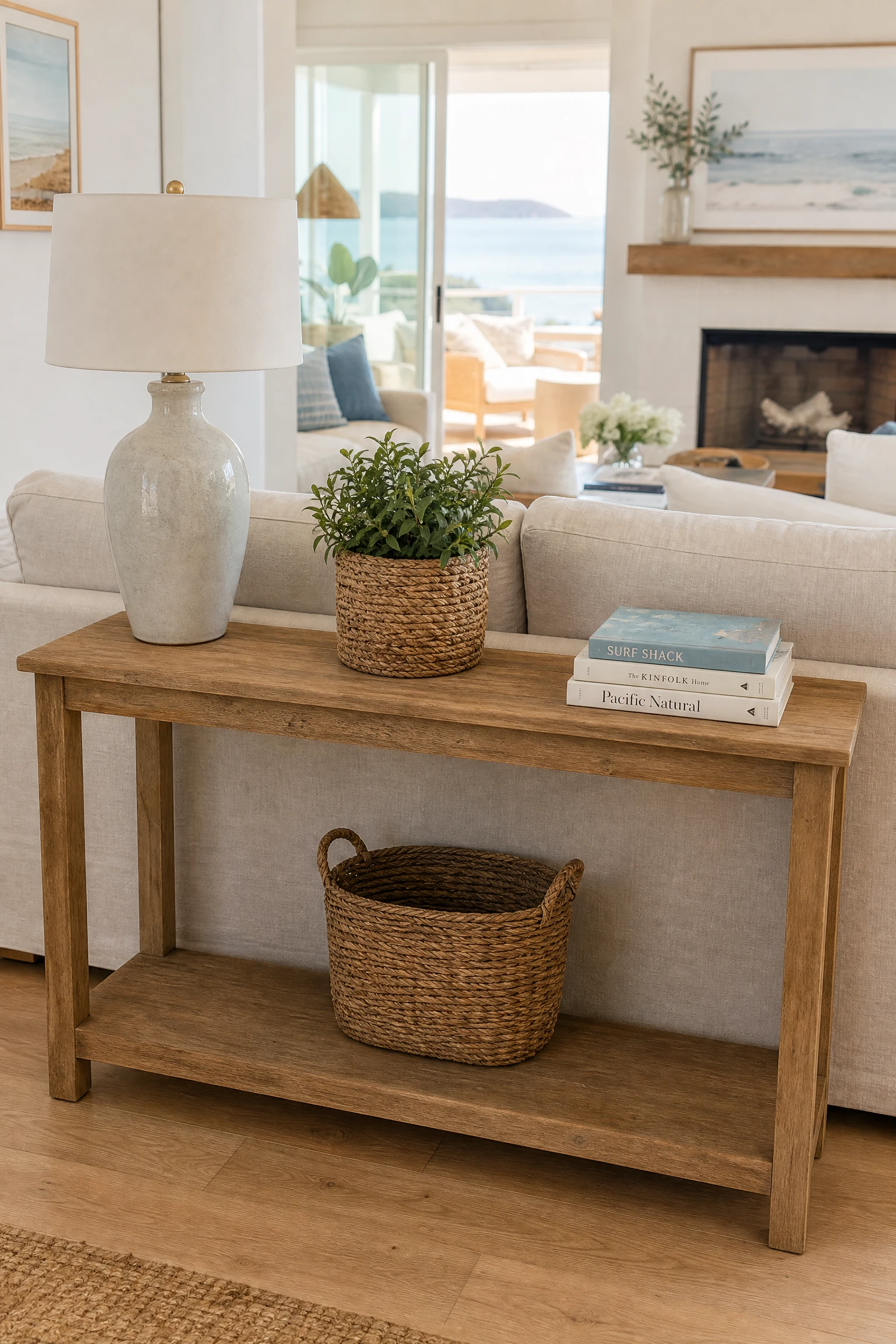
22. Soft Stripe Patterns That Reference the Classic Without Copying It
The stripe is one of the most recognizable visual codes in coastal design, and used well it genuinely adds to the story of the room. The key distinction between stripes that feel fresh and those that feel tired is scale and palette. A wide, loosely-woven stripe in warm white and soft sage on a single large cushion reads entirely differently from a tight navy-and-white stripe on everything in the room. In a current coastal living room, stripes work best as an accent rather than a dominant pattern, appearing on one or two cushions, a single throw, or an area rug. The palette should stay within the room’s broader color story: sandy stripes on a cream ground, pale blue on white, soft sage on linen. Avoid bold, high-contrast stripes unless your entire design direction is deliberately graphic and nautical. For most coastal interiors, the stripe should feel like a gentle suggestion of the theme rather than a statement about it.
Designer Note: Mix a stripe with at least one other pattern in the room, either a subtle texture or a loose organic print, to keep the room from reading as too coordinated or theme-heavy.
23. Capiz Shell and Natural Material Light Fixtures
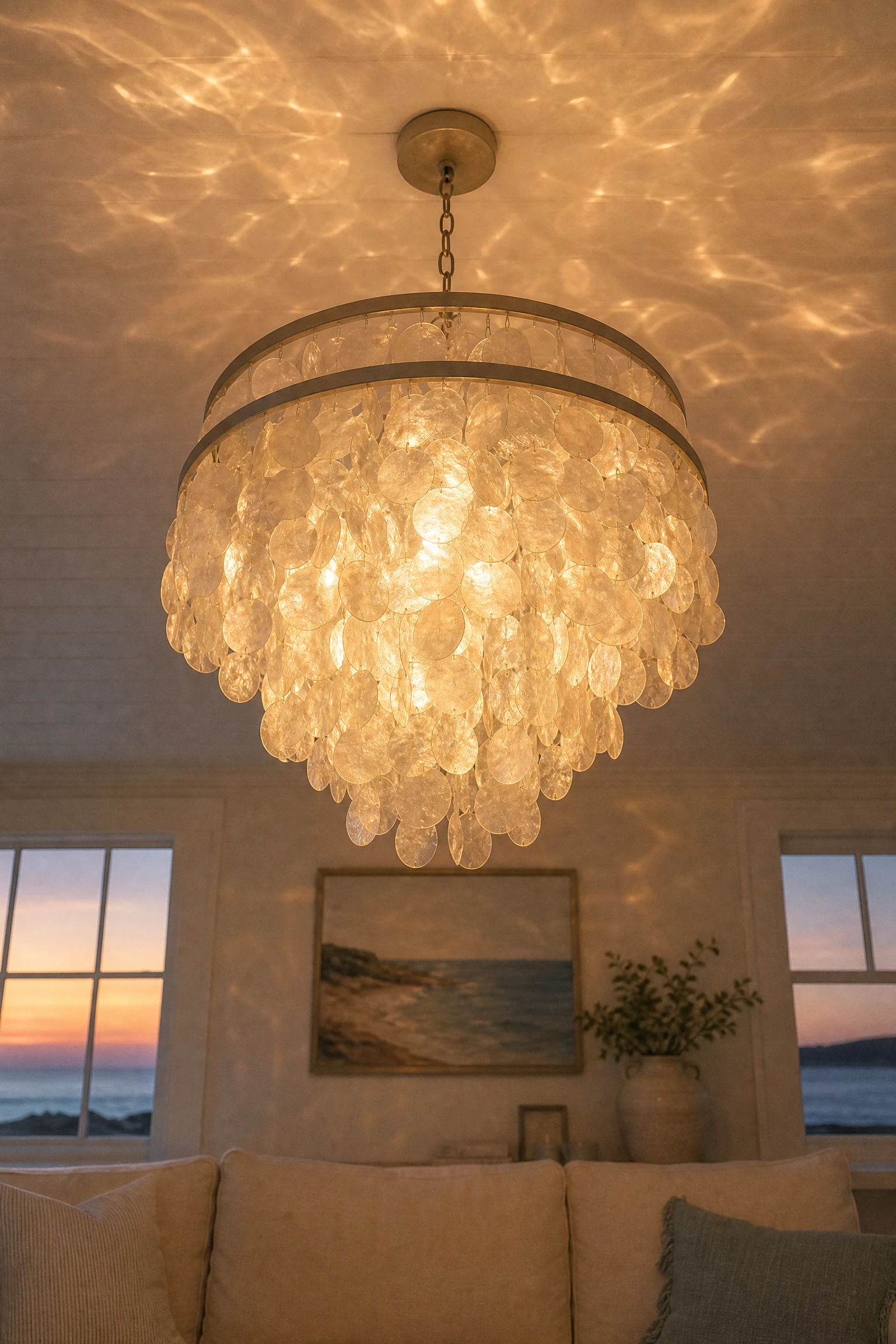
Capiz shell chandeliers and pendants have been a staple of coastal interior design for good reason. The thin, translucent shells catch and diffuse light in a way that genuinely mimics the soft shimmer of light on water, and no synthetic material has come close to replicating that effect convincingly. A capiz shell chandelier in a dining area that opens into a coastal living room is one of the most effective single design decisions you can make for the overall atmosphere of the space. If a full chandelier is too large a commitment or investment, a capiz shell flush mount or a cluster of smaller capiz pendants at varying heights creates a similar effect. The color of natural capiz is a soft iridescent white that works with virtually any coastal palette. One honest note: capiz shell fixtures are delicate and can be fragile during installation. If you are not confident with light fixture installation, hiring an electrician for this particular piece is worth the cost.
Designer Note: Capiz fixtures look best in rooms that also get good natural light during the day, as the daytime shimmer of the shells is just as beautiful as the lit effect at night.
24. A Coastal Color Moment in an Unexpected Place
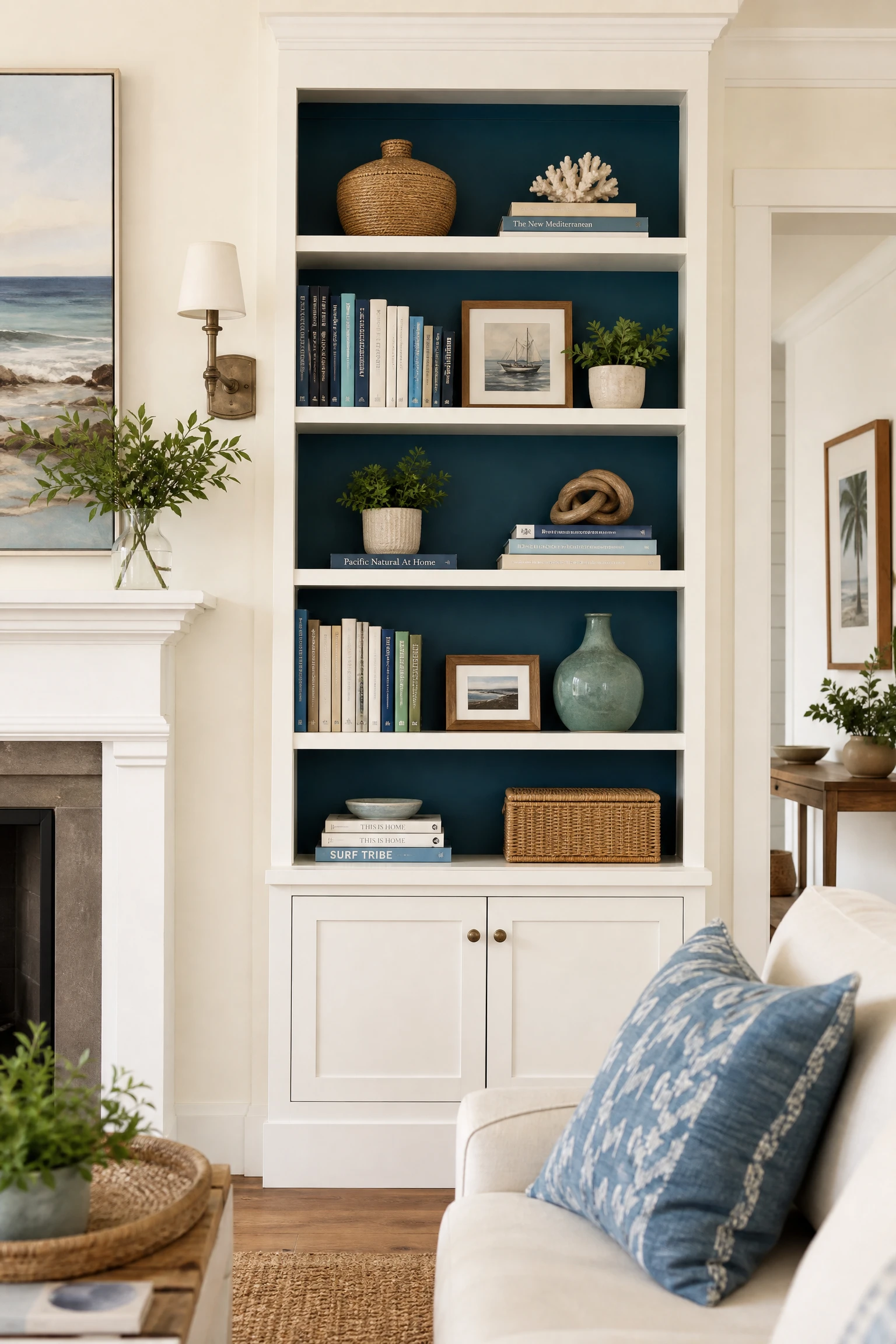
One of the most effective tricks in a well-put-together coastal living room is placing a genuine color moment somewhere you do not immediately expect. The inside of a bookcase painted in a deep ocean teal or a soft jade green, visible only when you look directly into the shelves, creates a beautiful backdrop for objects and books without committing the whole room to a bold color. A ceiling painted in a very pale aqua or sky blue, what designers often call a haint blue, adds a layer of color that you only fully register when you look up, giving the room a quality of light that feels almost coastal without being obvious about it. An unexpected color on the back of a door, on the inside of a window frame, or on a single piece of statement furniture like an armchair or ottoman in a soft coral or denim blue adds personality and depth without disrupting the overall balance of the room. This kind of detail is what separates a room that has been genuinely thought about from one that has simply been furnished.
Designer Note: Haint blue ceilings have a long history in Southern coastal architecture and genuinely do make rooms feel more open and airy. It is an underused trick that delivers a lot for a single can of paint.
25. The Final Layer: Scent, Sound, and Small Daily Rituals
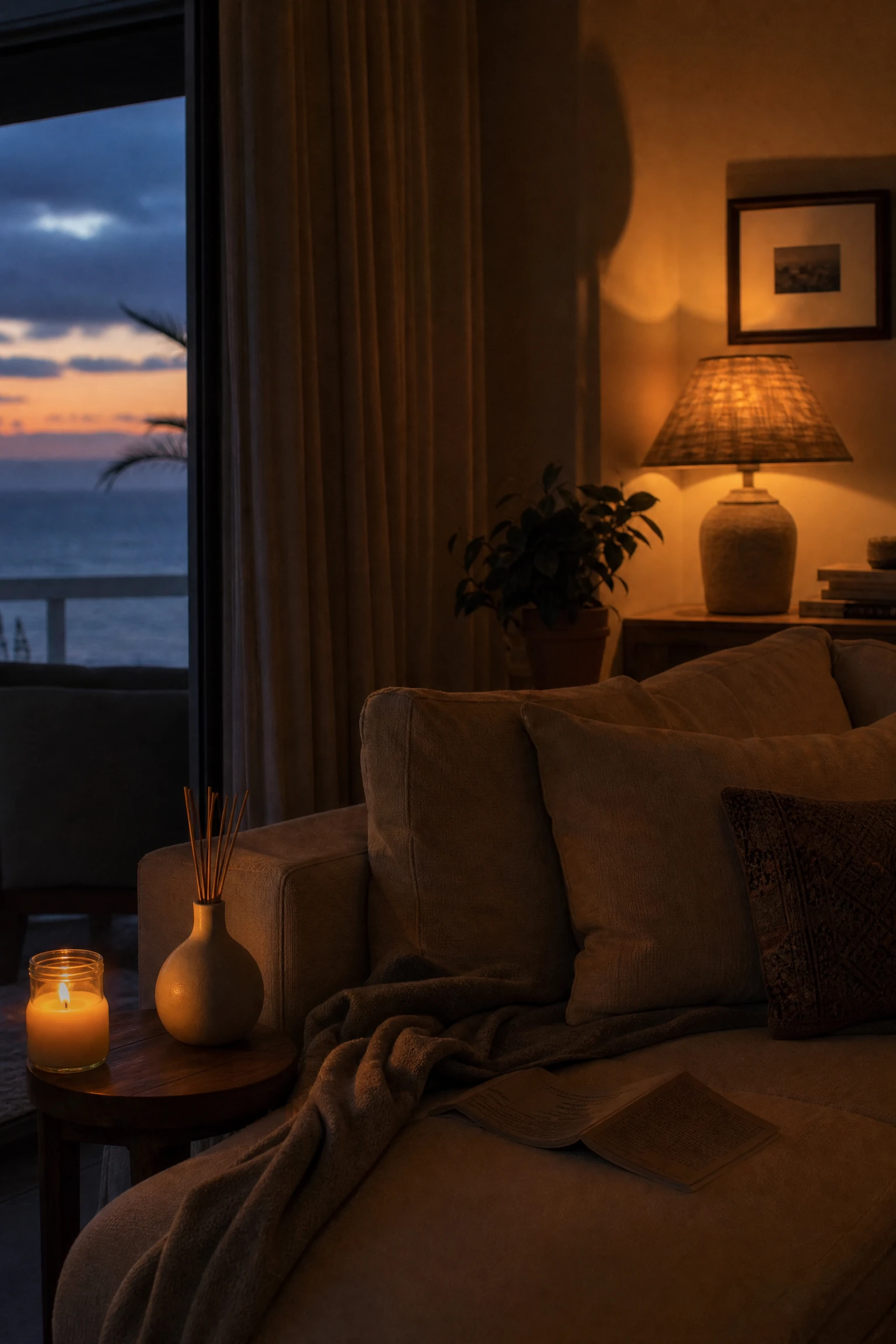
This last idea is not a furniture choice or a color decision, but it might be the most important one in a coastal living room. The feeling that makes coastal spaces so deeply appealing is not entirely visual. It is also about scent, the softness of what you touch, the sense of ease in how the room is used. A coastal living room that smells of driftwood and sea salt through a simple diffuser or a quality candle shifts the experience of the room in a way that no paint color can replicate. A linen spray on the sofa cushions, a woven cotton throw that actually gets used rather than displayed, an uncluttered coffee table that has room for a cup and a book, a window that is opened in the morning to let the breeze in if the climate allows, these are the small daily choices that make a coastal living room feel genuinely lived-in rather than styled for a photograph. In practice, the best coastal rooms are ones that have been furnished for how people actually spend their time in them, not just for how they look in a still image.
Designer Note: Edit the room regularly. Coastal style depends on a sense of breathing room, and that means occasionally removing something that has accumulated rather than adding another layer.
Bringing It All Together
A coastal living room is not about buying a set of matching pieces and calling it done. It is a direction, a feeling you are working toward one decision at a time. What runs through every idea in this article is the same principle: lightness, restraint, and an attention to the materials and textures that actually evoke the coast rather than just illustrating it. You do not need all 25 of these ideas. You need the handful that speak to how you actually live and what your room genuinely needs.
Start with the biggest things first: the sofa, the wall color, the rugs. Get those right and the rest becomes much easier to layer in over time. Some of the most beautiful coastal living rooms are ones that have been built gradually, where things have been added and edited as the owner’s taste and understanding of the space developed. That patience and willingness to edit is itself a very coastal quality. The ocean does not rush, and neither should your living room.
If you take one thing from this article, let it be this: the goal is a room that makes you feel something when you walk into it, that slow exhale, that sense of arriving somewhere you actually want to be. Everything else is just furniture. Work toward the feeling first, and the details will follow.
Frequently Asked Questions
What colors work best for a coastal living room?
The most effective coastal living room palettes are built on warm neutrals like sandy beige, warm white, and natural linen, with accents in soft aqua, dusty teal, sage green, or pale blue. You do not have to default to navy and white, which reads more nautical than coastal. The goal is a palette that evokes the light and atmosphere of the coast, which means staying away from anything too saturated or too dark in the larger pieces.
How do I make a coastal living room look expensive on a budget?
Focus your budget on the sofa and one or two statement pieces, and be resourceful with everything else. A good linen sofa cover can give an older sofa an entirely new quality. Thrift stores and secondhand furniture platforms are excellent sources for the kinds of natural wood and rattan pieces that coastal style depends on. Large-format prints from online print shops, jute and sisal rugs, and simple woven baskets are all affordable and make a significant visual impact.
Can I do coastal style in a dark or north-facing room?
Yes, but you need to compensate for the lack of natural light with your color and lighting choices. In a dark room, go with warm whites rather than cool whites, as warm tones hold up much better under artificial light. Layer your lighting generously, using table lamps, floor lamps, and pendants rather than relying on a single overhead fixture. Mirrors placed opposite windows help reflect whatever natural light is available and make the room feel brighter than it is.
What is the difference between coastal and nautical style?
Coastal style is broad and atmospheric, drawing on the colors, textures, and materials of seaside environments in a relaxed and liveable way. Nautical style is more specific and graphic, using the iconography of sailing and the sea, navy and white stripes, rope details, anchor motifs, and ship-inspired shapes. Coastal can include nautical elements, but it does not have to. Most contemporary coastal interiors lean away from the nautical and toward something more understated and organic.
How many coastal accessories are too many?
A useful rule of thumb is to style a surface or shelf with what feels right, then remove one or two things. Coastal interiors depend on a sense of ease and breathing room, and that quality is undermined by too many accessories competing for attention. On a coffee table, three or four objects are usually enough. On a bookcase shelf, two or three items alongside a book cluster. A single strong piece almost always outperforms a collection of smaller ones.
Do I need to live near the coast to use coastal style?
Not at all. Coastal style is about evoking a feeling rather than representing a literal location. Plenty of the most beautifully executed coastal interiors exist in landlocked cities and countries. What matters is the palette, the materials, the quality of light, and the overall sense of relaxed ease. If the room feels like somewhere you want to slow down, it is doing its job, regardless of what is outside the window.