Black Countertop Kitchen Ideas That Start With the Right Cabinet Pairing

Black countertops are having a sustained moment in kitchen design, and it is easy to understand why. A black countertop surface, whether in matte granite, honed soapstone, polished quartz, or a solid engineered surface like Dekton, brings depth, sophistication, and a horizontal weight to the kitchen that lighter countertop materials simply cannot replicate. But most articles about black countertops focus on the surface itself: the material options, the finish choices, the veining or the solid tone. What they rarely address is the decision that actually determines whether the kitchen looks extraordinary or whether the black countertop looks like a design afterthought: the cabinet colour.
The cabinet colour in a kitchen with black countertops sets the entire emotional register of the space. White cabinets with black countertops create maximum contrast and a kitchen that reads as crisp, graphic, and enduringly classic. Natural wood cabinets with black countertops create a warmth and organic balance that neither material achieves on its own. Dark or all-black cabinets with black countertops create the most dramatic and most committed version of the palette. Coloured cabinets with black countertops create the most personal and most expressive kitchens available. This article is organized by that cabinet decision first, and then by the specific design moves within each cabinet colour group that make the black countertop perform at its best.
White and Cream Cabinets With Black Countertops
White and cream cabinets with black countertops is the most widely used and most reliably successful cabinet and countertop combination in kitchen design because it delivers the maximum possible contrast on the most visible horizontal surface in the kitchen. The black countertop against white cabinetry creates a kitchen that reads as simultaneously enduring and completely contemporary, which is a genuinely rare combination.
1. Crisp White Shaker Cabinets With Matte Black Granite Countertops
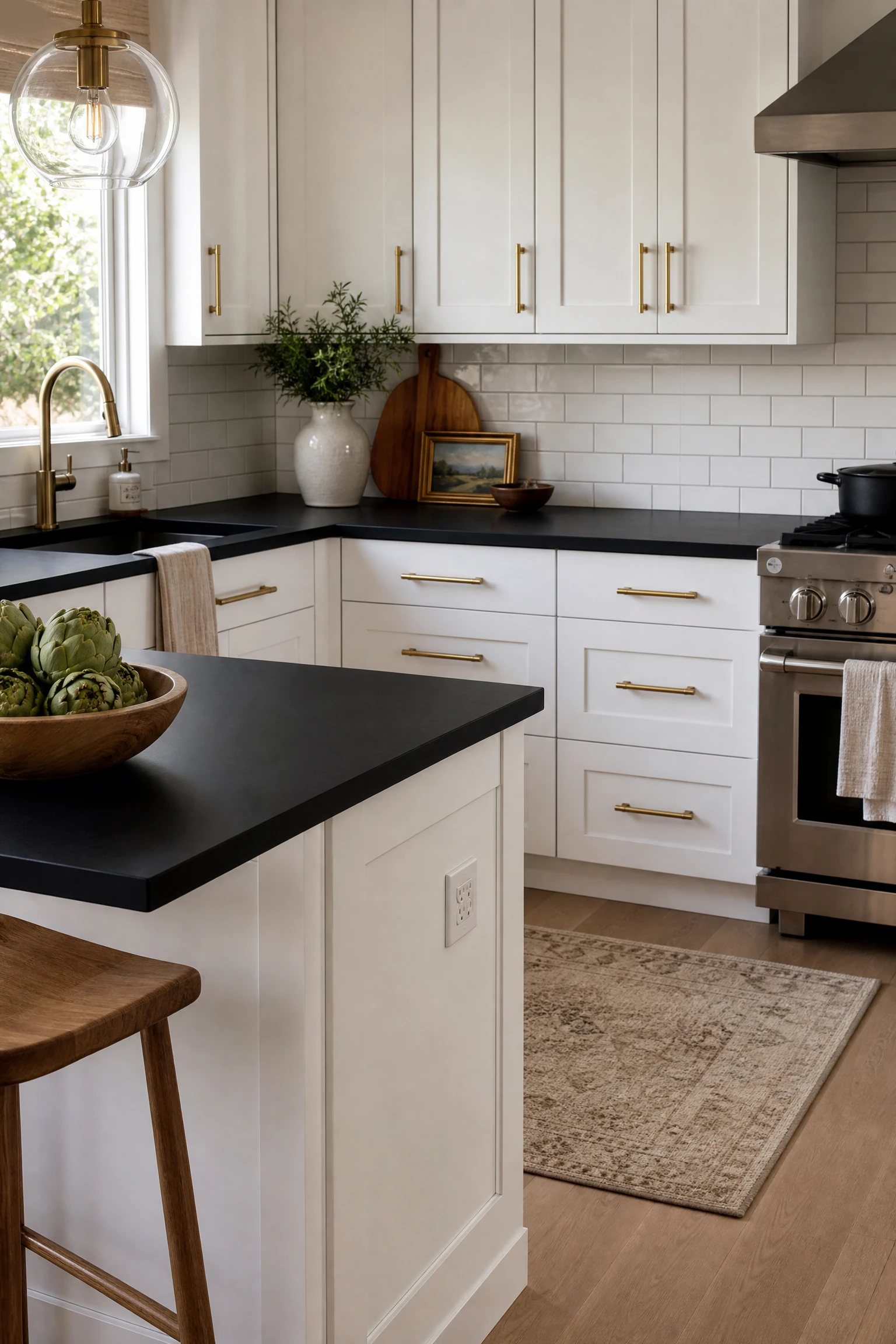
White shaker cabinets with matte or honed black granite countertops is the single most popular black countertop kitchen combination in current design, and its popularity reflects a genuine design quality rather than a trend moment: the combination works because the two elements bring out the best in each other. The white shaker cabinet profile, with its simple recessed panel door and clean frame, reads as distinctly traditional in form and completely contemporary in white paint, and the honed black granite countertop provides the horizontal design weight that the traditional cabinet form needs to read as modern rather than simply period. Matte or honed black granite specifically suits this combination because the soft, non-reflective surface of the honed finish creates a warm, tactile quality that polished granite does not have, and this warmth prevents the high-contrast combination from reading as cold or clinical. Hardware in brushed brass or matte black both work: brass adds warmth and luxury, matte black creates a crisper, more graphic consistency.
Pro Move: Choose a honed or leathered black granite finish over a polished finish for everyday kitchen use. Polished black granite shows every water mark, fingerprint, and crumb with unforgiving clarity because the reflective surface catches light around every surface deposit. A honed or leathered finish has enough surface texture to disguise the fingerprints and water marks that are an unavoidable reality of a working kitchen, while delivering the same depth and richness of colour as the polished version.
2. Warm Cream Cabinets With Black Quartz Countertops
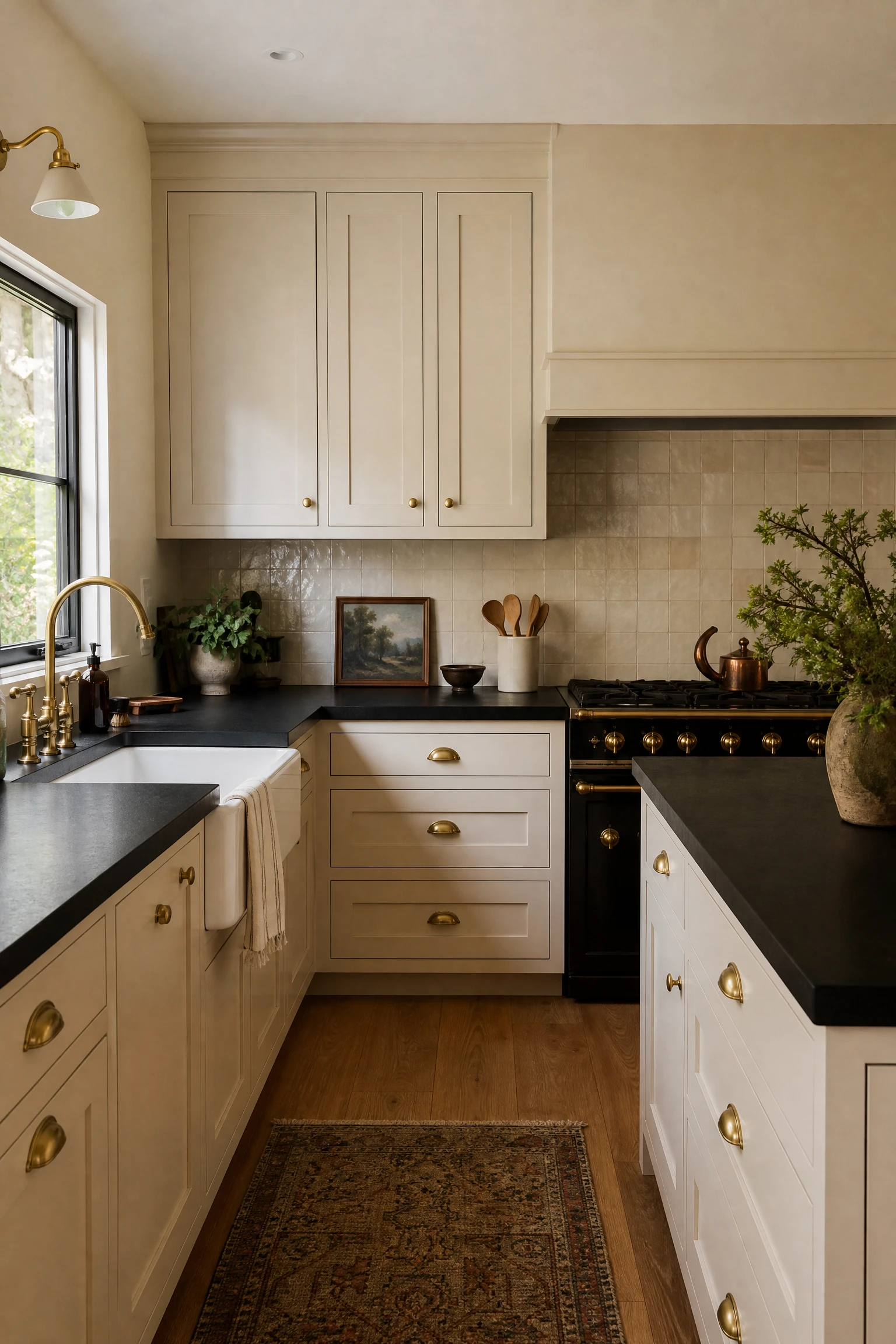
Cream or warm off-white painted cabinets with black quartz countertops create a warmer and more organic version of the high-contrast black and white kitchen because the warmth of the cream shifts the palette from graphic and architectural toward something more liveable and more traditionally grounded. Black quartz in a solid tone or with very subtle movement suits cream cabinets better than a heavily veined black stone, because the veining in a complex black stone tends to carry cool grey or silver tones that can fight the warmth of the cream. The cream and black combination works particularly well in kitchens with warm timber flooring, brass or antique gold hardware, and a backsplash in a natural stone or handmade ceramic tile that shares the warmth of the cream palette. The overall effect is a kitchen that reads as Hamptons-inspired or quietly rich rather than the starker, more graphic quality of the pure white and black combination.
Designer Advice: When choosing the specific cream for cabinets alongside black countertops, select a cream with a yellow or warm undertone rather than a pink or grey undertone. A pink-cream cabinet alongside a black countertop can read as slightly dated or overly traditional. A grey-cream can fight the cool depth of the black. A warm yellow-cream creates the specific warmth that makes the combination feel genuinely inviting rather than simply well-contrasted.
3. White Handleless Cabinets With Black Waterfall Island Countertop
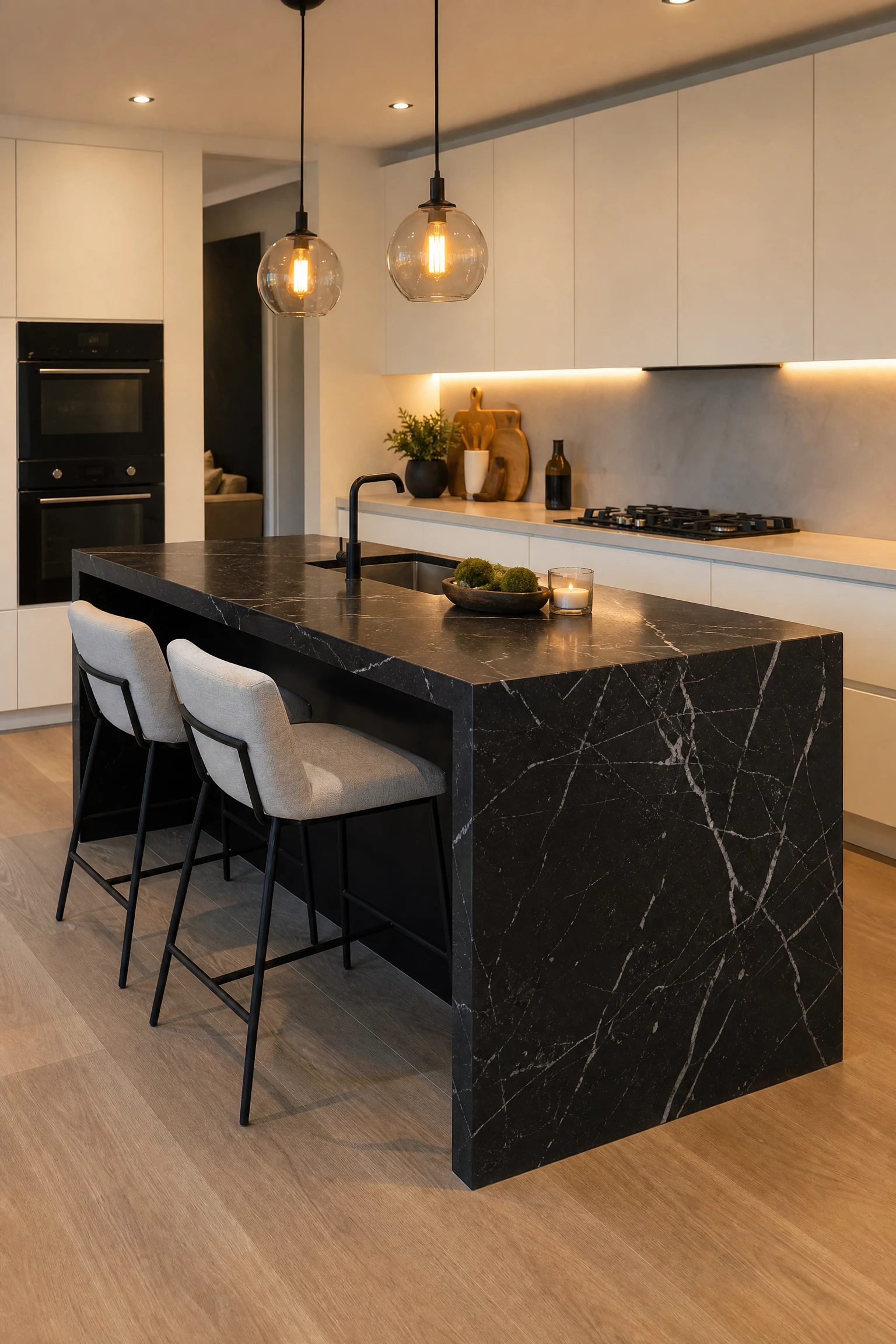
Flat-panel or handleless white cabinets with a black countertop that wraps as a waterfall over one or both ends of the kitchen island creates the most dramatic and most architecturally strong expression of the white and black kitchen. The waterfall black countertop, where the countertop material continues vertically down the end panels of the island to the floor, turns the island from a piece of furniture into a sculptural object with a strong vertical and horizontal presence. Against white handleless cabinetry, the black waterfall island reads as the single most deliberate design element in the kitchen and its material quality becomes the focal point from every viewing angle. The stone choice for a waterfall island needs to be made specifically for the waterfall application: the material will be seen on three planes simultaneously, the horizontal top and two vertical end panels, and the veining or pattern of the stone needs to read consistently across all three faces. Book-matching the stone panels so the veining mirrors itself across the vertical faces is the mark of a genuinely resolved waterfall island.
Heads Up: A black waterfall island adds significant visual weight to the kitchen from every angle including from adjacent living or dining spaces in an open-plan layout. Before committing to a black waterfall island in an open-plan kitchen, spend time in the space and consider how the black mass will read from every position in the adjoining room. An island that creates a dramatic focal point from the kitchen entrance can create an unexpected visual barrier or a heavy presence from the sofas and dining table of an adjoining open-plan space.
4. White Cabinets With Black Countertop and Contrasting Backsplash
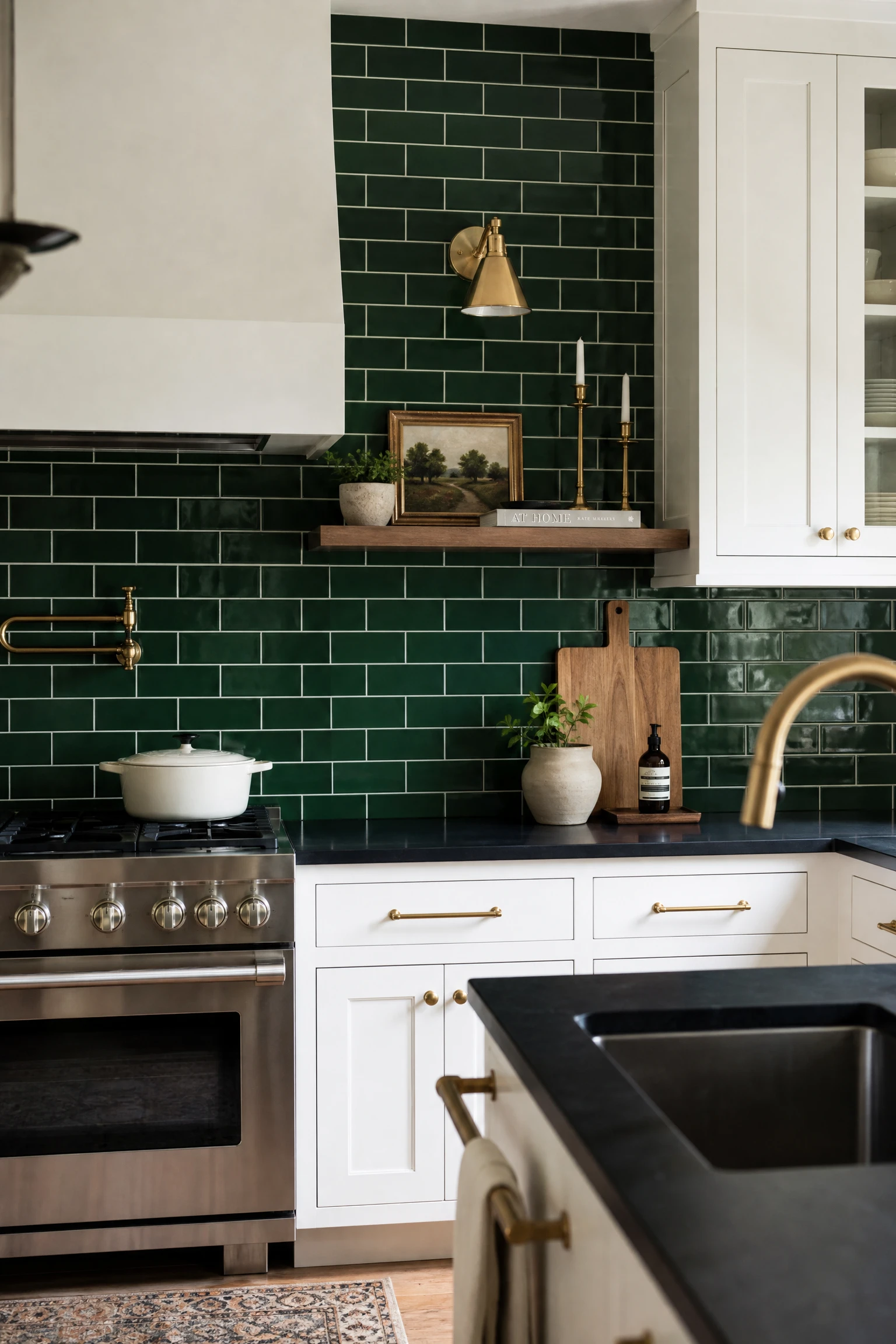
The backsplash in a white cabinet and black countertop kitchen is the element with the most freedom to introduce character, colour, and material interest because it sits between the two dominant tones and can bridge them, contrast with them, or extend one of them without disrupting the fundamental relationship between white above and black below. A white marble backsplash with grey veining connects the white cabinet colour to the black countertop through the tonal gradation of the marble. A cream zellige tile backsplash introduces warmth and artisanal texture between the clean white and the deep black. A forest green subway tile backsplash introduces a third colour that creates the most distinctive and most personally expressive kitchen from the white and black foundation. A matte black backsplash in the same material as the countertop creates the most graphic and most contemporary result: the black surface runs continuously from the countertop surface up the wall behind it, creating an unbroken dark zone that frames the white cabinetry with maximum visual weight.
Quick Tip: If the backsplash and the countertop are in the same black material, use a contrasting grout in the backsplash tile to prevent the surface from reading as a single flat mass. A white or light cream grout in a black tile backsplash creates a visible grid that adds texture and visual interest to the dark surface while maintaining the tonal connection to the black countertop below.
5. White Cabinets, Black Countertops, and Brass Hardware
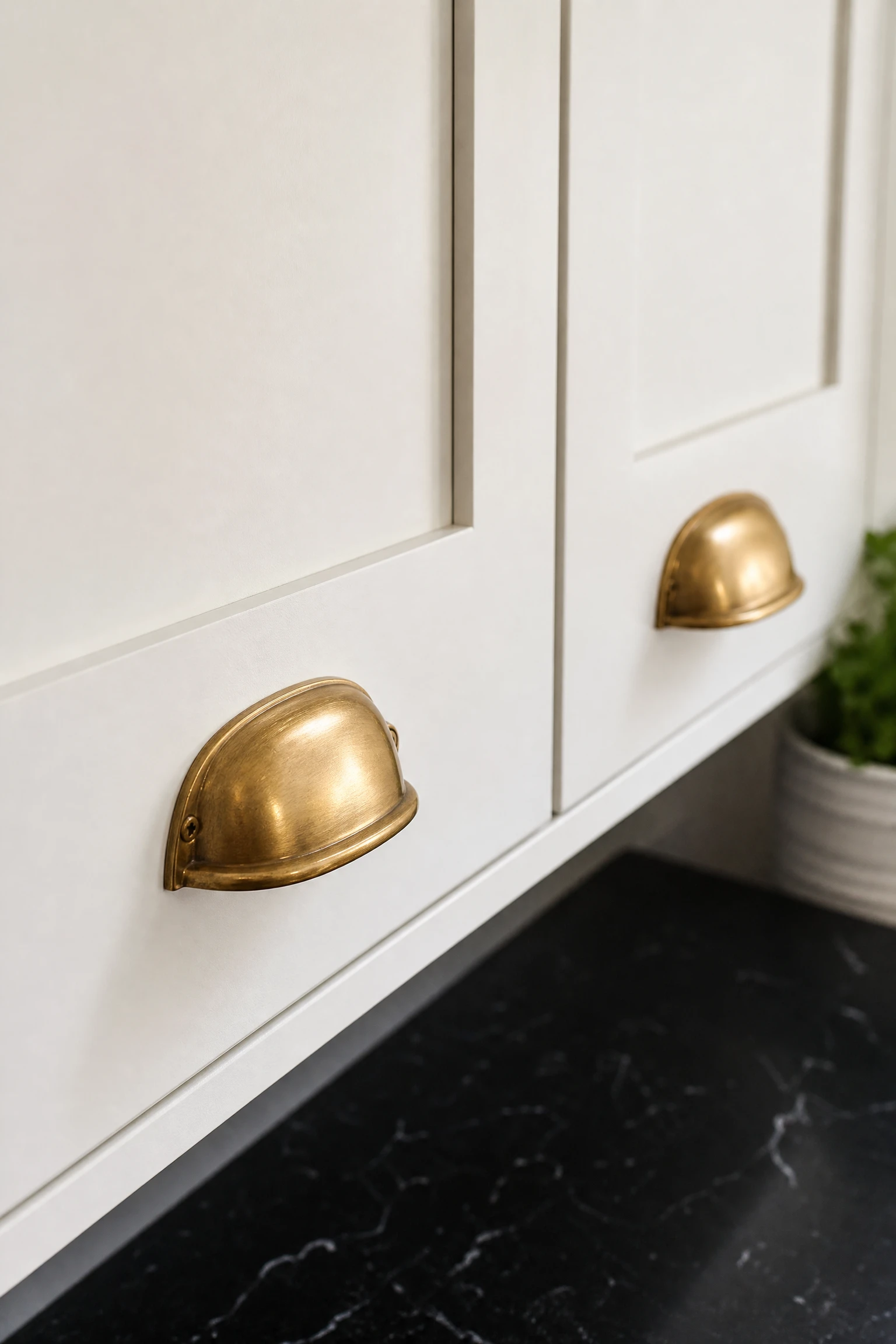
The hardware decision in a white and black kitchen is the choice that most directly affects whether the kitchen reads as warm or cold, contemporary or classic, graphic or rich. Brushed brass or aged brass hardware on white cabinet doors with black countertops introduces a warm metallic presence that bridges the cool contrast of white and black and shifts the palette from graphic design territory into something warmer, more considered, and more enduring. The specific brass finish matters: unlacquered or living brass develops a natural patina over time that deepens its warmth and creates a visual connection to the black countertop as both surfaces develop character through use. Brushed brass maintains a more consistent appearance. Polished or lacquered brass reads as more formal and more deliberate. All three are correct for different versions of the white and black kitchen, but the warmest and most enduringly satisfying is almost always the unlacquered or brushed version that ages naturally alongside the kitchen.
Reality Check: Brass hardware in a white and black kitchen is the element most likely to look dated if the specific finish or profile is too trend-specific. Avoid novelty hardware shapes and very specific period-revival profiles in favour of simple bar pulls, simple cup pulls, or simple knobs in a quality brass finish. Simple hardware in a quality material lasts longer stylistically and can be updated independently of the cabinetry if the direction of the kitchen changes.
6. Cream Cabinets With Black Countertop Island and White Perimeter
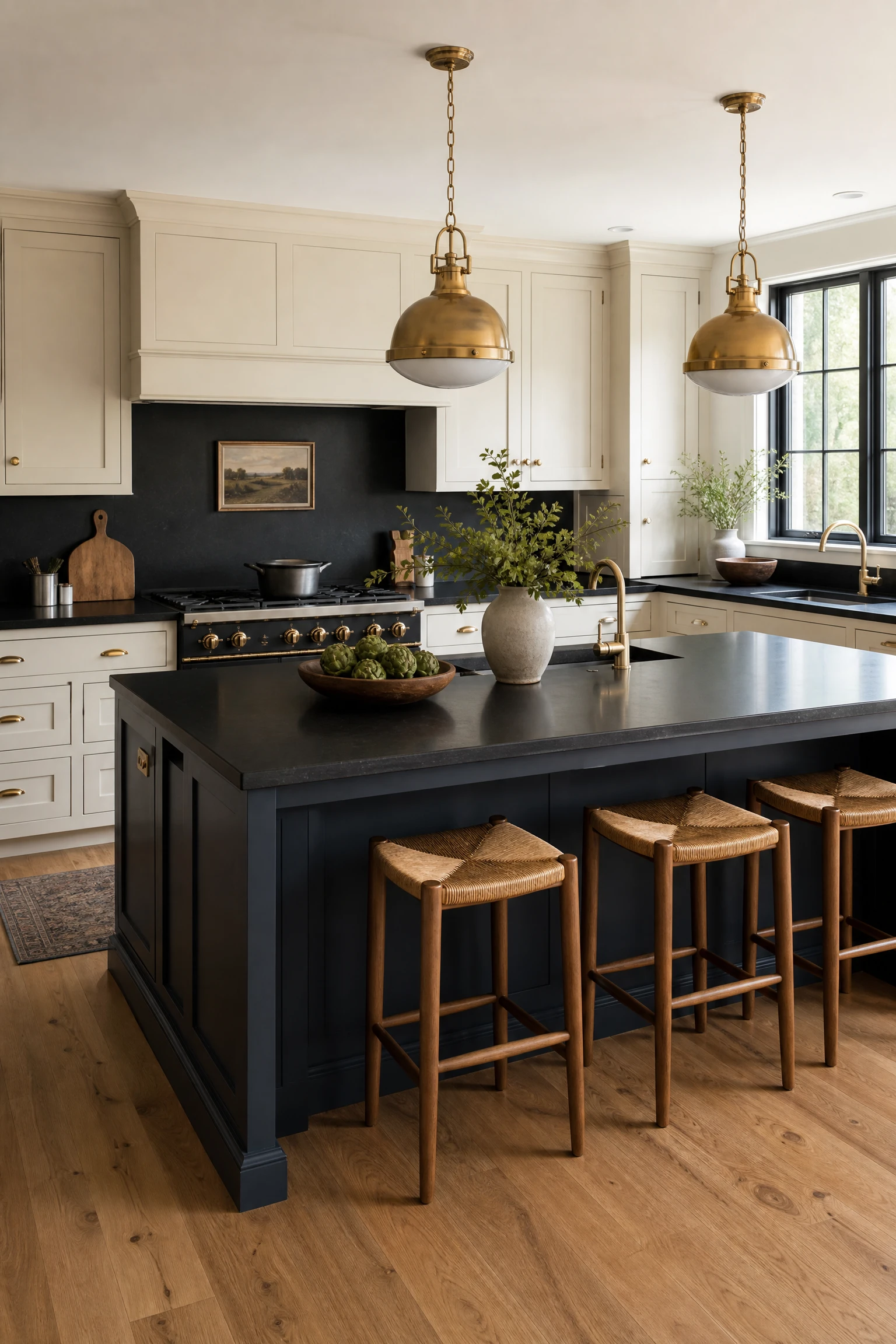
A two-tone approach where the perimeter kitchen cabinets are in cream or warm white and the island cabinets are in a deeper tone, whether charcoal, navy, or a warm forest green, with the black countertop consistent across both elements, uses the countertop as the visual link between the two cabinet colours rather than as a contrasting element against one. The black countertop surface at the same level across both the cream perimeter and the darker island creates a visual continuity that makes the kitchen read as a single designed space rather than two separate cabinet colours competing for attention. This is the most considered application of the two-tone kitchen trend because the matching countertop across both tones does the visual work of integrating the two cabinet colours.
Designer Advice: When using a matching black countertop across both elements of a two-tone kitchen, ensure the countertop material is genuinely from the same slab or the same production batch across the island and the perimeter. Slight differences in tone between two black countertop surfaces installed at the same time are dramatically more visible than the same variation between two lighter-toned surfaces, because the darkness of the black surface makes any tonal difference more apparent.
| Cabinet Colour | Black Countertop Mood | Best Hardware | Best Backsplash | Kitchen Style |
| Crisp white | High-contrast, graphic | Brass or matte black | White marble or black tile | Contemporary, transitional |
| Warm cream | Warm, rich | Brushed brass or antique gold | Zellige, handmade ceramic | Hamptons, traditional |
| Light wood (oak) | Organic, balanced | Brushed brass | Stone, cream tile | Scandi, farmhouse, warm modern |
| Dark walnut | Rich, layered | Aged brass or bronze | Dark stone, moody tile | Mid-century, eclectic |
| Navy blue | Bold, nautical, classic | Brass or chrome | White subway, marble | Classic, coastal, contemporary |
| Forest green | Botanical, distinctive | Brushed brass | Cream or stone | Boho, earthy, eclectic |
Natural Wood and Timber Tones With Black Countertops
Natural wood cabinets with black countertops create the most organically balanced version of the dark countertop kitchen because the warmth and grain of the timber provides a natural material counterpoint to the cool depth of the black surface. This is the combination that most consistently prevents a black countertop kitchen from feeling cold, industrial, or stark.
7. Light Oak Cabinets With Honed Black Quartz

Light oak or blonde timber cabinets with a honed black quartz countertop create the most Scandinavian-influenced and most immediately warm version of the black countertop kitchen because the pale honey tone of light oak and the soft matte quality of honed black quartz share a quality of considered, tactile materiality that suits a Nordic design aesthetic specifically and a broadly warm minimal aesthetic generally. The grain of the light oak cabinet face reads warmly alongside the flat, deep black of the matte quartz, and the contrast between the two surfaces is material rather than purely tonal: the warmth of the wood versus the coolness of the stone, the organic variation of the grain versus the precise flatness of the quartz surface. Hardware in brushed brass or a warm-toned brushed gold is the most natural complement, adding a third warm material that connects the oak and the countertop through a bridging metallic tone.
Pro Move: Pair light oak cabinets and black quartz countertops with a warm-white or cream backsplash tile rather than a bright white. The cool blue-white of standard bright white tile can fight the warmth of both the oak and the black quartz and make the kitchen read as colder than it actually is. A warm cream or ivory subway tile or a natural stone tile in a light fossil tone maintains the warmth of the material palette throughout the kitchen.
8. Warm Walnut Cabinets With Polished Black Granite

Warm walnut or dark-toned timber cabinets with a polished black granite countertop create the richest and most layered version of the natural wood and black countertop kitchen because both materials have depth, warmth, and complexity that reward close attention. The brown and amber tones of walnut and the deep reflective surface of polished black granite create a material combination that reads as genuinely rich: the wood is warm and organic, the granite is cool and precise, and the contrast between them creates the specific visual tension that makes this combination so striking in practice. Aged or unlacquered brass hardware adds the third warm metallic tone that prevents the combination from becoming too cool or too dark. A light or warm-cream backsplash provides the visual relief that both the dark wood and the dark stone need.
Heads Up: Polished black granite in a kitchen with natural timber cabinets requires more frequent cleaning than a honed or matte finish because the reflective surface shows every water mark, greasy fingerprint, and crumb with maximum visibility. In a household where the kitchen is cooked in daily and cleaned intermittently rather than immediately after use, a honed or leathered black granite surface is a more practical choice than polished, and delivers equal material beauty with considerably less maintenance anxiety.
9. Natural Timber Kitchen Island With Black Countertop and White Perimeter

In a kitchen where the perimeter cabinets are white or cream and the island is in a natural timber, using a black countertop consistently across both elements creates a kitchen where the timber island reads as a warm, material-rich centrepiece against the white perimeter, and the black countertop runs across both in a way that makes the kitchen read as a single, cohesive design decision. The natural timber of the island base introduces warmth and organic material quality at the centre of the kitchen, the white perimeter maintains brightness and openness around the edges of the room, and the continuous black countertop top surface ties both elements together horizontally. This is the most design-forward version of the two-tone kitchen and one of the most widely referenced combinations in current kitchen design because it solves the visual challenge of using two different cabinet materials at the same level without making the kitchen look like two separate kitchens placed next to each other.
Quick Tip: Choose an island timber that is warm in tone but not too similar to the kitchen floor. A very pale oak island base in a kitchen with pale oak flooring creates a visual blending where the island disappears into the floor rather than floating above it as a distinct furniture piece. A slightly darker or more golden timber on the island creates the distinction needed for the island to read as a separate element within the kitchen rather than an extension of the floor.
10. Bamboo or Pine Cabinets With Black Matte Countertop

Lighter softwoods and bamboo, whether in their natural pale tones or with a light oil or wash treatment, create the most affordable and most relaxed version of the natural wood and black countertop kitchen. Bamboo specifically has a regularity of grain and a pale, slightly green-tinged warmth that suits a matte black countertop in a kitchen going for an eco-conscious, natural, and contemporary aesthetic. Pine with a light wax treatment has a knottier, more characterful grain that suits a farmhouse or cottage-style kitchen with a black countertop in a matte or leathered stone finish. Both materials are significantly more affordable than oak or walnut, and the combination of a budget-friendly cabinet material with a quality black countertop surface inverts the typical design hierarchy in a way that can produce surprising and genuinely distinctive results.
Reality Check: Lighter softwoods including pine and bamboo are more susceptible to marking, denting, and general wear than hardwoods like oak and walnut. In a kitchen with heavy daily use, light-toned softwood cabinets may develop dings and surface marks more readily than hardwood alternatives. A protective hard wax oil finish on softwood cabinets applied at installation and maintained annually reduces this vulnerability without changing the appearance of the natural timber.
Dark and Two-Tone Cabinets With Black Countertops
Dark cabinets with black countertops create the most committed and most dramatically bold version of the dark kitchen. Done well, this combination creates a kitchen that feels genuinely well-considered. Done poorly, it creates a kitchen that feels oppressive and poorly lit. The difference lies entirely in the quality of the lighting and the inclusion of at least one warm material element within the dark palette.
11. Charcoal Gray Cabinets With Black Countertops
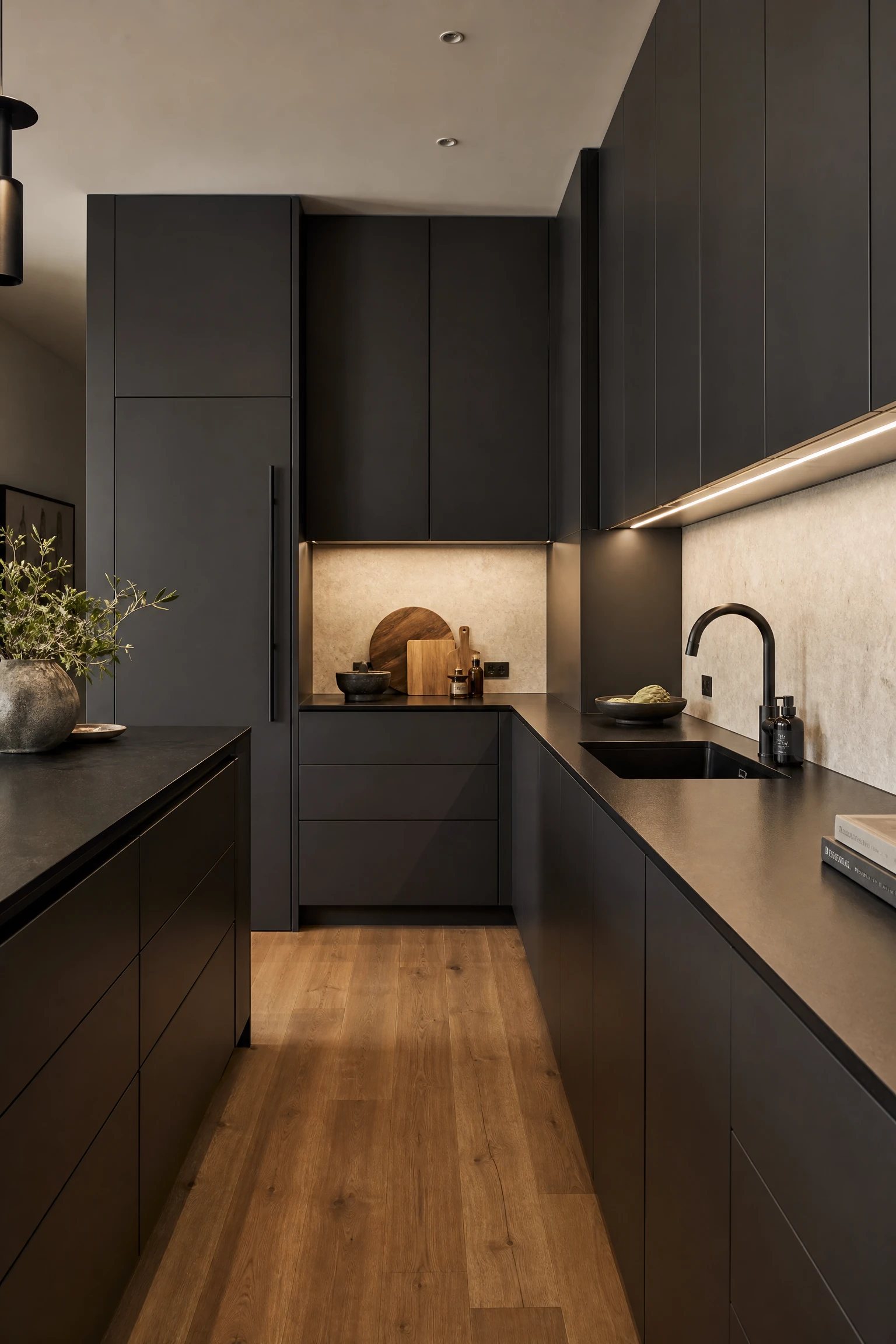
Charcoal gray cabinets with black countertops create a tonal kitchen where the distinction between the cabinet and countertop colours is visible but not contrasting, and the result reads as a considered monochromatic composition rather than a high-contrast two-tone arrangement. The charcoal cabinets sit one shade lighter than the black countertop surface, creating a depth gradient that moves from the lighter charcoal on the vertical cabinet faces through to the darkest horizontal countertop surface. This approach requires good lighting and at least one warm element to prevent it from reading as a grey and black exercise in austerity rather than a genuinely designed kitchen. Warm timber flooring, a cream or light stone backsplash, brass hardware, and warm-toned pendant lighting above the island all provide the warmth that the monochromatic dark palette needs.
Designer Advice: In a charcoal and black kitchen, under-cabinet LED lighting is not optional. Without it, the transition zone between the dark cabinets and the dark countertop is the darkest area in the kitchen, which is also the primary food preparation surface. Under-cabinet LED strips in warm white at 3000K illuminate the countertop surface from above the sight line and create a warm glow that separates the cabinet from the countertop visually and makes the food preparation zone genuinely usable.
12. Navy Blue Cabinets With Black Granite Countertops
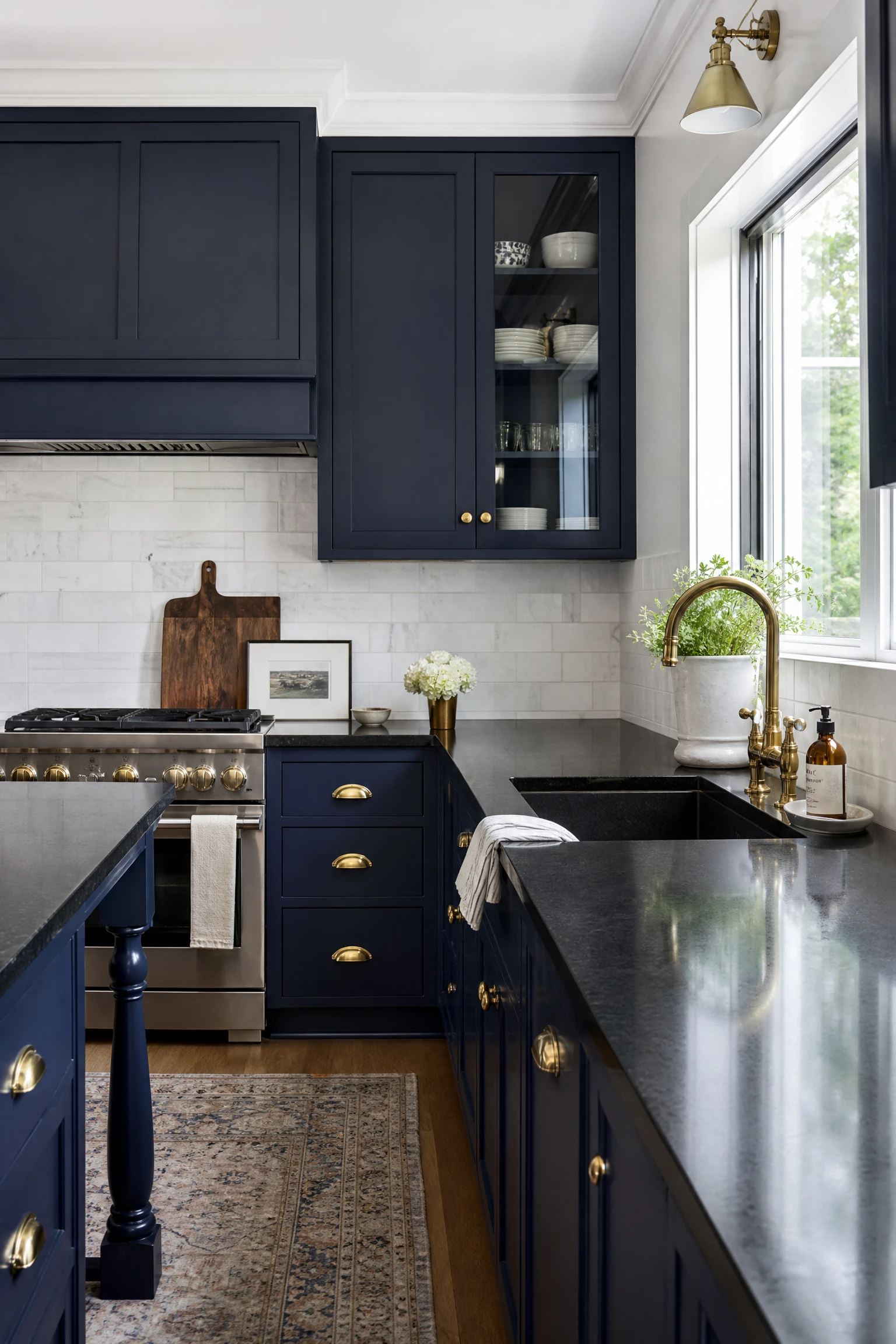
Navy blue cabinets with black granite or quartz countertops create the most classic and most widely appealing version of the dark cabinet and dark countertop kitchen because the deep blue of navy introduces a colour presence alongside the black that prevents the kitchen from reading as purely monotone dark. The distinction between navy and black is visible at the cabinet-to-countertop junction and creates a clear material boundary that defines the horizontal countertop as a separate and specific design element rather than a tonal continuation of the cabinet colour. This combination has a specific luxury quality associated with high-end kitchen design and yacht or maritime interiors, and it suits kitchens that want to feel both contemporary and considered. Brass or polished gold hardware and a white or light stone backsplash are both practically necessary to prevent the navy and black from becoming a dark, flat environment that reads as oppressive rather than moody.
Pro Move: In a navy and black kitchen, keep the ceiling and upper wall areas in a crisp warm white to create a strong visual lift above the dark cabinet and countertop zone. A white ceiling that continues down to the top of the upper cabinets creates a clear boundary between the dark lower kitchen and the bright upper room and prevents the dark palette from reading as enclosed and heavy in the vertical plane.
13. All-Black Kitchen: Cabinets and Countertops
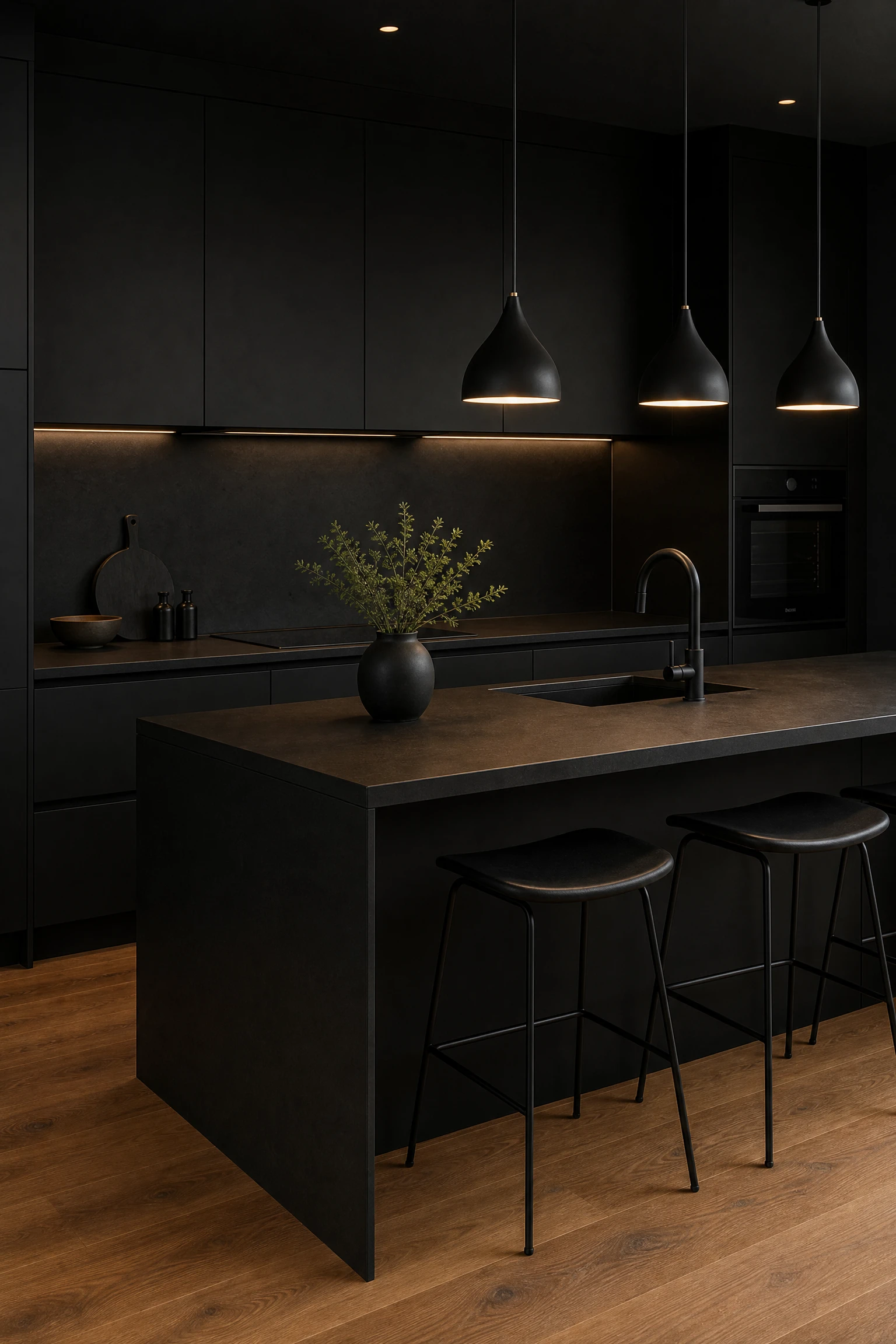
A fully black kitchen, where the cabinets, countertops, backsplash, and appliances are all in black or near-black tones, is the most committed and most architecturally specific version of the dark kitchen and the one that requires the most careful planning of lighting and material contrast to succeed. In a well-lit kitchen with good natural light and carefully planned warm artificial lighting, a fully black kitchen creates a dramatic, gallery-like environment where the food, the cookware, and the people in the kitchen become the visual focal points rather than the kitchen surfaces themselves. The material distinction between surfaces matters enormously in a fully black kitchen: a matte black cabinet alongside a honed black countertop alongside a black matte tile backsplash reads as three distinct surfaces in the same colour family because of the different light behaviour of each material. Without those material distinctions, a fully black kitchen reads as a flat, undifferentiated dark environment.
Heads Up: A fully black kitchen in a home with children or pets, or in a household where cleanliness is managed on a daily rather than immediate basis, will show grease, fingerprints, crumbs, and dust more dramatically than any other kitchen colour. The dark surfaces amplify every surface deposit and require more frequent and more thorough cleaning to maintain the dramatic, editorial quality that makes the all-black kitchen so visually compelling. Be honest about your cleaning habits before committing to this palette.
14. Two-Tone: Dark Lower Cabinets and White Upper Cabinets With Black Countertops
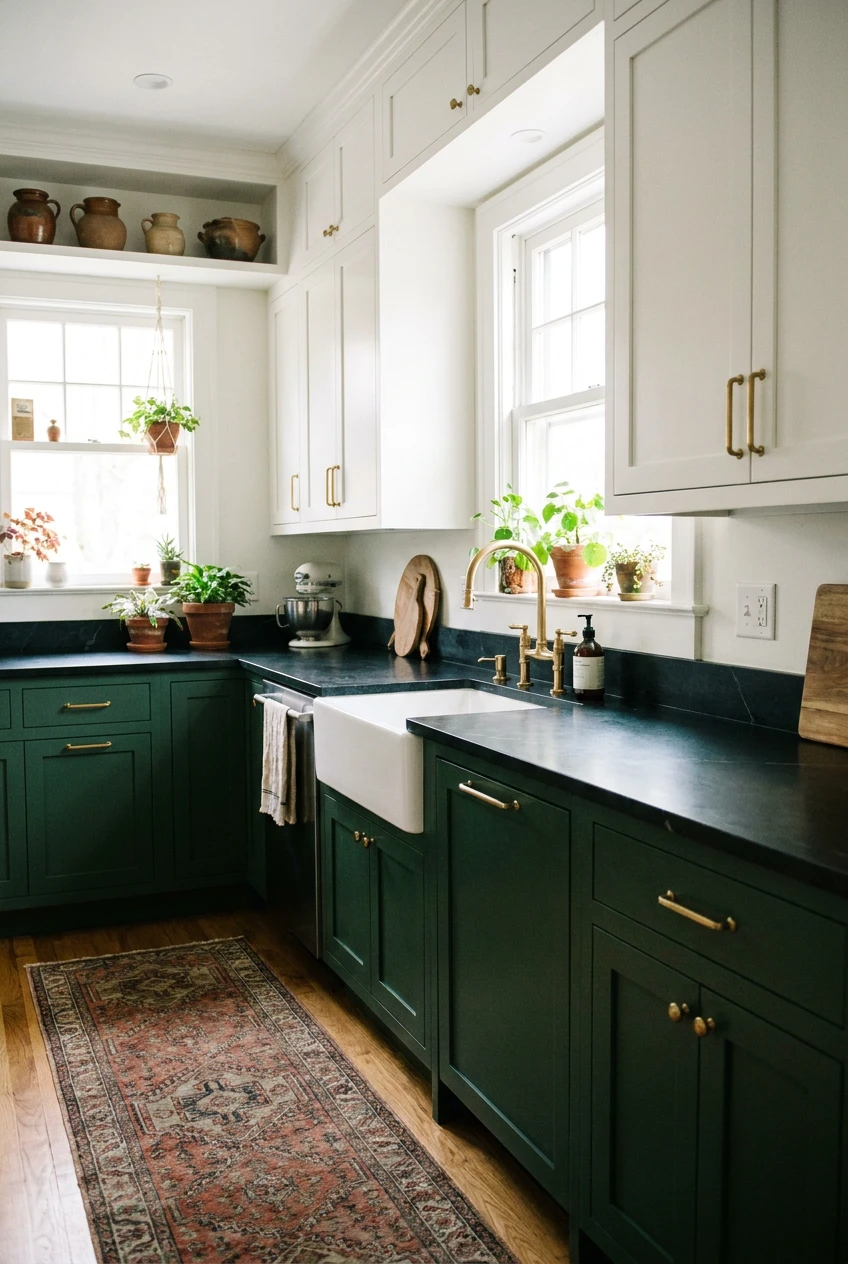
The most popular two-tone kitchen arrangement in current design pairs dark lower cabinets with white or cream upper cabinets and uses the black countertop as the horizontal divide between the two tones. The black countertop surface at the transition point between the dark lower and the white upper creates a strong, clean horizontal line that makes the two-tone division read as a deliberate design decision rather than a budget compromise. The dark lower cabinets ground the kitchen with visual weight, the white upper cabinets maintain brightness at eye level and above, and the black countertop defines the junction between the two zones with maximum precision. Navy, forest green, charcoal, and even deep burgundy all work as the lower cabinet colour in this arrangement. The countertop connection between the two means the specific colour of the lower cabinet is less critical than its depth: the lower cabinet needs to be significantly darker than the upper cabinet for the visual logic of the arrangement to read clearly.
Quick Tip: Use the same hardware finish across both the dark lower and the white upper cabinets rather than different hardware for each tone. Consistent hardware across the full kitchen makes the two-tone arrangement read as a single designed composition. Different hardware on each tone makes the kitchen look as though the two halves were designed separately and assembled in the same room.
“A black countertop does not make a kitchen dramatic. The cabinet colour it is paired with makes a kitchen dramatic. The countertop simply decides whether that drama reads as warm or cool, light or heavy, classic or contemporary.”
Coloured Cabinets With Black Countertops
Black countertops are one of the best possible foundations for coloured kitchen cabinets because the dark horizontal surface makes every cabinet colour appear more vivid, more saturated, and more confident than the same colour alongside a white or pale countertop. This group covers the most distinctive and most personally expressive kitchen combinations available with black countertops.
15. Forest Green Cabinets With Black Countertops
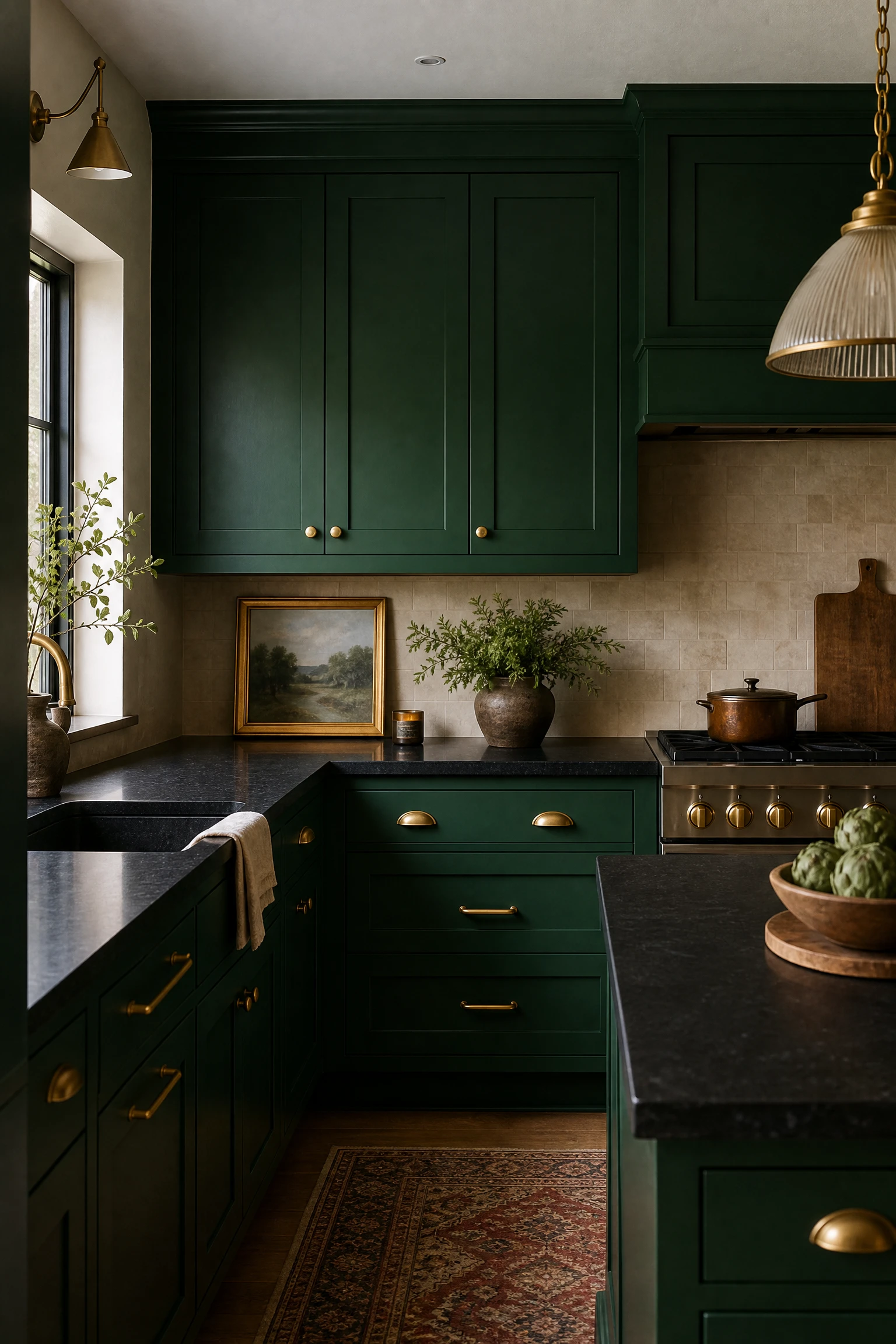
Forest green cabinets with black countertops is arguably the most visually extraordinary coloured cabinet and black countertop combination available because the deep botanical green and the dark horizontal black create a palette that is simultaneously richly coloured and deeply grounded. The black countertop does not compete with the forest green cabinet colour: instead it absorbs the colour into the horizontal plane in a way that makes the green read as the primary palette decision and the black as its natural shadow. Brass hardware is the essential companion for this combination because the warm gold of brass connects the organic warmth of the forest green to the neutral depth of the black in a way that chrome or matte black hardware cannot. A cream or light stone backsplash maintains the brightness needed to prevent the green and black from reading as too dark.
Designer Advice: Forest green cabinet paint in a kitchen needs to be in a fully saturated, confident tone rather than a muted or dusty version of the colour. A desaturated or grey-green cabinet alongside a black countertop can lose its identity and read as simply a darker neutral rather than a genuine colour choice. The green needs to be present and specific enough to create a real visual relationship with the black countertop and the brass hardware rather than blending into the dark palette.
16. Sage Green Cabinets With Black Countertops
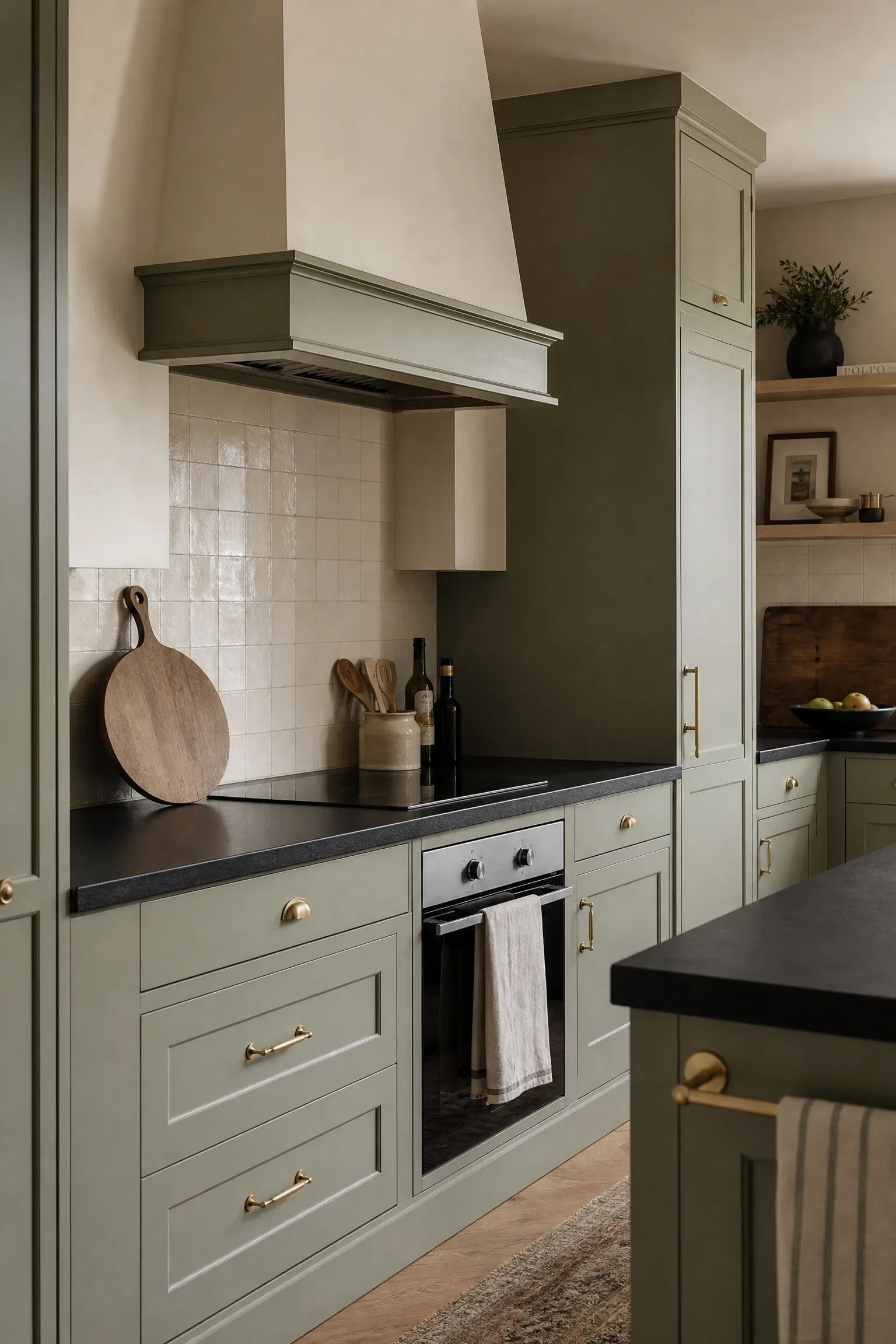
Sage green cabinets with black countertops create a softer and more approachable version of the green and black kitchen because sage sits in the grey-green territory where the colour reads as both warm and cool simultaneously. The black countertop alongside sage cabinets creates a combination that reads as calm and considered rather than bold and graphic, and the overall effect is more spa-like than dramatic. Brushed brass hardware and a cream backsplash tile suit sage and black, as does a light stone tile that shares the warm grey-green quality of the sage. This combination works in smaller kitchens where a more fully saturated colour like forest green would be too dominant, and in kitchens where a calmer, more organic atmosphere is the goal rather than a strong design statement.
Reality Check: Sage green cabinet paint changes significantly in different light conditions. Under cool artificial light, sage can read as slightly grey or slightly blue-grey. Under warm artificial light, the same sage reads as warmer and more genuinely green. Under natural daylight, sage reads most accurately as the warm grey-green it is at its best. Test sage cabinet samples under every light condition in the specific kitchen before committing, particularly if the kitchen has primarily artificial or north-facing natural light.
17. Navy Blue Perimeter With Black Island Countertop
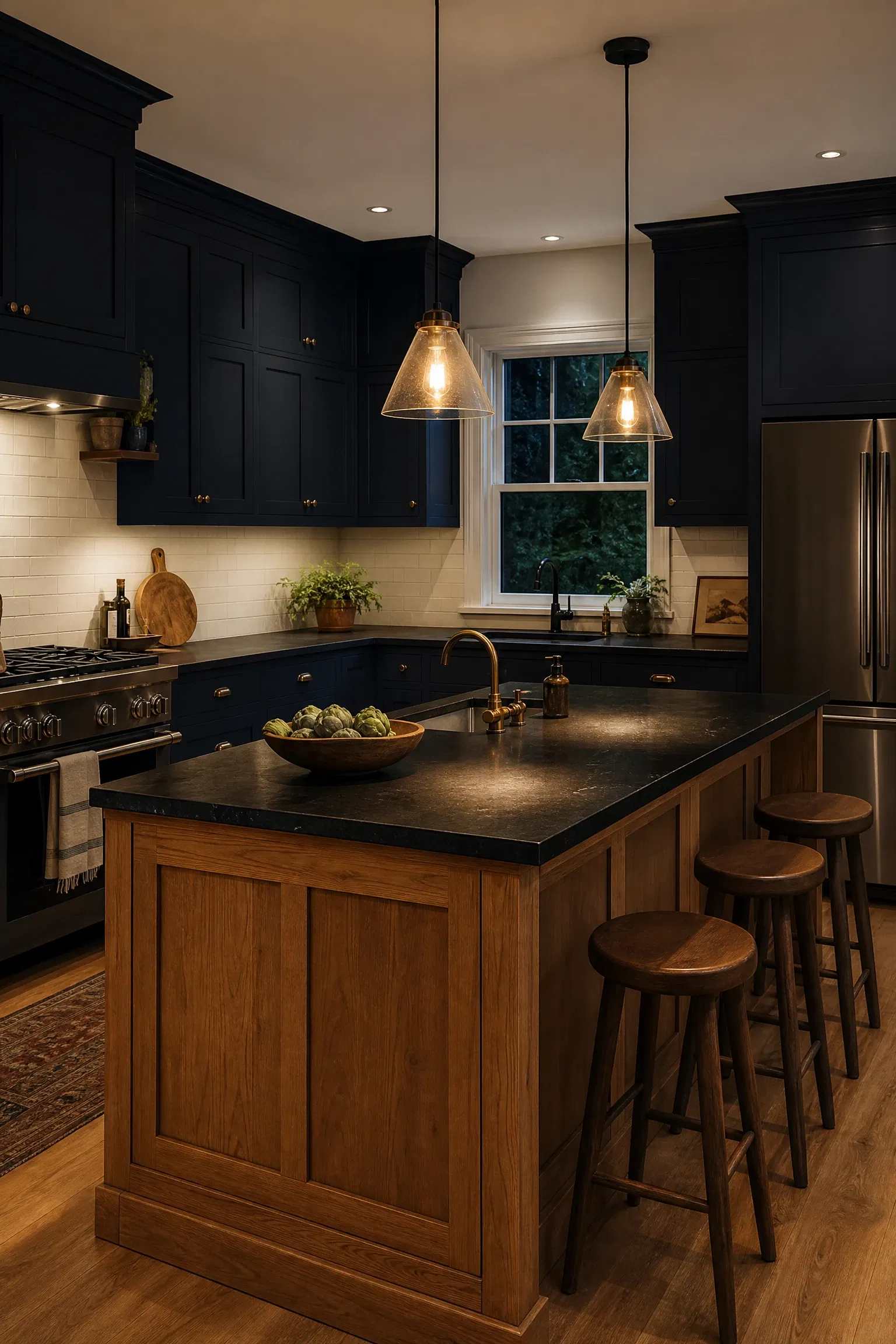
Navy perimeter cabinets alongside a matching black countertop on both the perimeter and a lighter or contrasting island creates one of the most architecturally resolved and most hotel-like kitchen combinations available. The navy perimeter with black countertop creates the primary dark, considered backdrop of the kitchen, and the island in a contrasting material, natural timber, warm cream, or even a lighter grey, with the same black countertop surface, creates the functional centrepiece that connects both elements through the shared countertop level. This arrangement suits open-plan kitchens where the navy and black perimeter creates a clearly defined kitchen zone against the lighter adjoining living or dining space, and where the island provides the warm, accessible centre that makes the dark perimeter feel inviting rather than excluding.
Pro Move: In a navy perimeter and black countertop kitchen, position pendant lights above the island at a height low enough to cast warm light directly onto the black countertop surface. The reflection of warm pendant light on a black countertop creates a visual warmth and a sense of depth in the countertop surface that overhead lighting at ceiling height never achieves. This is the specific lighting move that makes kitchen photographs of dark countertops look so extraordinary and that is most often missing from the real installations.
18. Terracotta or Warm Orange Cabinets With Black Countertops

Terracotta or warm burnt orange cabinets with black countertops create the most unexpected and most energetically warm version of the coloured cabinet and black countertop kitchen. Terracotta is the complementary colour to the cool, slightly blue quality of deep black, which means the two colours sit at maximum colour distance from each other and create a contrast that is vivid and warm rather than stark and cool. In practice, a terracotta cabinet kitchen with a black countertop reads as genuinely joyful and confidently personal in a way that no neutral or cool-toned cabinet colour achieves alongside black. Warm brass hardware in an aged or brushed finish, a cream or natural stone backsplash tile, warm timber flooring, and abundant natural light are all required companions to make this combination work at its warmest and most liveable.
Quick Tip: Terracotta and black is a strong, specific colour combination that suits a kitchen with a confident, personality-led design direction. If the rest of the home is in neutral, restrained tones, a terracotta and black kitchen will read as a bold departure rather than a cohesive continuation of the home palette. Consider how the kitchen palette connects to the adjoining spaces before committing to a very strong cabinet colour.
19. Dusty Blue or Powder Blue Cabinets With Black Countertops

Dusty or powder blue cabinets with black countertops create a kitchen that reads as both vintage-influenced and completely contemporary, because the muted, soft-toned quality of dusty blue has an inherently nostalgic quality that the black countertop dark precision updates and makes current. The contrast between the light, slightly faded blue and the deep black creates a combination with a genuine visual depth that neither element has on its own. Aged brass or antique brass hardware in this context feels perfectly appropriate: the warmth and slight oldness of antique brass connects the vintage-influenced blue with the contemporary black in a way that chrome or modern hardware does not. A white or cream backsplash tile, or a simple white subway tile with a warm off-white grout, maintains the brightness of the kitchen without competing with the specific blue and black combination.
Heads Up: Dusty or powder blue cabinet paint, particularly in lighter saturations, can fade in direct sunlight over time. In a kitchen with strong direct southern or western sun hitting the cabinet faces, choose a paint specifically formulated for durability and UV resistance, or accept that the cabinets will lighten and shift in tone over years of sun exposure. Many homeowners find the aged, slightly faded quality of sun-affected cabinet paint enhances the vintage character of this specific colour combination rather than diminishing it.
Black Countertop Material and Finish Ideas
The specific material and finish of the black countertop determines its maintenance requirements, its tactile quality, its light behaviour, and the specific depth and movement of colour it delivers. These ideas address the countertop material decision specifically rather than the cabinet pairing.
20. Honed Black Granite: The Most Forgiving Everyday Black
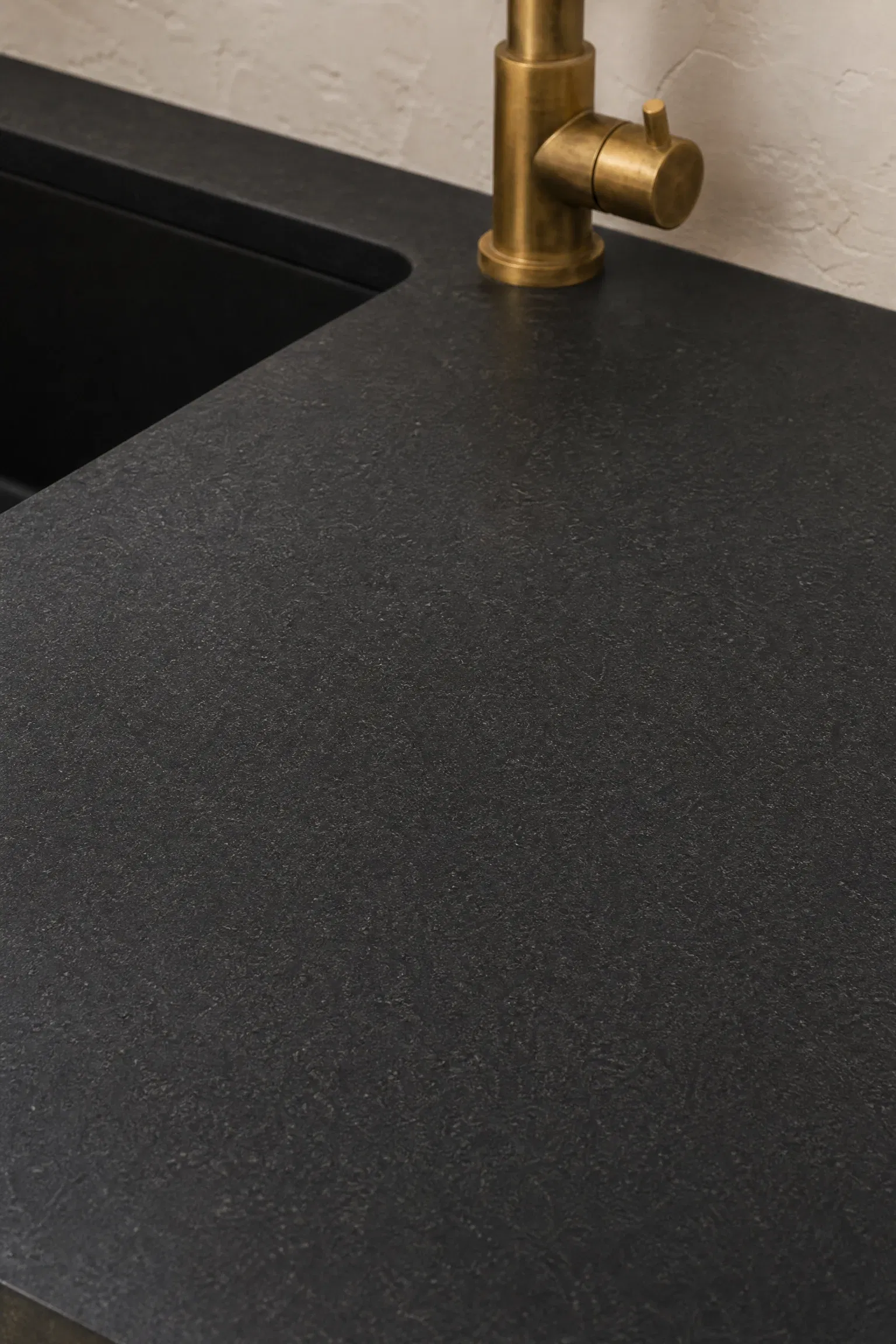
Honed black granite, achieved by stopping the polishing process at the matte stage rather than taking it to a high shine, is the most practical and most liveable of all the black countertop materials for a kitchen used daily by a household that is not willing to commit to aggressive maintenance. The matte surface of honed granite does not show fingerprints or water marks with the unforgiving clarity of polished granite, and the slight surface texture of the honed finish gives the stone a tactile warmth that polished surfaces lack. Honed black granite also does not need sealing as frequently as polished granite, because the honed surface is slightly more resistant to surface moisture penetration than the ultra-smooth polished version. The colour of honed black granite is slightly softer and slightly less deep than the same stone polished, because the matte surface absorbs rather than reflects the light, but this quality is in most cases an advantage rather than a compromise.
Pro Move: Ask for a leathered finish option when specifying black granite for a kitchen. A leathered finish takes the granite surface beyond honed to a very slightly textured surface that emphasises the natural grain of the stone. Leathered black granite has even better fingerprint and water mark resistance than honed, and the texture of the surface creates a material richness that honed does not quite achieve. It is available from most quality stone suppliers and costs approximately the same as honed.
21. Black Quartz: The Low-Maintenance Black
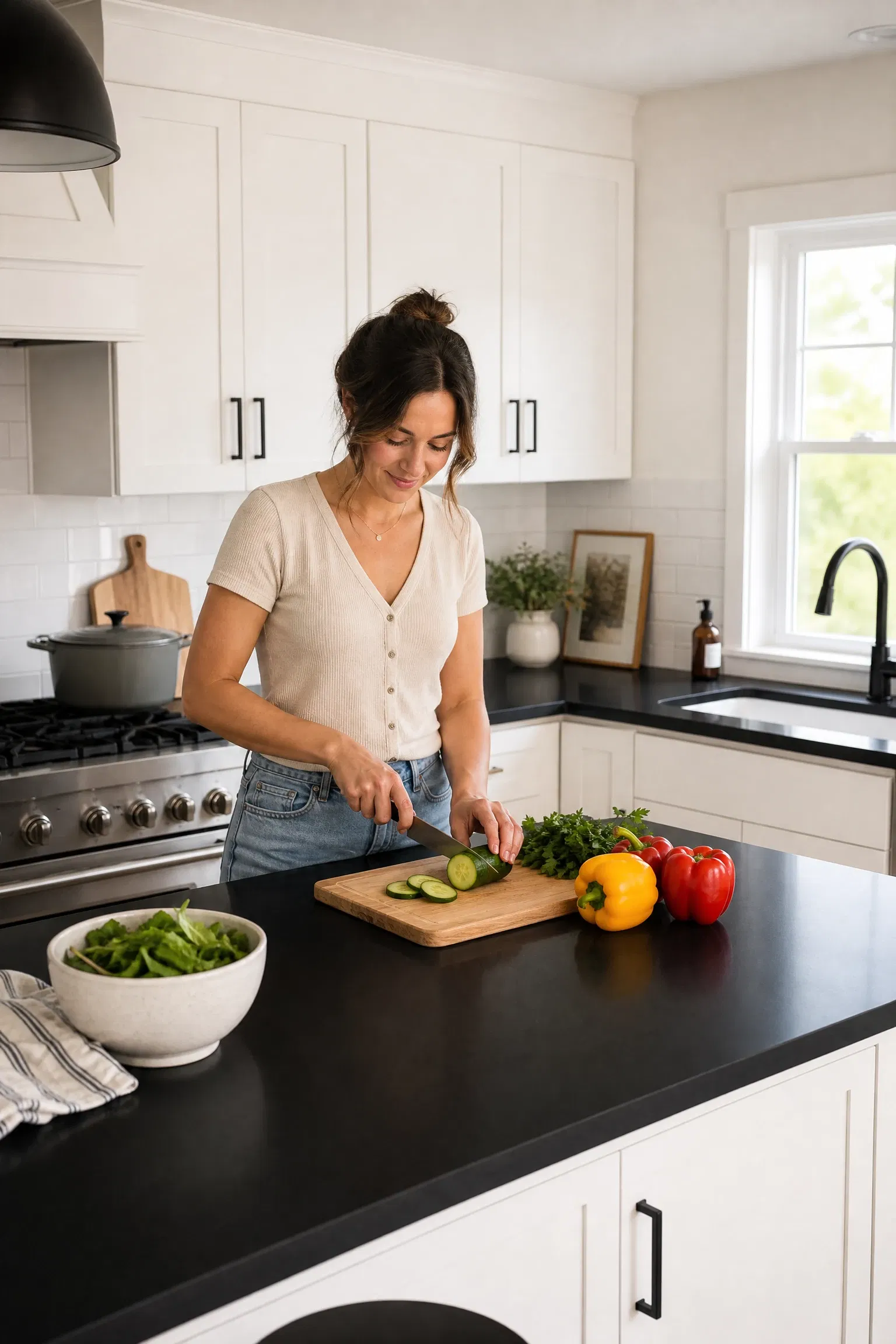
Black engineered quartz, available from suppliers including Silestone, Caesarstone, Cosentino, and multiple other manufacturers, is the most practical black countertop material for everyday kitchen use because it is non-porous, requires no sealing, is highly resistant to staining, and is available in a consistent colour and pattern that allows perfectly matched slabs across multiple sections of the kitchen without the natural variation of stone. Solid matte black quartz in particular has a visual quality very close to honed black granite at a similar or slightly lower price point and with significantly lower maintenance requirements. The specific black quartz products that most closely replicate the appearance of natural black stone include Silestone Eternal Marquina, Caesarstone Blackened Steel, and Cosentino Silestone Loft Poblenou. All provide the deep, considered quality of a black stone countertop with the practical simplicity of an engineered surface.
Reality Check: Black quartz, like all quartz countertops, is not heat-resistant in the same way as natural stone. Placing very hot pans directly from the hob or oven onto a quartz countertop can cause thermal shock that damages the resin binder in the engineered surface. Always use a trivet or heat pad between hot cookware and a quartz countertop regardless of the countertop colour.
22. Black Marble: The Luxury Black With Character
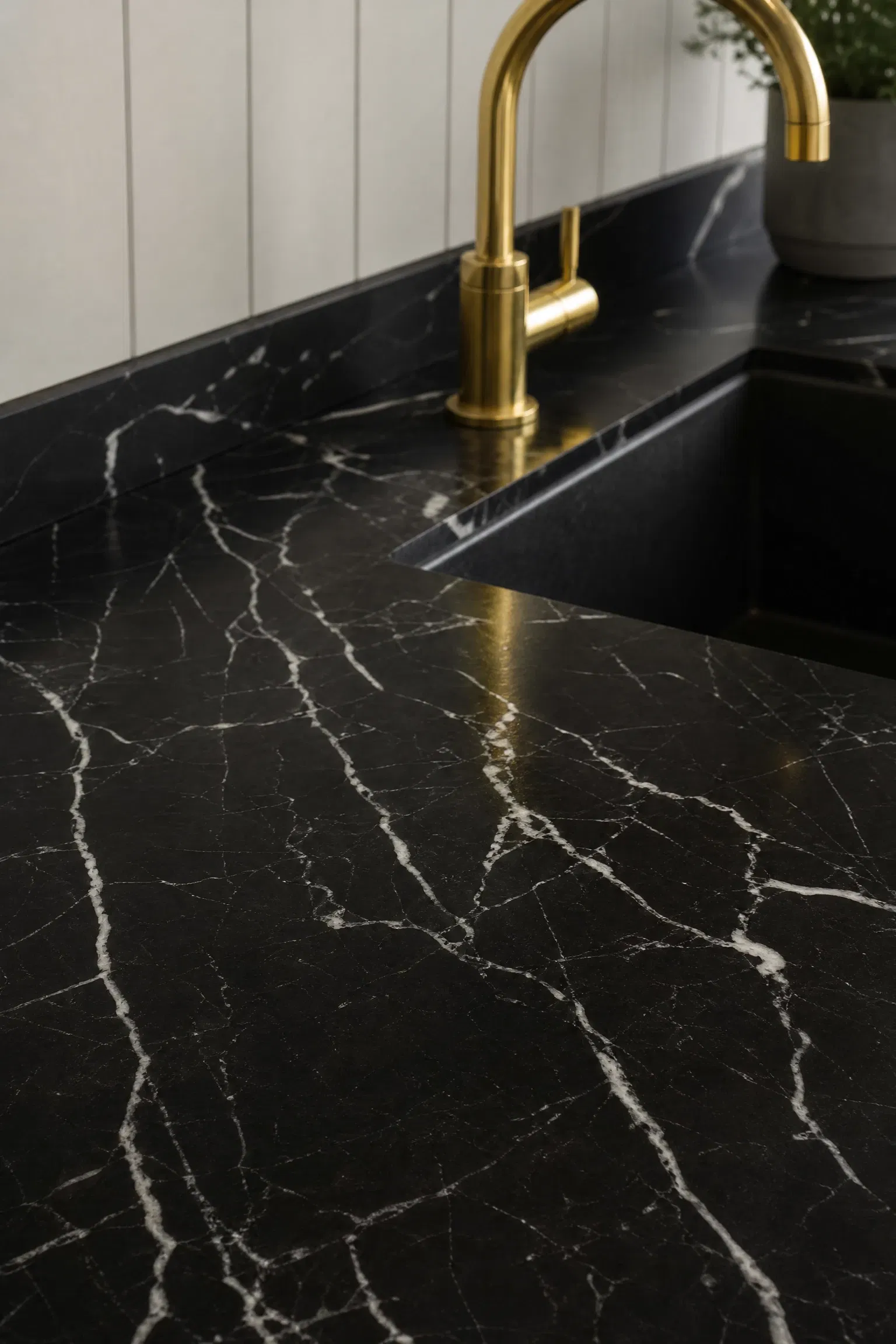
Genuine black marble, whether in the distinctive white-veined Nero Marquina, the gold-veined Black Forest marble, or the silver-grey-veined Portoro, is the most visually extraordinary and most high-maintenance black countertop material available. The veining in black marble creates a surface with an inherent visual complexity and a material richness that no engineered alternative replicates, and in a kitchen with white or cream cabinets, the white or gold veining of a black marble countertop creates a visual focal point of genuine luxury that sets the kitchen apart from any standard interpretation of the white and black kitchen. The honest maintenance note is important: black marble, like all marble, is porous and susceptible to etching from acidic kitchen substances including lemon juice, vinegar, wine, and tomato. It requires sealing on installation and regular resealing, and the daily cooking activities of a working kitchen will inevitably leave light etch marks on a marble surface that accumulate over time. Homeowners who accept the developing patina of a marble surface, treating the etch marks and stains as a record of the kitchen in use, are the right audience for black marble. Those who want a perpetually pristine surface are not.
Designer Advice: Request a honed rather than polished finish for any genuine black marble kitchen countertop. Honed black marble shows etching and marks significantly less clearly than polished black marble because the matte surface does not create the light contrast between an etched area and an undamaged area that the reflective polished surface shows immediately. A honed Nero Marquina or Portoro countertop is one of the most beautiful surfaces available in a kitchen and is considerably more liveable than the polished version of the same stone.
23. Black Soapstone: The Warmest Black
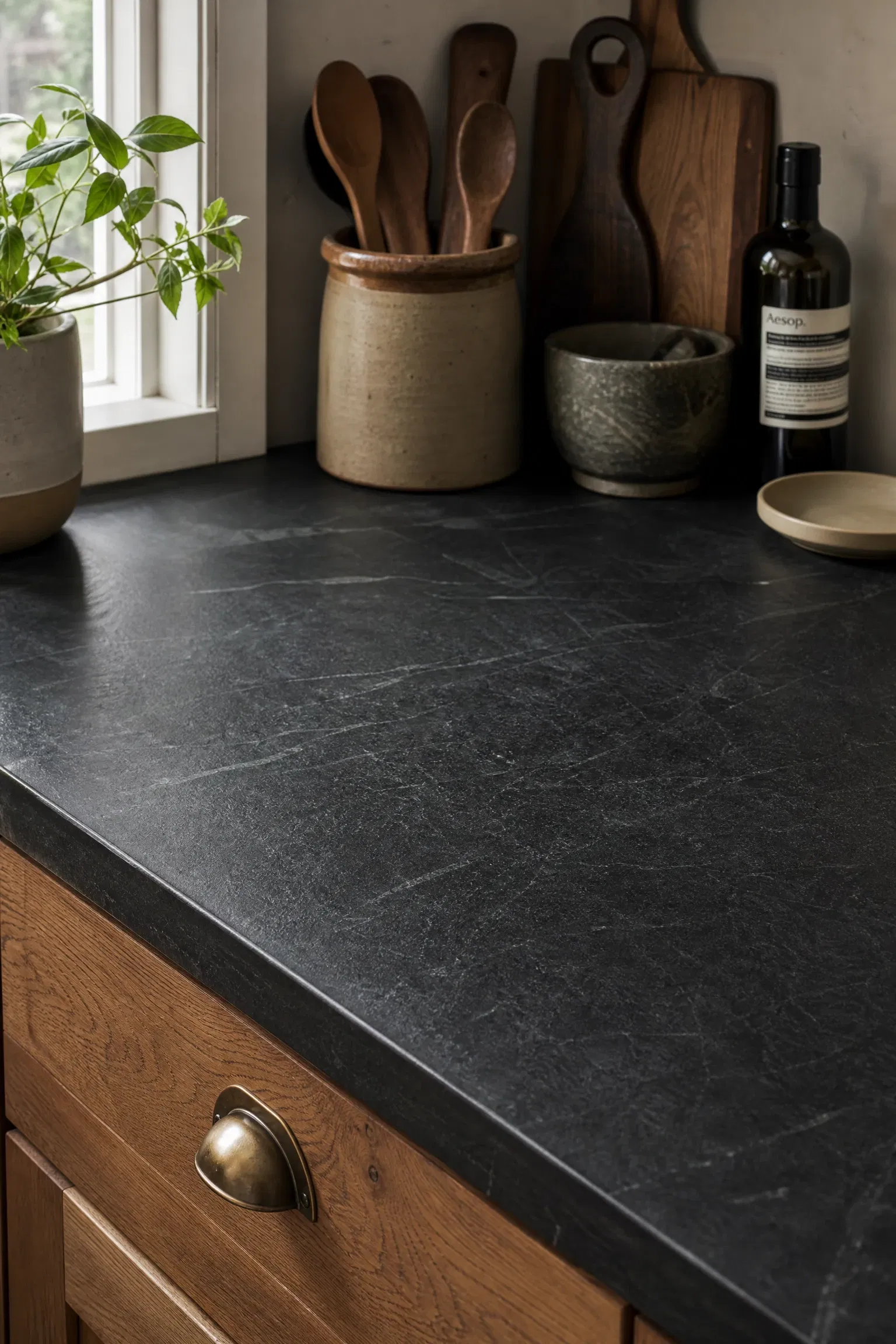
Soapstone is the warmest and the most tactile of all the black countertop materials because its naturally smooth, slightly soft surface is warm to the touch in a way that granite, quartz, and marble are not. Genuine soapstone, which is quarried primarily in Brazil, the United States, and Finland, has a naturally dark grey to near-black colour that deepens over time with regular treatment with mineral oil. The oiling process that maintains soapstone and deepens its colour is something many soapstone enthusiasts come to enjoy as a ritual of maintaining the material relationship with their kitchen surface. Scratches on soapstone can be sanded out with fine sandpaper and re-oiled, which makes it one of the most repairable natural stone surfaces available. Soapstone is also naturally non-porous and completely resistant to acid etching, which makes it significantly more forgiving in daily cooking use than marble.
Quick Tip: Apply food-grade mineral oil to a new soapstone countertop weekly for the first month, then monthly thereafter. The oil does not seal the surface in the way that granite sealer works, but it accelerates the natural darkening process and creates the rich, deep black tone that makes aged soapstone so beautiful. Untreated soapstone will darken naturally with use over time, but regular oiling in the early months achieves the same depth in weeks rather than years.
24. Black Dekton or Sintered Stone: The Most Durable Black
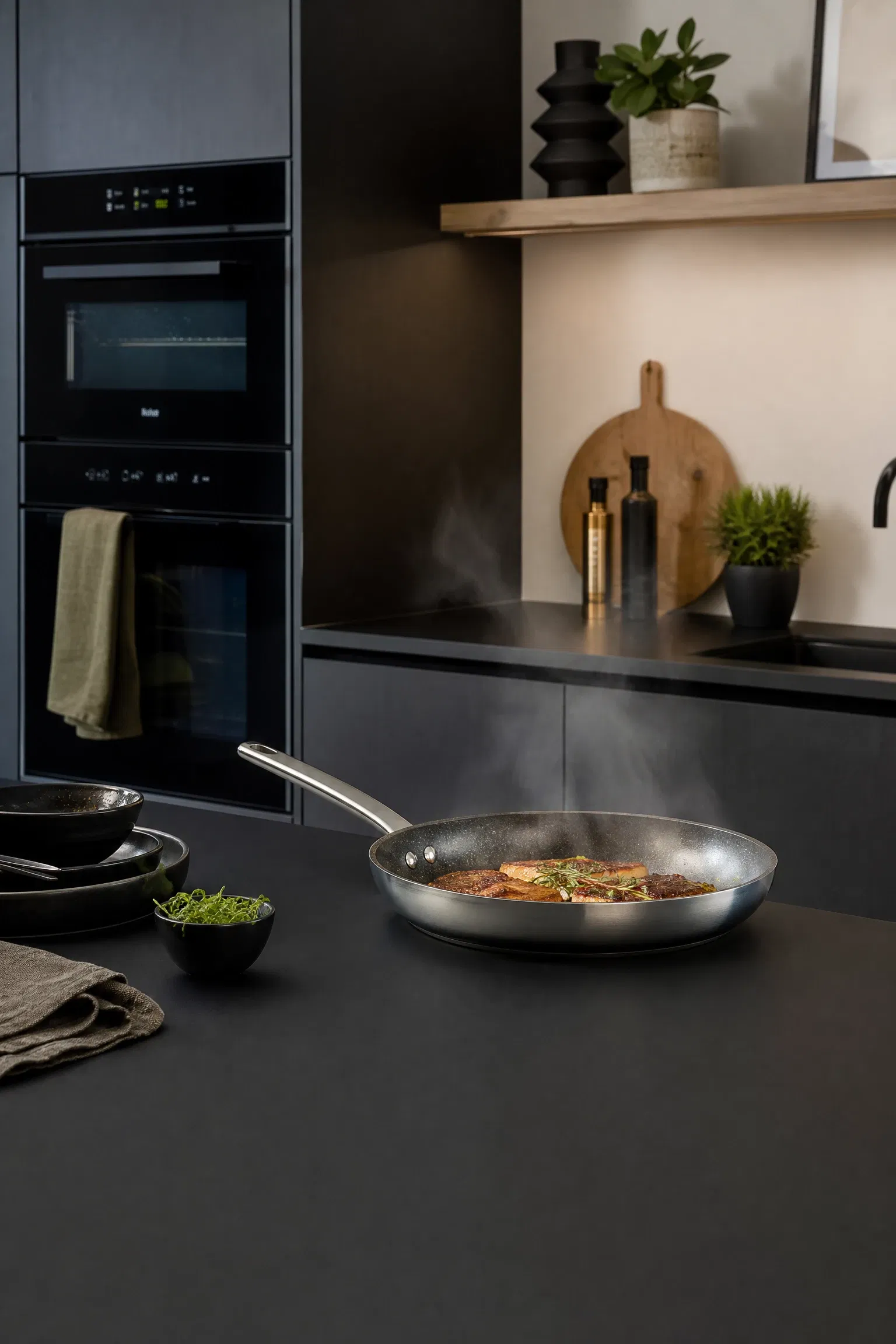
Sintered stone surfaces including Dekton by Cosentino and Neolith by TheSize are the most technically durable black countertop materials available, made through a process that subjects a mixture of natural minerals to extreme heat and pressure to create an ultra-compact surface that is non-porous, scratch-resistant, UV-resistant, and capable of withstanding direct contact with very hot cookware without damage. Dekton in particular is available in a wide range of black and near-black tones with varying degrees of surface movement, from the solid matte black of Dekton Domoos to the more complex, slightly veined quality of Dekton Glori. The practical advantages of sintered stone for a busy kitchen are significant: it is the one black countertop material that can genuinely be used as a trivet, a cutting board-adjacent surface, and a baking preparation area without the maintenance concerns of natural stone. The one limitation is edge chip sensitivity: sintered stone surfaces, unlike natural stone, can chip at the edges when struck with significant force, and the chips are more visible and less repairable than natural stone edge damage.
Pro Move: Specify a thickness of 12mm or above for a sintered stone black countertop at edge detail positions like the island waterfall and any cantilevered overhangs. Thinner 8mm sintered stone at corners and edge positions is more vulnerable to chipping from everyday contact with bags, stools, and cookware handles. The additional material cost of the thicker specification is a worthwhile investment for the most vulnerable edge positions.
25. Matte vs. Polished Black: The Most Important Finish Decision

The single most consequential finish decision for any black countertop material, regardless of whether it is granite, quartz, marble, or engineered stone, is whether to choose a matte, honed, or leathered finish versus a polished, high-gloss finish. Polished black surfaces create the deepest, most dramatic visual effect and the most reflective quality of any countertop surface, but they also show every fingerprint, water mark, crumb, and surface deposit with complete clarity because the reflective finish creates high contrast between clean and dirty areas of the surface. Matte and honed black surfaces create a softer, slightly less deep visual quality but are significantly more forgiving in daily use because the flat, non-reflective surface does not create the light contrast around surface deposits that the polished finish does. For a kitchen that is used daily for cooking and eating by a family or a household that is not committed to wiping the counter immediately after every use, a matte or honed finish is consistently the better practical choice. For a kitchen that is used by very clean and very attentive occupants, or for a kitchen where a show-quality surface is the explicit design goal, polished black creates the most dramatic possible result.
Heads Up: Ask any stone supplier or kitchen designer for a physical sample of both the matte and polished versions of any black countertop material you are considering and live with both samples on your existing kitchen counter for at least a week before deciding. Place them in the actual cooking zone of your kitchen and observe how each shows the daily marks of real cooking use. The sample that still looks good after a week of normal use without cleaning is the right finish for your household.
26. Black Countertop With Waterfall Edge to the Floor
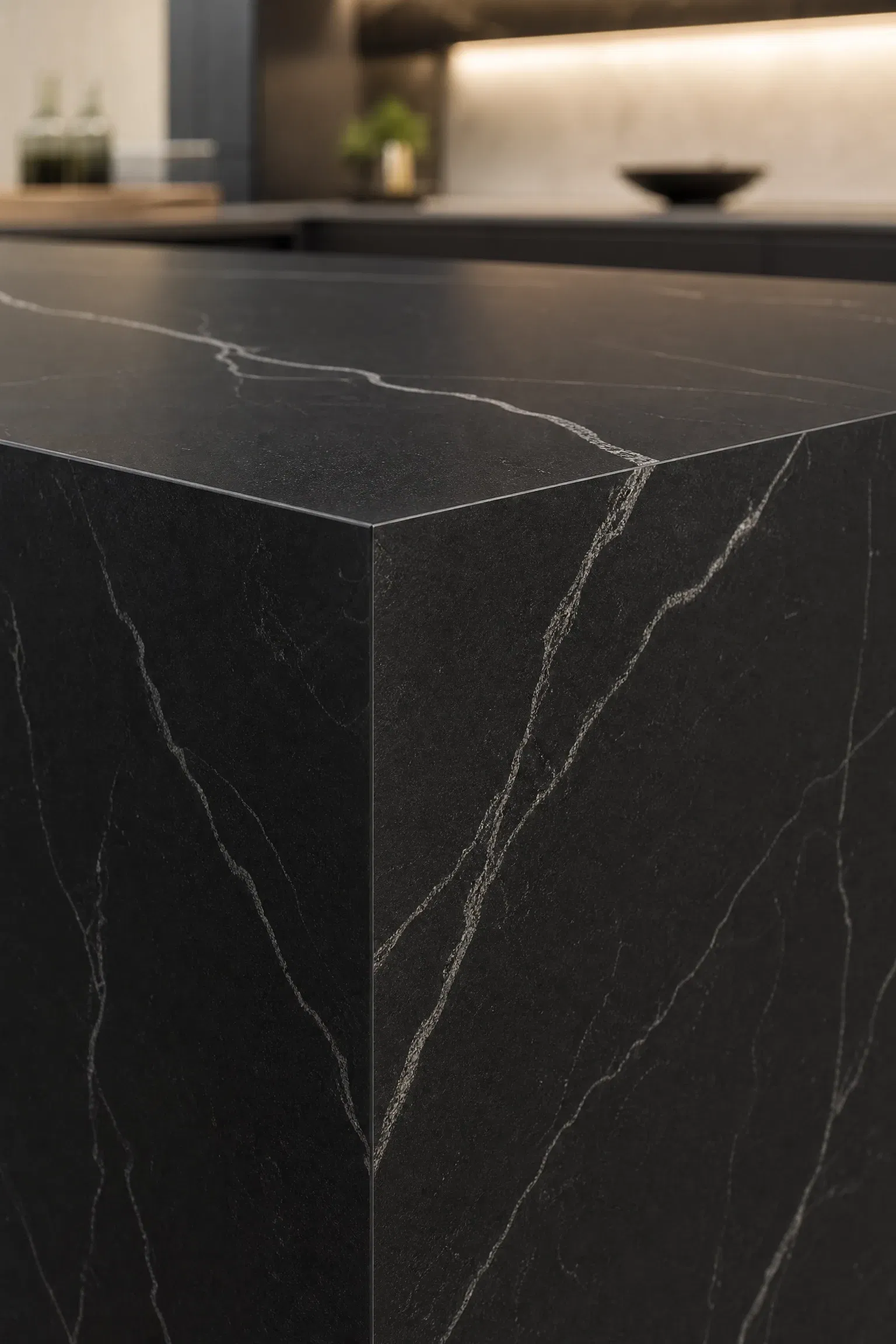
The waterfall edge detail, where the black countertop material continues vertically from the horizontal counter surface down one or both end panels of the island to the floor, is the single most dramatic and most architecturally significant application of a black countertop in kitchen design. When a quality black stone or engineered surface with visible veining or movement is used for a waterfall island, the three-dimensional quality of the stone becomes the defining visual element of the entire kitchen and the island becomes a sculptural object rather than simply a functional surface. The book-matching of stone panels for a waterfall island, where the slabs are cut and positioned so the veining mirrors itself across the two vertical end faces, is the mark of a genuinely considered installation and is worth the additional cost and the planning required to achieve it. For solid-tone black countertop materials, the waterfall edge creates a clean, architectural quality that suits a contemporary minimal kitchen particularly well.
Designer Advice: Specify a 45-degree mitre joint at the point where the horizontal countertop surface meets the vertical waterfall panel, rather than a butt joint. A mitre joint creates a seamless corner where the stone appears to wrap continuously around the edge without any visible horizontal seam at the most exposed and most looked-at junction of the waterfall detail. A butt joint creates a visible horizontal line at the corner that interrupts the continuity of the stone and reduces the sculptural quality of the waterfall effect.
27. Black Countertop Backsplash Continuation
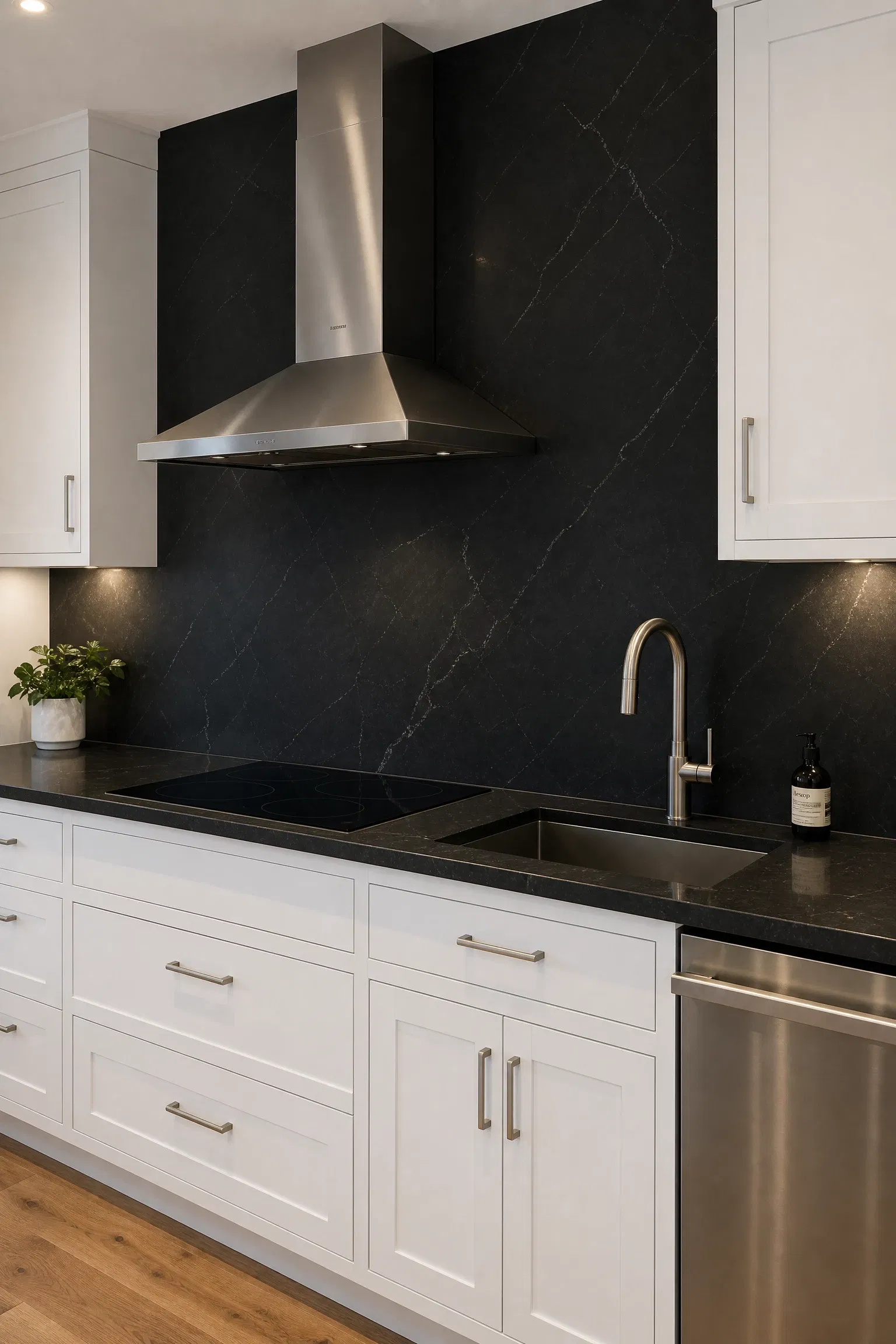
Continuing the black countertop material from the horizontal counter surface up the wall as the backsplash creates the most seamless and most visually unified version of the black countertop kitchen because it eliminates the visual boundary between the counter and the wall and creates a single continuous dark surface that frames the cooking and washing zone of the kitchen as a unified architectural feature. This approach is most effective with large-format slab materials like Dekton, Silestone, or a quality large-format porcelain where the seams between horizontal and vertical surfaces can be minimised. The continuous black surface from counter to wall creates a professional, high-specification appearance that is associated with luxury kitchen design and that makes even a simple white cabinet kitchen read as genuinely premium. The practical maintenance note is that the vertical backsplash surface collects cooking splatter and needs regular cleaning to maintain its appearance, and in a matte or honed material the cleaning residue can leave a slightly lighter film that requires buffing rather than simply wiping.
Reality Check: A black slab backsplash continuation requires perfectly flat wall surfaces and precise installation to avoid any visible variation in the plane of the vertical surface. A wall with minor imperfections that would be completely invisible behind a tiled backsplash will be magnified by a flat black slab surface that catches light across its full extent and reveals any variation in the wall plane behind it. Skim-coat plastering to a perfect flat finish before the slab installation is the required preparation, not optional.
28. The Complete Black Countertop Kitchen: Getting All Three Decisions Right
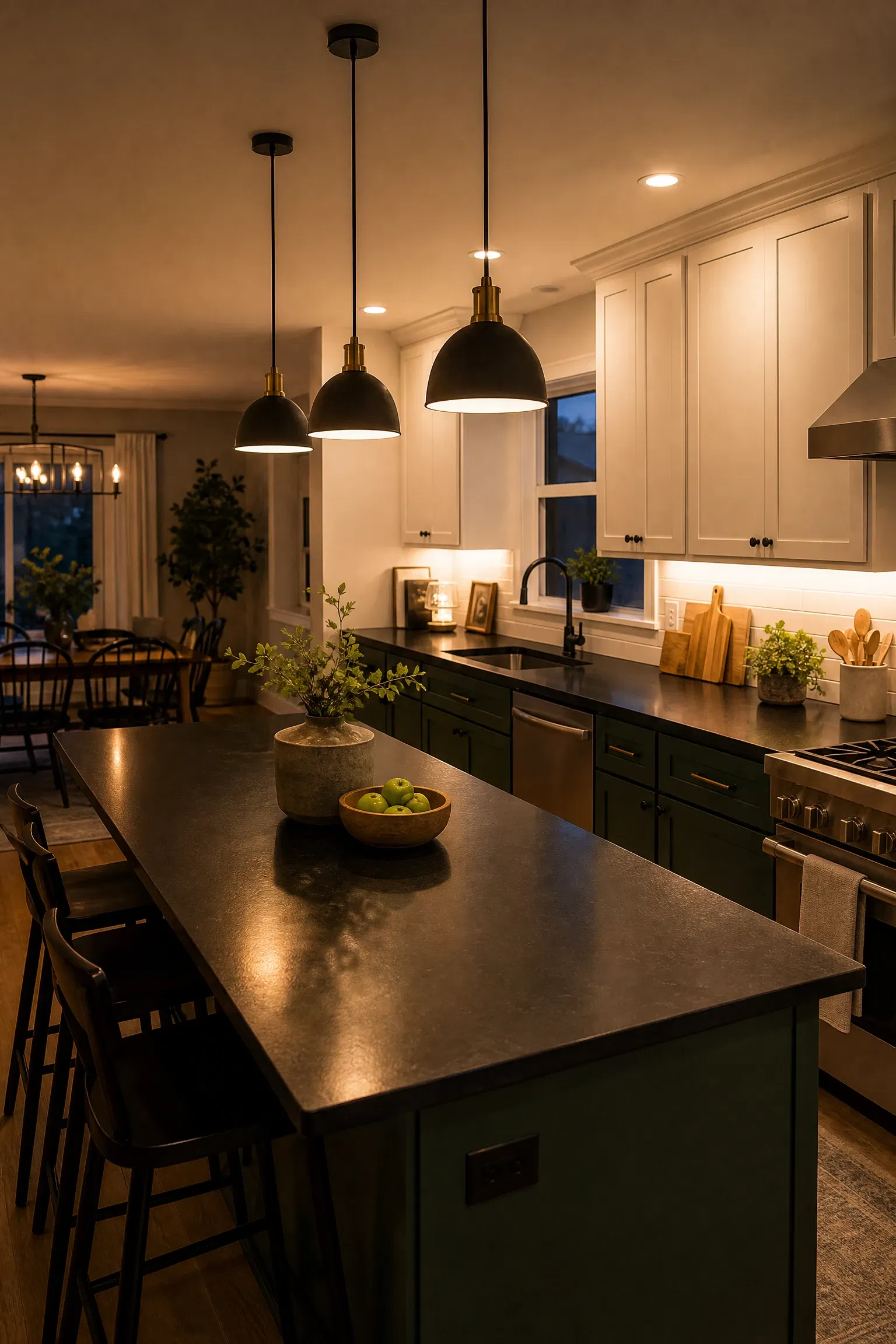
A black countertop kitchen that genuinely looks extraordinary and genuinely works for daily life over years rather than months almost always gets three decisions right simultaneously: the cabinet colour and its specific tone relationship with the black, the countertop material and finish chosen honestly for the household’s actual maintenance habits, and the lighting strategy that makes the black surface look deep and warm rather than flat and cold. A kitchen with perfectly chosen cream cabinets and beautiful black granite that has a single overhead fluorescent tube will never photograph or live as well as it should. A kitchen with all-black cabinets and a matte black quartz countertop that has warm pendant lighting above the island, under-cabinet LED strips at 3000K, and a floor lamp in the adjacent kitchen dining zone will look genuinely extraordinary every evening. Lighting in a dark countertop kitchen is not a finishing detail. It is part of the core design decision and needs to be planned alongside the cabinet colour and the countertop material rather than addressed after both of those decisions have already been made.
Pro Move: Install at least three separate warm light sources in any kitchen with black countertops: a pendant or surface ceiling fitting above the island or the main preparation area, under-cabinet LED strips along the full length of the upper cabinet base above the countertop, and a warm ambient source in any adjoining dining area that spills warm light back into the kitchen zone. Together these three sources create the layered, atmospheric quality of a genuinely designed dark kitchen. Any two of the three without the third will feel incomplete.
Final Thoughts
A black countertop is one of the most versatile and most enduringly beautiful decisions available in kitchen design, and the specific combination it creates depends entirely on what is around it. With white cabinets it becomes crisp and graphic. With warm timber it becomes balanced and organic. With dark cabinets it becomes dramatic and committed. With coloured cabinets it becomes personal and expressive. The countertop itself simply provides the dark, grounding horizontal surface; the cabinet colour determines what the kitchen is.
Before choosing a cabinet colour or a countertop material, spend time in your kitchen at different times of day and assess what the natural and artificial light does to the existing surfaces. The kitchen that looks extraordinary in a showroom or a photograph is almost always in a room with better light than your specific kitchen, and the most reliable way to translate inspiration into reality is to understand the light conditions of your own space first and then choose the specific cabinet and countertop combination that performs at its best in those conditions. A black countertop kitchen with the right lighting, the right cabinet colour, and the right material finish will be a kitchen that looks better in real life than in any photograph taken of it.
“Which cabinet colour would you pair with black countertops in your kitchen? Drop your choice in the comments below.”
Frequently Asked Questions
Do black countertops make a kitchen look smaller?
Not necessarily, and in many cases the opposite is true. A dark horizontal surface with lighter cabinets above it creates a visual grounding at the counter level that makes the kitchen feel more defined and more considered without reducing its perceived size. The kitchens that feel smaller with black countertops are those where the dark countertop is combined with dark cabinets, dark flooring, and insufficient lighting, so that all the horizontal and vertical surfaces are absorbing light simultaneously. Black countertops with light or white cabinets, a light backsplash, and good lighting consistently make kitchens feel more spacious than the same kitchen with darker countertops in the same conditions.
What is the best material for black kitchen countertops?
For low maintenance and durability, black quartz or sintered stone like Dekton are the best choices because they are non-porous, require no sealing, and are resistant to staining and heat. For the most natural and most visually complex result, honed or leathered black granite is the best choice because it has the organic quality of natural stone with better fingerprint and water mark resistance than polished granite. For the warmest and most tactile surface, soapstone is uniquely suited to a kitchen because it is warm to the touch, naturally non-porous, and fully repairable when scratched. For the most dramatic and most luxury appearance, black marble like Nero Marquina is unmatched, but requires the most maintenance commitment of all the options.
Do black countertops show fingerprints and scratches?
Polished black countertops show fingerprints, water marks, and surface deposits very clearly because the reflective surface creates high contrast between clean and marked areas. Honed, matte, or leathered black countertops show the same marks considerably less clearly because the non-reflective surface does not create the same light contrast. For a household with active daily kitchen use, a honed or leathered finish is the practical recommendation regardless of material. Scratches on black quartz and sintered stone are permanent and cannot be repaired, while scratches on black granite, marble, and soapstone can be polished, re-sealed, or sanded out depending on the material.
What backsplash goes with black countertops?
White or cream subway tile is the most widely used and most consistently successful backsplash with black countertops because it provides the brightness and the visual relief that the dark countertop surface needs without competing with it. Natural stone tile in a light fossil or warm grey tone suits black countertops with natural wood cabinets. A black tile backsplash in the same material as the countertop creates the most graphic and most contemporary result. A coloured tile backsplash in forest green, sage, or terracotta creates the most distinctive and most personal result when used with white or cream cabinets. The rule across all options is to use warm-white or cream grout rather than bright white grout, which can appear too stark and cool alongside a deep black surface.
What hardware finish works best with black countertops?
Brushed brass or unlacquered brass is the most consistently beautiful hardware choice alongside black countertops because the warm gold tone of brass creates a warm metallic contrast that prevents the kitchen from reading as cold or clinical. Matte black hardware creates the most graphic and most contemporary result in a white and black kitchen but can make a dark cabinet and dark countertop kitchen read as very flat and tonally uniform. Chrome provides the coolest and crispest metallic quality and suits a very contemporary or architectural black countertop kitchen best. Avoid polished gold, which can read as too ornate alongside the clean precision of most black countertop materials.
Are black countertops a lasting choice or a trend?
Black countertops have been used in high-end and professional kitchens for decades, and their enduring use in those contexts suggests they have genuine staying power rather than simply being a current trend. Dark stone surfaces in black granite and soapstone were used in laboratory and professional kitchen installations long before they became popular in domestic design, and their qualities of depth, durability, and versatility suit the kitchen environment specifically. The specific styling that surrounds a black countertop, the cabinet colour, the hardware, and the backsplash, determines whether the kitchen looks dated in five years. The countertop itself, in a quality natural stone or engineered surface, will look as relevant in fifteen years as it does today.