Minimalist Lighting Ideas That Actually Change How a Room Feels
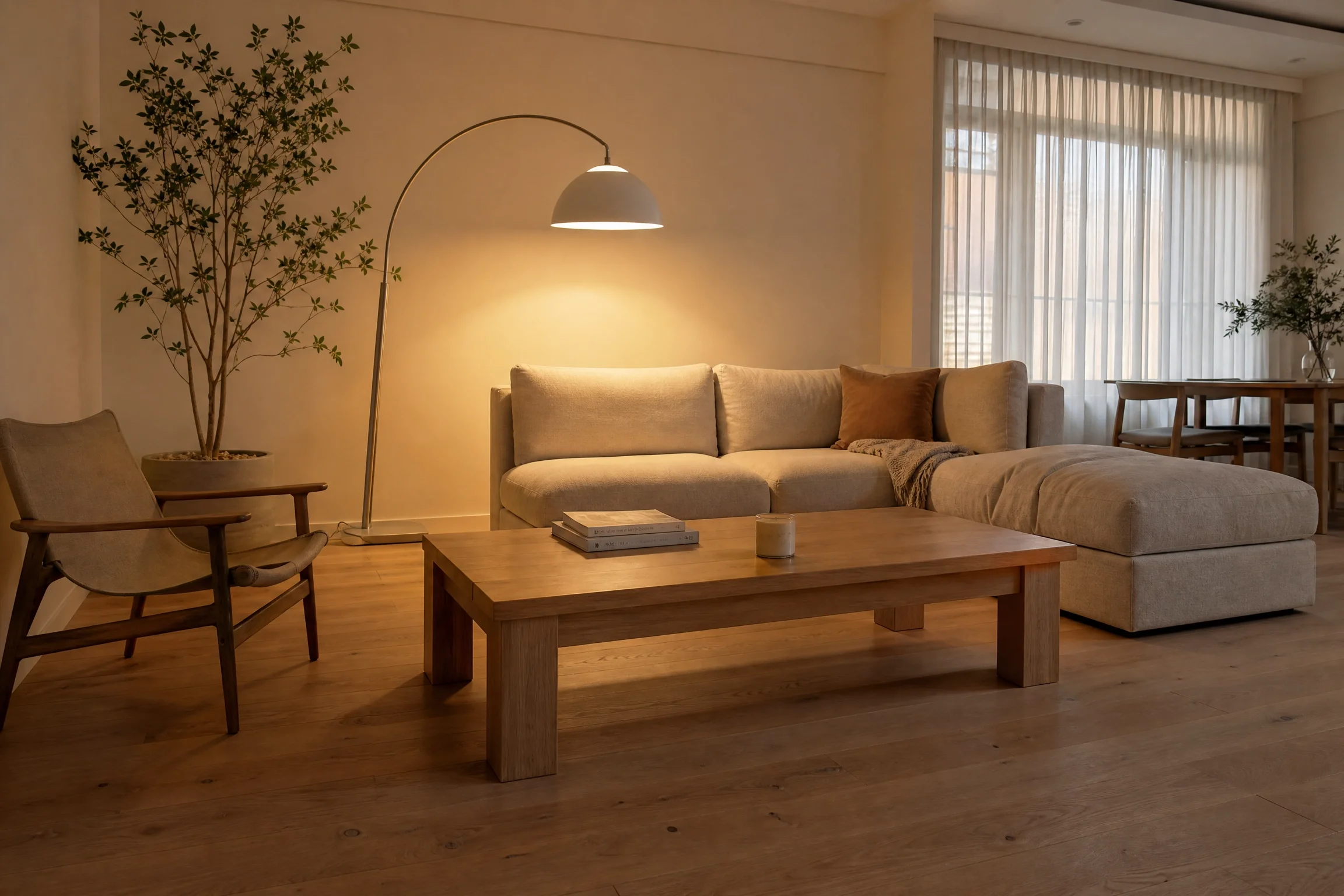
There is a particular kind of frustration that comes with a room that looks right on paper but feels off in real life. You have the furniture, the color palette, the carefully chosen rug, and yet something is missing. Nine times out of ten, that missing thing is the lighting. Not more of it, not fancier fixtures, but the right lighting placed thoughtfully and chosen with intention. Minimalist lighting is not about stripping everything down to a single bare bulb. It is about making deliberate choices that do real work in a room, fixtures that earn their place, light that behaves the way you actually need it to.
The ideas here come from real rooms and real decisions, the kind you make when you are standing in a space and asking yourself what it genuinely needs. Whether you are starting from scratch or looking to fix one specific corner of a room that has never quite worked, these minimalist lighting approaches are practical, specific, and grounded in how light actually shapes the way a space feels. No fussy chandeliers, no complicated installations. Just ideas worth trying.
1. The Single Pendant Over a Bedside Table
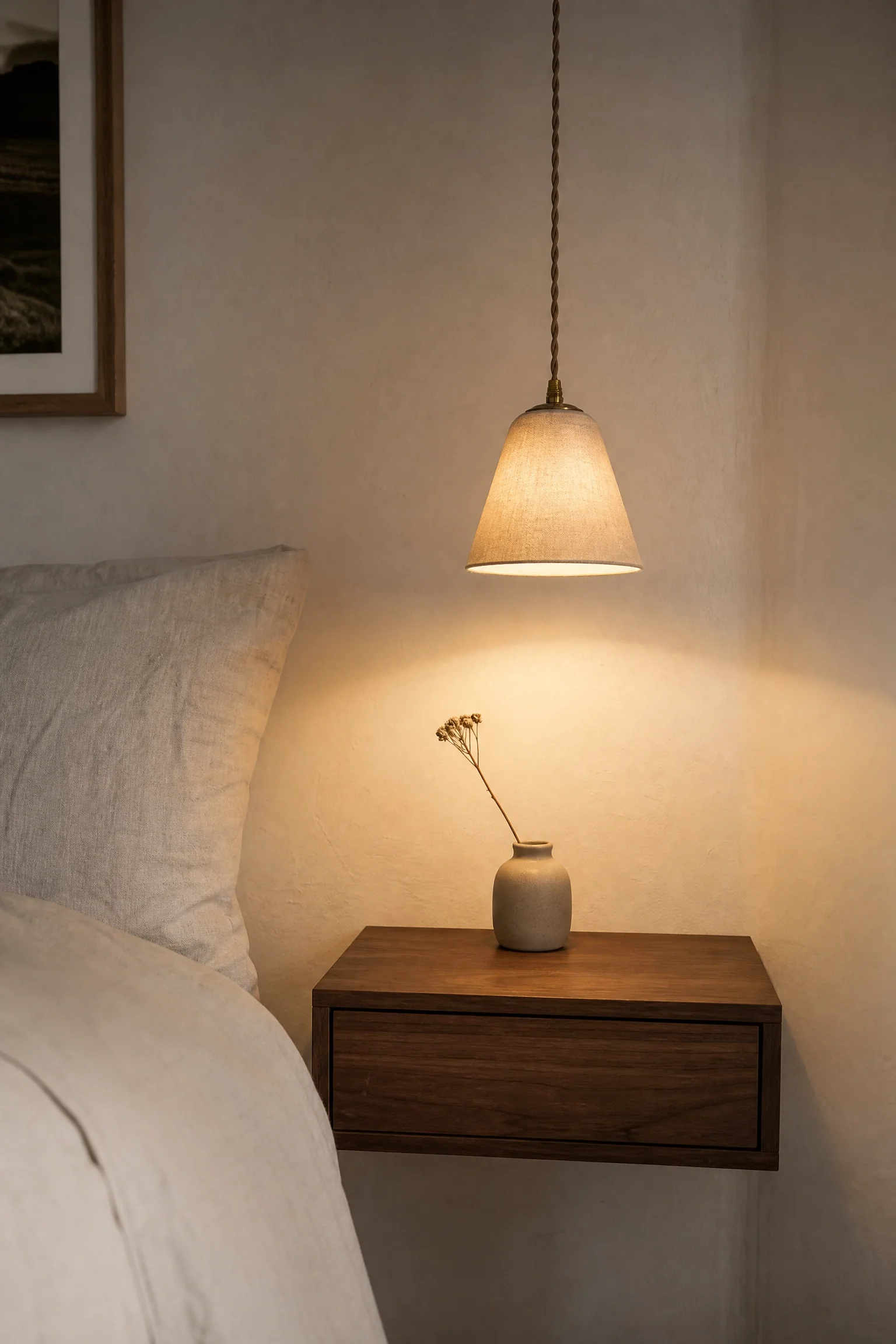
Most people automatically reach for a table lamp on their nightstand, and that is exactly why swapping it for a single hanging pendant feels so unexpectedly good. In practice, a pendant suspended from a ceiling hook or wall-mounted canopy clears the entire surface of your bedside table, which in a minimalist bedroom is a bigger deal than it sounds. Choose a pendant with a linen or frosted glass shade in a warm 2700K bulb, and position it so the bottom of the shade sits roughly at shoulder height when you are sitting up in bed. This puts the light exactly where you need it for reading without flooding the whole room. The cord or cable becomes part of the visual interest, especially in natural cotton braid or a matte black finish against a white wall. This is an affordable upgrade, cord pendant kits run from $30 to $80, and the effect is far more considered than a standard lamp. One honest note: if your ceilings are low, check your pendant length carefully before committing.
Designer Note: Use a dimmer switch with your pendant. A 2700K bulb at 30 percent brightness at night reads as warm and almost candlelit, which is exactly what a bedroom needs.
2. Recessed Lighting With a Warm Dimmer Setup
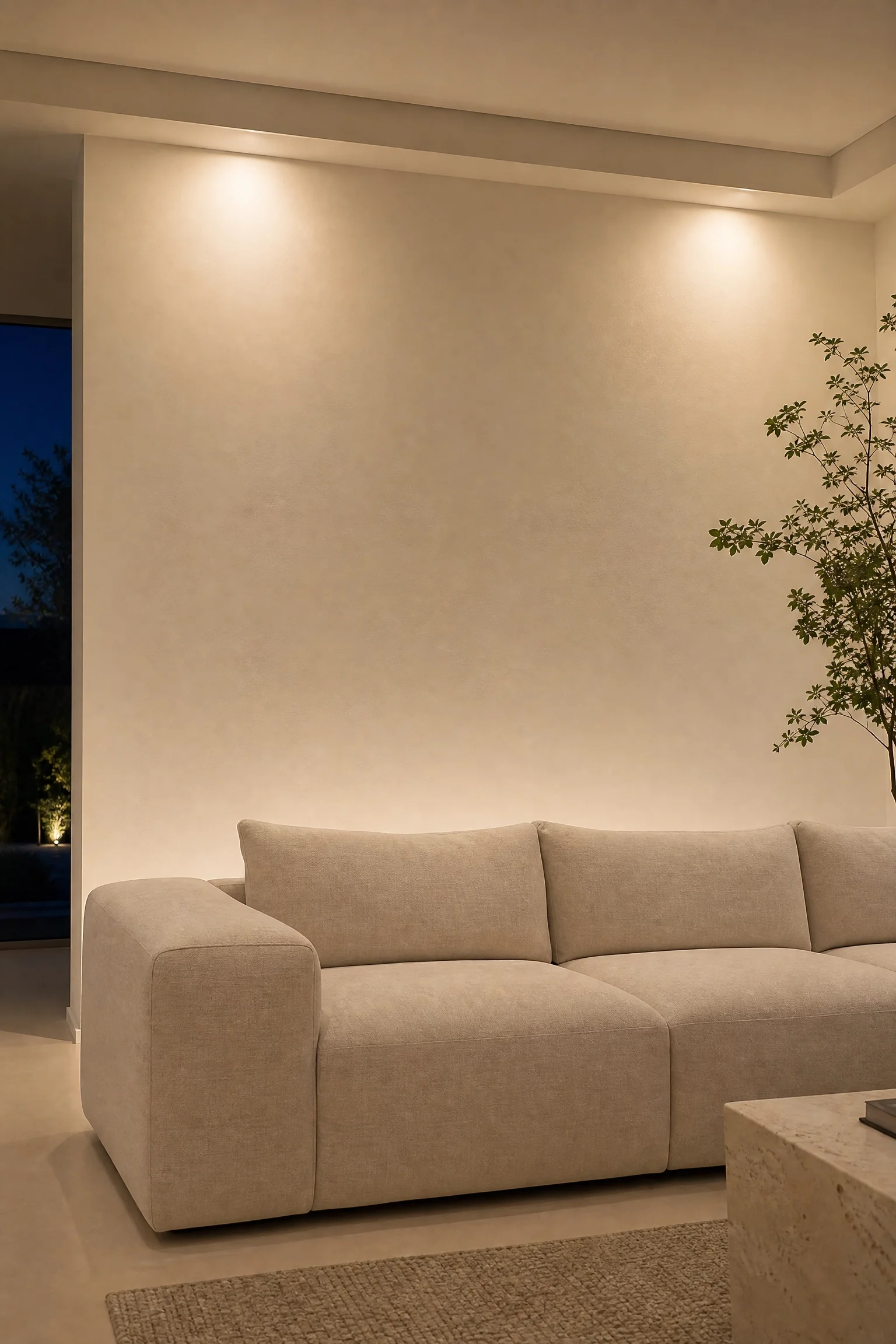
Recessed lighting has a reputation for feeling clinical, and that reputation is earned when it is done wrong. The mistake most people make is installing cool white bulbs at full brightness and leaving them that way. When recessed lighting is done right in a minimalist space, it disappears into the ceiling entirely and lets the room itself become the thing you notice. The key is threefold: use bulbs with a color temperature of 2700K or 3000K, install them on a dimmer, and position them so they wash walls or illuminate specific zones rather than blasting down from the center of the room. In a living room, a row of recessed lights along one wall creates what designers call wall-washing, a soft, even glow that makes the ceiling feel higher and the room feel calmer. This is a mid-range investment if you are retrofitting, but the impact on the daily feel of a room is significant. It works best in rooms with at least nine-foot ceilings.
Designer Note: Aim for a beam angle of 38 to 60 degrees for ambient recessed lighting. Narrow spots, around 15 to 25 degrees, are better reserved for accent work like highlighting artwork.
3. A Thin Rattan Floor Lamp in a Reading Corner
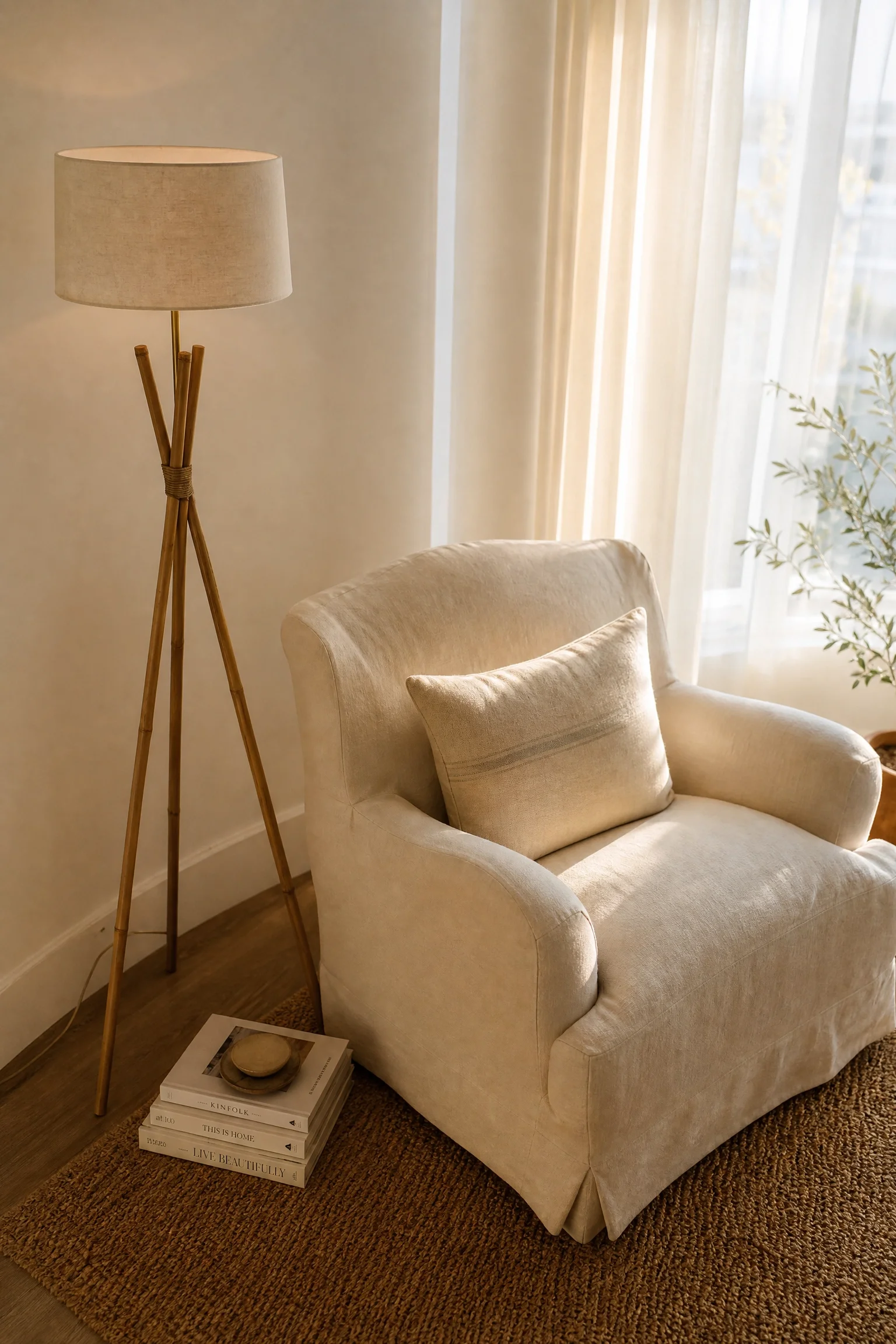
One thing that works really well in a neutral minimalist room is introducing a natural material through a floor lamp rather than through furniture or textiles, because it gives you warmth without visual weight. A slim rattan or bamboo floor lamp with a small drum shade in ivory linen reads as organic and considered, not bohemian or cluttered. Place it in the corner behind a chair or sofa at an angle, so the light spills forward over a seating area rather than glaring directly at eye level. The lamp itself becomes part of the negative space in the room, its slim silhouette barely registering against the wall. Look for lamps with a tripod base in a natural finish, which adds a sculptural quality without competing with anything else in the space. Budget-friendly options are widely available under $100, and the texture contrast against smooth plaster walls or linen upholstery is subtle but genuinely effective. One limitation worth noting: rattan lamps are not ideal as a primary light source, they are best used as layered ambient or task lighting.
Designer Note: Pair a rattan lamp with a warm Edison-style LED bulb in the 2200K range for a glow that feels more like late afternoon sun than electric light.
4. LED Strip Lighting Tucked Behind a Floating Shelf
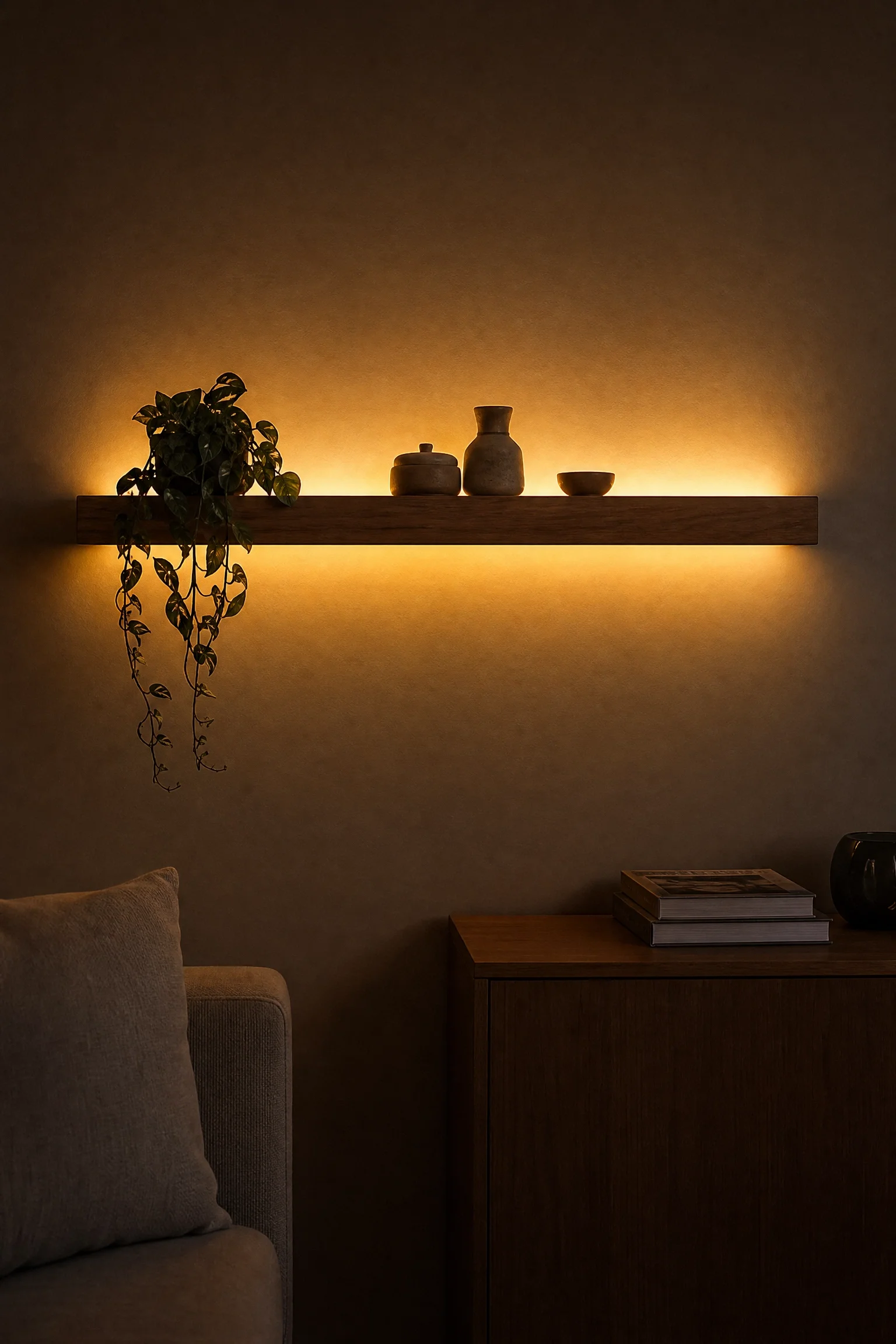
LED strip lighting has a complicated reputation in interior design circles because it is so often done in exactly the wrong way, think neon-blue gaming setups or harsh white bars under kitchen cabinets. But when it is done right, concealed strip lighting is one of the quietest and most effective tools in a minimalist room. The approach here is to run a warm white LED strip along the back edge of a floating shelf, positioned so the light washes down the wall behind and below it rather than projecting outward into the room. The result is a soft halo effect that adds depth and dimension to a plain wall without a single visible fixture. This works especially well in living rooms or bedrooms where you want ambient light without overhead glare. Use a strip rated at 2700K and install it with the LEDs facing away from direct sightlines. This is one of the most budget-friendly ideas on this list, quality strips with adhesive backing cost around $15 to $40 for a standard shelf run.
Designer Note: Warm white strip lighting at low brightness behind a shelf full of books or ceramics creates what photographers call rim lighting, which gives objects a soft, gallery-like quality.
5. A Matte Black Swing-Arm Wall Sconce
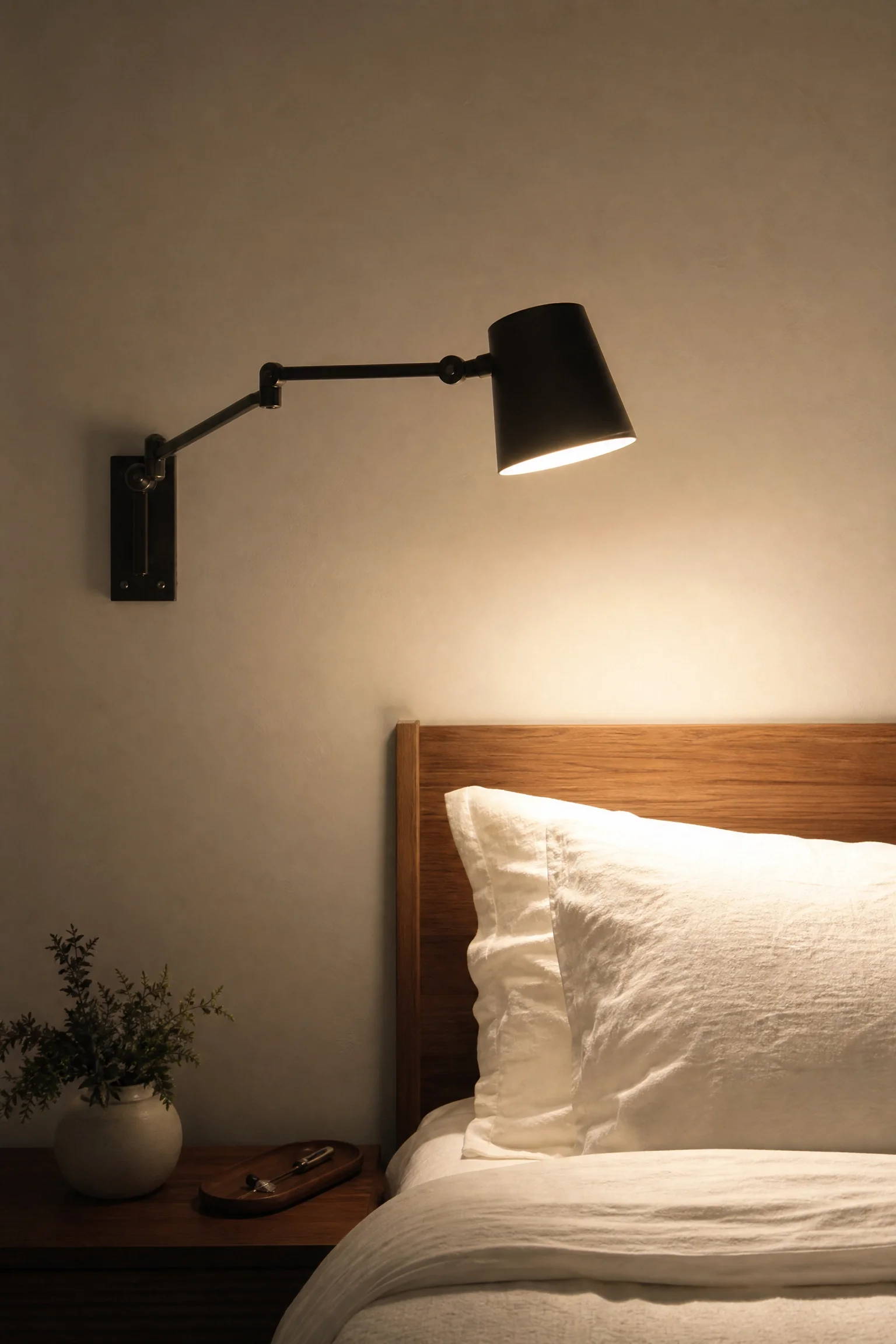
The swing-arm wall sconce is one of those fixtures that earns its place in a minimalist room because it does two things well at once: it provides directed task lighting and it keeps surfaces completely clear. In a bedroom flanking the headboard, it replaces both the bedside table lamp and the need for a table at all, which is ideal if you are working with limited floor space. In a living room, it can anchor a reading chair without requiring a floor lamp. Matte black is particularly effective in minimalist rooms because it reads as a sharp graphic element against white or warm grey walls, almost like a piece of line art. Look for sconces with a simple articulated arm and a small metal or fabric shade. Good options exist at every price point, from around $40 for basic versions to $200 or more for designer pieces with a heavier arm and better hardware. The installation does require putting two screws into a wall and connecting two wires, which is a manageable DIY job for most people. If your walls are concrete or brick, account for additional installation time.
Designer Note: Mount sconces so the bottom of the shade sits at seated eye level, roughly 48 to 54 inches from the floor, for the most comfortable reading position.
6. Japandi-Style Paper Lanterns as Overhead Diffusers
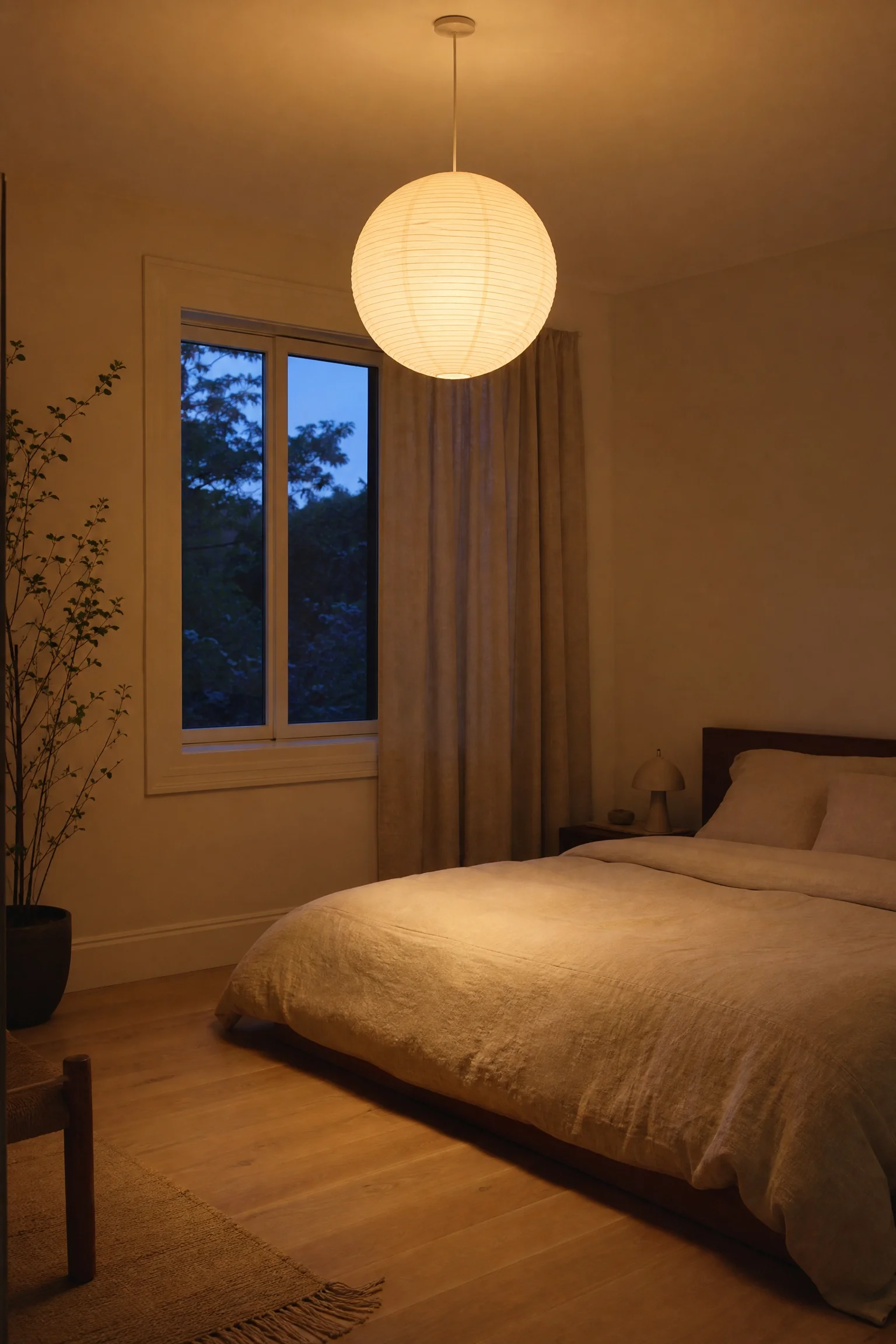
In Japandi design, which blends Japanese minimalism with Scandinavian warmth, overhead lighting is almost always soft and diffused rather than direct. A paper lantern pendant, the kind associated with the Noguchi Akari series or its more affordable counterparts, achieves something genuinely hard to replicate with any other fixture: it turns the light source itself into something beautiful and soft rather than just a glowing bulb. The paper diffuses light in every direction, eliminating harsh shadows and creating an evenness to the room that feels calm and lived-in. In a bedroom or small living room, a single large lantern, 18 to 24 inches in diameter, hung at the right height creates the light equivalent of natural overcast daylight, soft, directionless, and flattering. Original Noguchi lanterns are an investment at $200 and up, but very close alternatives are available for $20 to $50 and are nearly indistinguishable once lit. The main limitation is that paper lanterns are not suited for high-humidity rooms like bathrooms or kitchens.
Designer Note: Go one size larger than you think you need. A lantern that reads as generously sized in a room creates presence without weight, while a too-small lantern looks accidental.
7. Candle-Style Wall Sconces Without the Wiring
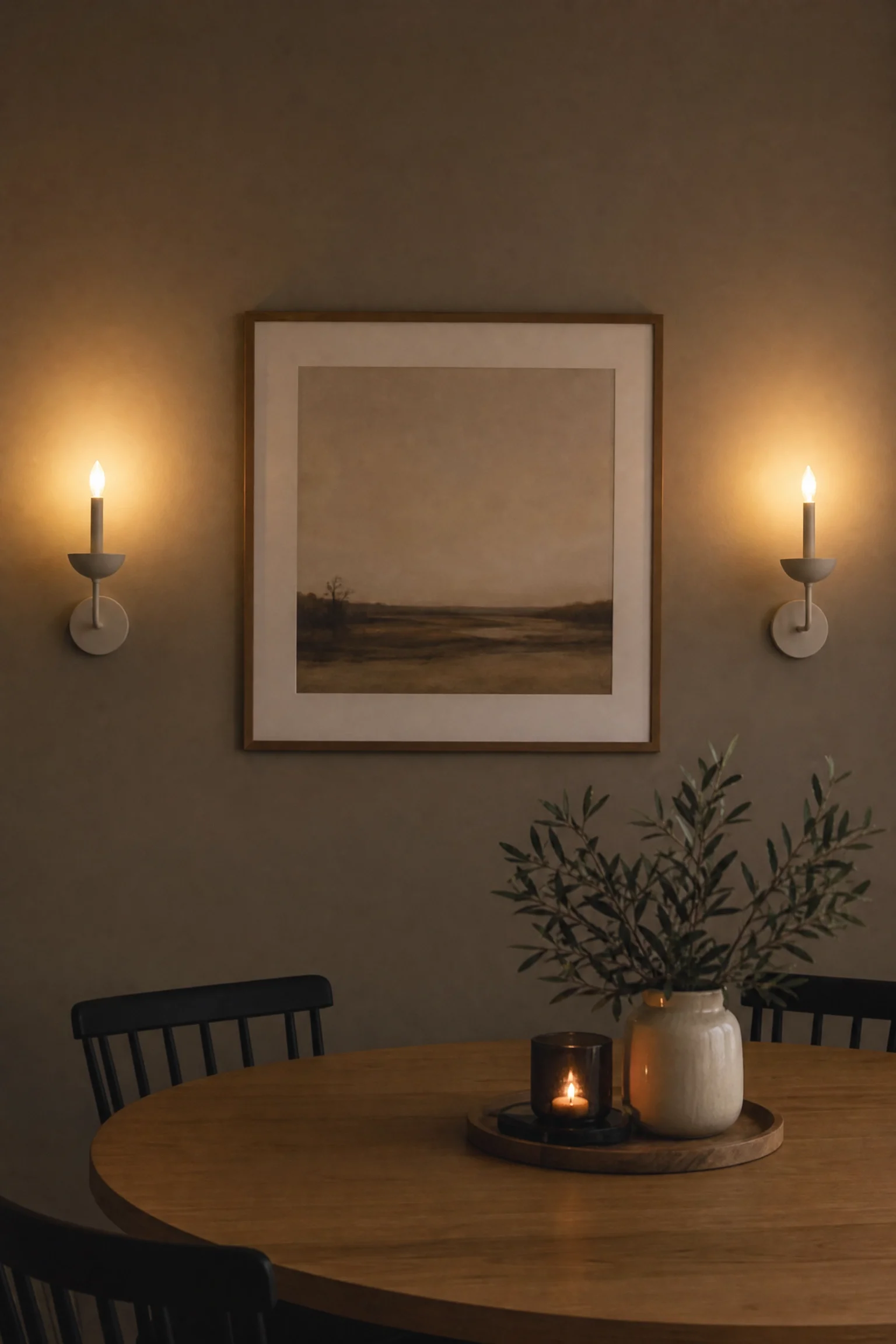
Not every lighting solution needs to involve an electrician, and battery-operated or plug-in wall sconces have quietly become a genuinely good option for renters or anyone who wants to try a placement before committing to a permanent installation. Candle-style sconces with warm flickering LED bulbs work particularly well in dining areas, hallways, and bedrooms where the goal is atmosphere rather than function. The flicker effect in quality LED candle bulbs is remarkably convincing, especially at a distance, and the warm amber tone, around 1800K to 2200K, creates the kind of glow that makes any room feel like it is lit by actual candles. Choose sconces with a simple cup or torch design in a matte finish, white, brass, or black, and hang them at eye level in pairs for a symmetrical, collected look. This is one of the most affordable approaches on this list, a good pair of plug-in sconces with cord covers can be installed for under $60.
Designer Note: Use cord covers in the same color as your wall paint to make the cord practically invisible. A two-inch wide paintable cord cover from a hardware store costs about $8 and takes ten minutes to install.
8. Under-Cabinet Lighting in a Minimalist Kitchen
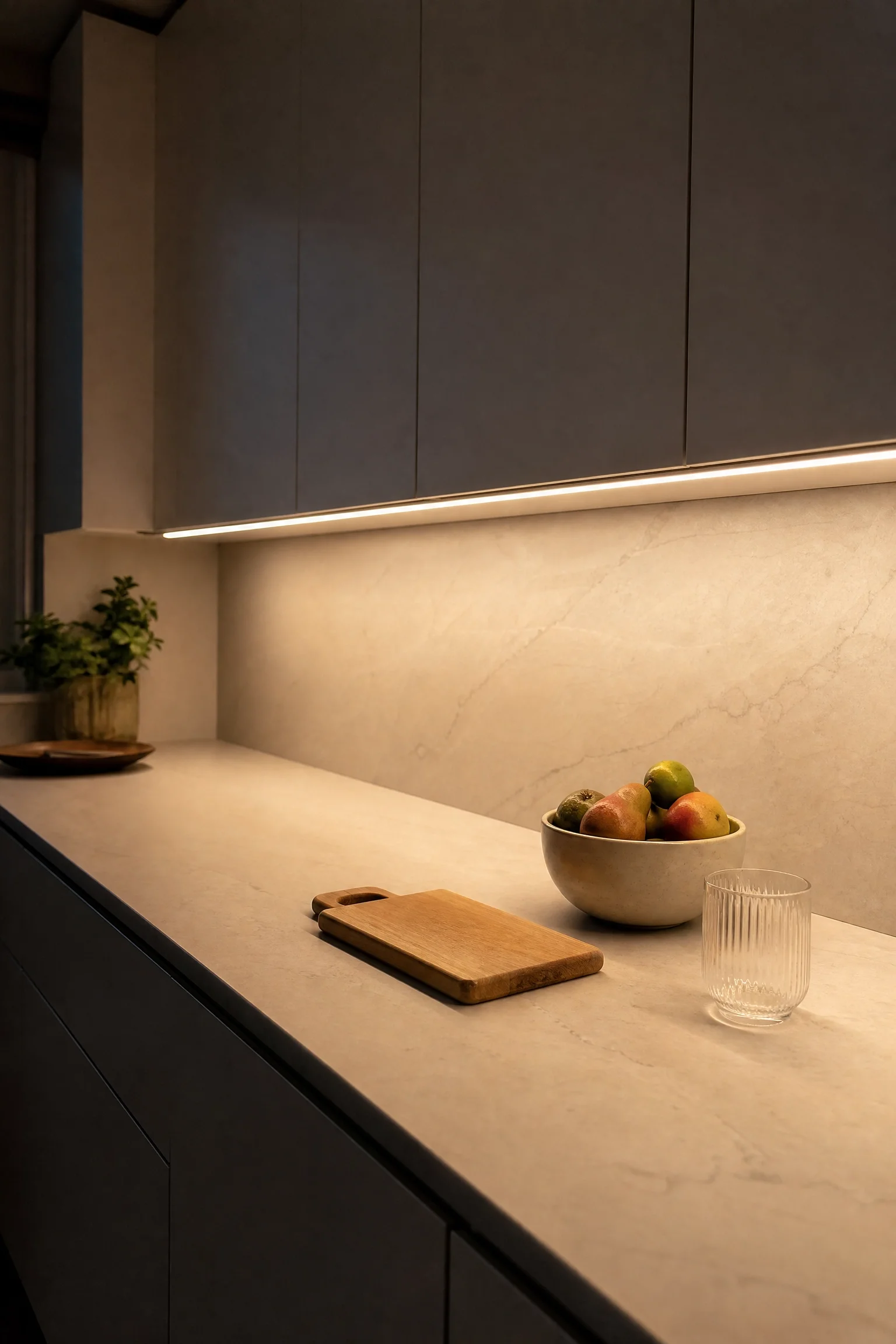
A minimalist kitchen lives and dies by its surfaces, and under-cabinet lighting is one of the most practical ways to make those surfaces look intentional rather than just empty. The goal is task lighting that is completely invisible during the day, flat LED puck lights or a slim recessed strip mounted flush to the underside of upper cabinets so no fixture is visible from standing height. When switched on, the light washes across the countertop evenly, eliminating shadows under cabinets that make prep work feel harder than it needs to be. Use a warm white at 3000K rather than a cool daylight temperature, which can feel harsh against stone or wood countertops. In kitchens with open shelving rather than upper cabinets, the same approach works along the underside of the shelf above the counter. This is a mid-range investment at $50 to $150 depending on the length of your countertop run, and the payoff in daily usability is significant.
Designer Note: Wire your under-cabinet lights to a switch separate from your overhead kitchen lighting so you can use counter lighting alone in the evenings for a warmer, less institutional feel.
9. A Linear Suspension Lamp Above the Dining Table
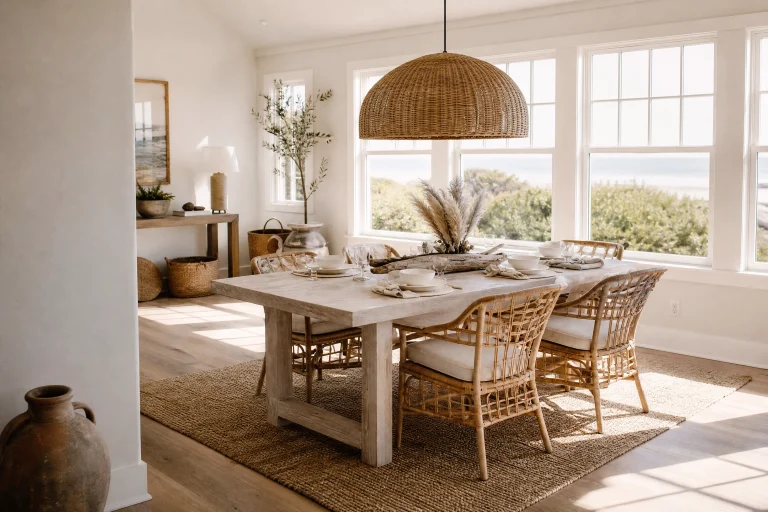
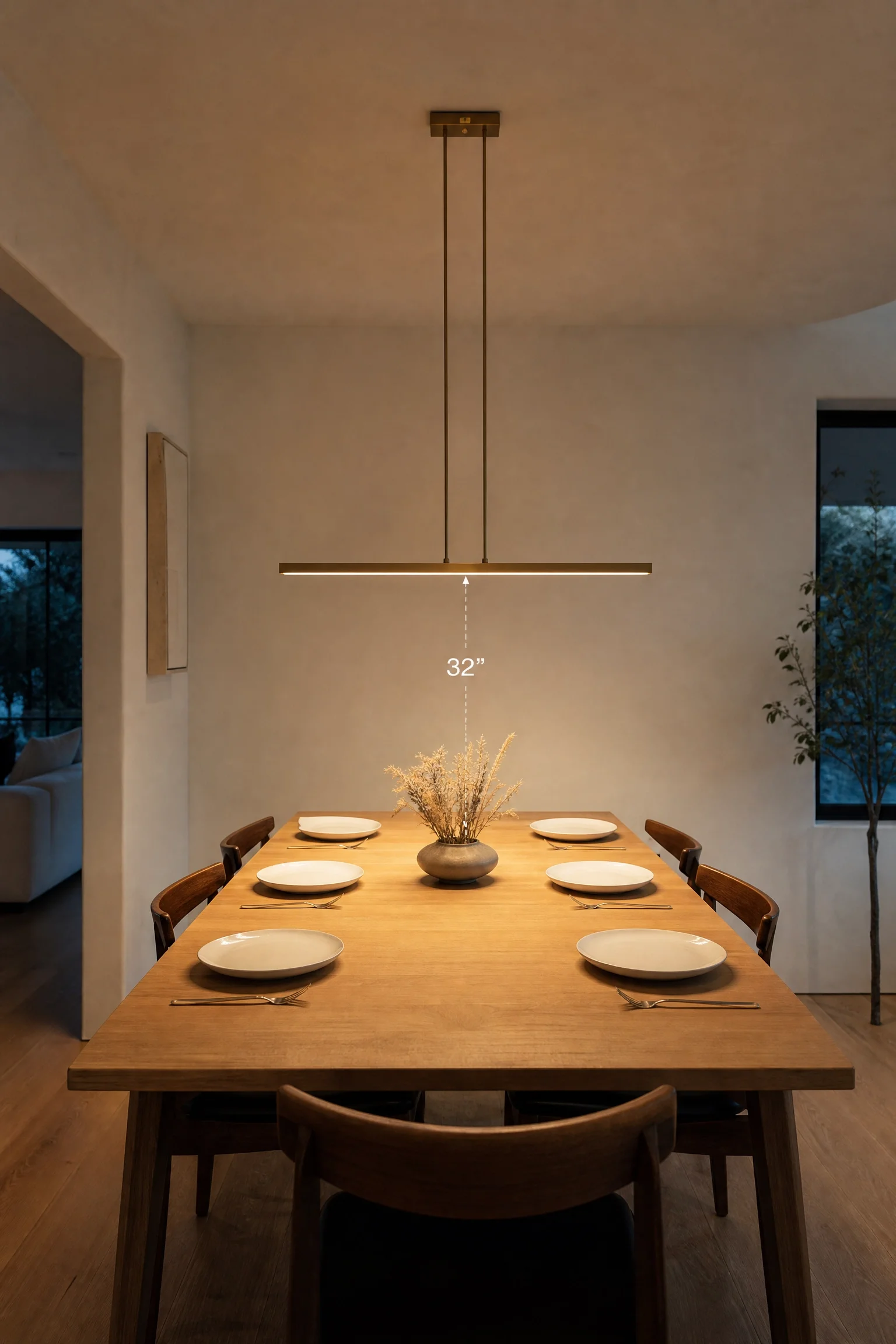
Round pendant clusters above dining tables have had a long run, and they work well, but a single linear suspension fixture brings a different kind of calm to a minimalist dining room. A long, narrow pendant, whether a metal tube, a row of small glass globes on a single bar, or a sleek wood and brass combination, follows the natural geometry of a rectangular table and creates a visual relationship between the fixture and the surface below it. In practice, this reads as more considered than a single centered pendant because it acknowledges the shape of the table rather than ignoring it. Hang the bottom of the fixture 30 to 36 inches above the tabletop for the best balance of illumination and visual comfort. A warm bulb at around 2700K is essential here, dining rooms need light that is flattering to both food and people, and a cooler temperature will undermine both. Linear suspension fixtures range from very affordable IKEA options to high-end pieces, so this is an idea that works at almost any budget.
Designer Note: If your dining table is 72 inches or longer, look for a linear pendant that runs at least two-thirds of the table length. A fixture that is too short over a long table looks proportionally awkward, even from a distance.
10. Layered Table Lamp Styling in a Living Room
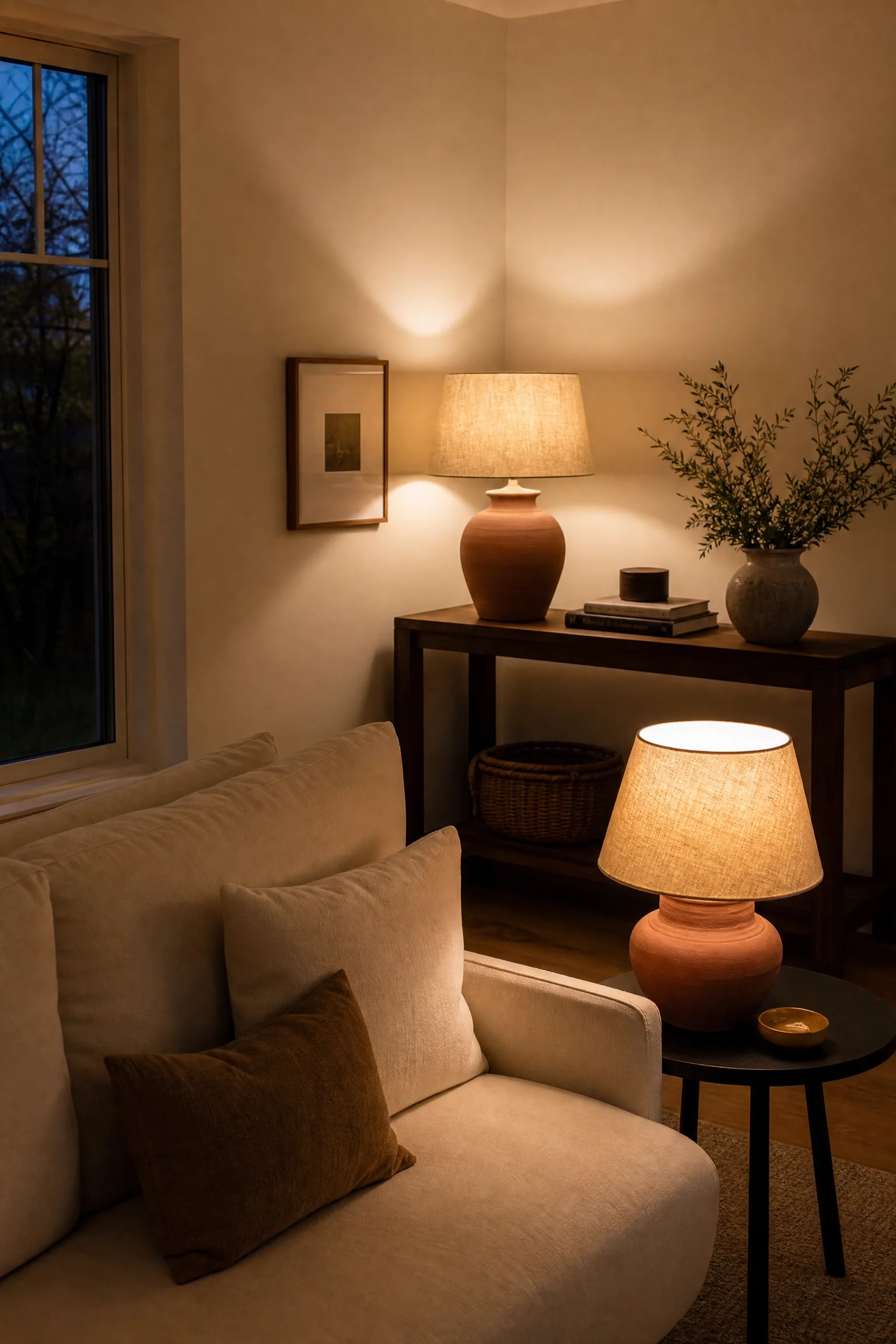
The single overhead light is one of the most common mistakes in living room design, and it is also one of the easiest to fix. Layered lighting means using multiple light sources at different heights so the room can be lit differently at different times of day. In a minimalist context, this does not mean accumulating a lot of lamps. It means choosing two or three well-placed table lamps that together build the ambient layer of the room. Look for lamps with simple ceramic or concrete bases in a neutral tone and shades in natural linen or rice paper, materials that diffuse light softly rather than directing it harshly. Spread them across the room: one on a console table, one on a side table near the sofa, and if space allows, one at floor height in a corner. When all three are on at a low setting, the room reads as warm, three-dimensional, and genuinely comfortable. This approach works at any budget since good minimalist table lamps are widely available from $30 to $300.
Designer Note: Use the same bulb color temperature across all lamps in a room. Even a difference of 300K between two adjacent lamps can create a visual inconsistency that makes the space feel unresolved.
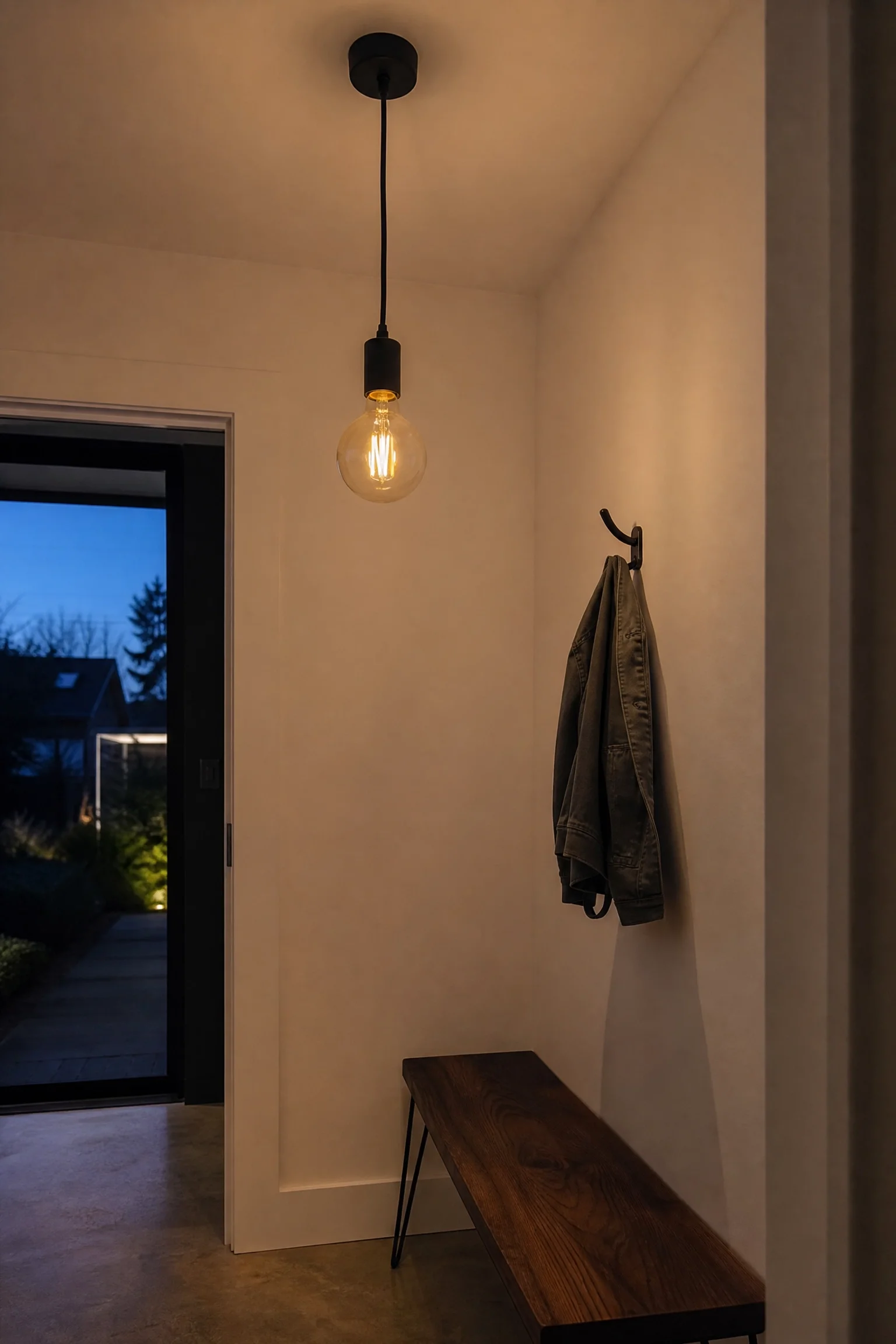
11. A Bare Bulb Pendant in an Exposed Filament Style
There is a version of the bare bulb pendant that reads as lazy and unfinished, and there is a version that reads as confident and deliberate. The difference is entirely in the bulb itself and the context around it. A carbon filament LED bulb in a globe or tubular shape, warm amber at around 2200K, is a design object in its own right. Hung on a simple fabric cord with a minimal ceiling canopy in matte black or brass, it works beautifully in entryways, over kitchen islands, or in small dining areas where the room itself is clean enough to let a single sculptural element take focus. The key is choosing a space that is uncluttered enough for the bulb to read as intentional. If the surrounding room is busy, a bare bulb looks like a shortcut. In a calm, minimal room, it looks like a choice. Carbon filament LED bulbs are widely available from $8 to $20 and use very little energy while producing a glow that is closer to vintage incandescent than almost any other modern option.
Designer Note: Use bulbs rated at 40 watts equivalent or lower. A bare bulb at full brightness creates glare; the goal is a glow you can look at directly without discomfort.
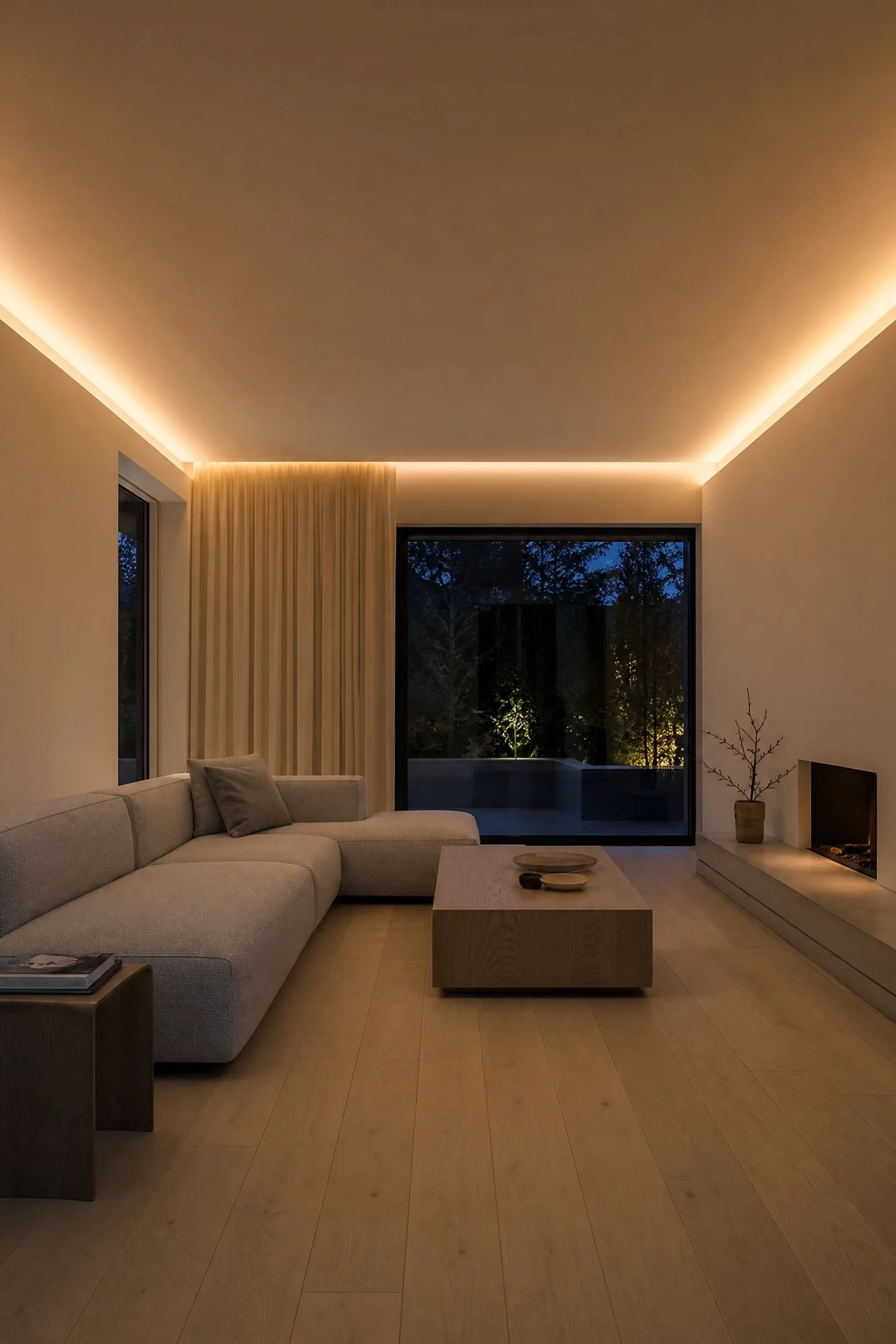
12. Cove Lighting Along a Ceiling Perimeter
Cove lighting is one of the fixtures most closely associated with professional interior design, largely because it requires a small amount of construction work that most people do not attempt on their own. But for anyone doing a renovation or working with a contractor, it is worth asking about. A shallow ledge built along the top of one or more walls, with LED strip lighting concealed inside and aimed upward at the ceiling, creates a soft indirect glow that wraps the entire room in gentle, even light. There are no visible fixtures, no shadows, and no glare. The ceiling becomes the light source, which is one of the most calming lighting effects possible in a home. Cove lighting works in living rooms, primary bedrooms, and dining rooms. At 2700K with a dimmer, it can be dialed from bright enough for general activity to low enough for late-evening winding down. This is an investment-level idea, the construction and electrical work can run $500 to $2,000 depending on room size, but the result looks genuinely bespoke.
Designer Note: The depth of the cove, the gap between the ledge and the ceiling, should be at least four inches. A shallower cove will show hotspots in the strip, breaking the illusion of even, floating light.
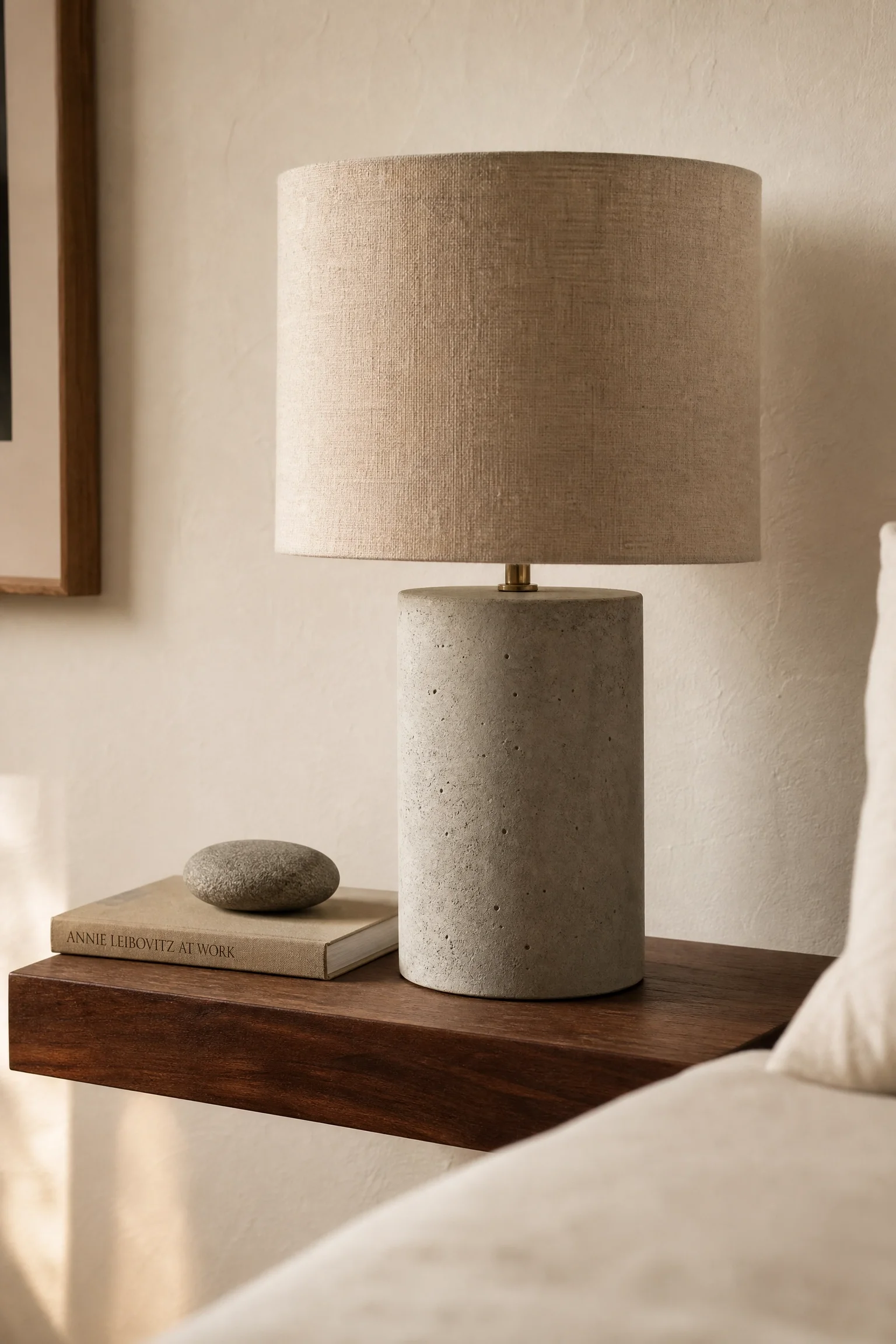
13. A Concrete or Stone Table Lamp Base
In a room with soft textiles and warm wood tones, a concrete or stone lamp base introduces a quiet sense of weight and material contrast that makes the whole space feel more grounded. This is a detail that works particularly well in Wabi-sabi or Japandi-influenced rooms, where the beauty of a material in its natural, unpolished state is part of the point. Concrete bases have a slight roughness and tonal variation that makes them look almost geological next to smooth plaster walls, and that contrast is interesting in a way that a standard ceramic or resin base simply is not. Pair a concrete base with a linen shade in a natural oatmeal tone and a 2700K bulb, and the result is a lamp that looks less like a product and more like something you found. These are widely available from independent makers on marketplaces like Etsy, as well as from design-forward retailers, typically in the $60 to $180 range. Concrete is heavy, so check that your side table can bear the weight before ordering.
Designer Note: A matte, unsealed concrete base will lighten slightly over time as it absorbs ambient moisture and oils. This natural aging is part of the appeal, but if you prefer consistent color, look for a sealed finish.
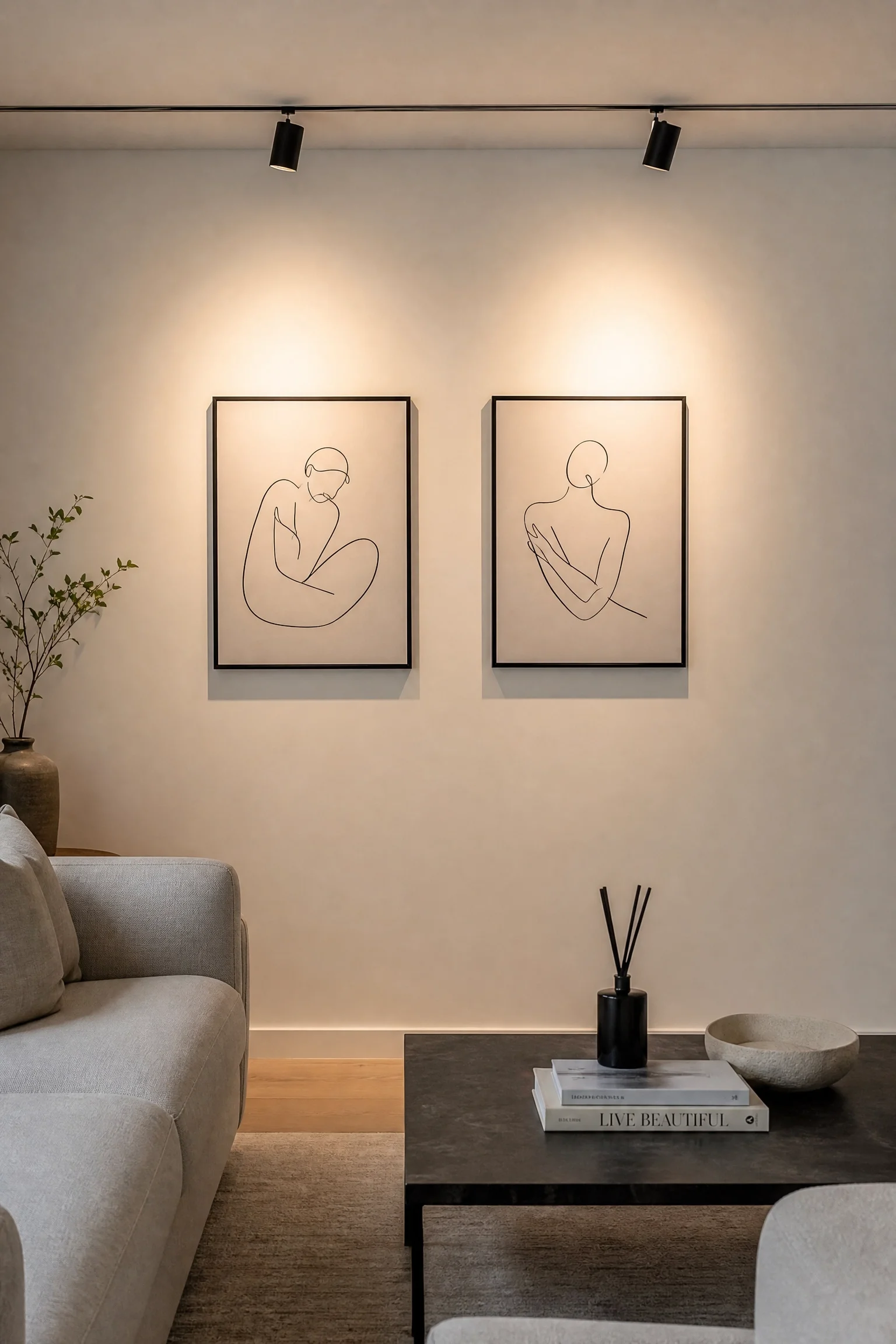
14. Directional Track Lighting for a Gallery Wall
Track lighting is often dismissed as too commercial or industrial for a home, but in a minimalist room with a gallery wall or a collection of artwork, it is one of the most purposeful choices you can make. The logic is straightforward: individual adjustable heads on a single track allow you to point light precisely at each piece of art, creating accent lighting that makes the whole arrangement look deliberate and curated. In a living room or hallway, a short two- or three-head track in matte black or brushed nickel almost disappears into the ceiling once the lights are aimed and drawing attention to the wall below. Use narrow-beam LED heads, around 15 degrees, specifically designed for accent work. The warmth of 2700K to 3000K keeps artwork colors accurate without the blue shift of cooler temperatures. This is a mid-range investment, good track systems run $80 to $250 for a basic setup, and the result makes any gallery wall feel significantly more considered.
Designer Note: Aim accent heads at a 30-degree angle from the wall surface. This angle minimizes glare on glass-fronted frames while still casting enough light across the artwork to illuminate it properly.
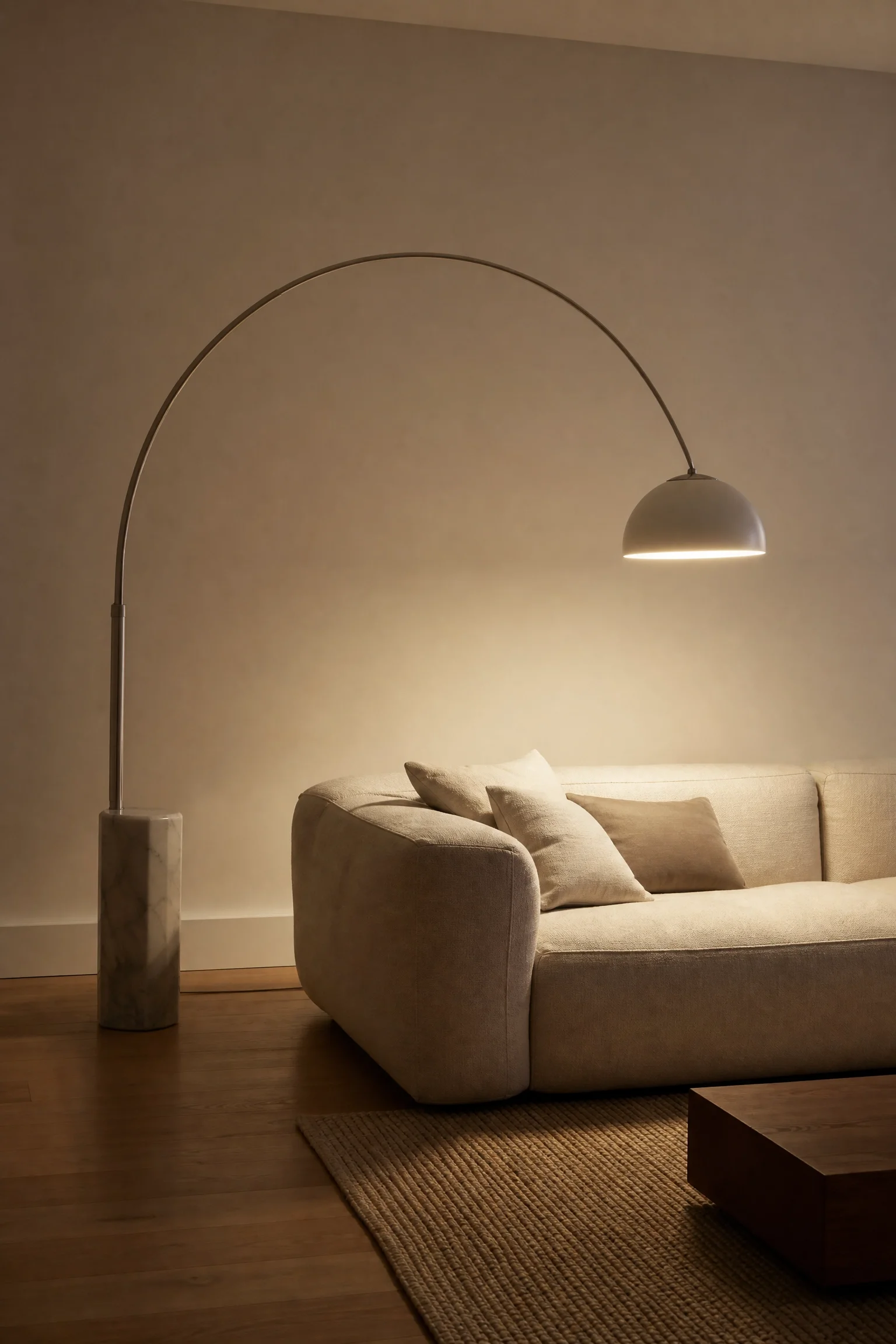
15. A Tall Arc Floor Lamp Over a Sofa
The arc floor lamp has been a design staple since the mid-century modern era, and it has not lost its usefulness. A tall arc lamp, with the base placed beside or behind a sofa and the arm extending out to position the shade directly over the seating area, solves a problem that comes up constantly in open-plan living rooms: how do you get overhead-quality light over a sofa without installing a ceiling fixture directly above it. The arc lamp does exactly that without any wiring. In a minimalist room, look for an arc lamp with a simple marble or stone base, which provides enough visual weight to balance the height of the arc, and a dome shade in white or black that directs light downward. This is genuinely one of the more versatile pieces in a minimalist living room because moving it is a matter of minutes. Mid-range arc lamps with a solid base run $150 to $400, and the quality difference between budget and mid-range is significant, particularly in the stability of the base.
Designer Note: Position the shade so its center sits directly over where you usually sit, not over the center of the sofa. The point of a reading arc lamp is personal light, not room light.
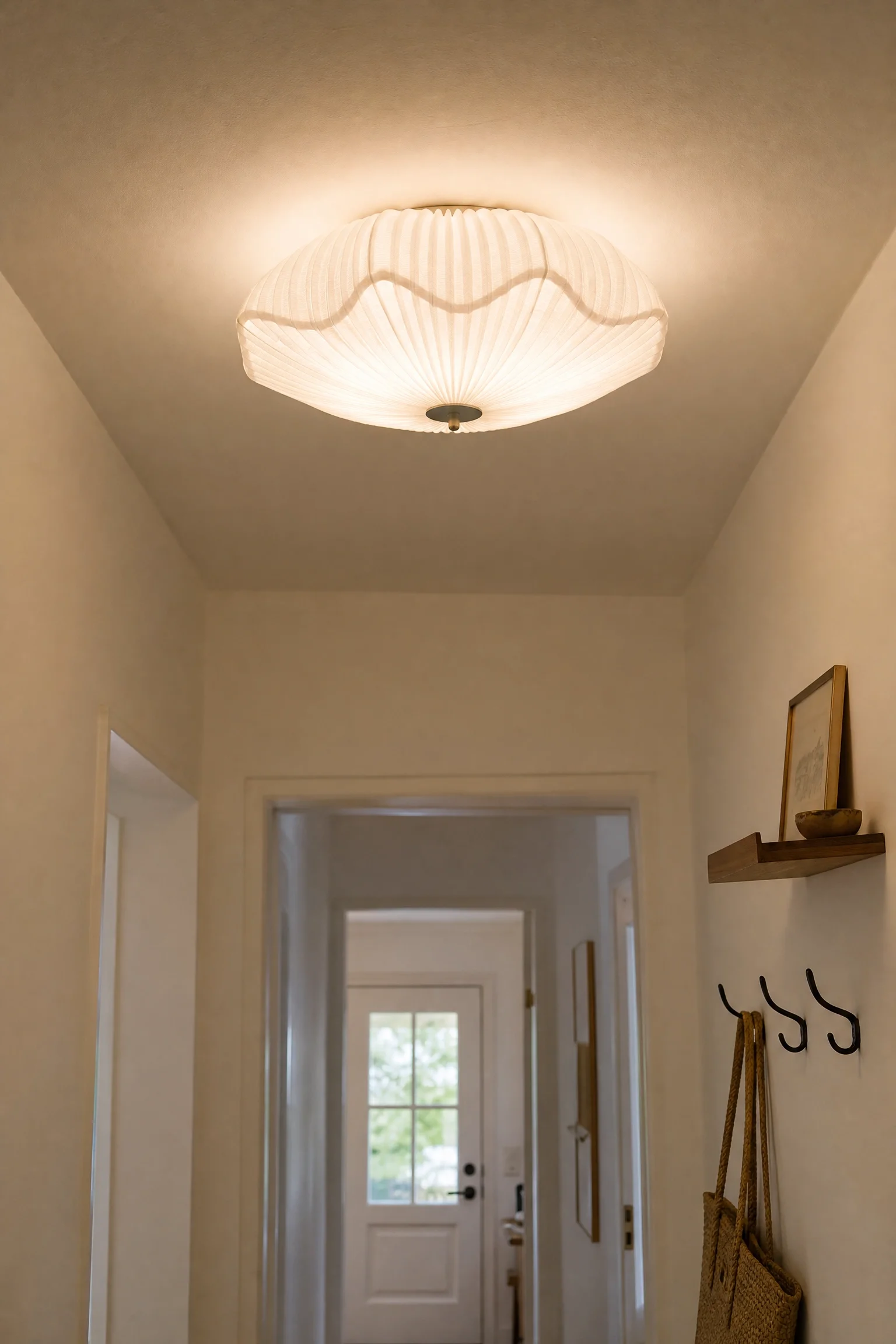
16. Flush Mount Fixtures With a Sculptural Profile
Flush mount ceiling lights have historically been the most boring category in lighting, the thing you install when you have no other choice and low ceilings. That has changed considerably in the past few years, with designers producing flush mounts that are genuinely interesting as objects while still sitting flat against the ceiling and taking up minimal visual space. In a hallway, small bedroom, or bathroom, a flush mount with a sculptural or geometric profile in a matte plaster finish, frosted glass, or pleated fabric becomes a ceiling feature rather than just a practical necessity. Look for fixtures that produce light in a warm, diffused way rather than casting downward in a single hard beam. Pleated fabric flush mounts in white or off-white are particularly effective because they glow softly from every angle and add texture to what is usually the most ignored surface in a room. Good options are available from $60 to $250.
Designer Note: In rooms with standard eight-foot ceilings, a flush mount with a profile no deeper than six inches keeps the ceiling feeling generous rather than crowded.
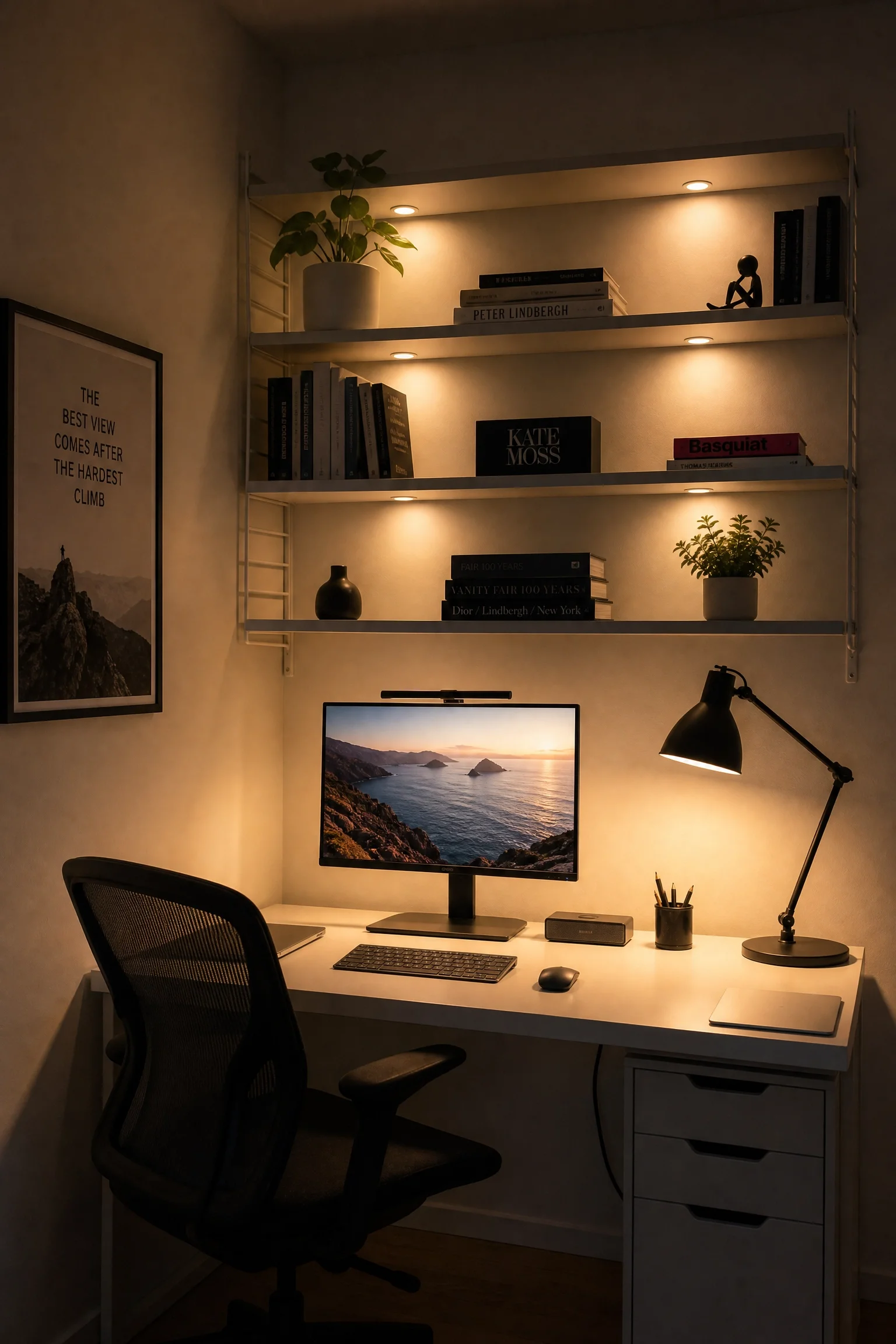
17. Integrated Shelf Lighting in a Home Office
A home office that relies entirely on overhead lighting will almost always feel harsh and tiring after a few hours. The most effective fix is integrating a light source directly into the shelving that likely already exists above or beside your desk. Small, slim LED puck lights mounted inside a bookcase or open shelf unit, aimed toward the back wall of the shelf, create a zone of warm ambient light that reduces the contrast between your bright monitor and the dark room behind it, which is one of the main causes of eye fatigue during long screen sessions. This is separate from your desk task light, which should still exist, but together they create the kind of layered office lighting that professional designers build into home offices from the start. Warm white at 3000K works well in a work context, bright enough to read by but not so cool as to feel clinical. Budget for LED puck lights ranges from $15 to $60 for a basic set with a remote dimmer.
Designer Note: Reduce screen brightness to match the ambient light level in your office rather than working with a very bright screen in a dark room. Shelf lighting makes this adjustment natural rather than forcing you to choose between the two.
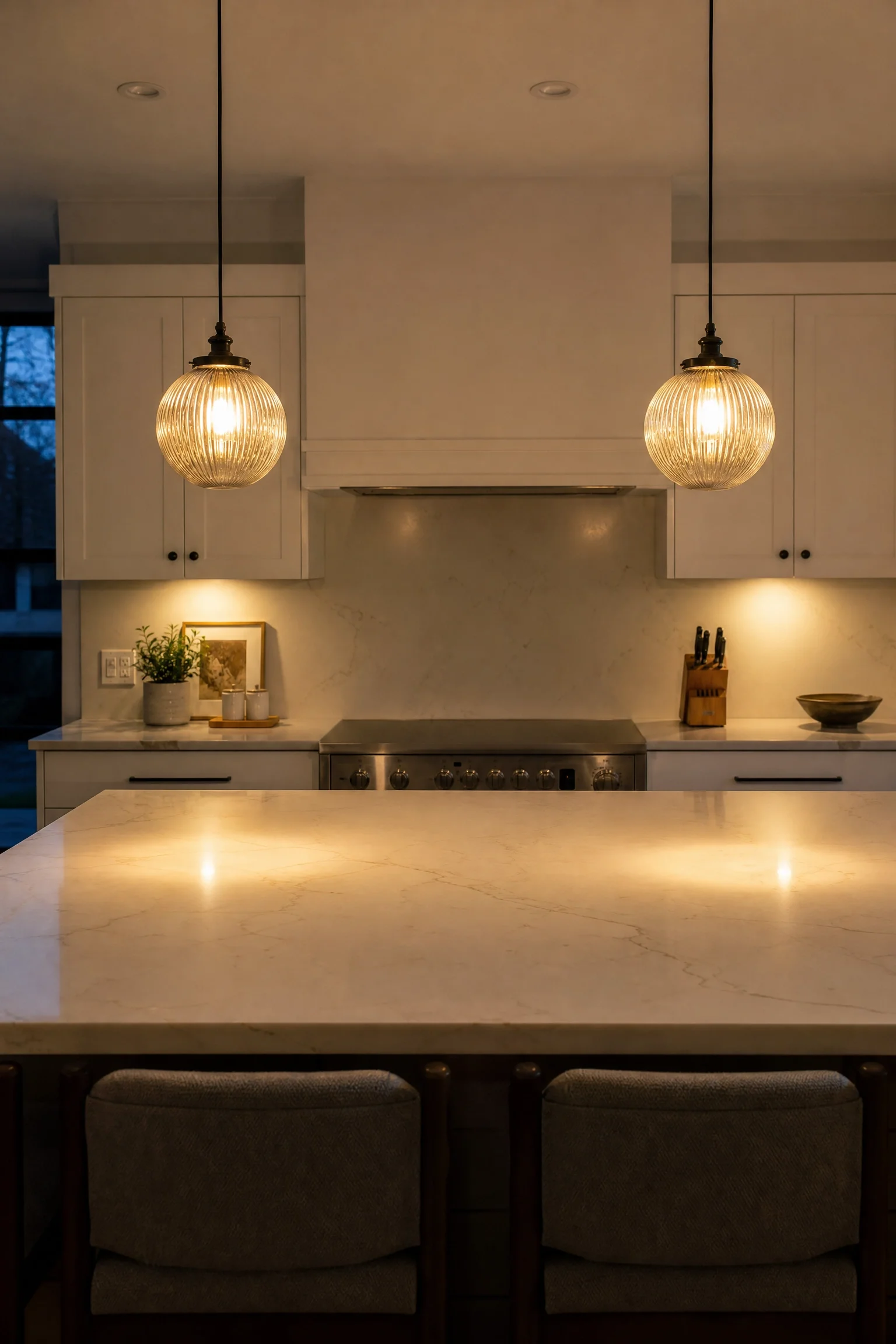
18. A Pair of Matching Pendants Over a Kitchen Island
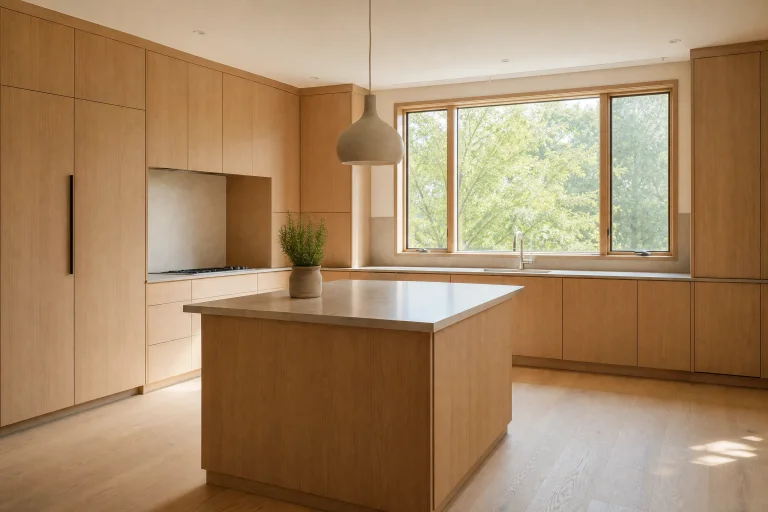
Two pendants over a kitchen island is one of those arrangements that looks so natural and balanced that it barely registers as a design decision, which is exactly the point. In a minimalist kitchen, matching pendants in a simple form, think small ribbed glass globes, matte ceramic domes, or thin brass cylinders, provide the kind of visual rhythm that makes a kitchen feel resolved rather than assembled. The key word is matching: two identical pendants spaced evenly create symmetry, and symmetry reads as calm. Mixed pendants can work in eclectic kitchens, but in a minimal one, the contrast creates visual noise rather than interest. Hang pendants so their bottoms sit 30 to 36 inches above the countertop, and space them roughly one-third of the island length apart, centered over the island as a pair. Use bulbs at 2700K to 3000K, and if your island is also where you prep food, consider pendants with a downward-focused shade to make sure the light actually reaches the work surface.
Designer Note: If your island is shorter than 48 inches, a single centered pendant will almost always look better proportionally than a forced pair.
19. Bathroom Vanity Lighting at Eye Level
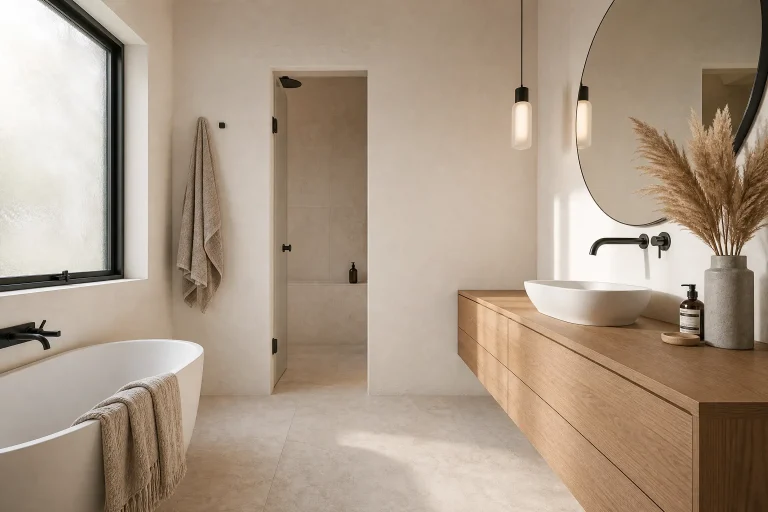
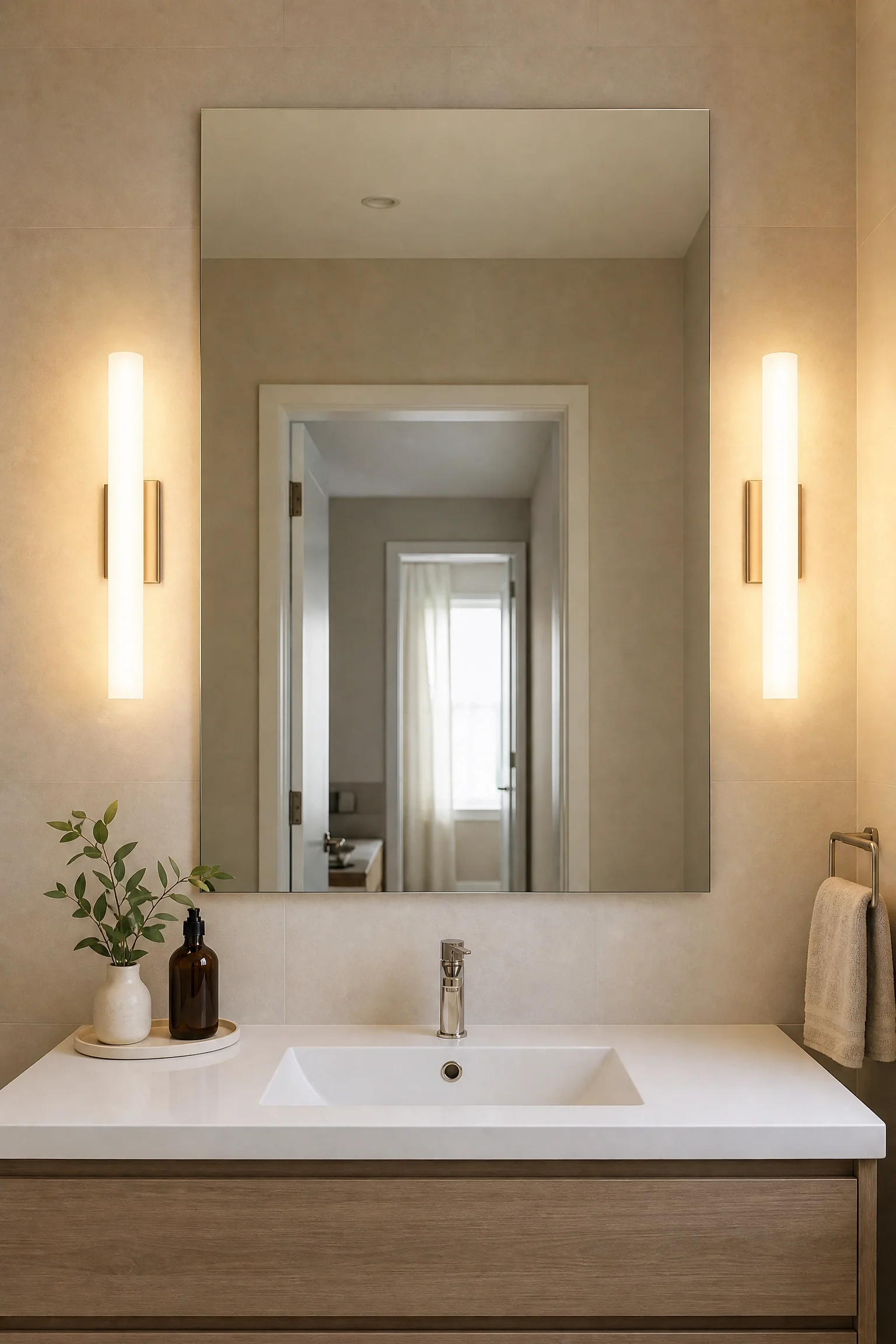
The classic mistake in bathroom lighting is a fixture mounted directly above the mirror, which creates downward shadows across the face and makes tasks like applying makeup or shaving harder than they need to be. In a minimalist bathroom, two simple vertical sconces mounted on either side of the mirror at eye level, roughly 60 to 65 inches from the floor to the center of the fixture, eliminate this problem entirely. The light comes from beside the face rather than above it, which is how flattering light always works. Choose sconces with a frosted glass or linen shade to diffuse the bulb and avoid harsh hotspots. In a small bathroom, a single sconce mounted to the side and slightly in front of the mirror can achieve the same effect. Warm white at 3000K is the right color temperature for a bathroom, close enough to daylight to be accurate for color matching while warm enough to feel comfortable first thing in the morning. Good bathroom sconces are available from $40 to $200.
Designer Note: Always use fixtures rated for damp locations in a bathroom, even if they are positioned away from the shower. Moisture travels farther than you expect in a small enclosed room.
20. A Low-Profile Bedside Table Lamp With a Linen Shade
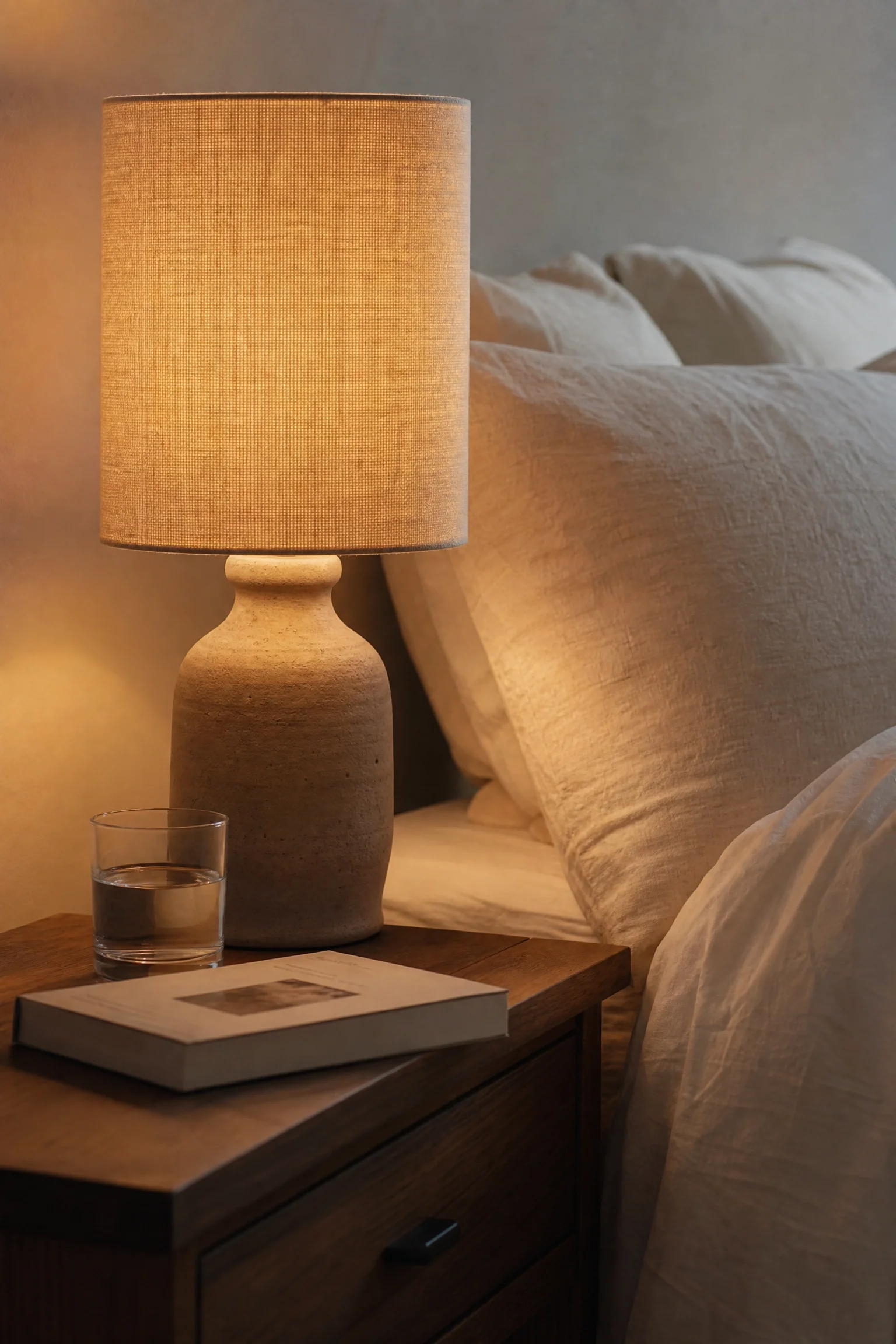
There is a specific kind of table lamp that belongs in a minimalist bedroom, and it is worth being precise about what it looks like. It has a base no taller than 12 inches, in a material that has some visual texture: turned wood, hand-thrown ceramic, or brushed brass. The shade is narrow and tapered or straight-sided rather than flared, in natural linen or cotton that lets light glow through rather than blocking it. This proportion, short and focused, keeps the lamp from competing visually with the bed or the headboard. It sits on the bedside table and does its job quietly. At 2700K with a 40-watt-equivalent bulb, it produces enough light for reading without brightening the whole room. This is the anti-statement lamp: it does not ask to be noticed, and that restraint is what makes it work in a room that is trying to feel calm. Good options exist at every price point, from $30 to $250, and the material of the base is the single biggest factor in whether it reads as considered or generic.
Designer Note: Avoid shades wider than the base of the lamp. A shade that overhangs its base dramatically draws too much attention upward and disrupts the quiet profile you are trying to achieve.
21. Moonlight-Effect Outdoor String Lights on a Covered Porch
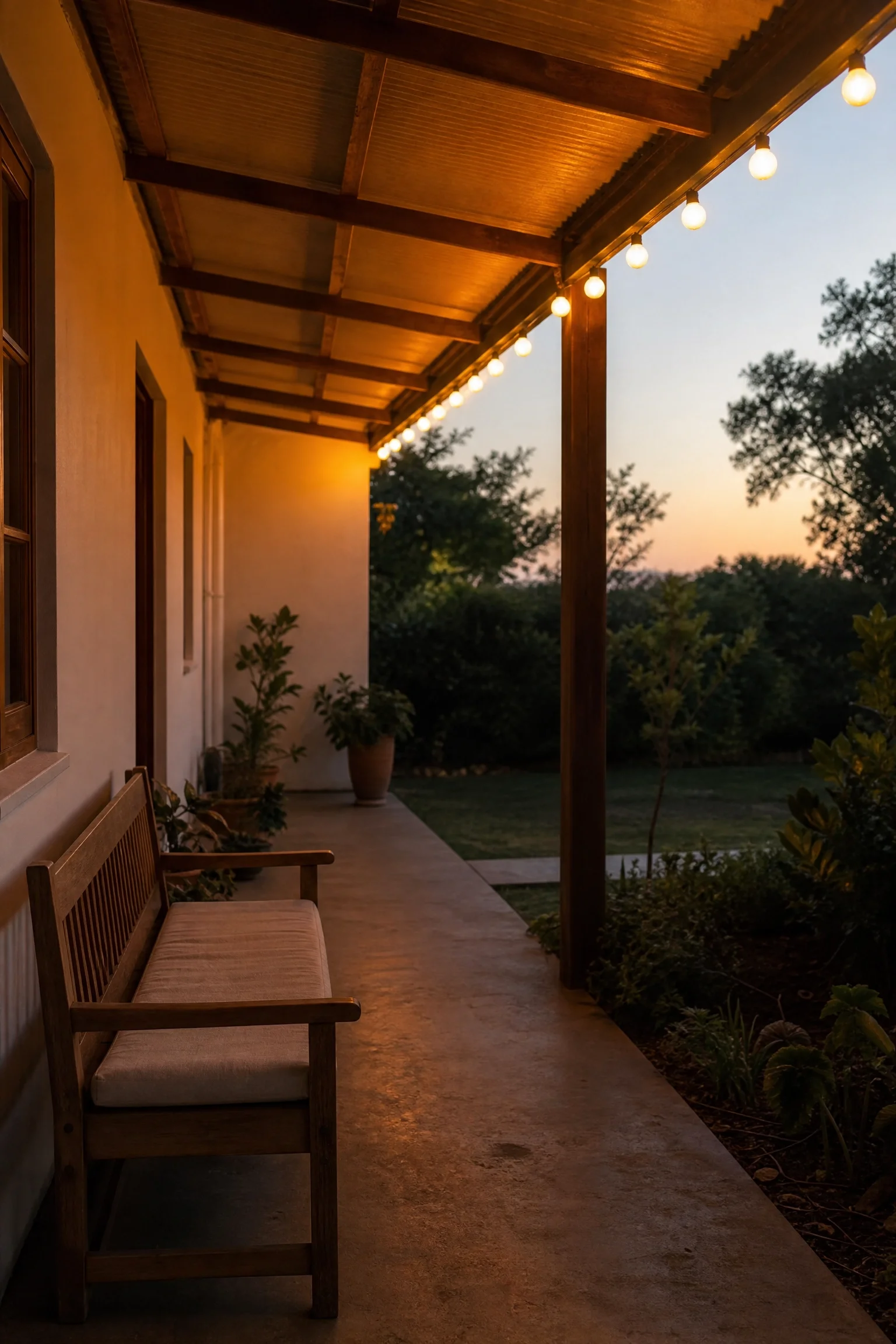
Outdoor spaces benefit from minimalist lighting principles just as much as indoor rooms, and a covered porch or small terrace is one of the easiest places to get this right without spending much money. The approach here is specifically not the grid of string lights draped in tight rows across the ceiling, which reads as festive rather than considered. Instead, run a single strand of warm globe lights loosely along the outer edge of the porch roof, just above the sightline, so the light appears to come from the perimeter rather than the center. Use globe bulbs in a warm 2200K amber tone with a matte or frosted finish rather than clear glass, which creates pools of soft light rather than visible bright points. The effect, especially at dusk when there is still a little natural light remaining, is often described as moonlight coming through a canopy: warm, directionless, and soft. Quality outdoor string lights rated for wet locations run $25 to $70 for a 25-foot strand.
Designer Note: Plug your outdoor string lights into a timer or smart plug set to come on at dusk and go off at midnight. Lights that turn off on their own feel more intentional and less like they were forgotten.
Final Thoughts
Good lighting in a minimalist home is one of those things that rarely announces itself. When it is working, the room just feels right. You are not thinking about the fixtures or the bulbs or where the light is coming from. You are just comfortable, or productive, or relaxed, depending on what the room is for. That is the real goal of minimalist lighting: to create a quality of light that matches how you want to feel in a space, and then to step out of the way.
The ideas here are not about following trends or buying expensive fixtures. Most of them are achievable on a modest budget with a bit of planning and attention to color temperature, placement, and scale. The consistent thread across all of them is intention. Every light source in a minimalist room should be there for a reason, doing something specific. When you approach a room’s lighting that way, asking what each fixture needs to contribute rather than just where a lamp might look nice, you end up with spaces that feel genuinely calm and considered. That is worth the effort.
Start with one room. Pick one idea from this list that addresses something that has always bothered you about a particular space. Try it. The change is almost always more significant than you expect, which is the quiet power of getting lighting right.
FAQ
What color temperature is best for minimalist lighting?
For most living spaces including bedrooms, living rooms, and dining rooms, a color temperature of 2700K is the most versatile choice. It produces warm white light that feels comfortable and residential rather than clinical. For kitchens and home offices where you need a bit more alertness and color accuracy, 3000K works well. Avoid anything above 4000K in a home setting unless you have a specific need for daylight-accurate color rendering, such as a photography or art studio.
Do I need a dimmer switch for minimalist lighting?
Not strictly required, but a dimmer switch makes an enormous difference in how a room feels at different times of day. The ability to reduce a living room or bedroom from full brightness at 100 percent to a low warm glow at 20 percent means a single light source can serve multiple purposes without you needing to add or remove fixtures. Dimmer switches for standard LED bulbs cost around $15 to $30 and are a straightforward DIY installation for most standard wall switches.
How many light sources does a minimalist room actually need?
The honest answer is that it depends on the size and purpose of the room, but as a general guideline, most rooms benefit from at least two to three light sources operating at different heights. A single overhead light is almost always insufficient for a comfortable living room or bedroom, regardless of its brightness. The goal is to be able to adjust the lighting to match your activity, bright for tasks and reading, dim and layered for evenings and relaxation. Two or three sources used together achieve this in a way that one fixture cannot.
Can minimalist lighting work in a small room without making it feel dark?
Yes, and it often works particularly well in small rooms. The key is to use wall-mounted fixtures and pendants rather than floor lamps, which take up visual and physical space. Recessed lighting, wall sconces, and pendants keep the floor clear and the walls open, which makes a small room feel larger rather than more crowded. Light-colored lampshades that allow light to glow through rather than directing it downward in a single beam also help distribute warmth throughout the room.
Is it worth investing in smart lighting for a minimalist home?
Smart lighting can be genuinely useful in a minimalist home, particularly if you find yourself managing multiple rooms and wanting consistent control over color temperature and brightness throughout the day. Systems that adjust from a warmer tone in the morning and evening to a slightly cooler, brighter tone during working hours can support your natural rhythm without requiring you to think about it. That said, smart lighting is an investment, starting at around $50 per bulb for quality systems, and it is worth being honest about whether you will use the features. If a simple dimmer switch achieves what you need, it is a better choice.
What is the biggest lighting mistake people make in minimalist rooms?
Relying on a single overhead light source is the most common and most damaging mistake in minimalist rooms. A ceiling fixture at full brightness casts flat, shadowless light that makes even a beautifully designed room look two-dimensional and uncomfortable. The second most common mistake is choosing the wrong color temperature, typically a cool white or daylight bulb in spaces meant for relaxation. Both of these issues are inexpensive to fix: add one or two secondary light sources and swap your bulbs to a warmer temperature, and most rooms improve dramatically.