Dining Room Mirror Placement Ideas That Make Every Dinner Better

The mirror goes up, the room looks fine, and then at the first dinner party a guest asks why they can spend the whole meal watching themselves eat. Mirror placement in a dining room is entirely about controlling what the glass reflects, and every idea here starts with that reflection first, because a mirror aimed at the wrong thing does more damage to a dining room than no mirror at all. That rule sounds counterintuitive but holds up every time.
1. Hang It to Reflect the Chandelier and Double the Candlelight
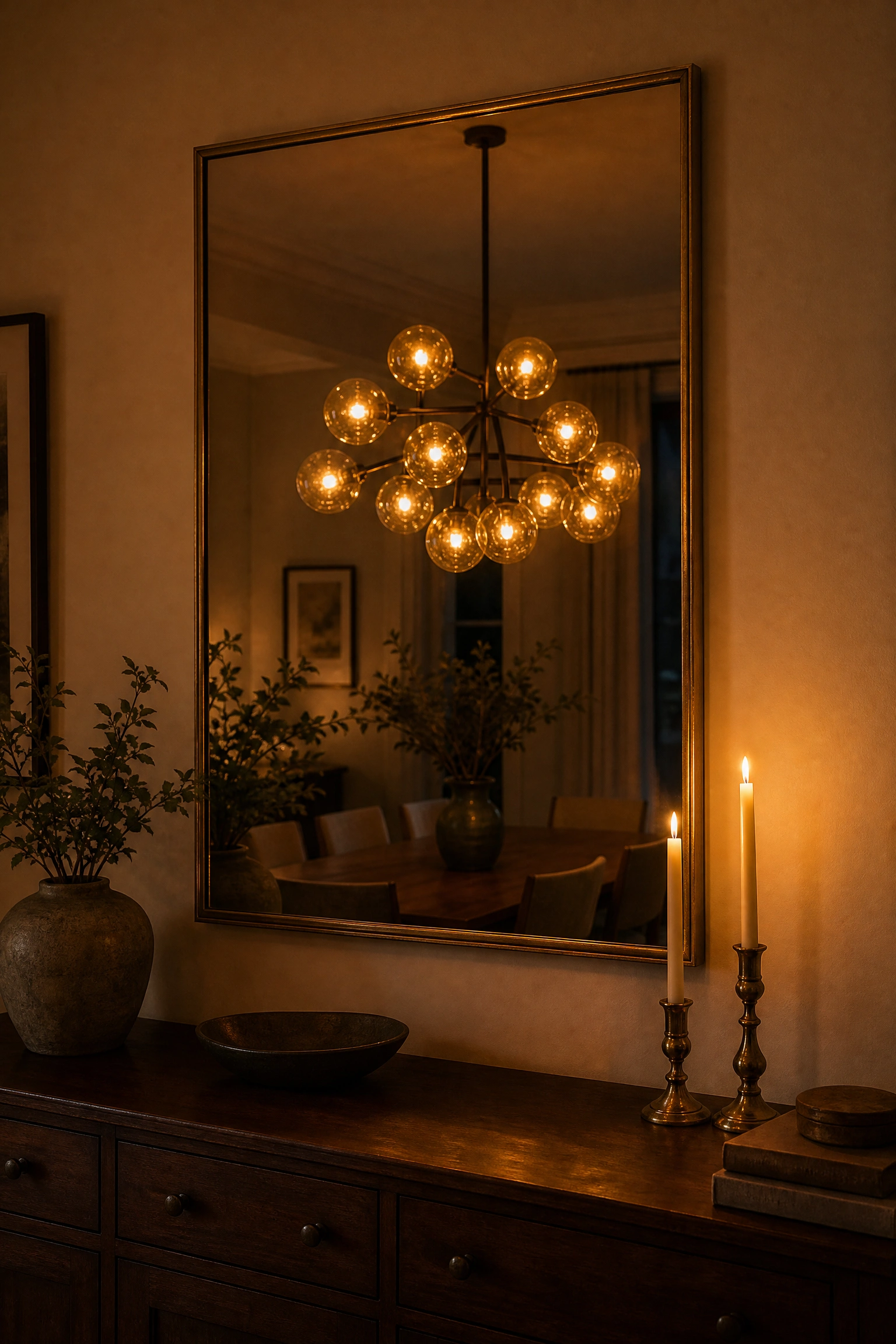
Positioning a mirror on the wall opposite or beside the dining chandelier so the fixture appears in the reflection is the single most effective placement decision in a dining room, because warm pendant or candlelight reflected back across the room reads as a second light source and gives dinner gatherings a depth and warmth that no additional lamp or fixture can replicate at the same cost. Use warm-toned bulbs at 2700K in the chandelier before hanging the mirror, because the mirror amplifies whatever light it is given, and cool white light reflected back across a dinner table feels clinical rather than inviting.
Pro Move: Hang the mirror before the dinner gathering and observe what it catches at table height during the evening. The reflection of candlelight or a warm chandelier glow changes the atmosphere of a dining room more dramatically at night than any daytime placement test will reveal.
2. Position It to Reflect a Window and Bring Daylight Across the Room

A mirror placed on the wall opposite a dining room window bounces natural daylight back across the table and into the darker zones of the room, making a north-facing or naturally dim dining room feel noticeably brighter without any electrical work and giving the glass a genuine functional purpose beyond decoration. Centre the mirror at the same height as the window opening rather than at standard eye level so the reflection captures the full window rectangle including the sky, which reads as a second window rather than a bright patch on an otherwise blank wall.
Reality Check: In a dining room where direct afternoon or morning sun hits the window for several hours, a mirror placed exactly opposite will create uncomfortable glare across the table during those periods. Angle the mirror 10 to 15 degrees off a perfectly parallel position to bounce diffused light without sending a direct sun reflection into seated guests.
3. Hang It Above the Sideboard to Reflect the Table Setting

The classic dining room mirror placement, a large rectangle or oval hung above a sideboard or buffet with the bottom edge 4 to 8 inches above the furniture surface, works because the reflection captures the dining table, the floral arrangement, the candlesticks, and the gathered guests from across the room, giving the space a sense of visual depth and communal warmth that a bare wall behind the sideboard completely lacks. Hang the mirror so its centre sits at standing eye level, approximately 57 to 63 inches from the floor, so the reflection reads correctly when guests are moving through the room rather than only when they are seated.
Designer Advice: Size the mirror to between two-thirds and the full width of the sideboard below it. A mirror significantly narrower than the sideboard looks stranded and disconnected from the furniture it is meant to anchor; one wider than the sideboard overwhelms the relationship between the two pieces.
4. Angle It to Capture a Garden or Outdoor View
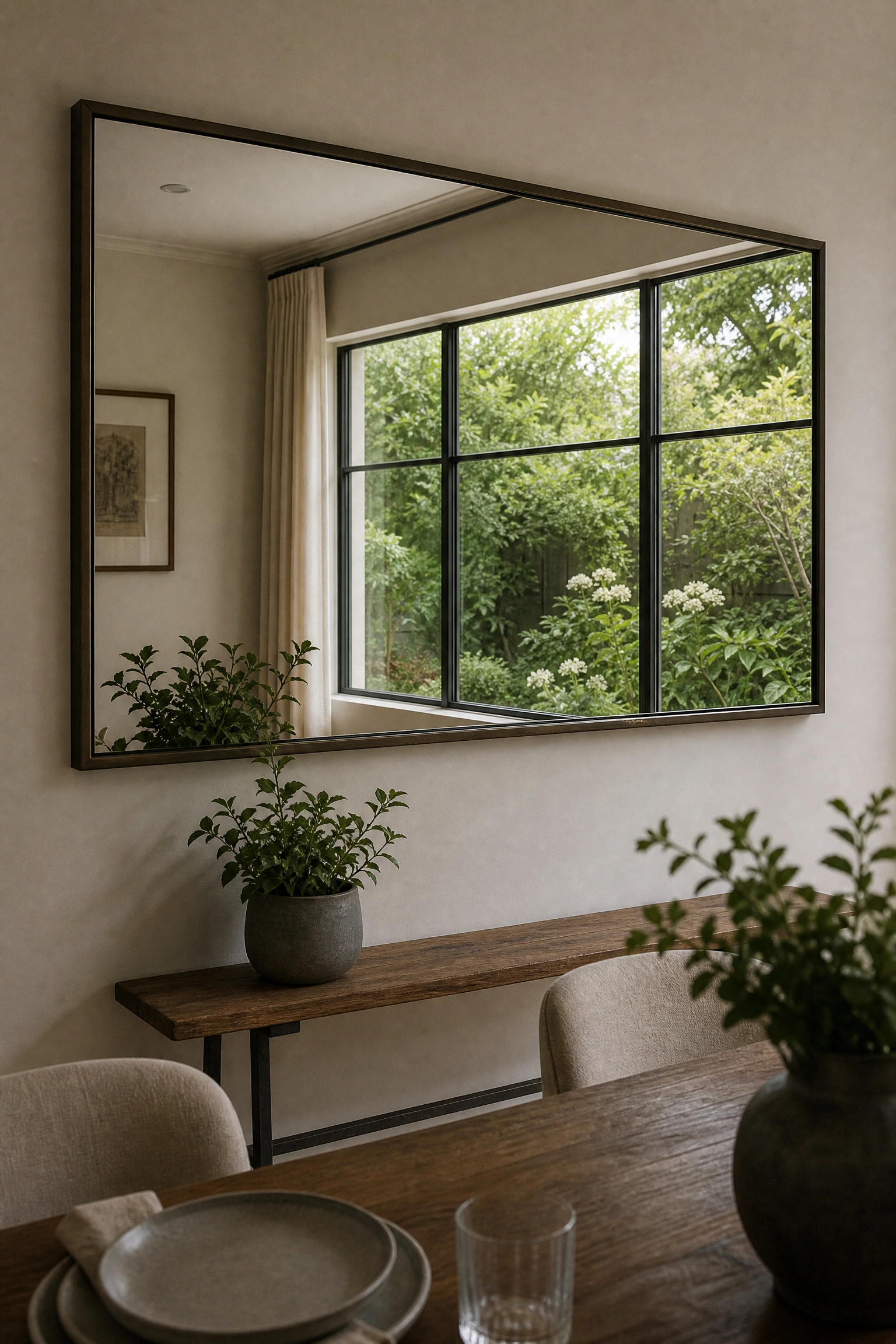
A mirror placed on a side wall and angled slightly so its reflection catches a window with a garden, courtyard, or tree view beyond it brings the outdoor landscape into the dining room from a position that would not otherwise have that view, effectively giving diners the pleasure of looking toward green and open space from a seated position without requiring an additional window. This placement requires standing at the mirror position and checking what the glass actually captures before hanging, because even a small change in the angle of incidence significantly changes what appears in the reflection.
Heads Up: Before drilling a single anchor hole for this placement, hold the mirror against the wall at the intended position and look at the reflection from the primary dining seat to confirm it captures the outdoor view rather than the kitchen doorway or a cluttered corner. Test the angle first with a picture-hanging strip.
5. Use a Full-Length Mirror on a Long Narrow Wall to Extend the Room

In a dining room that is noticeably longer than it is wide, a full-length or floor-to-near-ceiling mirror on one of the short end walls makes the room appear to continue beyond the wall and gives the table arrangement the visual breathing room it needs to feel placed within a generous space rather than wedged into a narrow one. The frame should be minimal, a slim metal edge or a simple wood surround, so the boundary between mirror and wall reads as architectural rather than decorative and the illusion of depth holds from across the room.
Reality Check: A full-length mirror on the end wall of a narrow dining room will reflect whoever sits at the head of the table directly back at themselves throughout the meal, which most people find distracting rather than atmospheric. Hang it high enough that the primary reflection captures the upper room and ceiling rather than seated faces, or angle it very slightly upward toward the ceiling.
6. Place It to Reflect a Piece of Art on the Opposite Wall
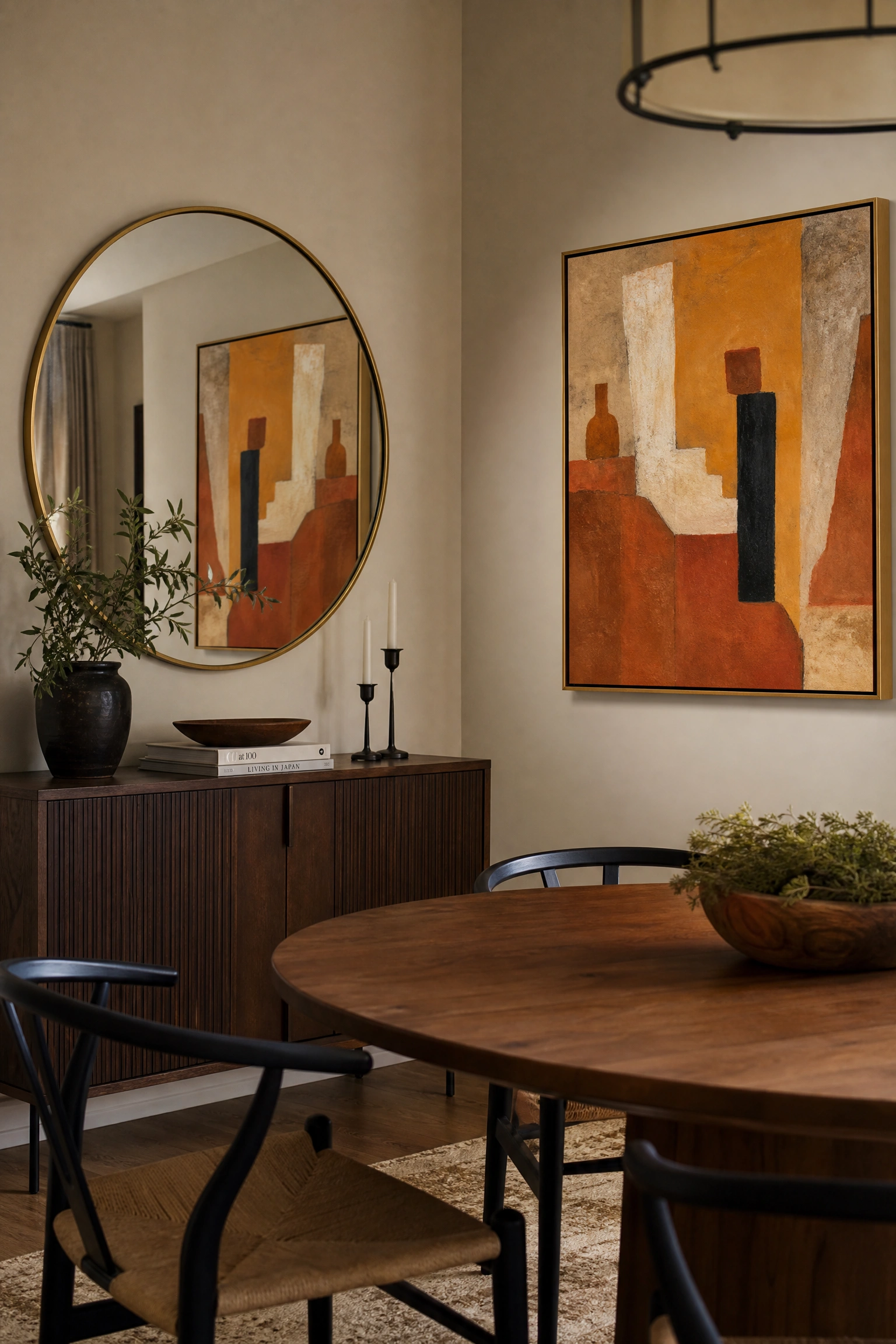
Hanging a mirror on one wall so its reflection captures a significant piece of artwork on the opposite or adjacent wall makes the art visible from two positions in the room simultaneously and gives the dining space the quality of a curated gallery where the design decisions are clearly in conversation with each other. This placement works best when the art is a large, strong piece that deserves to be seen from multiple angles rather than a small print that loses its presence in a mirror reflection from across the room.
Pro Move: Stand at the mirror wall and look at the reflection before hanging to confirm the art appears fully and centrally in the glass. A mirror that reflects only a partial corner of a painting reads as an error rather than an intentional pairing, and the adjustment needed is often just a few inches in either direction.
7. Hang It High Enough That No Seated Guest Sees Their Own Face

The most widely reported discomfort with dining room mirrors is that guests spend the meal watching themselves eat, which is entirely a height error rather than a placement error, and the fix is to hang the mirror so its bottom edge sits high enough that the reflection at table height captures the room behind the diners rather than the faces of people seated at the table. In practice this means positioning the mirror so a person seated at the table sees the wall above their chair back in the reflection, not their own face, which typically requires the bottom edge of the mirror to sit at least 54 to 60 inches from the floor.
Designer Advice: Test seated reflection height before fixing the mirror permanently by holding it at the intended position and sitting at the dining table to check what appears in the glass at eye level from a seated position. This one test prevents the most common dining room mirror complaint.
8. Create a Mirror Panel Wall Behind the Head of Table Position

A large framed mirror or a pair of matched mirrors installed on the wall at the head of the table position, rather than on a side wall, creates an architectural focal point that makes the main host seat read as the composed and intended centre of the room rather than simply the chair nearest the kitchen, and the reflection behind the host captures the length of the table and the gathered guests in a way that gives the room a formal, considered quality borrowed directly from traditional European dining room design. Size the mirror or mirror pair to fill at least two-thirds of the wall width between dado rail and ceiling for the placement to read as intentional rather than decorative.
Reality Check: A mirror at the head of the table position will reflect whoever sits opposite the host directly back at that guest throughout the meal. Confirm that the person most often in that seat is comfortable with the arrangement before committing to a permanent installation.
| Placement Goal | Where to Hang It | What to Avoid Reflecting |
| Double chandelier warmth | Wall facing or beside the fixture | Cool white bulbs, bare ceiling |
| Bring in daylight | Opposite a window, centred on the glass | Direct south/west sun causing glare |
| Anchor the sideboard | Above sideboard, 4-8 inches gap | Clutter on the sideboard surface below |
| Capture outdoor view | Side wall angled toward garden window | Kitchen doorway or utility areas |
| Extend a narrow room | Short end wall, full height | Seated guest faces at eye level |
| Reflect art | Opposite or perpendicular to the artwork | Partial corner of a painting |
| Add architectural weight | Head of table wall, two-thirds wall width | Guest directly opposite host seat |
| Brighten a dark corner | Dark corner wall beside a warm lamp | Blank walls or dark unlit surfaces |
9. Use a Round Mirror Above a Round Table for Visual Harmony

A round mirror hung above or beside a round dining table creates a formal repetition of circular forms that reads as a deliberate compositional decision rather than a coincidence of furniture choices, and the unified circular theme carries through to any round chandelier hanging above, giving the dining zone a layered geometry that is one of the cleanest and most satisfying visual arrangements in interior design. Size the round mirror so its diameter is slightly smaller than the table diameter so the mirror reads as a companion form rather than a competing one.
Heads Up: Round mirrors above round tables work best when the room has enough wall height to allow the mirror to hang clear of the furniture and still read as a full circle from across the room. In rooms with ceilings below 9 feet, the proportions can feel compressed and a tall oval mirror often reads more elegantly than a round in the same position.
10. Hang a Wide Horizontal Mirror to Make a Low Ceiling Feel Higher
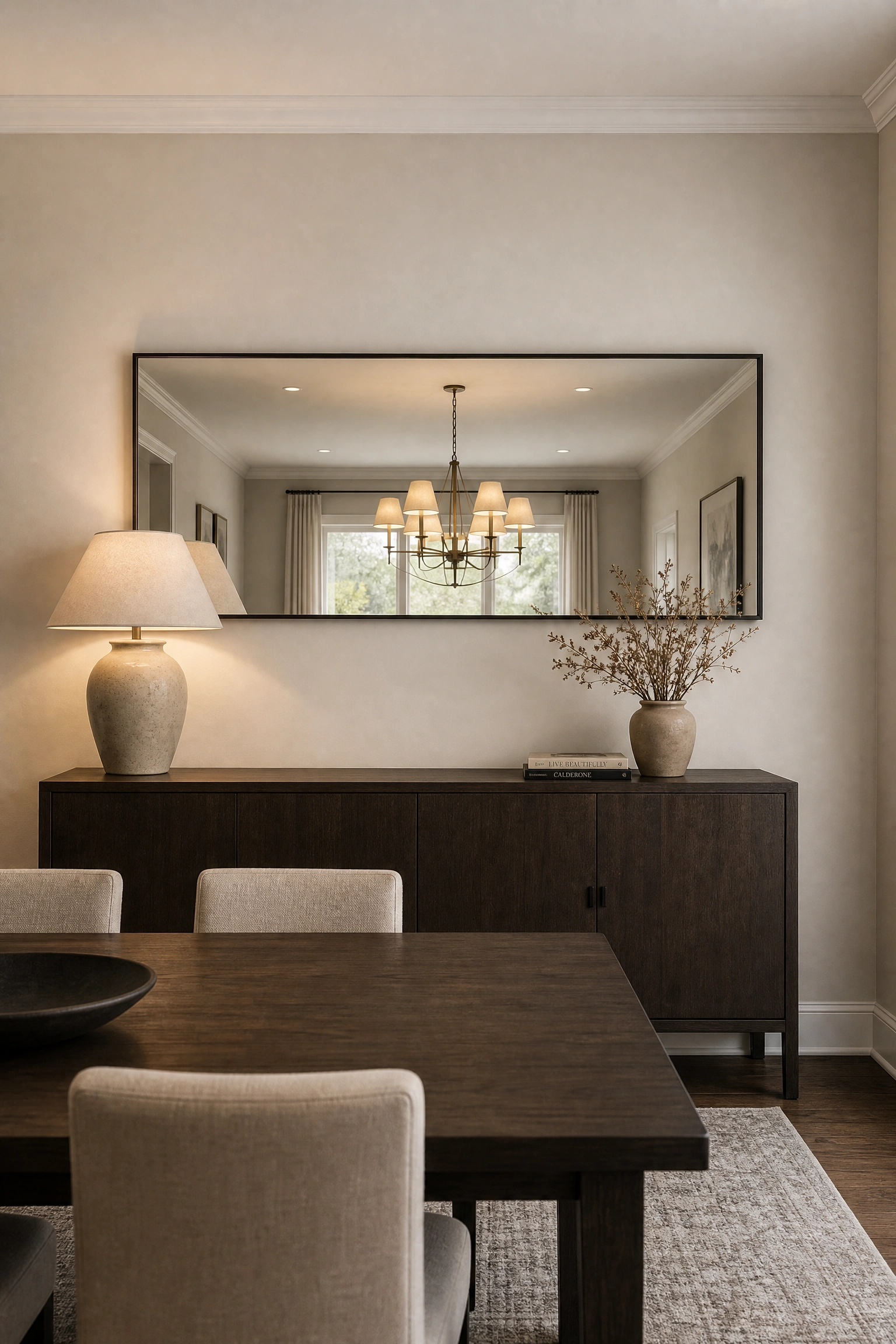
A wide landscape-format mirror hung horizontally above a sideboard or along the main dining wall reflects the ceiling and the upper portion of the room, making the ceiling read as further away than it actually is and giving a dining room with standard 8-foot ceilings the quality of a room with more generous proportions. The horizontal emphasis of the mirror also echoes and reinforces the horizontal plane of the dining table below it, creating a tonal visual relationship between the two surfaces that makes the room read as more considered from the entrance.
Pro Move: Pair a wide horizontal mirror with a chandelier that hangs low over the table so the fixture appears in the reflection alongside the table below it. The mirror then reads as a frame for the full dining composition rather than simply a piece of wall decor.
11. Use a Leaning Floor Mirror in a Dining Room That Cannot Be Drilled

A large mirror leaned against the dining room wall rather than hung on it delivers all the same reflective benefits of a wall-mounted mirror, including light amplification, perceived depth, and visual interest, without requiring any wall anchors, which makes it the right solution for renters, for rooms with difficult wall materials like poured concrete or old plaster, or for anyone who wants the flexibility to reposition the mirror as the room evolves. Lean it against the wall beside or behind a sideboard rather than in a bare space so it reads as an intentional element anchored by the furniture beside it rather than a mirror that has simply not yet been hung.
Designer Advice: A leaning mirror in a dining room must be secured with two small furniture anchor straps attached to the wall above at the back of the frame to prevent it from toppling if the floor is uneven or if the mirror is accidentally knocked. A falling mirror in a dining room is a serious safety risk regardless of how stable it appears when first positioned.
12. Place a Narrow Tall Mirror in a Compact Dining Corner

A tall narrow mirror, with a height-to-width ratio of at least 3:1, placed in the corner of a compact dining room draws the eye vertically and makes the corner read as a designed destination rather than a dead zone, while the reflective surface bounces light from the surrounding room back into what is typically the darkest area of the space. Position a small table lamp on a nearby surface so the mirror has something warm to reflect in the corner, because a mirror that captures only a dark corner and a blank wall does nothing useful for the room.
Reality Check: Mirrors in dining room corners work well only when the corner itself is tidy and styled. A corner mirror that reflects an electrical outlet, a shoe rack glimpsed from an adjacent hallway, or stacked dining chairs doubles the visual noise rather than resolving it.
13. Hang a Mirror to Reflect Candlelight on the Table During Evening Meals

Positioning a mirror specifically to catch the reflection of candles on the dining table at the typical evening dining hour, rather than to capture daylight or the chandelier, is the placement decision that most noticeably changes the atmosphere of the room during actual meals because the flickering, moving reflection of real candlelight in a dining room mirror creates a depth and warmth that no static light source produces. Place the mirror at an angle where the candle flames appear in the lower portion of the glass rather than at the top, so the warmth of the reflection fills the space at table level where it does the most atmospheric work.
Pro Move: Use unscented pillar candles or LED flame candles on the table in front of the mirror during styling tests before the first dinner gathering to confirm the mirror captures the flame rather than the candle base or the table surface. The height and angle of the candle holder determines what the mirror sees.
14. Use a Vintage or Antique Mirror for a Dining Room with Age and Character

An antique mirror with foxing, slight silvering variation, or a patinated frame adds a material history to a dining room that a new mirror in any finish cannot replicate, and the slightly imperfect reflection of an aged mercury glass mirror gives the room a romantic, atmospheric quality during evening meals that a perfectly clear contemporary mirror does not produce because the aging of the reflective coating softens and flatters the room it captures. Source antique mirrors from estate sales, specialist dealers, and auction houses rather than buying reproduction aged mirrors, which imitate the look of age without having it.
Heads Up: True antique mercury glass mirrors with significant foxing or clouding reflect less clearly than modern mirrors, which can read as beautiful in a warm-lit evening dining room but underwhelming in the context of the daytime light-bouncing function. Assess an antique mirror in low warm light before purchasing to confirm the reflective quality suits the dining room use case.
15. Hang a Mirror Between Two Sconces to Create a Formal Wall Treatment

A mirror flanked symmetrically by two matching wall sconces on the dining room wall creates the most formally composed wall treatment available in a dining room, referencing the classical proportional logic of candelabra-flanked mirrors in Georgian and Regency dining rooms that communicated wealth and order through symmetry, and the sconces on each side illuminate the mirror’s frame and the surface below while the mirror reflects the warm sconce light back across the dining table. Choose sconces with a candlelight-style flame bulb at 2200K to 2700K so the light they cast and the light they reflect reads as warm and flattering rather than bright and functional.
Designer Advice: The mirror and sconces in this composition must all be centred on the same vertical axis and the sconces must be hung at identical heights on each side or the symmetry reads as an attempt at perfection that narrowly missed, which is worse than an asymmetric arrangement.
16. Place a Mirror Behind Open Shelving to Add Depth to a Display

Installing a mirror flush against the dining room wall behind a set of open floating shelves makes the ceramics, glassware, and small plants displayed on the shelves appear to float in front of a reflective depth, turning a practical storage and display solution into something that reads as a considered architectural detail, and the reflected light that the mirror bounces forward through the shelved objects adds a glow to the display that no overhead or undershelf lighting achieves as naturally. Use a frameless or slim-framed mirror so the glass reads as part of the wall rather than a competing object behind the shelves.
Pro Move: Position a small warm lamp on one of the shelves so the mirror reflects the lamp through the objects stored in front of it. The glow through ceramics and glassware with a warm amber source behind it produces an effect at dinner time that looks like the shelves are internally lit.
17. Hang a Large Square Mirror as a Graphic Focal Point on a Plain Wall

A large square mirror, uncommon enough in shape that it reads more as a piece of wall art than a standard rectangular mirror, hung on a plain dining room wall at eye level with nothing else on the wall creates a graphic, contemporary focal point that suits dining rooms where the furniture and palette are already doing enough decorative work and the wall needs one strong, clean element rather than a gallery or a pattern. Size it generously, at least 36 by 36 inches and ideally larger, so the square reads as a significant design decision rather than a tile-like accessory that gets lost on a full dining room wall.
Heads Up: A large square mirror placed at standard eye level in a dining room will reflect whoever sits opposite it during meals. Confirm before hanging that the reflection captures the room above the chair backs rather than the faces of seated guests by testing from a seated position before fixing the final wall anchors.
18. Use a Sunburst or Starburst Mirror as a Standalone Dining Room Statement

A sunburst or starburst mirror in aged gold or antique brass hung on the dining room wall without any furniture or art supporting it beneath reads as a standalone sculptural statement that suits dining rooms where the walls are otherwise simple and the mirror is expected to carry the full decorative weight of the space, because the radiating form has enough visual presence to hold a wall without needing a sideboard or console beneath it in the way that a flat rectangular mirror does. Choose one with a diameter of at least 28 to 36 inches from tip to tip of the outermost rays so it reads as significant from across the dining table.
Pro Move: Hang a sunburst mirror on the wall at the end of the dining room that is visible from the entrance so it is the first and last element a guest sees when moving through the space. Its radiating form makes it the natural focal point and gives the room a clear visual hierarchy from the moment someone walks in.
19. Install a Full Mirrored Panel on a Feature Wall for Maximum Impact

A floor-to-ceiling or near-full-height mirror panel on the main dining room wall creates the most dramatic expansion of perceived space available without any structural change, making a small dining room read as significantly larger from every seated position at the table and giving the room the quality of a grand European brasserie or a high-end restaurant where mirror panels are used to create visual depth and social energy simultaneously. Use a frameless installation or a very slim metal channel edging so the panel reads as an architectural surface rather than a piece of furniture leaning against the wall.
Reality Check: A full mirror panel wall in a dining room reflects every guest at every seat throughout the meal. This reads as glamorous and energetic to some households and deeply uncomfortable to others. Consider who actually eats in the room regularly before committing to an installation that cannot easily be reversed.
20. Use a Mirror to Connect an Open-Plan Dining Zone to the Living Area

In an open-plan space where the dining and living areas share a floor but lack architectural separation, a large mirror placed at the boundary between the two zones reflects each area into the other and makes the two spaces read as connected rather than simply adjacent, and the reflection of the living area seen from the dining table and vice versa creates a sense of visual continuity that a physical partition would deliberately prevent. Position it on the low dividing element between the zones, a bookcase back panel, a partial wall, or a console table, so it reads from both sides of the open plan equally.
Designer Advice: A mirror used to connect two open-plan zones should reflect the most attractive elements of each zone in its glass. Before installing, stand on each side of the intended position and look at what the glass would capture. If one side reflects a beautiful vignette and the other reflects the television or the kitchen bin, reposition rather than proceeding.
21. Group Multiple Small Mirrors Into a Dining Room Gallery Arrangement

A cluster of five to nine small mirrors in varied shapes, round, oval, hexagonal, arched, and irregular, hung in a composed arrangement on the dining room wall creates a reflective gallery that catches light from multiple angles simultaneously and reads as a piece of wall art in its own right, because the multiple small reflective surfaces together produce a dynamic brightness that shifts through the day in a way that no single large mirror achieves. Keep all frames in the same finish, aged brass, matte black, or natural wood, so the varied shapes read as a collected set rather than unrelated pieces placed near each other.
Heads Up: Lay the full arrangement on the dining room floor before putting a single nail in the wall. Mirror gallery arrangements planned mentally rather than physically almost always require significant adjustment during installation, and each misplaced anchor hole in a dining room wall is visible at close range.
22. Hang an Arched Mirror to Soften a Formal Rectangular Dining Room

An arched mirror, with its curved top referencing the architectural arch found in classical doorways, windows, and alcoves, introduces a soft form into a dining room where every other element, the table, the chairs, the windows, and the door frames, is rectangular, and this single curved silhouette softens the formality of the space in a way that makes a traditional or contemporary dining room feel more approachable and human without losing any of its considered quality. Hang it with significant wall space above the arch peak to the ceiling so the curved top reads as a complete form rather than a truncated shape crowded by the ceiling above it.
Reality Check: Arched mirrors in dining rooms read most convincingly when they are generously tall. A small arched mirror, under 24 inches in height, loses the architectural quality of the arch form and reads as simply a decoratively shaped small mirror rather than a reference to classical architectural proportions.
23. Use a Triptych of Three Matching Mirrors Above a Long Sideboard

Three identically sized and framed mirrors hung in a horizontal row at equal spacing above a long dining room sideboard creates a formal, composed wall treatment that reads as architectural rather than decorative and mirrors the horizontal linearity of the sideboard below with the same discipline, making the sideboard wall read as a single considered composition rather than a piece of furniture with three objects floating above it. Space the mirrors 3 to 5 inches apart so they read as a deliberate set rather than three separate pieces placed near each other, and hang all three at identical heights from the same reference measurement.
Pro Move: Use a long level and measure each mirror position from the sideboard surface rather than from the floor, since sideboard surfaces are more precisely level than most floors and produce a more reliably even result for multiple-mirror arrangements.
24. Place a Mirror to Reflect the Dining Table Centrepiece

Positioning a mirror at an angle where it captures the dining table centrepiece, a floral arrangement, a sculptural candelabra, or a composed tablescape, in its reflection effectively doubles the visual presence of the centrepiece and makes it visible from multiple seats at the table and from the room entrance simultaneously, which is the design move that makes a well-styled table feel like the genuine centre of a designed room rather than a vase placed on a surface. The mirror should be close enough to the table that the centrepiece appears clearly in the reflection rather than as a small element in a wide-angle view of the full room.
Designer Advice: Change the centrepiece seasonally and observe how each iteration looks in the mirror reflection. The mirror is more honest than any photograph about how the centrepiece reads from across the room, and it will reveal whether an arrangement that looks good up close has the visual weight to carry a dining room from a distance.
25. Hang a Pair of Matching Mirrors Symmetrically to Frame a Focal Wall

Two identical mirrors hung symmetrically, one on each side of a dining room focal feature such as a window, a fireplace, or a piece of art, create a formal bracketing composition that references the paired candlestick or sconce tradition in classical interiors and makes the central feature read as more deliberately placed and architecturally significant than it would if standing alone on an otherwise bare wall. Match the frame finish of the paired mirrors to the most dominant metal in the room, brass to brass, iron to iron, or wood to wood, so the symmetry reads as a designed system rather than a coincidental pairing.
Heads Up: Paired mirrors hung symmetrically require both pieces to be installed at precisely the same height and the same distance from the central feature. Measure both positions from the same reference points before drilling, and use a long level to confirm the top edges of both mirrors align before the anchors are set.
26. Use a Frameless Mirror for a Minimal Contemporary Dining Room

A frameless mirror installed with slim clip hardware in a contemporary or minimalist dining room reads as an architectural element, a window or opening in the wall, rather than a piece of furniture added to the room, which is the correct quality for a space where every object is expected to have a reason and a frame would read as unnecessary ornamentation. Frameless mirrors require proper J-channel edging or grip-clip mounting hardware rather than adhesive alone, because the weight of unframed plate glass over time causes adhesive-only installations to fail without warning and a falling mirror in a dining room is a serious hazard.
Reality Check: Frameless mirrors in dining rooms must be installed by someone who understands the specific wall material and its load-bearing requirements. Drywall, plaster, concrete, and tile each require different anchor types and load ratings, and a large frameless mirror installed incorrectly is one of the higher-risk decorating decisions in any room.
27. Position a Mirror in a Dark Dining Alcove to Brighten It

A dining table positioned in an alcove, a bay window recess, or a structural nook gains natural light and visual depth from a mirror placed on one of the alcove side walls, angled to bounce ambient light from the main room back into the contained space and making the alcove feel bright and open rather than enclosed and shadowy. Choose a warm-framed mirror in aged brass, warm wood, or antique plaster for an alcove mirror so the frame reads as part of the warm intimacy of the enclosed space rather than a cool architectural element that makes the alcove feel even more contained.
Pro Move: A warm lamp placed on the dining table inside the alcove with a mirror on the side wall reflects the lamp light back into the space and creates a layered warmth in the alcove during evening meals that makes the enclosed nook feel genuinely intimate rather than simply small.
28. Use a Mirrored Sideboard or Console to Add Reflective Depth at Furniture Level

A sideboard or console with a mirrored top surface or mirrored drawer and door fronts adds reflective depth to the dining room at furniture level rather than at wall level, catching the candlestick bases, the underside of a floral arrangement, and the warm lamplight from below in a way that a wall-mounted mirror cannot achieve, and the reflected surfaces at tabletop height make the objects displayed on the sideboard read as more present and three-dimensional than the same objects sitting on a matte wood surface. A fully mirrored sideboard is a significant commitment; a sideboard with a single mirrored top panel or mirrored insert panels reads as more restrained and suits a wider range of dining room palettes.
Designer Advice: Keep the surface styling on a mirrored sideboard minimal. The mirrored surface doubles every object placed on it visually, which means three candlesticks read as six and a vase with five stems reads as ten. A restrained arrangement of two or three objects reads as edited and deliberate; a crowded arrangement doubles into visual chaos.
Every dining room mirror placement decision comes down to two questions: what does the glass reflect, and what does that reflection do for the people eating in the room. Answer both before the anchor goes in and the mirror will work every time.