How to Build a Bohemian Living Room That Looks Collected, Not Cluttered
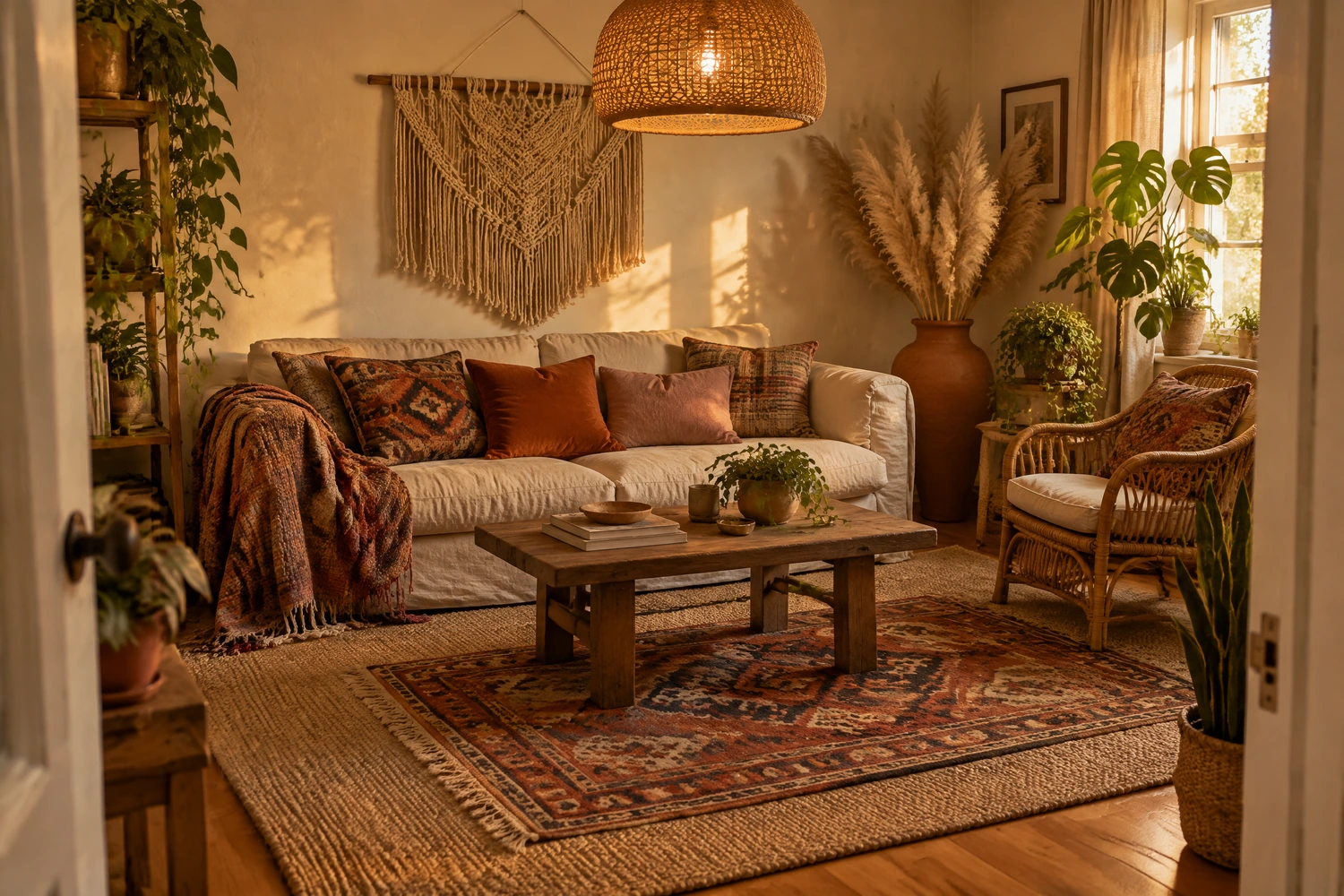
Bohemian style is the easiest aesthetic to get wrong and one of the most rewarding to get right. The mistake most people make is treating it as a permission slip for anything and everything, buying whatever feels interesting and adding it to a room until the room stops feeling like a living space and starts feeling like a styled shop. A well-done bohemian room is not random. It is layered, which is a very different thing. There is an earthy, warm palette holding everything together beneath the surface. There are materials with genuine weight and presence. There is a clear focal point the room builds around, and there are personal objects with real stories rather than mass-produced bohemian signifiers. These 28 ideas follow the order in which a bohemian room is actually built, from the ground layer through to the finishing details, so you can assemble the aesthetic with intention rather than accumulation. The distinction between those two outcomes is visible from the doorway.
LAYER ONE: THE PALETTE AND GROUND
1. Anchor the Palette in Earthy Warm Neutrals

A bohemian room needs a grounding palette beneath all its pattern and layering, and the most reliable foundation is a warm earthy neutral: terracotta, sand, warm ochre, raw linen, or aged cream. These tones absorb and unify the pattern and color that goes on top of them, preventing the room from reading as chaotic. The walls, the main sofa, and the largest rug should all sit within this warm neutral base, even if they are in slightly different tones. Once the neutral ground is established, jewel tones, pattern, and accent colors can be layered on top without the room losing its coherence. A bohemian room built on cool grey or pure white as its neutral base almost always looks harder and less inviting than one built on warm earth.
Designer Advice: Choose one warm neutral as the dominant tone and apply it to the walls and the largest piece of furniture. Every other color in the room becomes an accent when this ground is in place, which gives you freedom to layer pattern and color without the room becoming visually overwhelming.
2. Add Jewel Tones as Accent Colors

Deep jewel tones, terracotta, burnt orange, dusty rose, olive green, ochre, teal, and plum, are the accent layer that gives a bohemian room its warmth and depth. These colors appear in the cushions, throws, smaller rugs, ceramics, and art, never as the room’s dominant tone but always as the layer that makes the neutral ground feel rich rather than plain. The most effective bohemian rooms use two or three jewel tones that relate to each other, such as terracotta, olive, and dusty plum, rather than a rainbow of competing colors. These tones repeat across different surfaces and heights throughout the room so the eye can move between them and register the space as a considered palette rather than a collection of unrelated colors.
Quick Tip: If the room currently has no jewel tone and reads as flat, add one terracotta object, one in a muted olive, and one in a warm dusty pink to three different surfaces. The repetition of three related tones across the room creates the beginnings of a bohemian palette without requiring any major changes.
3. Layer Multiple Rugs to Ground the Seating Zone

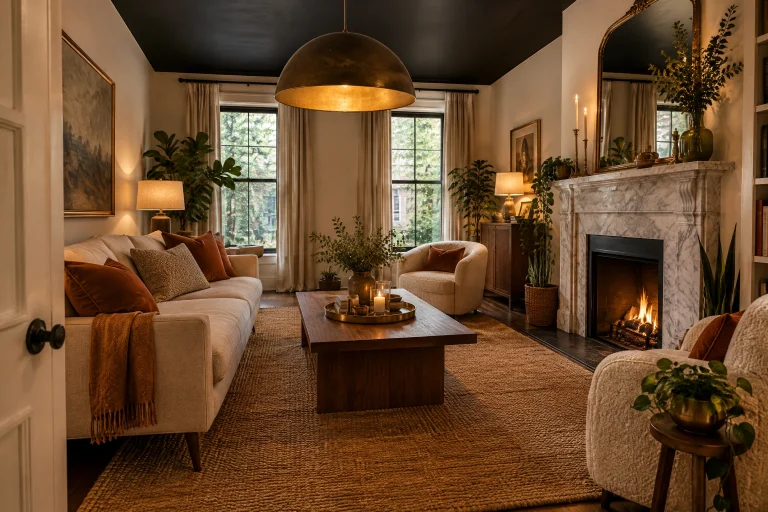
Layered rugs are one of the most defining characteristics of a well-executed bohemian living room, and they work both aesthetically and practically. A large natural fiber rug in jute, sisal, or flatweave wool provides the base layer and the correct scale, extending under all the main seating furniture. A smaller kilim, a Moroccan beni ourain, a Turkish vintage flatweave, or a Persian-style rug in a warm pattern is layered on top, slightly off-center, to add pattern and color without requiring a single large expensive patterned rug beneath the entire room. The layering creates visual depth at floor level that a single rug cannot achieve, and it allows pattern and neutral to coexist in the same zone without competing.
Pro Move: Turn the layered rug slightly off-axis rather than aligning it squarely with the base rug and the furniture. The slight angle reads as casual and effortless rather than composed, which is exactly the quality that separates a bohemian room from a styled showroom.
4. Use Warm Wood Floors or Treat Existing Floors With a Dark Stain
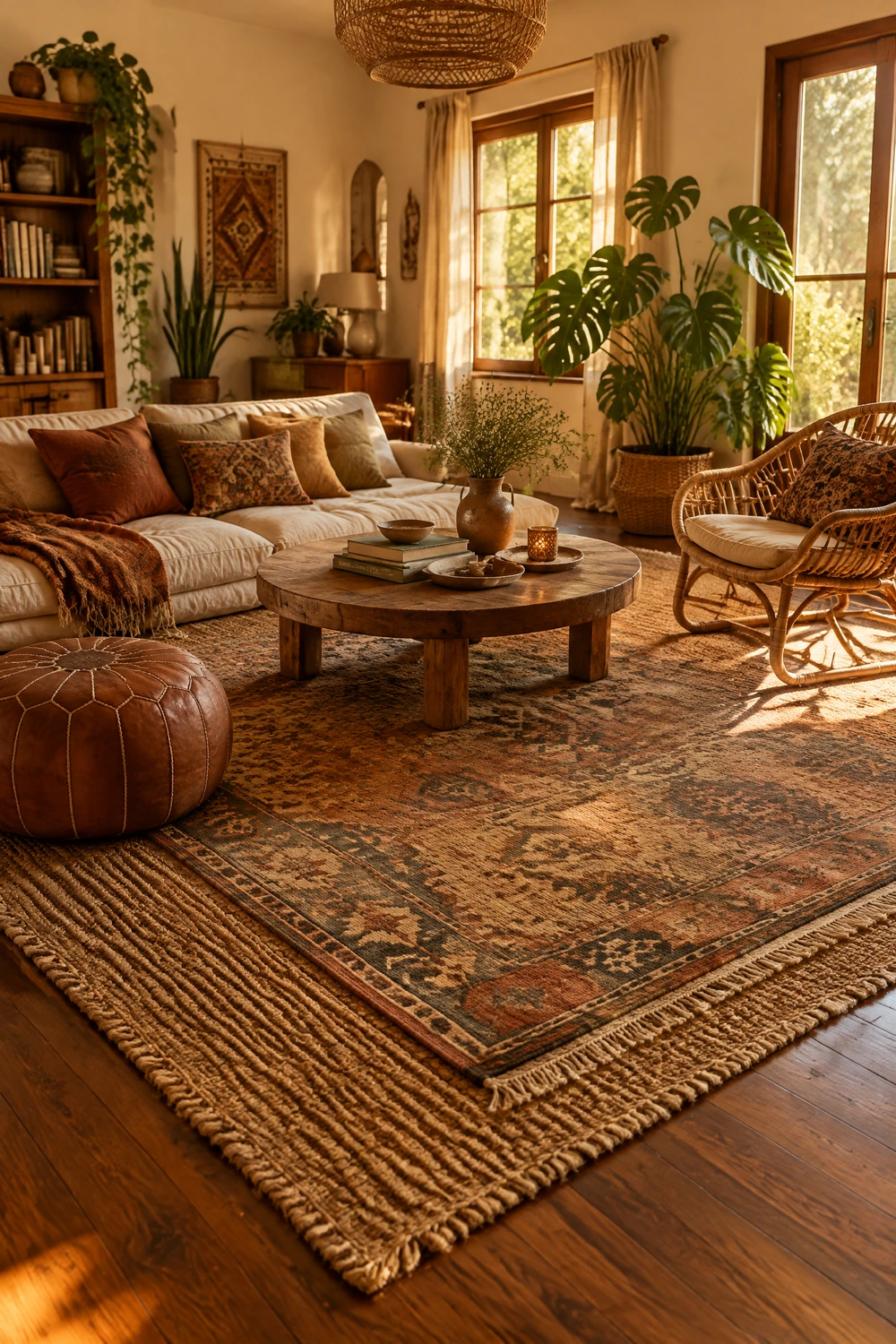
Warm wood flooring, whether natural, reclaimed, or treated with a warm medium-dark stain, is the floor finish that most effectively supports a bohemian room’s earthy palette. Cool grey floors or bright white tile fight the warm tones of a bohemian scheme. Dark or warm wood recedes beneath the layered rugs and furniture and allows the room’s warmer upper surfaces to dominate visually. Where flooring cannot be changed, a very large rug covering the majority of the floor surface achieves the same effect by making the flooring a background rather than a feature. Painted floor boards in a warm cream or terracotta are another deposit-safe option that changes the floor plane dramatically at low cost.
Heads Up: Bare concrete floors and bohemian decor rarely read well together because the cool, hard quality of concrete fights the warmth and softness that the style depends on. If concrete is the existing floor, cover as much of it as possible with large rugs before adding any other bohemian elements.
LAYER TWO: THE FURNITURE BONES
5. Choose a Low-Slung Sofa in a Warm Fabric

A low sofa, either a floor-level daybed, a mid-century low profile sofa, or a sofa with a visible solid base close to the floor, creates the relaxed, grounded quality that is central to the bohemian aesthetic. High-backed, high-legged sofas read as formal and push against the style’s inherent casualness. The fabric should be in a warm natural material: linen, cotton canvas, a woven slubby fabric, or a textured blend in a warm neutral tone. The sofa does not need to be perfect or new. A slightly worn linen sofa with visible texture reads as more authentically bohemian than a crisp, pristine upholstered piece.
Reality Check: A low sofa is only comfortable if it is deep enough to sit in properly. A sofa that is low but not deep enough to recline into becomes uncomfortable within twenty minutes. Depth of seat is more important than height in a bohemian seating arrangement.
6. Mix Rattan, Cane, and Wicker Furniture

Rattan chairs, cane-backed sofas, wicker armchairs, and bamboo side tables are among the most versatile and most specifically bohemian furniture choices available because they bring organic texture and lightness to a room that might otherwise feel heavy with layers of textiles. A single rattan armchair beside the sofa, a cane-backed chair at a desk, or a wicker side table beside the reading lamp each add the organic visual quality that mass-produced upholstered furniture cannot. The lightness of these materials also balances the visual weight of layered rugs and textiles below and around them, which prevents the room from feeling overly dense.
Designer Advice: Rattan and cane furniture benefit enormously from a cushion. A bare rattan seat is uncomfortable and visually incomplete. A flat linen cushion in a warm tone, tied to the seat back, adds comfort and color simultaneously and makes the piece read as intentionally styled.
7. Add Floor Cushions and Poufs for Low Seating

Floor cushions, Moroccan leather poufs, and large woven ottomans are the seating elements that most distinguish a bohemian living room from any other style. They add flexible, low-level seating that signals comfort and a relaxed approach to how the room is used, and they fill corners and zones that a conventional armchair would not reach. A cluster of floor cushions in different sizes and patterns beside the sofa or around a low coffee table creates the layered, gathered quality that photographs well and lives even better. Moroccan leather poufs in cognac, dusty rose, or olive green are durable, practical, and instantly recognizable as part of the bohemian vocabulary.
Quick Tip: Store extra floor cushions in a large woven basket beside the sofa when they are not in use. A basket full of floor cushions reads as both practical and decorative, and it keeps the room from looking cluttered when the cushions are not being used as seating.
8. Incorporate a Vintage or Antique Statement Piece

One genuinely old piece of furniture, a carved wooden chest, a rattan peacock chair from the 1970s, a brass-inlaid Moroccan side table, a mid-century credenza, or a heavily carved wooden coffee table, anchors a bohemian room in authentic history in a way that no amount of new bohemian-look furniture can replicate. The patina, the imperfections, and the visible age of a vintage or antique piece communicate that the room was assembled over time and with intention rather than bought in a single shopping trip. It does not need to be expensive: thrift stores, online marketplaces, and estate sales are consistently the best sources for the kind of worn, interesting furniture that a bohemian room needs.
Pro Move: Let the vintage or antique piece be the room’s one genuinely irreplaceable element. Everything else in the room can be replaced or updated, but the vintage piece gives the room its specific character. Choose it first and build the room’s palette around its existing tones.
9. Use a Carved Wooden or Brass Coffee Table

A carved wooden coffee table, a hammered brass tray table, a low Moroccan mosaic-topped table, or a raw-edge timber slab on simple metal legs each bring the kind of artisanal, handmade quality that is central to the bohemian aesthetic. The coffee table sits at the visual center of the room and determines how the seating zone reads, which makes it worth prioritizing over more peripheral furniture choices. A hand-carved table with visible tool marks, an imperfect hammered brass surface, or a reclaimed timber top with its history visible in its grain each tell a story of making rather than manufacturing, which is the quality that most distinguishes bohemian furniture from its mass-produced alternatives.
Heads Up: A very low coffee table requires floor cushions or low seating around it to function properly. A table that is 12 to 16 inches high pairs well with floor cushions and poufs. A table at standard coffee table height, around 18 inches, pairs better with conventional sofa seating.
LAYER THREE: THE TEXTILE LAYERS
10. Layer Cushions in Mixed Patterns and Textures

The cushion arrangement on a bohemian sofa is one of the most expressive and most frequently overdone elements of the style. The key is mixing patterns and textures within a consistent palette rather than simply piling on as many as possible. A kilim-patterned cushion, a velvet cushion in a jewel tone, a printed cotton cushion in a botanical motif, and a plain textured linen cushion in the palette’s neutral ground tone sit together cohesively because they share a color family even though no two of them match. The texture mixing, rough kilim weave beside smooth velvet beside slubby linen, is what gives the arrangement its richness and prevents it from reading as simply a lot of cushions.
Reality Check: There is a point at which cushions become an obstacle rather than a comfort. If sitting on the sofa requires removing more than three cushions, there are too many. Bohemian style is about generosity, not excess.
11. Drape a Vintage Kantha or Block-Printed Throw Over the Sofa

A vintage kantha quilt, a block-printed Indian cotton throw, or a hand-woven ikat blanket draped loosely over the sofa arm or back is one of the most specifically bohemian textiles available, because these pieces carry the evidence of hand production in their slightly uneven patterns, their visible thread, and their gentle fading. A vintage kantha particularly, stitched together from repurposed saris, brings a warmth and depth of color that no mass-produced throw replicates. These textiles are widely available from Indian textile suppliers, vintage markets, and online specialty stores, and they are often inexpensive relative to the visual richness they add.
Designer Advice: Drape the throw so the pattern is partially visible rather than folded away entirely. A block-print or kilim-patterned throw that is simply folded in thirds on the sofa arm shows almost nothing of its pattern. Unfold it to show two-thirds of the print and the design becomes part of the room’s visual story.
12. Hang a Kilim or Mix as a Wall Textile

A kilim rug hung on the wall, a woven mix in earthy tones, or a large block-printed textile suspended from a wooden dowel transforms a blank wall into the room’s most textured and most visually complex surface. Wall textiles in a bohemian living room do more than artwork can: they add warmth, absorb sound, and bring handmade quality to a vertical surface at a scale that most framed prints cannot match. A kilim hung above the sofa in warm reds, terracottas, and dark blues provides both pattern and color at exactly the right height and width to anchor the entire seating arrangement beneath it.
Quick Tip: Hang a textile wall piece from a wooden dowel or a simple brass curtain rod with end caps rather than nailing it directly to the wall. The dowel adds a natural element to the top of the piece and allows the textile to hang flat and straight without distortion.
13. Add a Macrame Wall Hanging in a Featured Position

Macrame has moved decisively past its brief period of overexposure and into a position of genuine design interest, particularly in larger, more complex forms. A substantial macrame wall hanging, at least 24 inches wide, with varied knotting techniques and fringe detail, adds handmade texture and vertical interest to a bohemian room in a way that is specific and organic. The natural cotton or jute cord reads as warm and earthy against a terracotta or cream wall, and the three-dimensional quality of the knotted surface catches light differently throughout the day in a way that flat art never does. A large, well-made macrame piece earns its place as a room-defining feature rather than a decorative afterthought.
Reality Check: A small macrame piece on a large wall reads as an afterthought. Scale is what makes macrame work as a design element. A large, complex piece with multiple knotting levels and generous fringe reads as intentional art. A small simple piece reads as a craft project.
14. Layer Floor-Length Curtains in Linen or Sheer Cotton

Floor-length curtains in natural, undyed linen or sheer cotton hung close to the ceiling and extending beyond the window frame on both sides add the softness and movement that a bohemian room needs at the window. Sheer or semi-sheer linen allows light to filter through in a warm, diffused quality that is specifically suited to the style’s organic, sun-drenched aesthetic. Where privacy requires a heavier curtain, a layered approach, a sheer linen panel in front of a lightweight cotton blackout behind, maintains the visual lightness at the window while handling the practical requirement. Curtain rods in natural wood, aged brass, or dark iron all suit the bohemian aesthetic better than chrome or silver.
Pro Move: Allow floor-length bohemian curtains to pool one to two inches on the floor. The slight puddle reads as relaxed and generous rather than impractically long, and it is exactly the kind of deliberately casual detail that gives a bohemian room its effortless quality.
LAYER FOUR: THE WALL STORY
15. Create a Gallery Wall of Mixed Frames and Media

A bohemian gallery wall differs from a conventional one in its deliberate embrace of variety: frames in different materials and finishes, natural wood beside aged brass beside painted rattan, sizes ranging from small square prints to large portraits or abstract canvases, and media mixing photographs, original artwork, pressed botanicals, woven textile panels, and vintage mirrors. The through-line holding it together is palette rather than format: every piece should contain at least one color from the room’s earthy warm range, and the overall grouping should be dense enough that the wall reads as a collected display rather than a sparse arrangement. Lay the arrangement on the floor first before committing to any nail holes.
Designer Advice: Include at least one mirror and one textile piece within a bohemian gallery wall. The mirror adds light and depth. The textile adds the handmade, organic quality that elevates the display above a conventional print collection.
16. Paint or Wallpaper One Wall in a Deep Earthy Tone

A single wall in a deep, warm earthy tone, terracotta, burnt sienna, warm ochre, dusty sage, or a rich clay, grounds a bohemian room in the palette at the architectural level and gives every layered element in front of it a clearly defined context. Against a terracotta or ochre wall, rattan furniture, kilim textiles, and warm-toned ceramics all read as intentionally coordinated even when they were not specifically chosen to match. Peel-and-stick wallpaper in a botanical or global-pattern design achieves a similar effect for those who cannot paint, and a richly patterned wallpaper on a single wall is one of the most immersive bohemian wall treatments available.
Quick Tip: A warm terracotta wall does not require any art to be effective. The color itself is the design statement, and a bare terracotta wall with a single piece of driftwood leaning against it, or a cluster of ceramic objects on a shelf in front of it, reads as more considered than a terracotta wall covered with art.
17. Display Collected Objects on Floating Shelves

Floating shelves in a bohemian living room are the primary surface for displaying the collected, curated objects that give the style its personality: hand-thrown ceramics in warm glazes, small sculptures from travels, stacked books with interesting spines, a framed pressed fern or botanical print, a small plant in a terracotta pot, a vintage brass candlestick. The key to a bohemian shelf that reads as collected rather than cluttered is variety in height, material, and category, with deliberate breathing room between groupings. Every object on the shelf should have a story or earn its place through genuine beauty. A shelf of genuinely chosen objects looks different from a shelf of things that simply accumulated, and the difference is felt rather than explained.
Heads Up: Avoid grouping objects by category alone on a bohemian shelf. All the ceramics together, all the books together, and all the plants together reads as organized rather than collected. Mix the categories within each shelf section: one ceramic, one book, one plant, one found object.
18. Hang Woven Baskets as Wall Art

A cluster of woven baskets hung on the wall, in different sizes, weave styles, and tones ranging from natural straw through to dark rattan and warm seagrass, is one of the most specifically and most effectively bohemian wall treatments available, because it combines decorative display with the organic material quality that the style depends on. Three to seven baskets arranged in an organic grouping on a single wall, with no particular symmetry, reads as a considered collection from global craft traditions. The arrangement is inexpensive to build incrementally, requires only small nails or adhesive hooks, and can be expanded or rearranged without commitment or cost.
Pro Move: Mix basket shapes: some round, some oval, some hexagonal or irregular. Mixing shapes within the same natural material family, straw, rattan, seagrass, gives the wall arrangement visual variety while maintaining the material cohesion that makes it read as a deliberate collection rather than a random grouping.
LAYER FIVE: LIGHTING AND PLANTS
19. Use Rattan or Woven Pendant Lights
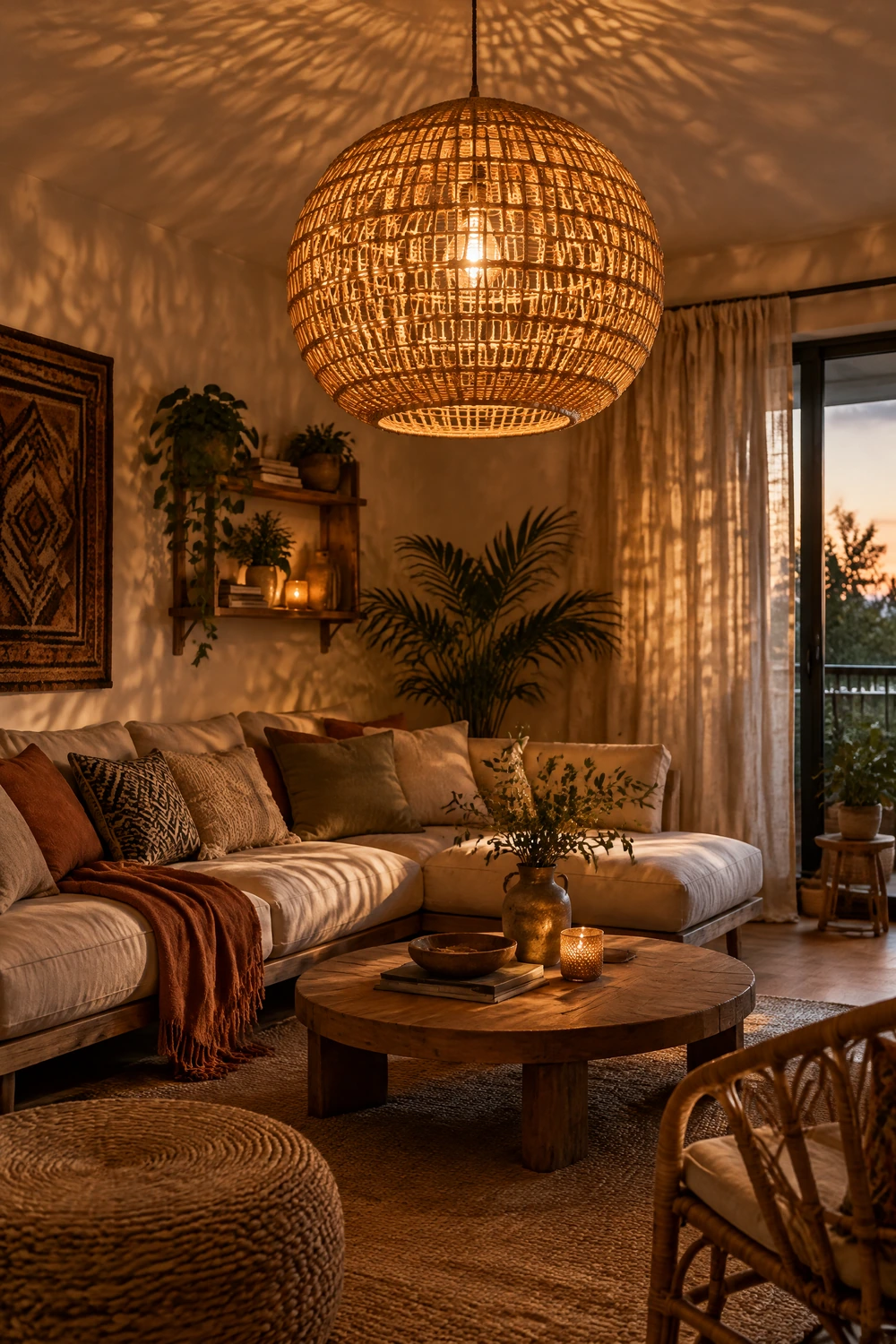
A rattan pendant, a woven seagrass shade, a beaded chandelier, or a paper lantern pendant are the ceiling lighting choices that most immediately signal the bohemian aesthetic, because they bring organic material and handmade quality to the room’s highest point. A large rattan ball pendant above the seating zone casts warm, dappled light through its weave that no conventional shade can replicate, and it functions as a sculptural object even when switched off. Multiple rattan pendants of different sizes clustered together above a coffee table or dining area amplify this effect and create one of the most recognizable bohemian lighting moments available.
Designer Advice: Always use warm white bulbs in a rattan or woven pendant. The warm light passes through the organic material and produces a golden, dappled glow that is central to the bohemian lighting aesthetic. Cool or daylight bulbs produce a blue-white light that fights both the pendant material and the room’s warm palette.
20. Add String Lights and Lanterns for Ambient Warmth

String lights woven through a dried botanical arrangement, draped along a shelf, or hung loosely behind a textile wall hanging create a soft, multi-point ambient warmth that is specifically suited to bohemian evenings. In a style that depends on atmosphere and sensory richness, the warm glow of string lights at multiple heights throughout the room adds the quality of candlelight at a scale that candles alone cannot achieve. Paper lanterns hung at different heights from the ceiling, Moroccan perforated metal lanterns on the floor casting geometric patterns of light, or a cluster of glass lanterns with pillar candles beside the sofa each add the warm, ambient light quality that the style requires.
Quick Tip: Plug-in string lights with a warm color temperature of 2200K to 2700K produce the most golden, flattering light for a bohemian room. This temperature sits closer to candlelight than to standard warm white LED and creates the atmospheric warmth that distinguishes evening in a well-done bohemian room.
21. Fill the Room With Plants at Multiple Heights

Plants in a bohemian living room are not optional accessories but structural elements of the style, because they add the organic life and visual complexity at multiple heights that no object or furniture arrangement can replicate. A large architectural plant, a fiddle leaf fig, a monstera, or a bird of paradise, in a floor-level terracotta or ceramic pot anchors a corner or fills the space beside the sofa at a scale that commands attention. Medium plants on shelves and surfaces add green at eye and hand level. Hanging plants, a trailing pothos or an air plant in a woven hanging holder, bring the organic element to ceiling height and close the vertical circuit from floor to ceiling.
Reality Check: Bohemian plant styling requires maintenance to stay effective. A dead or dying plant in a beautiful pot reads worse than no plant at all. Choose plant varieties suited to your room’s actual light conditions: snake plants and pothos for low light, fiddle leaf figs and monsteras for bright indirect light.
22. Use Dried Botanicals in Tall Vessels

Dried pampas grass, dried wheat stems, preserved eucalyptus, dried lunaria, and pampas in varied neutral and blush tones arranged in tall floor vases or wide ceramic vessels are among the most consistently effective bohemian decorating choices because they add organic scale, earthy color, and textural movement without the maintenance demands of living plants. The vessel matters as much as the botanical arrangement: a tall terracotta pot, a wide-mouthed stoneware jug, a hand-thrown ceramic with visible glaze imperfections, or a woven basket lined and used as a planter each contribute the artisanal material quality that a cheap glass vase undermines. Go larger with the arrangement than feels comfortable: the fullness of a generous dried botanical display is what makes it read as designed rather than spare.
Designer Advice: Mix dried botanicals of very different heights within the same vessel: tall pampas stems at the back, medium dried lunaria in the middle, and shorter dried seed heads at the front. The variation in height within a single arrangement is what gives it the organic complexity of a real gathered field bouquet.
LAYER SIX: PERSONAL AND FOUND OBJECTS
23. Display Ceramics and Pottery in Warm Glazes

Hand-thrown ceramics in warm reactive glazes, terracotta tones, warm ochres, dusty pinks, sage greens, and dark earthy browns, are the table and shelf accessories that most consistently bring the bohemian aesthetic to the room’s surfaces at a small scale. A grouping of three ceramic vessels in different heights and glaze colors on a shelf, a single large hand-thrown bowl on the coffee table, or a row of terracotta pots on a windowsill each add the imperfect, handmade quality that mass-produced ceramics in regular shapes and uniform glazes cannot replicate. The slight warp in a hand-thrown rim, the drips and variations in a reactive glaze, and the roughness of an unfinished foot ring are all signs of hand production that a bohemian room reads as beautiful rather than flawed.
Quick Tip: Group ceramics in odd numbers: three, five, or seven. Odd groupings read as collected and organic. Even groupings read as purchased as a set, which works against the bohemian aesthetic’s emphasis on accumulated, individual objects.
24. Collect and Display Objects From Travel and Markets

The objects that give a bohemian room its specific, irreplaceable character are almost always the ones that were found rather than purchased with decoration in mind: a piece of driftwood from a beach walk, a brass box from a Moroccan souk, a woven basket from a Mexican market, a ceramic bowl from a potter’s studio, a piece of textile from a flea market in Istanbul. These found and travelled objects read differently from their equivalent purchased versions because they carry a context and a history that a similar object bought from a homeware shop does not. A bohemian room that contains genuine found objects is always more compelling and more personal than one built entirely from bohemian-aesthetic products.
Pro Move: Group found objects from the same geographical or cultural context together on a single shelf or surface. A cluster of Moroccan objects, a group of pieces from Southeast Asia, or a collection of handcraft items from a single region reads as a deliberate collection with a point of view rather than a random assortment of world market finds.
25. Stack Books Horizontally With Objects on Top

In a bohemian room, books are decorative as well as literary, and the way they are displayed communicates a great deal about the room’s approach to collecting. A stack of three to five books with interesting or warm-toned spines, laid flat on a shelf or on the coffee table with a small ceramic object, a crystal, a dried seed head, or a small found stone balanced on top, reads as effortlessly styled. Books stacked horizontally show their top edges rather than their spines, which hides their titles but creates a more satisfying visual stack than books stood vertically in a row. A mix of horizontal stacks and vertical arrangements across a bohemian bookshelf gives the whole surface visual rhythm.
Heads Up: The object placed on top of a book stack is doing a significant amount of visual work. A beautiful, specific object, a hand-thrown ceramic, a piece of coral, a vintage brass object, reads very differently from a generic object placed there to fill the space. Choose carefully.
LAYER SEVEN: THE FINISHING DETAILS
26. Add Crystals, Candles, and Incense as Sensory Details

The finishing sensory layer of a bohemian room is made up of the small, specific objects that engage the senses beyond sight: crystals and geodes that catch light and carry geological history, a cluster of candles in warm cream or beeswax in vessels ranging from ceramic to hammered brass, and incense or a quality reed diffuser in a warm, complex scent. Individually these objects seem small. Together they create the sensory richness that makes a room feel inhabited and alive rather than simply furnished and decorated. A geode open to reveal its crystalline interior on a coffee table, three candles burning in a gathered cluster on the mantel, and a stick of palo santo or a sandalwood diffuser beside the sofa create the kind of multi-sensory experience that the best bohemian rooms consistently deliver.
Designer Advice: Scent is the most underused element in a bohemian room. Warm, complex scents, palo santo, oud, sandalwood, cedar, or a spiced incense, communicate the style’s global, sensory richness in a way that no visual element can. Choose one signature scent for the room and use it consistently.
27. Use Mirrors in Organic or Artisan Frames

A mirror in a round hammered brass frame, a sun-burst rattan surround, a carved dark wood oval, or an irregular raw-edge mirror is one of the most versatile finishing elements in a bohemian room because it reflects light and space while simultaneously functioning as a piece of decorative art. Placed opposite a window, a large mirror in an artisan frame bounces natural light back into the room and makes it feel larger and more golden. Placed above a console or on the focal wall, it anchors a surface arrangement and adds depth. A grouping of smaller mirrors in different shapes and frame materials, rattan beside brass beside dark wood, creates a wall display that is specifically bohemian in its embrace of variety within a consistent sensory register.
Quick Tip: A sun-burst or starburst mirror in rattan or brass is one of the most widely recognized bohemian accent pieces, and for good reason: its radiating shape adds movement and visual interest to a flat wall, and it works at virtually any scale from small accent to large statement.
28. Embrace Imperfection and Resist the Urge to Over-Edit
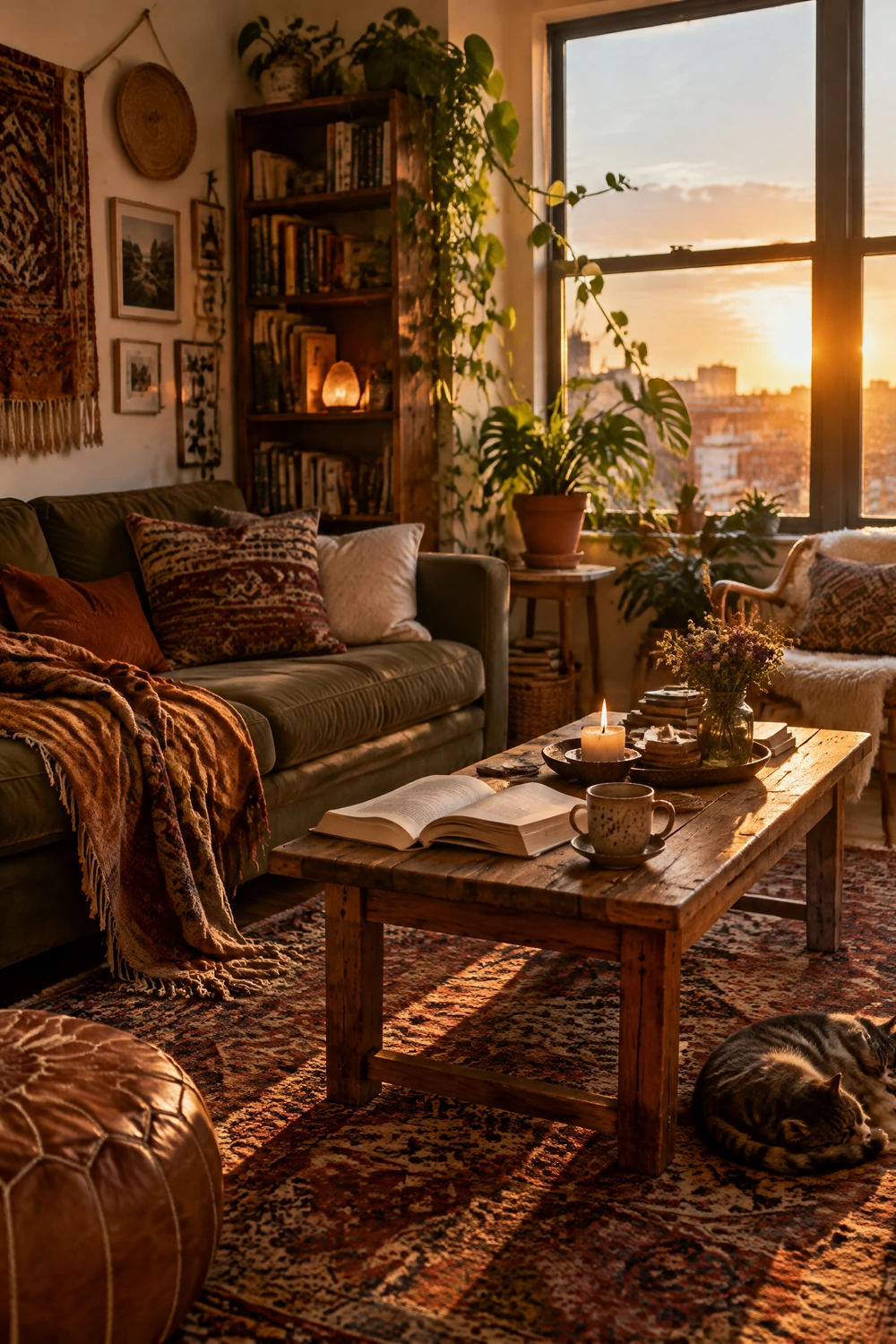
The most important finishing detail in a bohemian room is the willingness to leave it slightly imperfect. A perfectly matched, symmetrically arranged, fully coordinated bohemian room is a contradiction in terms, because the style’s entire visual and emotional language depends on the impression of things gathered over time, used with enjoyment, and arranged with feeling rather than precision. A throw that is not perfectly draped, a plant that has grown slightly toward the window, a stack of books where one has been left open, a candle that has burned partway down and been replaced: these are the signs of a room that is actually lived in, and they are what separates a bohemian room that feels authentic from one that feels like a set. Resist the urge to straighten every cushion and align every object. The imperfection is the point.
Reality Check: If the room looks like a bohemian product catalogue, it is not finished yet. A genuinely well-done bohemian room always looks like it might have looked slightly different last month and will look slightly different next month. The sense that it is still growing and changing is what makes it feel alive.
Building a Bohemian Living Room: The Layer Order
| Layer | Ideas Covered | What It Establishes | Do This Before… |
| Palette and Ground | 1-4 | The warm earthy base that holds everything together | Buying any furniture or textiles |
| Furniture Bones | 5-9 | The structural pieces the room is built around | Adding textiles or accessories |
| Textile Layers | 10-14 | Pattern, warmth, and handmade texture | Hanging art or styling surfaces |
| The Wall Story | 15-18 | Vertical interest and the room’s visual backdrop | Adding lighting or finishing details |
| Lighting and Plants | 19-22 | Organic life and atmospheric warmth | Adding small accessories and found objects |
| Personal and Found Objects | 23-25 | The specific, irreplaceable character of the room | Calling the room finished |
| Finishing Details | 26-28 | The sensory layer that makes the room feel alive | Photographing or showing the room |
The Difference Between Layered and Cluttered
The line between a bohemian room that looks collected and one that looks cluttered is almost always the presence or absence of a grounding palette. When every object, textile, and piece of furniture shares a relationship with the room’s warm earthy base, even a very full room reads as layered and intentional. When objects are added without reference to the palette, the room reads as busy regardless of how individually beautiful each piece is. Build the ground first. Establish the palette across the walls, the floor, and the main furniture before adding anything else. Then layer from there, one element at a time, always checking whether the new addition relates to what is already in the room. A bohemian room is built slowly. The ones that feel the most effortless took the most thought.