Black Ceiling Living Room Ideas That Make a Room Feel Designed

Painting a ceiling black is one of the most counterintuitive and most consistently rewarding design decisions available in a living room, and the reason most people hesitate is the same reason it works so well: it is unexpected. A black ceiling does three specific things to a room simultaneously. It lowers the perceived ceiling height, which in most living rooms creates intimacy rather than claustrophobia. It draws the eye upward, which makes light fixtures the room’s most dramatic design element rather than an afterthought. And it anchors the room from above, which gives the walls and furniture the freedom to be lighter, bolder, or more textured than they could be if the ceiling were competing with them for visual attention. Every decision that follows a black ceiling should respond to one of these three effects. These 28 ideas cover all of it, from the ceiling itself through to the furniture, textiles, lighting, and finishing details that make a black ceiling room feel genuinely designed. Done poorly, a black ceiling makes a room feel smaller and unfinished. Done right, it makes the room feel like no other surface decision could have.
CATEGORY ONE: THE CEILING ITSELF
1. Choose Matte Black Over Gloss for the Right Visual Effect
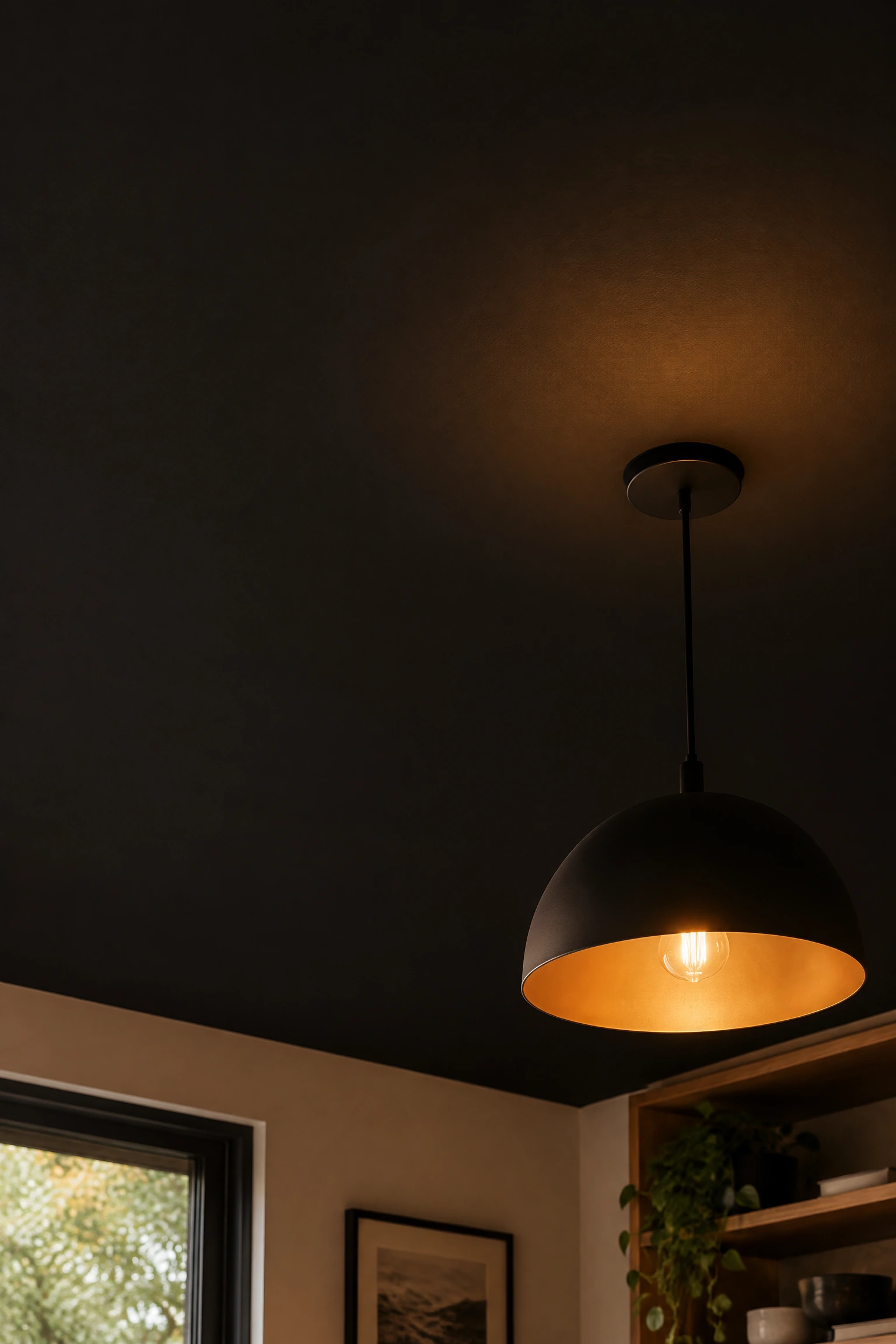
The finish of a black ceiling determines its entire visual character, and matte is almost always the correct choice. A matte black ceiling absorbs light rather than reflecting it, which creates the deep, velvety quality that makes a black ceiling look intentional and deliberate. A gloss or semi-gloss black ceiling reflects light back into the room, which creates a mirror-like surface that reads as industrial rather than designed, and which also reflects everything below it, including furniture, people, and whatever flaws the ceiling plasterwork contains. A ceiling in a flat or matte finish hides imperfections in the plaster and reads as a deliberate design choice. Any sheen higher than eggshell will undermine the effect.
Pro Move: Use a ceiling paint formulated specifically for ceilings rather than a standard wall paint. Ceiling paints are formulated to minimise drips during application and to produce a particularly flat, non-reflective finish. Apply two coats and allow each to dry completely before assessing the coverage.
2. Paint Just the Ceiling, Not the Walls
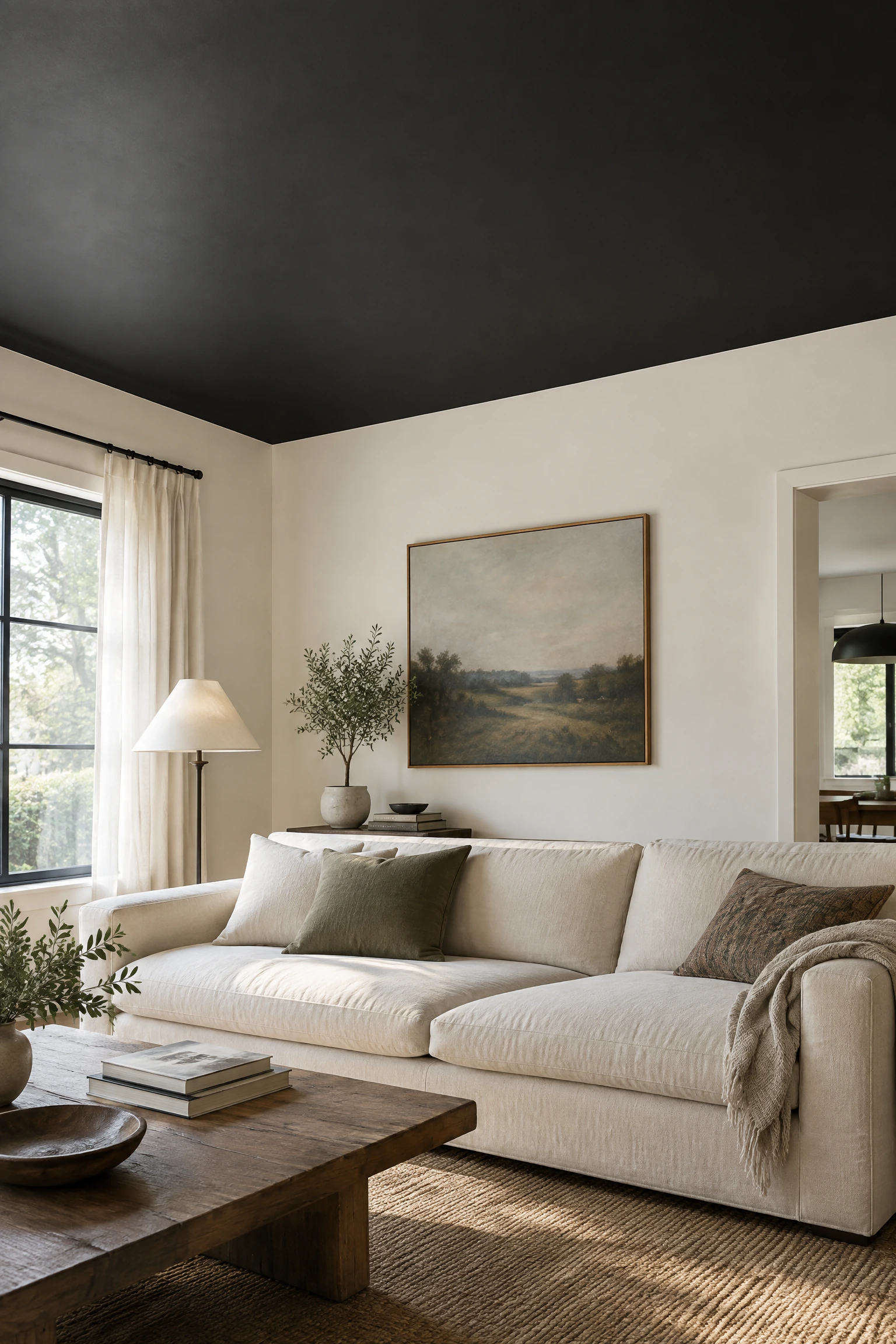
The most universally flattering black ceiling treatment in a living room is to paint the ceiling black while keeping the walls in a lighter tone, whether that is a warm white, a pale cream, a soft warm grey, or a deeper colour that is still significantly lighter than the ceiling. This contrast is what makes the black ceiling read as a ceiling rather than as a cave: the lighter walls reflect light upward into the room while the dark ceiling absorbs it, creating a visual boundary between the two that is far more interesting than a flat-painted room but far less overwhelming than an all-black space. The junction between the black ceiling and the lighter wall at the cornice or coving line is one of the cleanest and most graphic lines in interior design.
Reality Check: The transition between a black ceiling and a white wall at the coving or cornice line needs to be precise. A slightly wobbly line at this junction is more visible with a black ceiling than with any other ceiling colour, because the contrast is at its highest there. Use painter’s tape and take your time with the edges.
3. Extend the Black Down to the Picture Rail or Dado Line

Rather than painting only the ceiling black and stopping at the coving, extending the black paint down to the picture rail, to a dado rail, or even a third of the way down the walls creates a more immersive and more dramatically architectural version of the black ceiling treatment. The extended black zone wraps the upper portion of the room in a deep tone that makes the lighter lower section feel like a deliberate stage within the room, which suits rooms with strong architectural features and generous ceiling heights. This treatment is particularly effective in rooms with original cornicing or picture rails, where the black paint makes the plasterwork detail far more visible and more dramatic than it would be in the same colour as the wall.
Designer Advice: Extending black paint down to a dado or picture rail works best in rooms where the ceiling is at least 9 feet high. In rooms with standard 8-foot ceilings, the extended black zone can feel oppressive rather than dramatic. Test with a large swatch of dark paint at the junction before committing.
4. Try a Black-Painted Shiplap or Tongue-and-Groove Ceiling

A shiplap or tongue-and-groove ceiling painted black adds a textural dimension to the black ceiling treatment that a plain plastered surface cannot provide. The horizontal lines of the planking create a subtle linear pattern at ceiling level that catches and reflects light differently from a flat surface, adding visual depth and warmth to what could otherwise read as a blank dark plane. Black-painted shiplap specifically has become strongly associated with contemporary farmhouse and dark Scandi aesthetics, and it suits living rooms where the furniture and materials on the lower levels have an organic, textural quality that a plain plastered ceiling would not support as effectively.
Quick Tip: If adding real shiplap is not possible, a textured ceiling paint applied over existing plaster with a coarse-nap roller creates a subtle texture that adds visual interest at ceiling level without requiring structural changes. The texture catches and holds the matte black finish differently across the surface, giving the ceiling a quality of depth that a flat application does not.
5. Paint the Ceiling Black and the Trim the Same Black
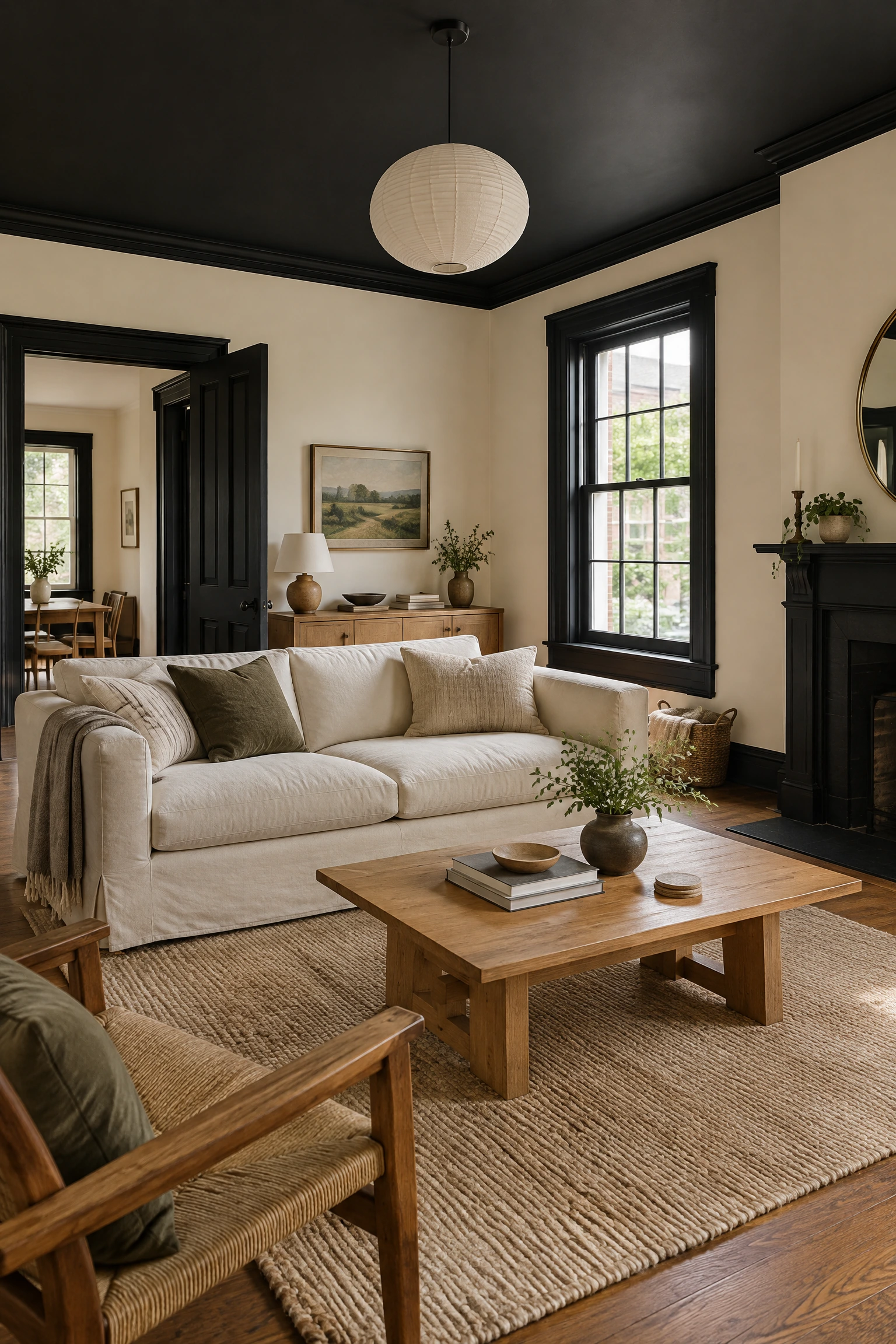
Painting both the ceiling and all the room’s trim, skirting boards, door frames, window architraves, and coving, in the same matte black creates a continuous dark framework around the room that makes the lighter walls feel like panels within a black grid rather than simply walls beneath a black ceiling. This treatment reads as more architectural and more intentional than a black ceiling alone, and it relates the ceiling to the rest of the room’s structure in a way that feels designed rather than decorative. The walls between the black trim elements can be any colour, from bright white through to a saturated jewel tone, and both extremes read beautifully within the black framework.
Pro Move: A room with black ceiling, black trim, and warm cream or soft white walls is one of the most versatile and most consistently effective colour schemes available in contemporary living room design. It suits furniture and textiles in any colour, photographs beautifully, and reads as considered in every light condition.
6. Use the Black Ceiling to Make a Low Ceiling Feel Intentional
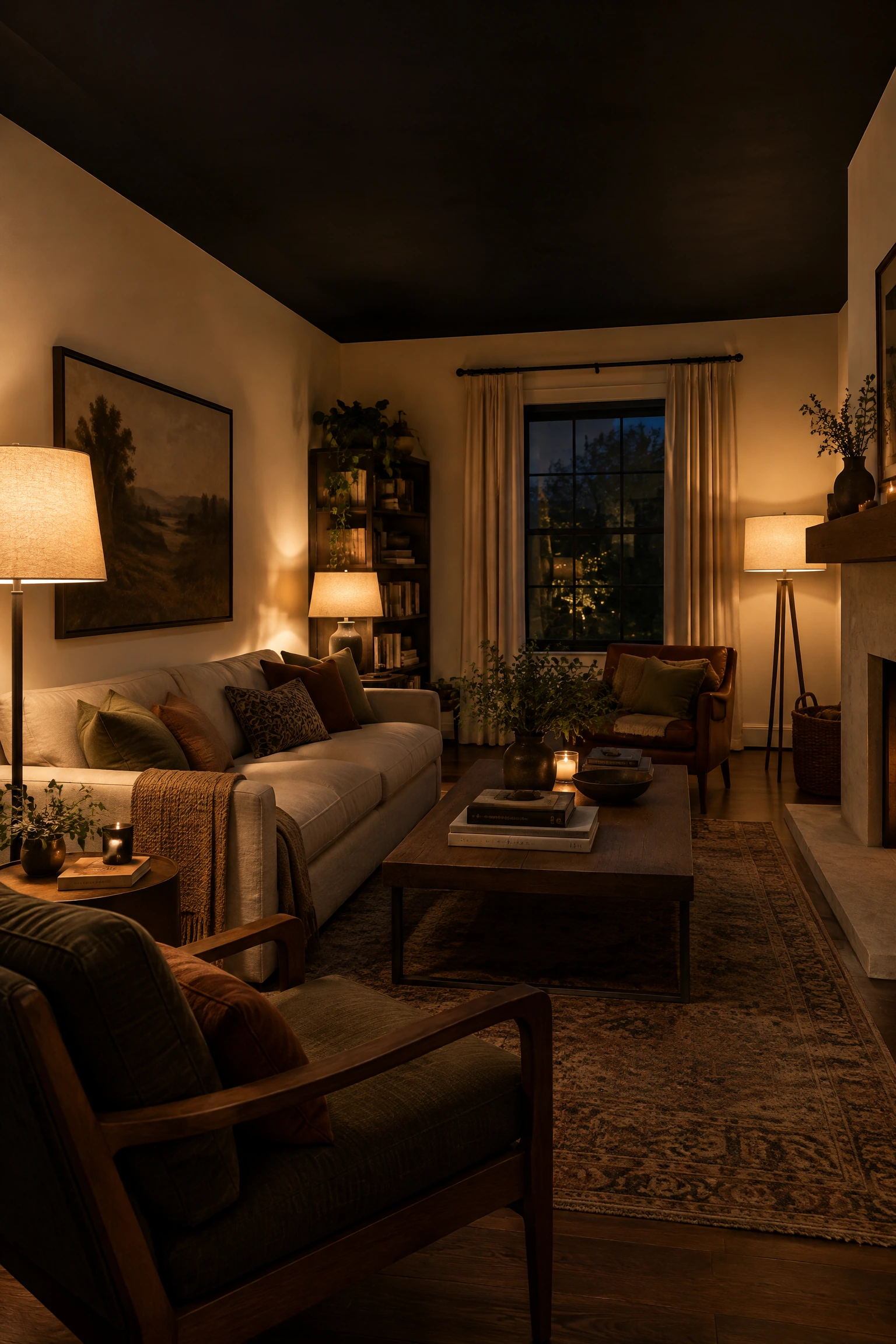
Counter-intuitively, a room with a low ceiling, one at or below 8 feet, often benefits more from a black ceiling than a room with generous height, because the black paint transforms the ceiling from a limitation into a deliberate design choice. A low ceiling left white reads as a constraint. The same ceiling painted black reads as an intentional cocooning effect. The darker tone causes the ceiling to recede visually, which paradoxically makes the room feel less constrained than the white ceiling it replaces. To support this effect, keep the walls light and use floor lamps, table lamps, and pendant lights positioned low rather than uplighters, which would illuminate the dark ceiling and draw attention to its proximity.
Heads Up: In a room with a very low ceiling, avoid a high-hanging pendant light that brings the dark ceiling into the eye line. A flush-mounted or semi-flush fitting in a sculptural design at ceiling level reads better than a pendant that hangs down into the room and makes the ceiling feel lower than it is.
CATEGORY TWO: THE WALL RESPONSE
7. Pair a Black Ceiling with Warm White Walls for Maximum Impact
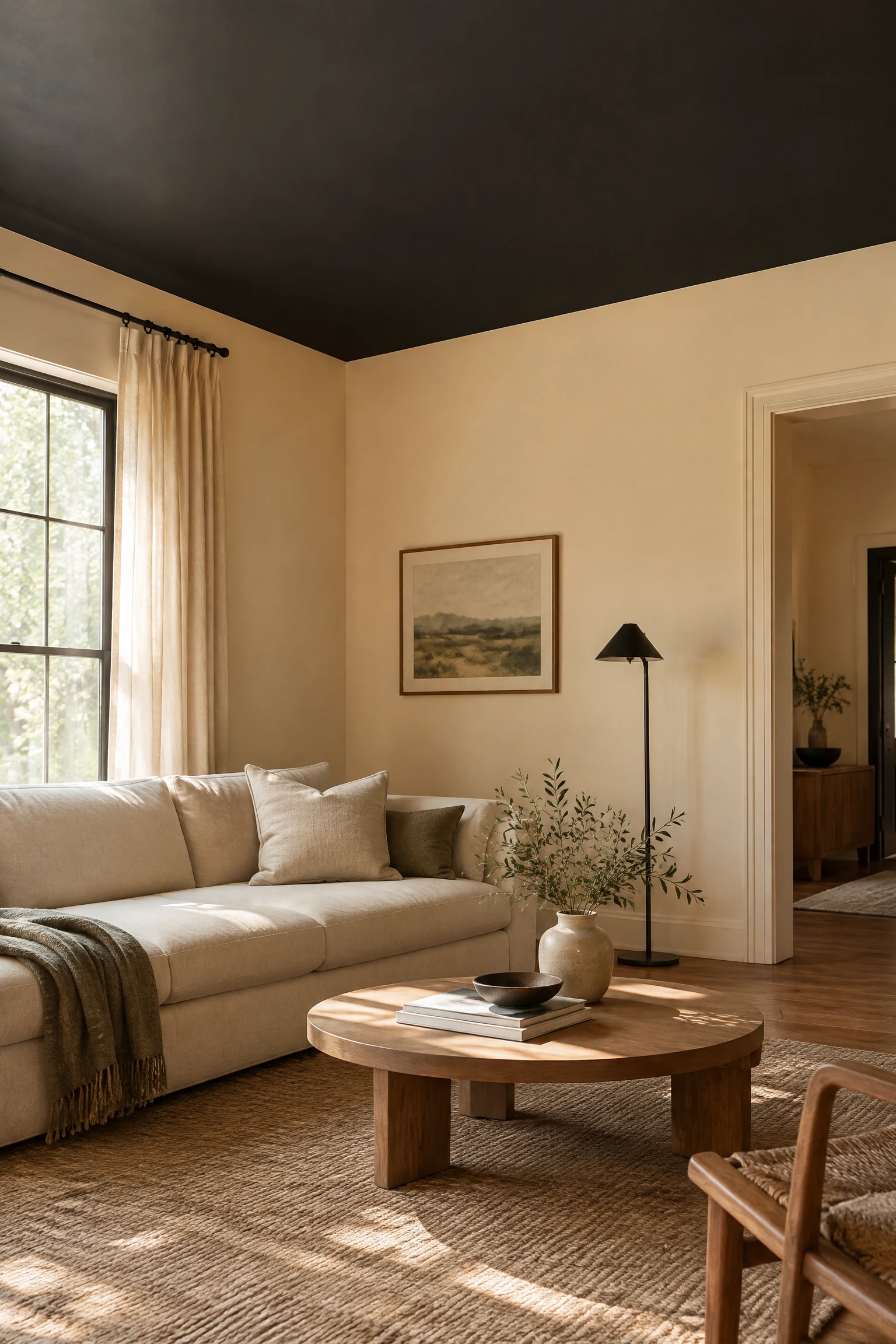
The most universally effective wall treatment beneath a black ceiling is a warm white, not a cool or pure white but a white with a yellow, cream, or pink undertone that reads as warm rather than clinical. Warm white walls below a black ceiling create the highest possible contrast between ceiling and wall, which makes both elements read more distinctly and the room feel more designed. The warmth of the white prevents the room from reading as cold or as a black-and-white graphic exercise, and it reflects the room’s light sources back into the space in a way that keeps the lower portion of the room bright and inviting regardless of how much light the ceiling absorbs. This is the combination that makes a black ceiling feel residential rather than commercial.
Designer Advice: Test the wall white beside the ceiling black before committing. A cool white next to a true matte black reads as graphically harsh in most domestic light conditions. A warm white reads as elegant. The visual difference between the right warm white and the wrong cool white in this context is significant.
8. Try Deep Jewel-Toned Walls for a Fully Immersive Effect
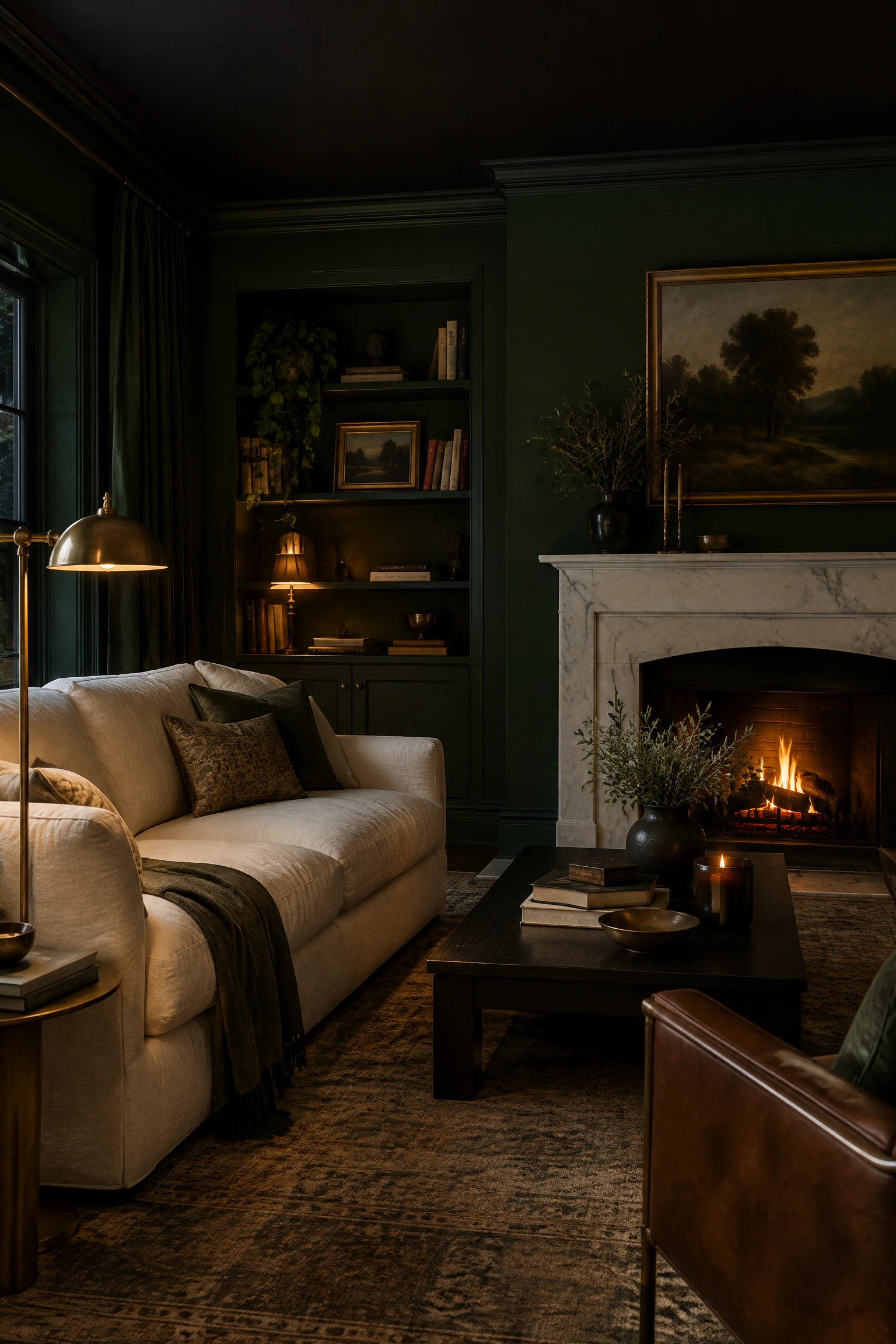
A black ceiling above walls in a deep jewel tone, navy, forest green, deep teal, burgundy, or rich plum, creates one of the most immersive and most considered living room colour schemes available. The deep wall colour reads as a mid-tonal layer between the black ceiling above and the lighter furniture and floor below, creating a three-level composition that has the depth and richness of a painting. The black ceiling in this scheme is no longer the most dramatic element but the anchor that keeps the jewel-toned walls from reading as too dominant. This combination is particularly effective in rooms used primarily in the evening, where artificial light makes the rich wall tones glow and the black ceiling disappears into shadow above the light sources.
Reality Check: A room with a black ceiling and deep jewel-toned walls requires significantly more warm, layered lighting than a room with lighter walls. In this colour scheme, overhead light should be avoided entirely in favour of lamps, candles, and directed task lighting that illuminate the walls and furniture without flooding the ceiling.
9. Use Light Warm Grey Walls for a Contemporary and Versatile Look

A light warm grey below a black ceiling is the most contemporary and most furniture-flexible of all the wall and ceiling combinations, because the warm grey sits comfortably beside almost any furniture colour or material without competing with it. The black ceiling adds the drama and depth that a plain warm grey room would lack, while the grey walls prevent the room from tipping into the high-contrast graphic territory of black ceiling and white walls. This combination reads as considered and grown-up in a way that suits a wide range of furniture styles, from mid-century modern through to contemporary minimalist and even transitional traditional.
Quick Tip: Ensure the grey chosen has a warm undertone, brown or pink rather than blue or green, to prevent the room from reading as cold. A warm grey with a black ceiling and warm wood furniture is one of the most consistently attractive combinations in contemporary living room design.
10. Install Floor-to-Ceiling Shelving on One Wall to Break the Dark Ceiling’s Weight

A room with a black ceiling and a wall of floor-to-ceiling shelving lined with books, plants, ceramics, and art creates a visual tension between the dark, enveloping ceiling and the richly textured, colourful wall below it that is one of the most satisfying contrasts in a designed living room. The shelving fills the wall from floor to ceiling, which means the eye travels up the full height of the room along the shelving surface and then hits the black ceiling at the top, creating a defined vertical limit that feels dramatic rather than oppressive. The objects on the shelves, in their variety of colour, material, and scale, provide the warmth and personality that the darker ceiling and trim work need to prevent the room from feeling austere.
Pro Move: Paint the back panel of the floor-to-ceiling shelving in the same black as the ceiling. The continuous dark tone from the ceiling through to the shelf back panels creates a cohesive dark envelope that makes the lighter books and objects on the shelves read as if they are displayed against the night sky.
CATEGORY THREE: THE LIGHTING RESPONSE
11. Choose a Statement Pendant or Chandelier That Reads Against Black
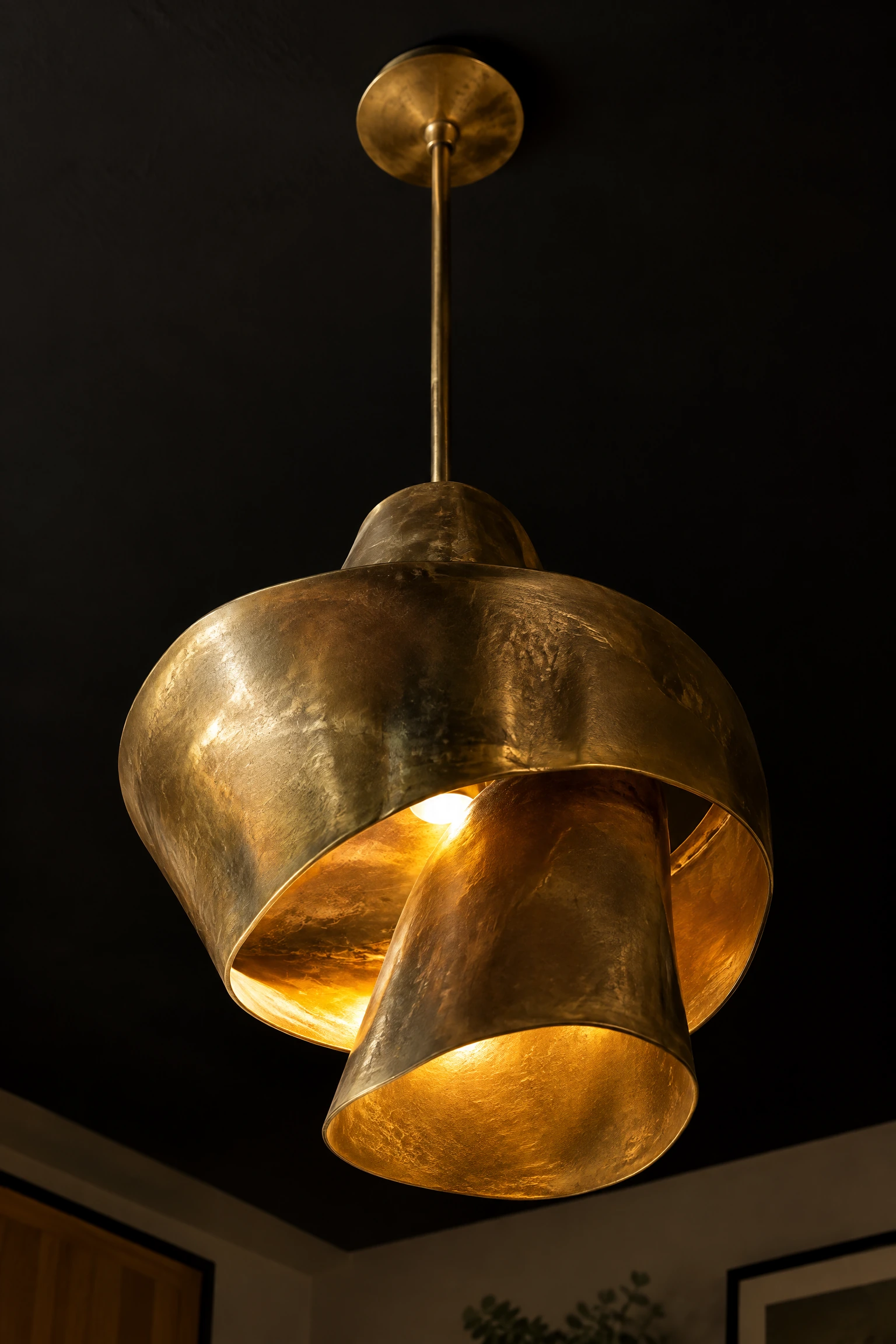
A black ceiling is the single most effective backdrop for statement lighting in a living room, because the dark surface absorbs all peripheral light and makes the fixture itself the only thing the eye sees at ceiling level. A sculptural pendant in aged brass, polished gold, warm bronze, or a textured natural material like rattan or woven seagrass hangs against the black ceiling and reads as a piece of jewellery displayed on dark velvet. The contrast between the warm metal or organic texture of the fixture and the matte black surface behind it is one of the most visually dramatic moments available in a room, and it is produced without cost beyond the price of the ceiling paint and the fixture itself.
Designer Advice: A black ceiling earns the most dramatic lighting moments with warm metal fixtures: aged brass, brushed gold, antique bronze. Cool metal finishes like chrome or brushed silver lose their impact against a dark background because there is insufficient contrast between the cool metal and the dark surface behind it. Warm metals pop. Cool metals disappear.
12. Layer Multiple Light Sources to Counteract the Ceiling’s Light Absorption
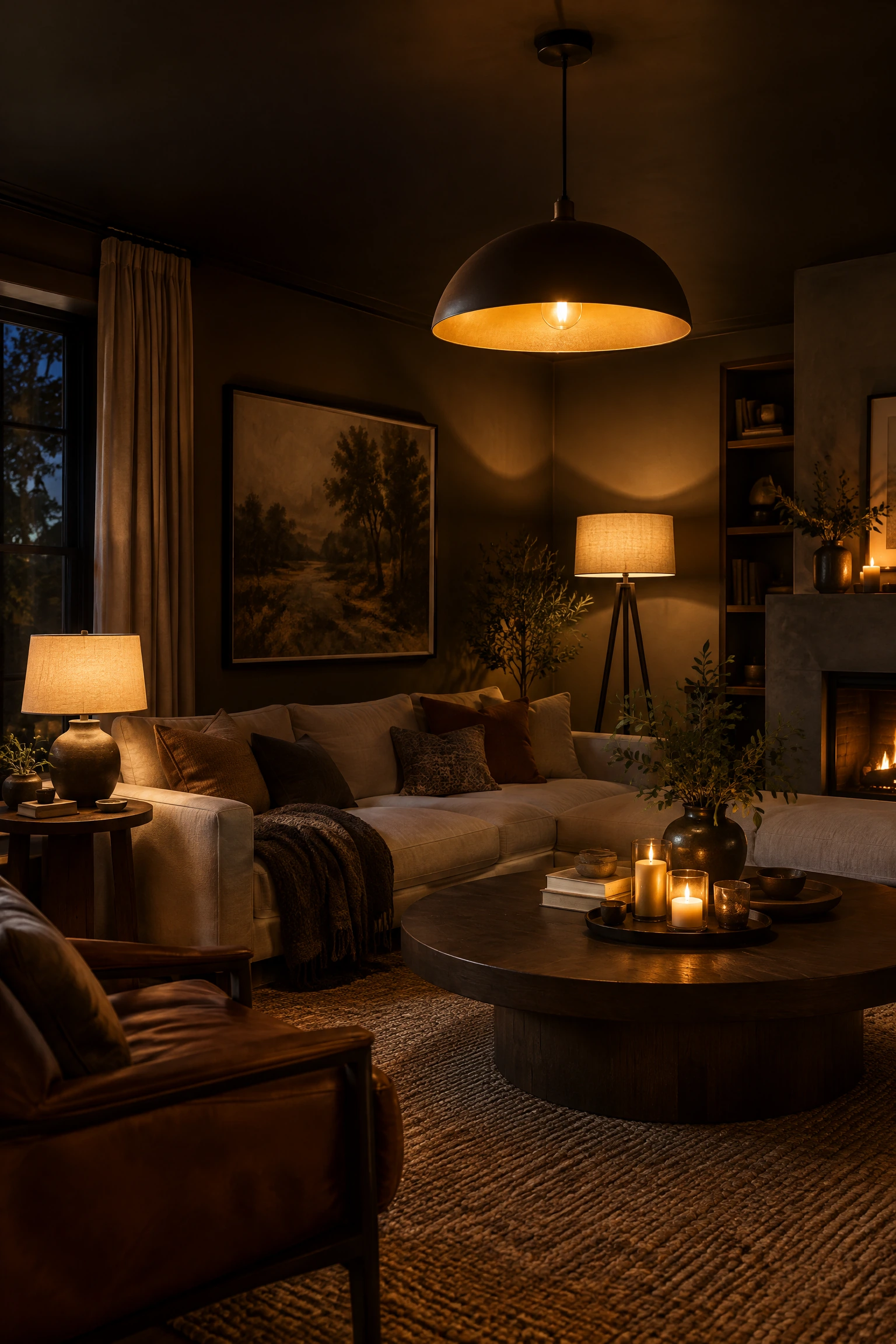
A black ceiling absorbs light rather than reflecting it back into the room, which means a living room with a black ceiling needs significantly more light sources than the same room with a white ceiling to achieve the same overall light level. Where a white-ceiling room might be adequately lit by one overhead pendant and two lamps, a black-ceiling room needs three or four lamp sources at standing and seated height, supplemented by directed task lighting, in addition to the ceiling fixture. This is not a limitation but an opportunity: the layered lighting that a black ceiling requires produces the warm, atmospheric quality of light that makes a room feel genuinely designed, because no single light source dominates and the room is lit from multiple directions at multiple heights.
Quick Tip: Install dimmer switches on all the light circuits in a room with a black ceiling. The ability to control the intensity of each light source independently allows the room to shift from a brightly lit functional space to a warmly atmospheric evening room without changing any of the fixtures, which is where a black ceiling delivers its most dramatic effect.
13. Use Recessed Downlights to Create a Star-Field Effect in the Black Ceiling
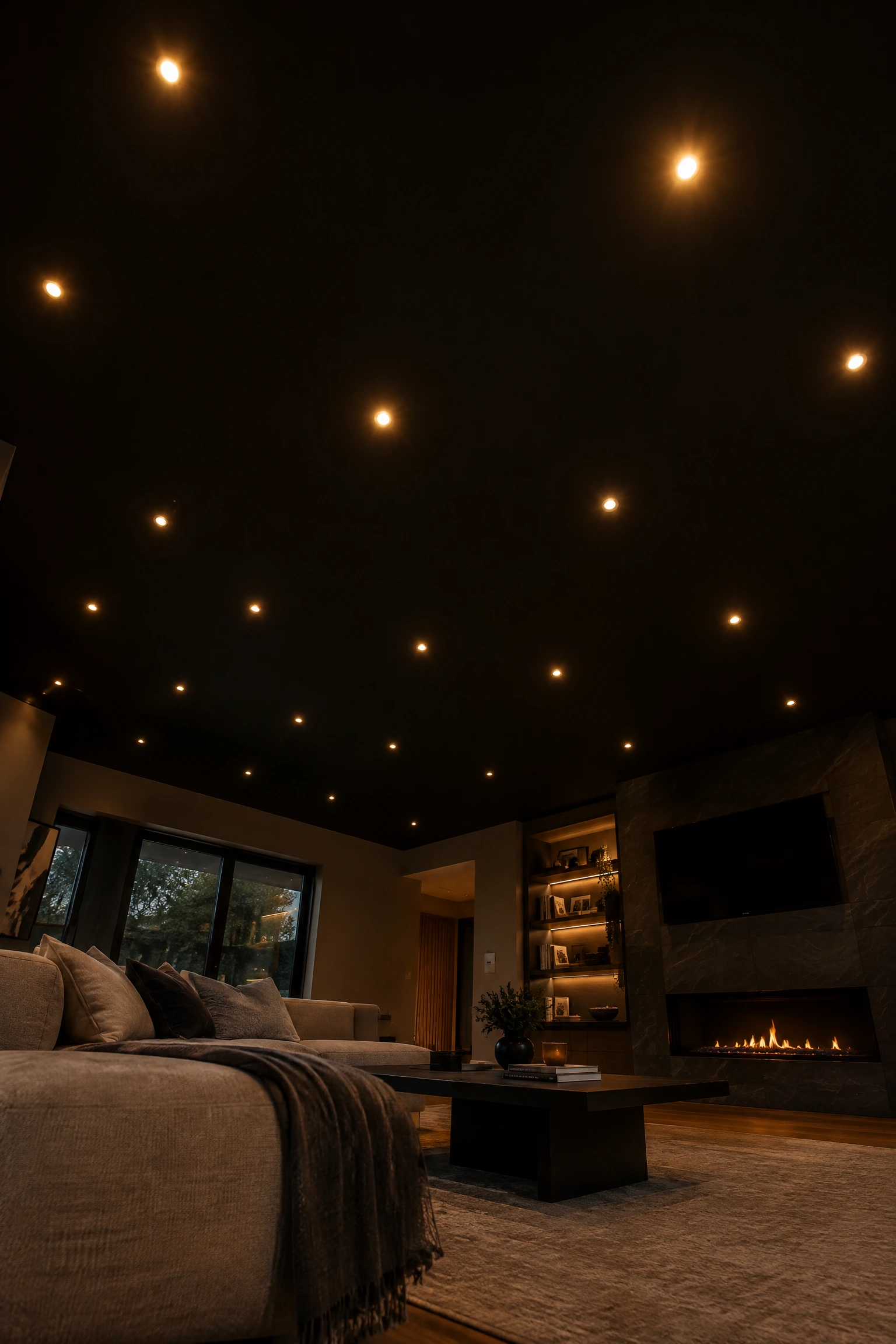
A series of recessed LED downlights set into a matte black ceiling at regular or deliberate intervals creates a star-field effect in the ceiling plane that is specifically beautiful in living rooms, because the dark surface disappears visually and the points of warm light appear to float in darkness rather than being mounted in a ceiling. The warmer the colour temperature of the LEDs, 2700K or lower, the more golden and the more specifically beautiful this effect becomes. Recessed downlights in a white ceiling are functional. The same lights in a black ceiling become one of the room’s primary design features.
Reality Check: Recessed downlights in a black ceiling need to be positioned carefully to avoid casting harsh downward pools of light that create awkward shadows on faces and furniture. Use wide-angle diffuser lenses and pair with side lamp sources so the downlights contribute to the overall light level without doing all the illumination work.
14. Install a Fireplace to Reflect Against the Dark Ceiling
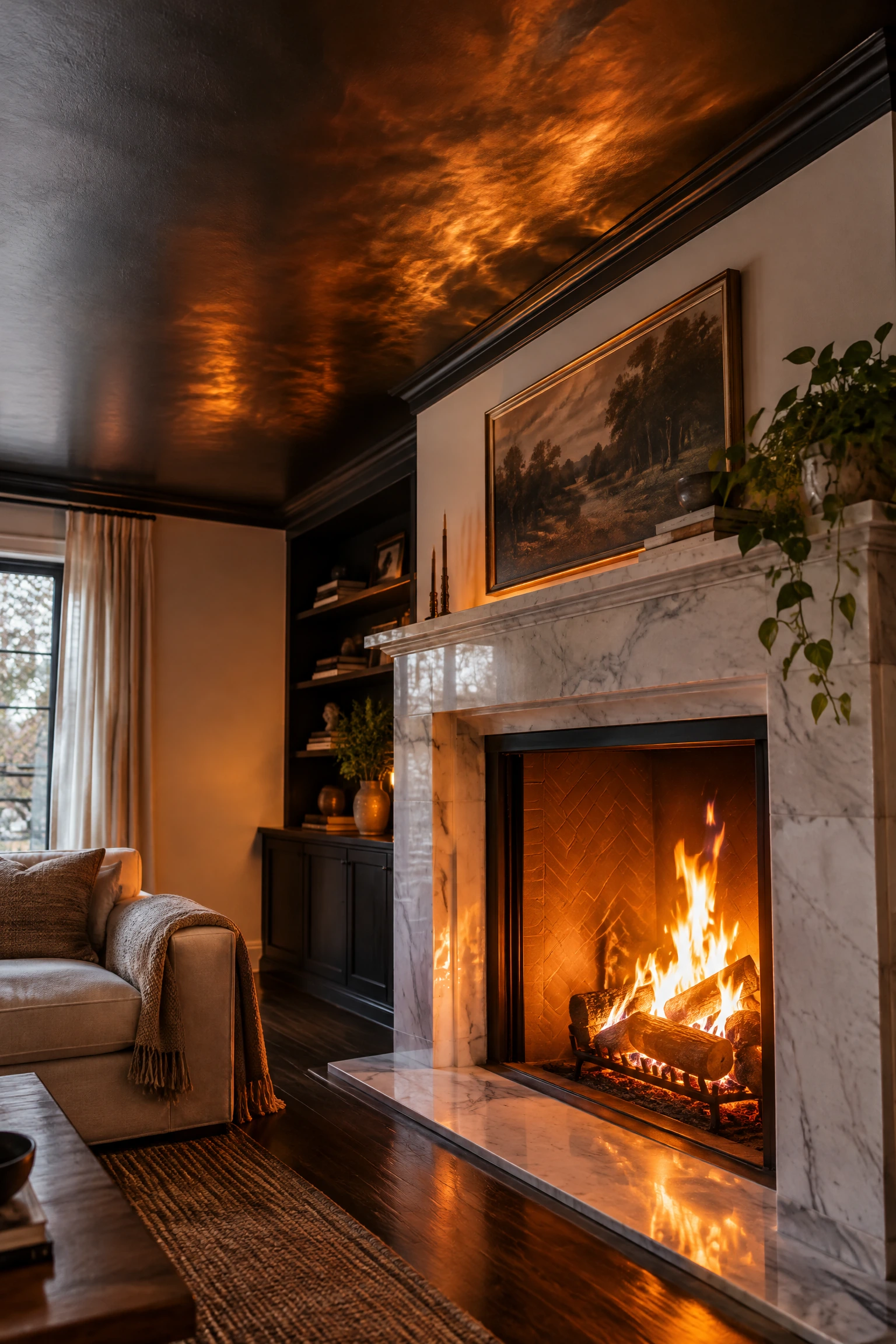
A fireplace in a room with a black ceiling creates one of the most compelling atmospheric moments available in residential interiors, because the moving orange and gold light of the fire reflects and flickers across the matte black ceiling surface in a way that it cannot on a white or pale ceiling. The dark ceiling holds the reflected firelight differently: rather than simply brightening, it appears to glow from within, with shifting warm tones moving across the surface as the fire changes intensity. If a fireplace already exists in the room and the ceiling is being considered for dark paint, this reflected firelight effect alone is reason enough to proceed.
Pro Move: Position seating so that the fireplace can be seen from the primary sofa position and the reflection of the fire on the black ceiling is visible from that seated position. The view of a fire and its reflection on a dark ceiling simultaneously is one of the most atmospheric moments in a well-designed living room.
15. Use Uplighters in Plant Pots or on the Floor to Illuminate the Ceiling

Floor-level uplighters, whether built into plant pots holding large indoor plants, positioned at the base of a fireplace surround, or placed in the corners of the room pointing upward, send warm light upward to graze the matte black ceiling and create a soft ambient glow that the ceiling absorbs and distributes laterally. This is one of the few lighting techniques that actually uses the black ceiling’s light-absorbing quality to the room’s advantage: the ceiling softens and diffuses the upward light rather than bouncing it back harshly, which creates a warm ambient envelope rather than a spotlight effect. The combination of upward floor-level light against a black ceiling with table and floor lamps at seated level produces one of the richest and most layered light environments available.
Heads Up: Uplighters pointed directly at a textured ceiling will reveal every imperfection in the plasterwork. On a perfectly smooth matte black ceiling, the grazing light is beautiful. On a ceiling with plaster imperfections, bumps, or brush marks, direct uplighting will make every flaw visible. Assess the ceiling surface quality before committing to this lighting approach.
CATEGORY FOUR: FURNITURE AND FLOOR
16. Choose Light-Coloured Upholstery to Balance the Dark Ceiling
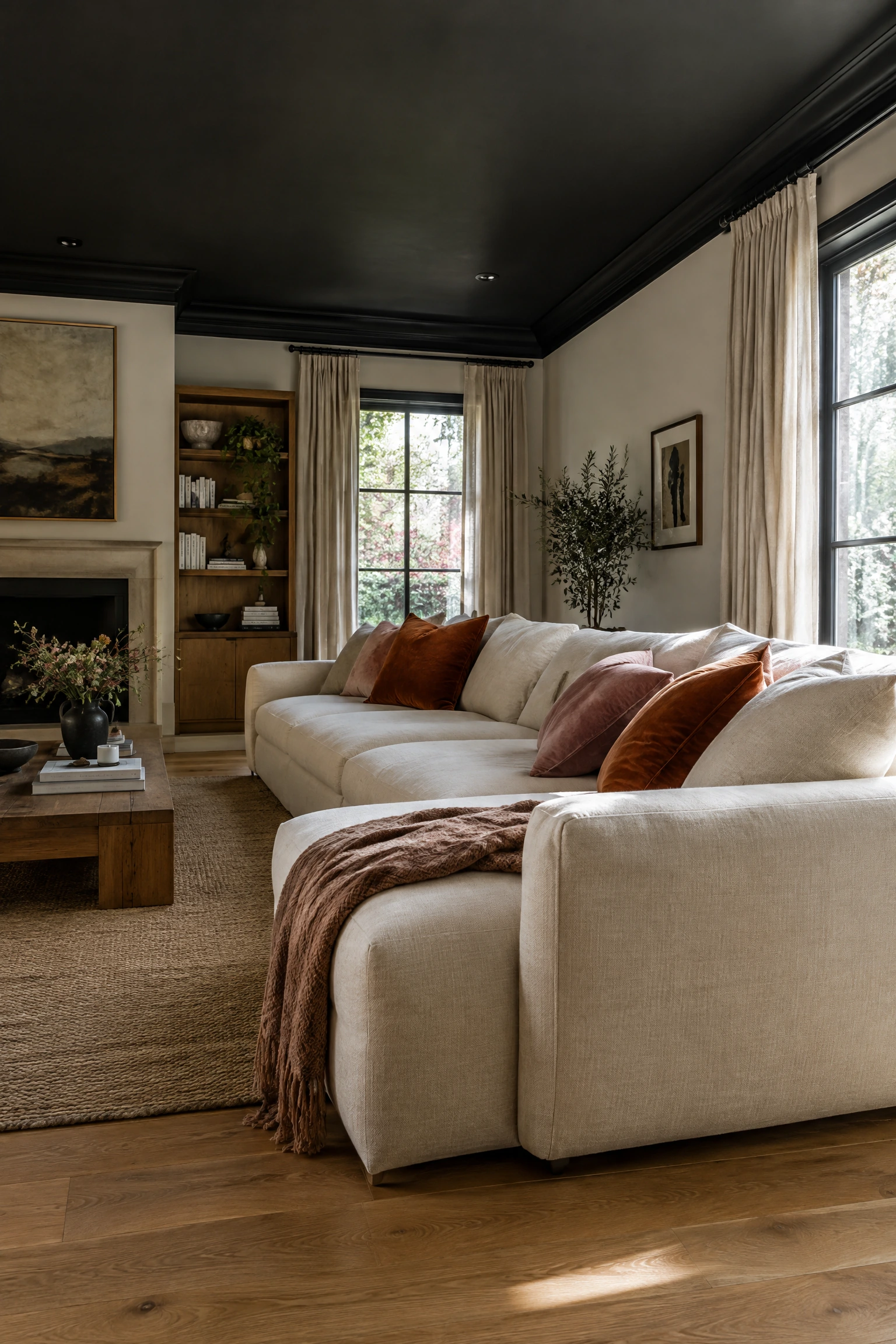
A black ceiling in a living room with dark upholstered furniture, brown leather, dark grey velvet, or navy fabric, creates a room where both the top and the middle layers are dark, which makes the space feel heavy and without visual relief. Light or mid-toned upholstery, a cream linen sofa, a warm oatmeal fabric armchair, a pale blush velvet, or even a natural rattan or pale wood chair, provides the bright, reflective middle layer that gives the room visual balance between the dark ceiling above and the floor below. The sofa in particular, being the room’s largest piece of furniture, does the most work to counterbalance the ceiling’s visual weight, and keeping it in a lighter tone is one of the most important decisions in a black ceiling room.
Designer Advice: If the existing furniture is dark and the ceiling is being considered for black, introduce light-toned textiles as a first step. Cream or warm-toned slipcovers, light cushions and throws, and a large light-coloured rug create the visual balance needed before committing to the ceiling colour.
17. Use Warm Natural Wood Furniture for Tonal Warmth
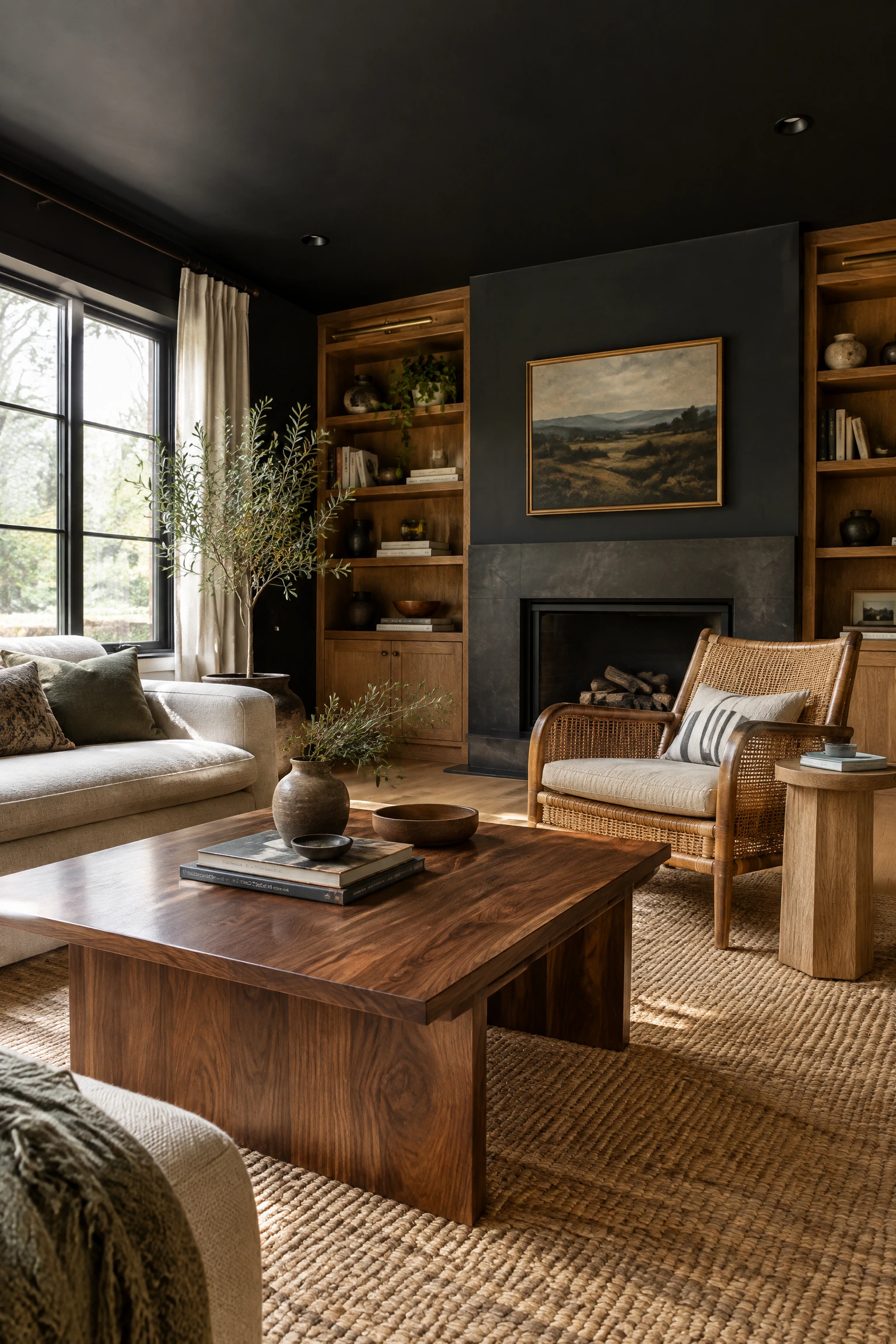
Natural wood furniture, in light to medium oak, walnut, ash, or rattan, provides the warm organic tone that a black ceiling room particularly needs to prevent the space from reading as cold or industrial. The grain and warmth of natural wood, at coffee table level, shelf level, or as a side table or bench, creates a material conversation with the matte black above that reads as intentional contrast rather than jarring opposition. Mid-century modern furniture, with its characteristic combination of warm wood legs and light-toned upholstery, is particularly effective in a black ceiling room because the wooden elements provide the warmth at multiple heights throughout the room.
Quick Tip: The warmer and more medium-toned the wood, the better it sits against a black ceiling. Very pale, bleached, or whitewashed wood can look washed out against a dark ceiling. Very dark wood, near-black ebonised timber or very dark walnut, merges visually with the ceiling tone and loses its tonal contrast. Medium warm oak and walnut are the sweet spots.
18. Add a Light-Coloured or Natural Fibre Area Rug to Anchor the Floor
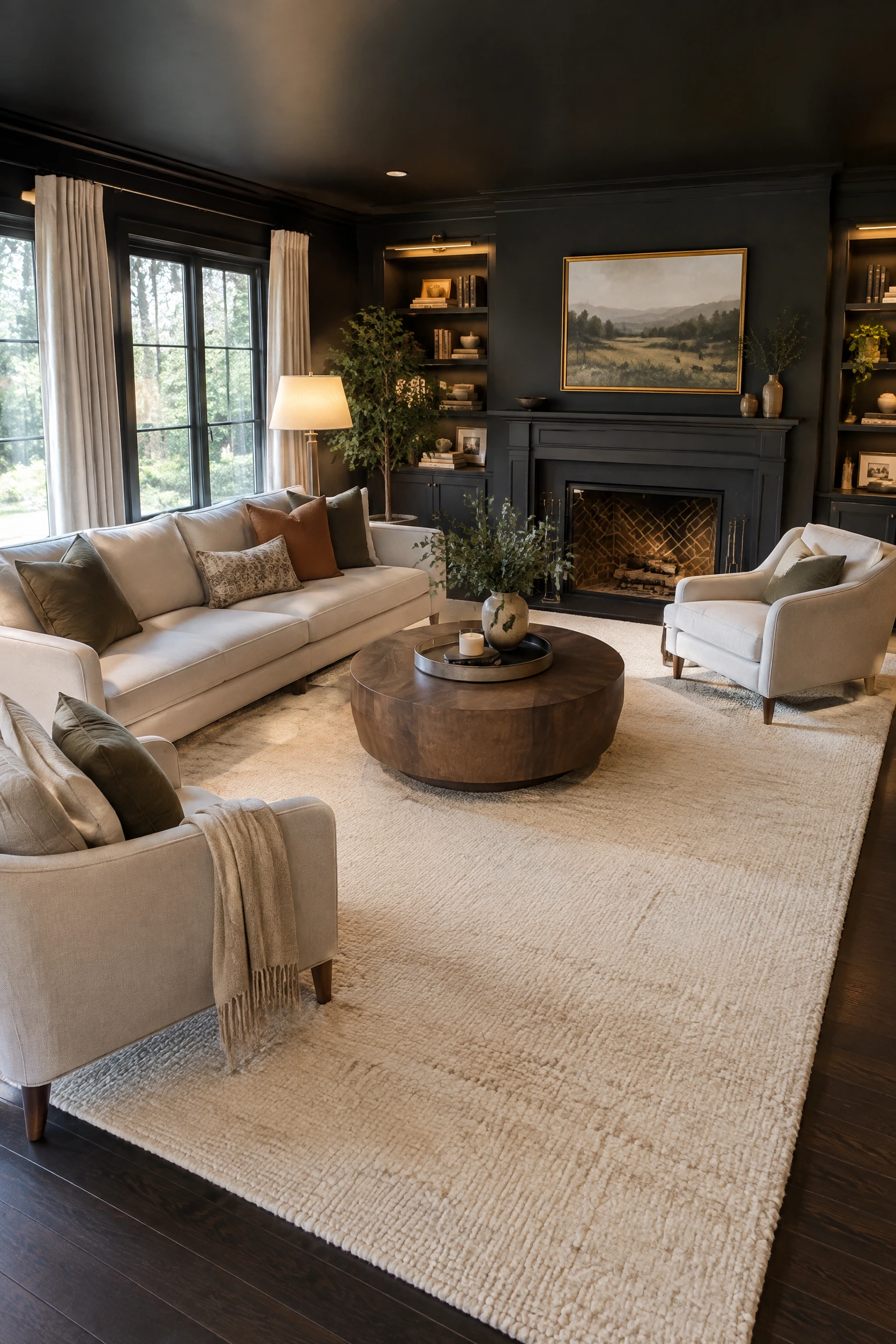
In a room with a black ceiling, the floor becomes the room’s primary light-reflecting surface, and choosing a rug in a warm light tone amplifies this effect significantly. A large cream, warm ivory, natural jute, or bleached sisal rug covering the main seating zone reflects whatever light comes from the room’s lamps and fixtures upward into the space, which counteracts the ceiling’s absorptive effect and creates a room where the light feels well-distributed rather than pulled downward. A dark rug beneath a black ceiling eliminates the floor’s reflective contribution entirely, which is the combination most likely to make the room feel genuinely dark rather than atmospherically intimate.
Reality Check: A cream or natural fibre rug in a black ceiling room requires slightly more maintenance than in a lighter room, because the contrast between a stained cream rug and the dramatic ceiling above it is immediately visible. Choose a performance fabric or a treated natural fibre that can be spot-cleaned easily.
19. Choose a Fireplace Surround in a Contrasting Light Material
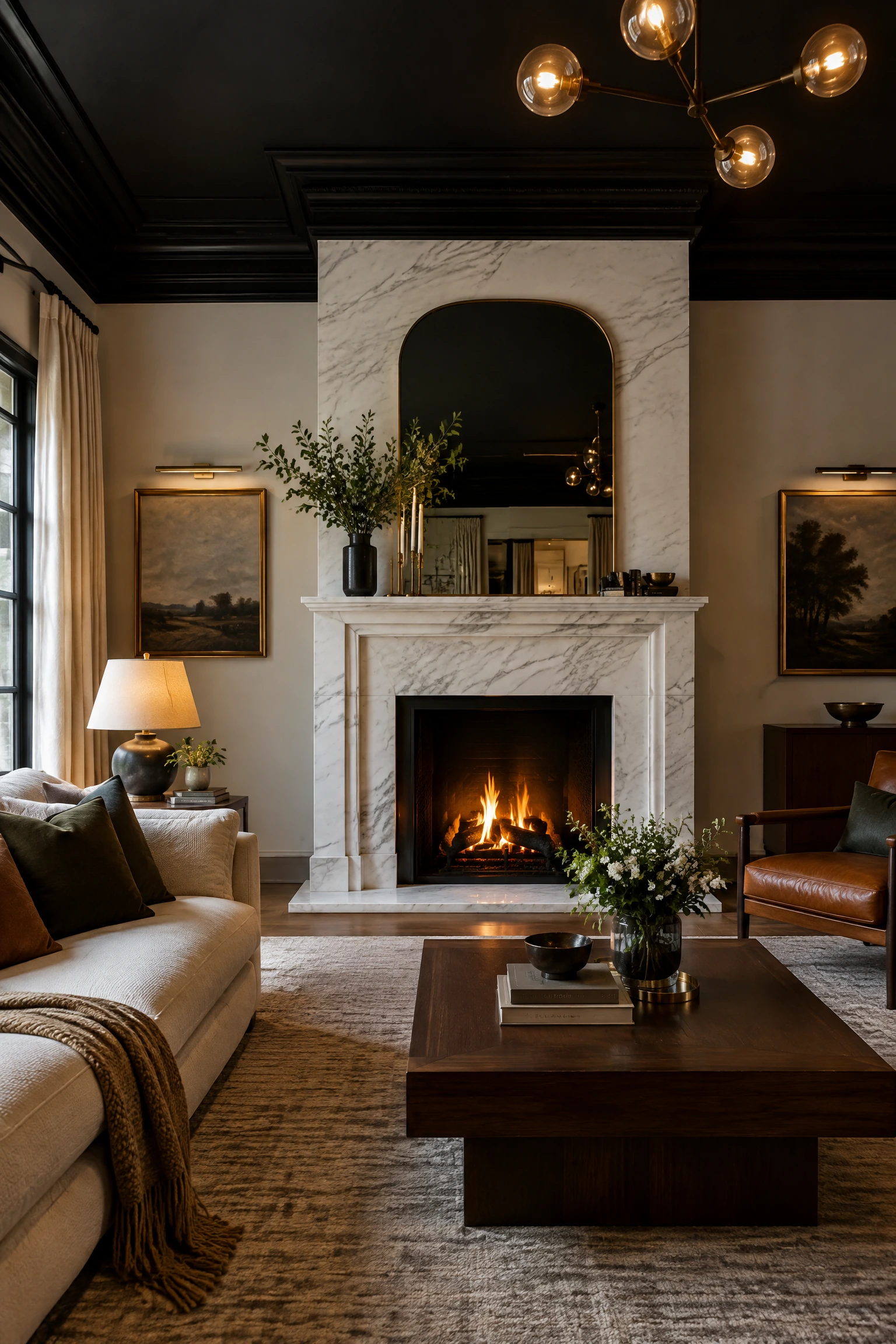
A fireplace surround in white marble, pale limestone, warm plaster, or light-painted timber creates a dramatic focal point in a black ceiling room because the pale surround reads against both the dark ceiling above and the darker fire opening below as a bright, luminous architectural feature. The contrast between a pale marble surround and a matte black ceiling is one of the most specifically beautiful material pairings in contemporary living room design, and it produces a result that reads as genuinely high-end without requiring expensive furniture or finishes elsewhere in the room. The fireplace surround’s pale tone also provides the visual anchor that the room needs at the most important architectural focal point.
Pro Move: An all-white or all-plaster fireplace surround in a room with a black ceiling and light warm walls reads as a three-layer composition of increasing darkness from floor to ceiling: pale marble surround, warm white walls, black ceiling. This gradient creates a sense of dramatic depth that is highly photogenic and genuinely beautiful in person.
CATEGORY FIVE: TEXTILES AND COLOUR
20. Use Rich, Warm Textiles to Counteract the Ceiling’s Cool Darkness

A black ceiling, particularly in a room with limited natural light, can read as cool and slightly remote if the textiles in the room do not counteract it with warmth. Velvet cushions in warm jewel tones, terracotta and dusty rose and warm amber, a wool or cashmere throw in a warm caramel or cream, a silk or velvet cushion in a deep rich burgundy, a sheepskin on the seat of an armchair: each of these warm textile additions pushes back against the ceiling’s cool darkness and creates the intimate, sensory warmth that distinguishes a successful black ceiling room from one that simply feels dark. The rule is that every layer of cool darkness in the room, the ceiling, any dark wall, dark trim, needs at least one warm textile at a different level to balance it.
Designer Advice: Velvet is the textile that works best in a black ceiling room because its pile reflects light directionally rather than diffusely, which adds warmth and richness at cushion and sofa level that flat-woven or linen fabrics cannot match. A velvet cushion in a warm jewel tone on a cream linen sofa beneath a black ceiling is one of the most effective and least expensive additions available.
21. Introduce Brass, Gold, and Warm Metal Accents Throughout
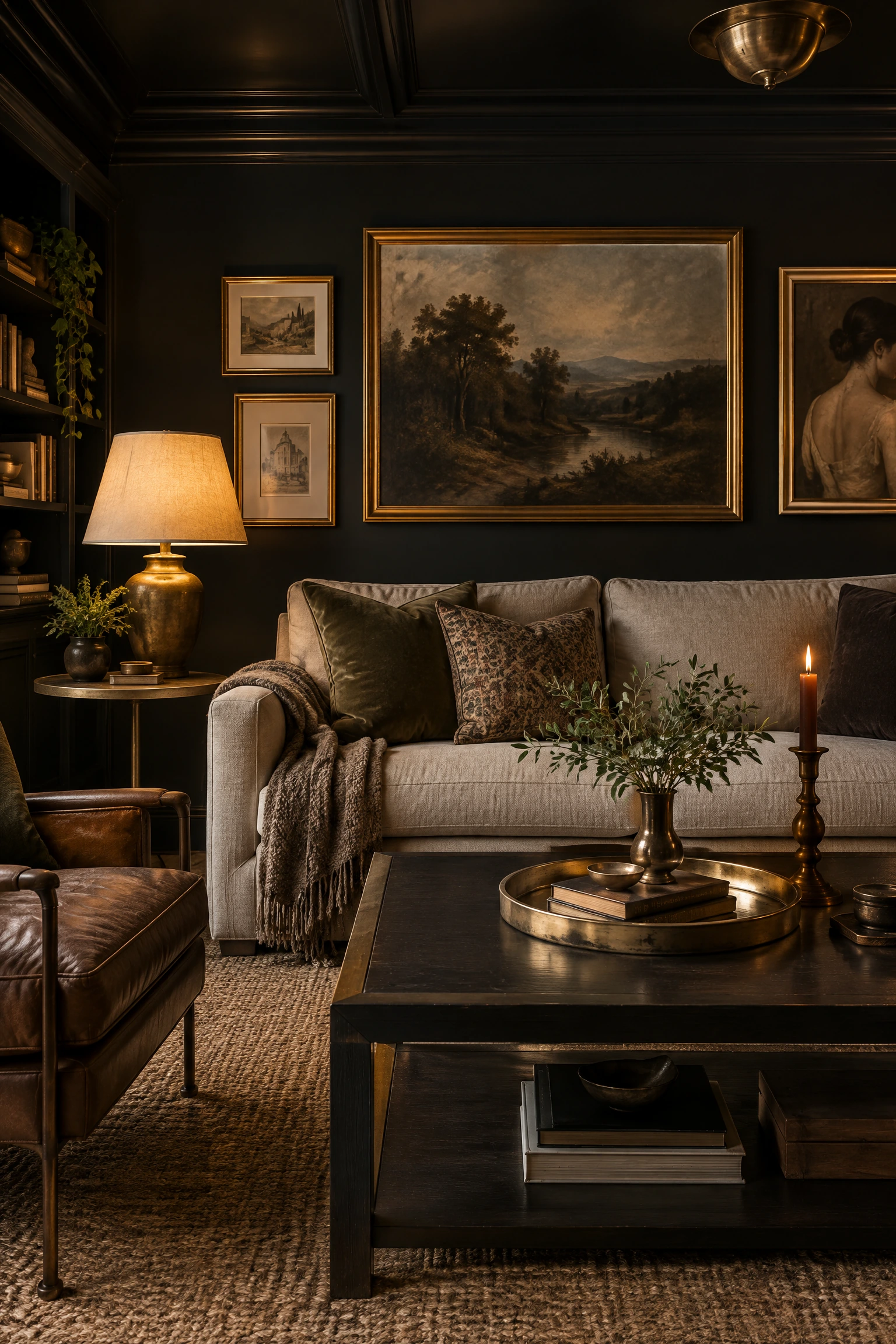
Warm metal finishes, aged brass, brushed gold, antique bronze, and warm copper, are the accent material that most effectively bridges the warmth of the textiles and the darkness of the ceiling in a black ceiling living room. A brass lamp base, a gold-framed mirror, a bronze candle holder, brass picture frame hardware, and a warm-toned metal tray on the coffee table together create a warm metallic thread that runs through the room at different heights and connects the warm elements to the dark ones in a way that reads as designed rather than coincidental. The key is consistency: choosing one metal family, either the warm brass and gold range or the cool chrome and silver range, and applying it consistently across all the room’s metal elements.
Reality Check: Mixing warm and cool metals in a black ceiling room reads as inconsistent and undermines the careful balance the scheme requires. A single black ceiling room with brass lamp bases, chrome picture frames, silver candle holders, and gold-framed art will always look less intentional than the same room with all warm or all cool metals throughout.
22. Add a Large Statement Mirror to Reflect Light and Add Depth
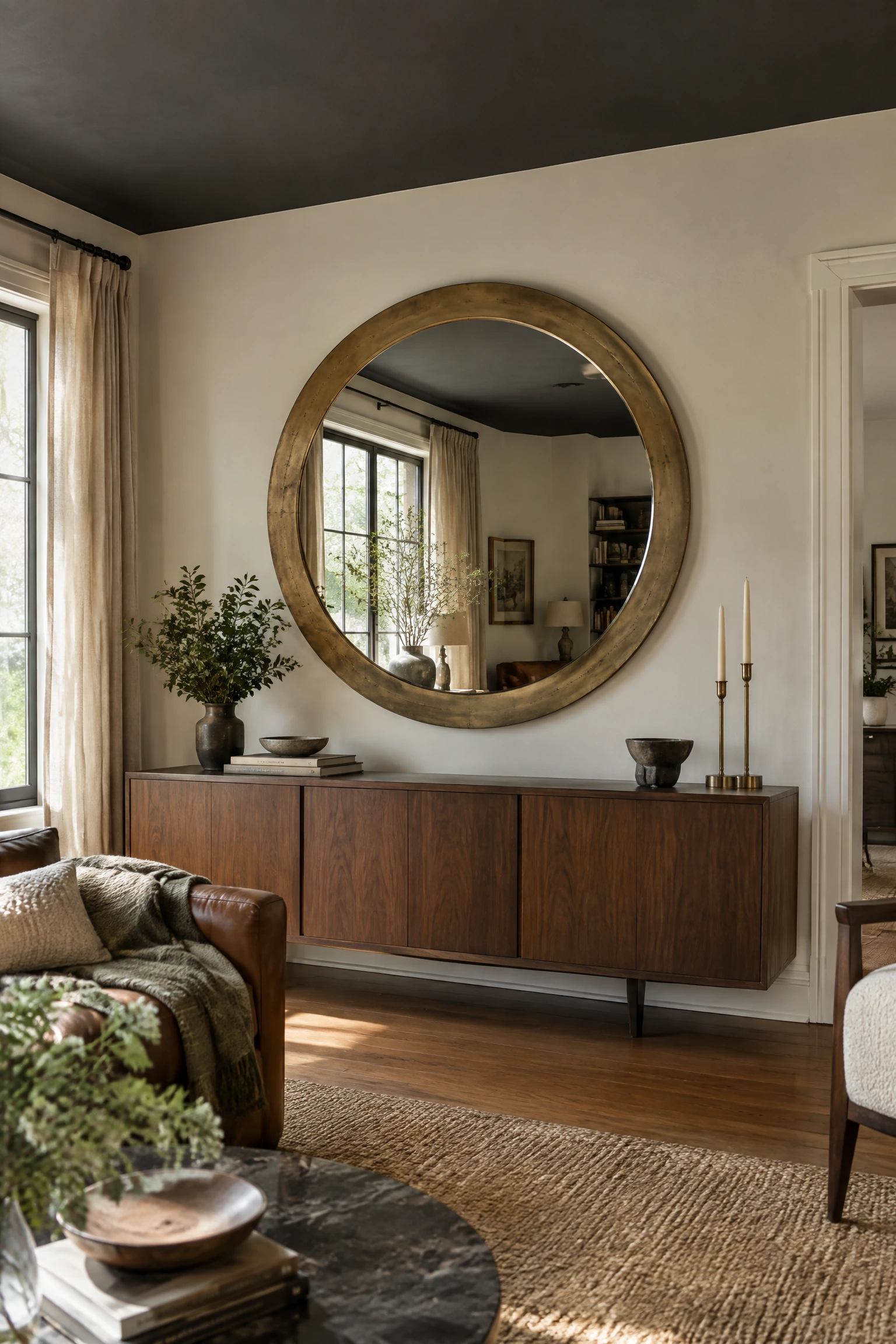
A large mirror in a warm metal frame, leaning against the wall or hung at a substantial height, is one of the most useful additions to a black ceiling living room because it performs two functions simultaneously: it reflects light back into the room from multiple sources, which counteracts the ceiling’s absorptive quality, and it creates the visual impression of a second room beyond the mirror, which adds perceived depth and space. Positioned opposite a window, the mirror bounces natural light across the floor level and into the room. Positioned opposite a well-styled zone, it reflects the warmth and richness of the room back on itself. In either position, the warm metal frame reads beautifully against the lighter wall surface and relates to the other warm metal accents in the room.
Quick Tip: A large round mirror in a wide aged brass or warm gold frame on a wall beneath a black ceiling is one of the most photographically striking and aesthetically effective combinations available. The circle contrasts with the rectangular geometry of the room and the frame provides the warm metal accent at a scale that commands attention.
CATEGORY SIX: STYLING AND FINISHING DETAILS
23. Use Plants to Add Organic Life and Visual Counterweight

Large indoor plants in a black ceiling room add something that no other decorative element provides: organic life at multiple heights that visually counteracts the ceiling’s geometric, architectural quality. A tall fiddle leaf fig or a large monstera beside the sofa, with its irregular organic canopy of leaves at near-ceiling height, creates a natural element that relates to the black above it in a way that reads as the indoor version of a forest canopy, dark sky visible above the organic shapes of leaves and branches. A trailing pothos on a high shelf, a snake plant in a dark ceramic pot in a corner, and a small plant on the coffee table each extend the organic layer from floor level upward through the room.
Designer Advice: Choose pots in dark tones, matte black, dark charcoal, or a deep terracotta, for plants in a black ceiling room. Pale or white pots introduce a competing light element at floor level that disrupts the room’s tonal composition. Dark pots ground the plants visually and allow the plants’ foliage to be the organic element rather than the container.
24. Create a Gallery Wall That Reads Against the Lighter Walls
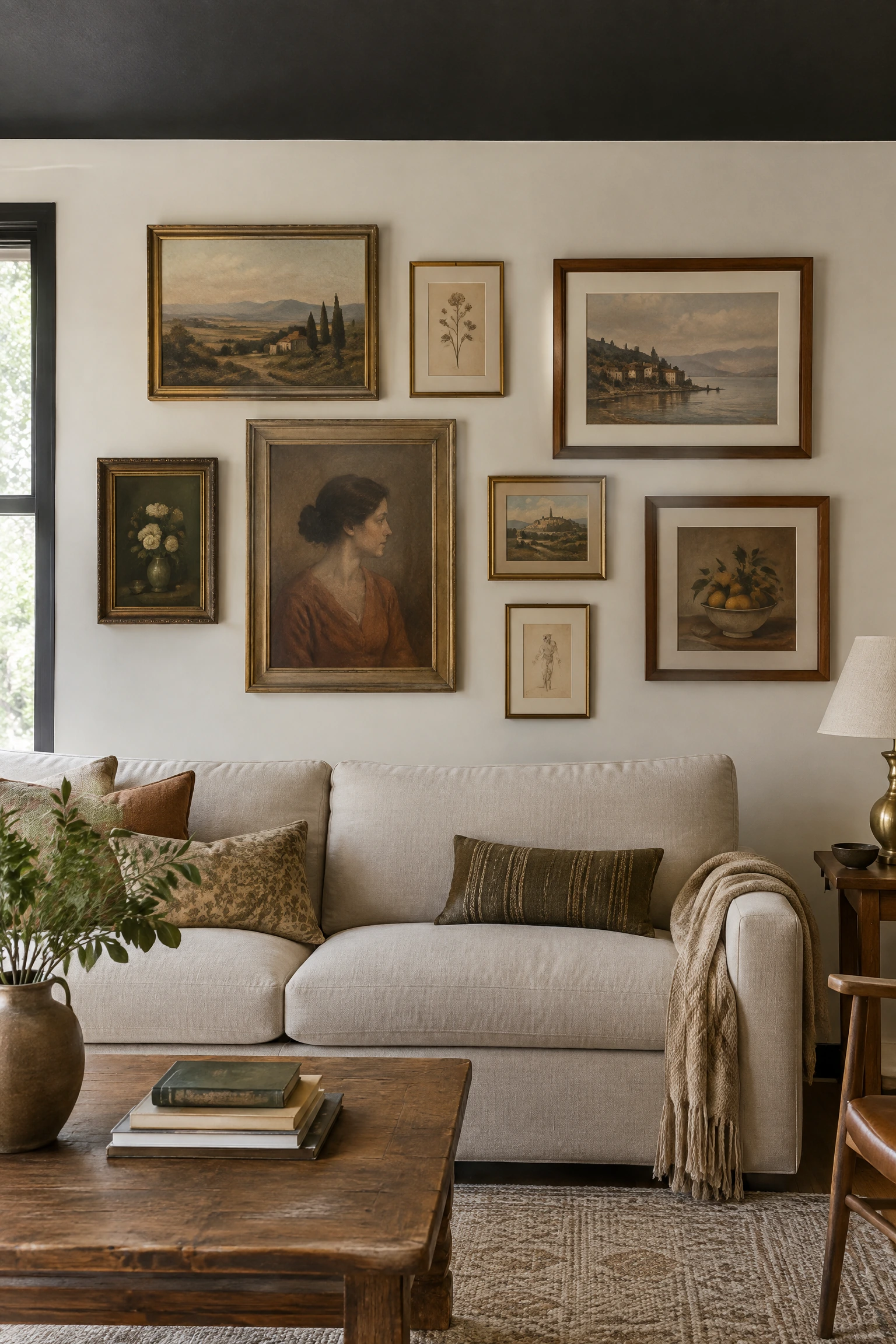
A gallery wall in a room with a black ceiling benefits from the ceiling’s architectural framing effect in a way that a gallery wall in a room with a white ceiling does not. The black ceiling creates a clear visual boundary above the gallery arrangement, which makes the grouping of frames read as occupying a defined, contained zone rather than floating on a wall of indeterminate height. The frames in a black ceiling room gallery wall work best in the room’s warm metal family, aged brass or antique gold, or in a natural wood finish that relates to the room’s other warm wood elements. Matte black frames against a warm white wall beneath a black ceiling create an arrangement where the frames read as extensions of the ceiling rather than as art objects in their own right.
Pro Move: Hang the top edge of the gallery wall slightly lower in a black ceiling room than in a standard white-ceiling room. Positioning the top of the grouping 8 to 10 inches below the ceiling line rather than close to the ceiling creates a visual gap between the dark ceiling and the gallery arrangement that makes both the ceiling and the art read more distinctly.
25. Style the Coffee Table With Objects That Have Metallic or Organic Texture
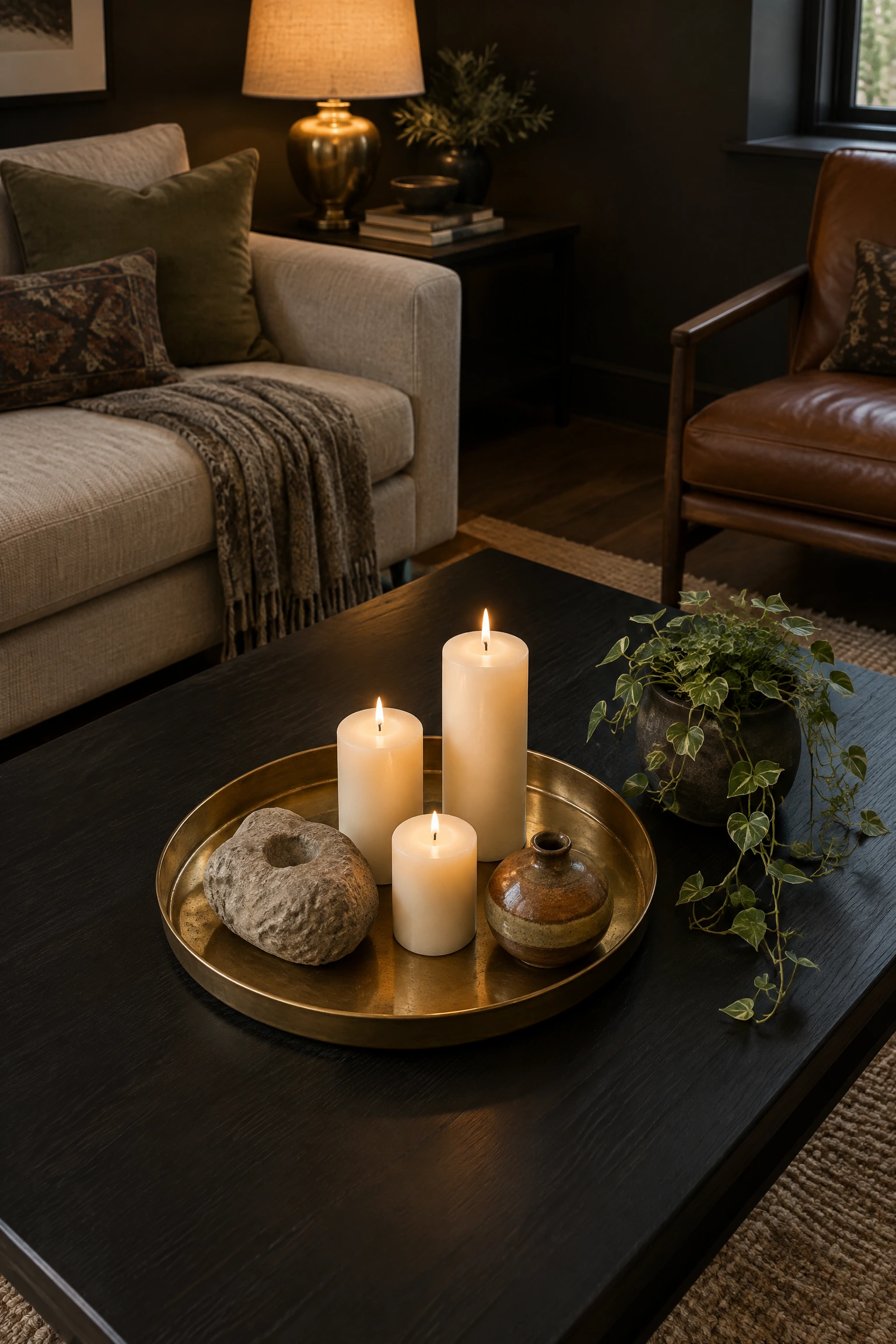
The coffee table in a black ceiling room sits at the most central and most visible point in the room’s composition, and the objects on it contribute to the tonal balance of the space. Objects with warm metallic quality, a brass tray, a gold-toned candleholder, an aged bronze sculpture or bookend, reflect warm light upward from table level that adds to the room’s light layering. Objects with organic texture, a rough-hewn stone, a piece of interesting bark used as a display base, a ceramic vessel with a reactive glaze, add the natural material quality that the room needs at human scale to prevent the dark ceiling from making the space feel overly architectural. A coffee table styled with a warm brass tray holding a candle cluster, one organic object, and a small plant reads as considered and in dialogue with the ceiling above it.
Quick Tip: Keep the coffee table surface lighter in tone than the ceiling. A dark coffee table beneath a black ceiling removes the mid-level light-reflecting layer from the room’s composition. A glass-topped table, a pale stone surface, or a light wood finish keeps the central floor zone visually bright and prevents the room from darkening at its most central point.
26. Add Art That References the Room’s Tonal Composition
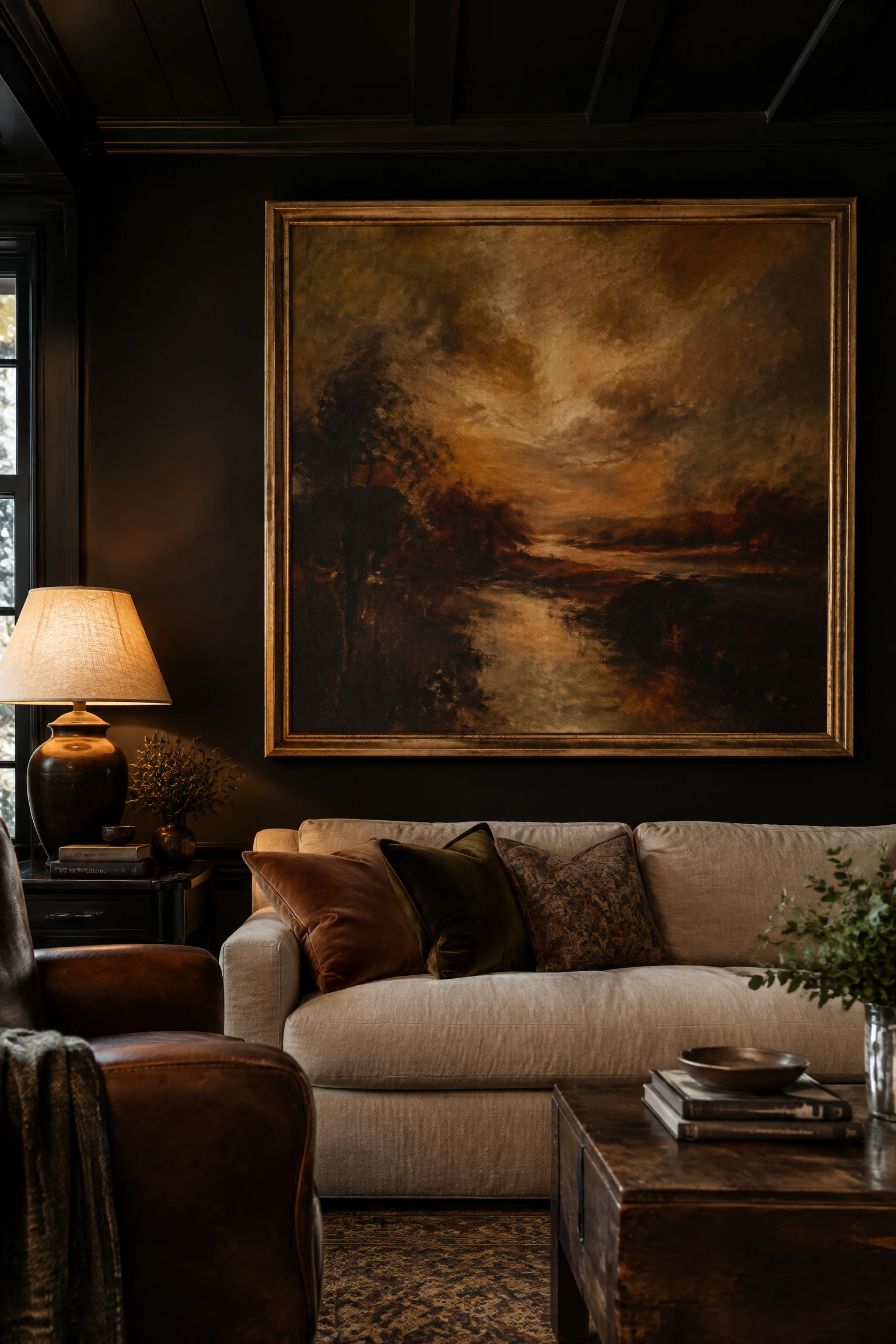
Art in a black ceiling room works best when it relates to the room’s tonal palette rather than introducing colours that compete with the carefully balanced composition above. Large-scale abstract art with dark grounds and warm metallic details, monochrome photography with warm grey tones, botanical illustrations on cream or warm paper stock, or oil paintings with the particular warm darkness of old masters all sit beautifully in a black ceiling room because their tonalities extend the room’s palette rather than disrupting it. Bright, saturated colour in a single large artwork can work in a black ceiling room if the colour relates to a key textile or accent material in the room, but a single oversaturated print in an otherwise controlled palette looks like something that wandered in from a different room.
Reality Check: The most common art mistake in a black ceiling room is choosing pieces that are too pale and too graphic, simple line drawings on white paper in white frames, which read as flat and insubstantial against the room’s rich tonal composition. Choose art with depth of tone and warmth of palette, even if the subject matter is simple.
27. Use Scent to Complete the Sensory Experience of the Room
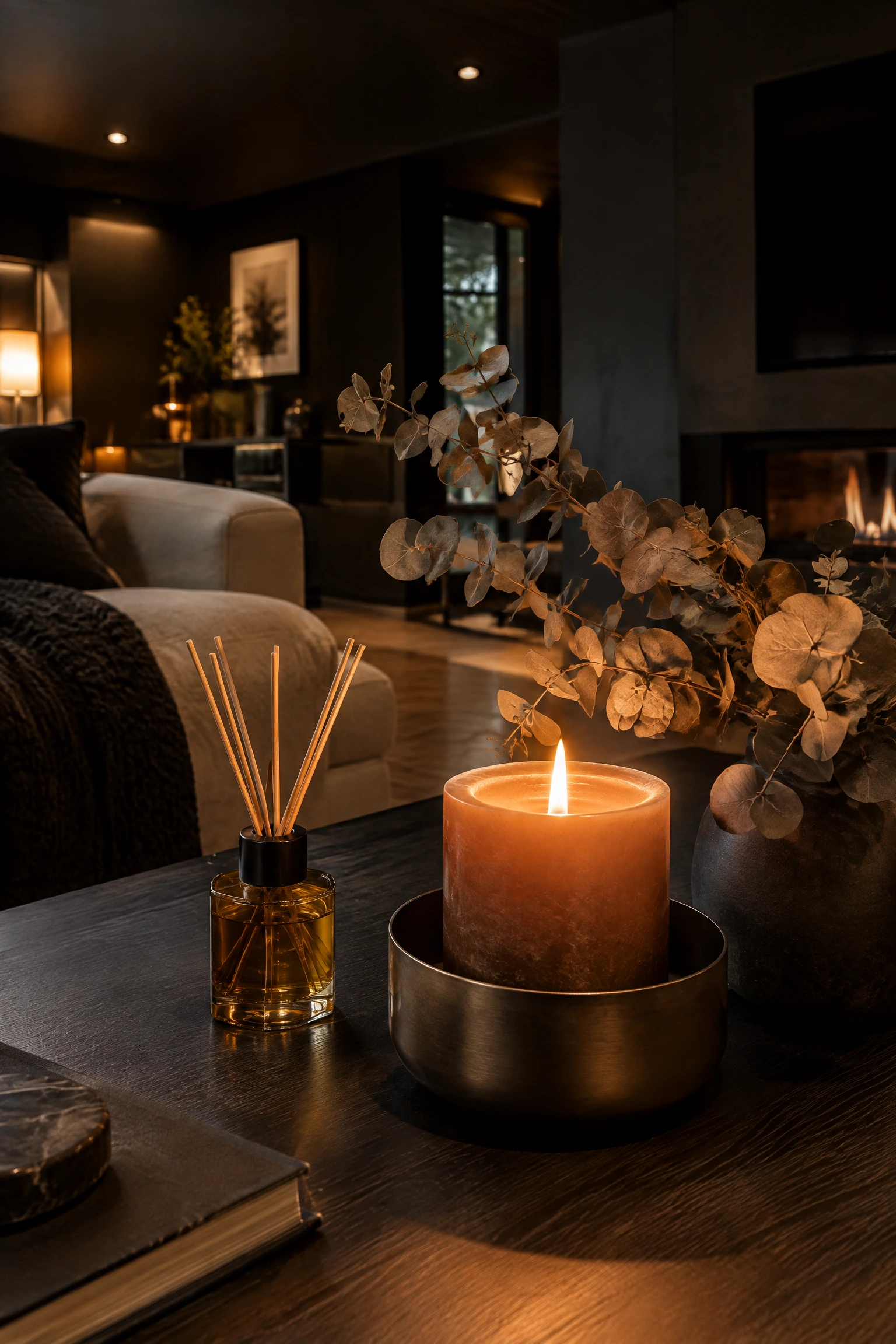
A room with a black ceiling, warm layered lighting, rich textiles, and carefully chosen art deserves an equally considered scent layer, because the atmospheric quality that a black ceiling room creates at its best is a fully multi-sensory experience rather than simply a visual one. The scents that suit a black ceiling room are those with depth and warmth: cedarwood and leather, dark amber and oud, smoky vetiver, sandalwood with a hint of tobacco, or a warm incense note. These are not sweet or floral scents but complex, slightly dark ones that match the room’s visual depth and amplify its intimate quality. A quality candle in a warm base scent burning on the coffee table beneath a warm lamp, in a black ceiling room with a fire in the grate, creates a sensory environment that is genuinely different from any other room type.
Designer Advice: Choose one signature scent for the room and use it consistently in candles, reed diffusers, and room spray. Over time, the scent becomes associated with the room’s specific atmosphere in the same way the light quality and the colour palette do, and it deepens the room’s identity beyond what is visible.
28. Edit the Room More Severely Than You Would in a Lighter Space
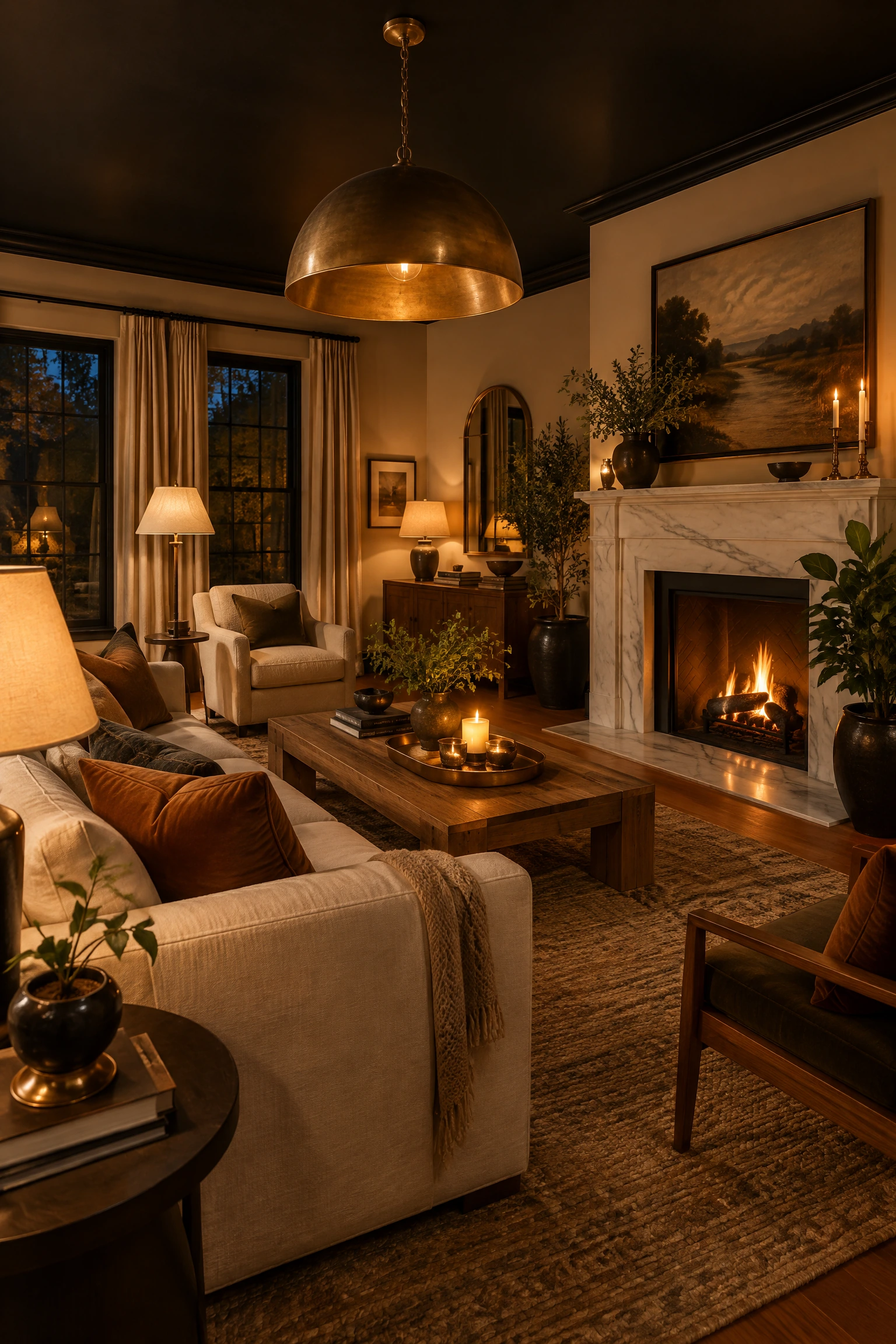
A black ceiling room requires more rigorous editing than a lighter room because the ceiling’s visual weight and the room’s intentional tonal composition mean that anything that does not belong to the palette or the aesthetic registers more prominently than it would in a neutral space. A mismatched cushion, a cheap lamp, a brightly coloured object that has no relationship to the room’s scheme, all of these are more visible and more disruptive in a black ceiling room than in a standard one. The room’s atmosphere depends on every visible element being part of the same intentional composition, which means editing out anything that does not contribute to the palette, the material quality, or the sensory atmosphere. A black ceiling room with ten well-chosen, well-positioned objects will always feel more designed and more successful than the same room with twenty objects that include ten that do not belong.
Reality Check: Walk into the room, look at the ceiling, and then scan every visible surface. Anything that makes you immediately think “that does not go” is something to remove or replace. The standard in a black ceiling room is higher than in any other room type because the architectural drama of the ceiling raises the expectations the room needs to meet.
Black Ceiling Living Room: The Decision Guide
| Decision | What Works | What to Avoid | Why |
| Ceiling finish | Flat or matte paint | Gloss or semi-gloss | Matte absorbs light and hides imperfections. Gloss reflects everything including flaws. |
| Wall colour | Warm white, light warm grey, deep jewel tones | Cool grey-white, bright primary colours | Warm tones counteract the ceiling’s cool darkness. Cool walls and a dark ceiling read as cold. |
| Lighting | Warm metal pendants, layered lamp sources, dimmers, 2700K bulbs | Single overhead fitting, cool white bulbs, fluorescent | Black ceiling needs multiple warm sources to compensate for light absorption. |
| Sofa colour | Cream, warm oatmeal, blush, pale sage | Dark navy, charcoal, deep brown | A light sofa provides visual relief between the dark ceiling and the floor. |
| Rug tone | Cream, warm ivory, natural jute, sisal | Dark rug, near-black floor covering | The rug is the floor’s primary light-reflecting surface. Keep it light. |
| Metal finishes | Aged brass, brushed gold, antique bronze, warm copper | Chrome, cool silver, mixed metals | Warm metals read beautifully against dark backgrounds. Cool metals disappear. |
| Art and frames | Warm wood frames, aged brass frames, art with tonal depth | White-framed graphic prints, very pale art | Art needs tonal warmth and depth to hold its own in a dark-anchored room. |
| Plants | Large architectural plants in dark matte pots | Multiple small plants in white or pale pots | One large plant adds organic scale. White pots compete with the room’s tonal composition. |
Why It Works
The reason a black ceiling transforms a living room rather than simply darkening it is that the ceiling is the one surface in a room that has almost no visual function in its conventional pale form. A white or cream ceiling sits at the top of the room, reflects a little light back into the space, and is otherwise entirely ignored. A black ceiling becomes the room’s most dramatic architectural statement, the element that every lamp, every piece of furniture, every textile, and every surface responds to and relates back to. The room gains a composition it previously lacked: a clear visual anchor at the top, a series of deliberately chosen elements in the middle, and a light floor to close the circle at the bottom. That is what a designed room looks like, and the black ceiling is what makes the design visible.