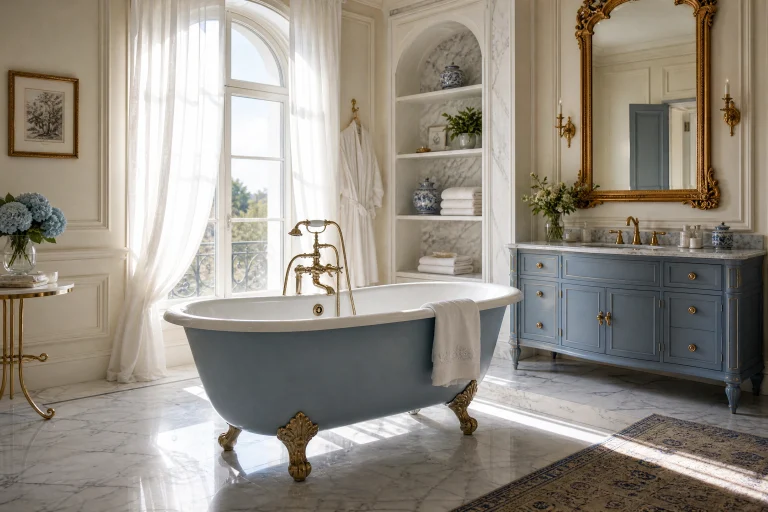
Coastal Dining Room Looks That Are Worth the Effort
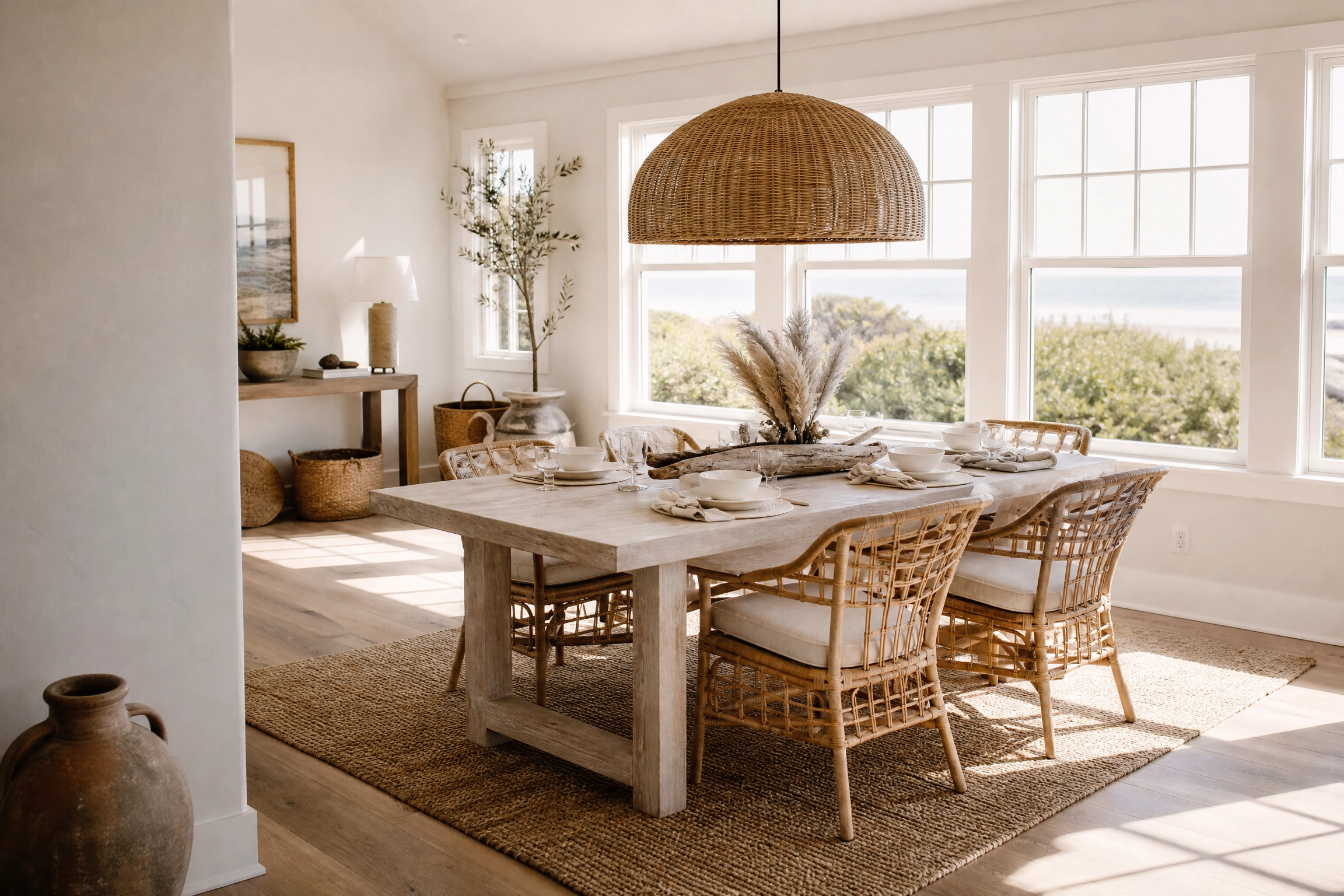
A coastal dining room done well is one of the most quietly civilised rooms you can build. It is also one of the most consistently underestimated — people assume the style is limited to beach houses, when it works just as well in a city flat. Not the plastic-anchor, rope-wrapped-everything version of beach decor, but the real thing: rooms that feel light, easy, and quietly beautiful in a way that makes you slow down before you even pick up your fork. Getting a coastal dining room right is less about buying the right accessories and more about understanding how natural light, organic materials, and a calm color story work together to create a space that feels lived-in and effortless. In practice, that is a harder balance to strike than it looks, which is why so many coastal dining rooms end up looking either too themed or too bland.
This collection covers 24 genuinely distinct ways to pull off a coastal dining room, organized across different style directions so you can find the approach that fits your home and your taste. Whether you are working with a small breakfast nook near the water or a sprawling open-plan space that needs some seaside soul, there is something here for every room and every budget. Some of these ideas lean into the relaxed, sun-bleached character of a beach cottage, while others bring a more polished, considered edge to coastal design. All of them are based on how rooms actually look and function in real life, not just how they photograph.
Casual Beach Cottage Style
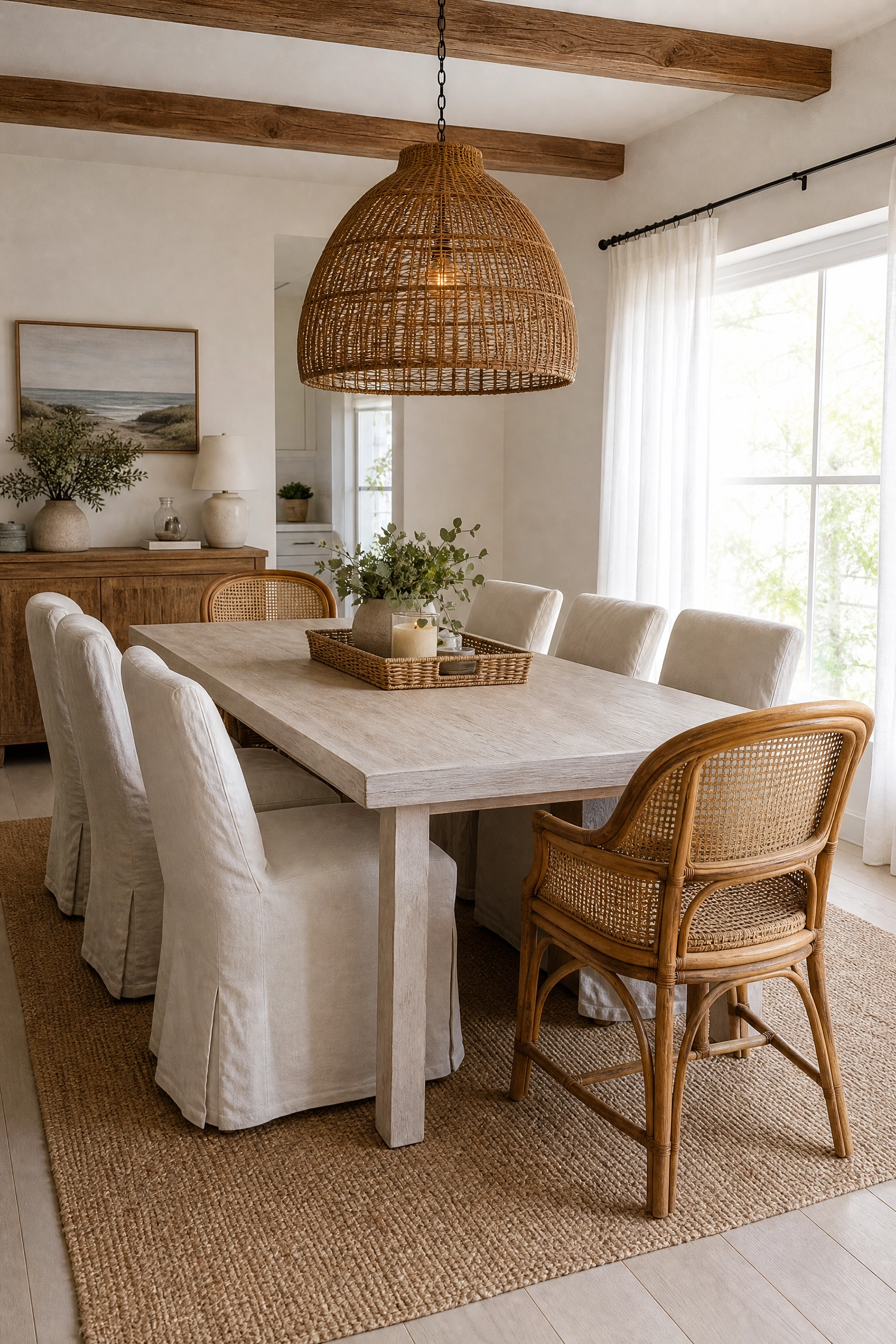
Whitewashed Wood Tables with Linen Slipcovered Chairs
A whitewashed or limeswashed dining table is one of the most reliable foundations for a casual coastal dining room, and it works because the finish reads as naturally weathered rather than deliberately decorated. Pair the table with linen slipcovered chairs in an off-white or warm sand tone, and you immediately get that sun-bleached, easy-living quality that is the backbone of beach cottage style. The slipcovered chair is a practical choice too, not just an aesthetic one, since covers can be removed and washed when life gets messy. For lighting, a rattan or seagrass pendant in a wide dome shape works beautifully here, casting a warm diffused glow over the table without feeling heavy. Keep the floor natural, whether it is pale oak hardwood, whitewashed boards, or even large-format limestone tiles, and add a jute rug underneath to anchor the seating area. One thing that works really well in this setup is mixing chair styles slightly, using matching slipcovered chairs on the long sides of the table but adding a pair of wooden benches or cane-back chairs at the ends to break up the uniformity. Budget note: slipcovered chairs from brands like Pottery Barn or IKEA with slipcover upgrades are genuinely affordable and hold up well in a dining setting.
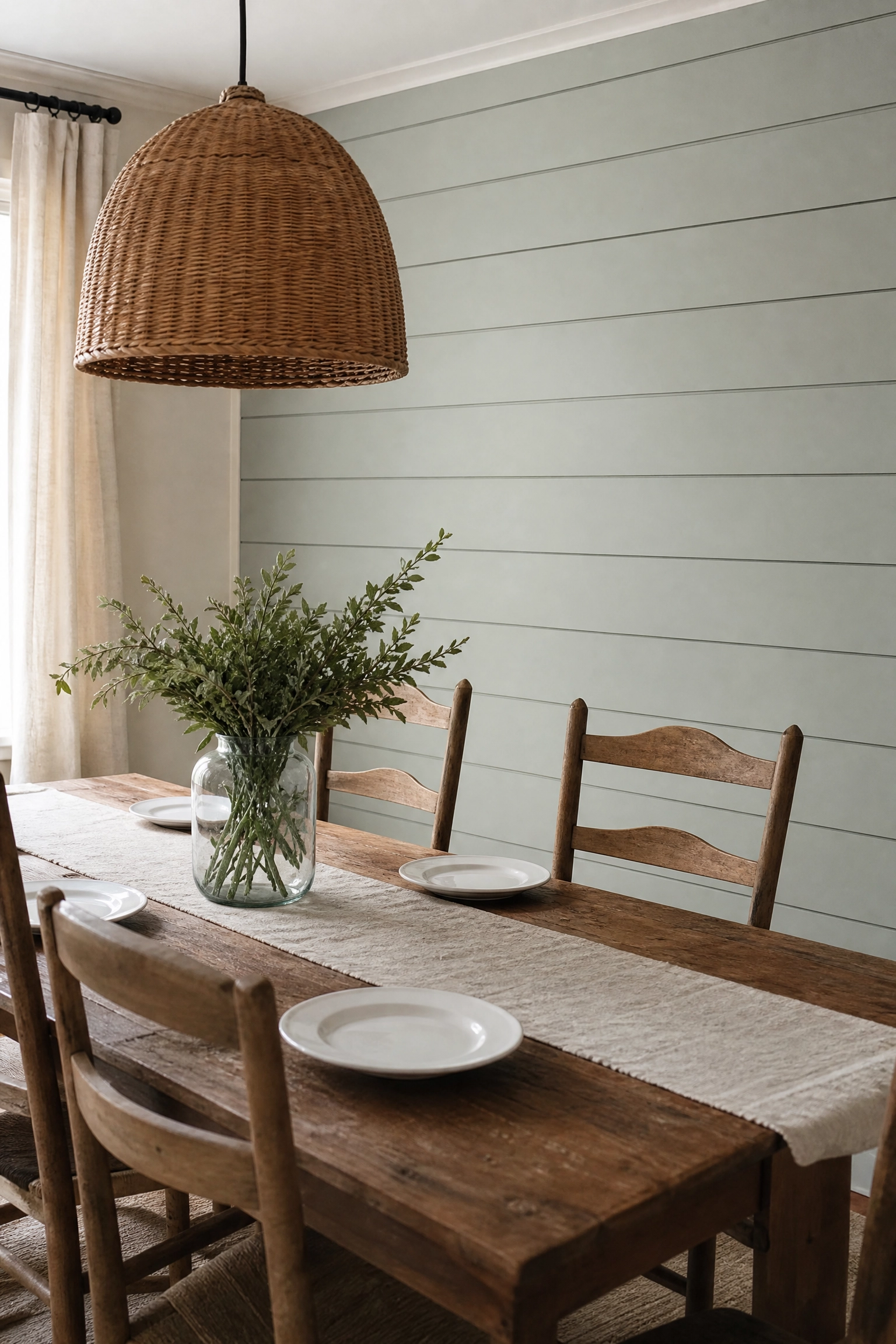
Shiplap Walls Painted in a Soft Sea Salt Tone
Shiplap is one of those materials that instantly signals coastal without trying too hard, particularly when it is painted in a very soft, slightly muted tone rather than a bright white. A color like Sherwin-Williams Sea Salt or Benjamin Moore’s Silver Mist sits beautifully on shiplap because the horizontal lines of the boards create shadow detail that keeps the wall interesting even in a neutral palette. In a dining room, running shiplap on a single feature wall behind a sideboard or buffet gives the space a clear focal point and makes the room feel intentional. Round this out with a reclaimed wood dining table, some simple ladder-back chairs in a natural finish, and a woven jute runner down the center of the table. A flush-mount or semi-flush fitting with a cane or rattan shade keeps the ceiling feeling relaxed rather than formal. One honest limitation of shiplap is that the grooves collect dust and can be harder to clean than smooth walls, so it is worth factoring in that maintenance reality before you commit to full-room coverage.
Vintage Wicker Chairs with a Marble-Top Dining Table
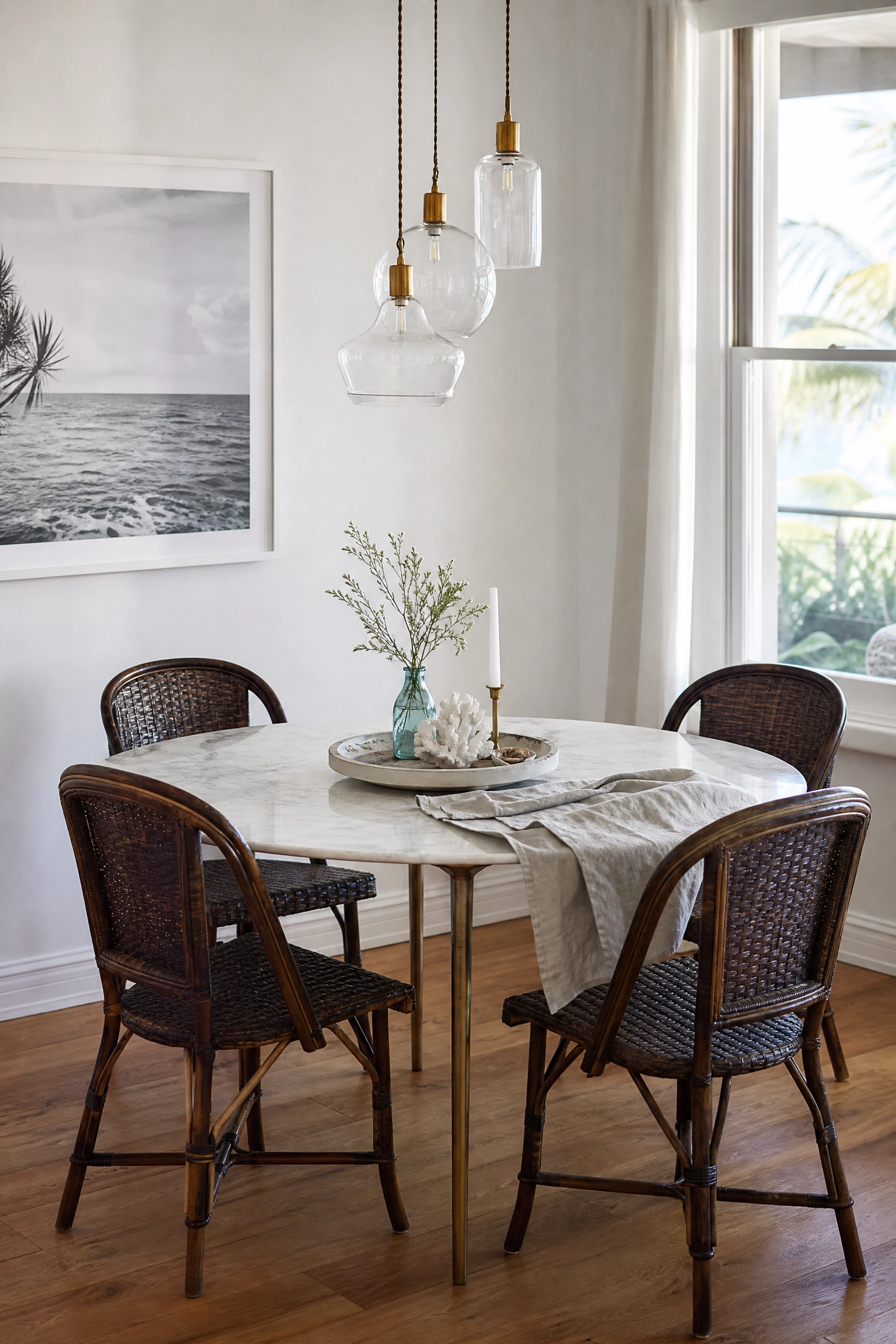
There is a version of coastal casual that is a little more collected-looking, as if the room came together over years rather than one shopping trip, and pairing vintage wicker or rattan chairs with a marble-top dining table is one of the best ways to achieve it. The combination of the organic, slightly irregular texture of wicker against the smooth, cool surface of marble creates a visual contrast that feels genuinely considered without being stuffy. Look for wicker chairs with a slightly distressed or dark-stained frame rather than the very bright, newly lacquered versions, since aged wicker reads more authentically coastal. A round marble table works particularly well in this setup because it softens the overall look and encourages conversation. Add a simple linen or cotton tablecloth in a soft stripe pattern for casual meals, and keep the walls bare or hung with one large piece of abstract ocean-inspired art to avoid overcrowding the space. For lighting, a cluster of glass pendant lights at different heights brings in that coastal water-glass quality without leaning nautical. This kind of look works best in medium to larger rooms since the combination of wicker and marble has a slightly generous visual weight.
A Blue and White Striped Palette on Every Surface
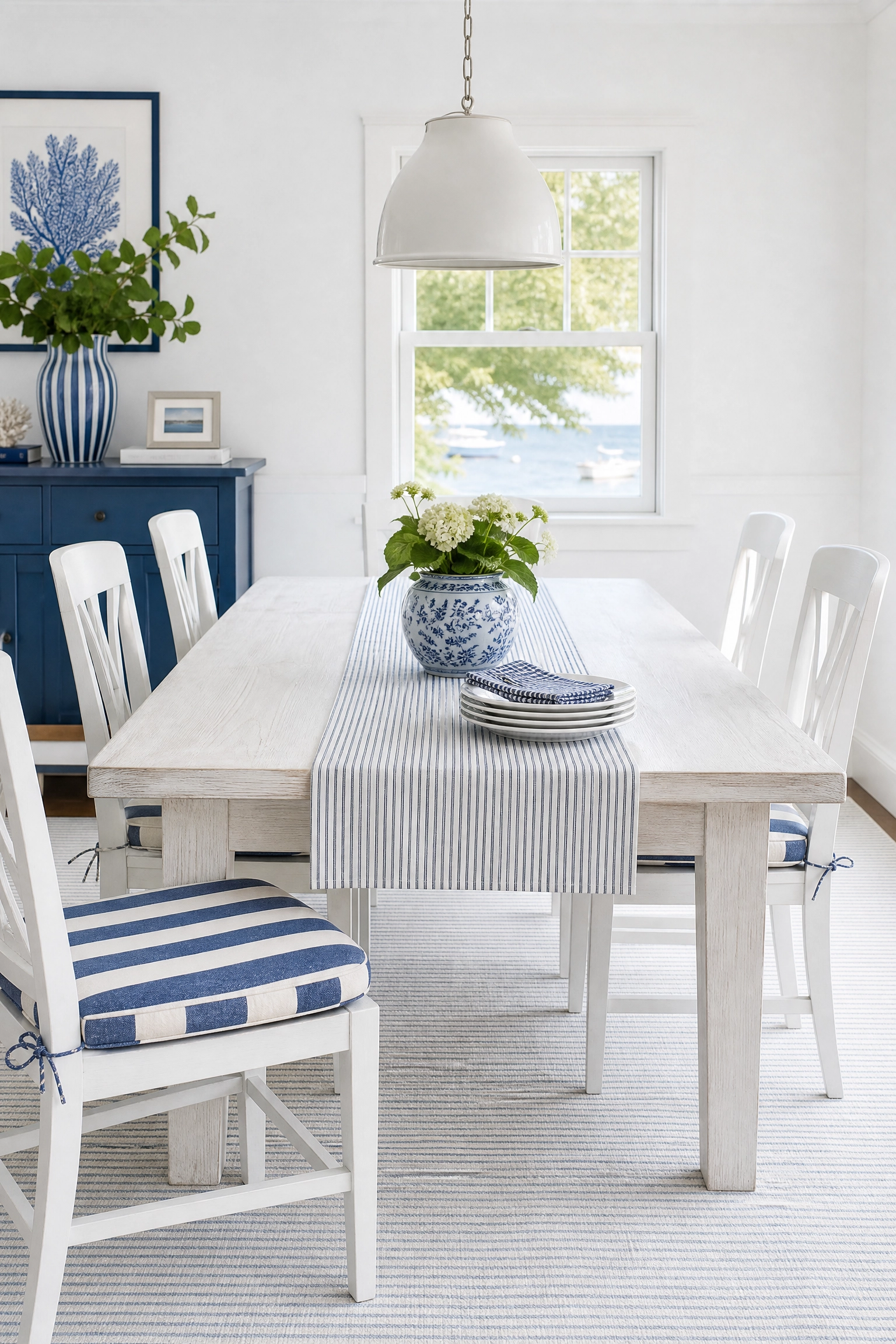
The blue and white stripe is one of the most classically coastal combinations in interior design, and it earns its place because it genuinely works at every scale, whether you use it on seat cushions, a tablecloth, wallpaper, or ceramic accessories. The key to making it feel fresh rather than predictable is varying the scale of the stripe across different surfaces: a wide bold stripe on seat cushion covers, a fine narrow stripe on napkins or placemats, and a very subtle stripe in the rug or runner. For this to work as a full dining room palette, keep the walls solid: a bright white or a soft off-white allows the blue and white accents to do the heavy lifting without the room feeling overwhelmed. A simple round or rectangular table in bleached or whitewashed wood anchors the space without competing. Pendant lighting in white-painted metal or white-glazed ceramic keeps the ceiling within the palette. From a design principle standpoint, this approach relies on repetition of color with variation in pattern scale, which is a technique professional designers use to create rooms that feel cohesive but not cookie-cutter. Budget-friendly note: cushion covers and tablecloths in this palette are widely available at a low price point, so this is an affordable way to refresh an existing dining room quickly.
Natural Driftwood Centerpieces and Earthy Table Accessories
Not every coastal dining room needs to be built around color. Some of the most beautiful ones keep the palette almost entirely neutral and let texture do all the work, and a driftwood-forward approach to table styling is a great example of this. A long, low centerpiece arrangement using pieces of smoothed driftwood, a few dried pampas grass stems, some bleached shells, and a couple of low white pillar candles looks genuinely organic and interesting without feeling manufactured. Serve this kind of styling on a dining table in dark walnut or a warm oak finish for contrast, and use linen napkins in a natural undyed tone, folded simply and secured with a piece of twine. The surrounding room can lean into the earth tones as well: terracotta floor tiles, walls in a warm greige or pale putty shade, and a jute or sisal rug underneath the table. Lighting should feel warm and a little ambient, so a chandelier with exposed Edison bulbs or a pendant with a natural linen shade works well here. One thing that works really well in practice is incorporating a small clay or stoneware bud vase or two into the centerpiece, since the irregular handmade quality of ceramics reads beautifully alongside organic driftwood.

Modern Coastal Style
A Sleek White Dining Table with Curved Upholstered Chairs
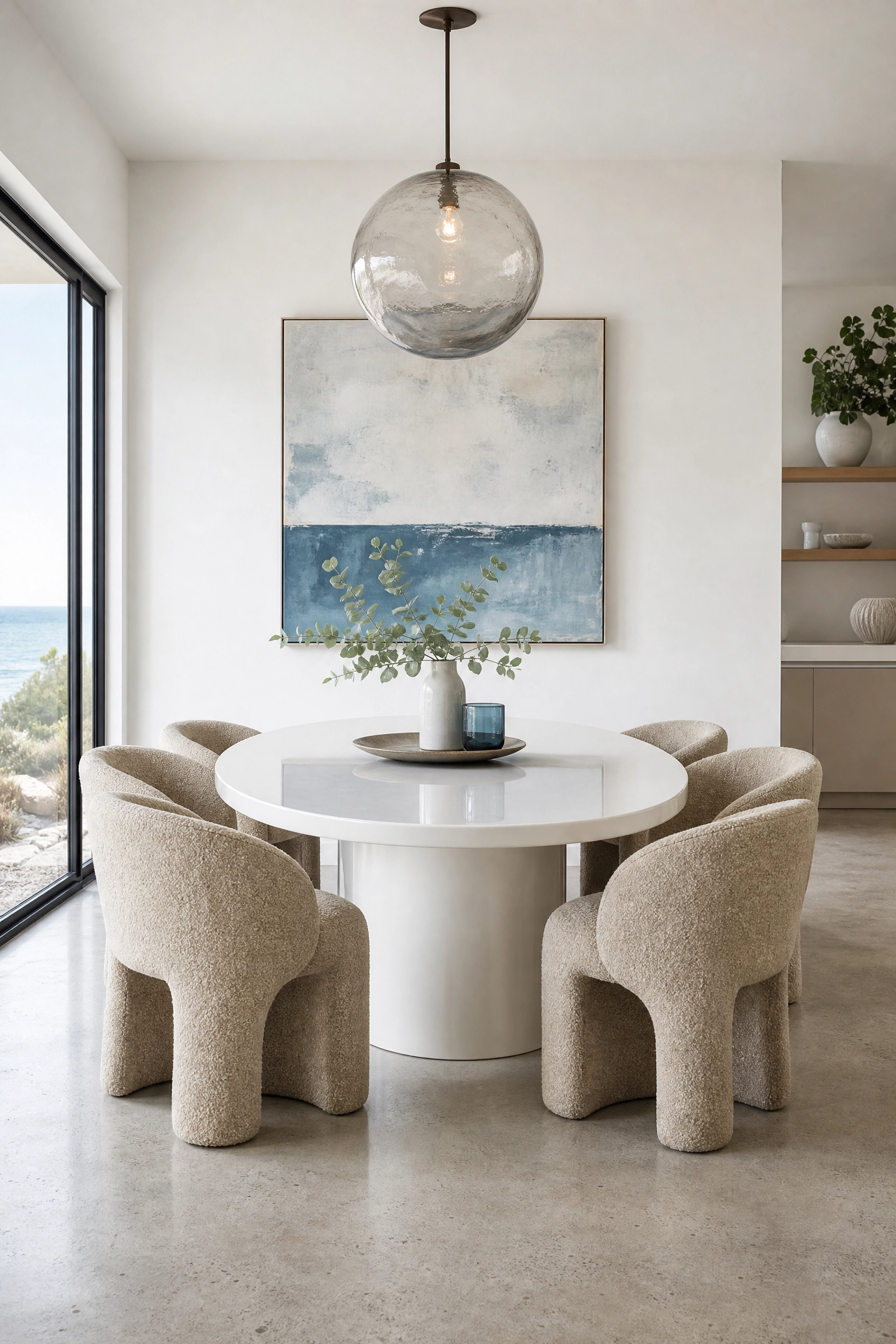
Modern coastal takes the breezy, open feeling of beach-inspired design and pulls it through a much cleaner, more architectural lens. A glossy or matte white dining table with simple rectangular or oval proportions is the right foundation here, ideally in a material like lacquered MDF, white Corian, or a painted solid wood that reads as deliberate rather than distressed. Pair it with curved upholstered dining chairs in a textured boucle or a woven fabric in a soft sandy tone, a warm white, or a very muted sage green, and you get a combination that is unmistakably modern but still soft enough to feel genuinely coastal. Curved chairs are having a significant moment in interior design right now, and they work particularly well in coastal rooms because the soft rounded silhouette echoes the natural organic shapes found near water. Pendant lighting here should be sculptural but restrained: a single large globe pendant in blown glass or a rectangular linear suspension fitting in brushed brass works beautifully. Keep wall decor to a single piece of oversized abstract art in muted blues, greens, and whites. This look works well in rooms with good natural light since it relies on brightness to feel fresh rather than cold.
Navy Lacquered Walls with Warm Wood and Brass Accents
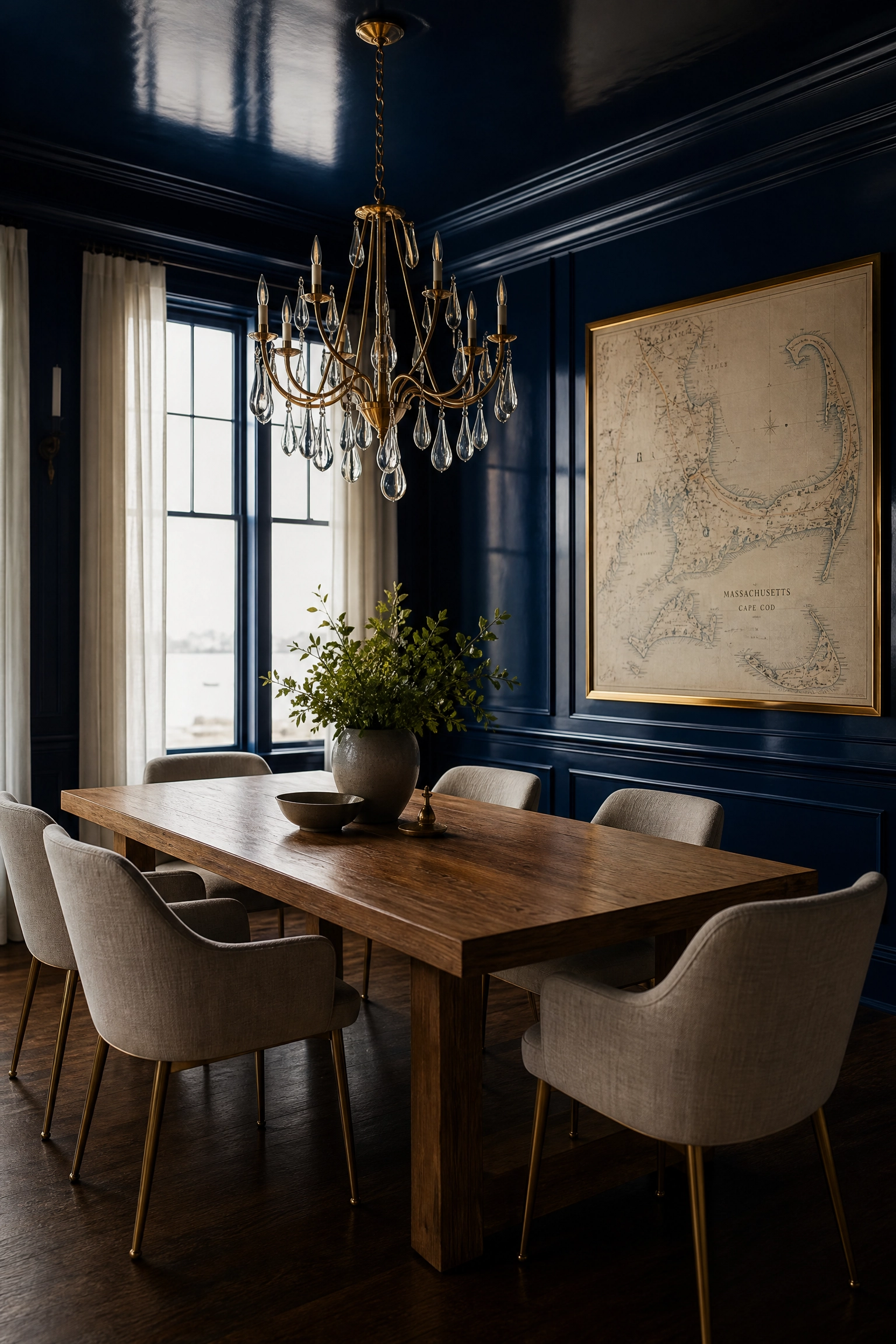
Deep navy used as a full wall color might seem counterintuitive in a room you want to feel light and coastal, but it can be deeply effective when balanced correctly, and rooms designed this way often show up in publications like Architectural Digest and Elle Decor for good reason. The key is pairing the navy with warm materials that stop the room from feeling cave-like: a dining table in a warm mid-toned oak or walnut, dining chairs in natural linen or a cognac leather, and plenty of brass in the hardware, light fittings, and accessory details. A statement chandelier in brushed brass or antique brass with glass or crystal drops becomes the room’s jewelry and bounces light around effectively. Large windows, ideally without heavy curtains or with very light sheer panels, are important here to ensure the room gets natural light to balance the dark walls. Artwork in warm sandy tones, aged maps of coastal regions, or abstract pieces with gold leaf details complement the palette rather than competing with it. This is genuinely an investment-level approach to coastal design, but done well it is one of the most striking and original interpretations of the style.
A Statement Travertine Dining Table with Woven Accents
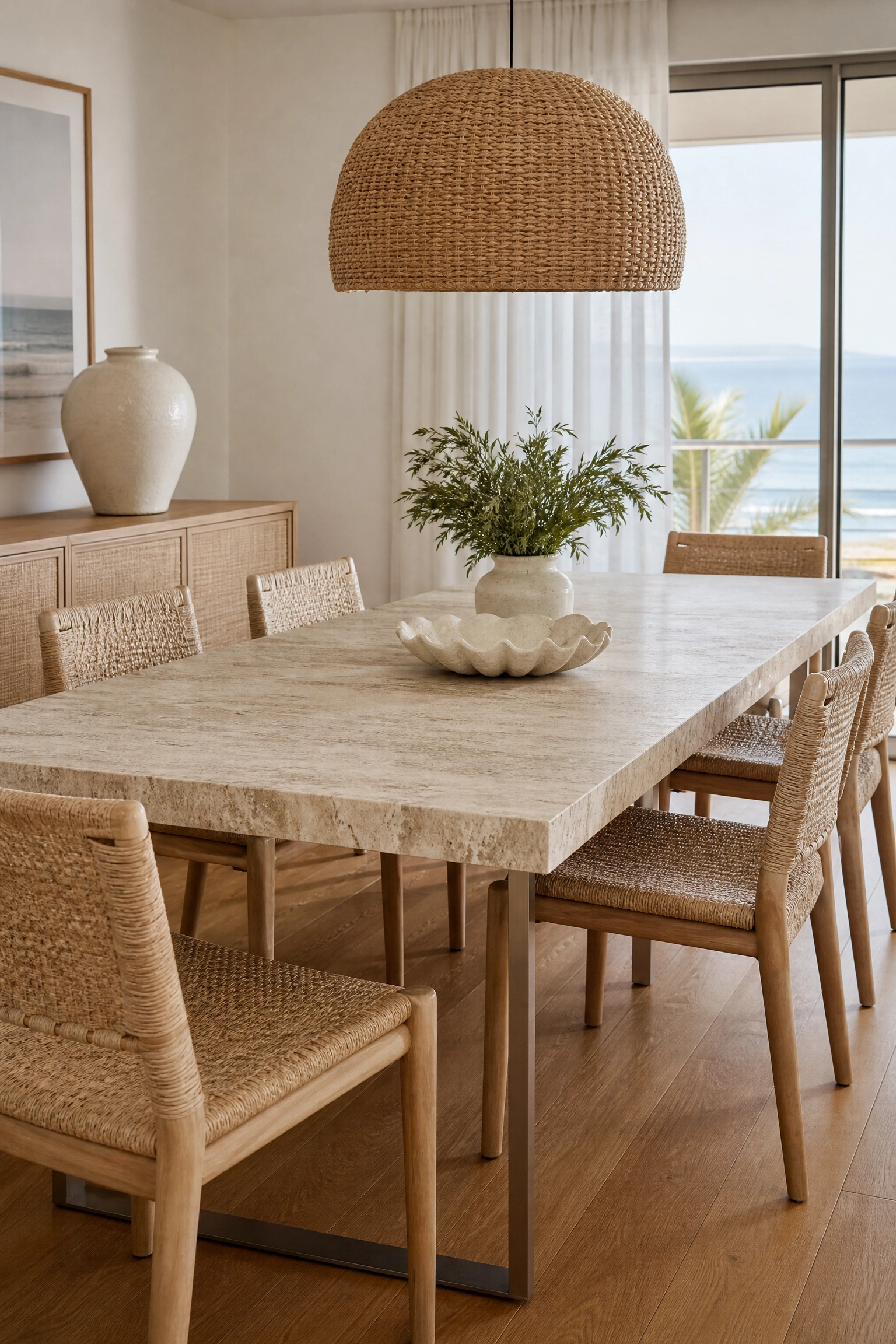
Travertine has become one of the most sought-after materials in contemporary interior design over the last few years, and its naturally porous, sandy, shell-flecked surface makes it one of the best possible materials for a coastal dining room table. A travertine-top dining table, either with a travertine pedestal base or with slim brushed steel or brass legs, immediately gives a dining room a sense of geological calm that connects naturally to a coastal narrative. The natural cream, beige, and warm grey tones of travertine work with almost every coastal color palette, from soft blue-green to terracotta to pure white. Around the table, woven dining chairs in natural rattan or a seagrass weave create a deliberate material contrast between the cool stone and the warm organic fiber. A large pendant light in a woven natural fiber or an aged brass ring chandelier keeps the lighting in conversation with the chair materials. One practical note: travertine is porous and requires sealing and occasional maintenance to keep it looking its best, so it is worth factoring in the care commitment before choosing it as a dining surface. This is a mid-to-investment-range choice but the visual impact is genuinely substantial.
Terrazzo Floors with a Muted Blue-Green Color Palette
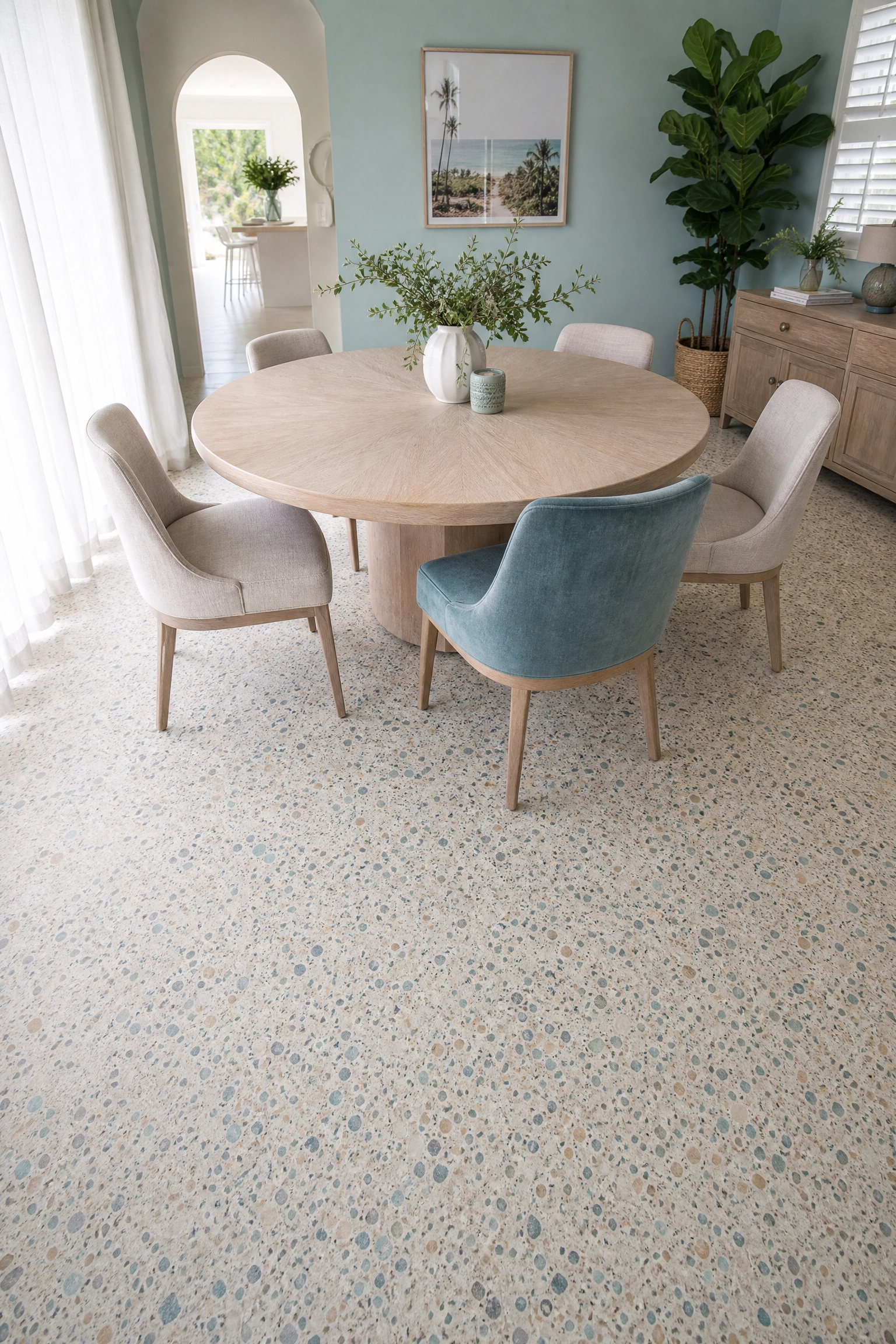
Terrazzo flooring is experiencing a genuine design revival, and in a coastal dining room it makes an enormous amount of sense because the flecked, multi-tonal surface of terrazzo naturally echoes the light-scattered, sandy quality of a beach. A terrazzo floor in a cream or light grey base with specks of soft blue, warm sand, and white immediately grounds a room in a coastal mood without any additional theme-ing required. From there, the wall color can be a soft blue-green, something in the teal family but muted enough to read as sophisticated rather than bright, and the furniture can keep things simple: a round dining table in bleached oak, a mix of simple upholstered chairs in a warm oatmeal linen, and one or two statement chairs in a complementary blue-green velvet. Velvet might seem like an unusual choice in a coastal room, but a very muted, dusty velvet in a coastal color reads as rich and relaxed at the same time. Keep window treatments light and sheer to let natural light pick up the mineral quality of the terrazzo floor. This is a fantastic choice for homes in genuinely warm climates where a cool, hard floor underfoot is a practical benefit as well as a visual one.
A Gallery Wall of Ocean Photography in Thin Black Frames
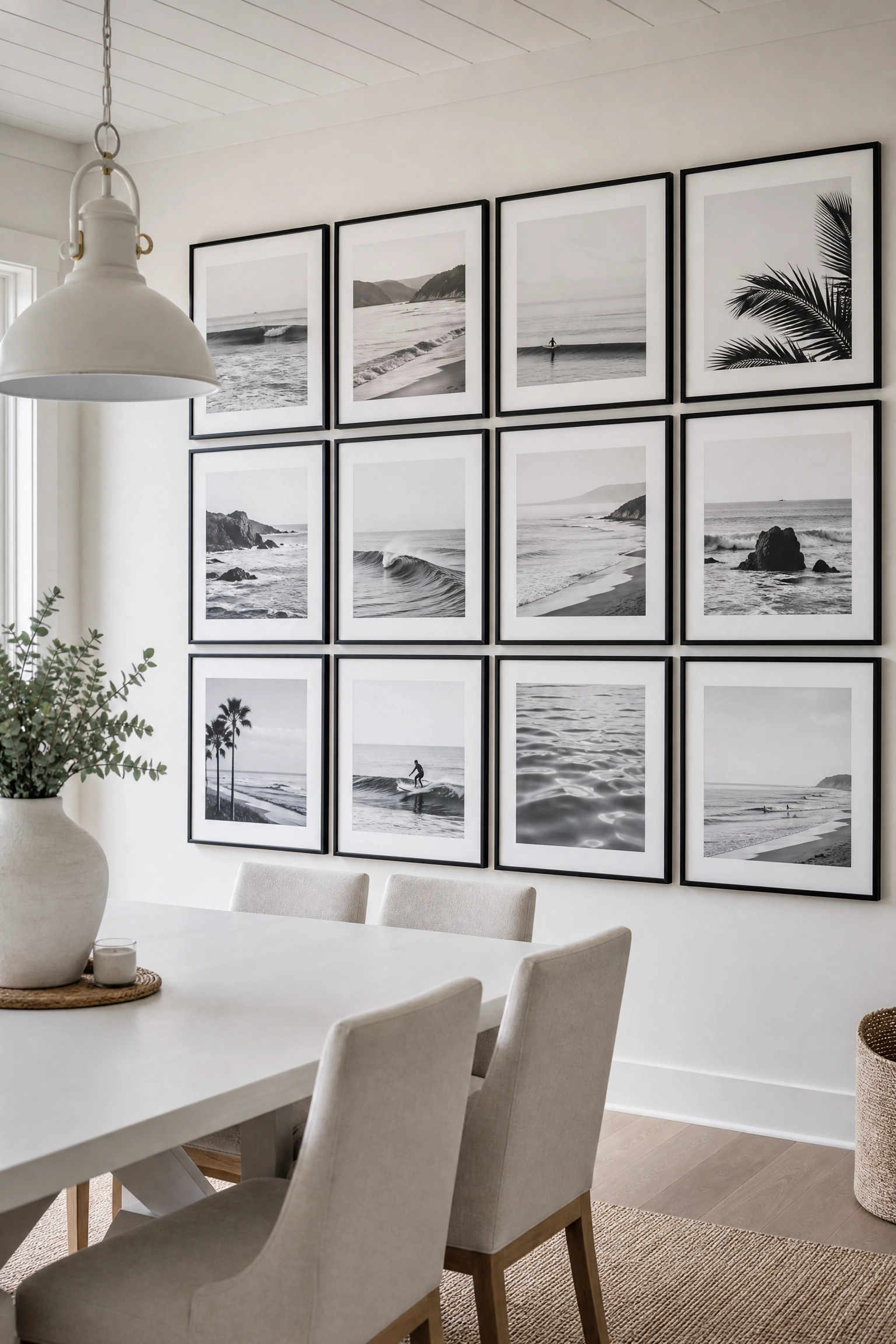
One of the cleanest and most modern ways to bring the coast into a dining room is through a carefully chosen gallery wall of large-format ocean photography, and the choice of thin black or very slim dark metal frames keeps the look sharp rather than rustic. This approach works best when the photographs themselves are consistent in tone: all black and white, or all with a similar cool blue-green color temperature, rather than a mix of warm sunset shots and cool morning shots that can feel visually scattered. A grid arrangement of nine to twelve prints in matching sizes and frames has a strong graphic quality that feels very current. The rest of the room should stay deliberately simple to let the photography carry the decorative load: a white or light grey dining table, neutral upholstered chairs, and a single pendant light in white-painted metal or concrete. This is genuinely one of the most affordable ways to make a bold coastal statement since high-quality ocean photography prints are widely available from independent artists on platforms like Society6 or Desenio at a very accessible price point. One thing to be aware of is that a gallery wall in a dining room is best positioned on a wall that is not directly behind the host or at head height where seated diners will be looking at it constantly during meals.
Coastal Grandmillennial and Collected Style
Botanical Wallpaper in a Blue and Cream Palette
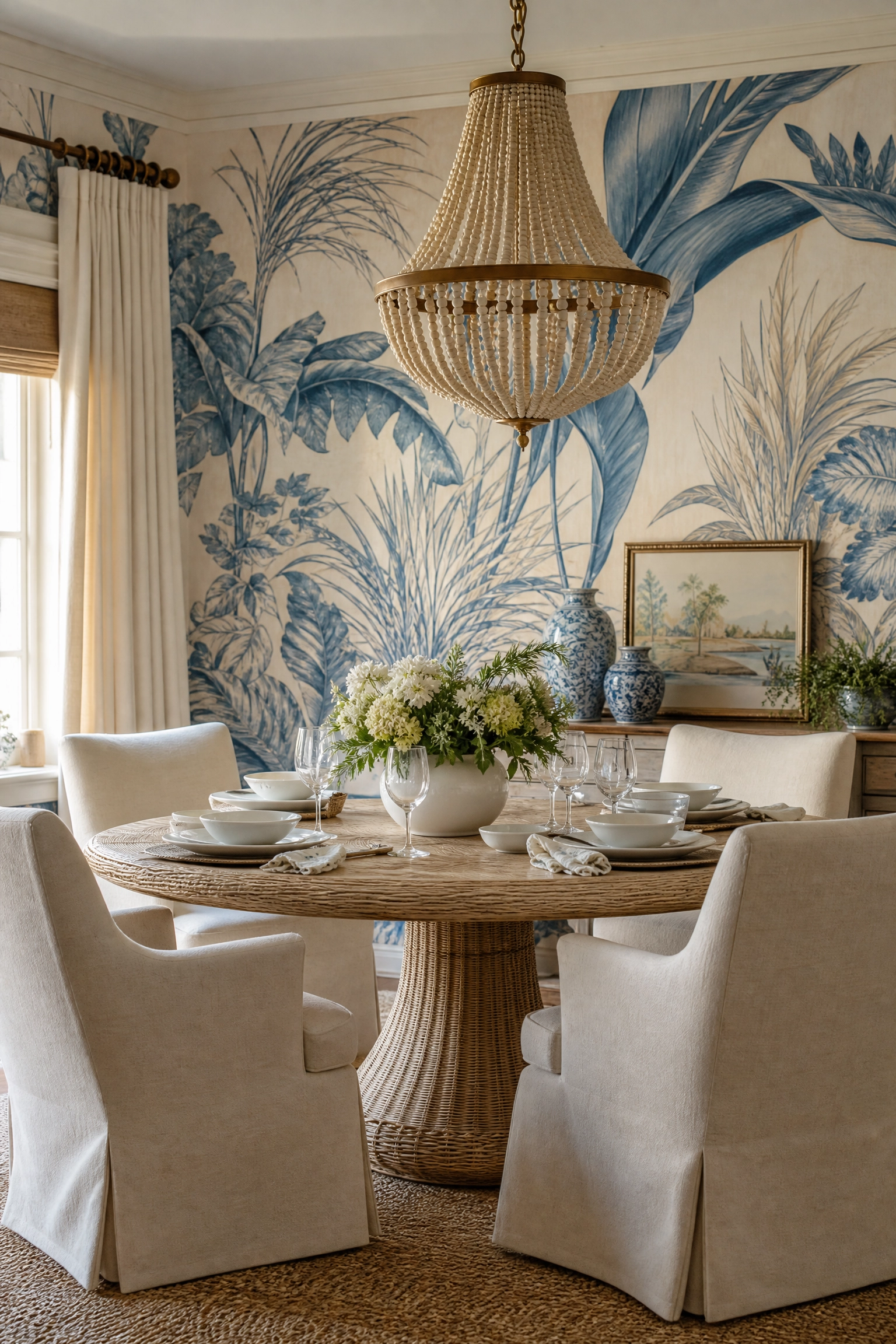
Coastal grandmillennial style is the design trend that feels most like a genuine reaction against minimalism, and in a dining room it produces some of the warmest, most atmospheric results. A large-scale botanical wallpaper in a blue and cream palette, featuring overscaled seagrasses, tropical leaves, or coastal flora, immediately gives a dining room real character and depth. This is a look that has been widely featured in interior design publications because it manages to feel both traditional and surprisingly fresh. The furniture in a wallpapered room like this needs to stay relatively restrained to avoid the space feeling too busy: a round pedestal table in a dark mahogany or a bleached wicker finish, upholstered chairs in a solid cream or warm white, and simple brass or antique gold hardware on any sideboards or storage pieces. Lighting should feel a little ornate but in keeping with the softness of the wallpaper: a beaded chandelier or a chandelier with fabric-wrapped arms and candle-style bulbs works beautifully here. One honest reality of wallpaper in a dining room is that it is more vulnerable to grease and moisture than in other rooms, so choose a wipeable or vinyl-coated finish wherever possible.
Mismatched Vintage Chairs Around a Farmhouse Table
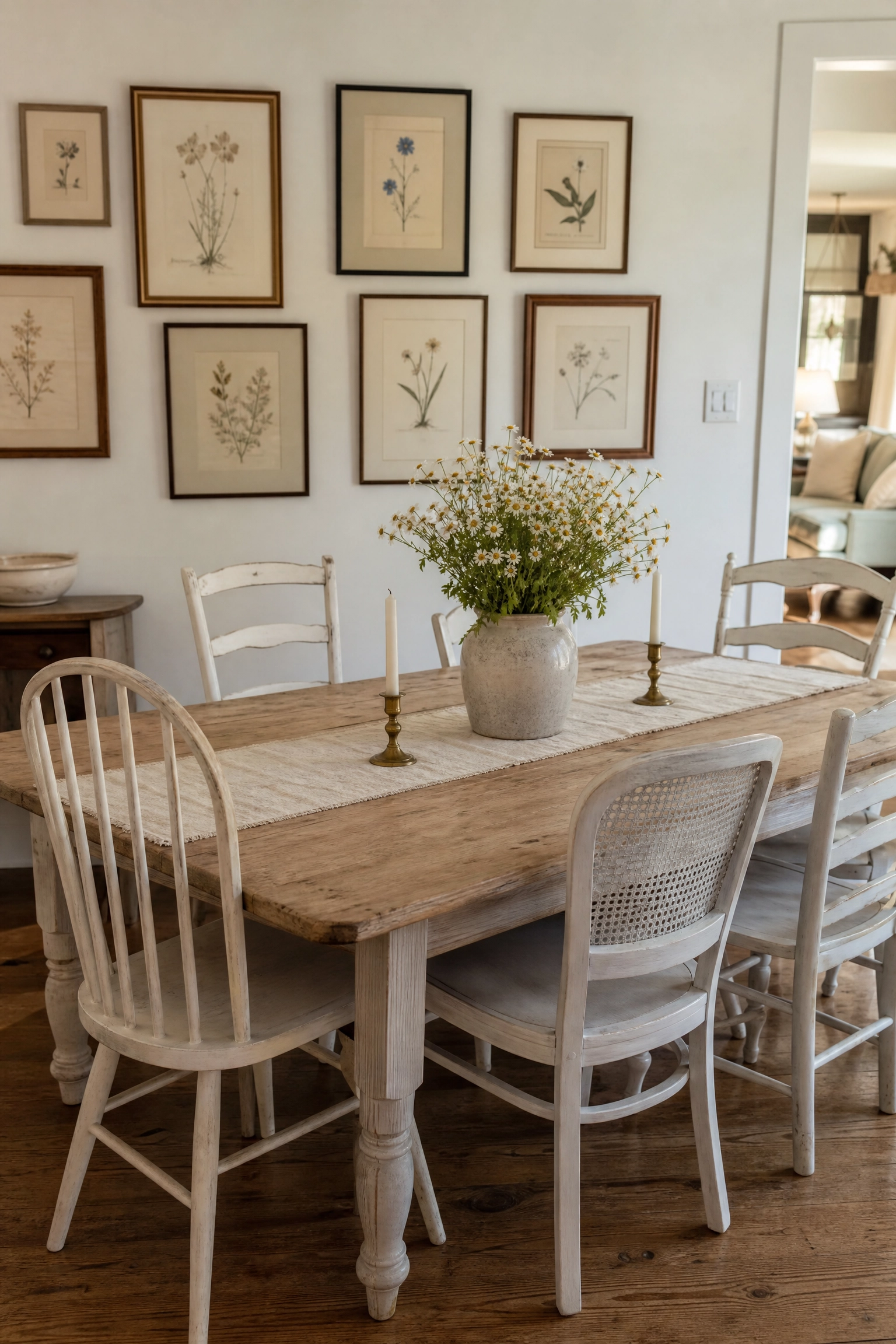
There is a version of coastal style that feels genuinely collected over time rather than designed in a single shopping session, and nothing captures that quality better than mismatched vintage dining chairs grouped around a large farmhouse-style dining table. The chairs do not need to be identical or even from the same era: a mix of a Windsor chair, a cane-back chair, a simple ladder-back, and a rush-seat chair, all painted in the same soft chalky white or a faded coastal blue, reads as deliberate rather than chaotic. The shared paint color is what ties them together visually, and the variety of silhouettes is what gives the room its personality. A long farmhouse table in a weathered pine or a whitewashed oak is the natural anchor for this kind of setup, and it benefits from a simple linen runner down the center rather than a full tablecloth. The walls can be wallpapered in a small-scale toile or a simple stripe, or kept white with a collection of framed botanical prints or vintage coastal maps. This approach is one of the most budget-friendly on this list since mismatched chairs are easy to find at thrift stores and estate sales, and a single paint color does a lot of the work.
Rattan Pendant Lighting with a Chinoiserie-Inspired Sideboard
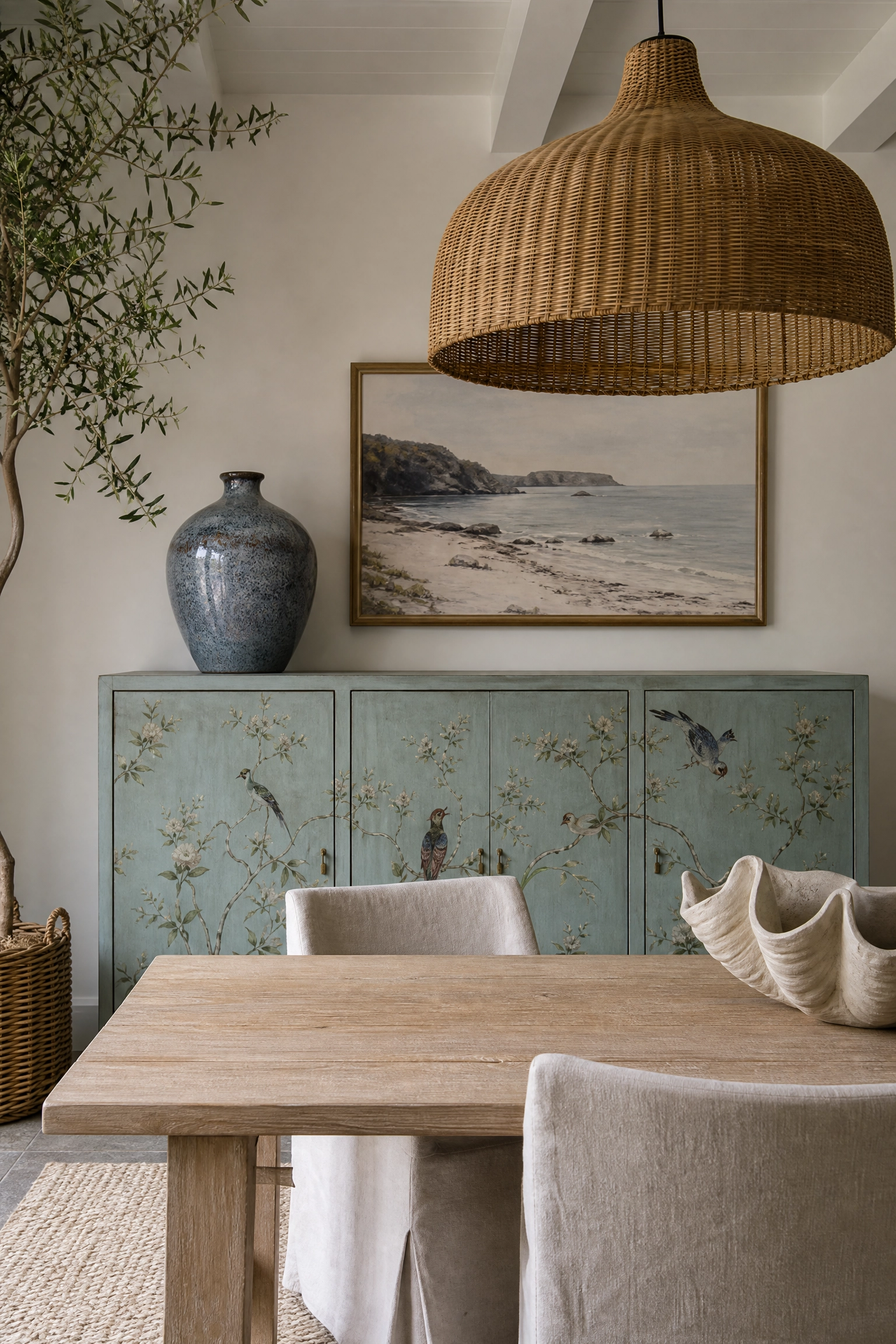
The combination of a natural rattan or seagrass pendant light and a chinoiserie-painted sideboard sounds like an unexpected pairing, but it is actually one of the more visually interesting directions in collected coastal design because it brings together the organic and the ornate in a way that feels genuinely layered. A chinoiserie sideboard in a soft blue-green with hand-painted birds, branches, or coastal landscapes on its doors is a piece that functions almost like art in the room, and it balances beautifully against the relaxed, undressed quality of a woven rattan pendant above the dining table. The dining table itself can be simple: a rectangular bleached oak or a dark ebonized wood, depending on whether you want to lean warmer or more dramatic. Upholstered chairs in a solid linen or a small-scale botanical print complement the painted sideboard without competing with it. From an E-E-A-T design perspective, this approach demonstrates an understanding of visual weight and how to balance a heavily decorated piece with simpler surrounding elements so the room does not tip into overwhelming. This is a mid-range to investment-level look since quality chinoiserie furniture carries a significant price tag, though good reproductions are available.
Coastal Blue Grasscloth Wallcovering with Warm Candlelight
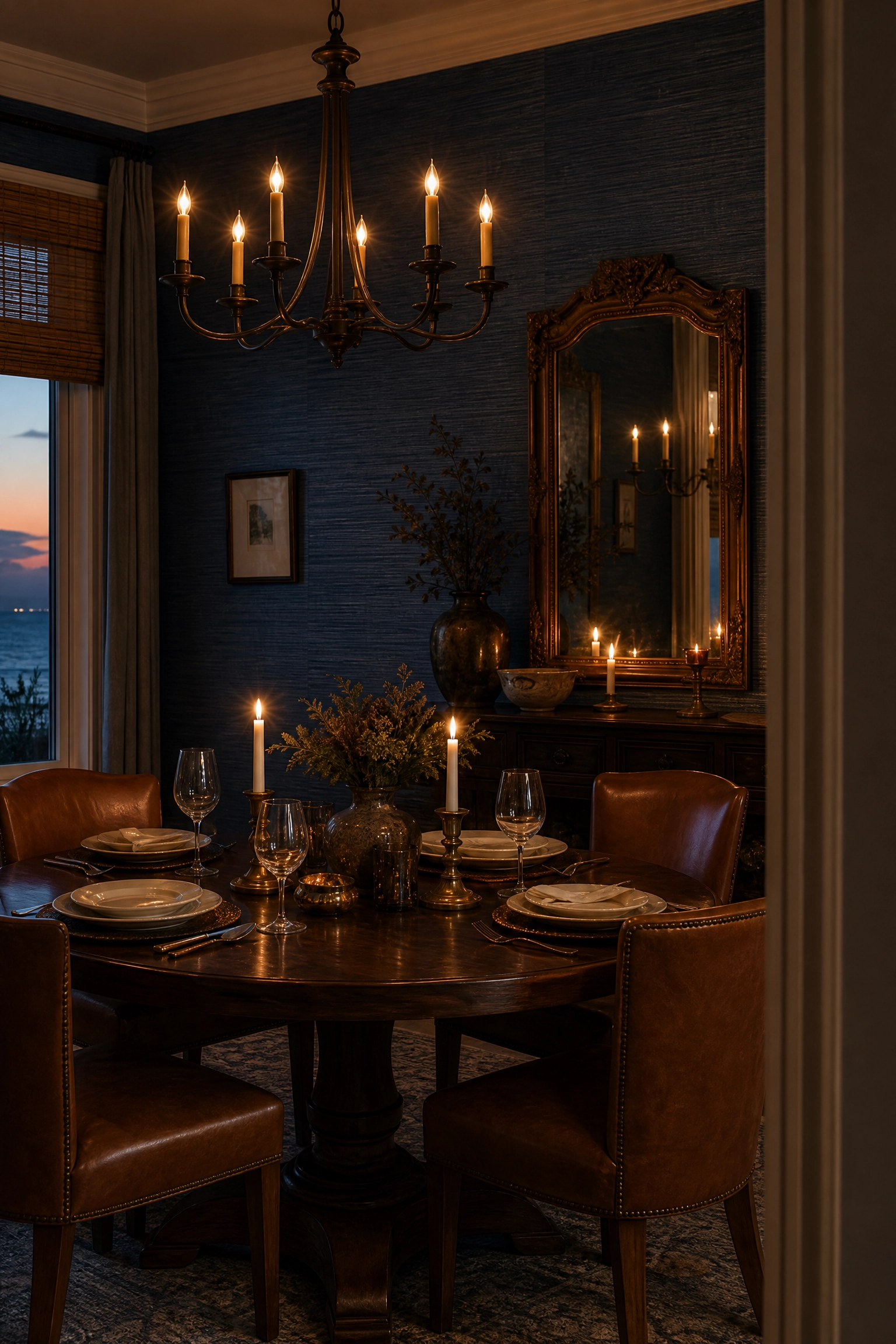
Grasscloth wallcovering in a coastal blue or a soft teal is one of those design choices that photographs beautifully and also feels genuinely special in person because the natural fiber of the grasscloth has a textured, slightly irregular quality that no painted wall can replicate. In a dining room, where candlelight and evening lighting play a significant role in the atmosphere, grasscloth walls do something particularly magical: the texture catches light in a way that makes the walls feel warm and dynamic rather than flat. Pair the grasscloth with a round dining table in a dark walnut finish, upholstered chairs in a warm ivory or a cognac leather, and a chandelier with candlestick-style bulbs or real candle arms for maximum atmospheric effect. A large antique mirror on the wall opposite the main window bounces light around the room beautifully and makes the space feel larger. Grasscloth is a natural fiber product and it does have some practical limitations worth knowing about: it cannot be wiped down as easily as paint or vinyl wallpaper, and it can be sensitive to high humidity, so it is better suited to a dining room that does not also function as a kitchen or open into a steamy cooking space.
Japandi Coastal and Wabi-Sabi Influence
A Low Oak Dining Table with Floor Cushion Seating
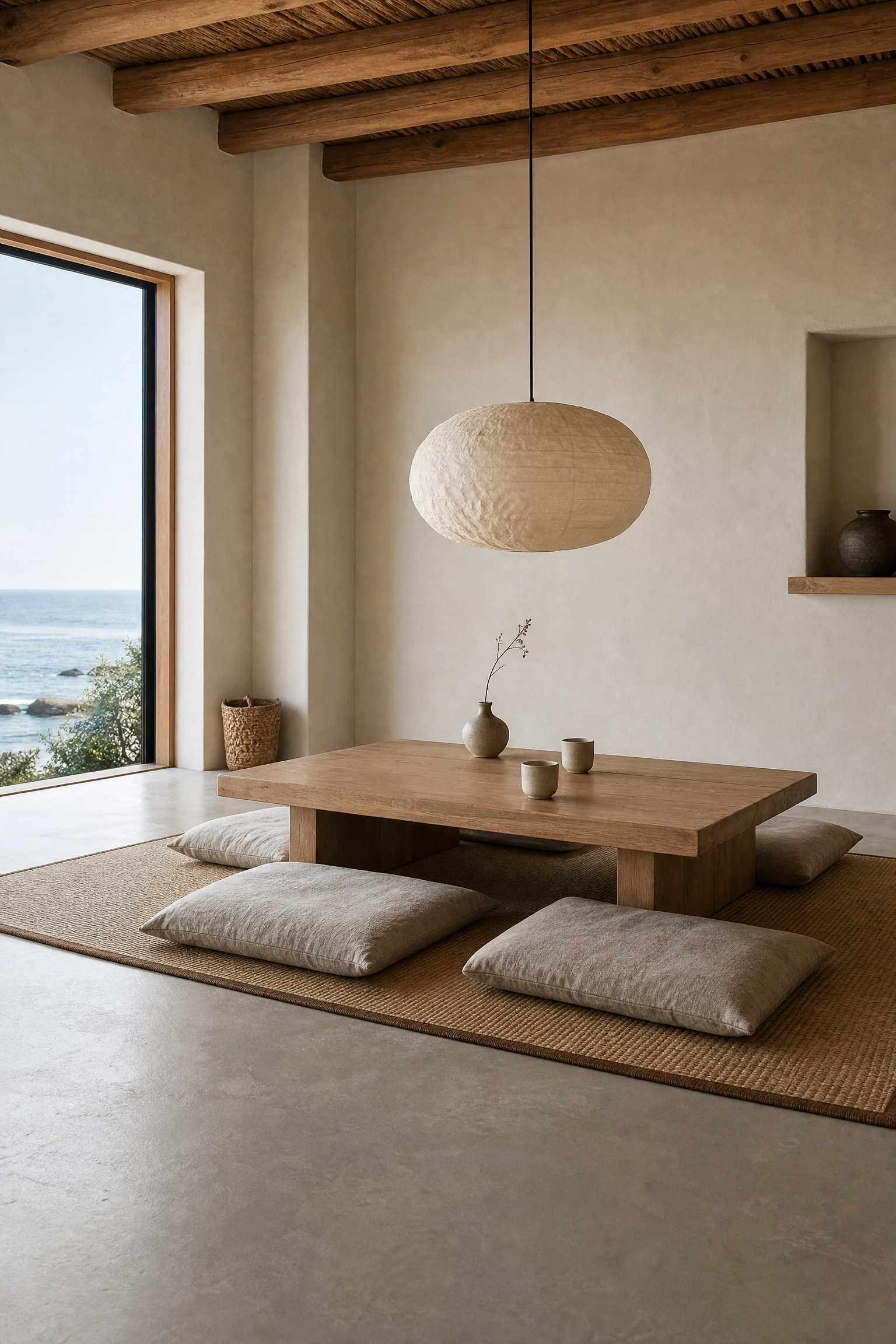
Japandi coastal takes the Japanese design principle of wabi-sabi, finding beauty in imperfection and natural aging, and fuses it with the Scandinavian love of clean lines and functional simplicity, then filters both through a coastal lens. In a dining room, this can manifest as a low, solid oak dining table with clean simple joinery and no decorative detailing, paired with floor cushions in a natural linen or undyed cotton for relaxed, ground-level seating. This kind of setup looks genuinely beautiful in a room with polished concrete floors, or with large pale stone tiles and a single woven tatami-inspired mat underneath the table. The walls should be bare plaster or a very muted warm white, with no framed art on every wall. A single large-scale ceramic vessel on the table, or a few handmade ceramic cups and plates in irregular organic glazes, provides all the decoration the space needs. Lighting in a Japandi coastal dining room should feel very deliberate and simple: a single large sculptural pendant in a natural dried fiber or a handmade paper shade works well. One thing to be aware of with this style is that it really does require restraint. Adding too many elements erodes the sense of peace that makes it special, so be honest with yourself about whether you are comfortable with a room that deliberately holds back.
Organic Shaped Dining Tables in Live-Edge Wood
A live-edge dining table, where the natural edge of the wood slab is preserved rather than cut square, is one of the best possible expressions of wabi-sabi in a coastal dining room because it brings the raw, unedited character of natural material directly into the space. Each live-edge table is genuinely one of a kind, with its own particular curve, grain, and natural variation in the wood, which means the table becomes the room’s primary piece of art. Pair the table with simple metal hairpin legs in a matte black or brushed steel finish to keep the overall look modern and coastal rather than rustic or traditional. Dining chairs around a live-edge table should stay clean and simple: low-back upholstered chairs in a textured sand or charcoal fabric, or simple molded chairs in a neutral color that do not compete with the drama of the table itself. Keep the rest of the room pared back: one large pendant light in a simple woven shade, white walls, and a single piece of abstract coastal artwork. From a practical standpoint, live-edge tables in raw or oil-finished wood do require annual re-oiling to keep the surface in good condition, and they are best treated with a board oil rather than a hard lacquer to preserve the natural quality of the edge.
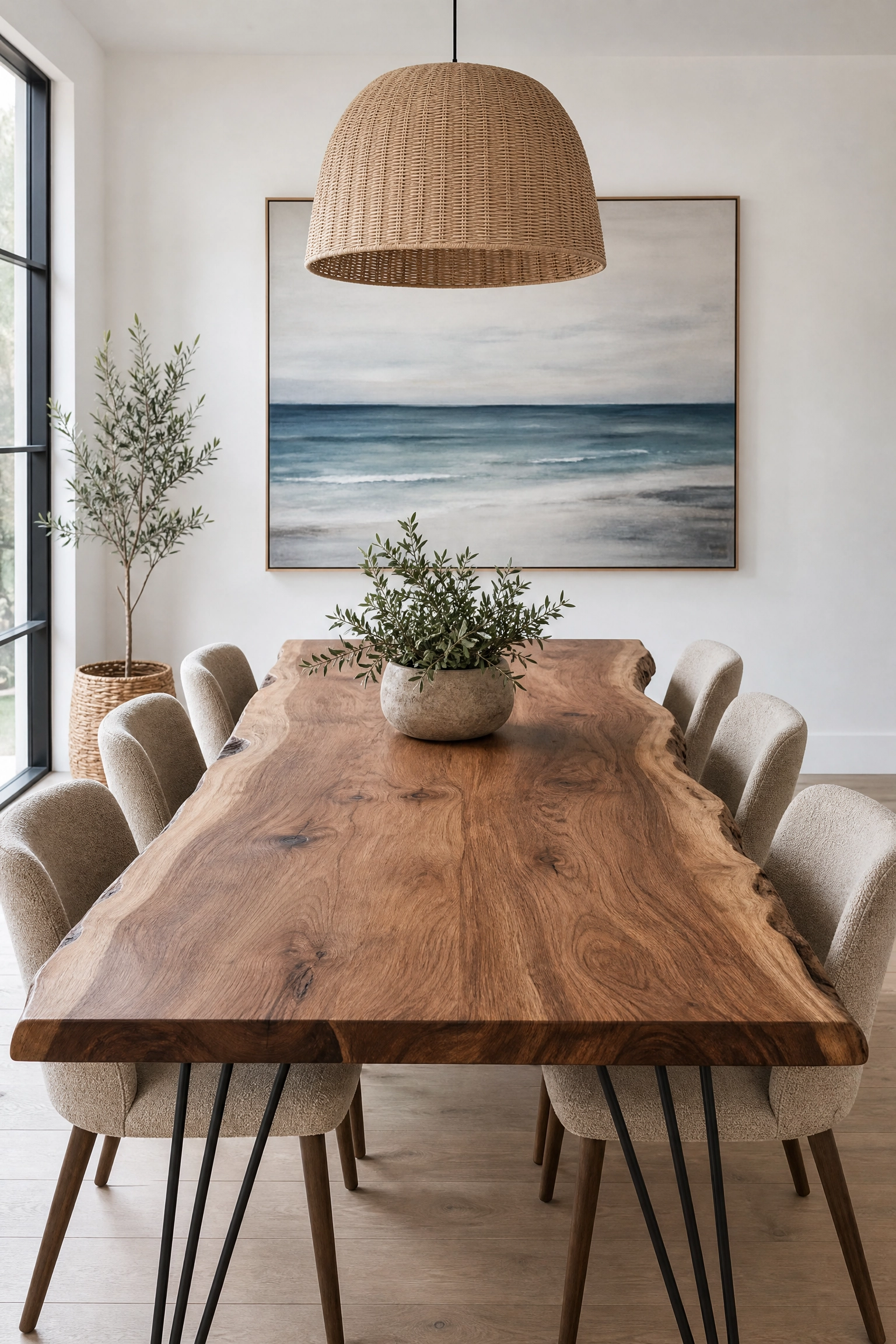
A Muted Sage Green Dining Room with Raw Linen and Clay
Muted sage green sits at a fascinating intersection of coastal and Japandi sensibilities because it reads simultaneously as a color found in coastal vegetation and as the kind of deeply restrained, complex neutral that Japandi design favors. In a dining room, sage green on the walls creates an immediate sense of calm, particularly when the shade is muted enough to avoid reading as bright or saturated. Furniture in this kind of room should lean into raw, natural materials: a dining table in an unfinished or oil-treated solid timber, dining chairs upholstered in raw unbleached linen, and a sideboard or shelf in a pale birch or white oak. Ceramic accessories in a hand-thrown clay with an earthy glaze in cream, rust, or soft brown bring a beautiful tactile quality to the table setting and complement the organic tone of the sage walls. Lighting should feel warm and close: a cluster of small pendant lights at slightly varying heights or a low-hanging linear suspension fitting in natural linen or woven bamboo. This is genuinely one of the most liveable and restful color choices you can make for a dining room, and the investment level is low since paint is the primary cost.
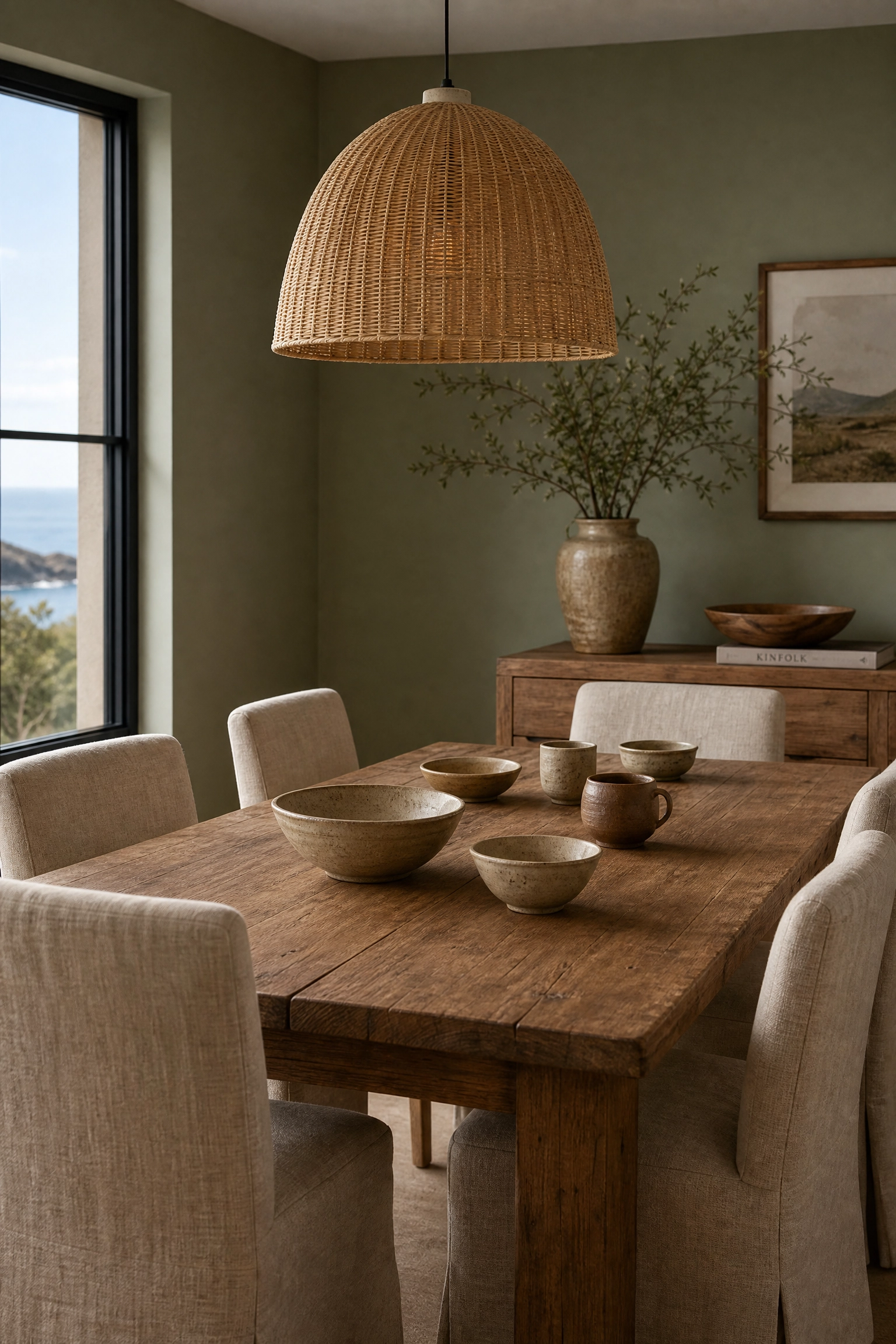
Black-Framed Steel Windows and a Minimalist Coastal Palette
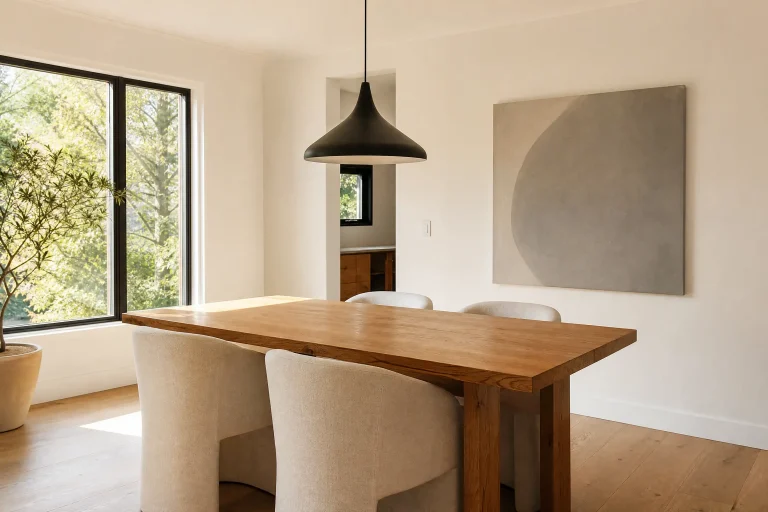
Black-framed steel windows or interior steel-framed partitions are an architectural feature that originated in industrial design but has been completely absorbed into modern coastal interiors, particularly in homes that lean toward a more refined, grown-up version of the style. The reason they work so well in a coastal context is that the thin black frames act like a drawing of the view outside, turning the window into a piece of framed landscape art, which in a coastal home means framing water, sky, or dunes. In a dining room with this kind of architecture, the interior design should be deliberately restrained to let the windows be the hero: a long rectangular dining table in a pale stone or washed oak, dining chairs in a soft putty or warm white upholstery, and a very simple linear pendant light in a matte black metal to connect visually with the frames. Keep the color palette to a tight range of white, sand, and very muted blue-grey, with no strong accents that would distract from the architectural quality of the windows. If your home does not have steel windows but you love this look, adding a steel-framed interior window or partition between the dining room and an adjacent space can achieve a similar effect at a fraction of the cost of full exterior window replacement.
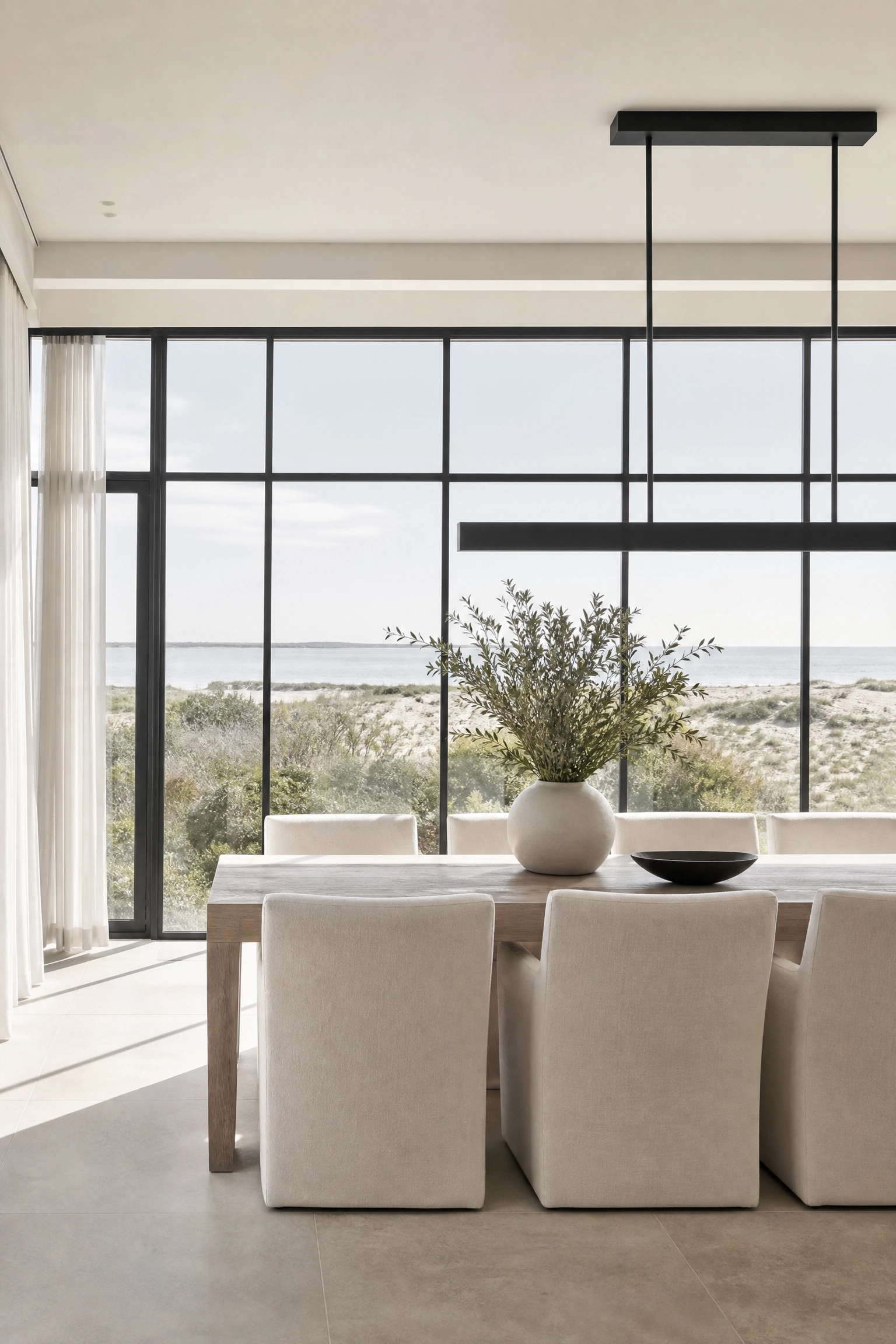
Maximalist and Bold Coastal Style
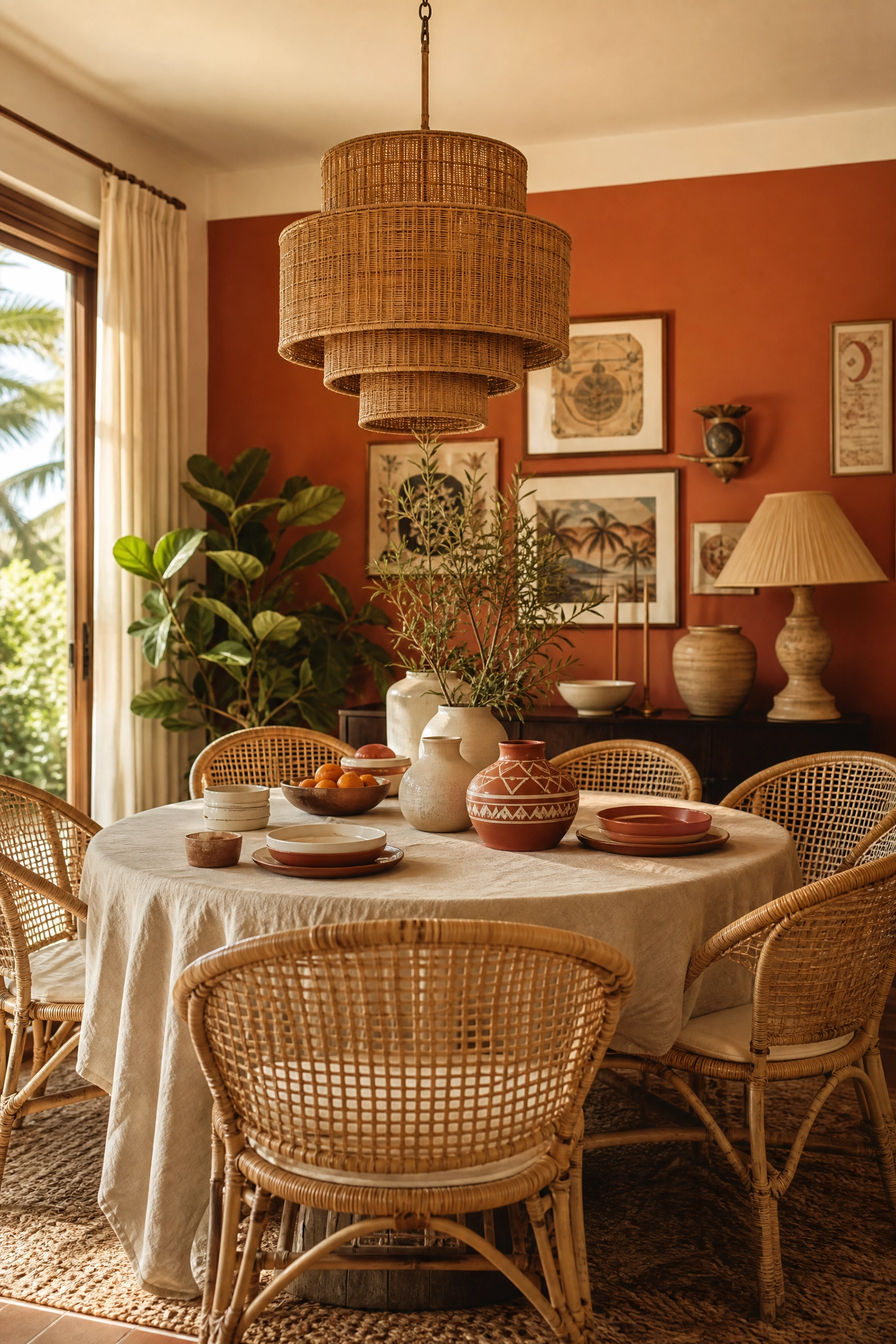
Coral and Terracotta Tones with a Rattan Chandelier
Not every coastal dining room needs to default to blue and white, and some of the freshest and most original coastal interiors being designed right now are built around warm, sun-baked tones that evoke the heat and color of a Mediterranean or tropical coastline rather than a Northern Atlantic beach. Coral, terracotta, warm orange-red, and sun-bleached clay are all genuine coastal colors when you consider how much of the built environment near warm-water coasts features these shades in tiles, stucco walls, and sun-weathered wood. In a dining room, a terracotta-painted wall paired with a large rattan or bamboo chandelier, a round dining table in a dark wenge or black-stained wood, and woven chairs in a natural pale rattan creates a dramatic, warm, deeply atmospheric space that still still reads clearly as coastal. Add ceramic accessories in cream, rust, and warm brown, and a simple linen tablecloth in an undyed natural tone. This palette works particularly well in dining rooms with limited natural light because the warm tones add perceived warmth that a cool blue-and-white palette would not deliver in a darker space.
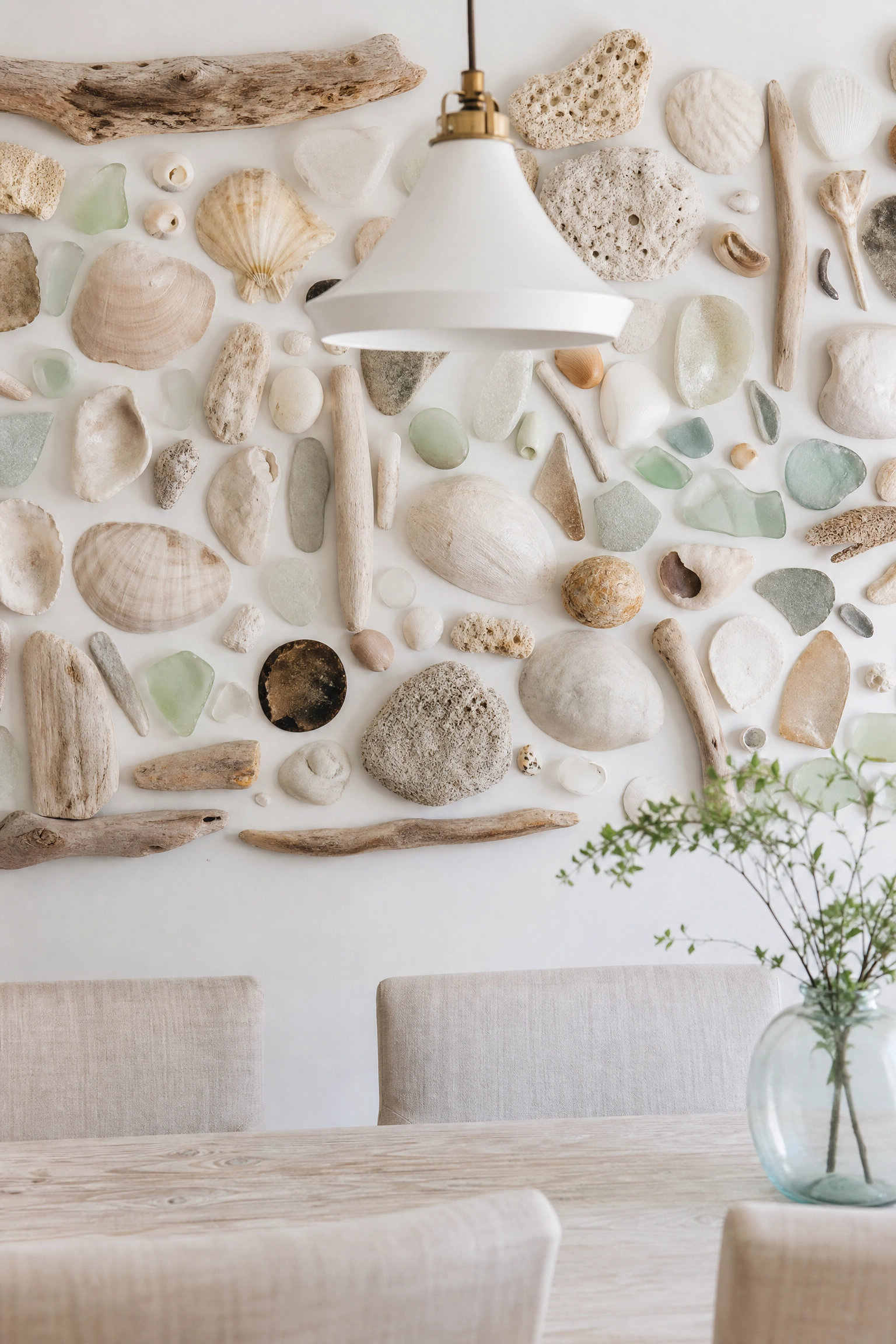
Maximalist Shell and Coral Art Installations as Wall Decor
Maximalist coastal design embraces the sea’s abundance rather than editing it down, and a dining room is actually a great place to explore this direction because the formality of the dining context gives permission for a certain level of drama that might feel overwhelming in a living room or bedroom. A large-scale wall installation made from collected shells, pieces of coral, fragments of sea glass, and driftwood arranged in a deliberate artistic composition is a genuinely striking focal point for a dining room feature wall. This kind of installation works best on a white or very pale wall so the organic materials read clearly against a clean background. Pair it with a simple but generously scaled dining table in a whitewashed or clear-finished solid wood, upholstered chairs in a soft natural linen, and a very simple lighting choice overhead so the wall installation remains the undisputed star. One thing that works really well in practice here is having the installation professionally mounted rather than attempting a DIY arrangement, since the balance, depth, and composition of a large organic installation is genuinely skilled work. Be aware that some coral is protected under CITES regulations, so ensure any coral pieces in an installation are legally sourced, either antique, vintage, or from a reputable sustainable supplier.
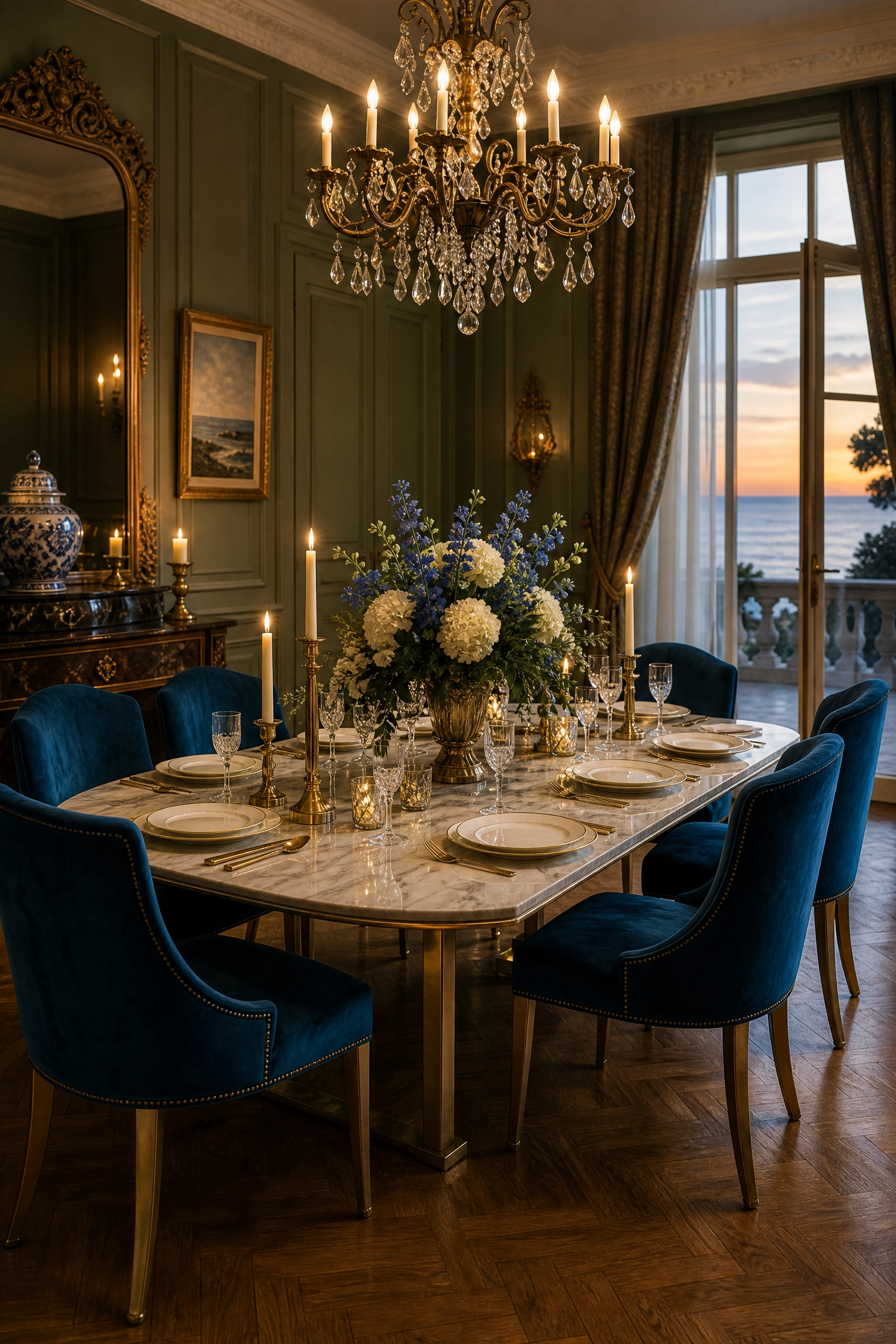
Peacock Blue Velvet Dining Chairs with Gold Accents
Peacock blue is one of those colors that sits right at the intersection of ocean depth and tropical glamour, and when used on velvet dining chairs it brings a level of richness and drama to a coastal dining room that few other choices can match. The deep, saturated quality of peacock velvet reads as luxurious rather than kitsch when it is surrounded by the right supporting materials: a dining table in a warm brass-legged marble or a high-gloss white, wall paneling in a soft grey-green or a pale sage, and lighting in antique brass or gold with glass or crystal detail. This is unabashedly maximalist coastal design, and it belongs in a room that is treated as a proper dining room rather than a casual eat-in kitchen. The velvet chairs become the room’s statement and everything around them should be chosen to complement their colour and texture without competing. From a practical standpoint, velvet dining chairs in a high-use family dining room require upholstery protection spray and regular brushing to keep them looking their best, and they are best suited to households without very young children or messy pets.
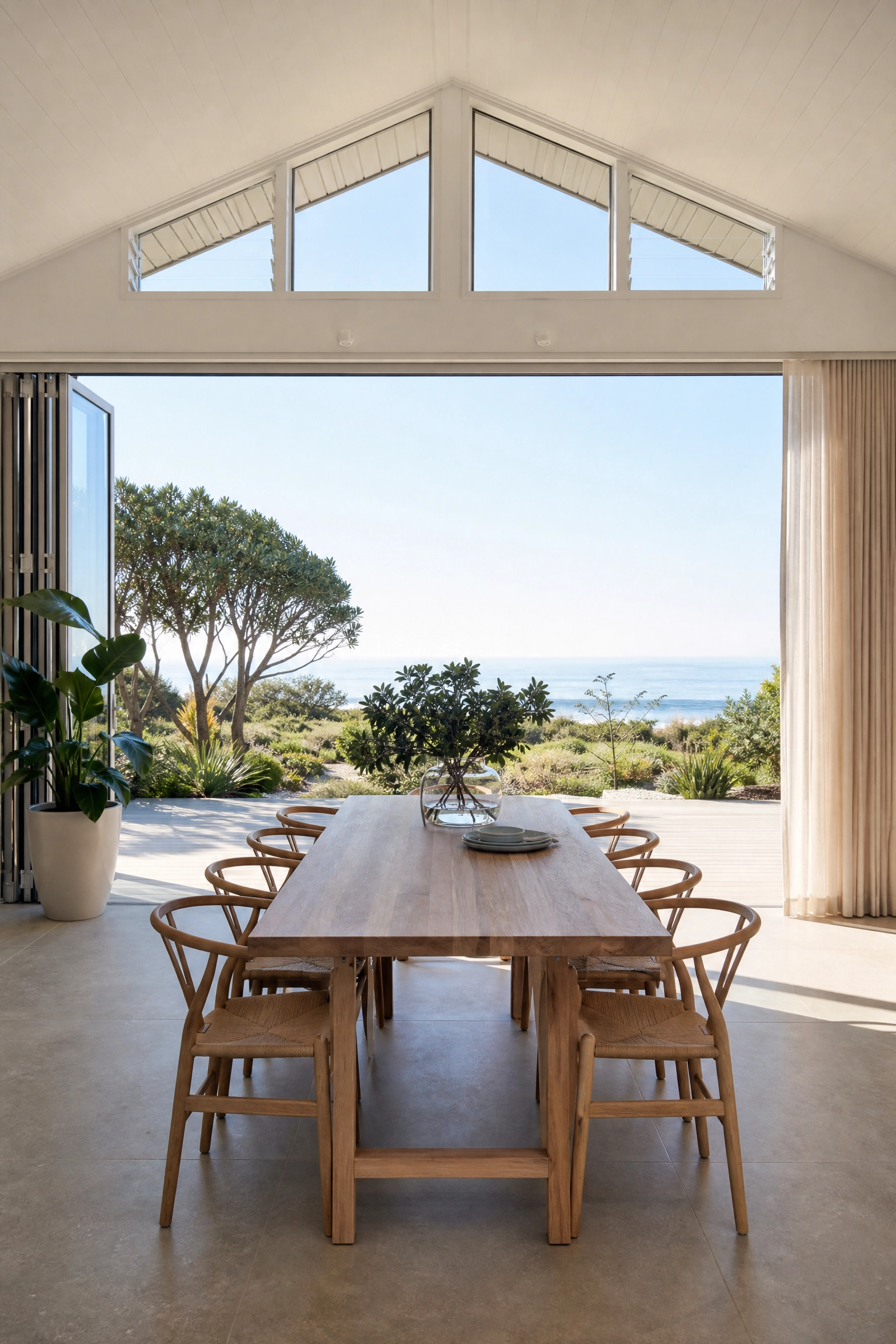
An Indoor-Outdoor Dining Room with Folding Glass Doors
One of the most dramatic and genuinely significant approaches to a coastal dining room is breaking down the barrier between inside and outside entirely, and the best way to achieve this is with large folding or sliding glass doors that open the dining room directly onto a terrace, deck, or garden. When the doors are open, the dining room extends into the outdoor space, making it feel like an open-air coastal pavilion, and when they are closed, the landscape beyond the glass becomes the room’s primary decorative element. The interior should be designed to work harmoniously with the exterior view and the outdoor furniture, so a consistent palette of natural materials, similar color tones, and a deliberately clean and uncluttered arrangement is important. Indoor-outdoor dining rooms work best with flooring that flows continuously from inside to outside: large-format porcelain tiles in a stone-effect finish are a practical choice since they are durable, weatherproof at the threshold, and visually consistent across both zones. This is an investment-level project in terms of architecture and glazing costs, but it is also one of the most life-changing things you can do to a coastal home since it fundamentally changes how you use and experience the dining space across all seasons.
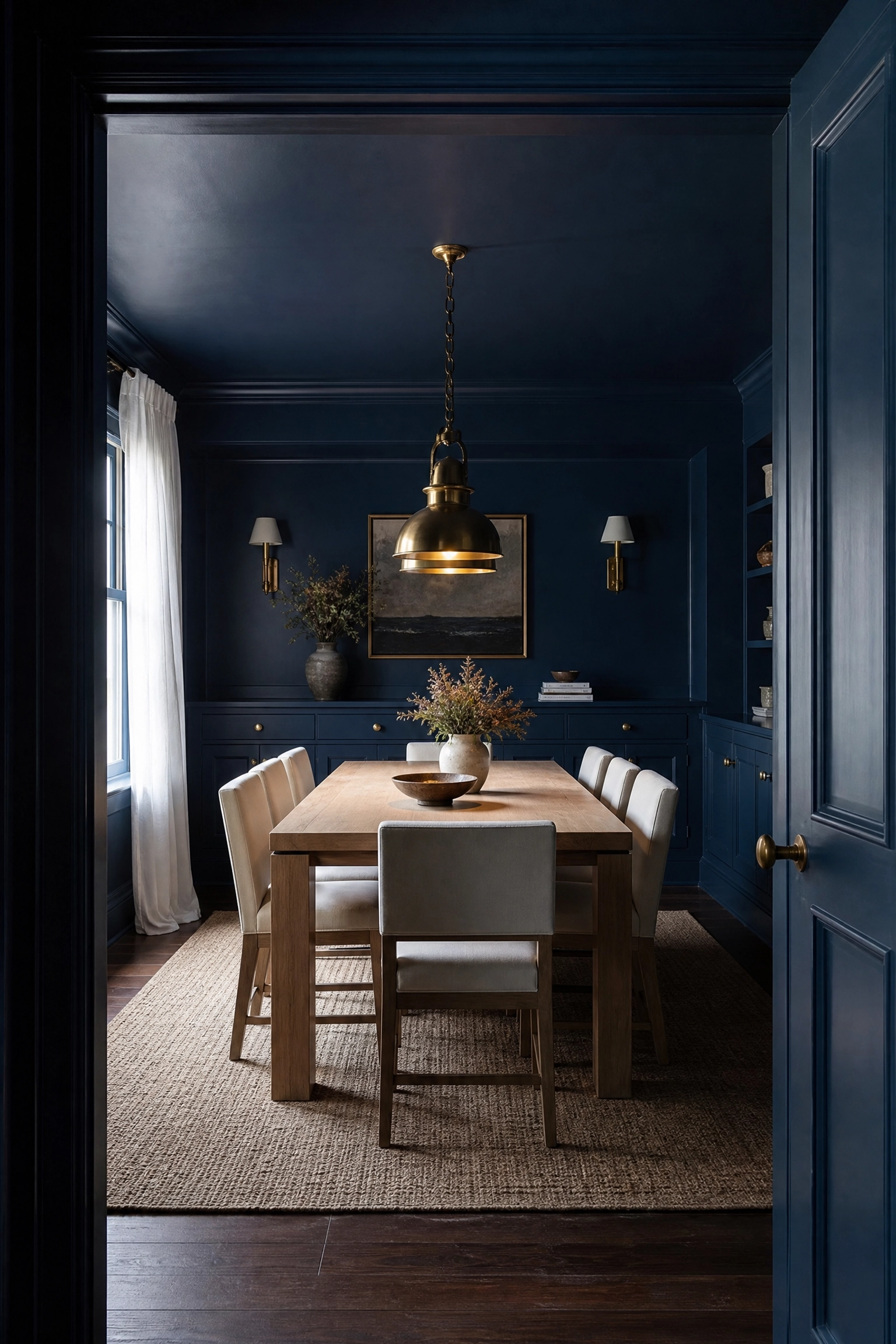
A Fully Blue Dining Room: Walls, Ceiling, and Joinery
One of the boldest and most contemporary directions in coastal dining room design is committing to a single blue tone across every surface: walls, ceiling, built-in joinery, and even the floor in some interpretations. This is called a tonal room or a paint-drenched room, and it works by eliminating the contrast between surfaces so that the architectural elements recede and the furniture and people in the room become the focus. In a coastal context, a deep soft navy or a mid-tone stormy blue used this way creates the sensation of being inside the ocean, which is genuinely extraordinary in a dining room where the atmosphere of the space has such a strong influence on how meals feel. The furniture should stand out: a dining table in a light wood like ash or maple, chairs in a warm cream or natural linen upholstery, and lighting in antique brass or warm gold that pops against the blue. One thing that works particularly well in this kind of room is mixing multiple sheens of the same paint color: a matte blue on the walls, a satin blue on the joinery, and a gloss blue on the ceiling, so the surfaces catch light differently throughout the day. This is a high-impact, relatively affordable approach since the transformation comes from paint rather than new furniture or structural changes.
Small Space and Practical Coastal Dining Ideas
A Round Pedestal Table in a Small Coastal Dining Nook
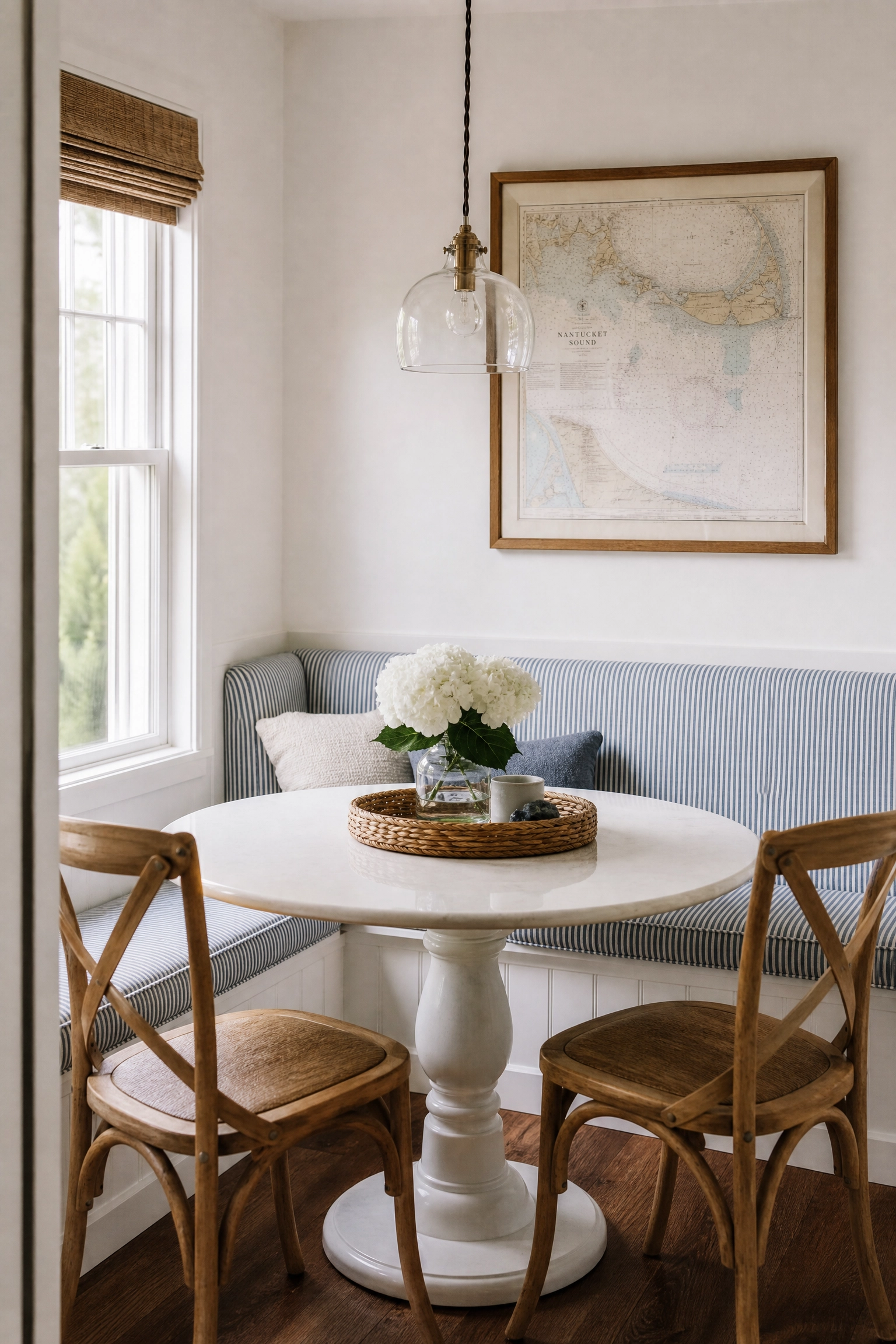
Small dining rooms and breakfast nooks benefit enormously from a round pedestal table because the absence of corner legs means it is much easier to squeeze extra seating around the table, and the rounded shape encourages the kind of relaxed, intimate conversation that a coastal dining room should feel like it enables. A pedestal base in a turned white-painted wood or a simple brushed metal column keeps the visual weight low and the floor visible, which makes the room feel larger than it is. Pair the round table with a mix of two or three simple upholstered side chairs and a small curved banquette built into the corner or against the wall, upholstered in a performance fabric in a soft stripe or a solid coastal tone. A banquette is one of the best space-saving choices in a small dining room since it takes up far less floor space than chairs on all sides. Keep the walls light: a soft white, a very pale sand, or a subtle stripe wallpaper. One pendant light centered over the round table, ideally with some visual weight such as a wide rattan shade or a glass globe, gives the space a clear focal point and makes the small nook feel intentionally designed rather than squeezed in.
A Fold-Down Wall-Mounted Dining Table for Tiny Spaces
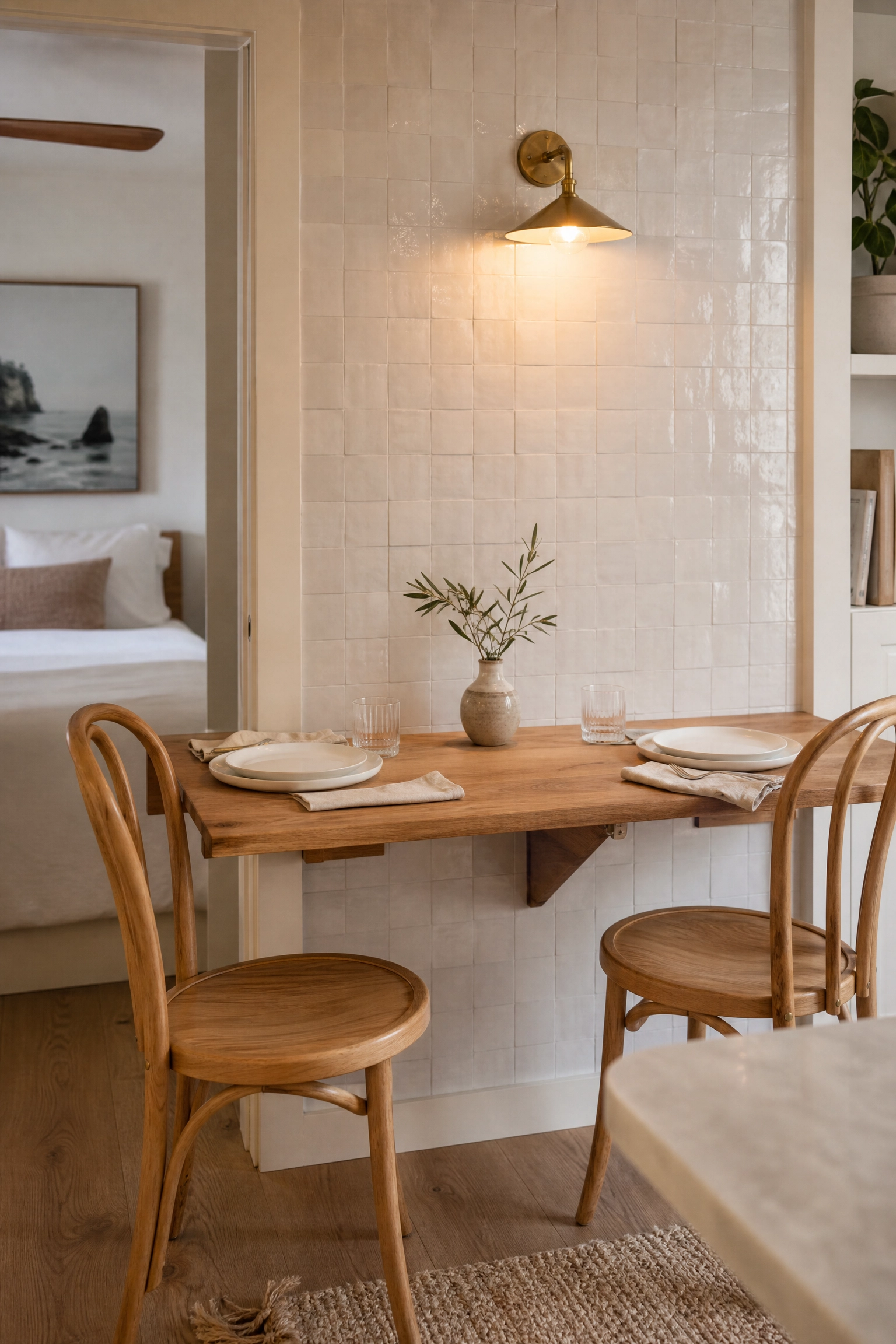
In truly compact coastal homes, a wall-mounted fold-down dining table is not a compromise solution, it is actually a clever design choice that opens up the floor space for other uses when dining is not happening. When the table is folded down, it can function as a beautiful dining surface for two to four people with the right chairs and styling, and when it is folded up against the wall, it becomes a flat surface that can display a piece of artwork, a mirror, or a collection of coastal objects. Choose a fold-down table in a solid timber with a clear-finished or lightly oiled surface, and pair it with folding or stackable chairs in a natural rattan or a simple bentwood design that can be stored flat against the wall or in a nearby cupboard when not in use. The wall the table mounts to is important: painted in a deep coastal color, tiled in a beautiful zellige or handmade ceramic, or covered in a botanical wallpaper, the wall becomes the visual backdrop that makes the setup feel considered rather than provisional. This is genuinely one of the most budget-friendly solutions on this list and it is ideal for studio apartments, beach houses with open-plan layouts, or any home where the dining area shares space with another function.
An All-White Coastal Dining Room with Texture Doing the Work
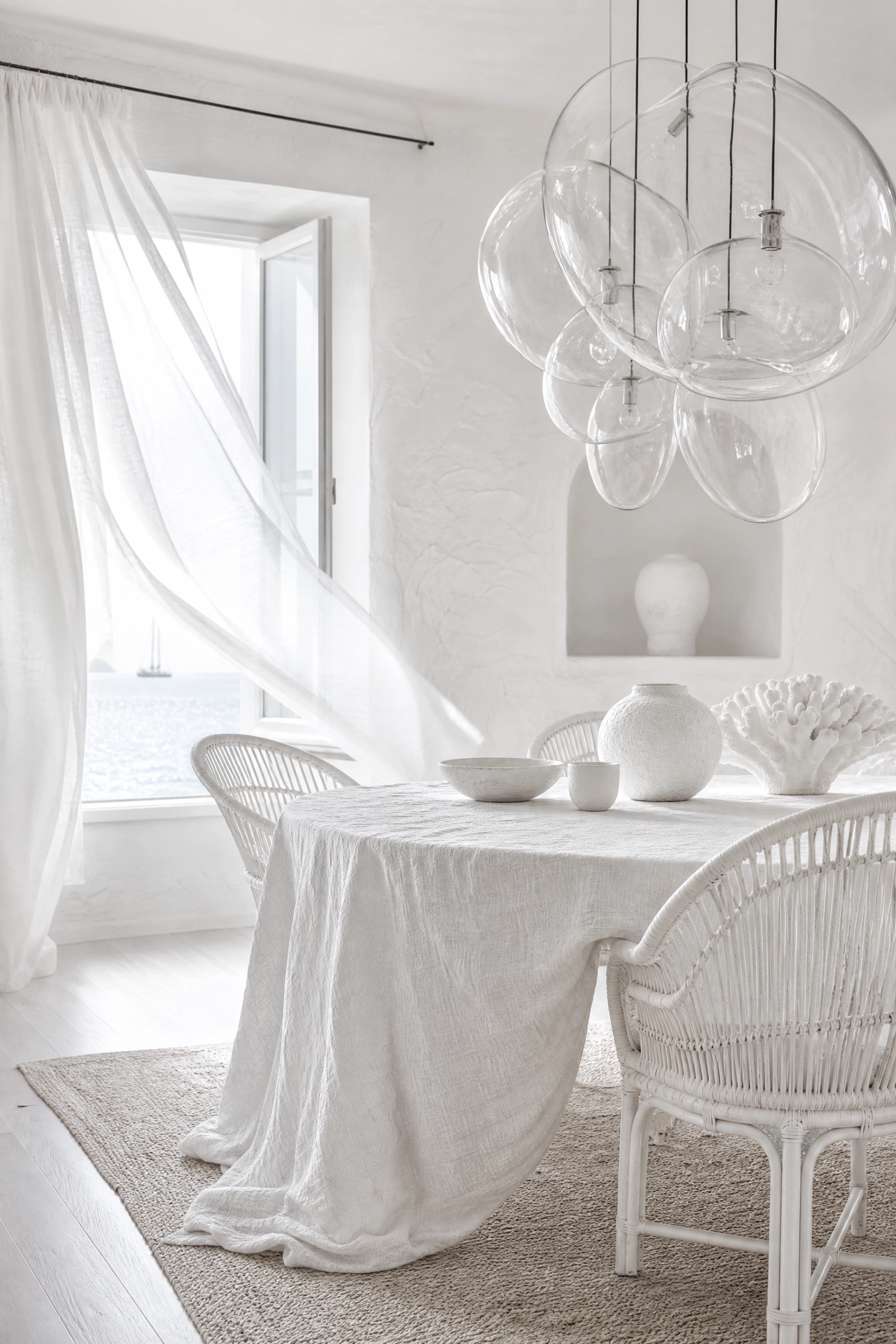
An all-white or near-white coastal dining room sounds simple, but getting it right requires more thought than it might seem because without color to create interest, every material and texture in the room has to earn its place. The most successful all-white coastal dining rooms layer different whites and near-whites with distinctly different textures: a rough linen tablecloth, smooth marble tabletop, woven rattan chair backs, a jute rug, a textured plaster wall, and a sheer cotton curtain that moves gently in the breeze. Each surface is technically in the same color family, but the variation in texture means the room has richness and depth rather than feeling flat or clinical. A statement lighting piece is especially important in an all-white room: a large sculptural pendant in a woven natural material or a group of hand-blown glass globes draws the eye upward and gives the room a focal point that color would otherwise provide. From a maintenance perspective, an all-white dining room is harder work than it looks in the photos, so consider using a performance or easy-clean fabric for dining chairs and a sealed or treated surface for the table.
A Built-In Coastal Banquette with Open Shelving
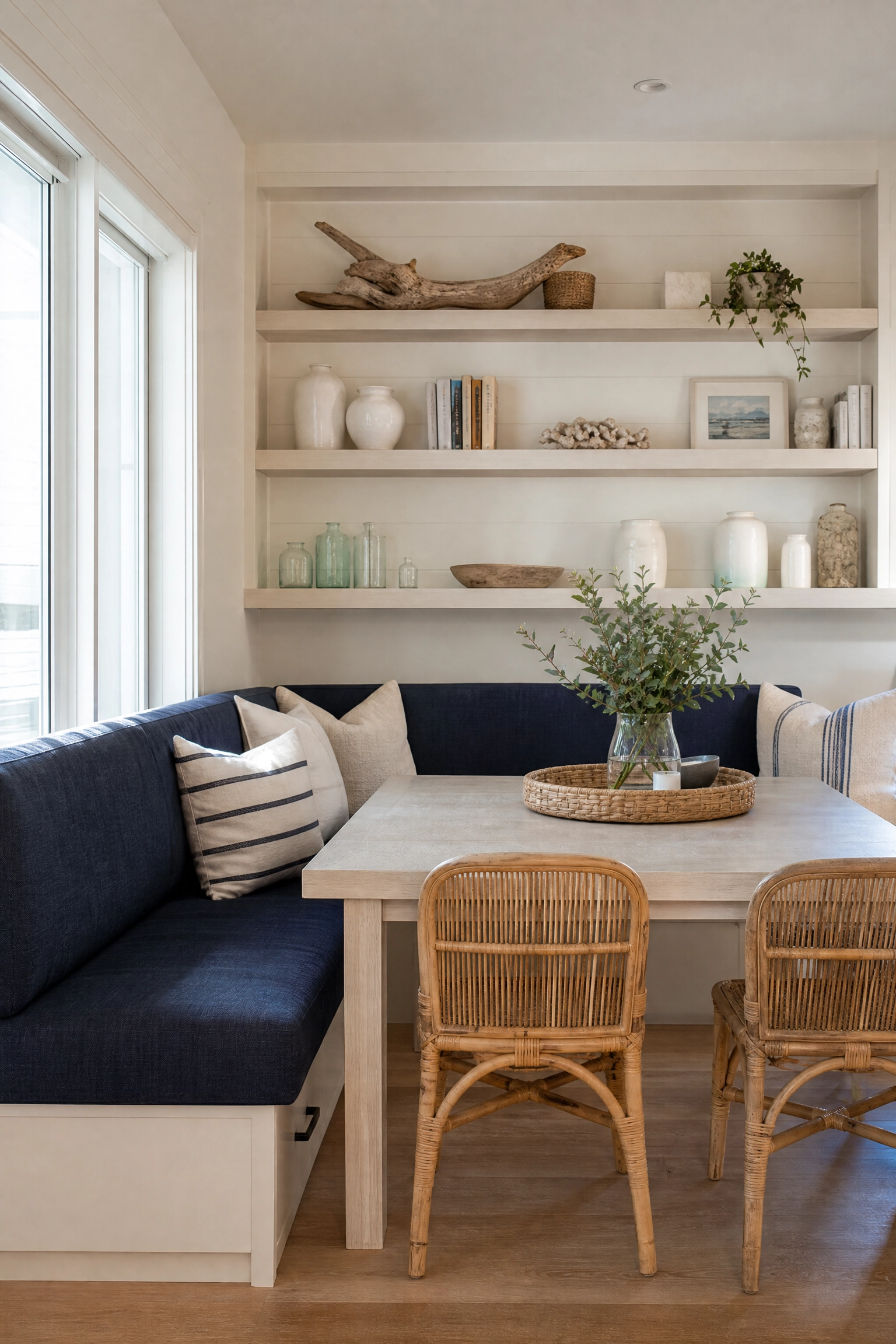
Built-in seating combined with open display shelving is one of the most practical and beautiful solutions for a coastal dining room that also needs to work hard as a family space. A banquette built into a corner or along a wall, upholstered in a performance-grade navy or sandy linen-look fabric, immediately gives the dining room a sense of permanence and intention that free-standing furniture rarely achieves. The built-in cabinetry that typically forms the base of the banquette can incorporate storage underneath for table linens, candles, and dining accessories, which is genuinely useful in a smaller home. Running open shelving above the banquette allows for a considered display of coastal objects, books, ceramics, and plants that adds personality without cluttering the table surface. Keep the display restrained and consistent: a few recurring materials like ceramic, glass, and natural wood, in a limited palette of blue, white, and sand, look intentional rather than random. A dining table positioned in front of the banquette should be in a material that complements the upholstery color rather than clashing with it, so a whitewashed wood works beautifully with navy while a warm oak works better with a sandy linen tone.
Final Thoughts
A coastal dining room is one of those spaces where the goal is less about achieving a specific look and more about achieving a specific feeling. When you walk into a well-designed coastal dining room, you slow down slightly. The light feels a little softer, the materials feel a little warmer, and the whole room sends a signal that this is a place for sitting down and spending time rather than rushing through. That is what all 24 of these ideas are working toward, regardless of whether they are using a classic blue and white palette or a maximalist all-blue paint-drenched room. The specific combination of materials, colors, and furniture that will work for your home depends on your space, your budget, and the kind of meals and moments you want the room to support. If you are starting from scratch, pick one idea that genuinely excites you and build from there. If you are refreshing an existing space, even small changes, like new chair upholstery, a new pendant light, or a rethought table centerpiece, can shift the feeling of the room significantly. The coast is one of the most universally appealing design references in interior design because it connects to something most people find genuinely restorative: the sound of water, the quality of light near the sea, the sense that time moves a little differently there. Bringing even a small piece of that into your dining room is always worth the effort.
Frequently Asked Questions
What are the key colors for a coastal dining room?
The most widely used coastal color palette centers on soft blues, crisp whites, warm sandy neutrals, and pale greens. That said, modern coastal design has moved well beyond the strictly blue-and-white palette. Terracotta, coral, sage green, and even deep navy used as a full-room tone are all legitimate coastal choices depending on which part of the world’s coastline you are taking inspiration from. The most important thing is keeping the palette cohesive and avoiding anything that reads as overly saturated or artificially bright.
What furniture works best in a coastal dining room?
Natural materials are the backbone of coastal dining room furniture. Dining tables in solid timber, particularly light woods like ash, oak, or whitewashed pine, work beautifully. Rattan, wicker, and seagrass chairs are classic coastal choices, while linen or performance-fabric upholstered chairs offer a more modern take. Avoid anything that reads as overly formal or heavily lacquered since coastal style is fundamentally relaxed in character.
How do I make a coastal dining room feel modern rather than themed?
The key to avoiding the themed or kitschy version of coastal design is restraint and material quality. Remove obvious nautical symbols like anchors, rope accents, and ceramic seahorses, and instead let the materials tell the coastal story: natural textures, organic forms, and a calm color palette do far more work than decorative accessories. Invest in quality furniture with clean lines, keep the wall decor minimal, and let natural light be a key design element.
What lighting works well over a coastal dining table?
Pendant lighting is almost universally used over dining tables, and in coastal rooms the best choices are rattan or seagrass pendants for a relaxed look, woven natural fiber shades for a Japandi or modern coastal feel, glass globes for a cleaner and more contemporary direction, or beaded or crystal chandeliers for a coastal grandmillennial approach. The size matters as much as the style: the pendant or chandelier should be proportionate to the table below it, typically sitting around 30 to 36 inches above the table surface.
Can I do a coastal dining room on a budget?
Yes, and some of the most charming coastal dining rooms are put together on a modest budget. The most affordable routes include painting existing furniture in a coastal color, swapping out dining chair cushions or adding slipcovered covers, adding a jute or sisal rug, and changing the lighting pendant over the table. A fresh coat of paint in a soft coastal tone is genuinely the highest-impact lowest-cost change you can make to a dining room.
Do coastal dining rooms only work near the actual coast?
Not at all. Coastal design is one of the most popular interior styles worldwide, and the vast majority of coastal dining rooms are in landlocked homes. The style works anywhere because it is really about a quality of light, a palette of natural materials, and a feeling of ease rather than about geographic location. If anything, a coastal dining room in a city apartment or a country house can feel like an even more welcome escape precisely because it contrasts so strongly with the environment outside.