Black Fireplace Living Room Ideas Built Around the Room’s Best Feature
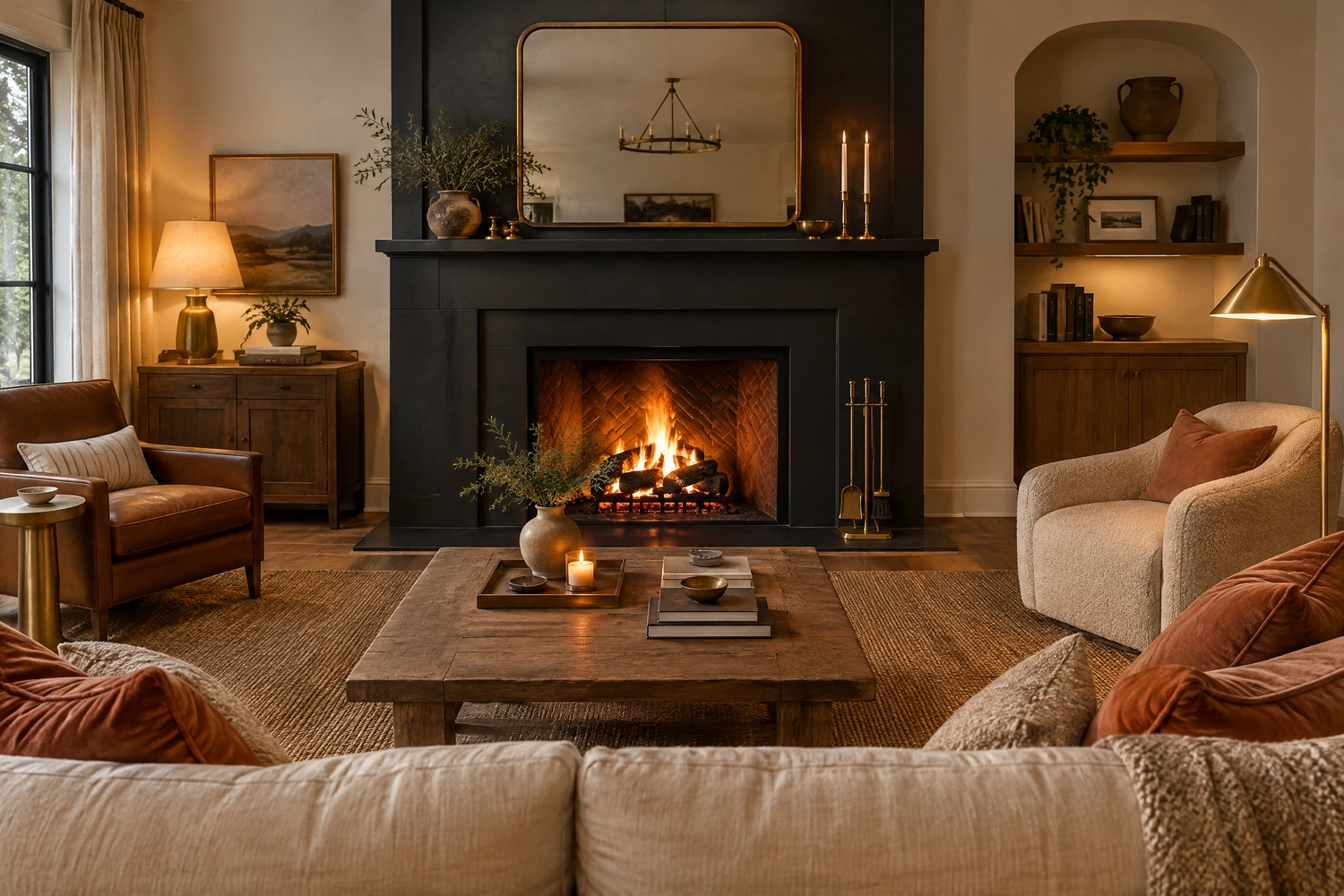
A black fireplace is the most commanding focal point available in a living room, and the rooms that make the most of it are the ones that understand what it is doing. A black surround or firebox does not simply add drama to the wall it occupies. It anchors the entire room from that one point, drawing the eye on entry, framing the fire as a piece of living art, and determining the visual hierarchy of every other element in the space. When the room is arranged around the fireplace rather than alongside it, the result is a room that feels genuinely designed. These 27 ideas move from the fireplace itself outward through the surround, the chimney breast, the mantel, the seating arrangement, the walls, the lighting, and the whole-room decisions that a black fireplace dictates. A black fireplace that is treated as a backdrop is wasted; one that is treated as the starting point produces a room with genuine purpose.
CATEGORY ONE: THE FIREPLACE ITSELF
1. Choose a Matte Black Steel or Cast Iron Surround for a Contemporary Look
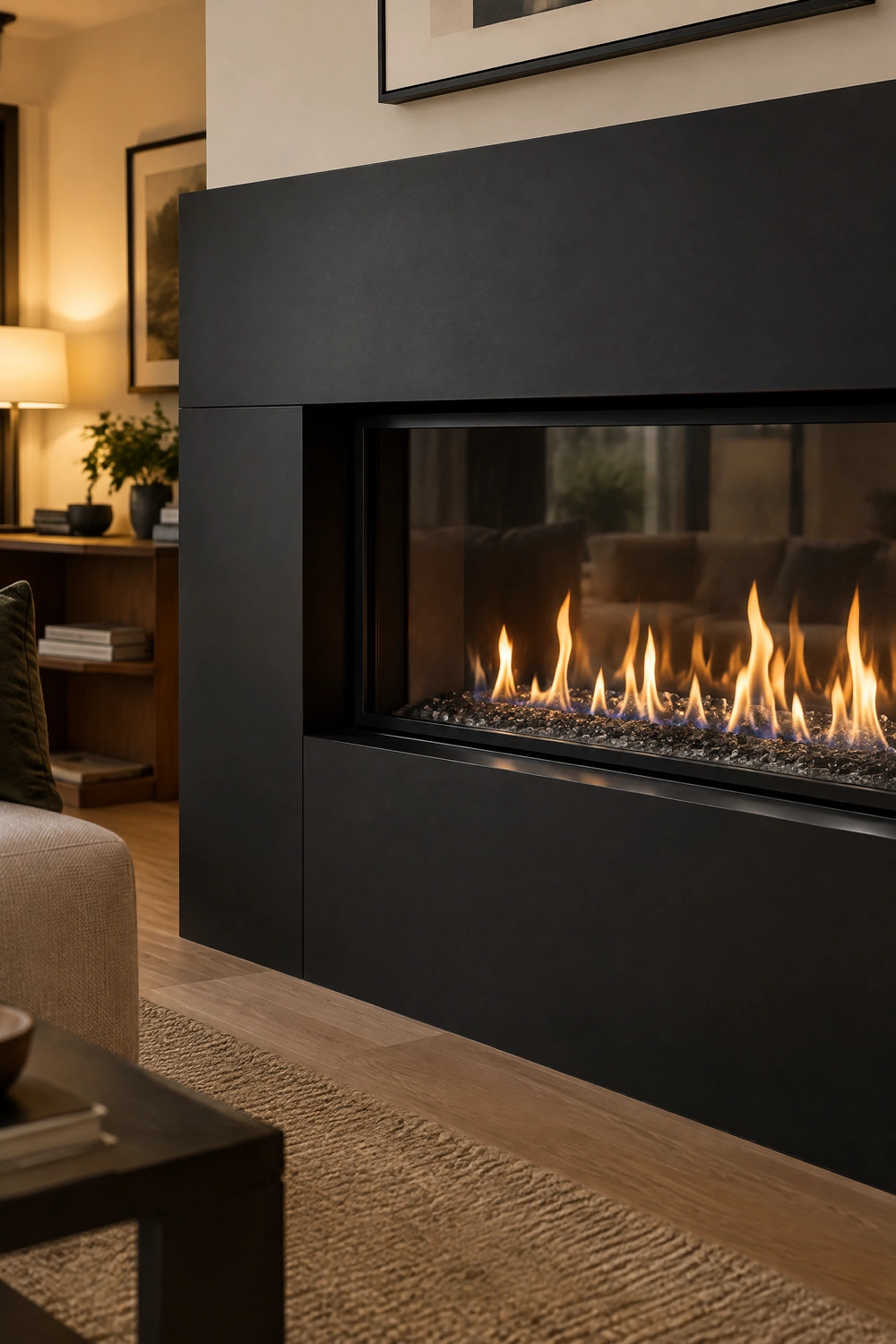
A matte black steel or cast iron fireplace surround is the most specifically contemporary and most architecturally minimal expression of the black fireplace available. The flat, light-absorbing quality of the matte finish reads as deliberate and modern rather than utilitarian, and the clean geometric lines of a steel surround, particularly in a linear or ribbon-style format, create the most graphic and most architectural version of the black focal point. In a room with warm natural materials, natural wood furniture, linen upholstery, and a jute rug, a matte black steel surround creates exactly the right tension between organic warmth and geometric precision that defines the best contemporary living room design.
Designer Advice: A matte finish on a steel or iron surround is non-negotiable for a contemporary look. A polished or satin black finish reads as stove rather than statement. Matte absorbs light, matte disappears into itself, and matte makes the fire the visual event rather than the surround.
2. Install a Black Marble Surround for Luxury and Pattern
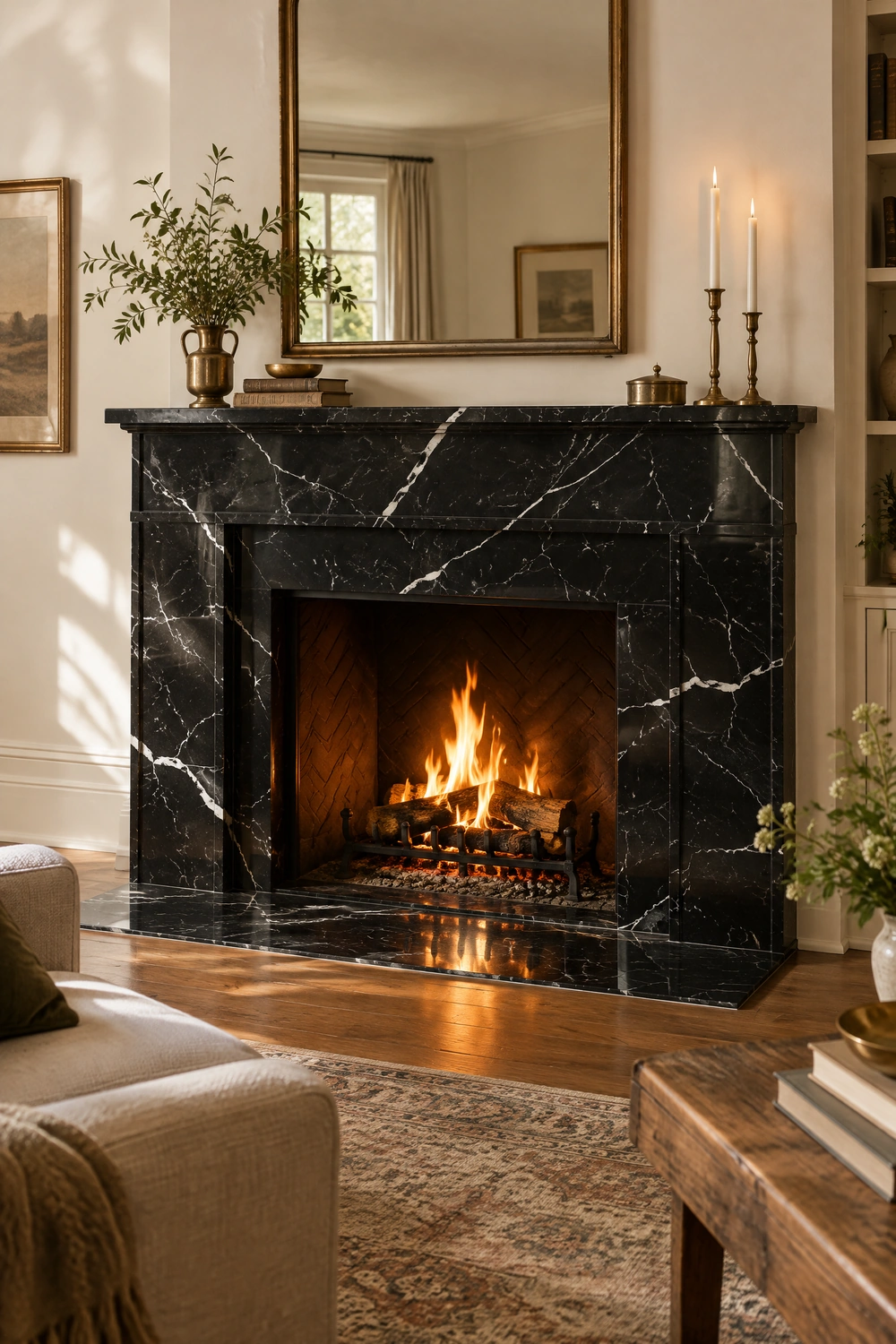
A black marble surround, whether in Nero Marquina with its white veining, Black Saint Laurent with gold and brown mineral lines, or a plain polished Absolute Black, introduces a material richness and surface variation to the black fireplace that a painted or powdercoated metal surround cannot provide. The veining in black marble catches light differently across the surface throughout the day, adding visual movement to the room’s primary focal point in a way that a matte, flat surface does not. Black marble paired with warm cream or off-white walls and natural wood furniture creates one of the most specifically rich and most photographically arresting living room compositions available.
Pro Move: Choose a black marble with visible veining rather than a plain polished Absolute Black. The veining is what distinguishes marble from painted stone and what gives the surround its individual character. A heavily veined Nero Marquina or a Gold Saint Laurent black marble reads as genuinely rich. A plain black polished stone reads as tile.
3. Paint an Existing Brick or Render Surround Matte Black
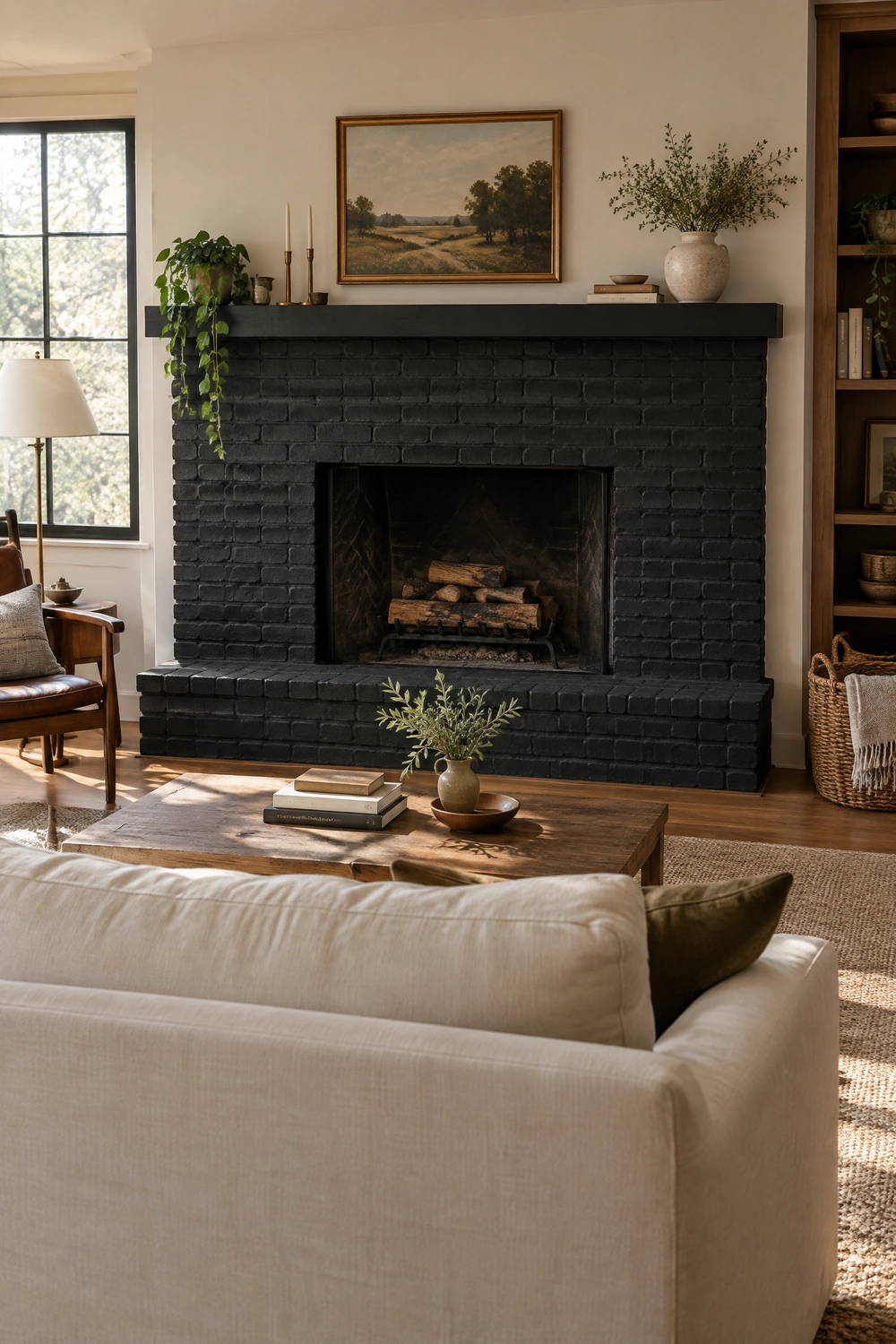
Painting an existing brick, render, or stone fireplace surround in a matte black specialist paint is the lowest-cost and most immediately significant black fireplace treatment available. A dated red brick surround or a beige render one, painted in two coats of a matte black masonry or specialist fireplace paint, becomes an entirely different architectural element. The painting process takes an afternoon and the effect is permanent and dramatic. The rough texture of the brick or render visible beneath the paint adds the organic quality that a completely smooth surface lacks, and the matte black paint sitting in the mortar joints of a brick surround creates a texture that a cast or poured surround cannot replicate.
Reality Check: Use a specialist fireplace or masonry paint rated for high temperatures rather than standard wall paint. Standard wall paint will discolour, crack, and peel when exposed to the heat generated by a functioning fireplace. Specialist paints are widely available and cost only marginally more.
4. Choose a Black Ceramic or Porcelain Tile Surround
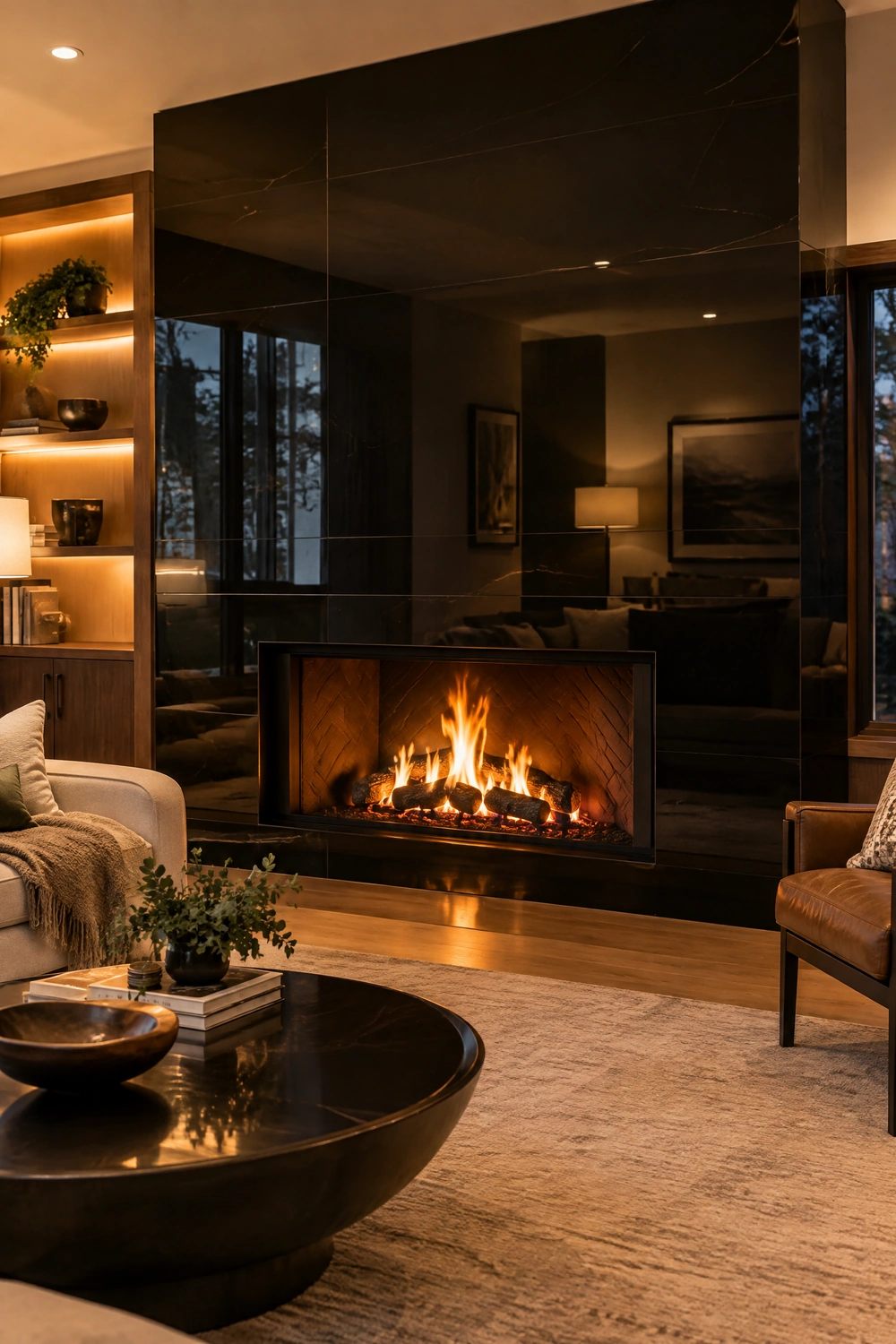
Large-format black ceramic or porcelain tiles on the fireplace surround and hearth create a highly polished, light-reflecting version of the black focal point that works particularly well in contemporary and transitional living rooms. The reflective quality of a glazed tile surface does something a matte surround cannot: it catches and bounces the light of the fire back into the room, creating a dynamic, shifting effect at the room’s focal point that changes throughout the day and evening as the natural and artificial light conditions change. Glossy black porcelain tiles in a large format, with minimal grout lines, read as architectural stone rather than tiling and create a focal wall effect that extends the black beyond the surround itself.
Quick Tip: Large-format tiles with minimal grout lines read as expensive stone. Small tiles with multiple grout lines read as budget tiling regardless of the tile quality. For a black tile surround that reads as designed rather than tiled, go as large a format as the installation allows and keep grout lines as thin as possible.
5. Install a Wall-Mounted Electric or Bioethanol Black Fireplace
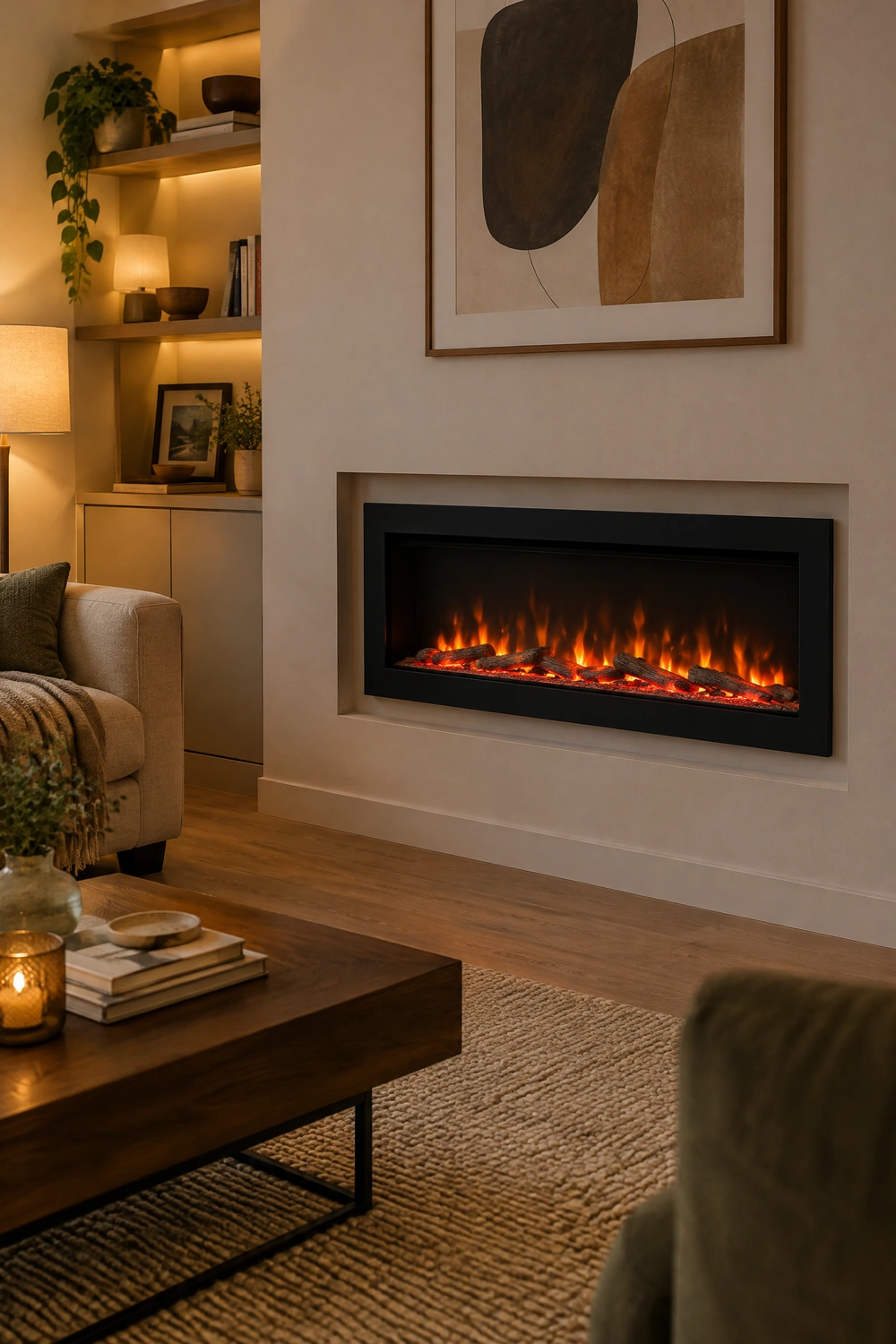
A wall-mounted black fireplace, whether electric with a realistic LED flame effect or bioethanol with a real but ventless flame, is the black fireplace solution for rooms without a chimney, for rented properties where structural changes are not possible, or for walls where a built-in installation would be prohibitively expensive. A wall-mounted unit in a matte black housing, mounted flush to the wall or within a recessed niche, creates a clean, graphic focal point that reads as a design feature rather than a retrofit. The most convincing electric flame effects use a combination of LED light and water vapour to produce a three-dimensional flame appearance, and the best bioethanol units produce a real flame and real warmth without requiring a flue.
Heads Up: A wall-mounted electric or bioethanol fireplace reads best when it is framed by a surround or built into a wall installation rather than simply mounted to a bare wall. The unit alone without context reads as an appliance. The same unit built into a flush wall panel, a plaster recess, or a slim frame reads as an architectural feature.
6. Consider a Double-Sided or Tunnel Black Fireplace
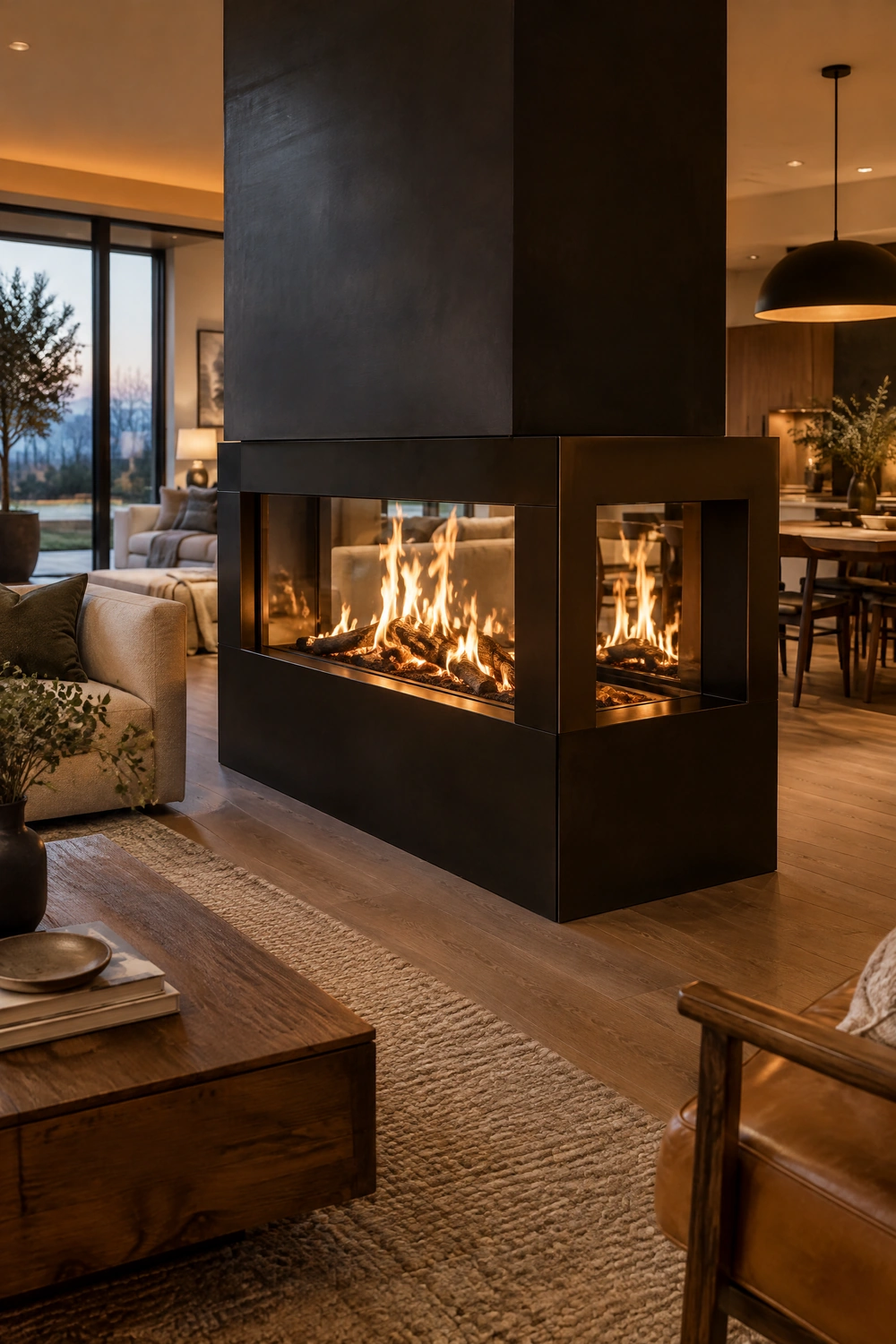
A double-sided or tunnel fireplace in a black steel or cast iron housing, visible from two adjacent rooms or from two sides of the same open-plan space, creates the most architectural and most dramatic expression of the black fireplace available. The fire viewed through a glass-enclosed tunnel of dark metal is a living sculptural installation that changes the visual connection between the rooms it divides or connects. This treatment is most effective in open-plan living spaces where a conventional single-aspect fireplace on one wall would leave the adjacent zone without a focal point, and where the double-sided unit can serve as both room divider and heat source for both zones simultaneously.
Designer Advice: A double-sided fireplace works best when it is not placed against any wall but floated in the space it divides, or built into a peninsula wall that projects into the room from one side. A double-sided unit placed against an exterior wall is simply a standard fireplace that happens to have glass on both sides. A unit floating in the plan is a genuine spatial event.
CATEGORY TWO: THE SURROUND AND CHIMNEY BREAST
7. Paint the Entire Chimney Breast Black to Extend the Focal Point
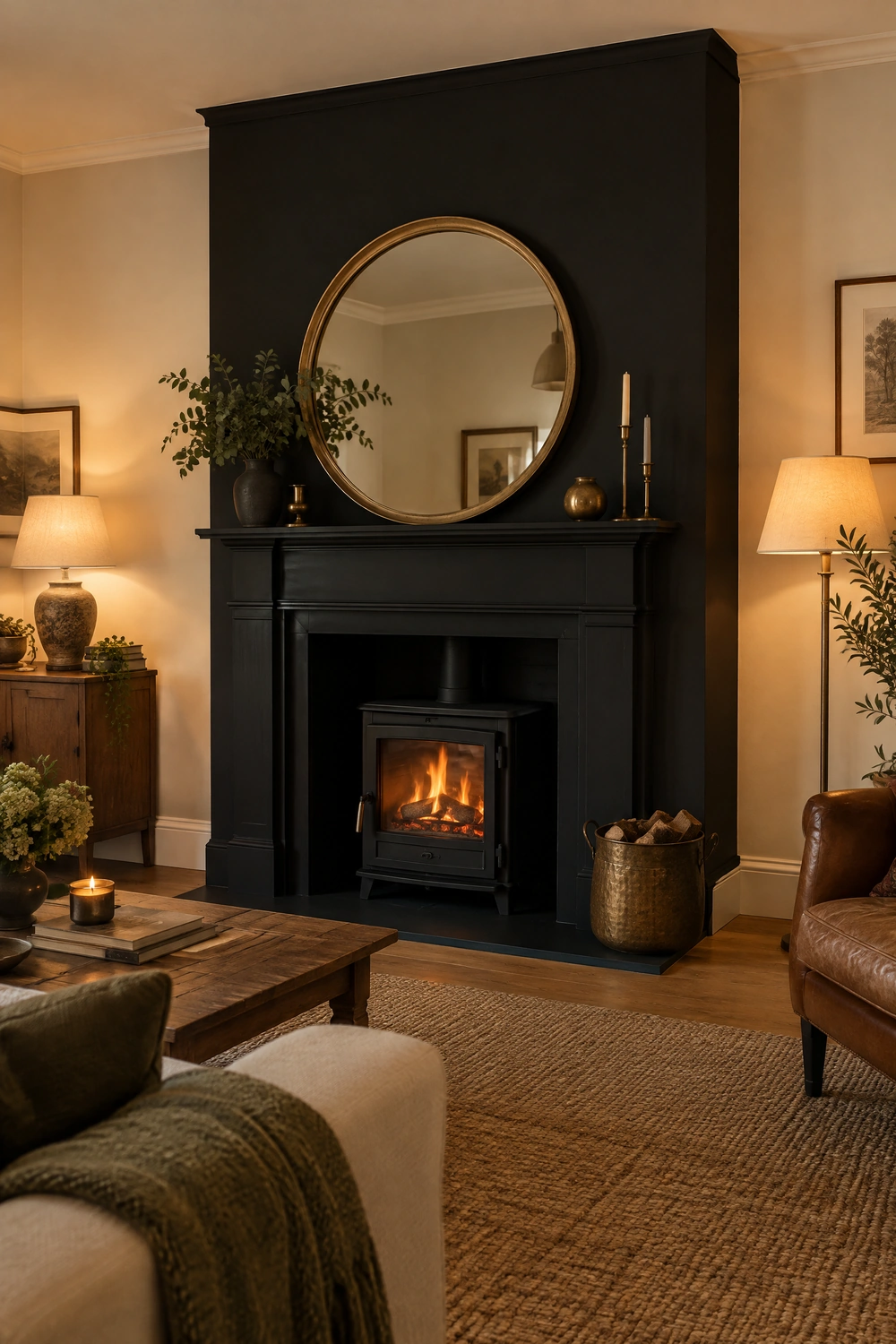
Painting the entire chimney breast, including the wall space above the mantel up to the ceiling, in the same matte black as the surround extends the focal point from a single architectural element to the room’s entire primary wall. The effect is one of the most dramatic and most commonly seen black fireplace treatments in contemporary interior design because it makes the chimney breast read as a single, unified design statement rather than a mantelpiece with a wall behind it. The black chimney breast wall becomes the room’s visual anchor and the backdrop against which every mantel object, every piece of art, and every decorative element placed on or near it is clearly legible.
Pro Move: When painting the chimney breast black, paint the full breast from skirting to ceiling including all the surrounding plasterwork and any alcoves beside the chimney. A chimney breast that is black only above the mantel, with lighter alcoves on either side, reads as an unfinished decision. The full breast painted uniformly reads as intentional architecture.
8. Build Flanking Alcove Shelves Into the Chimney Breast Recesses
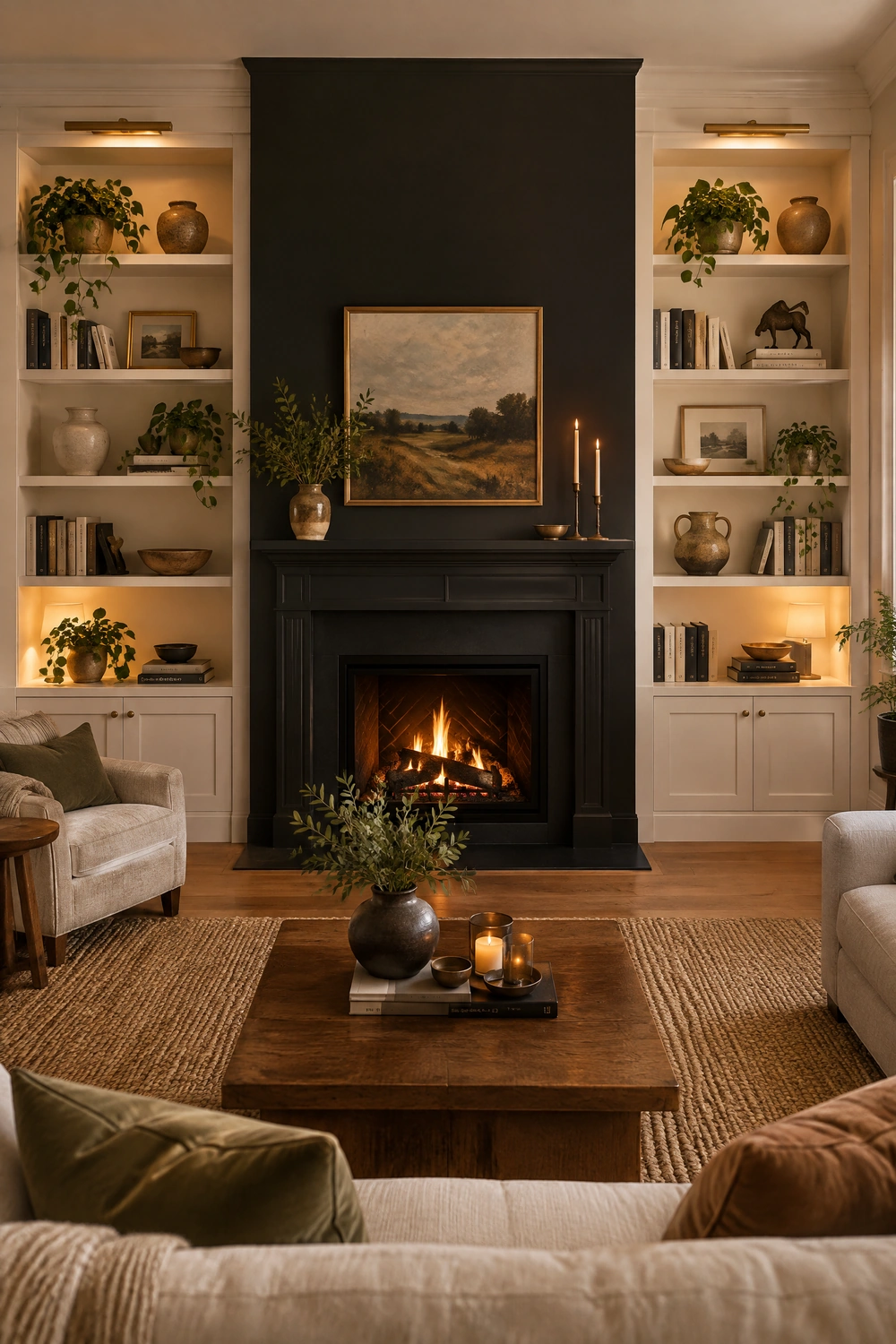
The alcoves on either side of a chimney breast are the most commonly underused spaces in a living room, and fitting them with floor-to-ceiling shelving, painted or built in a colour that relates to the black fireplace and the room’s palette, transforms them from awkward voids into the most organised and most visually enriching surfaces in the room. Shelves painted in the same black as the chimney breast wall create a symmetrical three-section composition: shelves, fireplace, shelves, in one continuous dark tone. Shelves in a contrasting light colour or natural wood provide the bright, warm elements on either side of the black focal point that balance its visual weight and warm the overall composition.
Reality Check: Built-in alcove shelving beside a black fireplace is one of the highest-value design investments available in a living room, both aesthetically and practically. It creates storage and display capacity that freestanding furniture cannot provide with the same proportion and the same architectural integration.
9. Install a Statement Light Above the Fireplace on the Chimney Breast
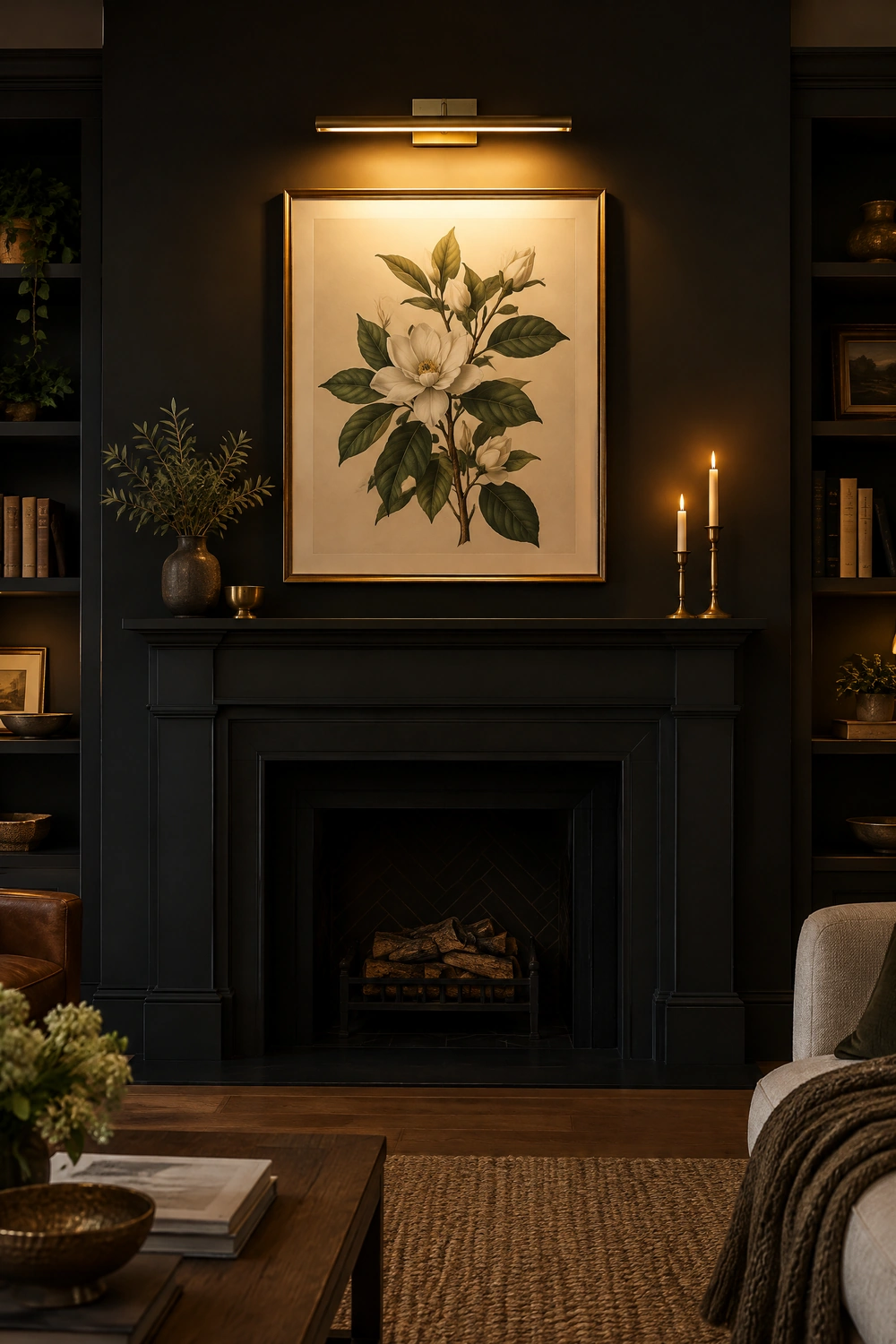
A wall-mounted light above the fireplace, whether a brass picture light illuminating a piece of art, a pair of sconces flanking a mirror, or a single dramatic pendant hanging from the ceiling above the mantel, creates a layered lighting moment at the room’s focal point that overhead lights and floor lamps cannot achieve. A picture light mounted above a large mirror or a significant piece of art on the black chimney breast wall frames the display zone and creates a warm, intimate light source at exactly the height and position where the eye is already drawn. This approach is specifically suited to the black fireplace wall because the dark background makes the warm light of the picture light or sconce read as particularly luminous.
Quick Tip: A battery-powered picture light is the installation-free option for illuminating art or a mirror above a black fireplace surround. Good-quality battery picture lights are indistinguishable from hardwired versions in normal use, take twenty minutes to install, and can be moved if the display changes.
10. Frame the Chimney Breast With Floor-to-Ceiling Curtains on Either Side
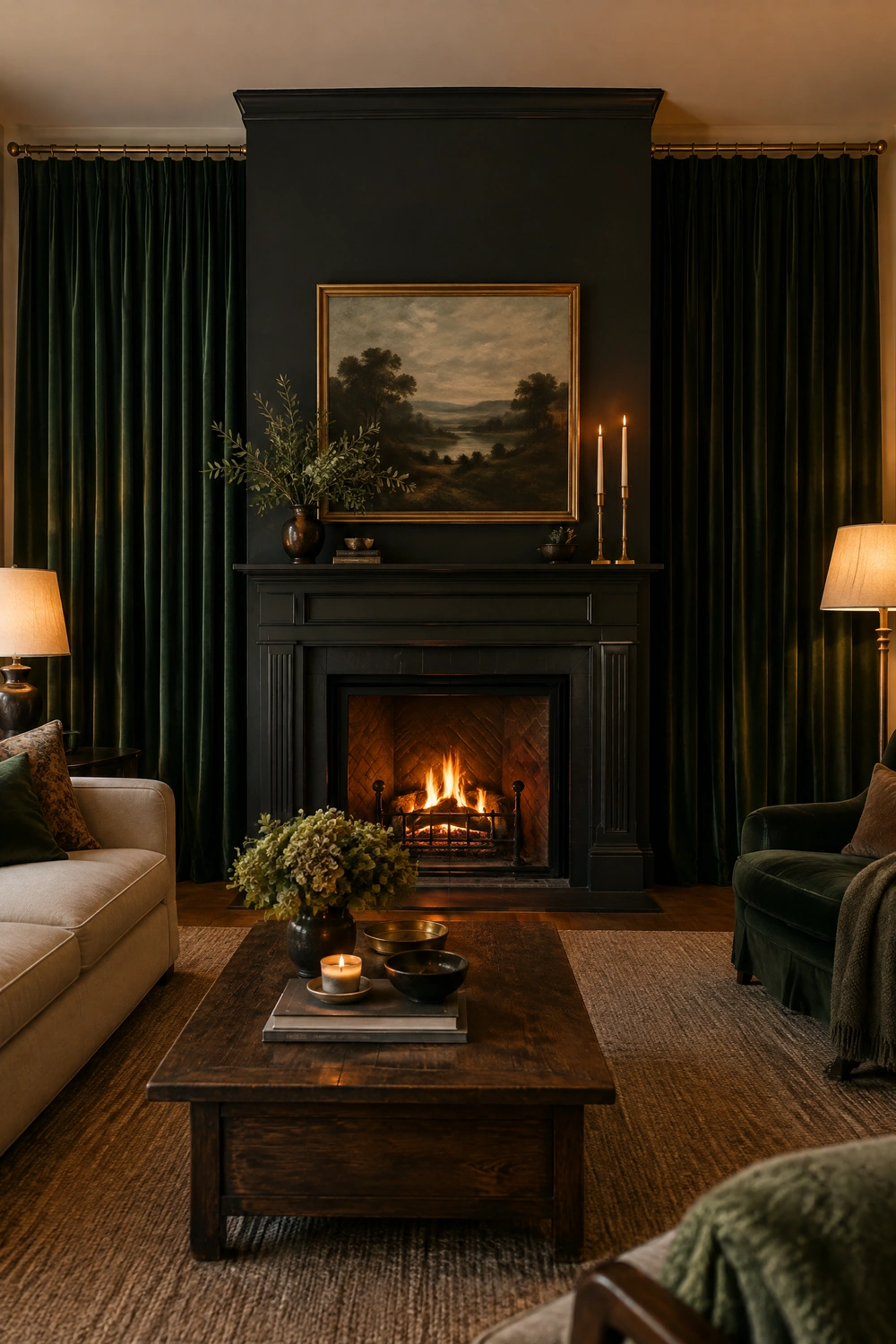
Hanging floor-to-ceiling curtains from ceiling-height rods on either side of the chimney breast, flanking the fireplace without covering any windows, creates a theatrical framing effect for the black focal point that adds height, drama, and textile warmth to the composition simultaneously. The curtains do not need to serve any practical function at this position. They exist purely to frame the fireplace wall in the way that a stage curtain frames a performance, drawing the eye toward the central feature and adding the soft vertical element that an all-hard-material fireplace wall lacks. Velvet curtains in a jewel tone, forest green, burgundy, or deep teal, flanking a black fireplace on a white chimney breast create one of the most specifically beautiful living room compositions available.
Designer Advice: Curtains used decoratively to frame a chimney breast rather than to cover a window should touch the floor with a slight puddle at the base, as puddle-length curtains in this position read as deliberately theatrical rather than impractically long. Hem them to hover rather than puddle and the theatrical framing effect is undermined.
CATEGORY THREE: THE MANTEL
11. Style the Mantel With Maximum Contrast Against the Black
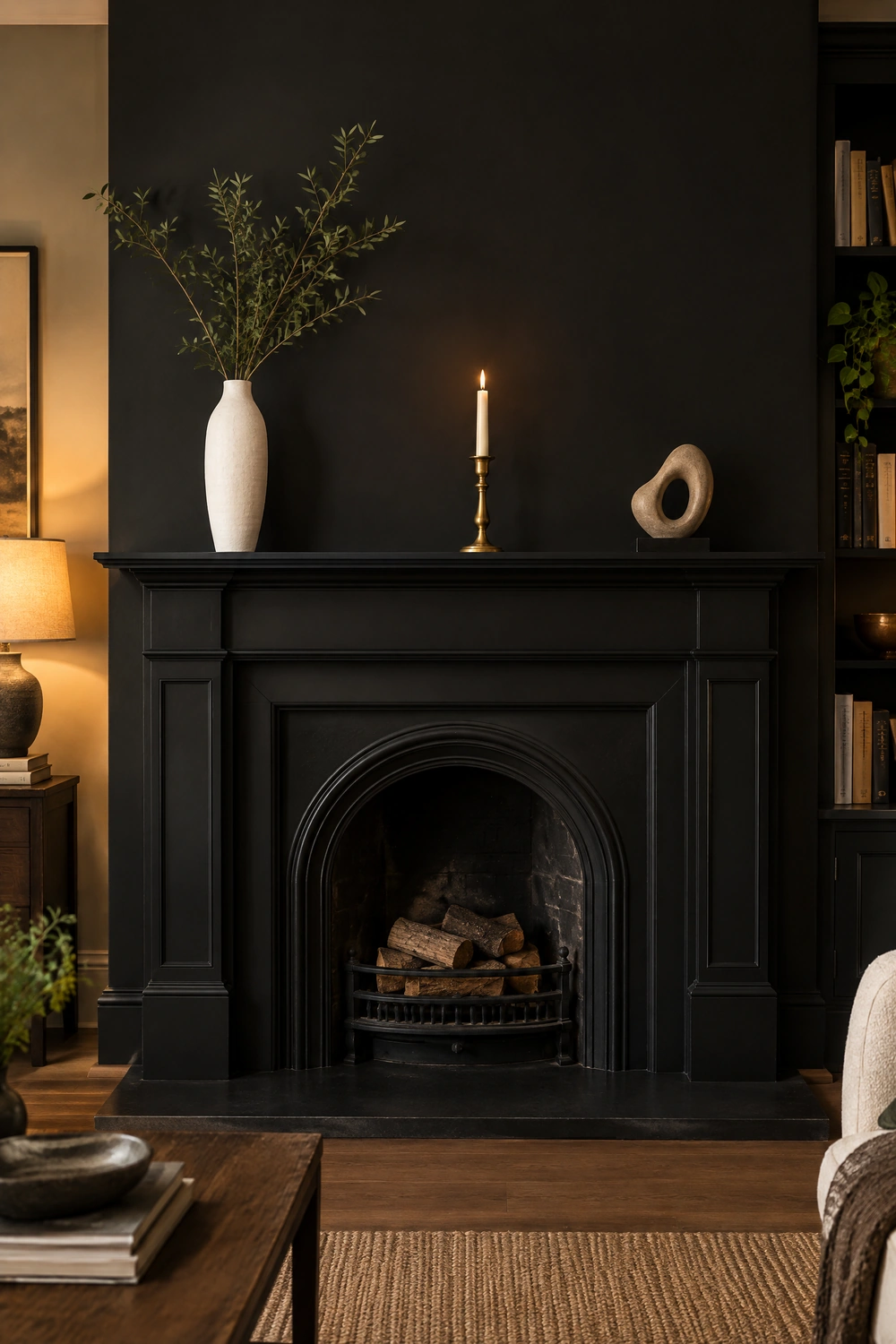
A mantel arrangement on a black chimney breast or above a black surround performs differently from a mantel arrangement on a lighter wall, because the dark background makes every object on the mantel significantly more visible and more legible than it would be against pale plaster. This is both the opportunity and the challenge of a black fireplace mantel: the objects placed on it are dramatically presented and completely exposed. The most effective mantel styling in this context uses a limited number of well-chosen objects of genuine quality and visual interest, placed with generous space between them, rather than a full and varied collection that reads as crowded when every element is clearly visible against the dark ground.
Pro Move: Against a black chimney breast, even three objects on a mantel read as a considered installation if those objects have the right scale and visual quality. A tall white ceramic vase, a warm brass candleholder, and a small sculptural object are enough to create a mantel moment that reads as complete rather than spare against a black wall.
12. Lean a Large Mirror or Artwork on the Mantel Against the Black Wall
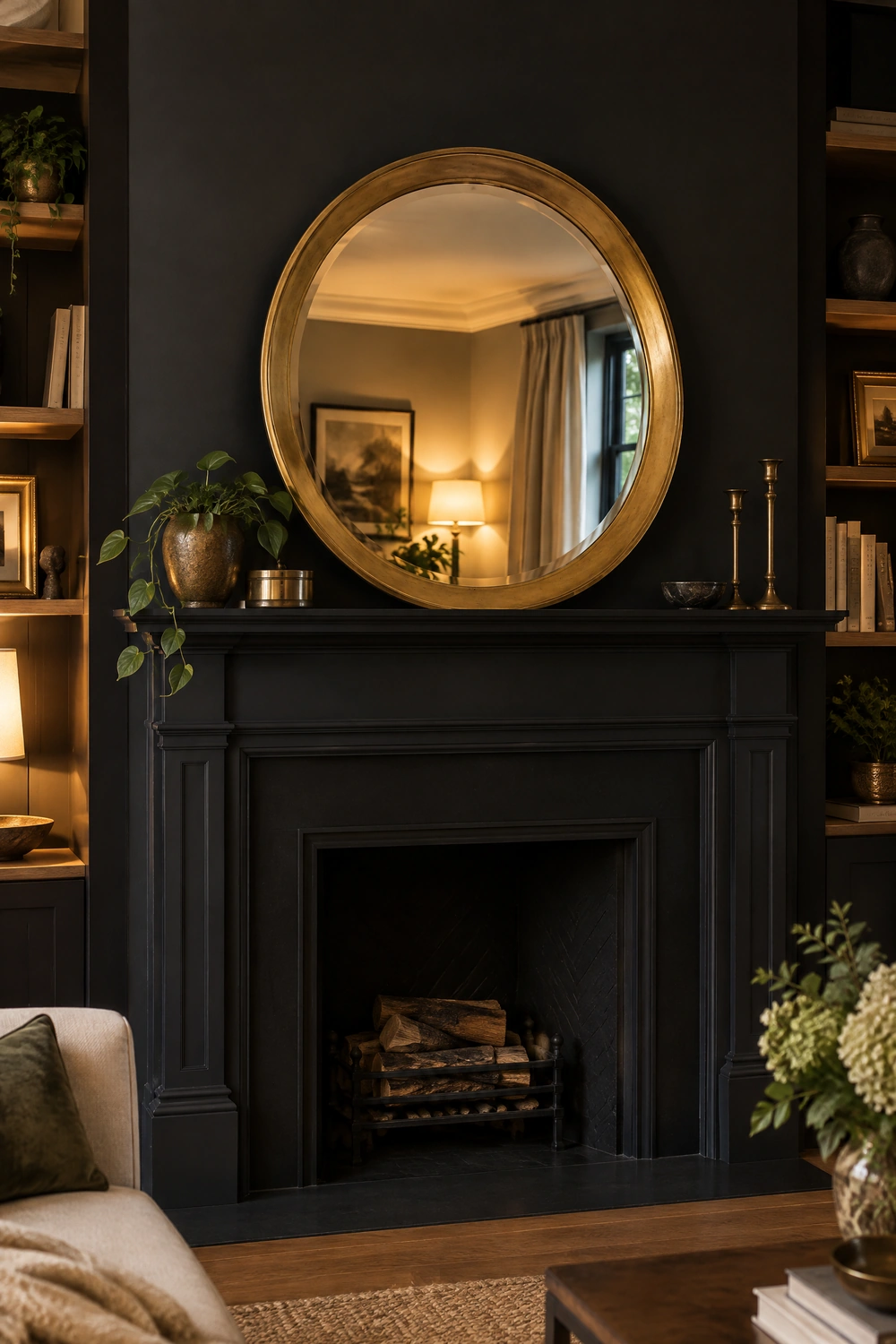
A large mirror or piece of art leaned against the black chimney breast wall on the mantel, rather than hung flat against it, creates the contemporary, casual confidence that the black fireplace setting particularly supports. A wide round mirror in aged brass leaning against matte black plaster above a matte black surround creates a composition of complementary dark and warm tones that reads as a deliberate design choice rather than a room where a mirror was placed because something was needed there. Leaning also allows the mirror or art to be moved or changed without leaving marks on the black painted surface, which is practical in a position where seasonal or permanent changes in display are likely.
Reality Check: A leaned piece above a working fireplace needs to be heat-resistant or positioned far enough from the firebox to be safe. A mirror or canvas directly above a gas or open fire can be damaged by heat. Check the clearance between the fireplace opening and the mantel shelf before placing any object there.
13. Use Asymmetric Mantel Styling for a Contemporary Effect
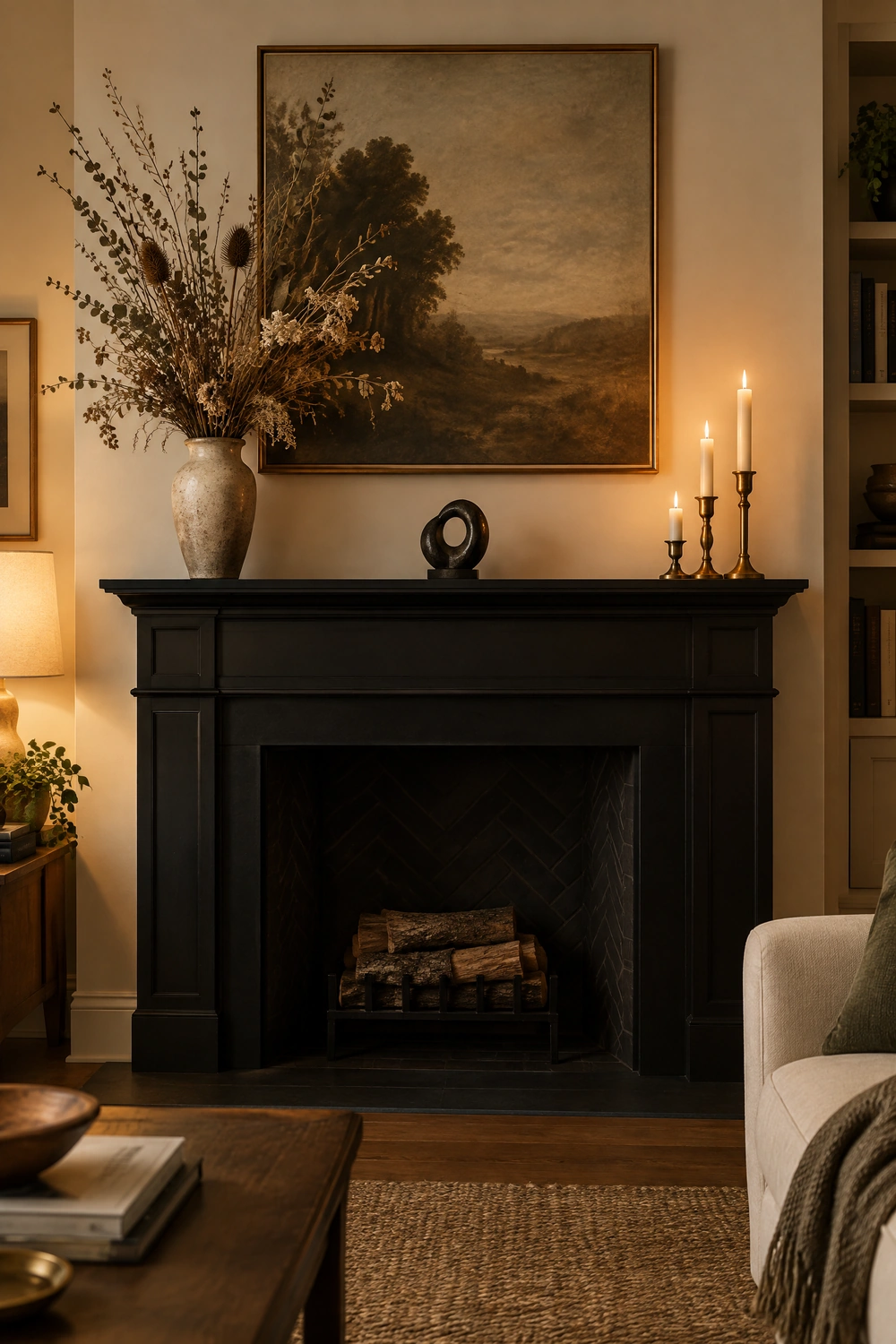
The symmetric mantel arrangement, with matching candlesticks and objects of identical height flanking a central mirror, is the conventional approach and one that reads as formal and traditional regardless of how contemporary the fireplace itself is. In a room with a black fireplace surround, asymmetric mantel styling, a large leaning mirror offset to one side, a tall botanical arrangement on the other, with a small cluster of objects in front of neither and one unexpected element breaking the horizontal line of the shelf, reads as more contemporary, more confident, and more in keeping with the deliberate, design-forward quality that a black fireplace communicates. The asymmetry should feel balanced in weight rather than simply uneven, with the visual mass distributed thoughtfully rather than randomly.
Designer Advice: Create asymmetric mantel balance by placing a tall element on one side and a wider, lower grouping on the other, so the visual mass is roughly equal despite the difference in arrangement. Tall and thin on the left balanced by shorter and wider on the right reads as considered asymmetry. Random heights with no relationship to each other reads as unfinished.
14. Add a Seasonal Layer to the Mantel That References the Fireplace’s Natural Context
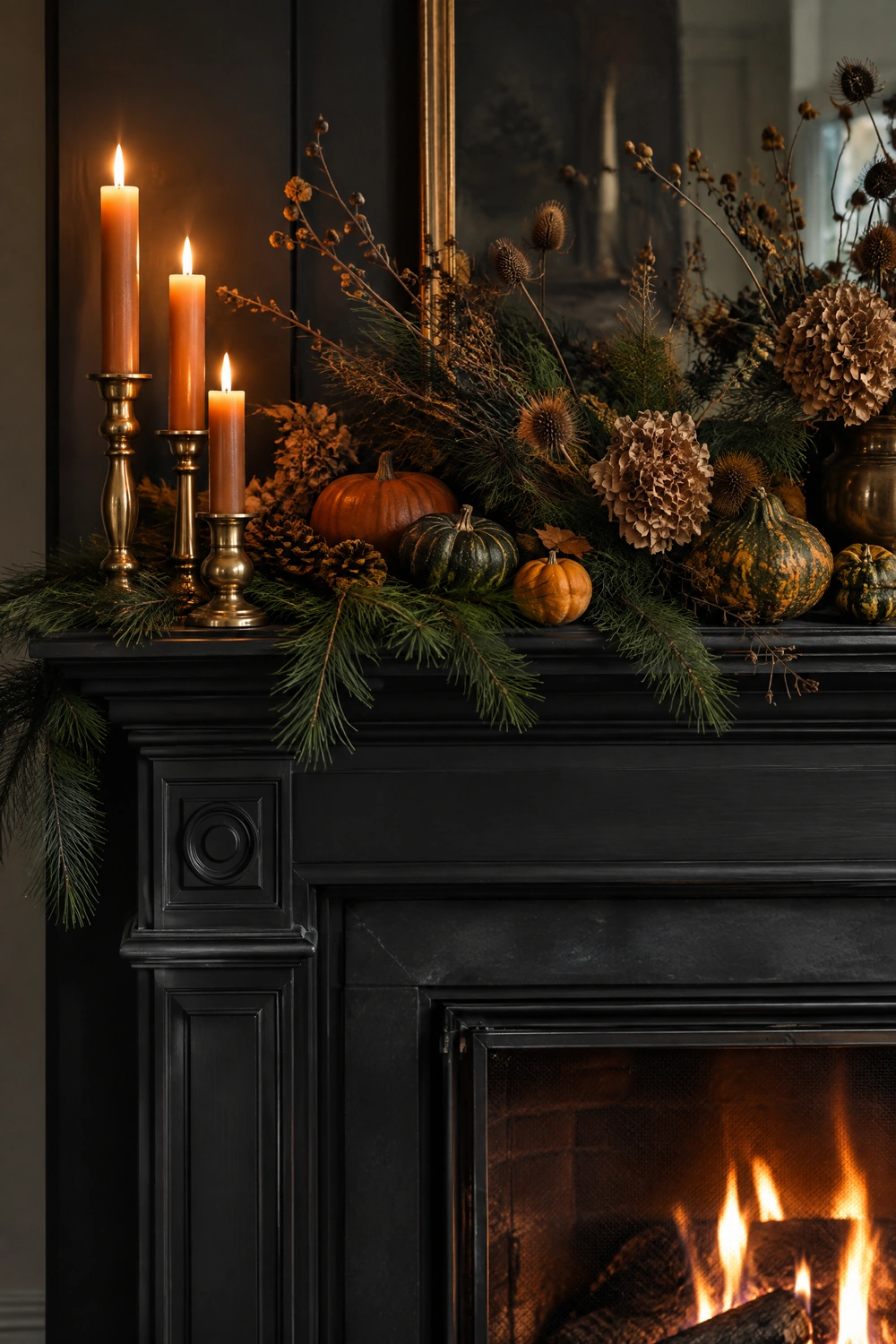
A black fireplace mantel that changes seasonally, with fresh or dried botanicals, seasonal objects, and textural additions that reference the natural materials of fire and hearth, gives the room’s primary focal point an ongoing sense of care and attention that a static arrangement cannot provide. In autumn, dried seed heads, pine cones, small gourds, and a cluster of warm amber candles. In winter, fresh pine branches, holly berries, and cream pillar candles. In spring, a budding branch or a forcing jar of bulbs. In summer, a single large architectural plant beside the fireplace rather than on the mantel. Each seasonal version of the mantel reflects the moment outside while relating to the permanent black surround below it, which gives the whole composition a quality of lived-in care.
Quick Tip: Keep a small collection of mantel-appropriate objects from each season in labeled boxes. Swapping the mantel seasonally takes fifteen minutes when everything is prepared and accessible, and the effect on the room is disproportionately large relative to the effort.
CATEGORY FOUR: THE SEATING ARRANGEMENT
15. Orient All Seating to Face the Fireplace as the Primary Focal Point
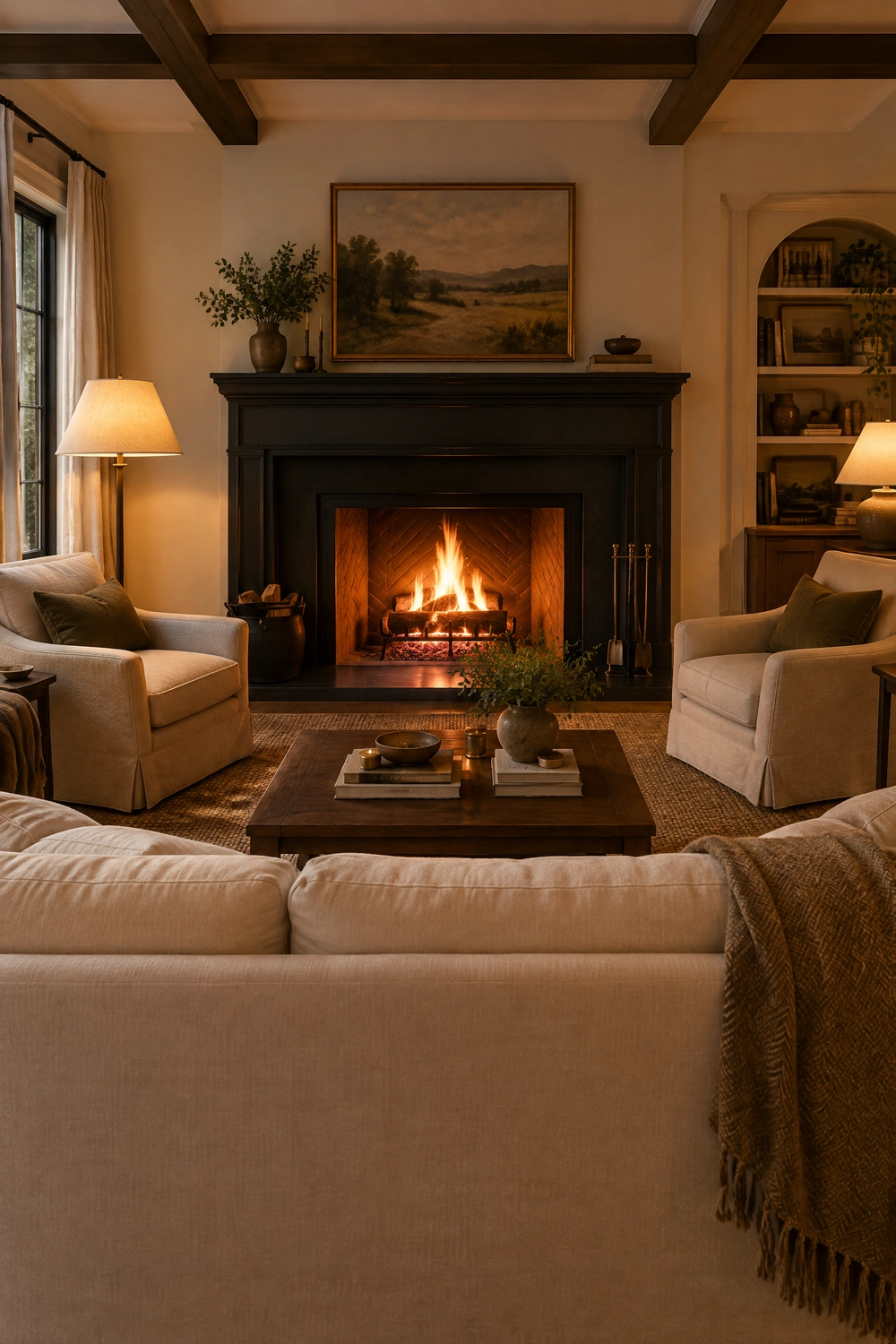
The single most important layout decision in a room with a black fireplace is ensuring that the primary seating faces the fireplace rather than the television or another secondary focal point. A black fireplace that is positioned as the room’s dominant visual anchor but then seated against, or at an angle to, is a missed opportunity of the highest order. The seating arrangement in a fireplace room should face the hearth as its primary orientation, with the television, if present, positioned at a slight angle on an adjacent wall or above the fireplace itself so that it can be seen from the seating without requiring the room to choose between the two focal points. When the sofa looks directly at the black fireplace, the room feels arranged rather than assembled.
Reality Check: Many living rooms have a television that competes with the fireplace for the seating arrangement’s primary orientation. If both are on the same wall, the television above the fireplace solves the problem. If they are on different walls, the fireplace should be the primary orientation with the television on an adjacent wall at a slight angle visible from the main sofa position.
16. Float the Sofa Away From the Wall Toward the Fireplace
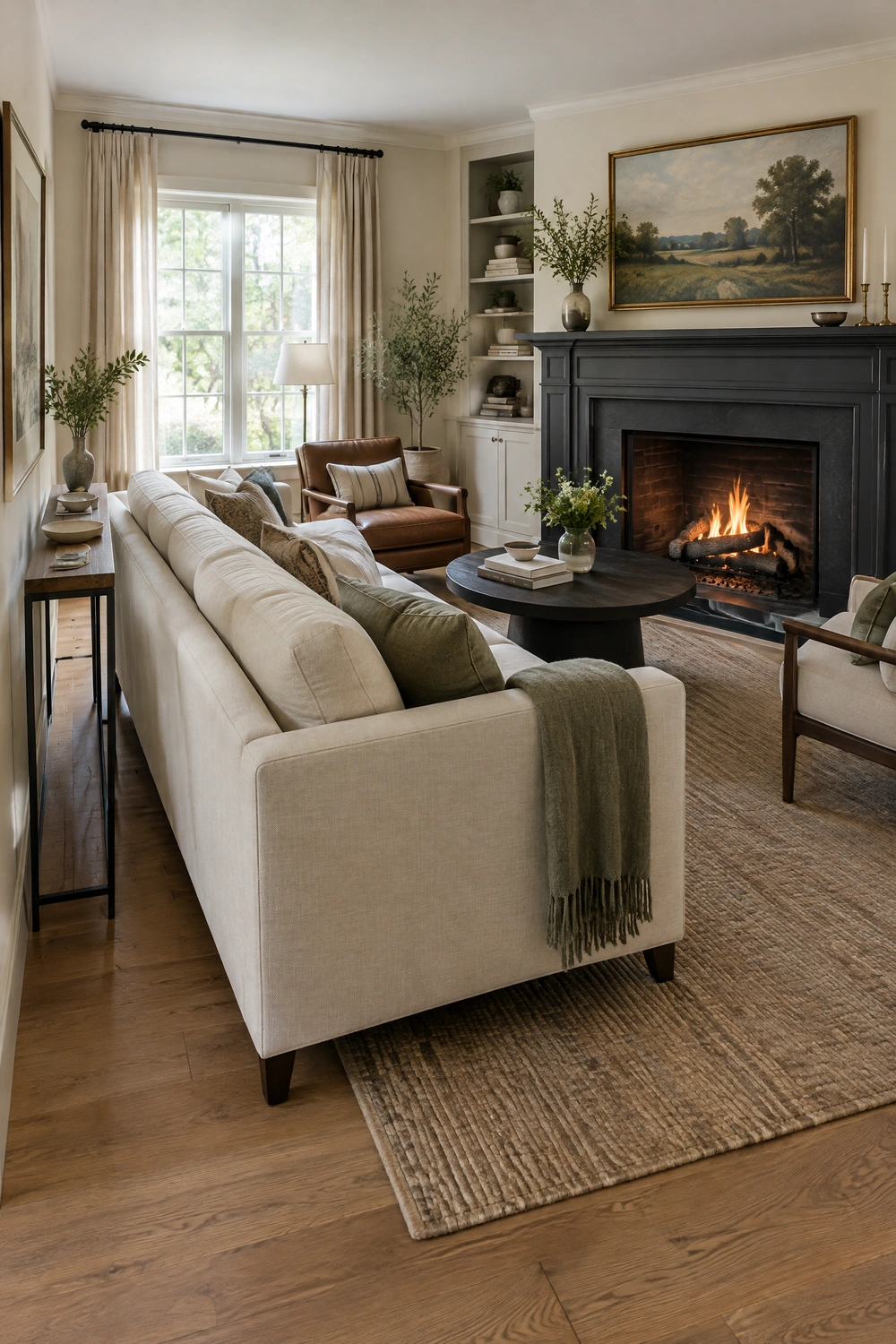
Pulling the main sofa away from the wall and toward the fireplace, so that there is a visible gap between the sofa back and the wall behind it, creates a seating arrangement that reads as gathered around the focal point rather than lined around the room’s perimeter. A sofa floating 18 inches from the wall, angled slightly toward the black fireplace, creates a conversation zone that has the fire at its heart rather than at its periphery. A console table placed in the gap between the sofa back and the wall at standing eye level serves as a secondary surface and a light source position, and the arrangement reads as the kind of grown-up, considered room composition that the black fireplace warrants.
Pro Move: Position a pair of armchairs at a slight angle toward the fireplace on either side of the sofa rather than directly facing it. This three-sided seating arrangement, two chairs and a sofa facing the hearth, creates the classic fireside conversation zone that is the archetypal purpose of a living room fireplace and the arrangement that makes it feel most fully inhabited.
17. Add a Low Bench or Ottoman Directly in Front of the Fireplace
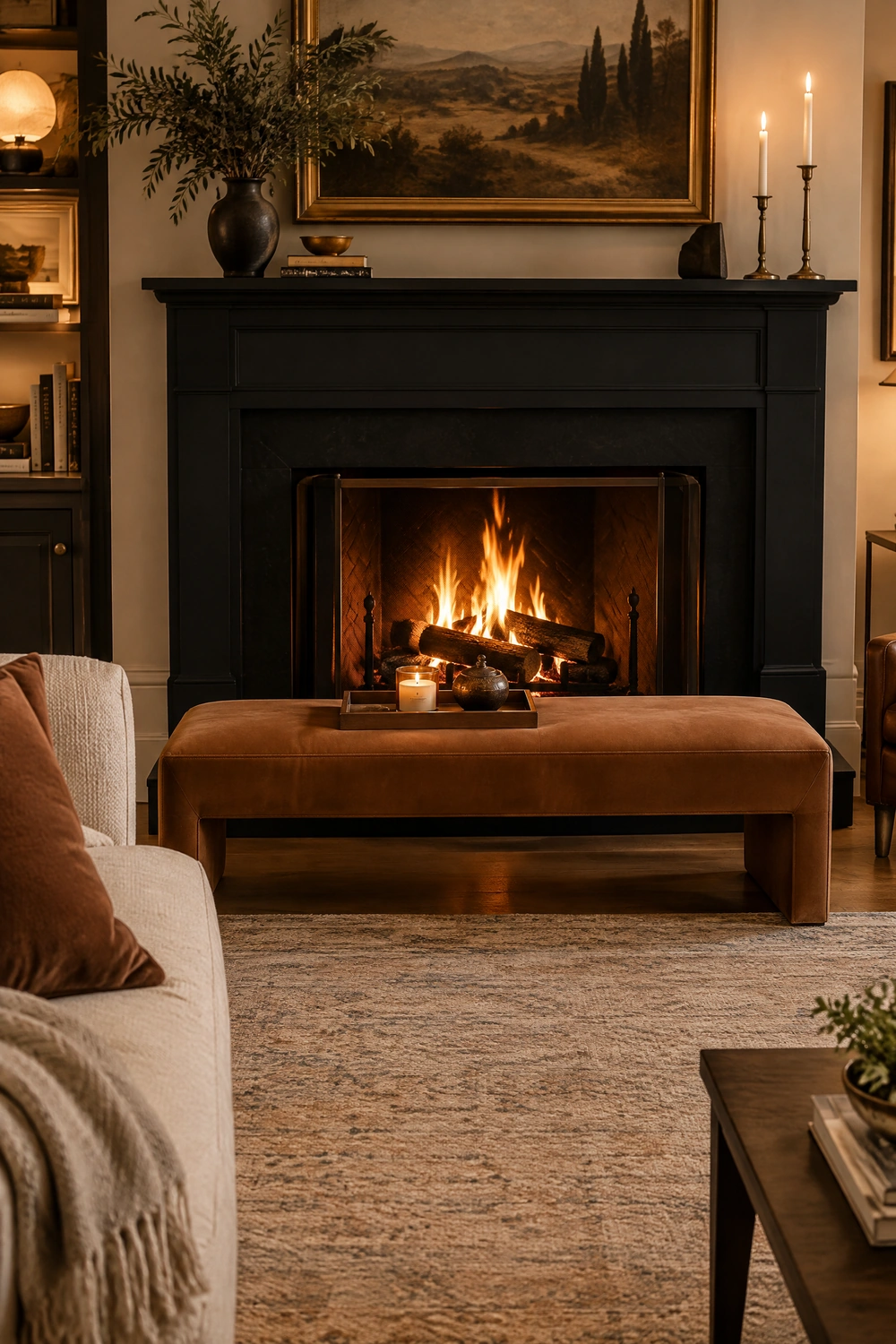
A low upholstered bench or a substantial leather or fabric ottoman positioned directly in front of the black fireplace, between the sofa and the hearth, creates a fourth seating option at the most coveted position in the room, immediately facing the fire. A low bench in a warm velvet or leather, in a tone that contrasts with but complements the black surround, reads as the centrepiece of the fireside seating arrangement and draws the eye toward the fire from the doorway. In practical terms, it provides occasional seating for guests, a footrest for the sofa occupants, and a styled surface when not in use, with a tray holding a candle and two objects creating a coffee table alternative at the heart of the arrangement.
Designer Advice: A bench or ottoman in front of a black fireplace should be in a lighter tone than the surround to prevent the two dark elements from merging visually into a single heavy zone at the room’s centre. A cream leather bench, a warm caramel velvet ottoman, or a natural linen upholstered piece each provide the contrast needed to make both the bench and the fireplace individually legible.
CATEGORY FIVE: WALL AND COLOUR RESPONSE
18. Keep the Surrounding Walls Warm White for Maximum Fireplace Impact
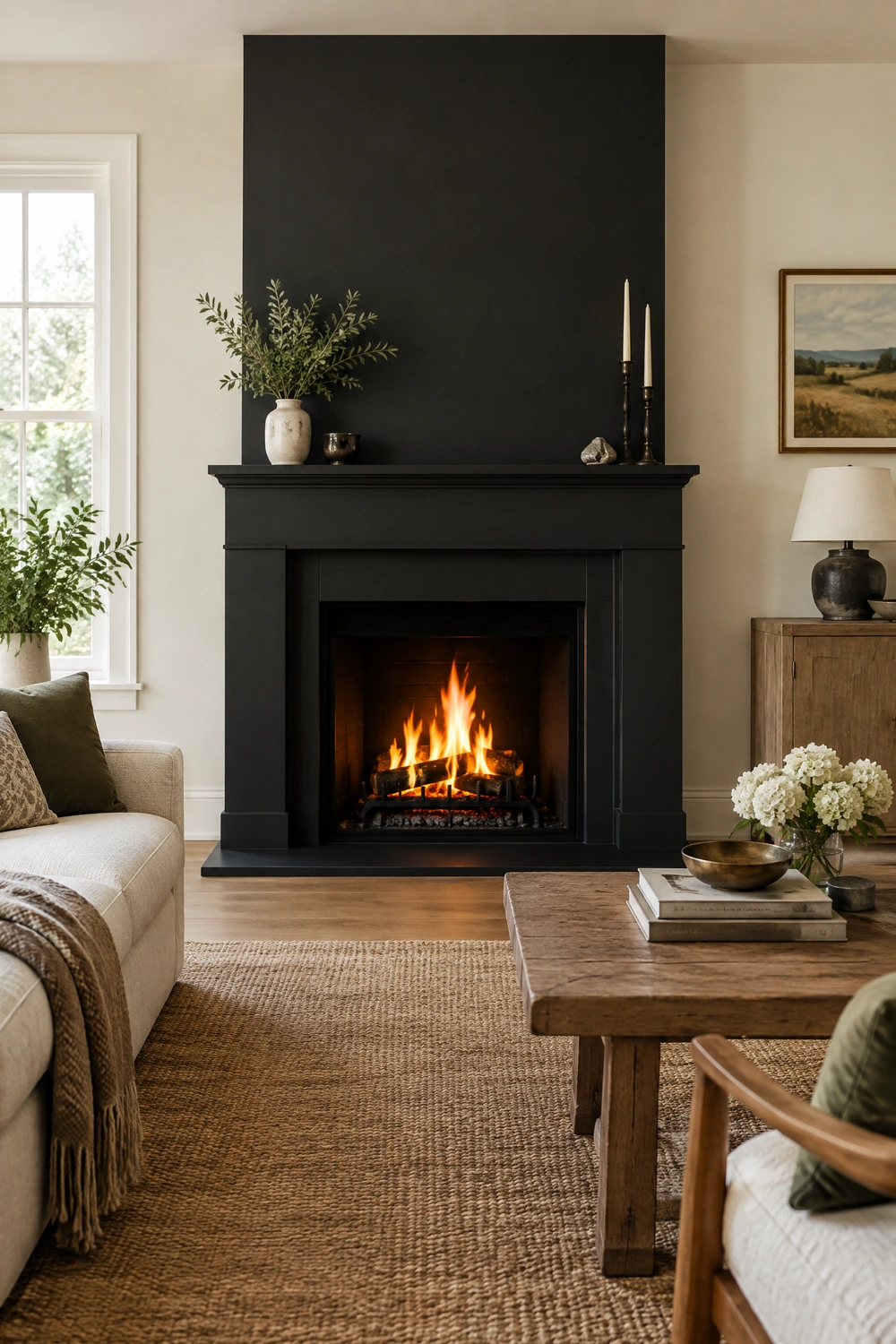
The fireplace wall treatment and the surrounding walls work together to determine how much visual impact the black surround commands, and the greatest contrast is achieved when the surrounding walls are in a warm white or very pale warm neutral. Against a warm white wall, a black fireplace reads with the same graphic clarity as a piece of dark art on a light gallery wall, and the fire inside it becomes the most visually active element in the room because the contrast between the dark surround, the orange flame, and the pale wall creates the highest possible sensory range. The warm white also reflects light back from the room’s lamp sources into the space beside and around the fireplace, which keeps the focal point from feeling dark at its edges.
Reality Check: Warm white walls beside a black fireplace need to be genuinely warm, with a yellow or pink undertone rather than a cool grey or blue undertone. A cool white wall beside a black fireplace reads as cold and clinical, which works against the fireplace’s primary function as a source of physical and visual warmth.
19. Try Deep, Dark Walls to Create a Fully Immersive Fireplace Room
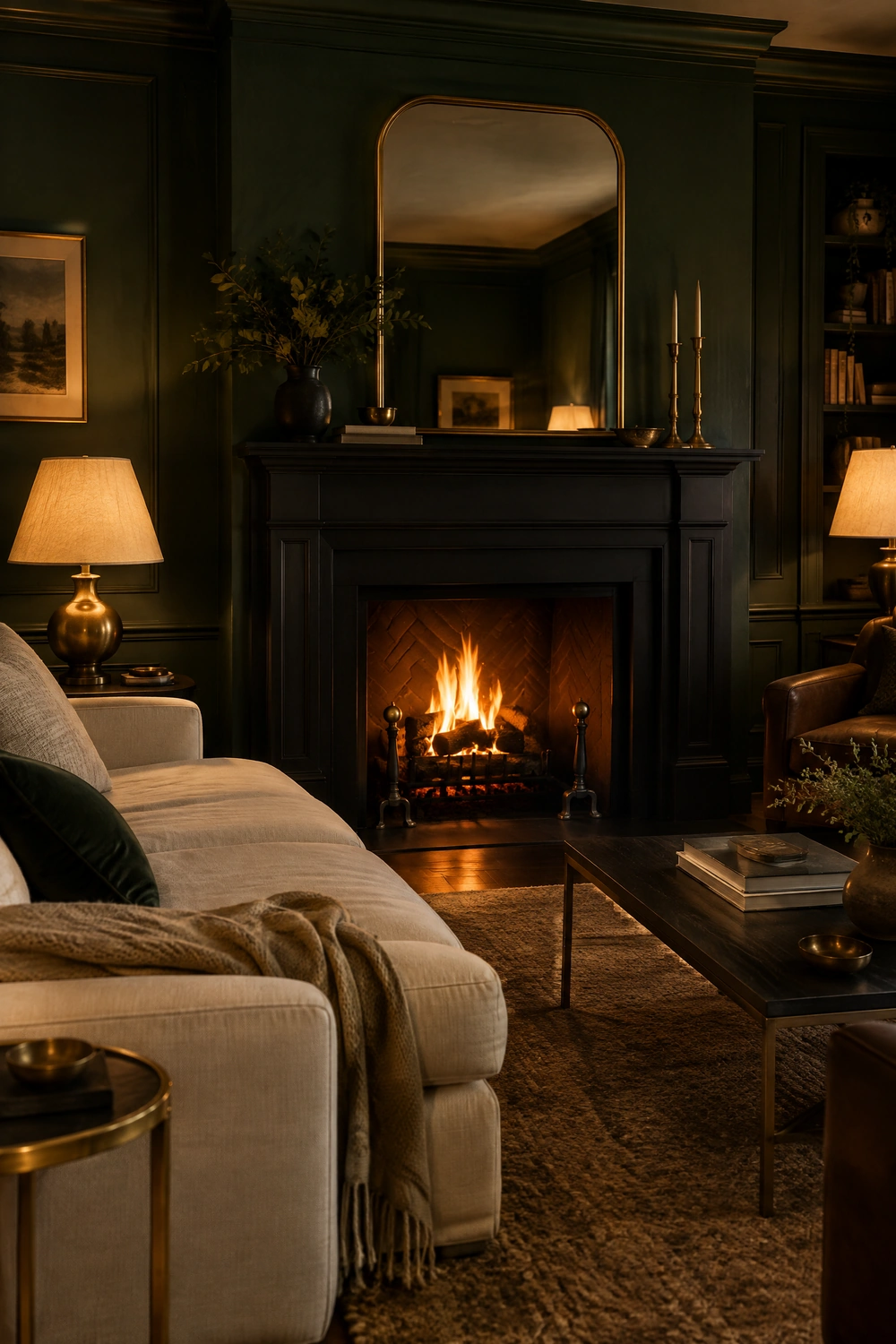
Painting the walls around a black fireplace in a deep, saturated tone, forest green, navy, plum, charcoal, or midnight blue, creates an immersive room where the black fireplace reads as a darker, harder material within a generally dark-toned composition. This treatment works best in rooms that are used primarily in the evening, where artificial light creates a rich, lamplight atmosphere rather than relying on natural light to brighten the space. A dark-walled room with a black fireplace, warm brass accents, velvet upholstery, layered lamps, and the fire lit is one of the most specifically beautiful and most atmospheric living room compositions available.
Designer Advice: Dark walls around a black fireplace require warm, layered lighting even more urgently than a lighter room. A single overhead light in this scheme makes the room feel dark and oppressive. Multiple lamp sources at different heights, supplemented by candlelight and the fire itself, make the same room feel intimate and designed.
20. Use Wood Panelling or Shiplap Around the Fireplace for Textural Contrast
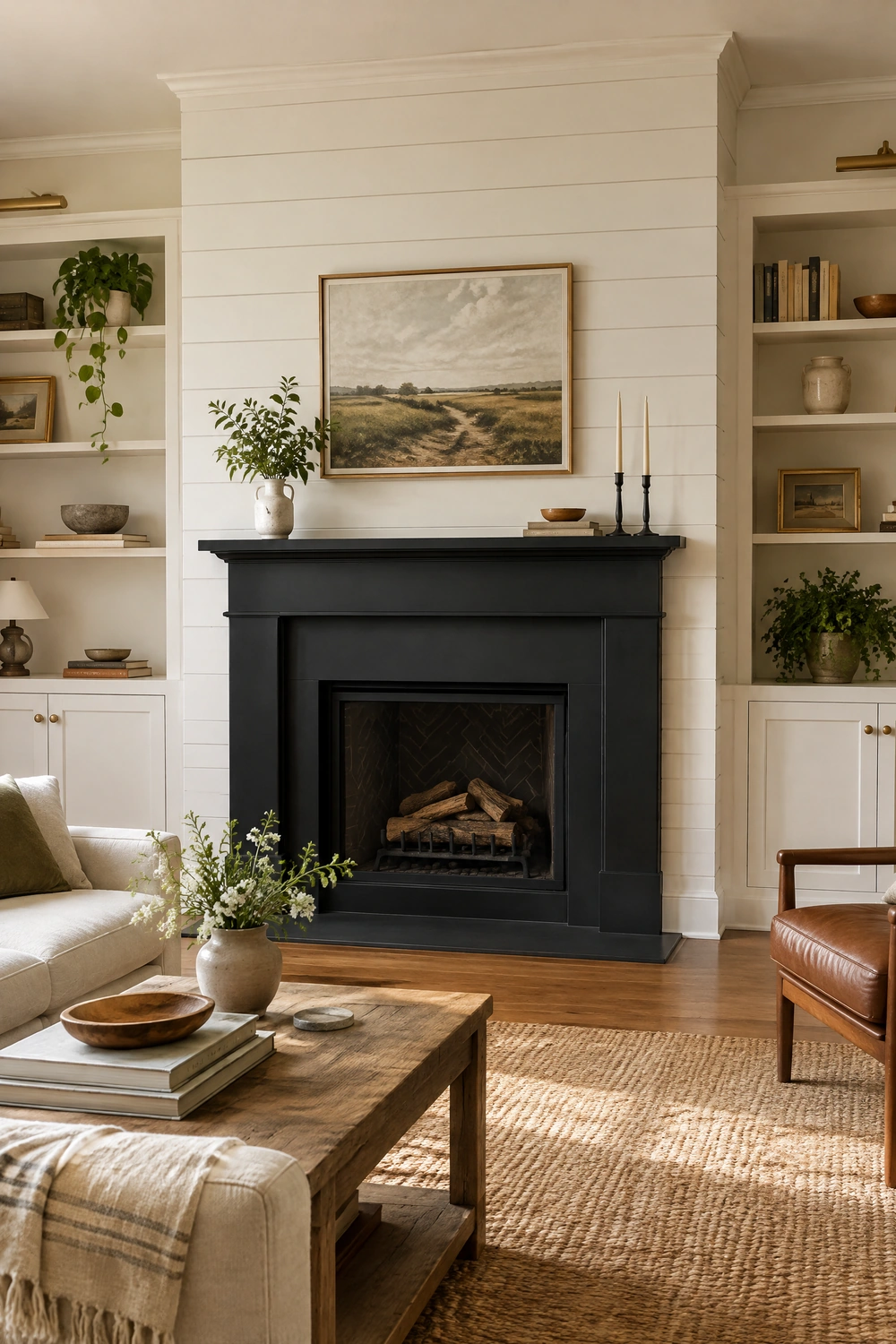
Wood panelling, shiplap, or tongue-and-groove boarding installed on the chimney breast wall or extending across the entire fireplace wall creates a warm, textured contrast with the hardness of the black surround that reads as particularly organic and particularly well-suited to contemporary farmhouse, dark Scandinavian, and transitional interior aesthetics. The horizontal or vertical lines of the boarding add a directional quality to the wall that a flat-plastered surface lacks, and when painted in a warm white or pale cream rather than left natural, the painted panelling creates a more complex and more textured white wall than plain plaster. Against the black surround, the painted panelling reads as architectural detail that frames the fireplace as a designed element rather than a utilitarian heat source.
Quick Tip: Shiplap or tongue-and-groove boarding on a chimney breast that is painted the same colour as the surrounding walls creates texture and shadow lines without introducing a new colour, which maintains the tonal simplicity of the scheme while adding the visual interest that a plain wall lacks. The shadow lines between boards are enough.
CATEGORY SIX: THE LIGHTING RESPONSE
21. Use Warm Candlelight on and Around the Mantel at All Times
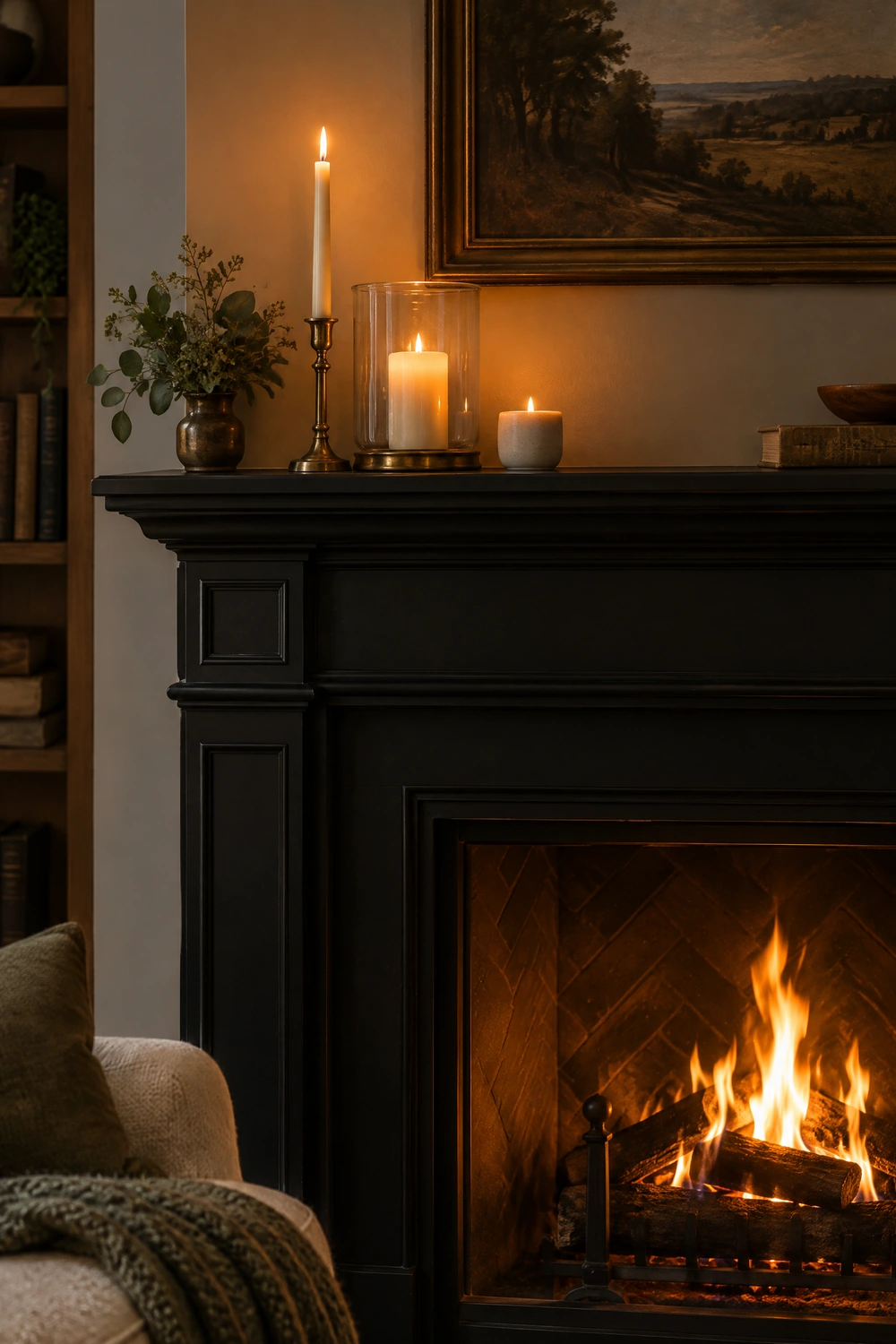
Candles on and around the mantel of a black fireplace perform the function of extending the warmth and movement of the fire into the times when the fireplace itself is not lit, and of adding a second layer of warm light at mantel height during the times when the fire is lit. A cluster of three candles of different heights in warm cream or beeswax tones in a mix of holders, a tall taper in a brass stick, a medium pillar in a glass hurricane, and a small votive in a simple ceramic holder, creates the layered candlelight arrangement that reads as considered rather than functional. In a room with a black fireplace, warm candlelight at mantel height is not optional decoration but part of the room’s core light design.
Reality Check: Never place open candles directly on a mantel shelf immediately above a working fireplace. Heat rises, and candles positioned above a lit fire can reach temperatures that deform the candle or cause the wax to run. Use hurricane glass holders for any candles near a working firebox and keep open flames at a safe distance.
22. Layer Multiple Lamp Sources to Balance the Fireplace’s Warm Light
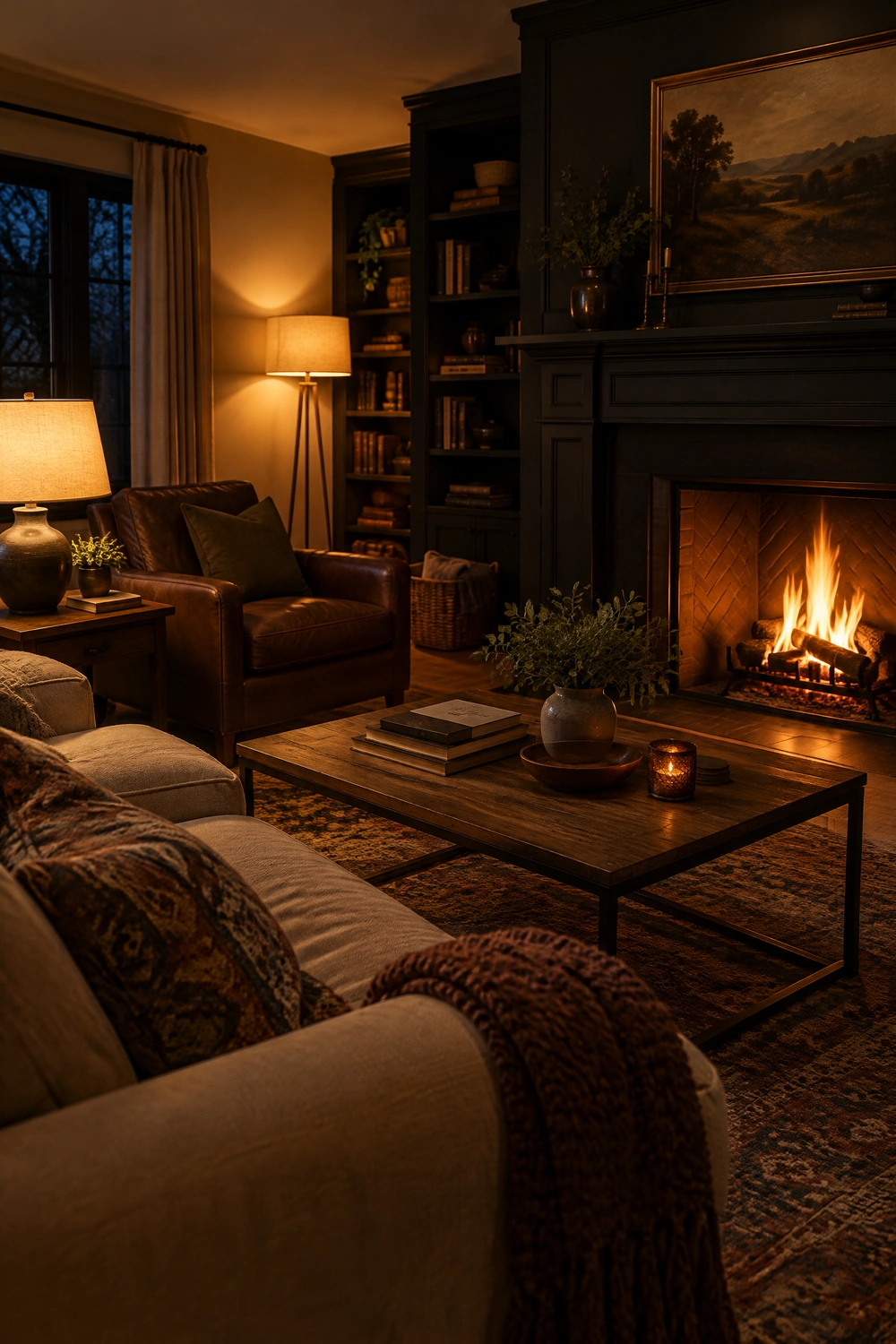
A black fireplace room lit only by the fireplace produces a dramatically atmospheric but functionally limited environment, with the area nearest the fire beautifully illuminated and the rest of the room falling into relative darkness. Layering floor lamps and table lamps at two or three positions around the room, all in warm 2700K bulbs, extends the fireplace’s warm, low light quality throughout the space and prevents the room from having a bright focal point surrounded by shadow. The lamps should be placed to complement rather than compete with the fire, at heights and positions that create light at seated level in the areas of the room away from the hearth zone. The combination of firelight and warm lamp light creates the most specifically residential and most atmospheric quality of light available in any room type.
Designer Advice: Install dimmer switches on all the lamp circuits in a fireplace room. With a fire lit and all other lights at 30 percent of maximum, the room produces the kind of warm, multi-source, low-level light that professional hospitality designers spend significant budget achieving. At zero cost beyond the dimmer switch installation.
23. Install a Picture Light or Sconces to Highlight the Mantel Display
A hardwired or battery-powered picture light mounted above the mantel, directed toward the art or mirror displayed there, creates a warm, directed light source at exactly the room’s most visible height that flatters both the display and the space around it. In a room where the fireplace is the primary focal point, the picture light frames the mantel display in a cone of warm light that makes it the room’s secondary focal point after the fire itself, and the two light sources, fire from below and picture light from above, together illuminate the chimney breast in a way that makes it genuinely the most interesting surface in the room. Sconces mounted on the chimney breast wall on either side of the mirror or art serve a similar function at larger scale and are the more traditionally architectural solution.
Quick Tip: A battery-powered picture light with a warm LED output requires no drilling near the fireplace and produces a quality of directed light that is essentially identical to a hardwired version. Install it in fifteen minutes, adjust the angle to direct light onto the display, and change the batteries twice a year.
CATEGORY SEVEN: WHOLE-ROOM MATERIAL AND COLOUR DECISIONS
24. Add Warm Brass and Gold Throughout as the Primary Accent Metal
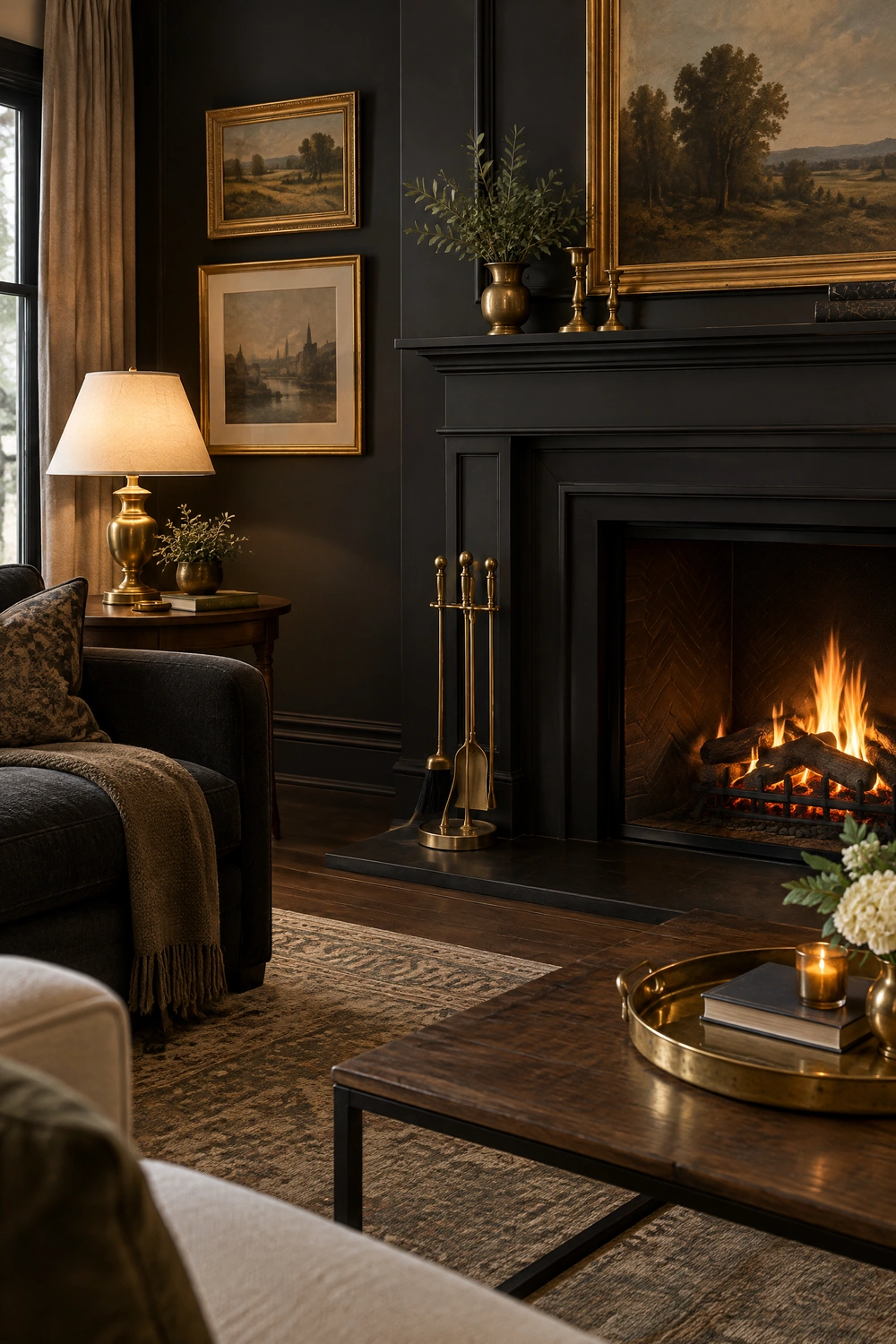
Warm brass and gold are the accent metals most consistently associated with black fireplace living rooms because they provide exactly the warm, luminous contrast that the dark surround and firebox require. A brass fireside tool set, a gold-framed mirror above the mantel, brass picture frame hardware on the flanking art, a brushed brass lamp base on the side table, and a warm metal tray on the coffee table each introduce the warm metal at a different height and in a different scale throughout the room. The repetition of the same metal family across different elements and positions creates the tonal coherence that distinguishes a designed room from one where each purchase was made independently. Against a black fireplace in particular, warm brass reads as gold in firelight, which amplifies its richness considerably.
Pro Move: A brass fireside tool set, whether a full set of poker, brush, shovel, and tongs in an aged brass finish, or simply a pair of brass andirons, is one of the most specifically beautiful and most functionally elegant additions to a black fireplace. The warm metal beside the dark surround at hearth level creates a material pairing that reads as enduring.
25. Choose Upholstery in Warm, Rich Tones That Relate to Firelight
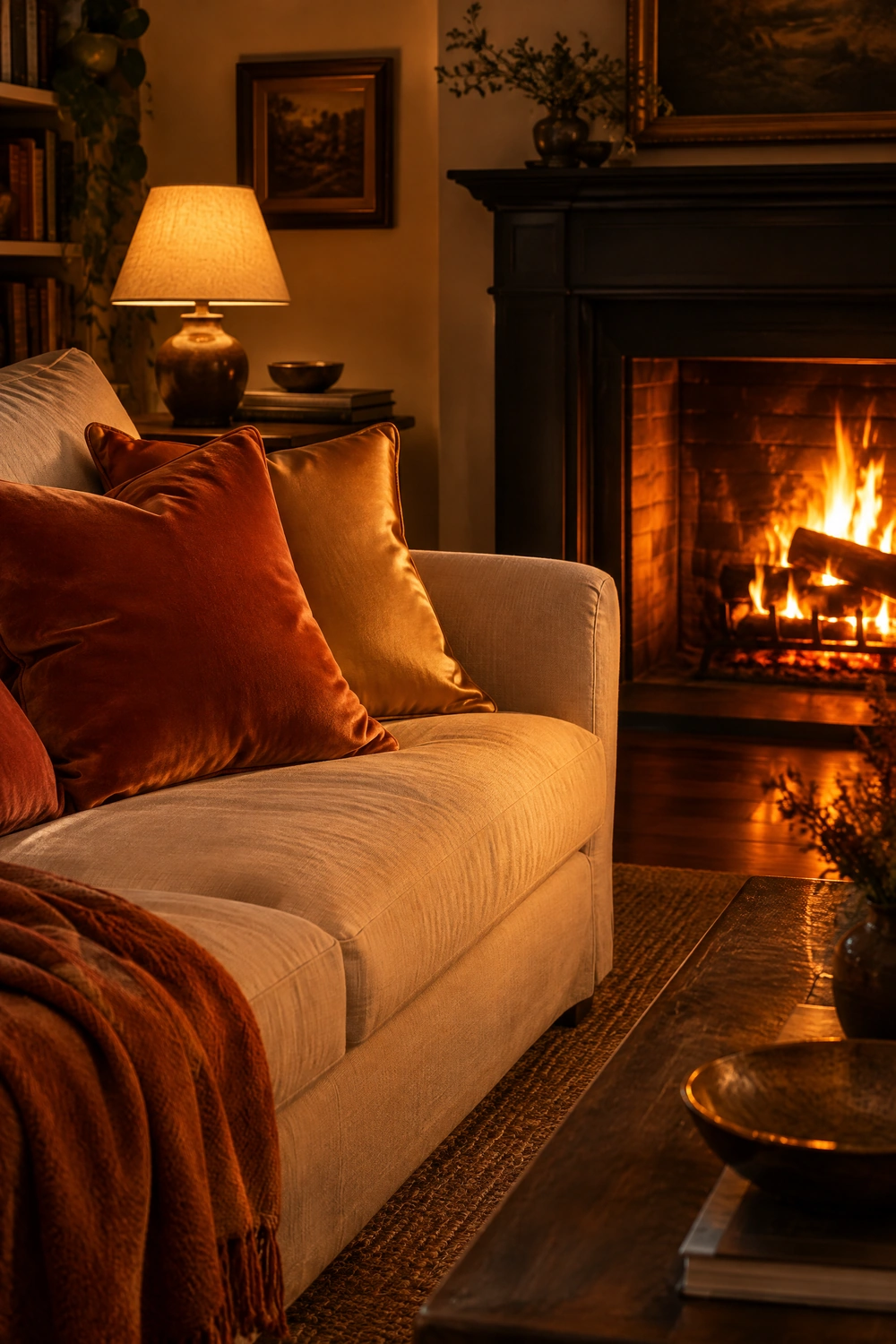
The upholstery in a black fireplace living room should be chosen in tones that the firelight will flatter, because the fire creates a warm, directional orange-gold light that enhances some materials and colours and diminishes others. Cream linen glows warmly in firelight. Velvet in terracotta, dusty rose, or warm amber becomes luminous. Natural leather in cognac or warm tan looks particularly beautiful in the flickering light of a fire. Cool or blue-toned upholstery, a grey velvet, a steel blue fabric, a cold white linen, reads as flat and slightly at odds with the fire’s warmth. The seating in a black fireplace room should be chosen in the knowledge that its primary context is warm, low, flickering light rather than the neutral daylight in which most purchases are made.
Heads Up: Visit the fabric sample of a potential sofa fabric in your own home in lamplight, not in the daylight of a showroom or the blue-tinted screen of an online photograph. The warmth of a terracotta velvet in an evening room with a fire lit is a different experience from the same fabric seen in daylight, and that evening experience is what you are designing for.
26. Layer Natural Organic Materials to Counterbalance the Black’s Hardness
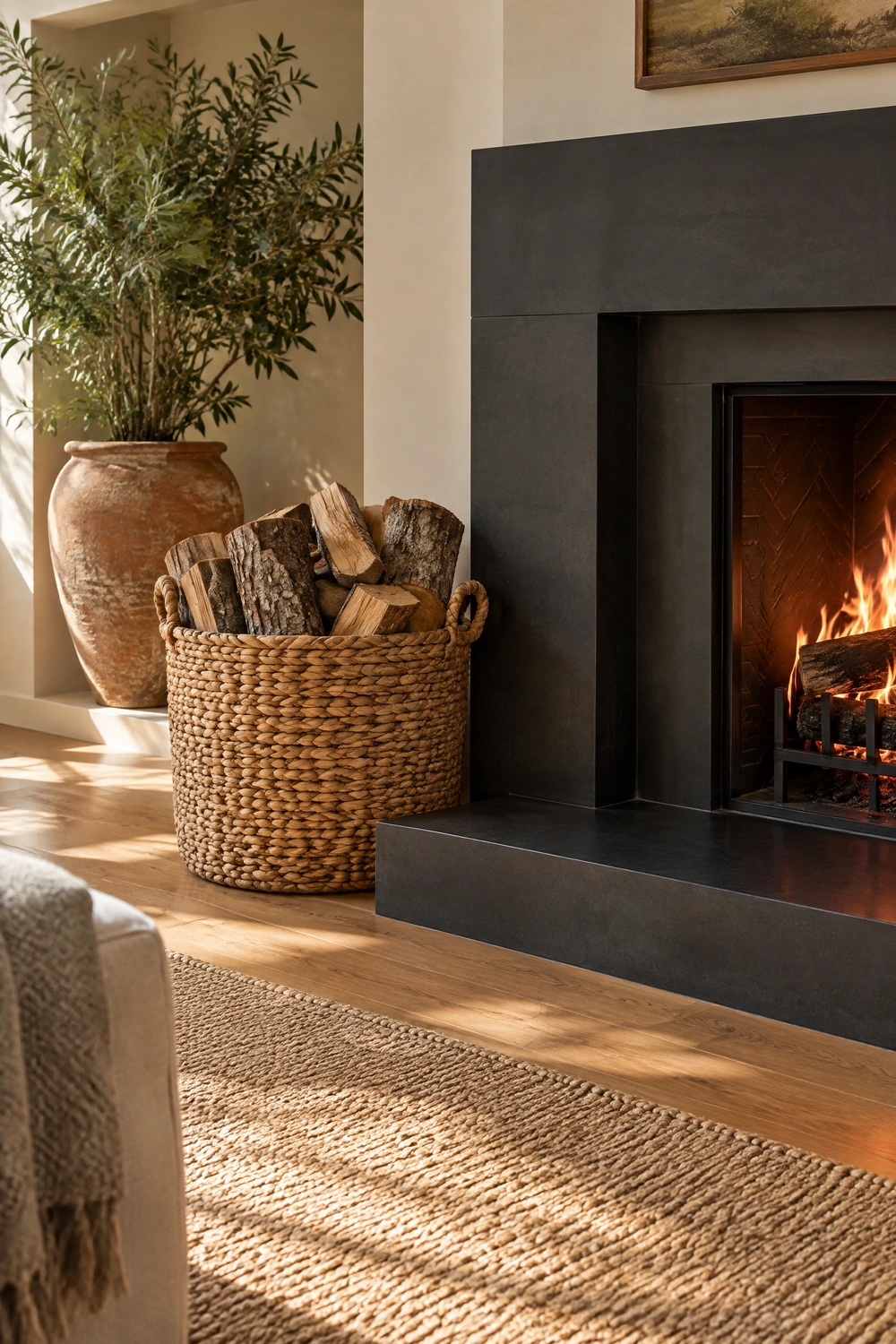
A black fireplace surround is one of the hardest, most geometric, and most architectural elements available in a living room, and it needs organic natural materials in its surroundings to prevent the room from reading as cold and industrial. A jute or wool rug at floor level, a rattan or cane armchair beside the sofa, a wooden coffee table with visible grain, a woven basket log holder beside the fireplace, and a large plant in a textured terracotta pot in the alcove beside the chimney breast each add organic material quality that softens the black surround’s hard edge and makes the room feel genuinely warm rather than dramatically styled. The log holder specifically, a large woven basket or a dark iron holder with wood stacked inside it, is a functional and beautiful object that directly references the fireplace’s purpose and adds warmth to the hearth zone even when the fire is not lit.
Designer Advice: A stack of real logs beside a black fireplace, in a well-chosen holder, is one of the most beautiful and most appropriate decorative elements available in this room type. The organic texture of the wood, its warm colour, and its direct relationship to the purpose of the fireplace make it the hearth zone’s most honest and most specific accessory.
27. Use Scent to Complete the Fireplace’s Sensory Experience
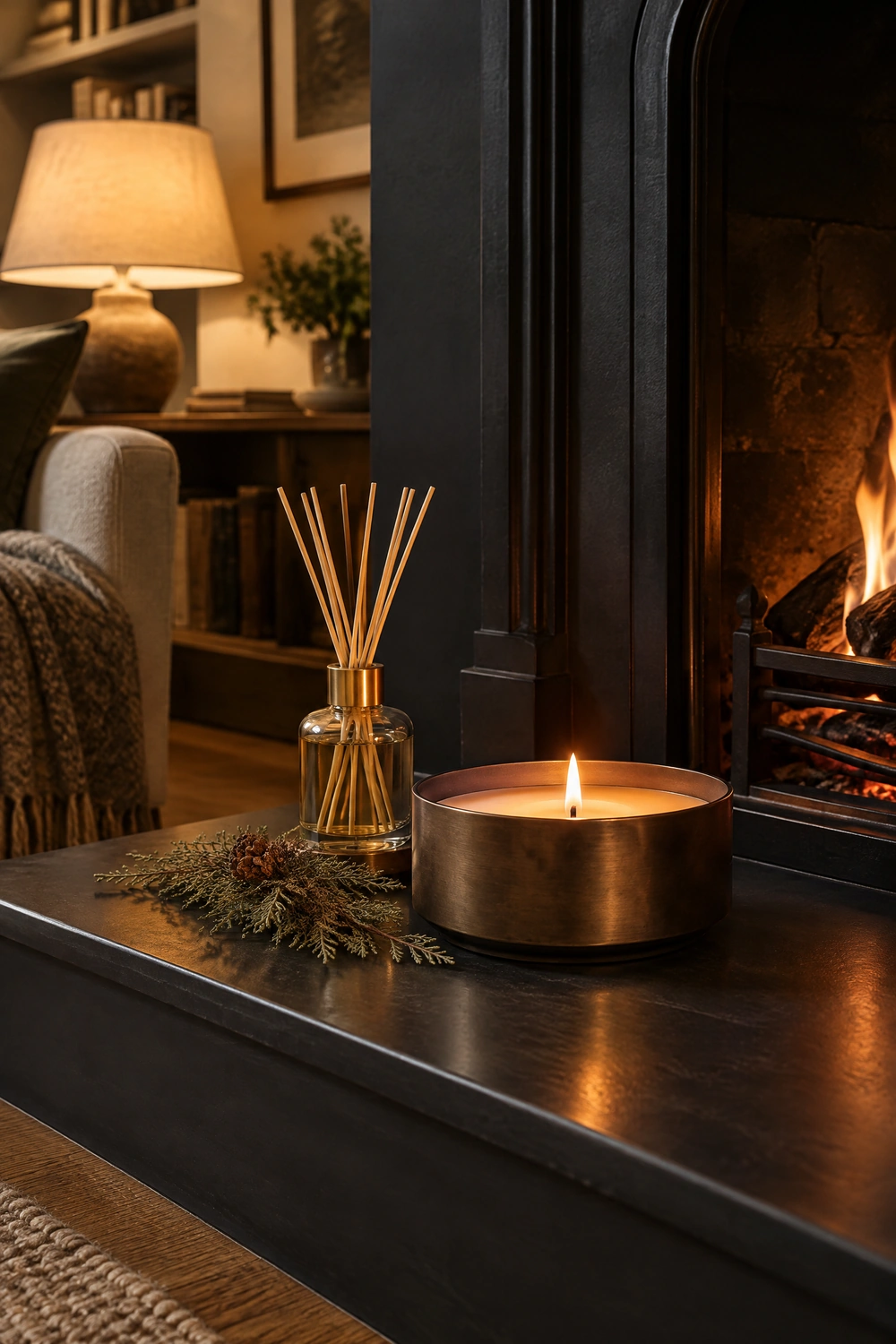
A black fireplace in a well-designed living room creates a multi-sensory experience: the visual drama of the dark surround and the flickering flame, the physical warmth of the fire, and the natural scent of wood smoke in a real fire or the neutral air of an electric one. For rooms without a working fire, scent becomes the missing sensory layer that bridges the visual drama of the black fireplace with the atmospheric warmth the room needs. A quality candle in a scent that references the hearth, cedarwood, woodsmoke, charcoal and oud, pine resin, or warm amber, burning beside or above the fireplace, creates the olfactory component that a non-functioning or decorative black fireplace cannot generate on its own. The scent and the visual focal point together create the full sensory experience of a living room built around its fire.
Pro Move: A crackling log fire scent diffuser beside a decorative or electric black fireplace is one of the most effective and least expensive ways to complete the sensory experience of the hearth in a room where a real fire is not possible. The combination of a realistic LED flame effect and a woodsmoke-adjacent reed diffuser creates an olfactory and visual impression of the fireplace experience that is more convincing than either element alone.
Black Fireplace Living Room: The Design Decision Guide
| Decision | What Works Best | What to Avoid | Why |
| Surround finish | Matte black steel, cast iron, matte marble, matte painted brick | Polished or gloss black finishes | Matte absorbs light and reads as deliberate. Gloss reflects the room and reads as an appliance. |
| Chimney breast wall | Full chimney breast in matte black, or warm white/pale neutral | Partial black treatment stopping at the mantel line | Full breast reads as intentional architecture. Partial reads as an unfinished decision. |
| Mantel styling | Limited well-chosen objects with generous space, asymmetric balance | Many objects in competing colours and heights | Against black, every mantel object is clearly visible. Quality of edit matters more here than anywhere else. |
| Seating orientation | Primary sofa facing the fireplace | Seating sideways to or away from the fire | A fireplace that nothing faces is a missed focal point. The room must address the fire to make it work. |
| Surrounding walls | Warm white or pale warm neutral for contrast; deep jewel tones for immersive effect | Cool grey-white or primary colours | Warm tones respond to the fire’s warmth. Cool tones fight it. |
| Lighting | Warm 2700K lamps layered at multiple heights, candles at mantel level | Single overhead light, cool white bulbs | The fire is the room’s primary warm light source. All other sources should match its warmth. |
| Accent metal | Aged brass, brushed gold, antique bronze consistently throughout | Chrome, silver, or mixed metals | Warm metals read as gold in firelight. Cool metals disappear. Consistency is essential. |
| Organic materials | Jute rug, natural wood, rattan, woven baskets, log holder with real logs | All-hard, all-smooth, all-geometric material palette | The fire is an organic element. The surrounding materials must respond with organic warmth. |
What the Black Fireplace Is Really Doing
A black fireplace in a living room is not simply a decorative choice. It is a decision about where the room’s visual and emotional centre will be, and every other decision in the room, the seating arrangement, the lighting, the materials, the colours, either responds to that centre or ignores it. The rooms that make a black fireplace work are the ones where every element faces the fire, references its warmth, and earns its place in the composition that the dark hearth anchors. The rooms where a black fireplace looks out of place are the ones where it was installed or added without the rest of the room being rearranged to address it. A black fireplace does not decorate a room. It defines one.