Coastal Lighting Looks That Make Every Room Feel Like the Shore
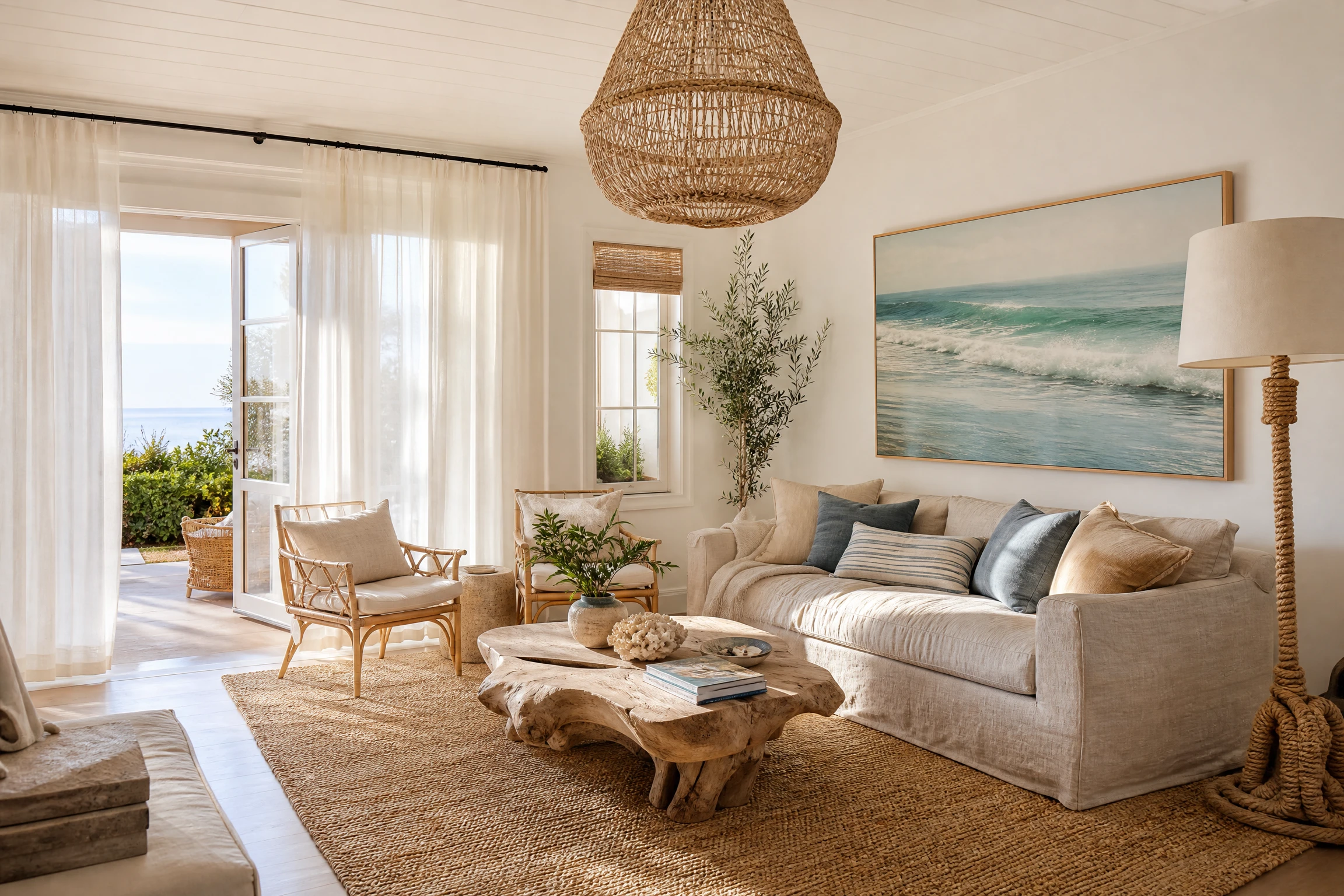
There is something about the right light fixture in a coastal room that clicks everything into place. You can have the linen curtains, the whitewashed furniture, the jute rug, and all the right textures, but without lighting that actually fits the story you are telling, the room can still feel a little flat. Coastal lighting is not really about buying a fixture shaped like a starfish. It is about understanding how light behaves in beach-inspired spaces, how natural materials carry warmth at different times of day, and how the glow from a well-chosen pendant or sconce can make a room feel genuinely relaxed rather than just decorated.
This article covers 24 coastal lighting ideas organized by style direction, from modern coastal and relaxed beach house vibes to organic natural looks, nautical-inspired fixtures, and outdoor living ideas. Each idea comes from a real understanding of how these rooms are put together in practice, what works, what tends to disappoint, and how to make the most of your budget. Whether you are renovating a seaside cottage, updating a landlocked home with coastal style, or just swapping out one or two fixtures to freshen things up, you will find specific, actionable ideas here that you can actually use.
Modern Coastal: Clean Lines, Breezy Finishes
1. Brushed Brass Pendants Over a Kitchen Island
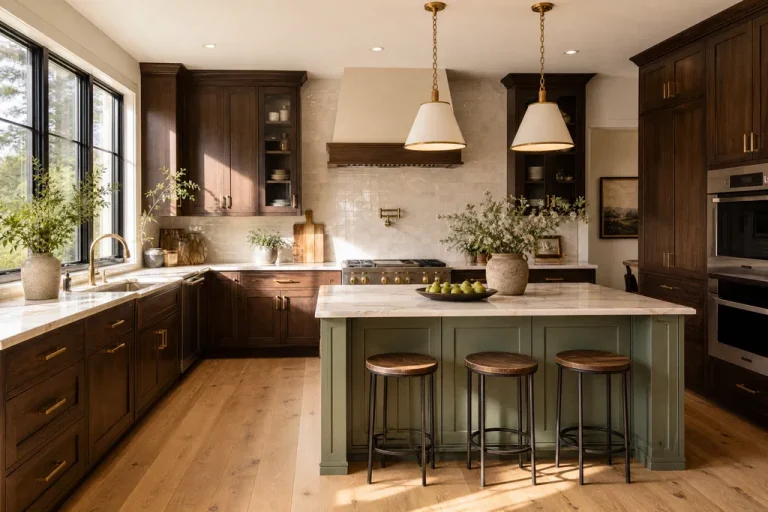
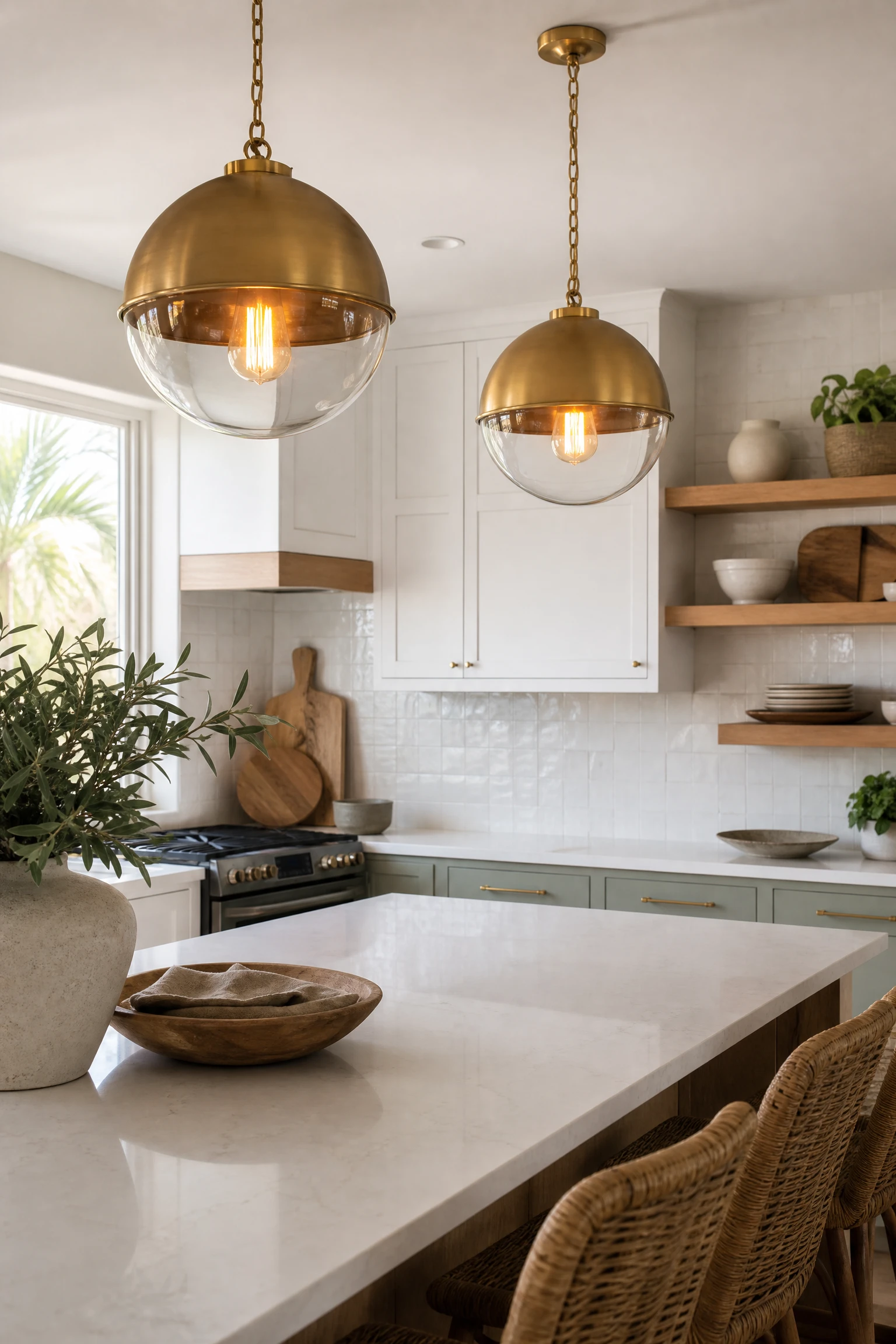
Modern coastal kitchens often walk a fine line between crisp and warm, and brushed brass pendants are one of the most reliable ways to get that balance right. Hang two or three simple globe-style pendants with a warm Edison bulb or a soft warm-white LED over a white or light grey quartz island, and the brass pulls out just enough gold to keep the space from feeling cold. The key is to choose brushed over polished brass, because the matte finish reads as more relaxed and less formal, which is exactly the energy a coastal kitchen should have. Pair with white Shaker-style cabinetry, a pale blue or sage green accent cabinet on the lower run, and open shelving in light oak for a layered, collected look. In practice, this combination works especially well when the backsplash tile has a handmade, slightly irregular texture, like a zellige or a soft ripple subway tile, because it adds the kind of organic imperfection that coastal spaces thrive on. Budget note: Brushed brass globe pendants are widely available at mid-range price points, and even affordable versions from big-box stores can look considered when hung at the right height, roughly 30 to 36 inches above the countertop.
Designer Advice: Always install pendants on a dimmer. A coastal kitchen feels completely different at 8am versus 8pm, and having control over the light level is what lets one fixture do double duty.
2. Matte White Flush Mounts for Low-Ceiling Beach Cottages
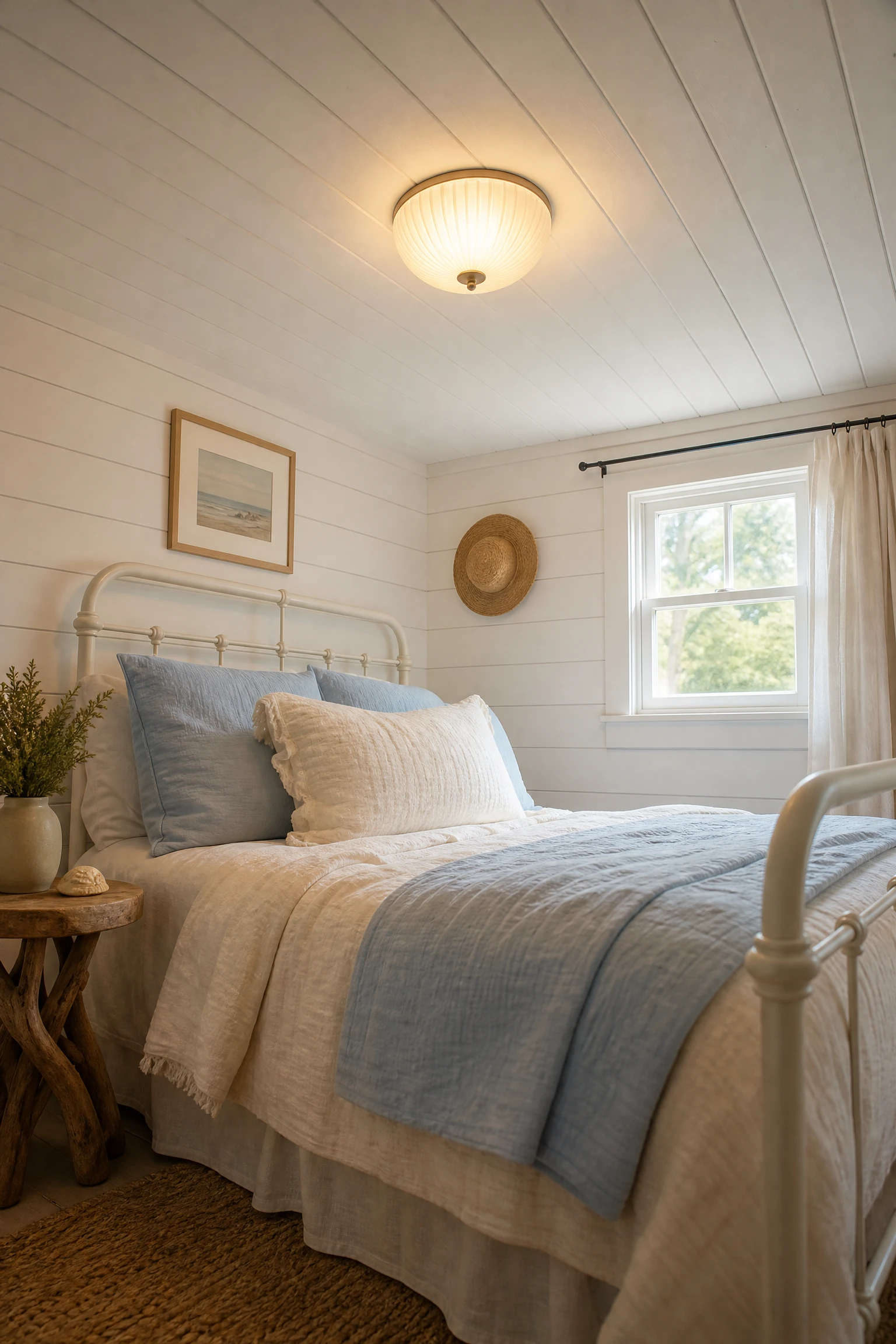
Not every coastal home has the ceiling height to pull off a pendant or chandelier, and this is something a lot of design articles gloss over. If you are working with ceilings under nine feet, a well-chosen flush mount is not a compromise. It is actually the smarter choice. Look for flush mounts with a slightly sculptural silhouette, like a fluted glass dome, a woven rattan disc, or a ridged linen shade, rather than a plain builder-grade fixture. Matte white or soft off-white finishes work best in beach cottage settings because they blend with the ceiling and let the fixture’s shape do the work rather than the colour. A fluted white glass flush mount in a small hallway or bedroom creates a subtle nod to sea glass without being literal about it. Pair with walls in a soft warm white like Benjamin Moore White Dove or Sherwin-Williams Alabaster, and keep the trim white and clean for a result that feels polished but not overdone. This approach is genuinely budget-friendly, as good-looking flush mounts in this style are available for well under $100.
Designer Advice: In rooms with low ceilings, resist the urge to go too small with the fixture. A slightly larger flush mount reads as intentional, while a tiny one just disappears.
3. Slim Linear Chandelier Over the Dining Table
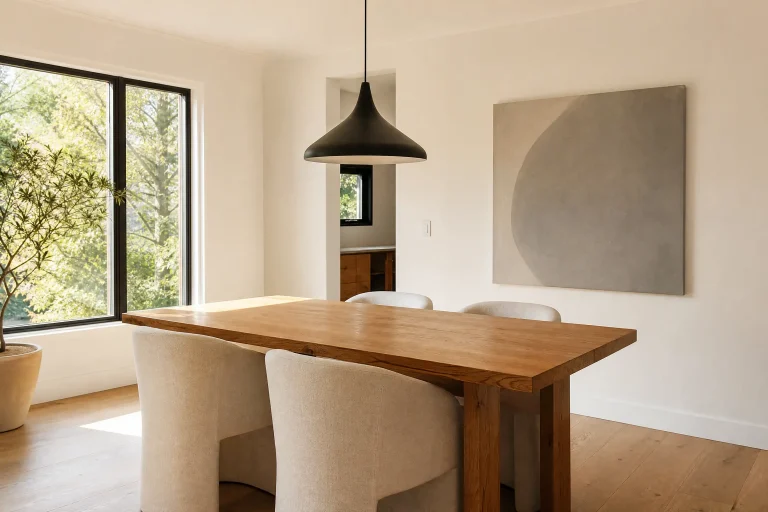
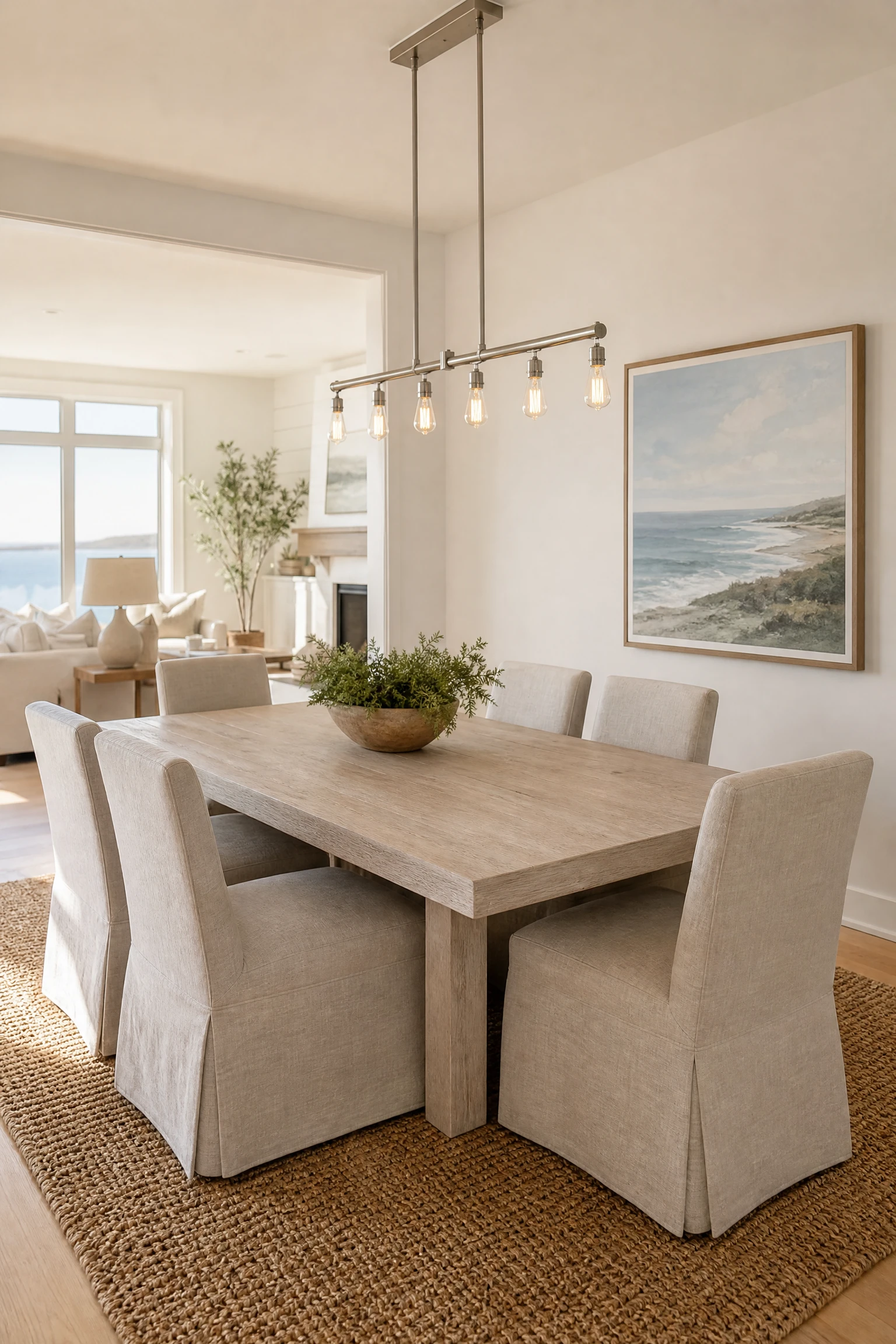
A slim linear chandelier is one of the best moves you can make in a modern coastal dining room, especially over a rectangular table in an open-plan space. The horizontal form mirrors the horizon line, which sounds like interior design theory but actually plays out in a really satisfying way in practice. Look for a linear fixture in warm black, aged bronze, or brushed nickel with exposed Edison bulbs or linen shades at each socket point, and hang it so the bottom of the fixture sits around 30 to 34 inches above the tabletop. Keep the surrounding palette simple: a dining table in light oak or whitewashed wood, chairs in natural linen or woven seagrass, and a woven jute or sisal rug underneath. The linear chandelier becomes the visual anchor for the whole space without competing with the textural story happening at floor level. One honest limitation here is that linear chandeliers work best when the table length is within about 12 inches of the fixture length on each side, so measure before you buy.
Designer Advice: If your dining area sits within an open-plan living space, choose a chandelier finish that echoes one other metal in the room, such as a cabinet pull or a side table leg, to tie the zones together visually.
4. Frosted Glass Wall Sconces in the Coastal Bathroom
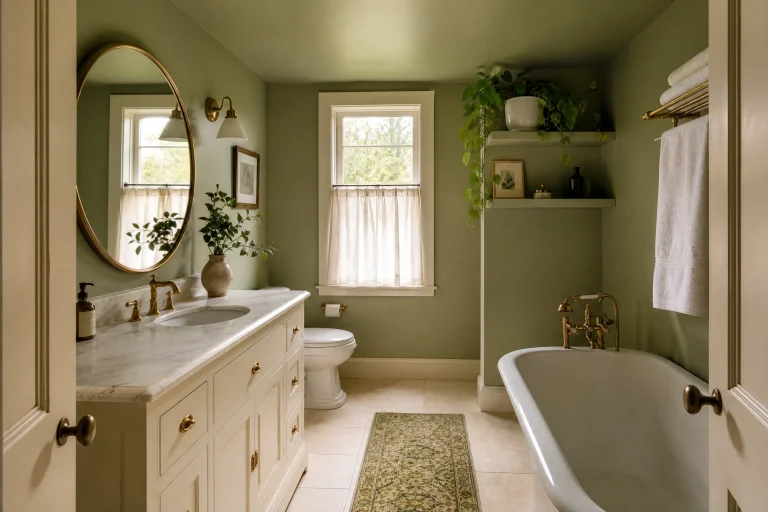
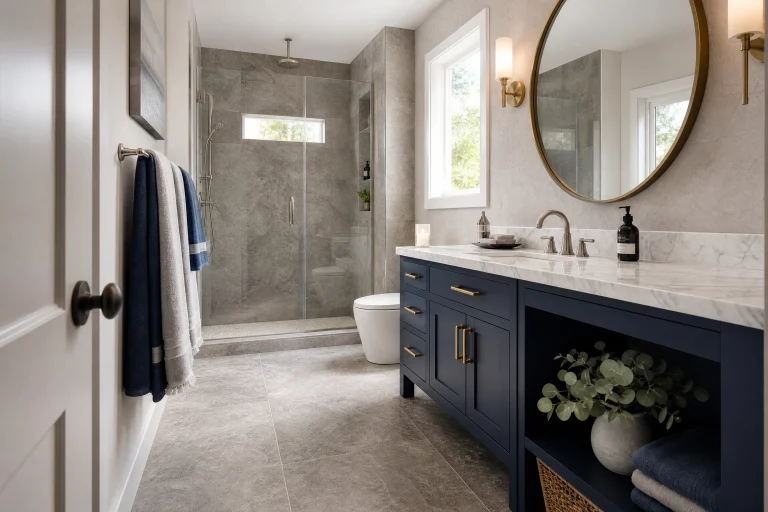
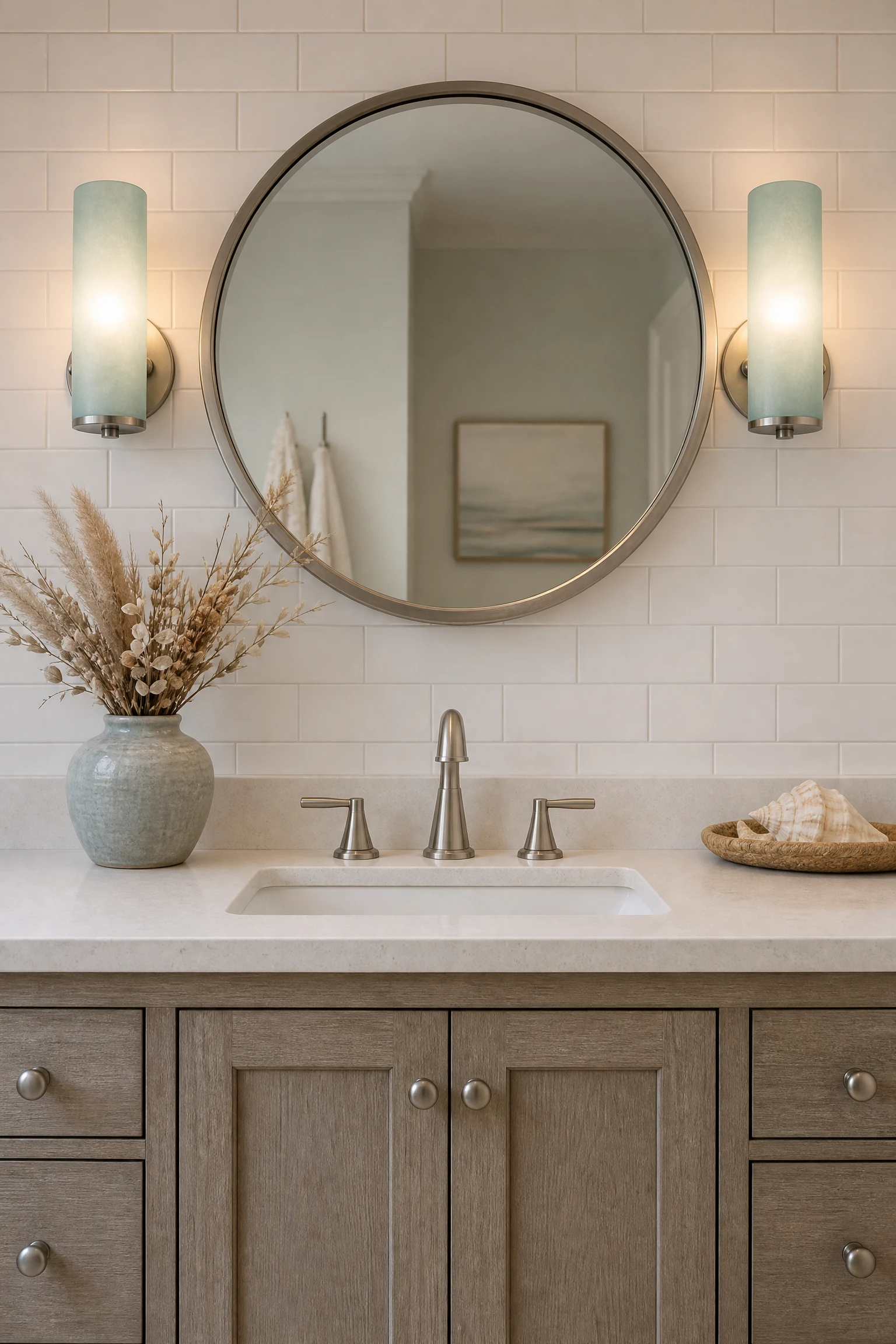
Bathroom lighting in a coastal home is one of those details that is easy to get wrong. Go too nautical and it tips into themed territory; go too minimal and the space loses its personality. Frosted or sea-glass-toned glass wall sconces flanking the vanity mirror hit the right note because they deliver even, flattering light while quietly referencing the colour palette of the ocean without being obvious about it. Look for sconces with soft sage green, pale aqua, or clear frosted glass shades in a simple cylindrical or slightly globe-shaped form, and mount them at eye level, roughly 60 to 65 inches from the floor to the centre of the fixture. Pair with a warm brushed nickel or antique brass faucet and hardware, a white vessel or undermount sink, and a vanity in a muted driftwood or navy finish. The glass sconce bounces light softly across the face, which is flattering and practical. In humid bathrooms, check that the fixture has a suitable damp rating before purchasing.
Designer Advice: Use a warm-white bulb (around 2700K to 3000K) in bathroom sconces rather than a cool white. Cool white makes skin tones look washed out and ruins the warm coastal atmosphere you have worked hard to build.
Relaxed Beach House: Warm, Worn, and Wonderfully Lived-In
5. Rope-Wrapped Floor Lamp in the Living Room Reading Corner
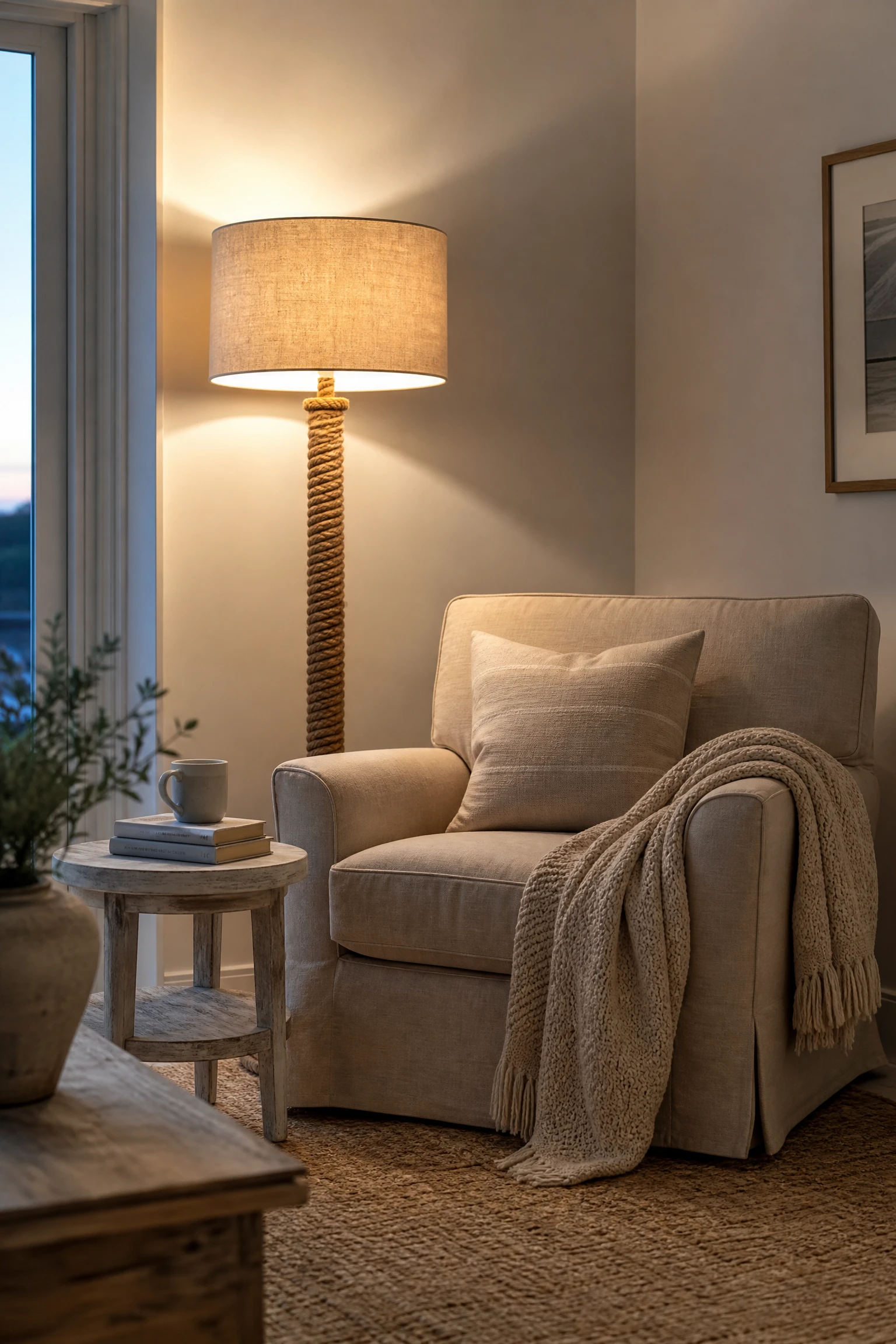
A rope-wrapped floor lamp is one of those pieces that earns its place in a beach house living room immediately. The natural fiber brings tactile warmth to the corner, the tall silhouette draws the eye upward without taking up floor space, and the diffused glow from a linen or paper shade is exactly the kind of soft, indirect light that makes a room feel genuinely cosy rather than just bright. Position it next to a wide armchair in a sandy linen or faded stripe fabric, add a small side table in light driftwood or whitewashed oak, and layer a chunky cotton throw over the arm of the chair. This setup is affordable and flexible. Because a floor lamp plugs in rather than hardwires, you can move it easily as the space evolves, which is a practical bonus in a rental property or a room where you are still figuring out the layout. One thing to be aware of is that rope fibers can pick up humidity over time in rooms near the ocean, so look for sealed or resin-coated rope finishes if you are near the coast.
Designer Advice: Place the floor lamp slightly behind and to the side of the chair rather than directly beside it. This creates a more natural pool of light and looks more intentional from across the room.
6. Driftwood Table Lamps on Nightstands
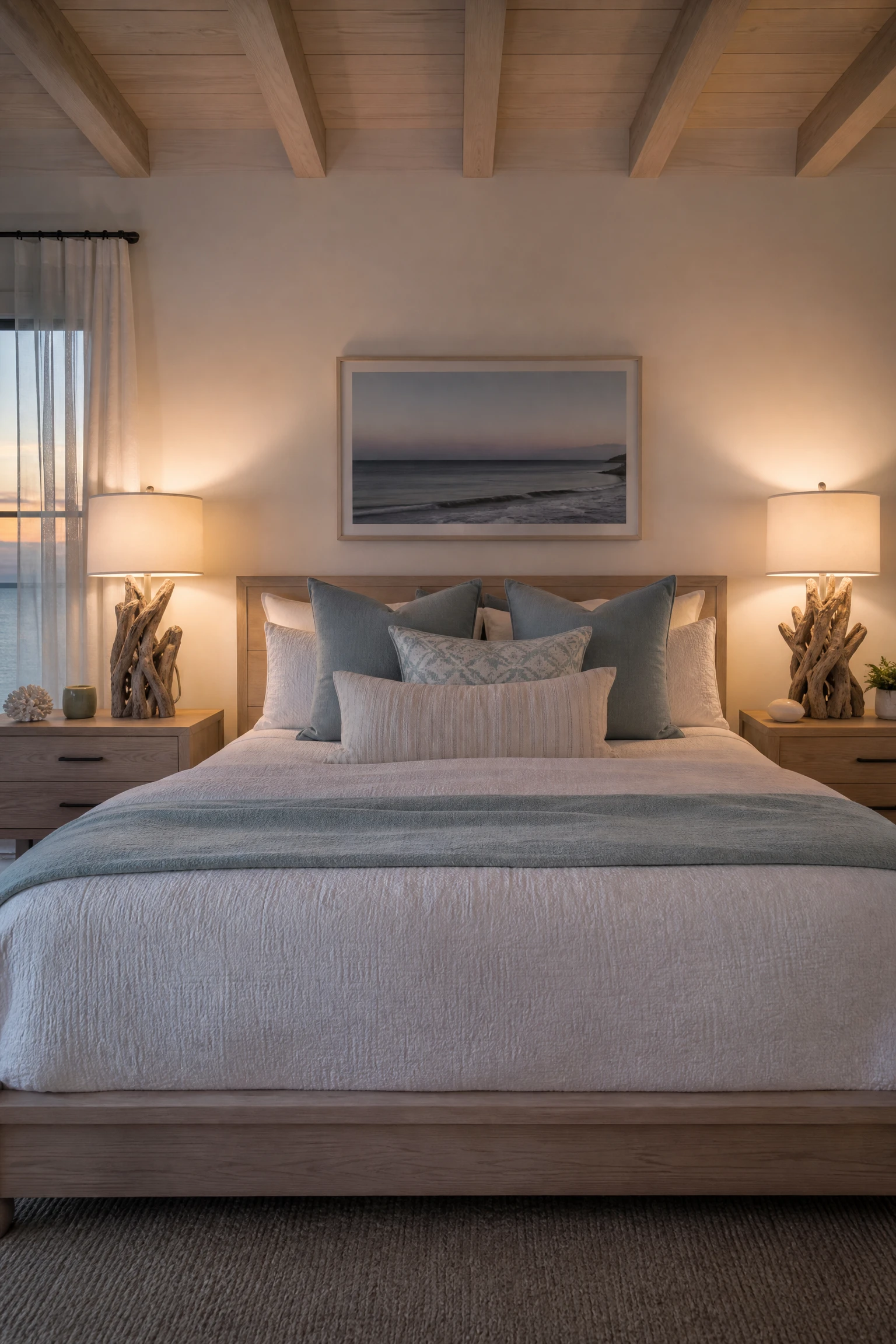
Driftwood table lamps are one of the most satisfying things to add to a coastal bedroom, because each piece of driftwood is genuinely unique and brings a sculptural quality that mass-produced ceramics rarely achieve. The irregular, weathered form of the base grounds the lamp in the natural world, and when paired with a simple white or natural linen drum shade, the overall effect is effortlessly relaxed. In practice, look for lamps where the driftwood base has been properly sealed and stabilized, because unsecured pieces can shift over time. Place matching lamps on each nightstand for a symmetrical look, or deliberately mismatch them for a more collected, organic feel. Keep the surrounding palette simple: white cotton bedding with a textured waffle or matelasse weave, pillows in soft blue and sandy cream, and a light-toned wood bed frame. These lamps tend to sit at a mid-range to investment price point depending on the size and quality of the driftwood, but they are pieces that hold up visually over time.
Designer Advice: Driftwood bases work best with a shade that is proportionally wider than you might expect. A shade that is too narrow makes the sculptural base look awkward, so err slightly on the larger side.
7. Woven Seagrass Pendant in the Breakfast Nook
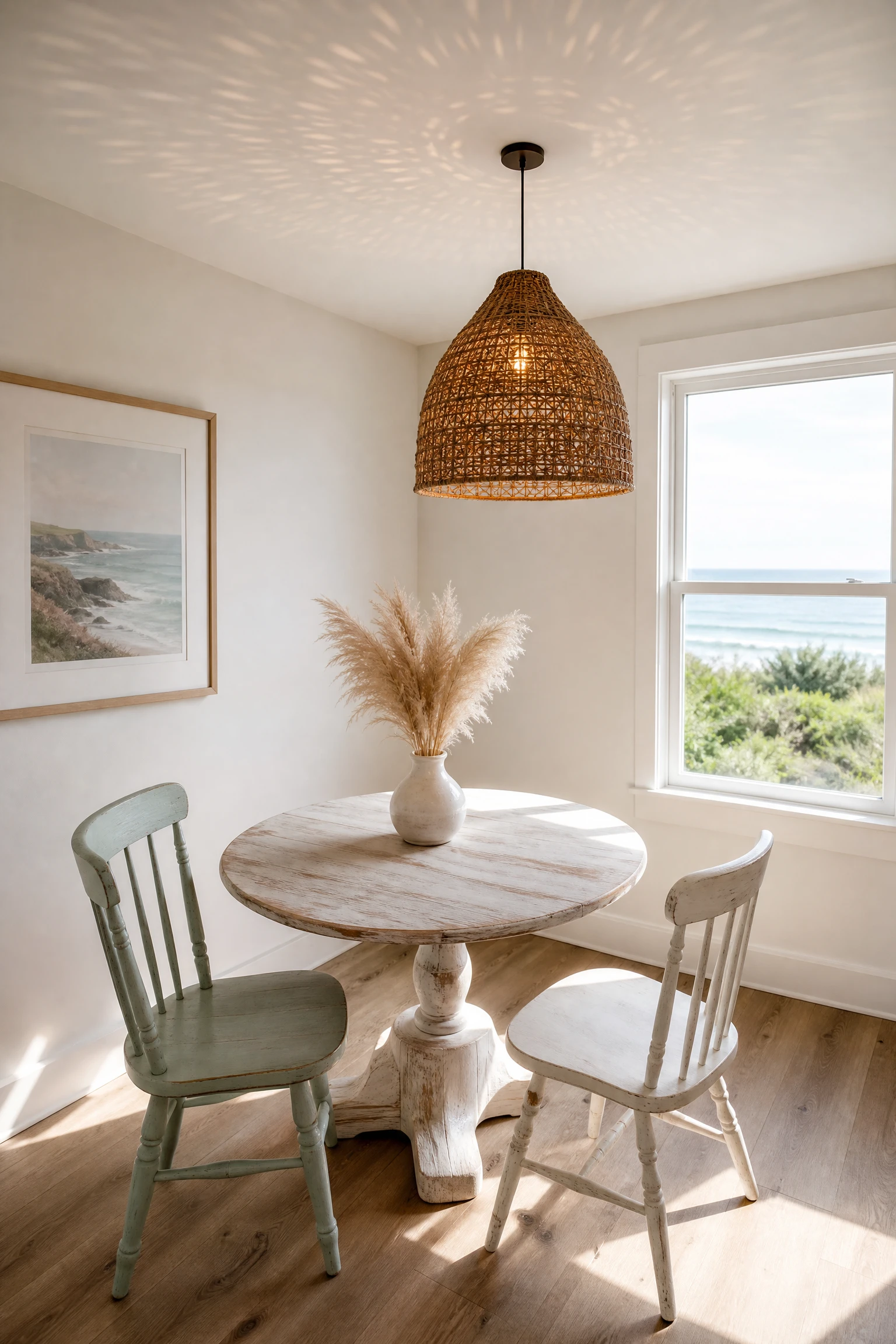
A seagrass pendant hanging over a small breakfast table or window nook is one of the most charming details in a relaxed beach house, and it is a surprisingly affordable one to pull off. The tightly woven natural fiber casts a gorgeous dappled shadow pattern on the ceiling and walls when lit from inside, which adds a layer of warmth and movement that no other fixture quite replicates. Look for a pendant with a tightly woven body and an open bottom so the light spills down onto the table, and hang it roughly 28 to 32 inches above the tabletop for optimal task and ambient light balance. Pair the nook with a round table in whitewashed wood, a pair of mismatched chairs in painted wood or wicker, and a small vase of dried pampas grass or sea oats as a low centerpiece. The seagrass pendant will reward you with texture, warmth, and shadow detail at a fraction of the cost of a rattan or bamboo alternative.
Designer Advice: Seagrass pendants collect dust in the woven fibers. A quick pass with a soft brush attachment on a vacuum every few weeks keeps them looking fresh and bright.
8. Lantern-Style Pendant in the Beach House Entryway
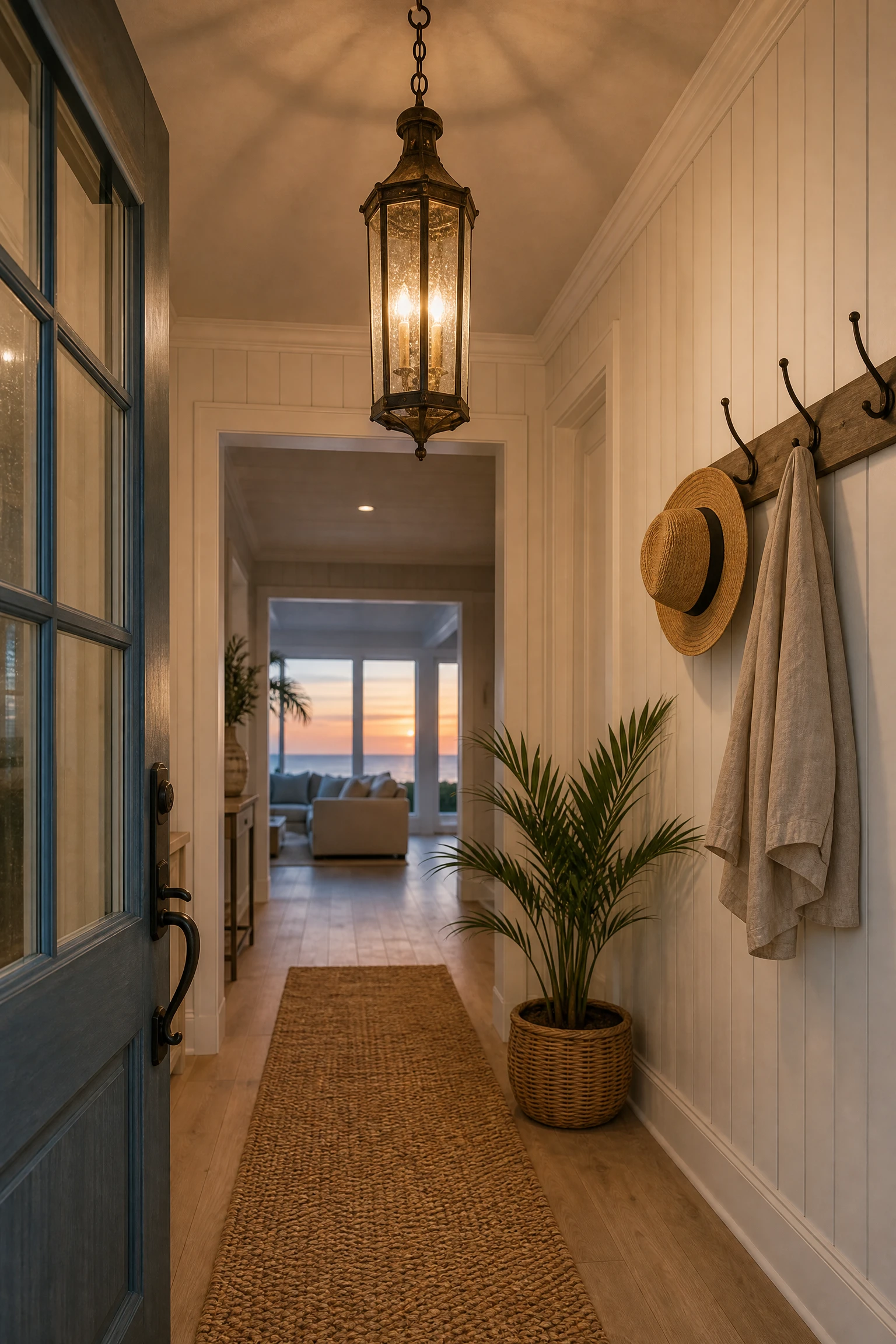
The entryway of a beach house sets the tone for everything that follows, and a lantern-style pendant does this better than almost any other fixture type in this context. The lantern shape reads as coastal and classic without being aggressively nautical, and it works equally well in cottages, bungalows, and more open modern beach homes depending on the material you choose. In a relaxed beach house, look for a lantern in weathered iron, aged bronze, or a painted matte black finish with clear seeded glass panels, which cast a warm, slightly textured glow onto the surrounding walls. Hang it low enough to be a statement piece, roughly 7 feet from the floor to the bottom of the fixture in a standard-height entryway, and pair with a ship-lap or beadboard wall treatment in white, a natural fiber runner on the floor, and a simple wooden coat rack or bench below. This approach works at all budget levels, as lantern pendants are available from very affordable price points through to artisan-made investment pieces.
Designer Advice: In a narrow entryway, choose a lantern that is taller and slimmer rather than wide and round. A tall lantern draws the eye upward and makes the ceiling feel higher.
9. Vintage-Style Schoolhouse Sconces in the Beach House Hallway
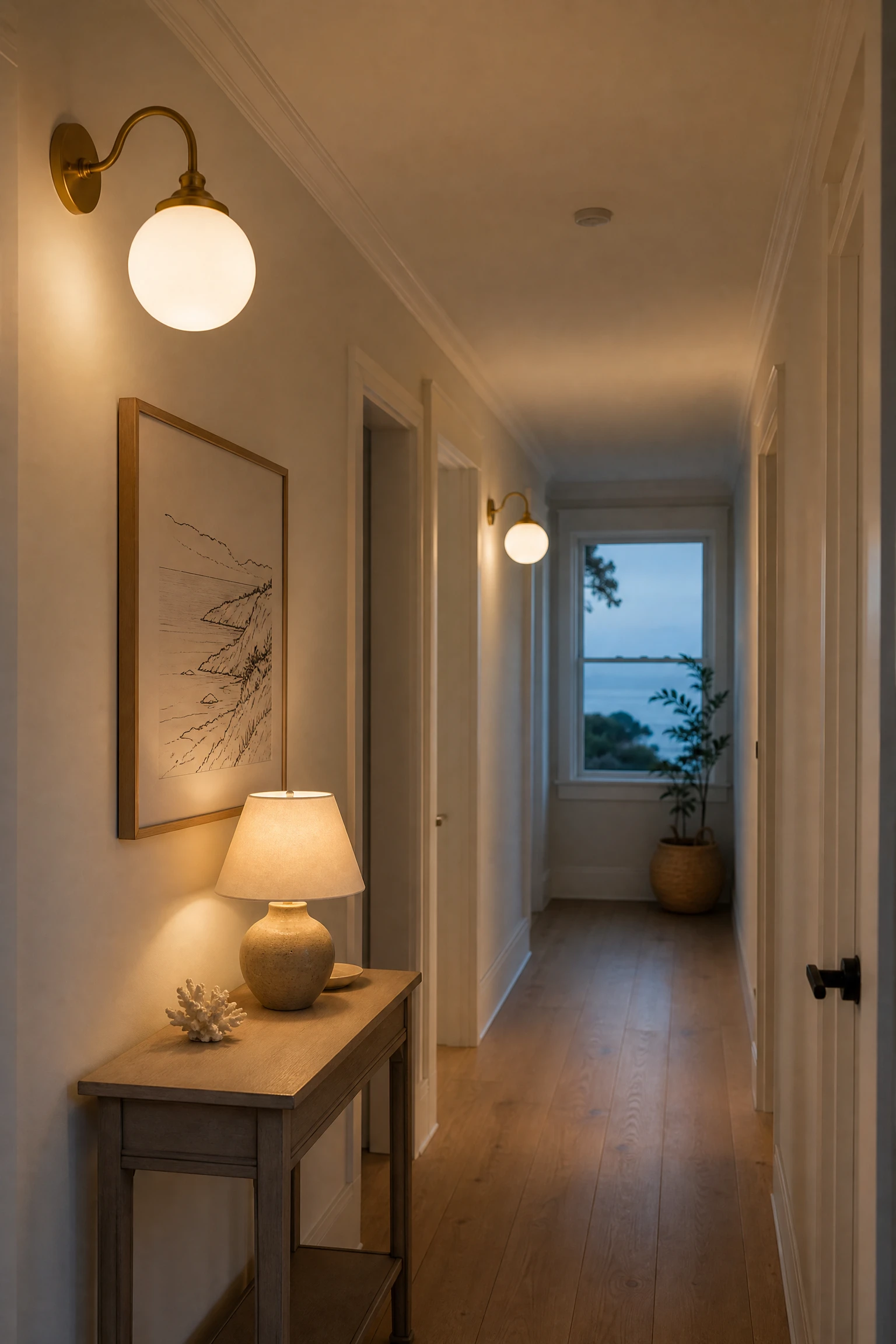
Schoolhouse sconces have been having a long and well-deserved moment in coastal interiors because they manage to feel both vintage and fresh at the same time. The simple milk glass globe on a wall-mounted arm brings a handsome, unpretentious quality to a beach house hallway that more elaborate fixtures sometimes lack. In a coastal context, look for versions in aged brass, unlacquered brass, or matte black, with a classic opal white or slightly amber-tinted glass globe that diffuses the light softly. Mount them at around 60 inches from the floor to the centre of the fixture along a hallway with white or soft cream walls, and space them about 6 feet apart for a rhythmic, welcoming effect. Add a narrow console table below one sconce with a small ceramic lamp in a sea-inspired glaze and a piece of coastal artwork above, and the whole hallway feels considered and complete. These sconces are available at very accessible price points and install quickly, making them one of the best-value upgrades in a coastal home.
Designer Advice: Unlacquered brass will naturally patina over time, developing a warmer, more aged look that actually suits beach house interiors beautifully. Embrace it rather than fighting it.
Organic and Natural: Texture, Form, and the Beauty of Raw Materials
10. Rattan Chandelier in the Coastal Living Room
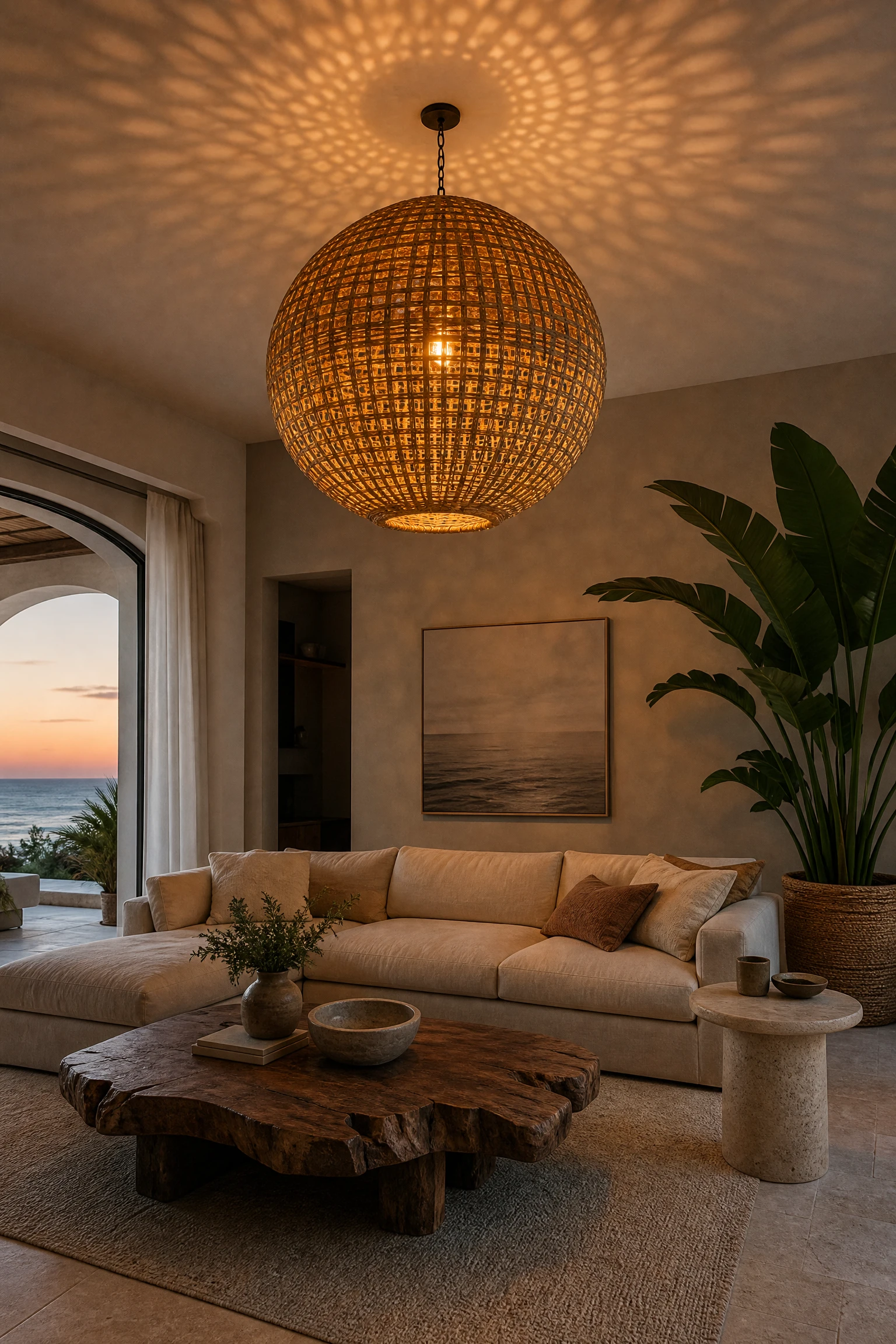
A rattan chandelier is one of those fixtures that photographs well and lives even better. In a coastal living room with a reasonably high ceiling, a large rattan globe or drum chandelier becomes the centrepiece of the whole space, casting warm, honeyed light through the woven gaps in the fiber and creating a subtle shadow pattern on the ceiling that shifts as the bulb flickers or dims. The visual weight of a rattan fixture is surprisingly light compared to a metal or glass chandelier of the same size, which makes it a good choice for rooms where you want presence without heaviness. Pair with a low-slung sofa in natural linen or washed cotton, a coffee table in live-edge wood or travertine stone, and walls in a warm greige or pale terracotta for a Coastal Grandmother-meets-Japandi atmosphere that feels thoroughly current. Rattan is a natural material and can be sensitive to humidity, so very humid coastal environments may cause slight warping or cracking over time. For beach houses close to the water, look for rattan pieces treated with a moisture-resistant sealant.
Designer Advice: Use a warm filament-style LED bulb inside a rattan chandelier. The warm glow shows through the weave beautifully, while a cool white bulb makes the whole thing look clinical.
11. Capiz Shell Chandelier for Soft, Luminous Dining Rooms
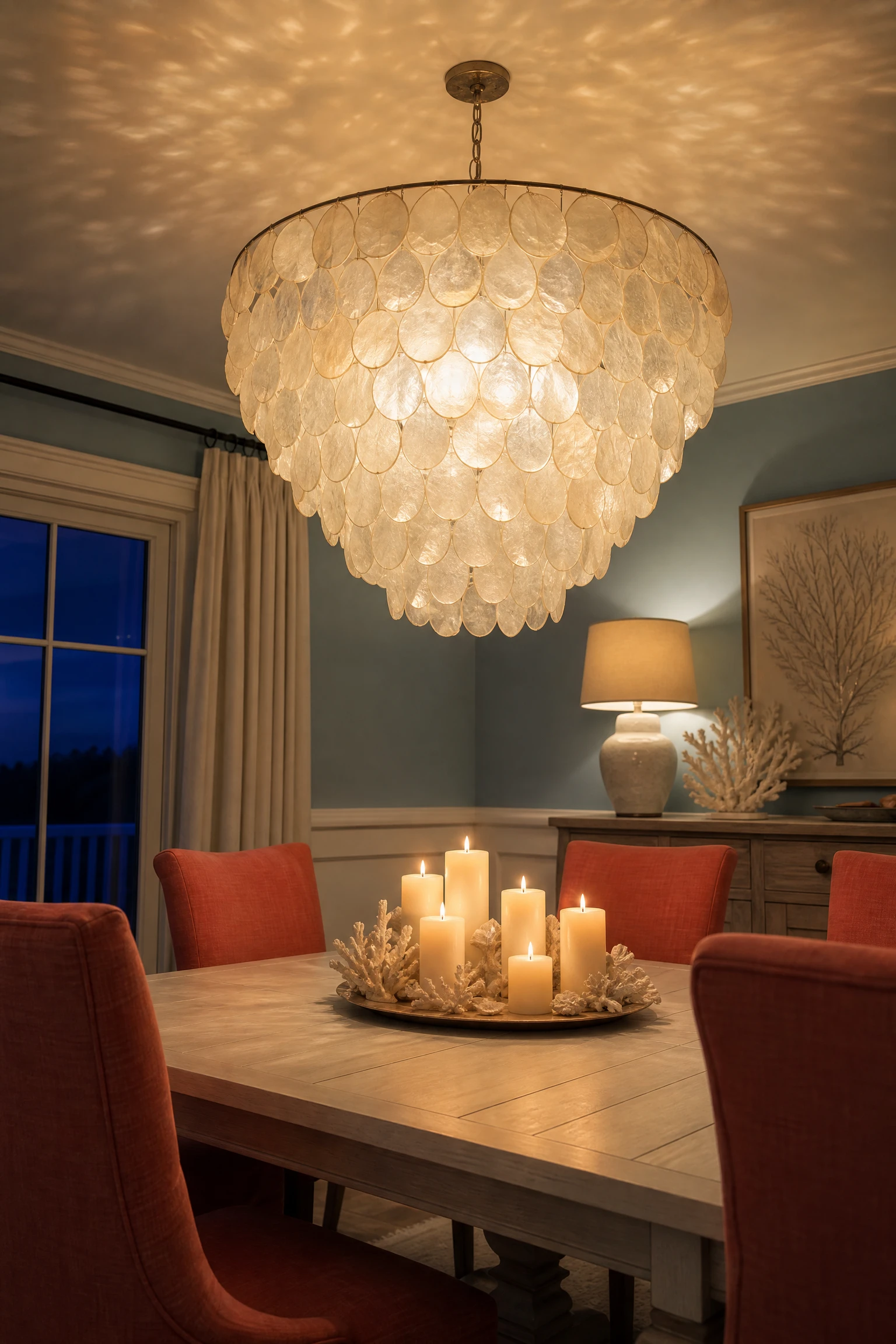
If you have never seen a capiz shell chandelier in person, the first time is genuinely impressive. The thin, translucent shells overlap like fish scales and catch light in a way that is unlike any other material, producing a soft, opalescent shimmer that bounces across the ceiling and walls. In a coastal dining room, a capiz chandelier directly over the table creates a genuinely special atmosphere for evening meals, with a warm, romantic glow that still reads as relaxed rather than formal. Pair with a dining table in washed or painted white wood, chairs upholstered in a soft blue or coral linen, and candles or simple bud vases on the table to add layers of light at different heights. The capiz chandelier is an investment piece, with good quality versions sitting at a higher price point, but it is also a fixture that tends to age well and become more beautiful over time as the shells develop a slightly warmer patina. One practical note: capiz shells are delicate and should not be cleaned with water, so a very gentle dry dusting is all they need.
Designer Advice: Hang a capiz chandelier slightly lower than you would a standard fixture over the dining table. The extra visual closeness draws attention to the beautiful texture of the shells and makes the glow feel more intimate.
12. Bamboo Arc Floor Lamp in the Reading Corner
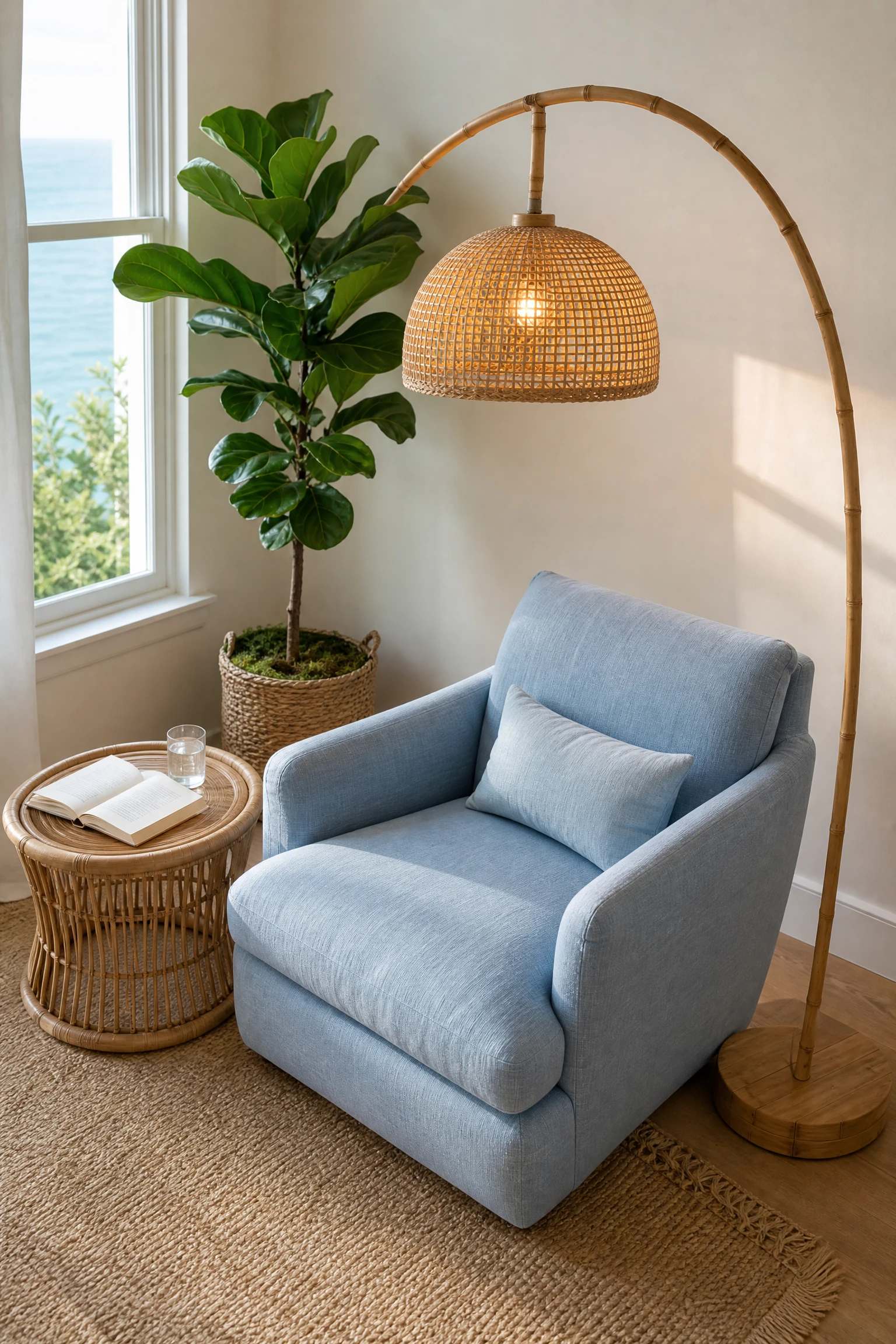
An arc floor lamp in bamboo or wrapped in a bamboo or wicker finish is one of the most practical and visually interesting additions you can make to a coastal living room that also doubles as a reading space. The arching form allows the light source to hang directly over a chair or sofa without being in the way, delivering focused task lighting where it is needed while the organic material keeps the whole piece feeling coastal and grounded. Look for a lamp with an adjustable or rotating head so you can redirect the light, and choose a shade in natural linen, paper, or a woven bamboo material that diffuses the light warmly rather than casting a harsh circle on the page. Position it arching over a wide linen armchair in a corner with a small round side table in light rattan and a stack of coffee table books with coastal or nature themes. This is a mid-range to affordable fixture choice depending on the brand, and its portability means you can reconfigure the room whenever you need to.
Designer Advice: Choose an arc lamp with a weighted base. A lightweight base on a tall arc lamp is a real stability problem, especially in a home with pets or children.
13. Wabi-Sabi Ceramic Table Lamp with a Linen Shade
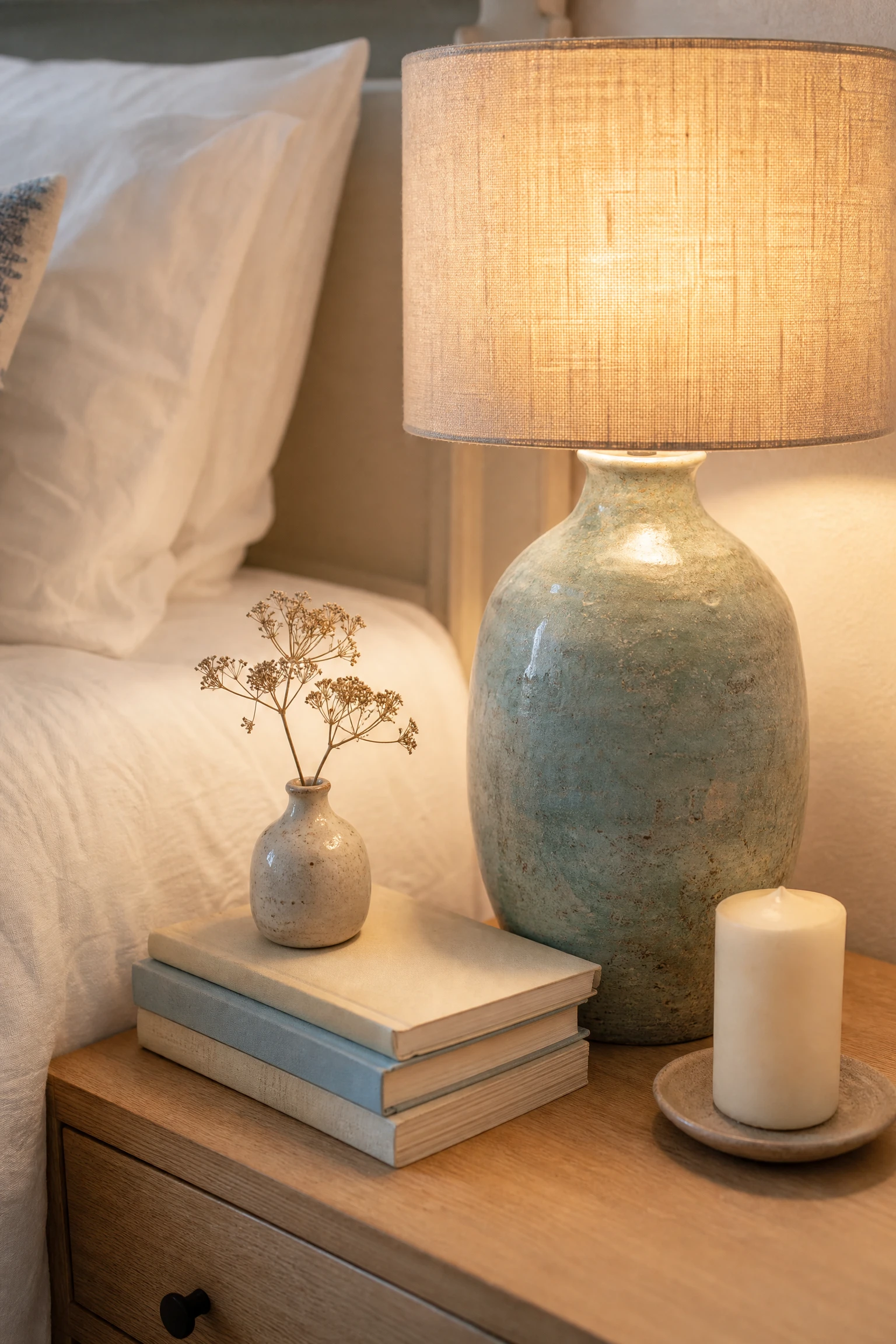
The wabi-sabi aesthetic, with its celebration of imperfection, natural form, and honest materials, fits coastal interiors so naturally that it sometimes feels like they were designed for each other. A handmade ceramic table lamp with an uneven glaze, a slightly irregular form, or a raw, unfinished base quality brings exactly this quality to a bedside table or console in a coastal room. Look for glazes in soft ocean tones like dusty aqua, warm sand, or muted sage, and pair the base with a simple natural linen drum shade that lets the character of the ceramic shine without competing with it. Place on a bedside table alongside a small stack of books, a sprig of dried botanicals in a simple bud vase, and a candle in a coastal-inspired scent for a bedside vignette that feels genuinely curated. These lamps are often handmade or small-batch produced, which pushes them into a higher price bracket, but the individual character of each piece justifies the cost for a room where those small details really matter.
Designer Advice: When shopping for ceramic lamps, look for ones where the glaze shows visible brush marks or pooling at the base. These are signs of a genuinely handmade piece rather than a machine-pressed imitation.
14. Sea Glass Mosaic Pendant for the Coastal Kitchen
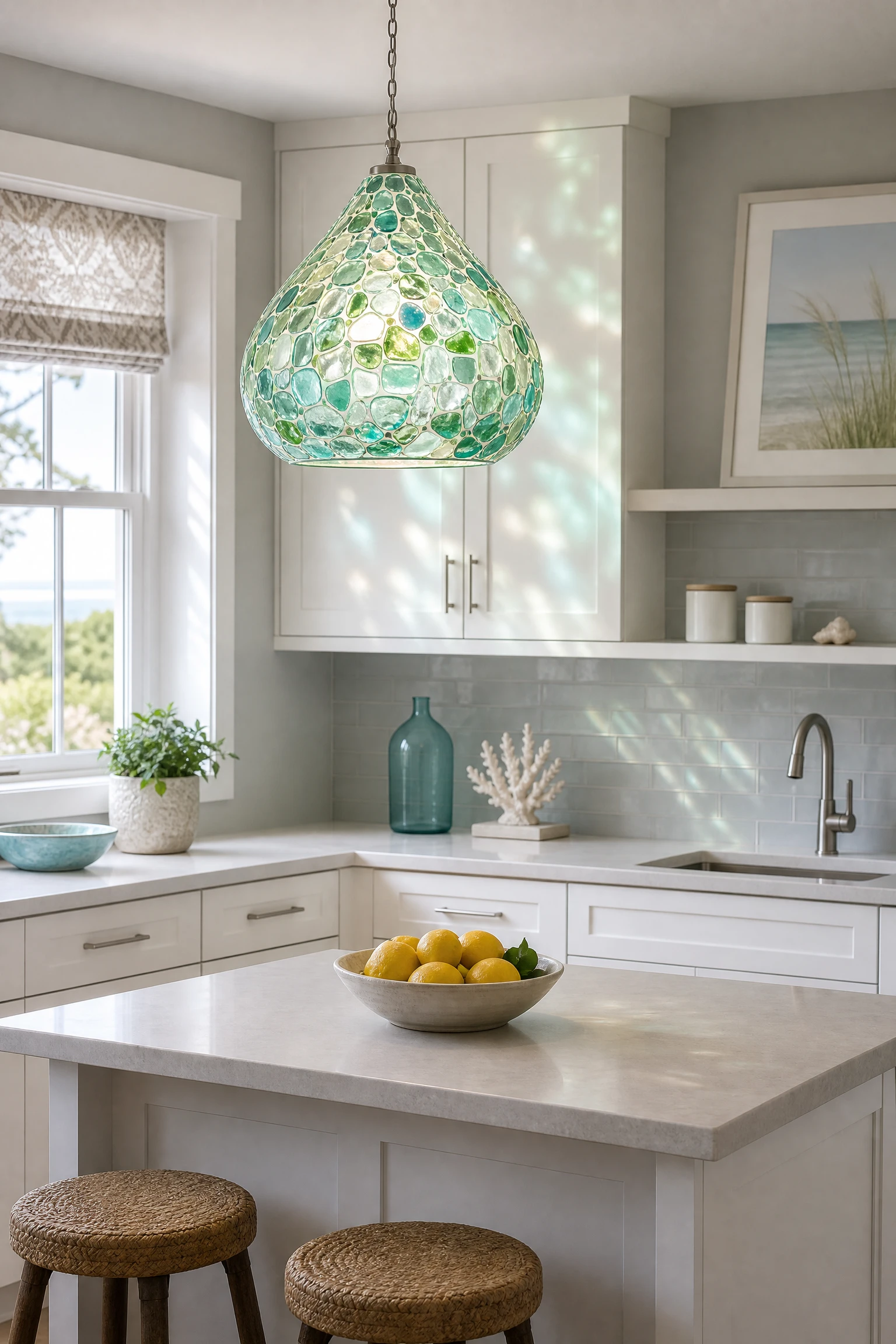
A sea glass mosaic pendant is a bold, characterful choice for a coastal kitchen, and when it is done well, it becomes one of those fixtures that guests immediately notice and comment on. The irregular pieces of coloured glass, usually in soft aqua, clear, pale green, and occasionally amber, are set into a metal frame and catch the light in dozens of different ways depending on the angle, producing a gentle kaleidoscopic effect on the surrounding surfaces. In a smaller coastal kitchen, a single oversized sea glass pendant over a modest island or peninsula makes a confident statement without needing to compete with anything else in the space. Keep the surrounding cabinetry and walls quiet, opting for white, soft grey, or a pale sage, so the pendant can hold the visual attention it deserves. This is typically an investment-level purchase, and the fragility of the glass panels means it is better suited to kitchens with normal humidity rather than those directly exposed to ocean spray.
Designer Advice: Pair a sea glass pendant with simple stainless steel or brushed nickel hardware elsewhere in the kitchen. Ornate hardware competes; simple hardware lets the pendant lead.
Nautical-Inspired: Maritime Motifs Done with Restraint
15. Porthole-Style Wall Sconces in the Bathroom or Hallway
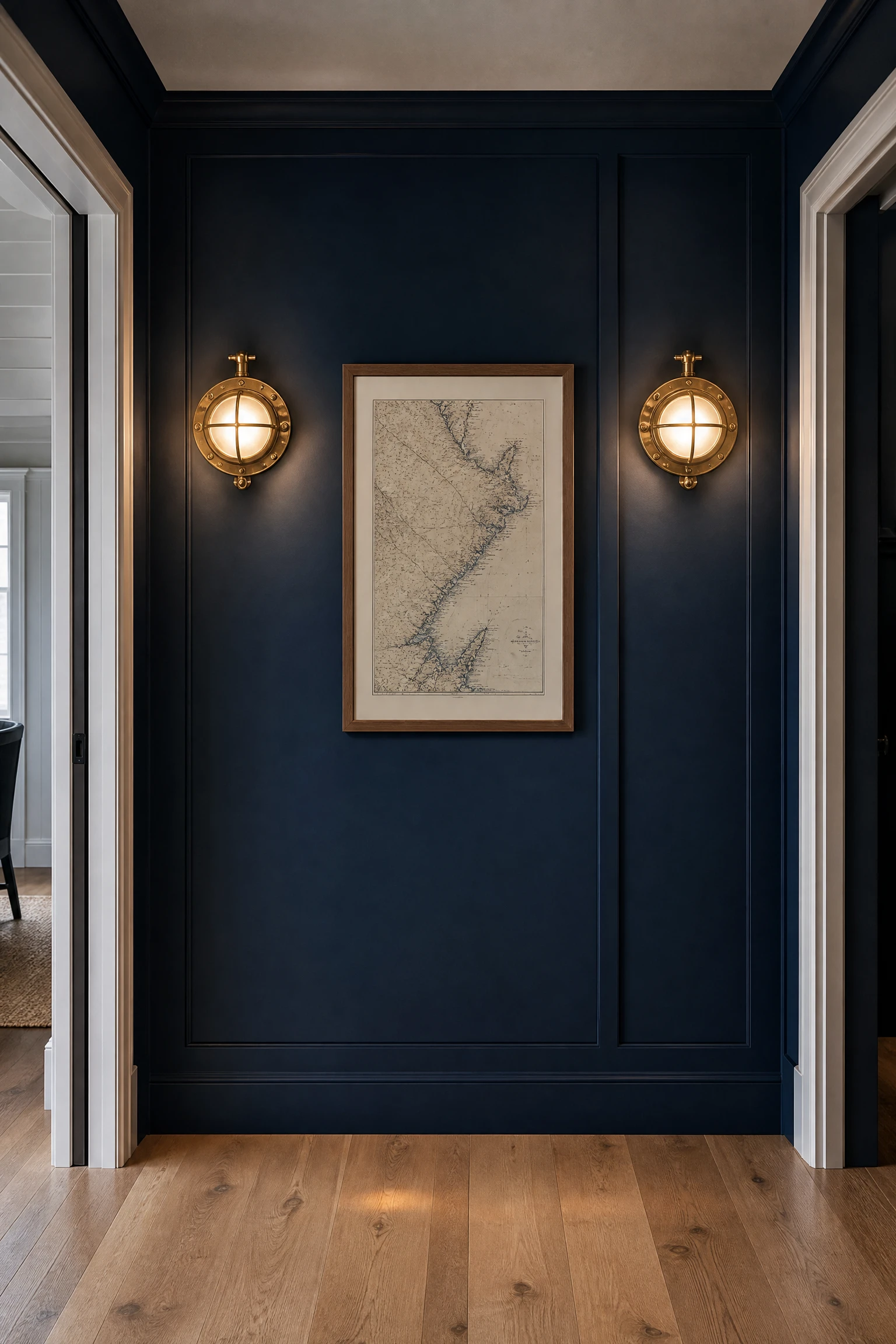
Porthole sconces are one of those nautical references that manage to feel specific and grounded rather than costume-y, especially when you choose versions in a clean, understated finish. A porthole sconce in aged brass or matte black with a frosted or clear glass lens reads as a knowing nod to maritime design rather than a heavy-handed theme, particularly when paired with simple, non-nautical surroundings. In a coastal hallway, mount a pair of porthole sconces at eye level on a wall painted in a deep navy or rich slate blue for a result that feels bold, characterful, and genuinely intentional. In a bathroom, they work particularly well above the vanity mirror or beside it, delivering direct, clear light that is flattering and functional. Keep the rest of the bathroom neutral so the porthole sconces carry the design direction on their own. These sconces are widely available at mid-range prices and have a timeless quality that means they will not look dated in a few years.
Designer Advice: Porthole sconces look strongest when the wall they sit on is a colour rather than white. A white wall flattens the fixture; a coloured wall shows off the circular silhouette properly.
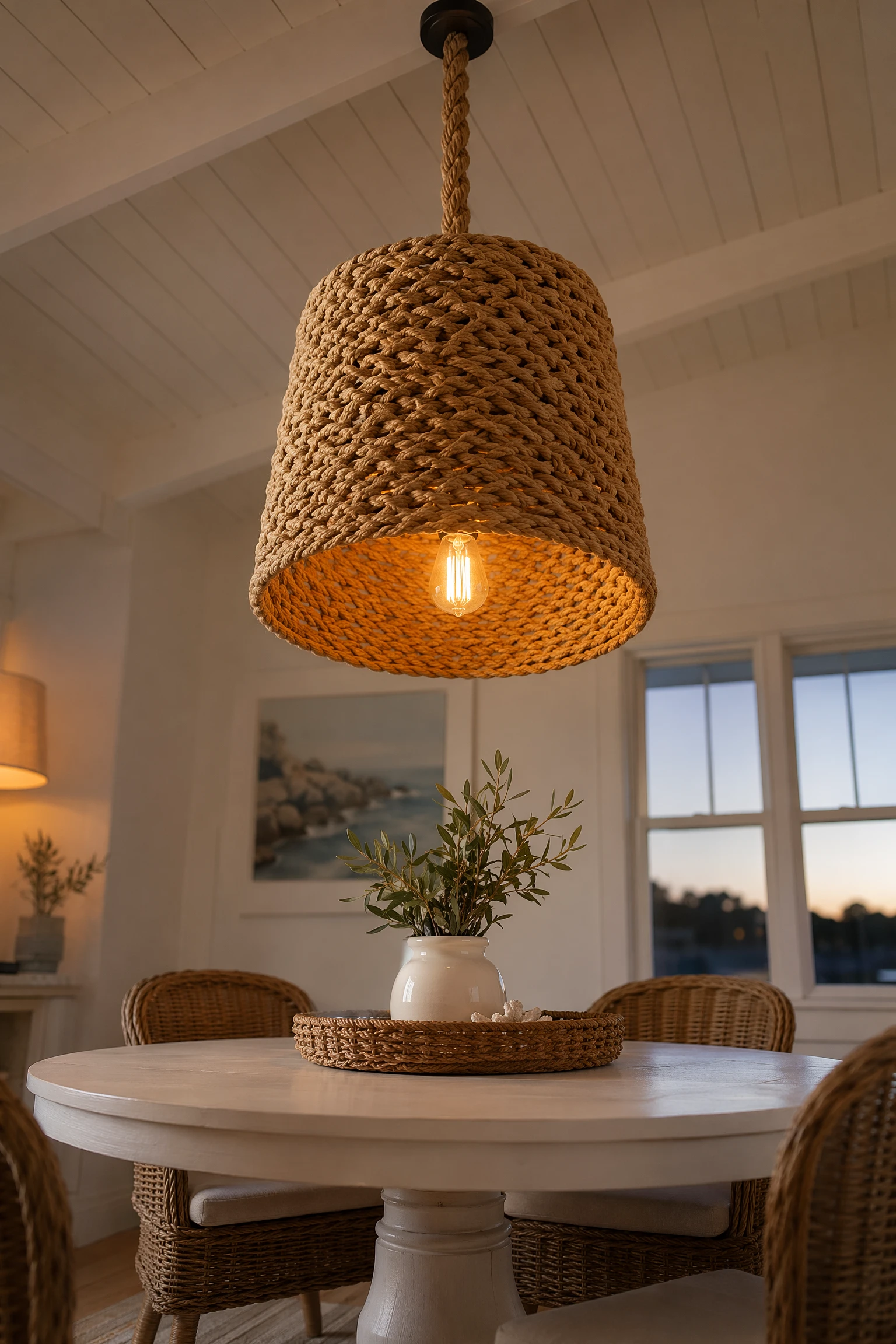
16. Rope-Knotted Pendant Over the Dining Table
A pendant light with a visible rope component, whether that is a rope-wrapped shade, a knotted rope cage, or a simple cord wrapped in braided cotton or jute, is one of the most direct ways to bring maritime craft into a coastal dining room without going overboard. The texture of the rope adds warmth and visual interest at ceiling height, and the hanging cord itself becomes part of the design rather than just a utility element. Look for pendants where the rope work is clean and intentional, with tight, even wrapping or confident, well-formed knots, rather than loose or uneven versions that can look messy rather than artisanal. Hang over a round or oval dining table in a room with white walls and light wood floors, and keep the rest of the furniture and accessories straightforward so the pendant has clear air to breathe. A rope pendant is typically a mid-range purchase, though handmade artisan versions will sit at a higher price point.
Designer Advice: Marine-grade rope finishes are worth seeking out if you live in a genuinely humid or salty-air environment. Standard rope can fray or mildew over time in these conditions.
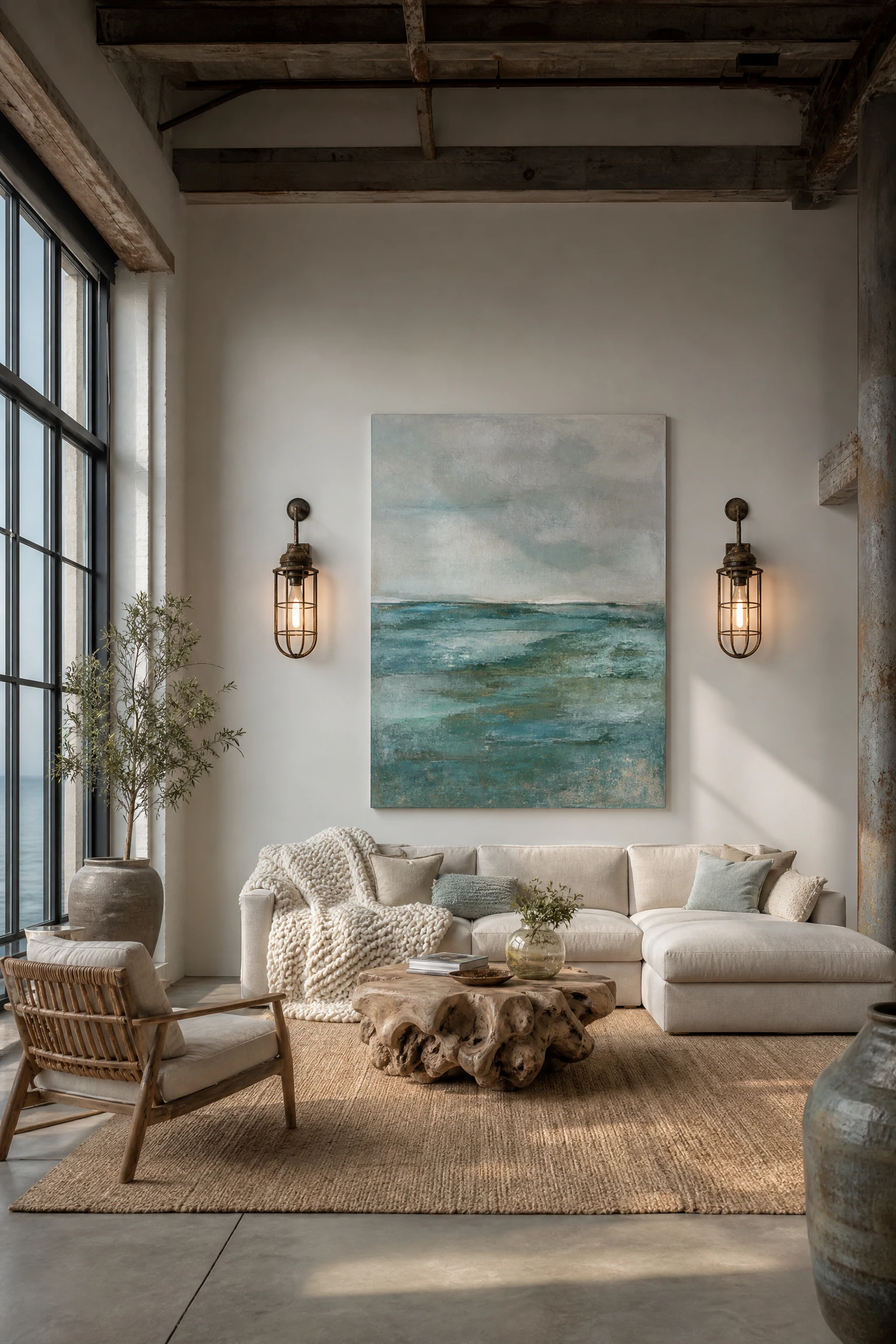
17. Caged Industrial Sconces in a Coastal Loft or Open-Plan Living Space
The intersection of industrial and coastal might not be the most obvious pairing, but in a loft-style or open-plan coastal home with high ceilings, raw concrete, or exposed structural elements, a caged industrial sconce in a weathered or dark metal finish creates a genuinely interesting tension with the softer coastal elements around it. Think of the look as a working harbour or a converted boathouse: stripped back, honest, and functional, but surrounded by natural light and water. Mount a pair of caged wall sconces in aged iron or dark bronze on either side of a large window or a statement piece of coastal artwork, and keep the bulbs visible with clear glass or open filament fixtures that reference the utilitarian look of dock lighting. Balance the rawness of the sconce with softer elements in the room: a chunky knit throw, linen upholstery, and a driftwood coffee table. This look works best in larger rooms where the scale of the fixture does not feel out of proportion.
Designer Advice: Use warm Edison-style bulbs in caged industrial sconces in coastal settings. Cool daylight bulbs push the space into feeling more warehouse than waterfront.
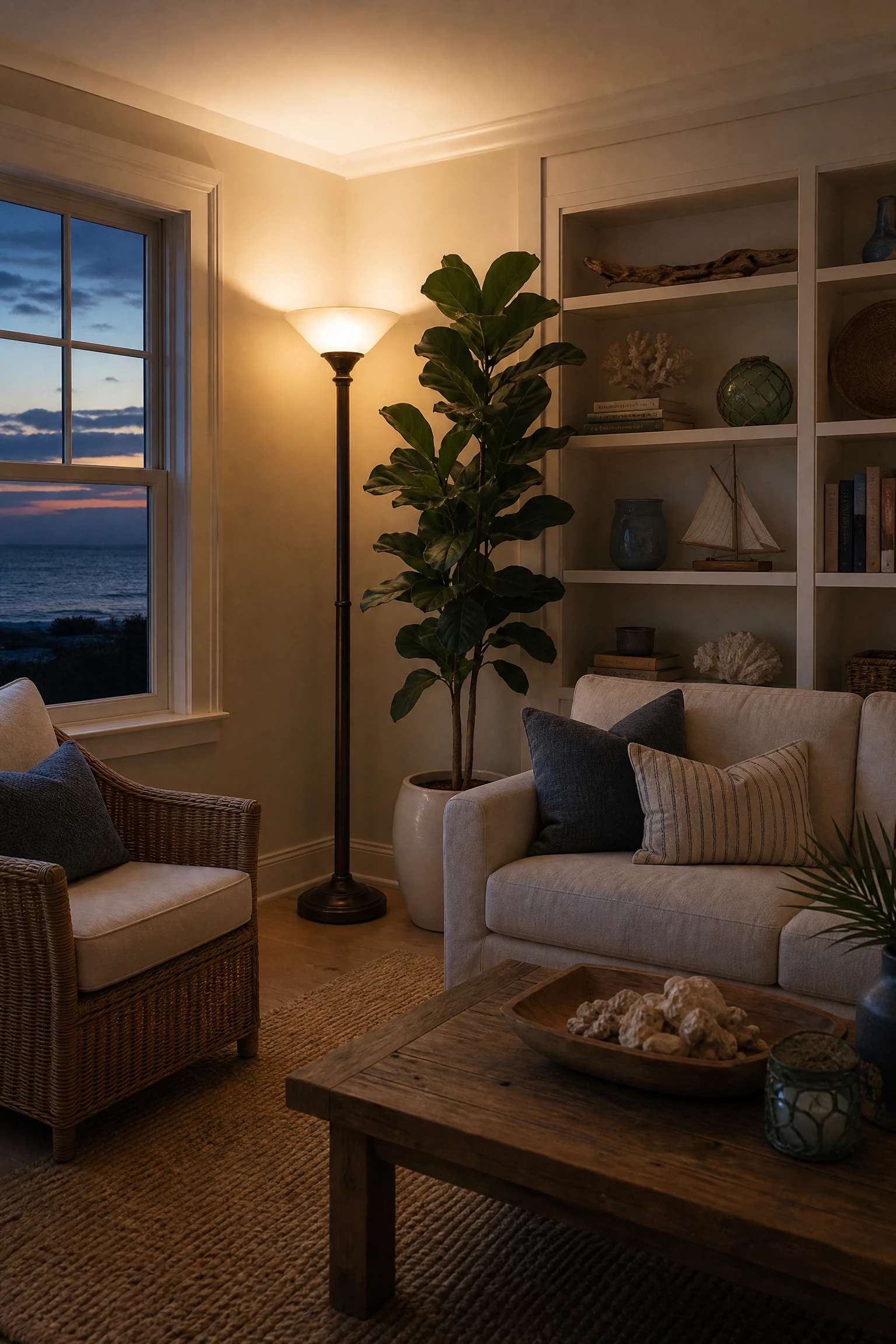
18. Mast-Inspired Torchiere Floor Lamp in the Living Room
A torchiere floor lamp with a slim, tall profile in a dark or weathered metal finish quietly references the silhouette of a ship’s mast without spelling it out, and in a nautical-leaning coastal living room, it adds exactly the kind of vertical interest that low-slung coastal furniture often needs. The upward-facing shade of a torchiere bounces light off the ceiling, which creates a soft, ambient glow that works particularly well in rooms where you want to read or have relaxed conversation without a harsh overhead fixture blasting down from above. Look for torchieres in dark bronze, aged iron, or matte black with a simple white or frosted glass bowl at the top, and position in a corner beside a bookshelf or a large indoor plant to anchor that zone of the room. This style is generally available at accessible price points and has a quiet, functional quality that suits coastal spaces well.
Designer Advice: A torchiere works hardest when the ceiling it bounces off is white or very pale. Dark ceilings absorb the upward light and reduce the effect significantly.
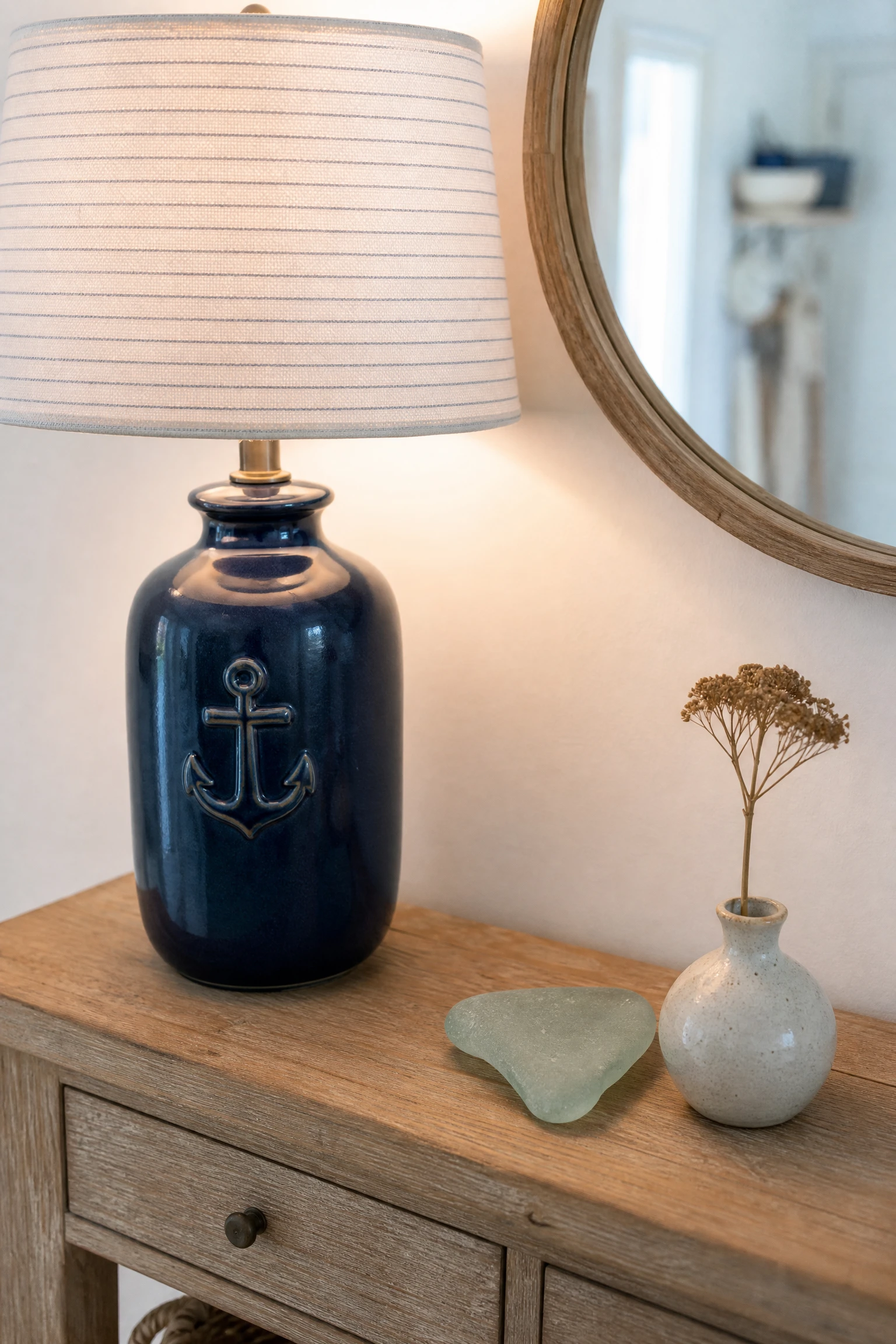
19. Anchor-Motif Table Lamp as a Subtle Nautical Accent
A table lamp with a subtle anchor motif pressed or cast into a ceramic or resin base is a way to bring a specific nautical reference into a room without committing to a themed look throughout. The key word here is subtle: a small, relief-carved or embossed anchor on an otherwise simple lamp base in navy, cream, or aged white reads as a knowing accent rather than a heavy anchor motif. Pair with a plain white or striped linen shade, keep the surrounding vignette simple with a few coastal objects like a piece of sea glass, a smooth stone, or a small piece of found coral, and let the lamp anchor the bedside or console table quietly. This kind of accent lamp is widely available at very affordable price points, making it a low-risk way to add a specific design note to a coastal room. Honest note: anchor motifs can tip into looking generic if the execution is not refined, so choose a lamp where the motif feels considered and well-proportioned rather than mass-stamped.
Designer Advice: Limit anchor motifs to one or two in a room. Any more and the nautical theme starts to overwhelm the space and crowd out the subtler coastal details you have worked to build.
Outdoor Coastal Living: Lighting for Porches, Patios, and Decks
20. String Lights Over the Coastal Patio or Deck
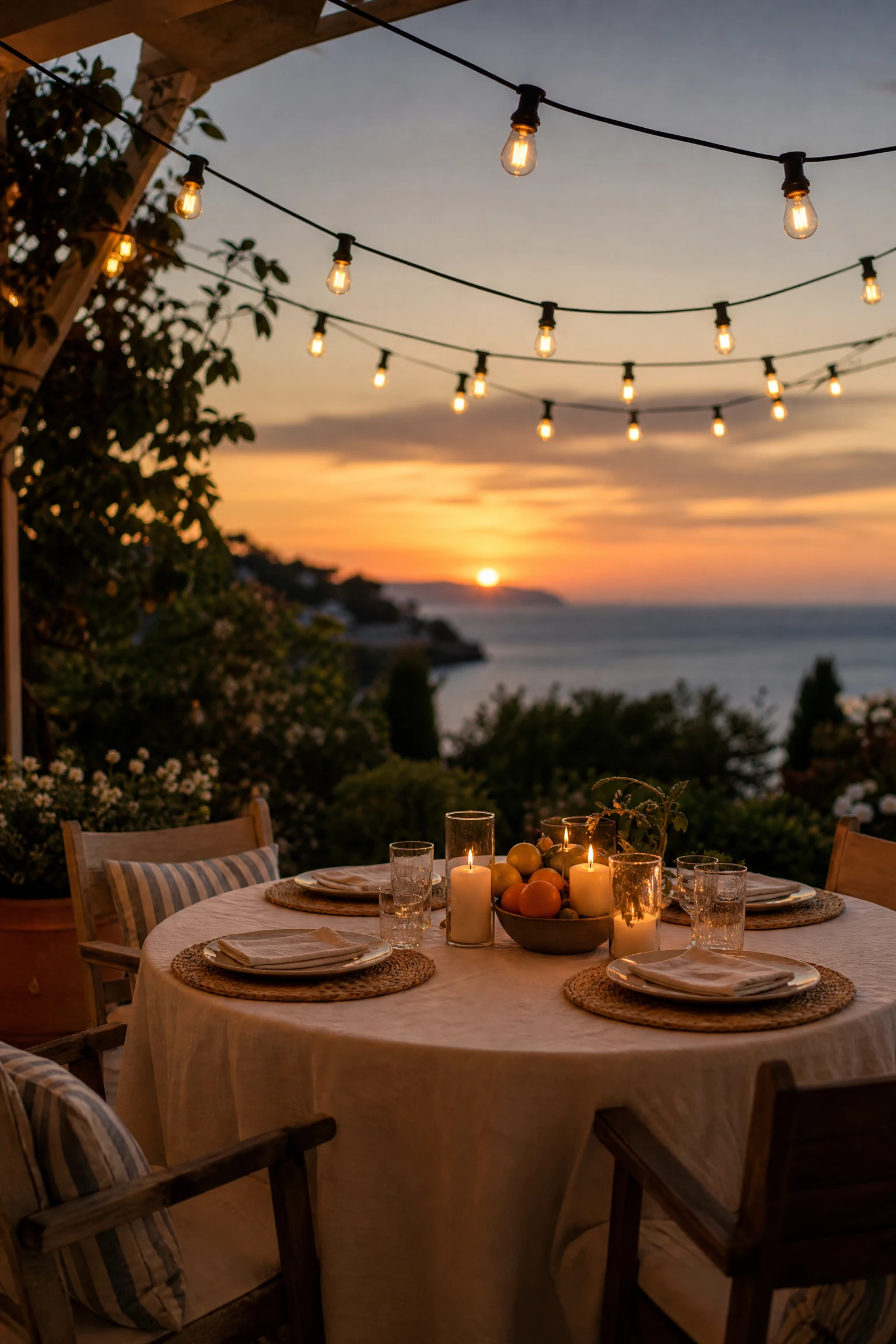
String lights are one of those ideas that could easily feel cliched, but in a coastal outdoor setting they are genuinely one of the most effective and versatile lighting tools you have. The warm, low glow from a run of outdoor string lights hung in a loose canopy or strung between two posts above a patio dining table creates an atmosphere that no other outdoor fixture quite replicates, and the relatively low light level means you can actually see the stars rather than washing them out with overhead brightness. Choose Edison-style bulbs with a warm colour temperature, around 2200K to 2700K, rather than globe-style LED versions in a neutral white, which are brighter and harsher. String them across a pergola, between wooden posts, or through the branches of a nearby tree for a look that feels effortless and genuinely beautiful on a summer evening. String lights are an accessible purchase at all price levels, though investing in commercial-grade waterproof cable means you will not be replacing them every season.
Designer Advice: Avoid hanging string lights too tightly or too rigidly. A slightly loose, gently sagging run of lights looks more relaxed and natural than a taut, geometric grid.
21. Marine-Grade Brass Wall Lanterns on the Coastal Porch
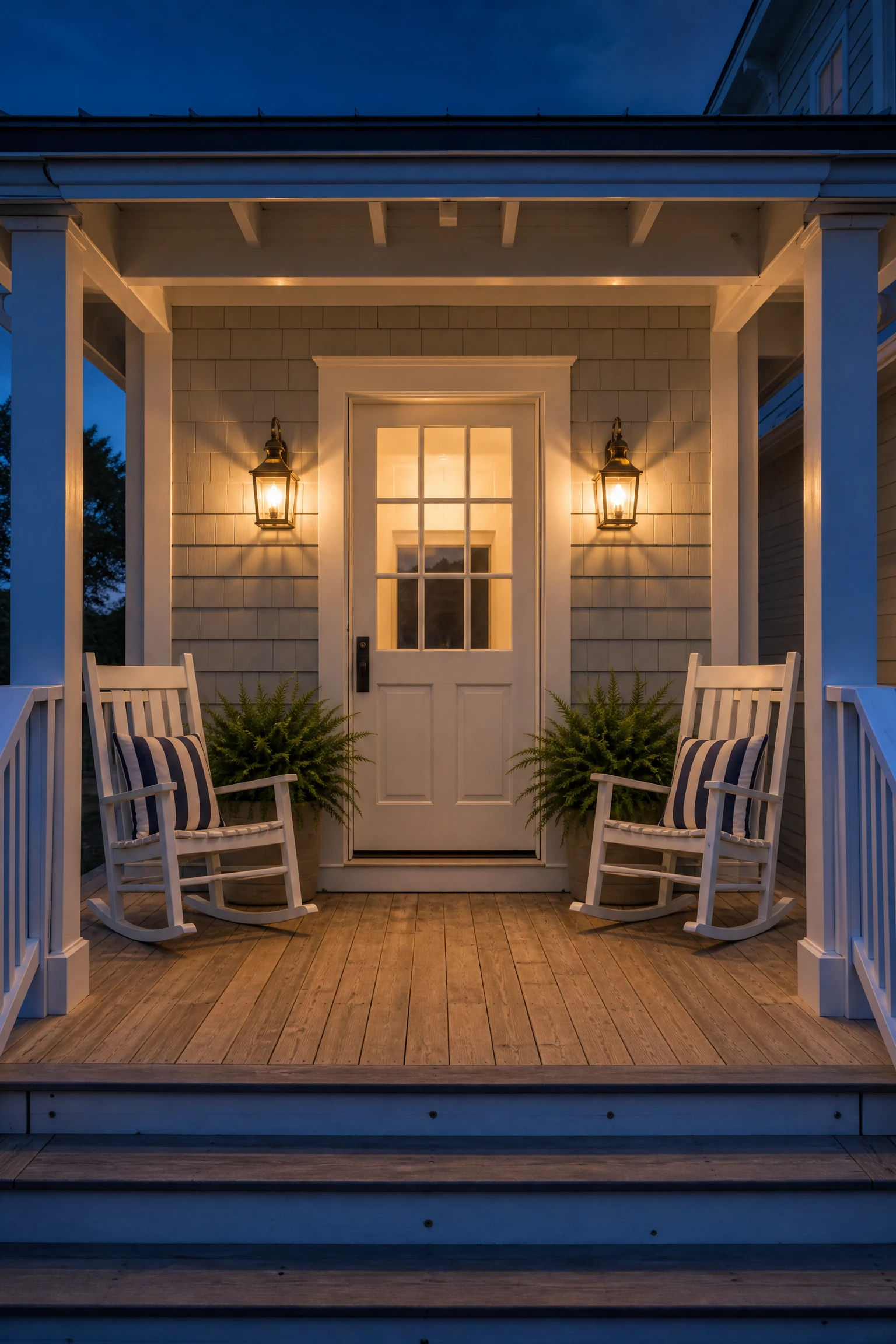
For a coastal porch that sees real weather, marine-grade brass or solid bronze wall lanterns are the material standard to hold to, and they happen to also be among the most beautiful outdoor fixtures available. Genuine marine-grade brass develops a warm, living patina over time that improves the look of the fixture rather than degrading it, and the solid construction means these lanterns can handle salt air, rain, and UV exposure without corroding or fading. Mount a pair flanking the front door of a coastal home or on either side of a porch bench for a symmetrical, welcoming effect. Pair with a natural wood or painted white porch floor, a pair of rocking chairs or a wooden bench with outdoor cushions in a stripe or solid coastal colour, and a simple potted plant or two for a porch that looks as good in the daytime as it does lit up in the evening. These are investment-level fixtures, but they are ones that will genuinely last for decades with minimal maintenance.
Designer Advice: Look for IP65-rated fixtures minimum for coastal outdoor use. IP65 means the fixture is fully dust-tight and protected against water jets from any direction, which covers most weather situations.
22. Solar Stake Lights Along the Coastal Garden Path
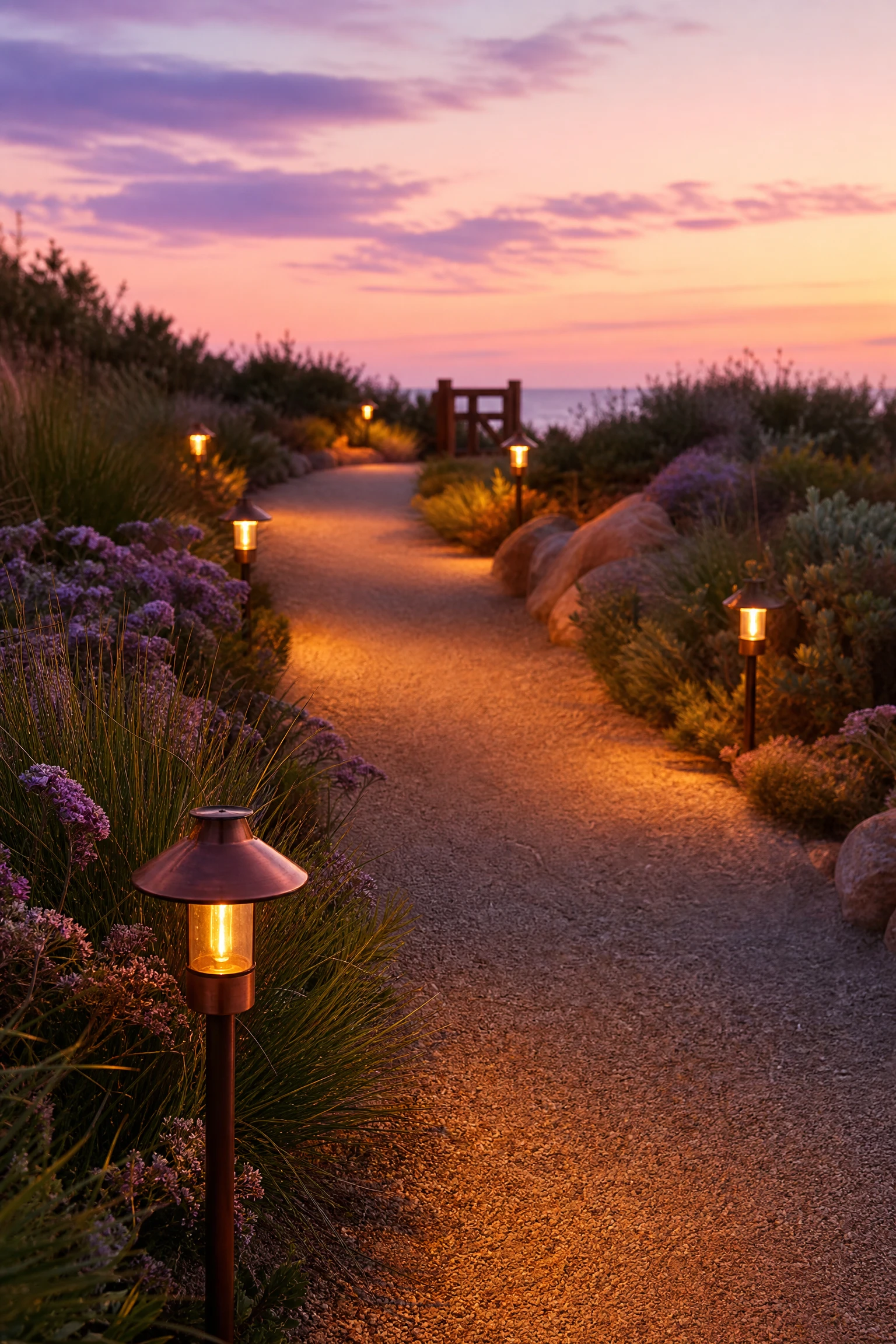
Solar stake lights along a coastal garden path are one of the most practical and sustainable outdoor lighting choices you can make, and in recent years the quality of solar lighting has improved to the point where it is genuinely comparable to wired alternatives in many scenarios. For a coastal garden with sandy soil, low plantings, and a path leading toward the water or a view, a run of warm-toned solar stake lights in a simple black or aged copper finish adds a guided, welcoming glow from dusk through the evening without any electrical work or ongoing running costs. Look for stake lights with a warm amber LED rather than a cool white, as warm tones blend into a coastal garden setting in a way that cool white never does. Space them evenly, roughly every 3 to 5 feet, for a rhythmic, polished effect. The main limitation of solar is that they need a full day of direct sunlight to perform at their best, so garden paths heavily shaded by trees or structures may not get enough charge.
Designer Advice: Choose solar lights with a built-in dusk-to-dawn sensor so they come on automatically at sunset and switch off at sunrise without any manual management.
23. Coastal Outdoor Ceiling Fan with Integrated Light Kit
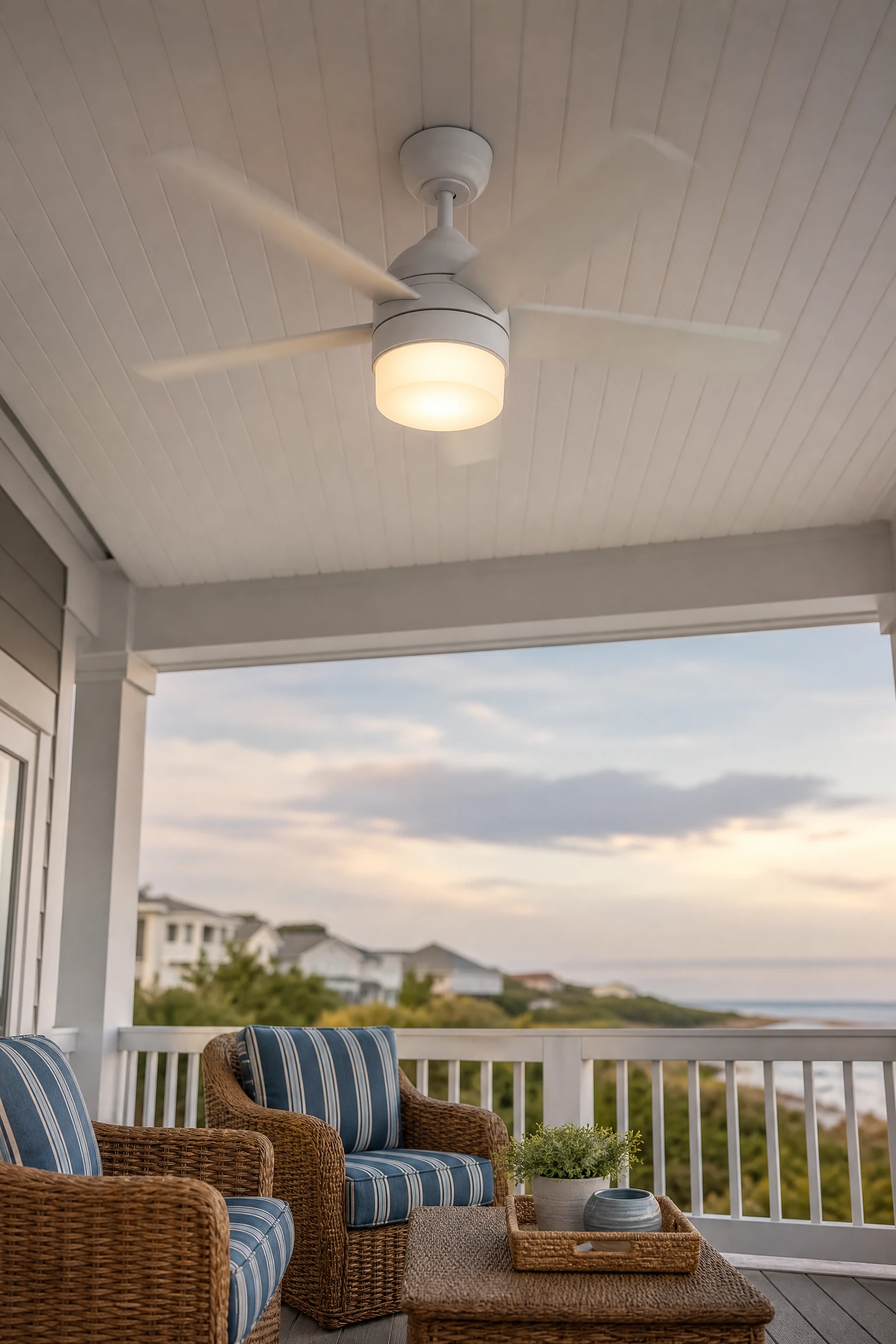
A covered coastal porch or screened outdoor living room calls for an outdoor ceiling fan with an integrated light kit, which is one of the most hardworking fixtures in the coastal outdoor living toolkit. The fan keeps the air moving on warm, humid evenings when the ocean breeze alone is not enough, and the light kit provides overhead illumination that makes the porch genuinely usable after dark for dining, reading, or just sitting. Look for fans with a wet-rated or damp-rated motor and ABS composite blades rather than wood, as wood fan blades warp dramatically in humid coastal environments. Finish options in matte white, brushed nickel, or a coastal distressed grey all work well, and a simple drum or globe shade in frosted white glass gives a clean, unobtrusive light source. This is a mid-range to investment-level purchase, but the dual function of a fan with an integrated light means it replaces what would otherwise be two separate fixtures.
Designer Advice: Always choose a wet-rated fan for open coastal porches exposed to rain, even if the porch is partially covered. Damp-rated fans are only suitable for fully covered, sheltered situations.
24. Wicker Lanterns as Decorative Outdoor Accents
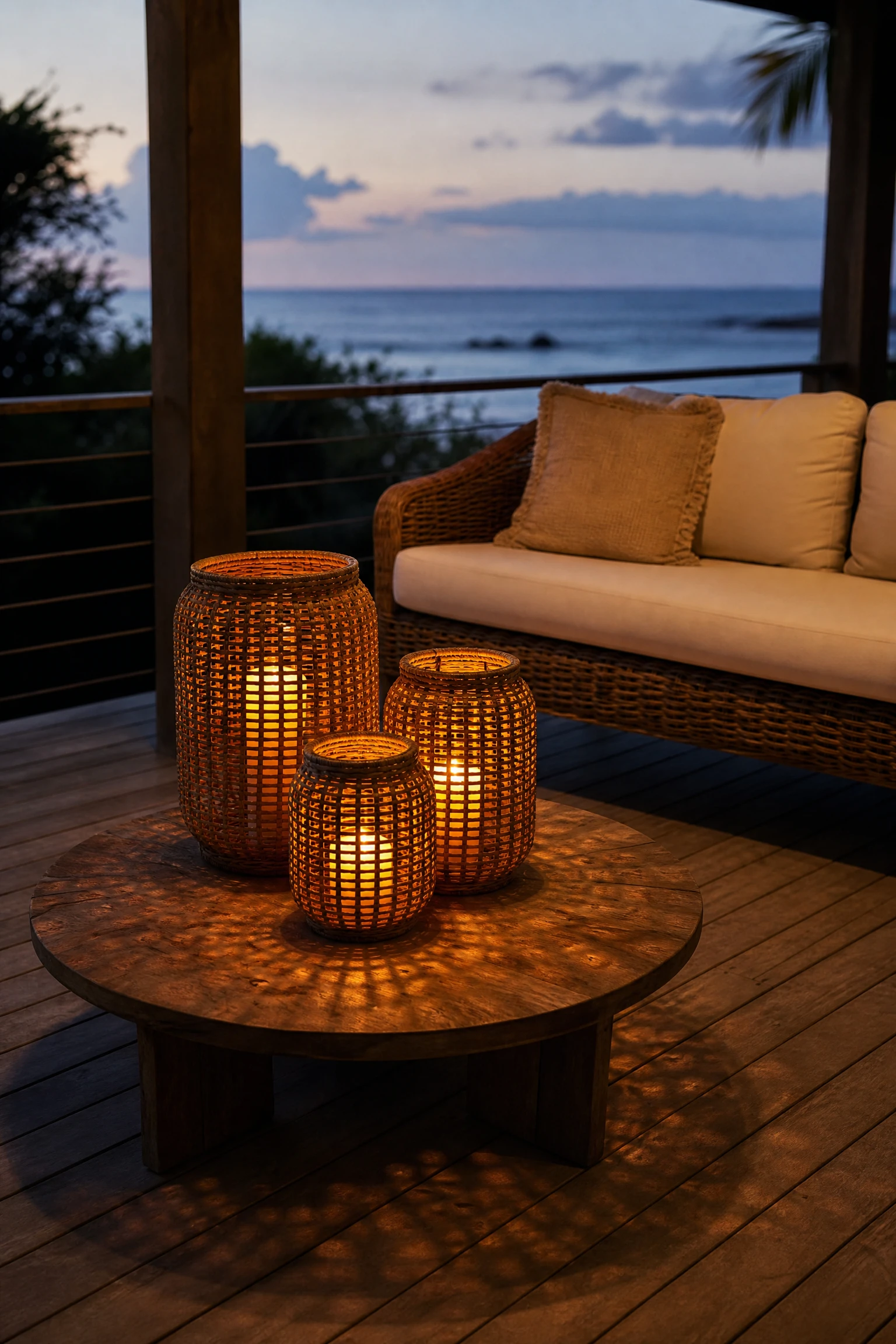
Wicker or rattan lanterns used as decorative outdoor accents, whether holding pillar candles, battery-operated flickering candles, or small LED tealights, are one of the simplest and most affordable ways to add warm coastal character to an outdoor seating area. Group three lanterns of varying heights on a low outdoor coffee table, on a porch step, or clustered in a corner of a covered deck for a layered, impactful effect that requires almost no installation and no electrical work at all. The woven material casts a beautiful shadow pattern from the flame or bulb inside, and the natural fiber color adds warmth to an outdoor space dominated by grey, white, or pale wood tones. If you are using real candles, choose outdoor-rated candles designed to resist wind. Battery-operated flickering LED candles are the more practical choice for areas with a sea breeze, as real candles in open lanterns in a coastal setting are fighting a losing battle most evenings. Wicker lanterns are widely available at very affordable prices and are easy to store or replace at the end of the season.
Designer Advice: Odd numbers of lanterns always look better than even numbers. A trio of three different heights reads as curated and intentional; two lanterns of the same height just looks paired.
Final Thoughts
Coastal lighting is one of those areas of interior design where the details genuinely matter more than the big gestures. You can have the most beautifully chosen furniture and the most carefully considered color palette, but if the lighting is wrong, everything feels slightly off. What makes coastal lighting work is the combination of the right material, the right color temperature, the right scale for the room, and an honest understanding of how the space is actually used through the day and into the evening.
The 24 ideas here span a wide range of styles, price points, and room types, because coastal style itself is not one single thing. It is a feeling, a set of material values, and a commitment to rooms that feel relaxed without feeling lazy. Whether you are drawn to the crisp, modern coastal look with brushed brass and clean lines, the warm and organic character of rattan and driftwood, the restrained nautical references of porthole sconces and rope pendants, or the simple pleasure of string lights over an outdoor dinner table, there is a version of coastal lighting that fits your home and your way of living in it.
Start with one room or one fixture type, get it right, and let the rest of the decisions flow from there. Good lighting is not about buying everything at once. It is about making choices that feel considered, honest about the materials they use, and genuinely suited to the life being lived in the space.
Frequently Asked Questions
What is the best color temperature for coastal lighting?
For most coastal interiors, a warm white bulb in the range of 2700K to 3000K is the right choice. This color temperature mimics the warm glow of natural late-afternoon light and works harmoniously with the sandy, natural, and organic tones that coastal spaces typically use. Avoid cool white or daylight bulbs (above 4000K) in living areas and bedrooms, as they make natural materials look flat and push the atmosphere toward clinical rather than relaxed. In kitchens and bathrooms where task clarity matters more, you can go slightly cooler at around 3000K, but stay below 3500K to keep the space feeling warm.
What materials work best for coastal lighting fixtures?
The best materials for coastal lighting depend on whether the fixture is going indoors or outdoors. For indoor fixtures, rattan, seagrass, driftwood, rope, capiz shell, ceramic, and frosted or sea-glass-toned glass are all excellent choices that bring natural texture and warmth. For outdoor fixtures, marine-grade brass, solid bronze, powder-coated aluminum, and ABS composite materials are the most durable options because they resist salt air, humidity, and UV degradation without corroding or fading over time. Avoid using indoor natural fiber fixtures outdoors, even in covered porches, as humidity causes them to deteriorate quickly.
How do I layer lighting in a coastal room?
Layered lighting means using multiple light sources at different heights and intensities to create a flexible, atmospheric room that works at different times of day and for different purposes. In a coastal living room, a good layered scheme might include a rattan chandelier or pendant for general ambient light, a rope-wrapped floor lamp for task reading, table lamps on side tables for warm accent light, and candles or decorative lanterns for evening atmosphere. The key is to avoid relying on a single overhead fixture for all the light in a room, as this creates flat, unflattering illumination. Install dimmers wherever possible so you can control the balance between sources as the light changes throughout the day.
Can I use coastal lighting in a landlocked home?
Absolutely, and in fact the majority of people decorating in coastal style do so far from the actual coast. Coastal lighting works in any home because it is really about a material palette and a mood rather than a literal geographic location. Natural fiber pendants, warm-toned ceramic lamps, driftwood bases, and frosted glass sconces all bring the relaxed, organic quality of coastal design to interiors regardless of whether the ocean is visible from the window. The key is to keep the surrounding palette and materials consistent with the coastal direction so the lighting feels like part of a considered whole rather than a randomly placed fixture.
What is the difference between coastal and nautical lighting?
Coastal lighting takes a broader, more relaxed approach that draws from the whole sensory experience of the seaside: natural materials, organic forms, soft light, and a colour palette inspired by sand, sea, and sky. Nautical lighting is more specific and references the functional, utilitarian world of boats, harbours, and maritime life, with fixtures that include porthole forms, rope and rigging details, anchor motifs, and dark metal finishes. Nautical is a subset of coastal, and the two can overlap comfortably in the same home, but nautical tends to be more literal and thematic while coastal is broader and more versatile.
How do I choose the right size pendant light for my room?
A commonly used rule of thumb is to add the length and width of the room in feet, then convert that number to inches for the approximate diameter of a ceiling fixture. So a 12-by-14-foot room would suit a pendant or chandelier roughly 26 inches in diameter. For pendants over a kitchen island or dining table, the fixture should ideally be about half to two-thirds the width of the surface below it. These are starting points rather than hard rules, and personal preference, ceiling height, and the scale of the furniture in the room all play into the final decision. When in doubt, err slightly larger rather than smaller, as undersized fixtures consistently look less considered and less impactful than ones that fill the space with confidence.