Scandinavian Entryway Looks That Actually Make You Want to Come Home
There is something about stepping into a well-designed Nordic entryway that just makes the whole day feel a little lighter. It is not magic, exactly, but it is close. Scandinavian design has always treated the entryway as more than a place to dump your coat and kick off your shoes. In countries like Sweden, Denmark, and Norway, the hallway is the first breath of home, and designers there put real thought into making it feel organized, warm, and genuinely welcoming without any unnecessary fuss. That combination of function and calm is exactly what makes this style so easy to love and so practical to pull off, even in the smallest of spaces.
The ideas in this article cover everything from budget-friendly swaps to more considered investments, and they work across all kinds of homes, from compact apartments with a narrow corridor to larger houses with proper mudroom potential. Each idea is different, and each one draws on real Scandinavian design principles like layered lighting, natural material choices, visual weight, and honest functionality. Whether you are starting completely from scratch or just looking to refresh what you already have, there is something here worth trying.
The All-White Wall with a Single Oak Bench
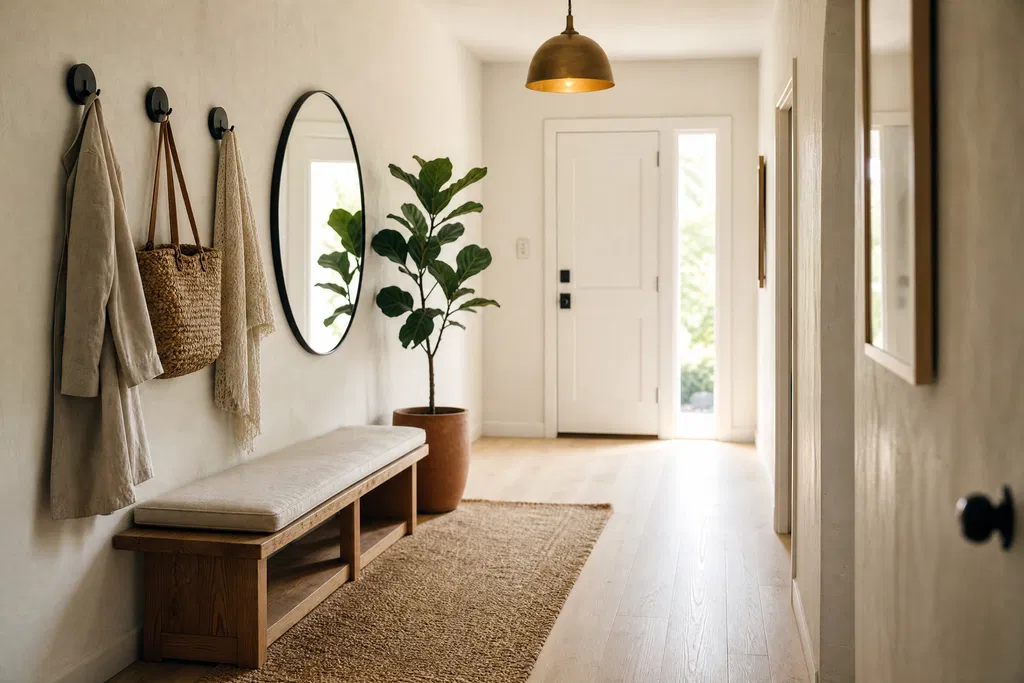
You come home after a long day, and the first thing you want is for the space to feel like it is already on your side. That is what an all-white entryway with one simple oak bench delivers every single time. Paint the walls in a true Scandinavian white, not a cold blue-white but a soft warm white like Farrow & Ball’s ‘All White’ or Jotun’s ‘Arctic White,’ and the whole corridor opens up immediately. The bench itself should be low-profile with clean lines, ideally in solid light oak or ash, since both woods have that distinctive pale grain that reads as unmistakably Nordic. Place a small linen cushion on top for comfort and a flat woven basket underneath for shoes. For lighting, a simple pendant in brushed brass or matte black hung at medium height keeps the mood warm without adding visual clutter. One thing that works really well here is keeping the walls completely bare except for a single round mirror above the bench, which bounces light around and makes even the narrowest entryway feel wider than it is. This is a genuinely affordable starting point since a solid oak bench can be found at IKEA or second-hand markets for very little, and white paint is about as budget-friendly as it gets.
Designer Advice: Resist the urge to add more than one decorative object. In Scandi design, negative space is doing half the work.

Peg Rail Systems Done the Nordic Way
Picture a rainy Tuesday when everyone in the house comes in at once, wet jackets, school bags, and a dog that needs toweling off. A Shaker-style peg rail mounted at the right height sorts all of that chaos out immediately. In Scandinavian interiors, peg rails are not an afterthought; they are a considered design feature, often running the full length of one wall and finished in a color that contrasts gently with the wall behind it. Try a painted rail in dusty sage or warm charcoal against a cream or off-white wall for a combination that feels collected rather than matching. Hang a mix of items at different visual weights, a heavier linen tote on one peg, a slimmer scarf on another, and leave at least two pegs deliberately empty. The floor below the rail stays completely clear, which is what makes this look so clean. Add a narrow floating shelf just above the rail for a ceramic tray where keys and sunglasses live, and you have a system that is as functional as anything a custom mudroom offers. This works especially well in long, narrow hallways where wall space is the only space you have.
Designer Advice: Mount the rail at 160 to 170 cm from the floor so coats hang without touching the ground, even long puffer jackets.

A Console Table with Hidden Storage
The console table is arguably the most versatile piece of furniture an entryway can have, and in a Scandinavian-style home it earns its place by doing double duty: looking good and keeping things sorted. A slim console in white-painted MDF or natural birch with a drawer or two underneath handles all the small items that would otherwise accumulate on the floor or vanish into a coat pocket. The surface stays deliberately spare: one small ceramic pot with a single stem, a tray for keys, and maybe a small stack of books if space allows. The color palette around the console should stay in the warm neutral range, soft greige walls, a jute runner on the floor below, and a wall-mounted lamp on one side rather than a floor lamp, which takes up footfall space. In practice, this look comes together best when the console is not too deep, around 25 to 30 centimeters is ideal for a hallway, leaving enough floor space to move without squeezing. Mid-range options from brands like Muuto, Hay, or even Hemnes from IKEA all do this beautifully at different price points. Just be honest: if you have more than one person’s daily essentials to manage, a single drawer will not cut it, and you will need to add a wall-mounted box or small cabinet alongside.
Designer Advice: Style the console surface in odd numbers. Three objects always look more intentional than two or four.
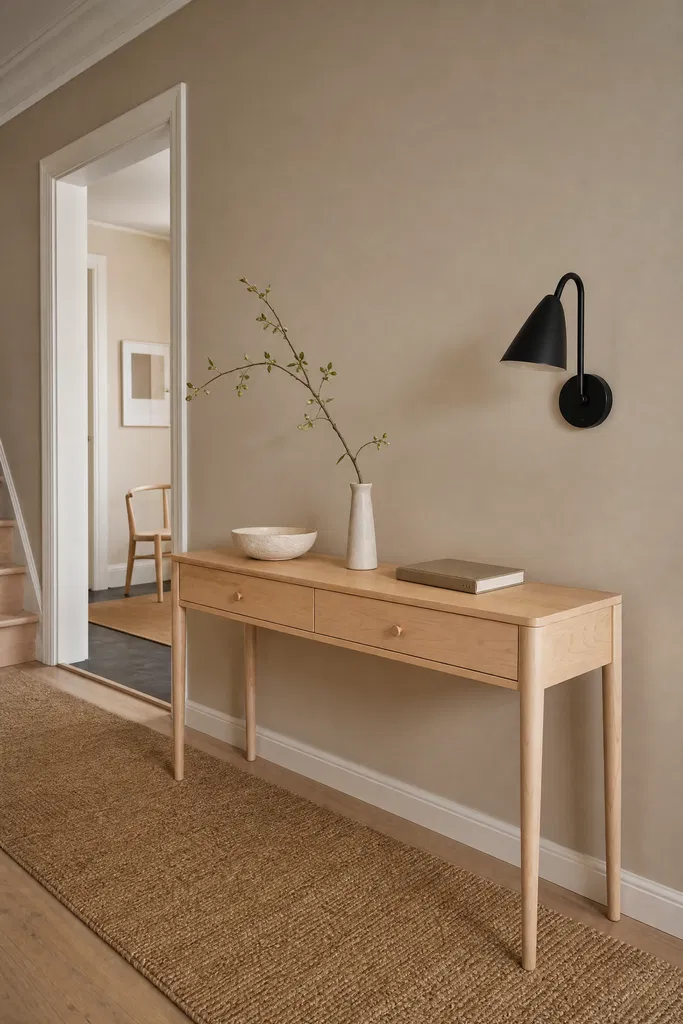
Light Wood Floors with a Natural Fiber Runner
Walk into almost any Danish home and the floor in the entryway is doing a lot of the heavy lifting, visually speaking. Light wood flooring in wide planks of pale ash, white oak, or whitewashed pine is the foundation of the classic Scandinavian entryway, and it makes the space feel airier and taller than it actually is. If you already have darker floors, a long natural fiber runner in jute, sisal, or a flat-weave wool blend achieves a very similar effect at a fraction of the cost. The runner should run the full length of the hallway rather than sitting as a small mat near the door, since a full-length runner draws the eye down the corridor and makes the space feel more considered. Look for geometric patterns in charcoal, oatmeal, or muted terracotta rather than anything too bold, since the pattern in Scandi spaces is typically subtle and earthy. One honest limitation here: natural fiber rugs like jute are not the best choice if you have pets or very young children, since they can be difficult to deep clean. A flat-weave wool option is more practical in those cases and still reads as appropriately Nordic.
Designer Advice: Use a rug pad underneath to prevent slipping and to add a little softness underfoot, especially on hard tile floors.

Bring in One Piece of Biophilic Design
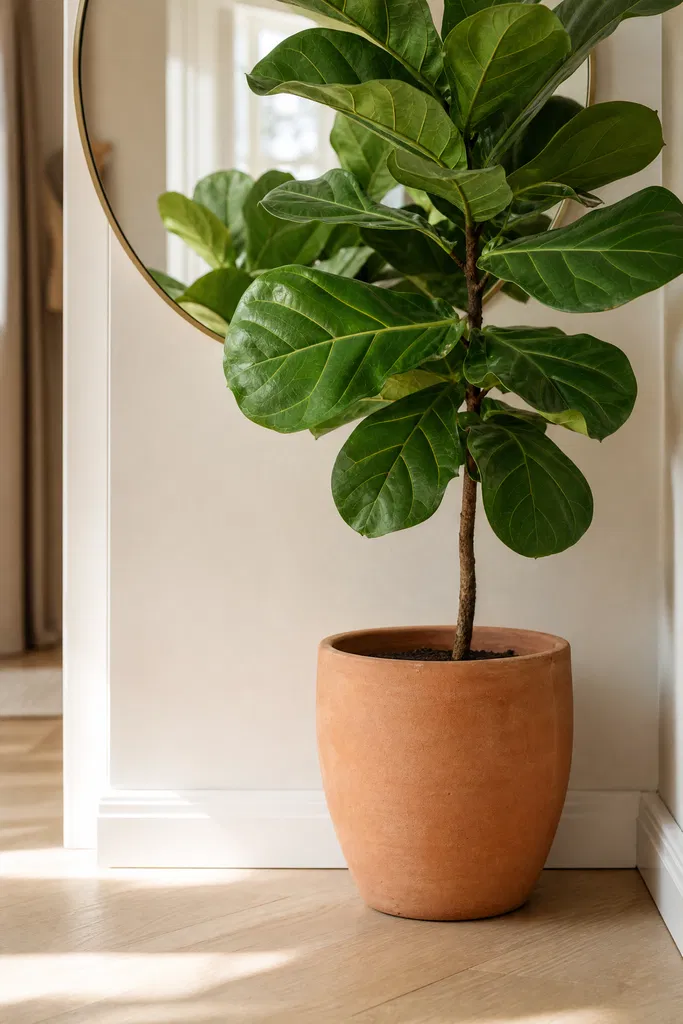
Scandinavian design has a deep and genuine relationship with nature, and in the entryway that usually means one well-chosen plant or branch arrangement that nods to the outdoors without trying too hard. The key word here is one. A single fiddle leaf fig in a tall, simple clay pot, or a cluster of dried pampas grass in a slim ceramic vase, or even a few stems of eucalyptus dropped into a glass bottle all do the job beautifully. The biophilic element in a Nordic entryway is not about creating a jungle; it is about referencing the landscape outside in a quiet, deliberate way. If natural light is limited in your hallway (which is very common), choose a hardy low-light plant like a snake plant or a ZZ plant rather than something that will struggle. The pot or vase choice matters too: go for unglazed terracotta, matte white stoneware, or dark anthracite ceramic for a look that feels handmade and grounded rather than mass-produced. This is one of the most affordable ideas on this list and also one of the most impactful since the organic shape of a plant immediately softens any space that might otherwise feel too stark.
Designer Advice: Place the plant near the mirror if you have one. The reflection doubles its visual impact without adding a second plant.
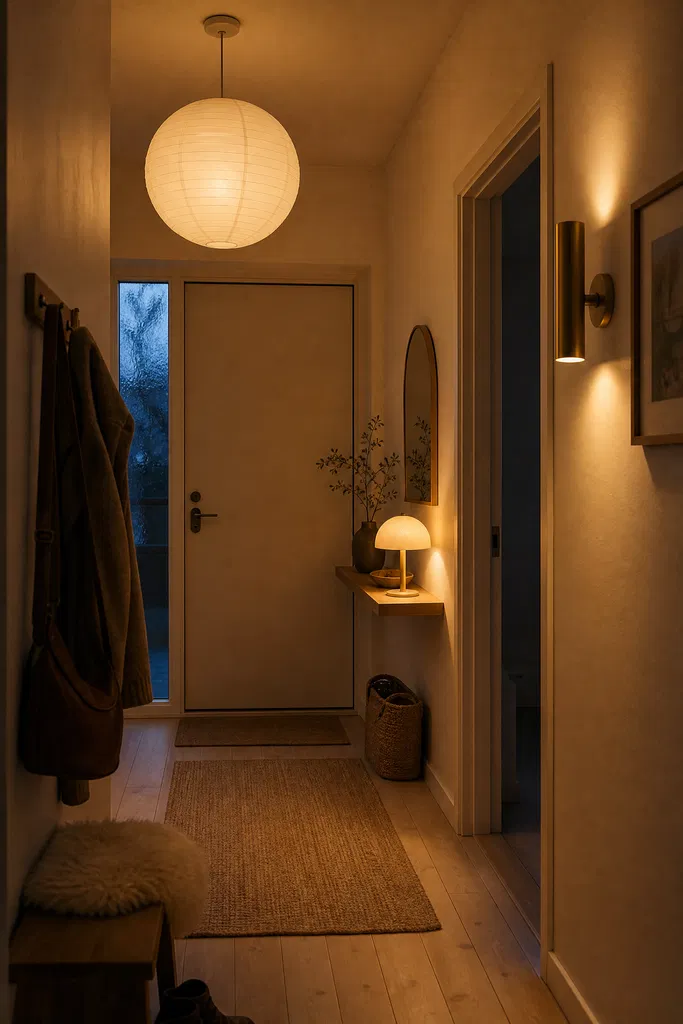
The Layered Lighting Approach
A single overhead bulb in a hallway is one of the most common mistakes people make, and it is also one of the easiest to fix. Scandinavian lighting design is built around the concept of layered lighting, meaning you never rely on just one source. In an entryway, this usually means combining a pendant or ceiling fixture for ambient light with a wall-mounted sconce or two for mid-level warmth, and a small LED strip or plug-in lamp near the floor or console for that soft, golden glow that makes the space feel cozy after dark. The color temperature matters enormously here: stick to warm white bulbs in the 2700K to 3000K range rather than cool daylight bulbs, which can make a white Scandi entryway feel clinical and cold. Pendant styles that work particularly well in Nordic hallways include paper globe pendants in the style popularized by Danish designer Isamu Noguchi, simple cone pendants in matte black, and exposed-bulb pendants with a visible warm-toned filament. Dimmer switches are a worthwhile investment if you are rewiring, since the ability to dial the light down in the evening makes a real difference to the mood. This layered approach works in tight spaces too since wall sconces take up zero floor space.
Designer Advice: If your entryway has no natural light at all, add a full-length mirror directly opposite the main light source to maximize the glow.
Built-In Storage that Disappears into the Wall
One of the things that professional interior designers working in the Scandinavian tradition get right more often than not is the use of built-in joinery that sits flush with the wall and all but disappears. In an entryway this means a built-in wardrobe or cupboard with flat handleless doors in the same color as the wall behind it, so the whole wall reads as one unbroken surface until you open it and find a beautifully organized interior with hooks, shelving, and a pull-out shoe rack. This is clearly an investment-level project rather than a quick fix, but the visual payoff in terms of calm and order is unlike anything a freestanding piece of furniture can achieve. The exterior of the doors can be painted in a soft warm white or a muted earthy tone like clay or pale sand, and the interior can go a contrasting dark shade to make it feel more finished when open. If you cannot commit to built-ins, a very similar effect can be achieved with a pair of IKEA PAX wardrobes fitted with flat-panel doors and painted in the same color as the wall, a trick that has been popular in Scandinavian homes for years. Be realistic about the width of your hallway before committing: built-in joinery needs at least 60 cm of depth, which can feel tight in a narrow corridor.
Designer Advice: Paint the inside of the built-in a contrasting color like deep charcoal or forest green to add a touch of surprise when the doors open.

Textured Walls with Limewash or Plaster Paint
Most people think Scandinavian design means perfectly smooth white walls, and while that is often true, there is a growing movement within Nordic interiors toward textured wall treatments that add warmth and depth without adding color or pattern. Limewash paint in a warm off-white or very pale stone tone creates a surface that catches light differently at different times of day, giving the wall a soft, lived-in quality that flat paint simply cannot replicate. Venetian plaster is another option at a higher price point, creating a polished marble-like finish that still reads as natural and artisanal rather than decorative. In the context of a Scandinavian entryway, a textured wall works best on a single focal wall, typically the one you see straight ahead as you walk in through the door, while the remaining walls stay smooth. This is a relatively approachable DIY project for limewash since most brands now sell it in easy-to-apply formulas, though Venetian plaster genuinely benefits from a professional application to get the depth and sheen right. The tactile quality of a textured wall adds a layer of sensory interest that aligns very well with the wabi-sabi influence that has quietly crept into Scandinavian design over the last few years.
Designer Advice: Apply limewash in two or three thin layers using a wide brush and vary the direction of your strokes for a more authentic aged finish.

A Gallery Wall Done in the Nordic Way
Gallery walls can look chaotic, and in a Scandinavian entryway chaos is the enemy. The Nordic take on a gallery wall is much more restrained than the maximalist version you see on social media: three to five frames, all in the same thin black or natural wood frame, all in the same size or in two complementary sizes, arranged in a tight grid rather than scattered organically across the wall. The prints themselves stay in the same muted palette, black and white photography, simple botanical line drawings, abstract minimal art in soft charcoal or warm ochre, or typographic prints in a clean sans-serif font. In practice this approach works best when you treat the grouping as one single artwork rather than a collection of individual pieces. The negative space around the grouping is just as important as the frames themselves, so resist the temptation to fill the whole wall. A single row of three identical frames at eye level, equally spaced, already looks more intentional and considered than most gallery walls twice the size. This is an easy and affordable way to add personality to an otherwise spare Nordic hallway.
Designer Advice: Use a paper template cut to the size of each frame and blue-tack it to the wall before hammering any nails. It saves a lot of regret.

Shoe Storage That Does Not Look Like Shoe Storage
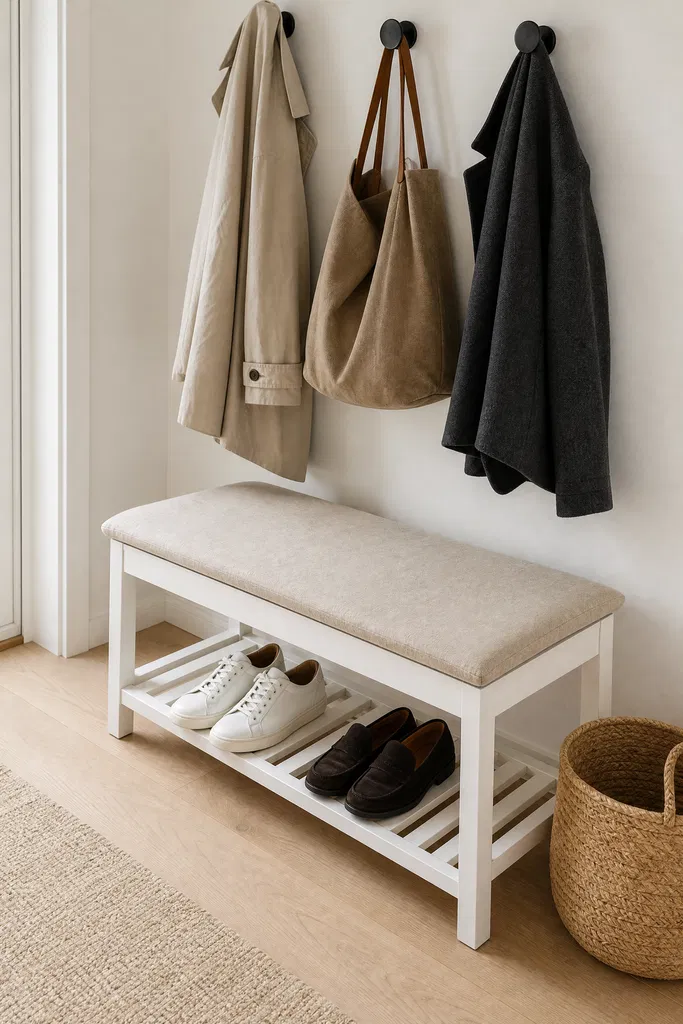
This is one of the most practical challenges in any entryway, Nordic or otherwise, and Scandinavian designers have spent a lot of time solving it with elegance. The goal is shoe storage that functions well but does not dominate the space or make the entryway look like a sports shop changing room. A low bench with a slatted lower shelf works beautifully since shoes sit on the shelf but are partially hidden by the bench seat above. Alternatively, a wall-mounted shoe cabinet with angled interior compartments stores several pairs per shelf in a footprint about half the size of a conventional shoe rack. The exterior of a shoe cabinet in this style should be as plain as possible: flat-panel doors in white, light oak, or painted wood, with no visible handles if you can manage it. For a more relaxed aesthetic, open woven baskets lined up along the floor below a peg rail each hold one person’s daily shoes and keep things visibly organized without the clinical feel of a closed cabinet. Be honest with yourself about how many pairs of shoes are actually being rotated daily and choose storage to match that number rather than trying to fit every pair you own into the entryway.
Designer Advice: Keep a shoe brush or boot scraper just inside the door in a Scandi entryway. It is a Nordic habit that genuinely protects your floors.
The Cozy Corner with a Small Armchair
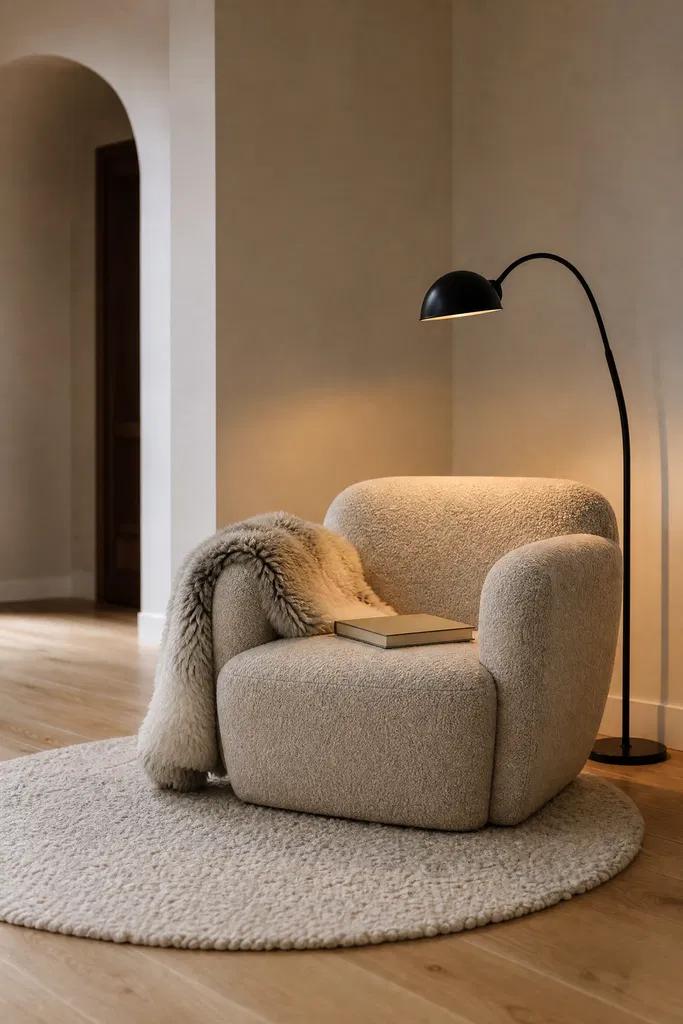
If your entryway is wide enough to spare even 80 cm in one corner, a small armchair changes the entire feeling of the space in a way that nothing else can. In Scandinavian homes, particularly in larger apartments and houses, a single chair in the entryway is a common sight, and it serves both a practical and an emotional purpose. Practically, it is a place to sit while putting on shoes or waiting for someone. Emotionally, it signals that this space is not just a passageway but a real room with a reason to pause. The chair should be small in scale, something like a classic Danish accent chair in natural sheepskin or a simple upholstered seat in a warm oatmeal boucle or muted sage wool. Keep the surrounding space very spare to avoid a cluttered feeling, and add a small floor lamp beside it rather than relying on overhead light. A single book or folded throw draped over the arm completes the look. This works best in wider hallways or L-shaped entries, and if your corridor is truly narrow this idea will not be practical, which is worth acknowledging rather than forcing.
Designer Advice: A sheepskin throw over a simple chair in the entryway is one of the most cost-effective ways to add warmth and texture in under a minute.
Japandi-Influenced Minimalism in the Entryway
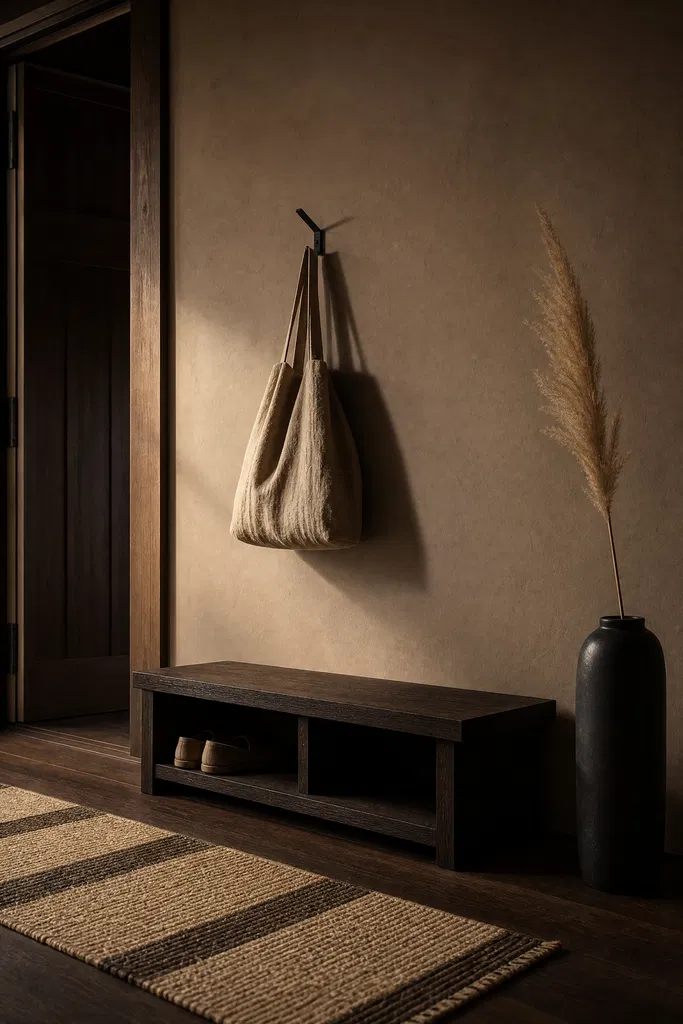
Japandi, the design style that fuses Japanese and Scandinavian sensibilities, has become one of the most consistently popular directions in Nordic-influenced interiors over the last few years, and it translates especially well into entryways. The palette shifts from pure white toward deeper, warmer neutrals: think soft mushroom, pale clay, warm sand, and muted charcoal rather than stark white. Materials lean toward dark-stained oak, blackened steel, and natural linen. The furniture silhouettes stay low to the ground and horizontal rather than tall and vertical, following the Japanese preference for a connection to the floor. A low Japandi-style shoe bench in dark-stained oak with clean through-lines, a single piece of ceramic pottery near the door, and a minimalist wall hook in blackened steel all work together to create an entry that feels meditative and intentional. One honest note: Japandi can tip into feeling stark and cold if you do not add at least one soft textile layer, so a folded linen cushion or a small handwoven wall hanging is worth including. This tends to be a mid-range to investment-level approach depending on how much genuine solid-wood furniture you use.
Designer Advice: Limit your material palette to three or four at most. Japandi discipline is what gives it that centered, intentional quality.
A Statement Mirror as the Focal Point
The mirror is probably the most hardworking single piece of decor in any Scandinavian entryway, and choosing the right one makes a disproportionate difference to how the whole space feels. A large round mirror in a simple black metal frame or a natural ash frame is the most classic choice, and for good reason: the circular shape introduces an organic softness that contrasts nicely with the clean horizontal and vertical lines of the furniture and architecture. Full-length mirrors leaning against one wall have also become a popular feature in Nordic hallways, particularly in apartments where the entryway is the only space with enough wall length to accommodate one. The size of the mirror should feel slightly larger than seems necessary, since a small mirror in a hallway tends to feel apologetic and does not do enough to reflect light. For a more dramatic approach, an arched mirror with a plaster or rattan frame brings a handcrafted texture that aligns with the contemporary Scandinavian move toward more artisanal, imperfect finishes. Keep the area immediately around the mirror very clear since the whole point of this idea is that the mirror itself carries the visual weight of the space.
Designer Advice: Mount the mirror at 160 to 165 cm to the center so it works for both taller and shorter household members.

Dark Accent Wall in a Muted, Moody Tone
Not every Scandinavian entryway needs to be white, and in fact some of the most striking Nordic hallways use a single deep, muted color on one wall to create a dramatic focal point that makes the lighter elements in the room pop by contrast. Colors that work exceptionally well in this role include deep forest green, slate blue, warm charcoal, and dark terracotta; shades that are rich without being heavy. The key difference between a Scandinavian dark wall and a generic dark wall is the restraint elsewhere in the room. Everything else stays neutral: white or light wood furniture, natural textiles in oatmeal or cream, and warm-toned lighting. The dark wall acts as a quiet backdrop rather than a statement, which is a subtle but important distinction. In practice this works particularly well on the wall directly behind a bench or console, framing the furniture like a painting and giving the entryway a sense of depth. Paint finish matters here: go for a flat or matte finish rather than satin or gloss since matte paint absorbs light in a way that makes dark colors feel more considered and less jarring.
Designer Advice: Test the dark color in at least an A4-sized patch and live with it for 48 hours in different lighting conditions before committing to the whole wall.

Woven Baskets as Both Storage and Decor
There is something about a well-chosen basket in a Scandinavian entryway that feels completely natural, almost inevitable. Baskets in this context are not a decorating hack or a trend: they are a genuine reflection of the Nordic appreciation for handcraft and natural materials. Seagrass, rattan, and hand-woven cotton rope are all good choices, and mixing two different weave textures adds visual interest without introducing color. The placement should be intentional: one large basket near the door for everyday shoes, one medium basket on the floor under a peg rail for sports bags or scarves, and one smaller basket on a shelf for bits and pieces. The sizes should vary since three identical baskets in a row can look too retail. In terms of color, natural undyed tones are most at home in a Scandinavian scheme, though a single basket in a dusty sage or washed denim blue adds a gentle note of color if the rest of the space is all-neutral. This is one of the most budget-conscious ideas on this list and also one of the most flexible since baskets can be repositioned or repurposed with almost no effort.
Designer Advice: Avoid plastic baskets or glossy finishes. The authenticity of natural materials is a big part of what makes them feel right in a Nordic space.

Floating Shelves in Lieu of a Console Table
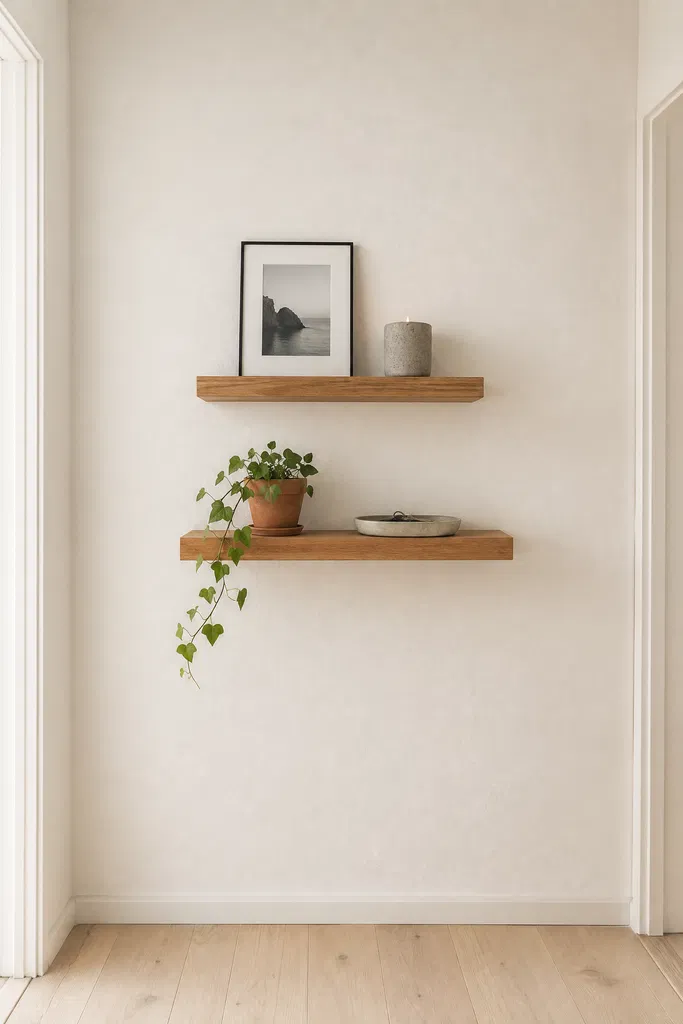
In a hallway that is simply too narrow for any freestanding furniture, a pair of floating shelves does everything a console table does without taking up a single centimeter of floor space. The shelves should be in solid wood rather than hollow board since the natural weight and grain of real wood reads as more considered, and light oak or ash are the most obvious Scandinavian choices. Mount two shelves staggered at slightly different heights rather than two shelves exactly one above the other, since the asymmetry introduces a little movement and makes the arrangement feel more curated. The lower shelf handles practical items: a ceramic key dish, a small potted plant, a folded scarf. The upper shelf can be slightly more decorative: a framed print leaned against the wall rather than hung, a simple candle in a concrete holder, or a small sculpture in white plaster or natural stone. This idea works especially well in rental situations since floating shelves are easy to install and patch on the way out, and the total cost can be very low depending on where you source the shelves.
Designer Advice: Lean a small piece of art against the wall on the upper shelf rather than hanging it. It looks more relaxed and avoids extra nail holes.
A Hygge-Inspired Entryway with Candlelight
Hygge, the Danish concept of coziness and convivial warmth, does not belong only in living rooms. A hygge-inspired entryway is one that greets you with soft light, gentle warmth, and a sense that someone was expecting you, which is one of the nicest feelings a home can offer. Candles play a central role here, and in Scandinavian homes it is genuinely common to light a candle in the hallway on dark autumn and winter evenings. A cluster of pillar candles on a wooden tray on the console, or a single wide candle in a simple glass holder on a shelf, adds exactly the right kind of light: flickering, amber-toned, and impossible to replicate with any electric bulb. Supplement this with a small plug-in lamp in the corner for safety and practicality. The textile layering matters for hygge too: a chunky knit throw basket, a sheepskin near the door for stepping onto with bare feet, and a linen doormat in a warm natural tone all contribute to the overall feeling. Be practical about candle safety and never leave them burning unattended, especially near the door where drafts are more frequent.
Designer Advice: Beeswax or soy candles in unscented or lightly pine-scented varieties feel most at home in a Nordic entryway and burn cleaner than paraffin.

Black Metal Accents Against White Walls
One of the sharpest and most satisfying combinations in Scandinavian design is matte black metal against a clean white wall, and it works to particular effect in an entryway where the contrast is encountered in close proximity. Black metal coat hooks, a matte black mirror frame, black metal shelf brackets, and a black-framed LED wall light can all live together in one space without feeling heavy or industrial because the white walls around them act as a reset. The key is consistency: every metal element should match in finish, and matte black is far more appropriate for a Scandinavian aesthetic than polished black or oil-rubbed bronze, which both carry associations with other design styles. Against this black-and-white framework, a single natural material introduces warmth: a light oak bench, a rattan basket, or a jute runner. This approach is particularly popular in contemporary Scandinavian apartments where the architecture is clean and modern, and it photographs extremely well if that matters to you. The total cost can be very reasonable since simple matte black hooks and brackets are widely available and inexpensive.
Designer Advice: Group black hooks in a cluster of three or five rather than spacing them evenly along a full wall. It reads as deliberate rather than functional.

Painted Wood Paneling at Dado Height
Wall paneling has made a strong comeback in Scandinavian-influenced interiors, and in the entryway it adds an architectural element that gives the space a sense of substance and craft. The most Nordic version of this idea uses simple vertical or horizontal tongue-and-groove paneling installed from the floor to roughly 100 to 120 cm up the wall, then painted in a muted, earthy color. Dusty blue-green, warm taupe, or a soft sage all work beautifully at dado height when the upper wall is left in a contrasting lighter shade or plain white. The transition line between the paneling color and the wall above creates a gentle horizontal band that makes the room feel wider and more architecturally interesting. Above the paneling, you can mount hooks, a mirror, or artwork, and the paneling below gives the space a finished, considered quality that plain plaster walls simply do not have. This is a mid-level DIY project that requires some patience and a decent miter saw, but the materials themselves are inexpensive and the results are genuinely impressive. In narrower hallways it can make the space feel slightly more enclosed, so factor that in before committing.
Designer Advice: Paint the paneling and the skirting board the same color for a more cohesive, finished look rather than leaving the skirting in white.

A Scent Station for Sensory Arrival
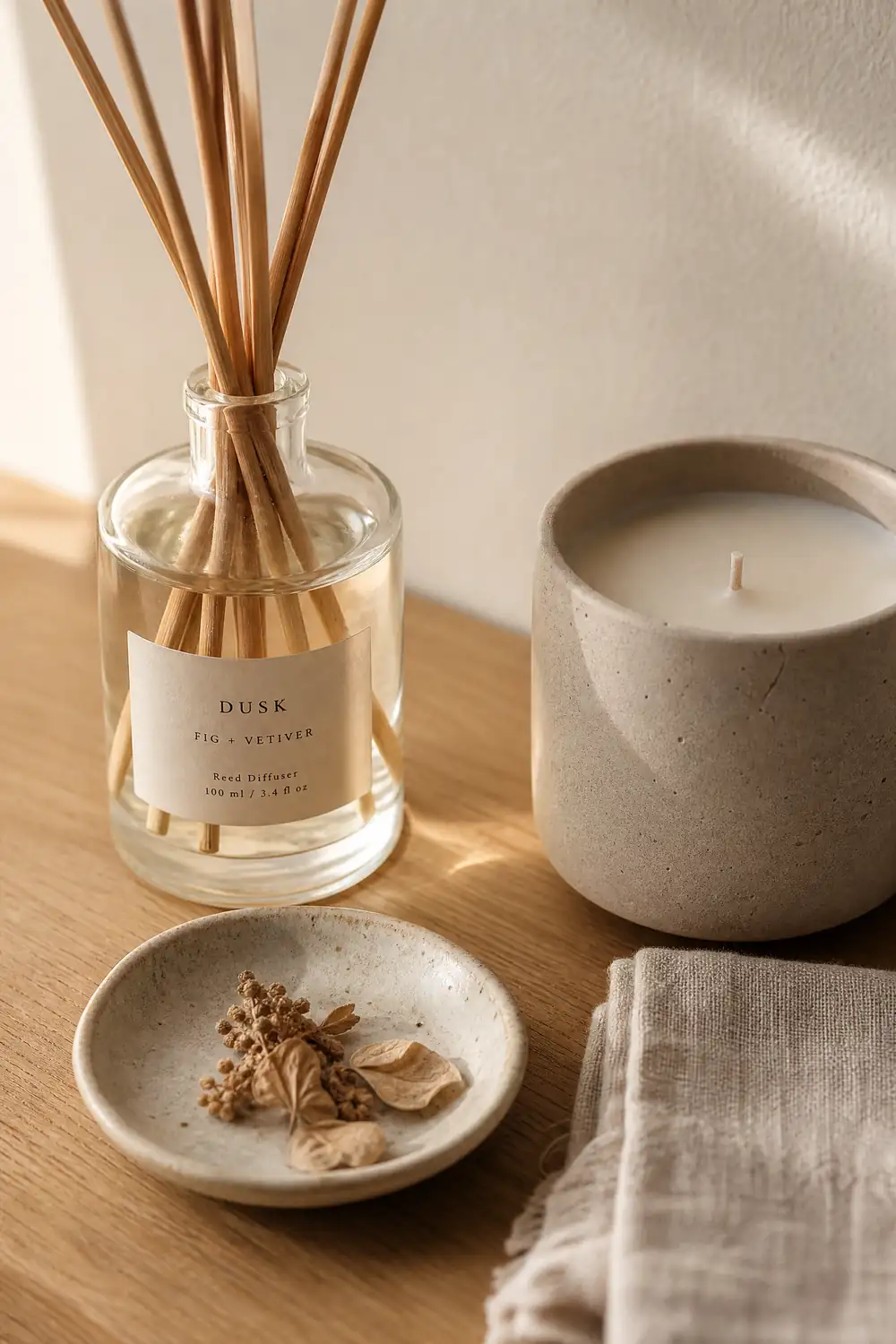
Scandinavian homes often smell as good as they look, and that is not an accident. Nordic interior culture places real value on sensory experience, and the scent of a home is part of its welcome. In the entryway, this might mean a reed diffuser in a minimal glass bottle on the console table diffusing a clean, forest-inspired fragrance like pine, cedar, or cool birch. It might mean a small linen sachet of dried lavender hung on a peg beside the coats. It could be as simple as a beeswax candle in a concrete holder that is lit for ten minutes before guests arrive. The point is that the entryway is the first sensory impression of your home, and a subtle, natural fragrance is a detail that most people feel before they consciously notice it. This is one of the most affordable upgrades on this entire list and requires no renovation, no drilling, and no furniture rearrangement. Just be careful not to use anything too heavy or sweet since Nordic fragrance aesthetics lean toward clean, cool, and botanical rather than warm and sweet.
Designer Advice: Change your entryway scent with the season. Pine and cedar for winter, fresh linen or elderflower for spring and summer.
A Narrow Mudroom Zone for Family Homes
If you have children or live with multiple people, the entryway faces demands that a purely aesthetic approach cannot meet. The Scandinavian mudroom concept solves this by combining a wall of deep hooks at adult height, a second row of smaller hooks at child height below, a bench with individual cubbies underneath each set of hooks, and labeled baskets for each person’s items. The look stays cohesive because every element is in the same material and finish: painted white joinery, natural oak accents, and woven baskets in matching neutrals. The floor in a family mudroom should be practical rather than precious: encaustic tile, poured concrete, or durable vinyl plank in a stone-effect finish are all appropriate and far easier to clean than light wood. Individual cubbies with each child’s name printed on a small ceramic disc or stamped leather tag add a personal touch without becoming childish or decorative. This is a more significant investment in terms of time and cost, but in a household with young children it pays back in daily sanity almost immediately.
Designer Advice: Add a small outdoor brush hook just inside the door for cleaning muddy boots before they come fully inside. Nordics swear by this.

Handcrafted Ceramics as Everyday Objects
One of the things that sets a genuinely Scandinavian entryway apart from a generic minimalist one is the quality and character of the small objects on display. Handcrafted ceramics occupy a special place in Nordic design culture, and placing one or two genuinely handmade pieces in the entryway adds a layer of authenticity and warmth that mass-produced items simply cannot replicate. A hand-thrown key bowl in a matte white or earthy terracotta glaze, a small vase with an intentionally irregular rim, or a ceramic catch-all tray with a linen-textured surface all communicate that the objects in this space were chosen with care. The imperfections in handmade ceramics are the point, not a flaw, and this aligns with the wabi-sabi thread that runs through contemporary Nordic interiors. You do not need many pieces: one or two well-chosen ceramics in a corner of the console or on a floating shelf is enough. Scandinavian ceramic artists whose work is widely available and relatively accessible in price include brands like Ro Collection and HAY from Denmark, and there is always a good selection at independent markets and Etsy shops if you want something more unique.
Designer Advice: A ceramic key bowl by the door is the single most practical luxury you can add to a Scandinavian entryway. You will never lose your keys again.

Vintage and Secondhand Finds with a Nordic Spirit
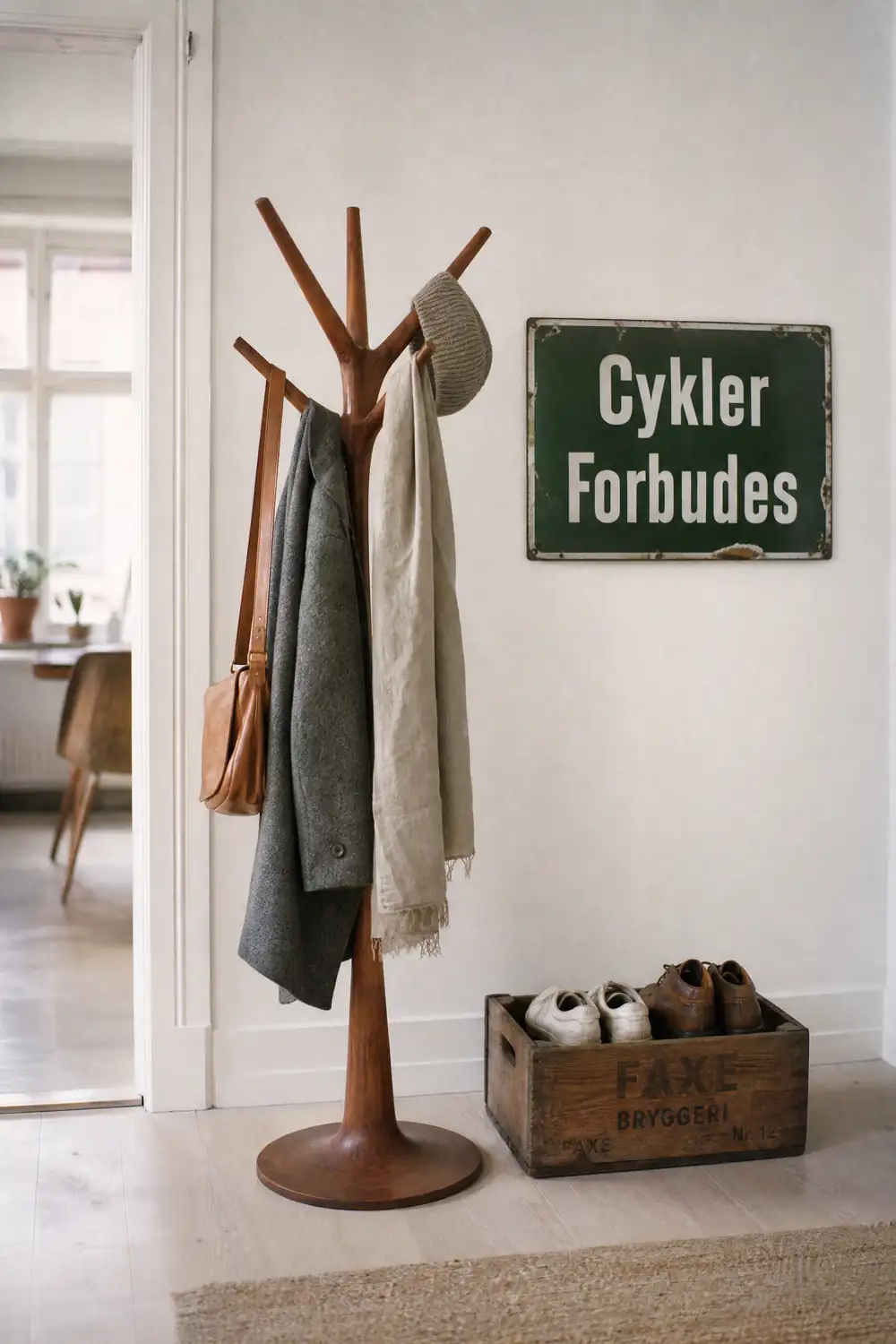
Scandinavian design has always had a strong relationship with sustainability and the idea of objects that last long enough to be passed down rather than replaced. Incorporating one or two vintage or secondhand pieces into your entryway honors that tradition and also adds the kind of character that newly manufactured furniture rarely achieves on its own. A mid-century Danish coat stand in teak, a vintage enamel sign with a simple word or symbol, a worn leather bench from a 1960s school corridor, or an old wooden crate repurposed as a shoe holder are all examples of pieces that read as Scandinavian in spirit even if they were not made in Scandinavia. The key to making vintage work in a Nordic entryway is restraint: one or two pieces with real provenance among newer, simpler elements, rather than an entryway that reads as entirely vintage or retro. Flea markets, online vintage platforms, and charity shops in cities are the best hunting grounds, and the price advantage compared to new furniture is significant. Just be honest about condition: a piece that requires extensive restoration before use may sit in a corner for months, which is not the calm entry experience you are aiming for.
Designer Advice: A single vintage coat hook rail from a school or train station has more character than any new one you can buy, and costs almost nothing secondhand.
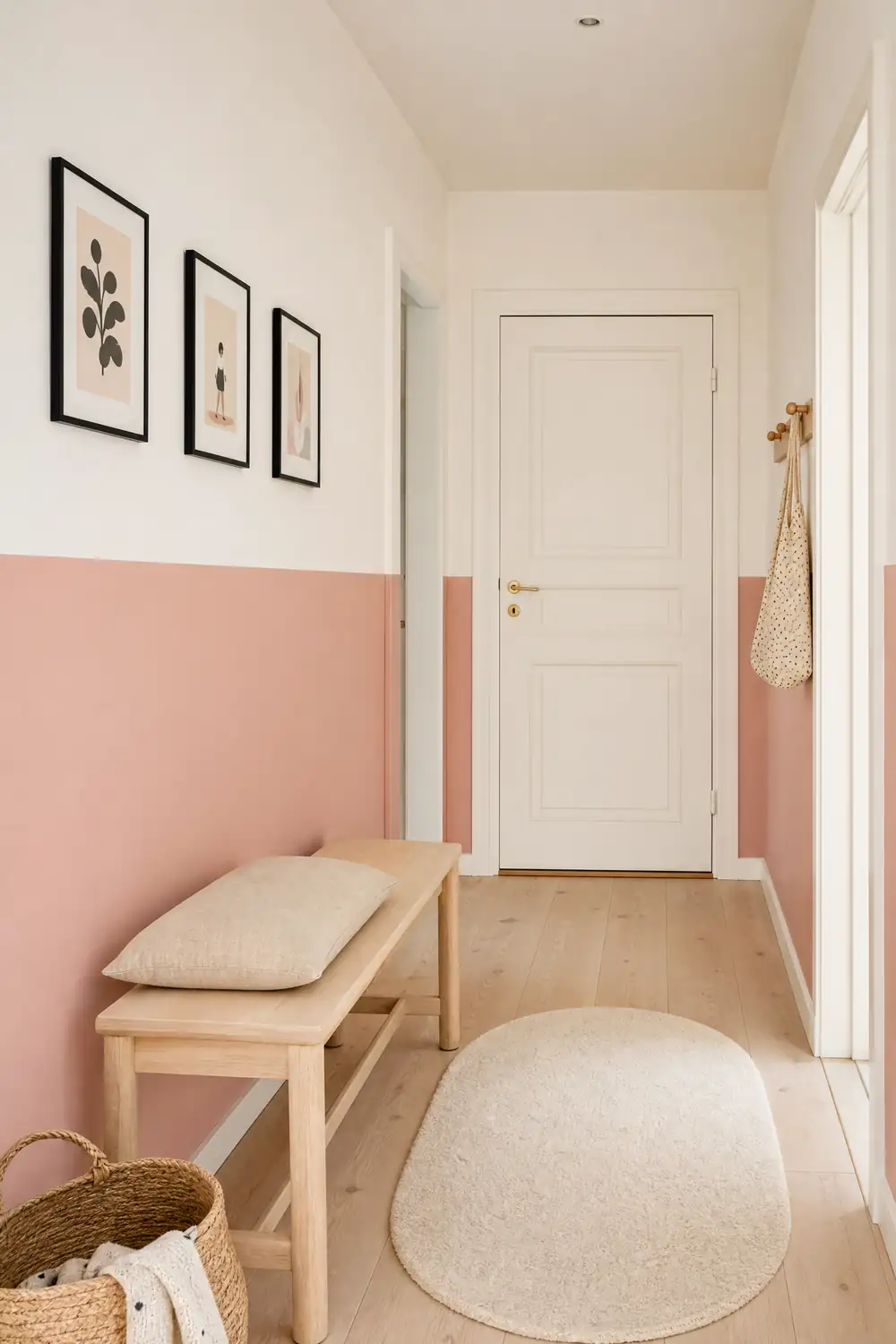
Soft Color Blocking with Warm Pastels
Contemporary Scandinavian design has quietly moved away from the all-white-everything look of the early 2010s toward a warmer, more considered palette that includes muted pastels used in unexpected ways. In the entryway, one version of this is color blocking: painting one wall or even just the lower third of the walls in a muted dusty rose, pale blush, soft butter yellow, or light moss green, while keeping the upper walls and ceiling in a clean warm white. The blocking is not dramatic or graphic but subtle, more of a gentle shift in tone than a deliberate contrast. Furniture and textiles in natural materials sit easily within this color story since the pastels are desaturated enough to read as neutrals rather than bold choices. This approach works particularly well in homes with children since the soft colors feel playful and welcoming without being loud. It also photographs beautifully in natural light. The budget implication is minimal since this is just a paint job, though achieving the right shade does require some testing since muted pastels can look washed out or overly pink depending on the quality and undertone of the specific paint.
Designer Advice: If you are unsure about color blocking, try it on the inside face of your front door first. It is a small surface, easy to repaint, and the impact is surprisingly strong.
The Decluttered Entryway with One Rule for Everything
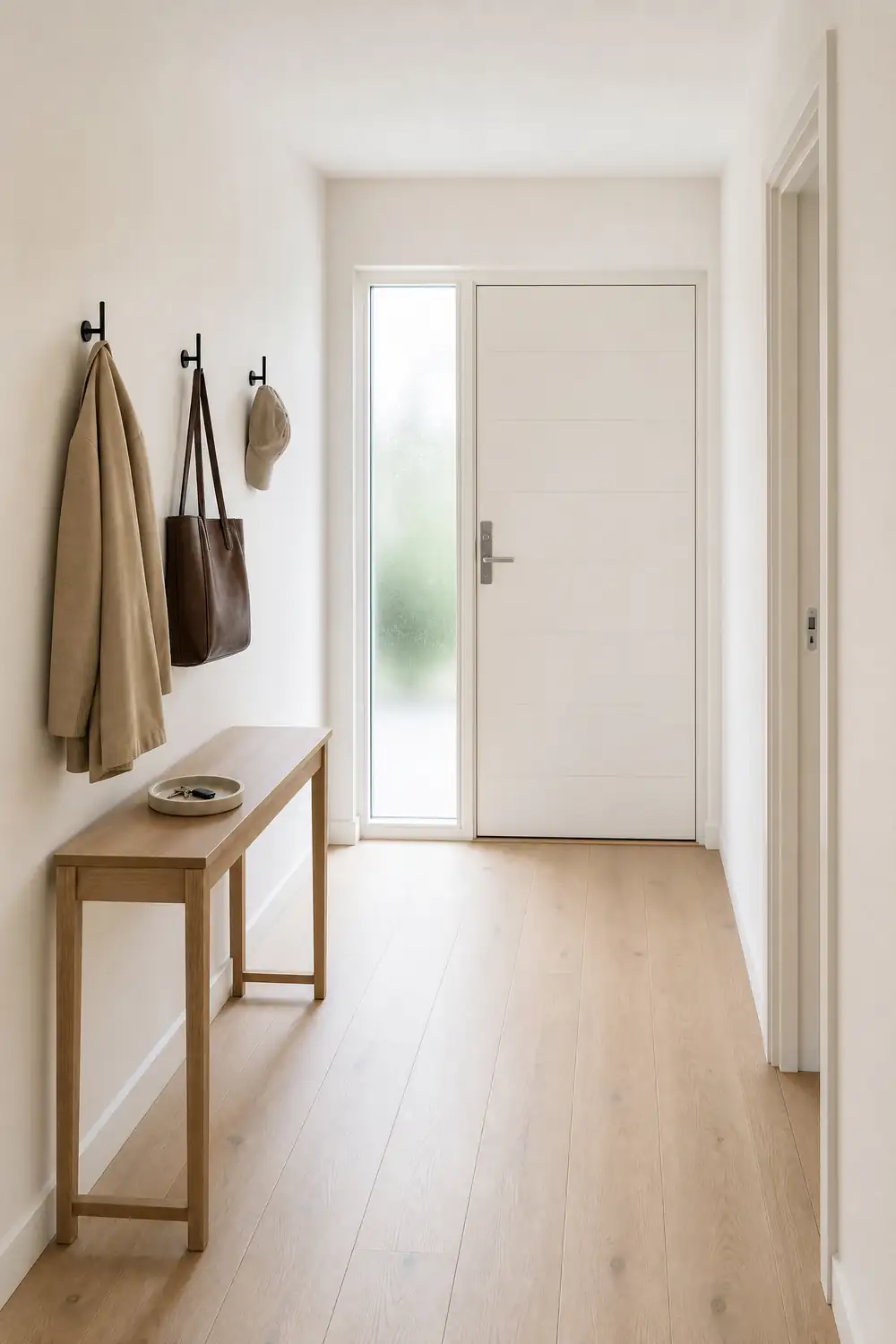
Perhaps the most purely Scandinavian idea on this entire list is also the simplest: the entryway that operates by a single household rule, and that rule is that nothing stays on the floor or on the bench unless it belongs there. This sounds obvious, but in practice it is the single change that makes the biggest difference between a hallway that feels like a Scandinavian design photograph and one that feels like a waiting room at a sports center. The furniture and materials can be anything on this list, but without the habit of putting things away properly, none of the aesthetic choices matter very much. The Scandinavian approach to this is practical and non-precious: give every item in the entryway a home, a hook for each coat, a basket for each person’s shoes, a tray for keys and mail, and a dedicated spot for the dog lead. When everything has a place, returning it to that place takes about ten seconds. The entryway stays calm, and the rest of the house benefits too since the transition from outside to inside is where clutter either gets contained or begins to spread. This is the most budget-friendly idea on the list because it costs nothing, but it requires genuine commitment, which makes it arguably the most demanding of all.
Designer Advice: Do a five-minute reset of your entryway every evening before bed. Nordic homes stay calm because their owners build small, consistent habits rather than occasional big tidying sessions.
Final Thoughts
What makes a Scandinavian entryway genuinely work is not any single piece of furniture or any particular shade of white paint. It is the combination of intention and restraint, the decision to choose things carefully, use them purposefully, and leave room for the space itself to breathe. Every idea in this list reflects that underlying principle in a different way, from the hygge warmth of candlelight to the rigorous calm of a built-in wardrobe that disappears into the wall.
You do not need to implement all twenty-five ideas. In fact, doing so would miss the point entirely. Pick two or three that genuinely suit your home, your family, and your daily routine. Start with the habits if you can, because a beautifully designed entryway filled with yesterday’s bags and last week’s mail is not a Scandinavian entryway at all. Start with what you already have, edit ruthlessly, and add only what earns its place.
The entryway is the first and last room you see every day. Making it feel calm, organized, and genuinely yours is one of the best investments you can make in your home, and it does not have to cost a fortune to get it right.
Frequently Asked Questions
What are the key features of a Scandinavian entryway?
A Scandinavian entryway typically combines light, neutral colors with natural materials like wood, wool, and linen. Function is central, so good storage for coats, shoes, and everyday items is essential. The space is kept deliberately uncluttered, with only a few carefully chosen decorative objects. Layered lighting, natural textures, and a sense of calm order are the most consistent features across Nordic hallway design.
What colors work best in a Scandinavian entryway?
Warm whites, soft off-whites, muted greys, and earthy neutrals like clay, taupe, and sand are the most common choices. Contemporary Nordic design has also embraced muted pastels and deeper accent tones like forest green, dusty blue, and warm charcoal as accent walls or lower wall colors. The key is always to use colors that feel soft and natural rather than bright or highly saturated.
How do I make a small entryway look Scandinavian?
Keep furniture off the floor as much as possible by using wall-mounted hooks, floating shelves, and slim console tables with legs rather than solid bases, since visible floor space makes a room feel bigger. Use a large round mirror to reflect light and add depth. Stick to a single light neutral color on the walls and keep decor to an absolute minimum, no more than two or three objects. A good runner rug in a natural fiber draws the eye down the length of the corridor and makes the space feel longer.
What furniture is essential for a Nordic entryway?
A bench or somewhere to sit while putting on shoes, some form of coat storage whether that is hooks, a peg rail, or a wardrobe, and a surface for everyday items like keys and bags are the three most essential pieces. A mirror is also close to essential in Nordic design since it is both practical and visually important for making the space feel open. Everything beyond these four elements is optional and should only be added if it genuinely serves a purpose.
Is Scandinavian entryway design expensive to achieve?
It does not have to be. Many of the most effective Scandinavian entryway ideas are also the most affordable, a coat of warm white paint, a secondhand oak bench, a few woven baskets, and a round mirror from a discount store can create a genuinely Nordic-feeling hallway for well under a hundred pounds or dollars. The more expensive route involves solid wood built-in storage and investment furniture from Scandinavian brands, but the principles of the style work at any budget. The most important investment is not financial: it is the habit of keeping the space clear.
How do I add warmth to a Scandinavian entryway without making it look cluttered?
Warmth in a Nordic entryway comes from material choices and lighting rather than from adding more objects. Natural wood, linen textiles, jute or wool rugs, and warm-toned lighting in the 2700K range all add warmth without adding visual noise. A single plant, one piece of handcrafted ceramic, or a sheepskin throw over a bench seat are all ways to introduce organic texture and warmth while keeping the overall look very clean. The rule of thumb is to add one warm element at a time and assess whether the space still feels calm before adding more.