Bedroom Mirror Ideas Worth Stealing Right Now

A bedroom can have everything right and still feel like something is off. Nine times out of ten, it is the mirrors: either there are none, or the one that is there is the wrong size, the wrong shape, or sitting in the wrong spot. Both problems have cheap, fast solutions that most styling articles never mention.
These 28 ideas show exactly what a well-chosen, well-placed mirror can do for a bedroom, and more importantly, how to make each one work in a real room.
1. The Oversized Leaning Floor Mirror That Makes a Small Room Feel Twice as Big

A full-length floor mirror leaned against the wall on the side of the room opposite the window is the single most effective way to expand the perceived size of a small bedroom. The mirror reflects the window light back across the room, doubles the visual depth of the space, and does all of this without any wall damage or commitment.
Pro Move: Go at least 65 inches tall for a leaning floor mirror. Anything shorter stops reflecting the ceiling and loses most of the space-expanding effect. Lean it at a slight angle forward so the reflection catches more of the room rather than just the wall behind it.
2. The Arched Mirror Above the Dresser That Anchors the Whole Wall

An arched mirror mounted or leaned above a dresser gives the wall a clear focal point and echoes the curved lines that feel most at home in bedrooms styled with soft, organic shapes. The arch adds height to a horizontal piece of furniture and makes the dresser look intentional rather than just placed.
Designer Advice: The mirror should be between two thirds and three quarters the width of the dresser below it. A mirror that is too narrow floats awkwardly; one that is too wide overwhelms the dresser and pulls the eye apart instead of together.
3. The Round Mirror on a Side Wall That Bounces Light Without Taking Over

A round mirror mounted on the wall perpendicular to the bed is the most feng shui-friendly and sleep-friendly option because it reflects light and space without pointing directly at the bed or the door. In practice, a 24 to 36 inch round mirror in a warm brass or matte black frame on a side wall adds brightness and visual interest while staying out of the way of the room’s energy flow.
Heads Up: Round mirrors with thin frames read as contemporary and minimal. Round mirrors with thick rattan, wood, or beaded frames read as warm and bohemian. The frame does almost as much design work as the mirror shape itself.
4. The Full-Length Mirror on the Back of the Closet Door

Mounting a full-length mirror on the inside of the wardrobe or closet door is the most practical placement in any bedroom because it serves as a dressing mirror, frees up floor and wall space, and stays completely hidden when the door is closed. This is also the placement recommended by both feng shui and Vastu Shastra practitioners for its minimal impact on sleep energy.
Quick Tip: An over-the-door mirror bracket means no drilling at all. For a cleaner look, use adhesive mirror strips that mount flush with no visible hardware, then peel off cleanly when you move.
5. The Gallery Cluster of Small Mirrors That Acts as Wall Art

Grouping three to five mirrors of different shapes but a matching finish, such as all brass-framed or all black, creates a gallery wall effect that functions as both art and light reflection. In a bedroom with limited natural light, a mirror cluster on the wall facing the window multiplies the brightness more effectively than any lamp.
Designer Advice: Lay the arrangement out on the floor before hanging a single one. The most common mistake with mirror clusters is hanging them too spread out, which makes them look like separate decisions. Keep the outer edges of the cluster within a 24 by 36 inch boundary for the arrangement to read as one cohesive moment.
| Mirror Cluster Size | Ideal Wall Space | Frame Finish to Use |
| 3 mirrors | 24 x 30 inches | Match all three exactly |
| 4 mirrors | 30 x 36 inches | Match finish, vary shape |
| 5 mirrors | 36 x 42 inches | Match finish, vary shape and size |
| 6+ mirrors | Full feature wall section | One finish family, mixed shapes |
6. The Vanity Mirror with Built-In Lighting for a Dressing Area

A dedicated vanity mirror with built-in LED lighting, mounted above a small desk or dressing table in the bedroom corner, creates a proper getting-ready zone that does not depend on the overhead light. Hollywood-style bulb mirrors give warm, flattering light from all angles; backlit LED mirrors give a cleaner, cooler look.
Reality Check: The color temperature of the bulbs in a vanity mirror matters enormously for how makeup looks in other lighting. A 3000K warm white bulb gives the most accurate read for natural daylight conditions. Cool white bulbs above 4000K will make makeup look different indoors than it does outside.
7. The Triptych of Three Arched Mirrors That Mimics a Window Wall

Three identical slim arched mirrors mounted side by side on one wall, spaced about two inches apart, create a triptych effect that reads like a row of arched windows from across the room. This works particularly well on a wall with no actual window, turning a blank surface into one of the most interesting focal points in the room.
Pro Move: Keep all three mirrors exactly the same height and alignment. Even a quarter-inch difference between frames becomes obvious once they are up. Use a laser level, not just a tape measure, and mark all three hanging points before touching a single nail.
8. The Antique or Vintage Mirror That Adds Character No New Piece Can Match

A mirror with an aged mercury glass surface, a carved ornate frame, or a distressed gilt finish brings a layer of history and warmth to a bedroom that brand-new pieces simply cannot replicate. In a room full of contemporary furniture, one vintage mirror creates the collected, considered look that interior designers call visual tension, where pieces from different eras make each other look better.
Quick Tip: Thrift stores, estate sales, and Facebook Marketplace consistently yield ornate vintage mirrors for $20 to $80 that would cost $300 to $500 new. The slight cloudiness of an old mercury glass surface is a feature, not a flaw.
9. The Slim Vertical Mirror That Makes Low Ceilings Feel Taller
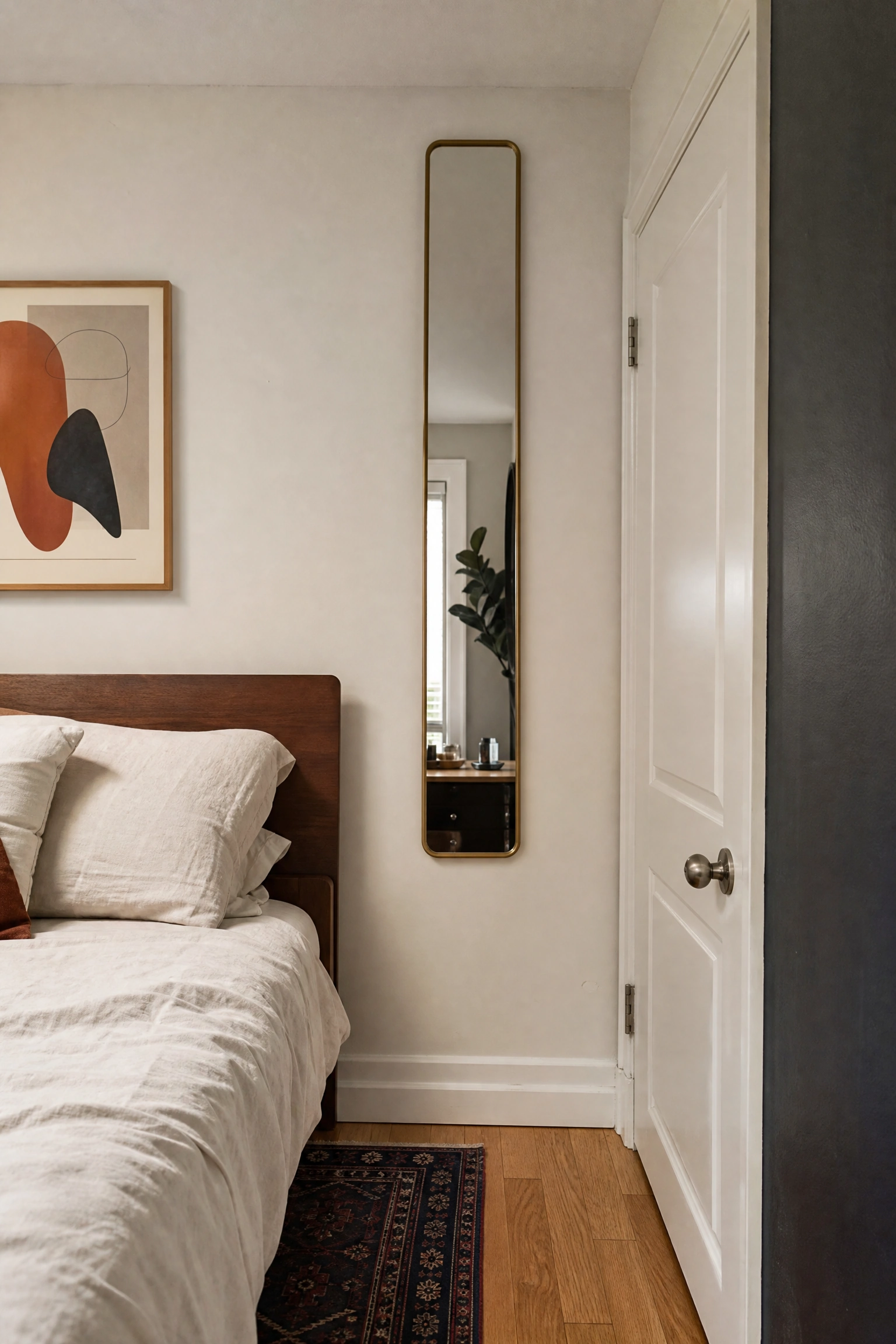
A narrow, tall mirror mounted vertically on the wall, something in the range of 12 inches wide by 48 to 60 inches tall, draws the eye upward and creates the illusion of a higher ceiling. This works especially well in apartments and older homes where ceiling height is under 8 feet, because the mirror reinforces the vertical lines of the room rather than the horizontal ones.
Heads Up: A vertical mirror only has its ceiling-raising effect when mounted higher on the wall, with the top of the frame at or above eye level. If the top sits below eye level it loses the upward pull and just reads as a narrow piece of art.
10. The Mirrored Wardrobe Doors That Double the Room Without Adding a Single Piece

Replacing standard wardrobe doors with mirrored panels is the highest-impact mirror upgrade in any bedroom because the surface area is enormous. A full wall of mirrored wardrobe doors doubles the perceived width of the room, reflects the window from across the space, and eliminates the need for a separate dressing mirror entirely.
Reality Check: Mirrored wardrobe doors with a slight bronze or antique tint are far more forgiving than plain clear glass. Clear mirrored doors show every fingerprint and smear immediately; bronze-tinted panels mask daily wear while still reflecting light effectively.
| Mirror Door Finish | Room Effect | Maintenance Level |
| Clear glass mirror | Brightest, most space-expanding | High – shows every mark |
| Bronze tinted mirror | Warm, flattering, vintage feel | Medium – hides daily smears |
| Smoked gray mirror | Moody, dramatic, contemporary | Medium – low contrast marks |
| Antique mercury finish | Aged, textured, characterful | Low – texture hides marks |
11. The Decorative Sunburst Mirror as a Bedroom Statement Piece

A sunburst or starburst mirror mounted above the bed or on a feature wall functions as sculptural wall art that also reflects light. The radiating frame catches and scatters light in a way flat mirrors cannot, and the organic, sun-like shape brings warmth and energy to a bedroom without requiring any additional decor around it.
Designer Advice: A sunburst mirror works best as a solo piece with clear space around it. Adding other framed art or objects nearby competes with the radiating frame and dulls the effect. Let it breathe and it will do all the work on its own.
12. The Leaning Mirror Propped Behind a Plant for a Styled Corner

Leaning a large floor mirror in a corner and positioning a tall plant, such as a fiddle leaf fig, a snake plant, or a faux olive tree, slightly in front of it creates a layered vignette that looks intentionally designed. The plant is reflected and doubled in the mirror, the greenery softens the hard reflective surface, and the corner transforms from wasted space into the most interesting part of the room.
Pro Move: The plant should sit between the mirror and the viewer, not beside it. When the plant overlaps the lower portion of the mirror, the reflection reads as a lush, layered moment rather than a plant placed near a mirror.
13. The Oval Mirror Above the Bed as a Soft Alternative to Art

An oval mirror hung above the bed in place of, or alongside, traditional wall art introduces a soft curved shape that contrasts beautifully with the rectangular geometry of the bed frame, headboard, and surrounding furniture. The oval format has enough visual weight to anchor the wall above a bed without the formality of a rectangular piece.
Quick Tip: An oval mirror above the bed should sit 6 to 8 inches above the top of the headboard. Any closer and it looks crowded; any further and it loses its connection to the bed and reads as a random piece of wall decor.
14. The Oversized Square Mirror That Creates a Clean, Architectural Look

A large square mirror, 30 by 30 inches or bigger, mounted flush on the wall brings a bold geometric presence to a bedroom that reads as considered and architectural rather than decorative. Square mirrors work particularly well in rooms with strong horizontal lines, such as low platform beds or floating shelves, because they introduce a contrasting geometry without clashing.
Designer Advice: Square mirrors in thin metal frames, particularly matte black or unlacquered brass, are the strongest version of this look. A thick ornate frame on a square mirror pulls it toward traditional; a frameless square mirror reads as modern and minimal.
15. The Mirror Placed to Reflect the Best View in the Room

The single most underused mirror placement principle is this: position the mirror to reflect the most beautiful thing in the room, whether that is a window with a garden view, a well-dressed bed, a piece of statement art, or a corner with good natural light. A mirror that reflects something worth seeing doubles the room’s best feature; a mirror placed without intention doubles whatever happens to be behind it, which is often clutter or a blank wall.
Reality Check: Before hanging any bedroom mirror, stand in its intended position and look at the wall where the mirror will go. Whatever you see directly behind you from that spot is what the mirror will reflect. If it is a pile of laundry or a flat white wall, move the mirror.
16. The Bronze or Warm Gold Frame That Pulls a Neutral Bedroom Together

In a bedroom with a neutral palette of cream, warm white, greige, or oatmeal, a mirror in a bronze, antique gold, or unlacquered brass frame adds the warm metallic note that keeps the room from reading as flat or unfinished. Bronze-framed mirrors are the 2026 replacement for the chrome and silver tones that dominated the previous decade, and they work with virtually every neutral backdrop.
Heads Up: Unlacquered brass frames will develop a natural patina over time, which most people find adds to their appeal. If you prefer the mirror to stay looking new, choose lacquered brass or a powder-coated brass-tone finish instead.
17. The Frameless Mirror That Disappears Into a Minimalist Bedroom

In a truly minimal bedroom where every object is chosen with restraint, a large frameless mirror mounted on the wall disappears into the space rather than announcing itself. It adds reflection and light without contributing any visual weight of its own, which makes it the right choice when the bed, the textile palette, or a single piece of furniture is meant to be the only focal point in the room.
Pro Move: Frameless mirrors look most intentional when they are genuinely large, at least 24 by 36 inches. A small frameless mirror reads as a bathroom mirror that ended up in the wrong room. Scale up and the frameless format reads as a deliberate architectural choice.
18. The Rattan or Wood-Framed Mirror That Adds Natural Texture

A mirror in a rattan, woven, or carved wood frame brings organic texture into a bedroom in a way that a painted metal frame cannot. This type of mirror works particularly well in rooms that lean coastal, bohemian, Japandi, or earthy, because the natural material of the frame ties directly into the textiles, furniture, and plants that define those aesthetics.
Quick Tip: A round rattan mirror between 24 and 30 inches works above a dresser, beside a bed, or as part of a gallery wall. A larger rattan floor mirror, 60 inches or taller, makes a strong statement in a bedroom corner and works well with a woven rug and a linen duvet.
| Frame Material | Works Best In | Pairs With |
| Rattan or woven cane | Boho, coastal, earthy bedrooms | Linen, jute, natural wood |
| Carved mango wood | Bohemian, global, eclectic rooms | Patterned textiles, warm neutrals |
| Solid oak or walnut | Japandi, Scandi, organic modern | Cream, sage green, warm gray |
| Unlacquered brass | Transitional, warm contemporary | Cream, terracotta, deep green |
| Matte black steel | Industrial, modern, minimalist | White, concrete tones, charcoal |
19. The Asymmetric or Irregular-Shape Mirror as a Sculptural Object

Asymmetric mirrors with one curved edge, an organic pebble outline, or an intentionally uneven shape are among the strongest design pieces in a bedroom because they function as wall sculpture first and mirrors second. An irregular-shaped mirror mounted on a plain wall needs nothing around it; the shape creates all the visual interest on its own.
Designer Advice: Asymmetric mirrors work best hung slightly off-center on the wall rather than perfectly centered. The deliberate imbalance of an off-center, asymmetric mirror reads as confident and considered; a perfectly centered asymmetric mirror can look like it was placed there because that was the only option.
20. The Pair of Identical Mirrors Flanking the Bed for a Symmetrical Look

Two matching mirrors, one on each side of the bed at the same height, create a balanced, formal symmetry that anchors the headboard wall without requiring a single large piece above the bed. This works especially well with slim rectangular or oval mirrors, which echo the vertical lines of bedside lamps and keep the composition light rather than heavy.
Quick Tip: Both mirrors must hang at exactly the same height or the symmetry collapses. Measure the center of each mirror from the floor, not from the top of the headboard, since headboards are rarely perfectly level.
21. The Mirror Used to Fake a Window in a Dark Bedroom
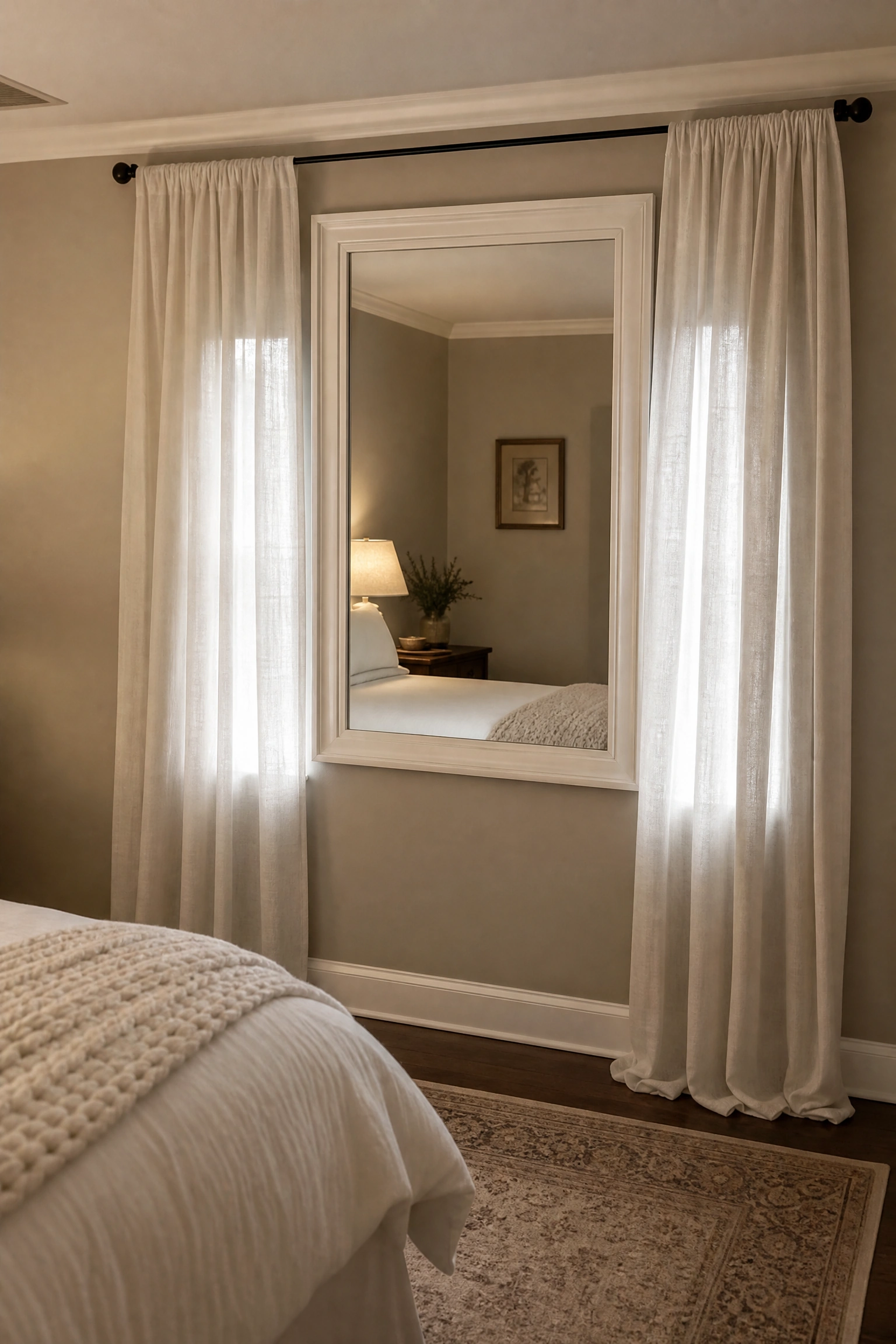
In a bedroom with no window or a window that faces a wall or fence, a large mirror mounted where a window would logically be, flanked by curtain panels on a full-width rod, creates the convincing suggestion of a window view. The mirror reflects the rest of the room back rather than showing sky, but the shape, scale, and surrounding curtains do enough visual work that the brain reads it as a light source.
Reality Check: This illusion works best with a mirror that has a slim white or wood frame and curtains in a sheer natural fabric. Heavy drapes or an ornate frame break the window impression immediately. The simpler the execution, the more convincing it reads.
22. The Propped Dresser Mirror with a Styled Tray Beneath It

Leaning a mirror against the wall above a dresser rather than mounting it creates a relaxed, unfussy look that suits casual and organic bedroom styles. The key to making it look finished rather than lazy is placing a small decorative tray at the base of the mirror on the dresser surface and grouping two or three objects inside it, such as a small vase, a perfume bottle, and a candle.
Designer Advice: Never place more than three objects on the dresser surface directly below a leaned mirror. The reflection doubles whatever is on the surface, so four objects become eight and the whole thing reads as crowded. Edit ruthlessly and the reflected version will look perfect.
23. The Fluted or Reeded Mirror Frame That Adds Depth and Texture

Mirrors with fluted or reeded frames, where the frame surface has vertical ridges running its length, are one of the strongest trending details in bedroom design for 2025 and 2026. The ridges catch light from different angles throughout the day, giving the mirror a three-dimensional quality that a smooth frame cannot match, and the vertical lines of the fluting add subtle height to the wall.
Heads Up: Fluted frames are available in plaster, gesso, resin, and real wood. Plaster and gesso versions are the most detailed and traditional-looking but the most fragile. Resin versions are nearly identical visually and far more practical for a bedroom where the mirror may be moved.
24. The Floor Mirror in the Corner as a Styling Station

A full-length floor mirror positioned in the corner of the bedroom, rather than flat against a wall, creates a natural dressing and styling station that does not require any furniture around it. Add a small hook on the wall beside it for tomorrow’s outfit, a low stool or ottoman in front for getting dressed, and the corner becomes the most functional square footage in the room.
Pro Move: Angling a corner floor mirror at 45 degrees between two walls means it reflects two different sections of the room at once, doubling the light-bouncing effect and giving a much wider view than a flat-against-the-wall placement.
25. The Smoked or Tinted Mirror for a Moody, Dramatic Bedroom
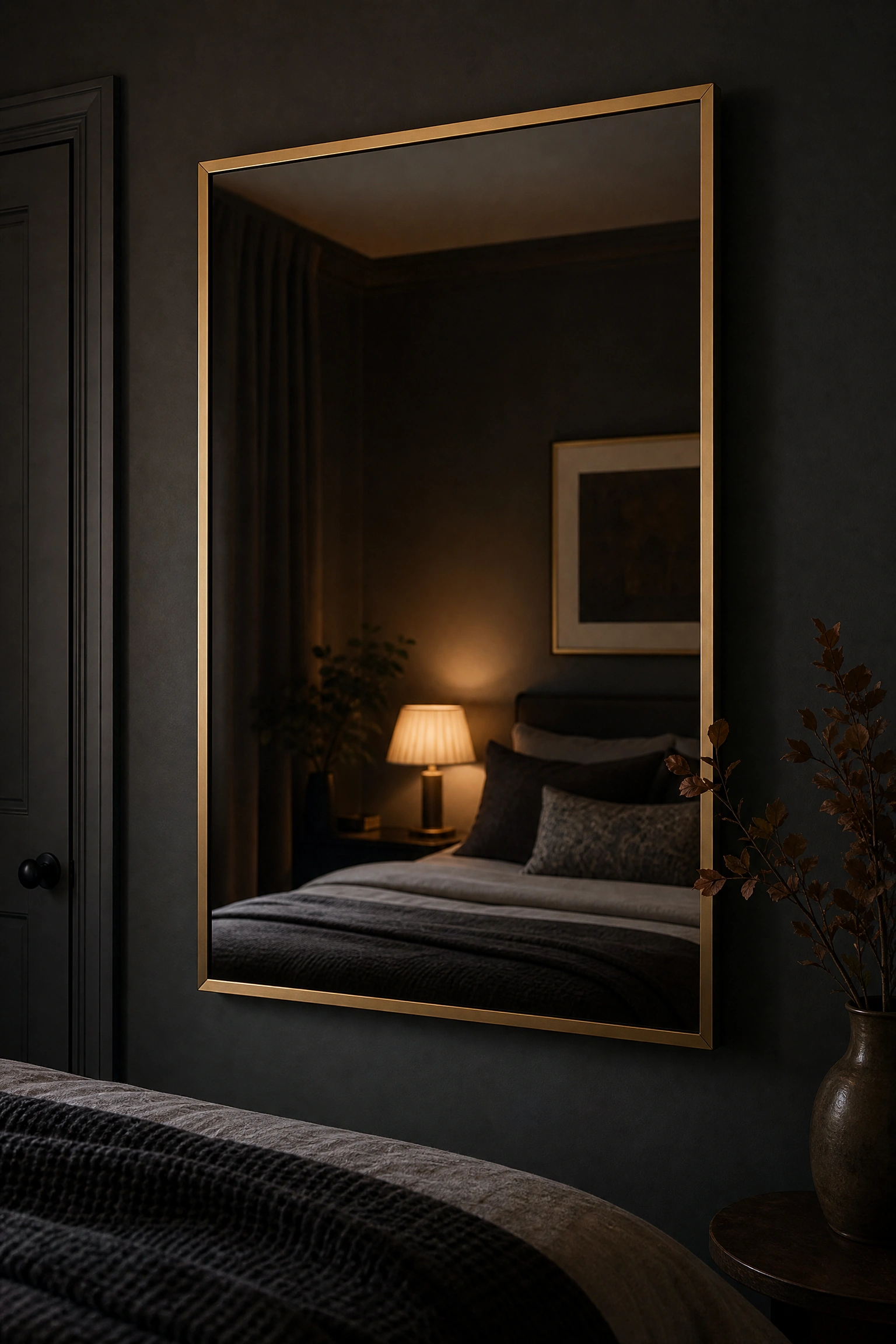
A mirror with a smoked gray or dark bronze tint reflects light and space while absorbing just enough of it to give the room a moodier, more intimate atmosphere than a standard clear mirror. Smoked mirrors are particularly effective in bedrooms with a dark or jewel-toned palette, where a clear mirror would create too much contrast and a bright reflection that fights the room’s atmosphere.
Designer Advice: Smoked mirrors work best in large formats. A small smoked mirror can read as a dark, flat object rather than a reflective surface. Go large, at least 24 by 36 inches, so the mirror reads as genuinely reflective even with its tinted surface.
26. The Mirror Above the Bed Used Instead of a Headboard

In a bedroom without a headboard, or in one where the headboard feels too heavy for the wall, a large horizontal mirror mounted above the bed at headboard height creates the same visual anchor without the bulk. A rectangular or wide oval mirror in this position defines the top of the bed, reflects the ceiling light downward into the room, and gives the wall above the bed a purpose without adding physical weight.
Quick Tip: A mirror used in place of a headboard should be at least as wide as the mattress, and ideally 6 to 12 inches wider on each side. Anything narrower reads as a decorative piece above the bed rather than a structural element defining it.
27. The Layered Mirror and Shelf Vignette That Turns a Wall into a Feature

Mounting a mirror on the wall and placing a narrow floating shelf directly below it, then styling the shelf with three to five carefully chosen objects, creates a vignette that gives a bedroom wall the layered, designed quality of a boutique hotel room. The mirror reflects the shelf display and doubles it, making the whole arrangement look twice as considered as it actually is.
Reality Check: The shelf should sit 4 to 6 inches below the bottom edge of the mirror. Closer than 4 inches and the shelf objects look crammed; further than 6 inches and the mirror and shelf read as two separate things rather than one composed moment.
28. The Slim Leaning Mirror Beside the Bed as a Nightstand Alternative

In a very small bedroom where there is no room for nightstands, a slim floor mirror leaned against the wall on one side of the bed serves as both a dressing mirror and a light-reflecting surface at the most useful position in the room. A narrow clip-on or adhesive hook on the mirror frame can hold a small light, and a tiny tray placed at the base on the floor holds a phone, a glass, and a book.
Heads Up: A leaning mirror beside the bed needs to be secured at the top with a furniture anchor strap to prevent tipping. This is a simple fix, takes under five minutes, and is worth doing even in a rental since the strap attaches to the wall with a small removable anchor.