Beige and Black Kitchen Ideas That Know Exactly How Much Black to Use

The beige and black kitchen is one of the most confident and consistently beautiful colour combinations in kitchen design, and it is also one of the easiest to get wrong. Too little black and the kitchen reads as unfinished, a beige room that never quite committed to anything. Too much black and the warmth of the beige disappears under a weight the room cannot carry. These 27 ideas move from the smallest possible black detail through to a fully black-dominant kitchen, so you can find the level of commitment that suits your space, your light, and your confidence. The lightest version of the combination is still a genuinely complete result; the bolder version rewards the rooms that can carry it.
1. Start with Black Hardware on Beige Cabinets

The smallest possible commitment to black in a beige kitchen is replacing the existing cabinet hardware with matte black handles, knobs, or bar pulls. Matte black hardware on beige Shaker or flat-front cabinets provides a graphic, deliberate contrast that immediately makes the kitchen read as intentionally designed rather than default, and it costs a fraction of any other change you could make. This is the entry point that consistently surprises people with how much difference a single small detail delivers.
Quick Tip: Choose hardware with a consistent profile across all cabinets rather than mixing bar pulls with knobs on the same door style. A consistent matte black bar pull from top to bottom is the most current and cohesive approach in 2025 kitchen design.
2. A Black Tap and Sink Fittings Against Beige Walls

A matte black mixer tap and matching sink fittings on a beige kitchen, whether wall-mounted above a butler sink or deck-mounted on the countertop, introduce black at the functional centre of the kitchen where it has maximum daily visibility without touching a single cabinet or countertop. The black fitting reads as a considered design detail rather than a colour decision, which is why it works in kitchens where the owner wants the effect of the palette without the permanence of painted surfaces.
Heads Up: Matte black tap finishes can be sensitive to limescale build-up in hard water areas. Look for taps with a PVD-coated finish rather than a painted one, as PVD-coated matte black is significantly more resistant to mineral deposits and everyday cleaning chemicals.
3. Black Pendant Lights Above a Beige Island or Worktop

Three black pendant lights hung in a row above a beige kitchen island or along the length of a run of beige cabinetry introduce the colour at ceiling level, where it catches the eye immediately and gives the room a vertical structure it would not otherwise have. Matte black pendants in a simple industrial or minimal silhouette work particularly well because they read as deliberate and architectural rather than decorative, and against beige walls or cabinetry they create a high-contrast moment that photographs beautifully.
Designer Advice: Position pendant lights so the bottom of the shade sits roughly 70 to 80 centimetres above the worktop surface. Too high and they fail to light the work area; too low and they interrupt sightlines across the island.
4. A Black Range Cooker as the Kitchen’s Hero Piece

A black range cooker set into a run of beige cabinetry is one of the most impactful single purchases in a beige kitchen because the range occupies an architectural position in the room and its black body provides a strong focal point that draws everything else in the kitchen toward it. Against warm beige cabinetry, a black range with brass or chrome knobs reads as professional and deeply considered, particularly when the surrounding tiles, oven housing, and extractor hood are chosen to frame rather than compete with it.
Pro Move: Brands like Falcon, Leisure, and Rangemaster offer black enamel range cookers at a wide range of price points. At the top end, Lacanche and La Cornue offer black with customisable trim colours, with brass trim being the most flattering complement to a beige kitchen.
5. Black Window Frames in a Beige Kitchen

Black-framed windows or Crittall-style internal glazing panels in a beige kitchen provide a structural, architectural application of black that costs nothing in cabinetry or fixtures but delivers an enormous amount of visual interest. The black frames create a grid of strong lines against the beige walls that reads as industrial-meets-warm, and the contrast between the dark frames and the beige interior is heightened every time natural light enters the room and catches the frame edges.
Reality Check: If replacing window frames is not an option, black window frame paint applied carefully to existing timber frames achieves the same visual effect at a fraction of the cost. Several paint brands offer metal-effect black paints specifically formulated for window and door frames.
6. A Black Countertop on Beige Lower Cabinets

A matte black or honed black stone countertop on beige lower cabinets is one of the most considered and immediately impactful applications of the palette. The horizontal black plane of the worktop runs the full length of the kitchen at working height, which is where the eye spends the most time, and against beige cabinetry beneath it the contrast is sharp, warm, and genuinely beautiful. Black granite, honed black quartz, or black soapstone are the most used materials here, each with a slightly different surface quality and maintenance demand.
Heads Up: Honed or matte black stone countertops show water marks and fingerprints more clearly than polished versions. In a high-use kitchen, a polished or leathered black granite is more practical to maintain than a fully flat matte surface.
Black Finish Guide for a Beige Kitchen: What to Know Before You Choose
| Black Finish | How It Reads | Best Beige Pairing | Watch Out For |
| Matte flat black | Velvety, warm, absorbs light | Warm sand or honey beige | Shows fingerprints heavily |
| Satin black | Slight sheen, easy to clean | Cream or warm off-white beige | More reflective than expected in strong light |
| Gloss black | Reflective, dramatic, expansive | Cool greige or pale stone beige | Shows every mark; needs constant cleaning |
| Textured black | Industrial, tactile, hides marks | Raw linen or natural oat beige | Harder to deep clean in grooves |
| Black-veined marble | rich, organic, grounded | Warm ivory or pale caramel beige | Natural stone requires sealing and careful maintenance |
7. A Black Backsplash Behind Beige Cabinets

A black tile backsplash on the splashback zone behind the hob or across the full run between upper and lower cabinets gives the beige kitchen its most concentrated area of dark contrast at a height where the eye naturally rests when working at the worktop. Black metro subway tiles, black slate, black Zellige, or large-format matte black porcelain all work well because they provide the dark backdrop that makes beige cabinetry above and below appear richer and more deliberate by comparison.
Designer Advice: Use a dark or black grout rather than a white grout with black tiles. White grout between black tiles creates a grid that competes with the tile colour for attention; dark grout makes the tiles read as a continuous dark surface and the overall effect is far more considered.
8. Black Open Shelving Against Beige Walls

Black powder-coated steel floating shelves or black-stained timber shelves mounted on beige kitchen walls give the room a graphic, editorial quality that painted cabinets rarely achieve. Because open shelves have no doors to close, the styling of the objects on them becomes part of the design, and black shelves against beige walls make a particularly beautiful backdrop for a mix of cream ceramics, natural wood boards, green-leafed plants, and a few dark or black objects that tie back to the shelves themselves.
Quick Tip: Limit open shelving to one wall in the kitchen rather than replacing all upper cabinets with open shelves. A full kitchen of open shelves requires constant styling discipline that most people find impractical in daily life; one wall of open black shelving is a manageable, beautiful design feature.
9. Black Lower Cabinets with Beige Upper Cabinets

Two-tone cabinetry with black on the lower cabinets and beige on the upper cabinets is the most used and most reliable distribution formula in the beige and black kitchen. The black lower cabinets ground the room with weight and contrast while the beige upper cabinets keep the room feeling light and open above eye level. The worktop sits between the two, ideally in a material that contains both tones, such as a black-veined marble, a warm grey stone, or a natural timber that bridges the dark base and the lighter top.
Pro Move: The beige used for the upper cabinets should always be warmer and slightly more yellow in tone than a standard white. A cool or blue-tinged off-white against black lower cabinets can read as clinical; a warm sand or honey beige reads as rich and considered.
10. A Black Kitchen Island in a Beige Perimeter Kitchen

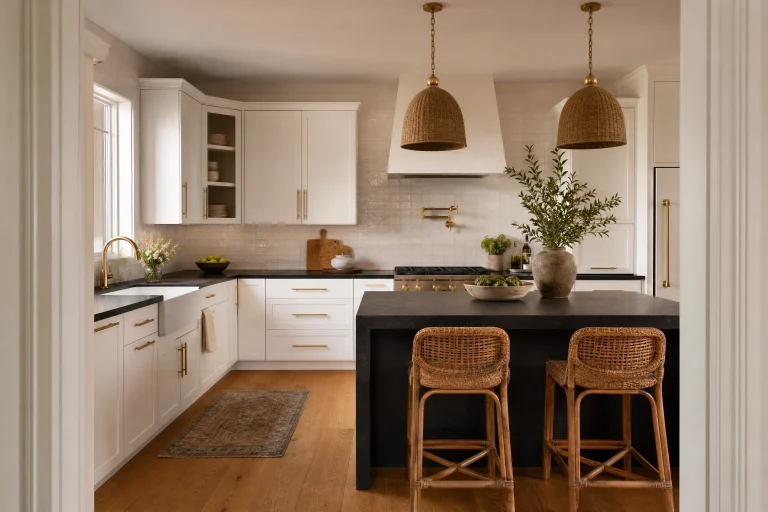
A black painted or lacquered island in a kitchen where the surrounding cabinetry is entirely beige creates a focal point that makes the island feel like a piece of furniture rather than a fitted unit, which is precisely the quality that high-end kitchen designers aim for when they specify an island in a contrasting colour. The beige perimeter disappears slightly into the background while the black island becomes the room’s visual and functional centre, especially when paired with bar stools in a warm linen or leather.
Designer Advice: A waterfall countertop, where the worktop material runs down the side of the island to the floor, looks particularly dramatic in a black island against a beige kitchen because it turns the island into a sculptural object rather than a box with a lid.
11. Black-Framed Glass Cabinet Inserts on Beige Cabinets

Replacing the central panel of two or four upper cabinet doors with black-framed glass inserts gives the beige kitchen an instant layer of architectural detail without changing the cabinet colour at all. The black metal frame of the glass panel creates a grid of dark lines against the beige cabinet body, and the glass reveals the interior of the cabinet, which becomes a display opportunity for cream crockery, glass vessels, or anything else that benefits from being seen rather than hidden.
Reality Check: Glass-fronted cabinets require the interior to be styled consistently at all times. If the interior organisation of the cabinet is likely to be chaotic in everyday life, consider choosing just two cabinet doors for glass inserts rather than all the upper cabinets, limiting the styling commitment.
12. A Black Apron or Butler Sink in a Beige Kitchen

A black fireclay or cast iron apron sink, sometimes called a butler sink, set into a beige cabinet run brings a strong material and colour presence to the kitchen’s most used functional zone. Black apron sinks have a weight and substance that stainless steel sinks rarely communicate, and against beige cabinetry, the contrast between the dark sink body and the warm cabinet fronts is one of those kitchen combinations that looks quietly expensive without trying to look expensive.
Quick Tip: Fireclay black sinks are significantly more chip-resistant than cast iron enamel ones. In a busy kitchen where heavy pots are used regularly, a fireclay sink in matte black will maintain its appearance more reliably than an enamel equivalent.
13. Black Skirting Boards and Toe Kicks in a Beige Kitchen

Painting the kitchen skirting boards and cabinet toe kicks in a matte black while the cabinets themselves remain beige grounds the entire kitchen with a thin, graphic band of dark colour at floor level that gives the room a precision and intentionality that few other details can match. The black toe kick visually lifts the cabinets off the floor and makes them appear to float slightly, which is a technique borrowed from high-end fitted furniture design and one that makes even standard kitchen units read as more considered.
Designer Advice: Use the same black on both the toe kicks and the skirting boards throughout the kitchen. Inconsistency between the two, such as black toe kicks and white skirting, draws attention to the junction between the cabinet base and the wall and makes both look like they were chosen separately.
14. Matte Black Appliances Alongside Beige Cabinetry

A suite of matte black appliances, specifically a freestanding fridge, a dishwasher panel, and a microwave, alongside beige cabinetry gives the kitchen a monolithic, editorial quality that stainless steel or white appliances never achieve against warm beige tones. The matte black absorbs light rather than reflecting it, which prevents the appliances from standing out as individual objects and makes them read as a continuous, deliberate part of the kitchen’s colour story.
Heads Up: Matte black appliance finishes are more sensitive to scratching and abrasive cleaning products than brushed steel or white. Always clean matte black surfaces with a soft damp cloth and avoid any cleaning product with an abrasive component, including most standard multipurpose kitchen sprays.
15. Black Grout with Beige Tiles for a Graphic Floor or Backsplash

Using black grout between standard beige or cream floor tiles or backsplash tiles transforms a plain neutral tiled surface into a graphic pattern that reads as both bold and warm simultaneously. The beige tile remains the dominant colour but the black grid lines between them create a deliberate visual structure that makes the floor or wall feel designed rather than default. This is one of the most cost-effective ways to introduce significant visual contrast into a beige kitchen without changing the tile itself.
Pro Move: Epoxy grout in black maintains its colour significantly better than cement-based black grout, which tends to fade to a dark grey over time especially in areas exposed to water, steam, and UV light. The epoxy option is more expensive to install but delivers a much longer-lasting result.
16. A Beige Linen Roman Blind with Black Piping or Border

A Roman blind in a warm beige linen with a black border, black piping at the hem, or a black fabric edging at the sides gives the kitchen window a tailored, couture quality that a plain beige blind never achieves. The black detail on the blind ties the window treatment to the black hardware or countertop elsewhere in the kitchen, which creates a colour thread running through the space at window level that makes the room feel designed from top to bottom rather than in isolated zones.
Quick Tip: A contrast-piped or contrast-bordered blind is straightforward to have made by any blind or curtain maker and adds very little to the cost of a standard bespoke blind. It is the most precise and controllable way to introduce black as a detail without any commitment to painted surfaces or fixed materials.
17. Black Bar Stools at a Beige Island

Matte black bar stools at a beige kitchen island or breakfast bar introduce black at a furniture level that is entirely removable and replaceable, making this one of the highest-impact and lowest-commitment applications of the palette. The black seating grounding the island visually and stopping it from appearing lightweight, and when the stools have a warm timber seat pad or a leather cushion in a tan or caramel tone, the contrast between the black frame and the warm seat material ties back to the beige of the surrounding kitchen.
Reality Check: All-matte black metal bar stools can feel cold in a kitchen that leans warm and organic. Adding a natural timber or leather seat pad to a matte black metal stool base gives you the graphic black frame while keeping the place where people actually sit in a material that feels warm to the touch.
18. A Black Feature Wall Behind Open Shelving in a Beige Kitchen

Painting a single kitchen wall in a deep matte black and mounting open shelves in natural timber or warm brass against it, within an otherwise fully beige kitchen, creates a contained moment of high drama that reads as an interior design decision rather than a colour scheme. The black wall behind the shelves makes every object displayed on them appear more carefully considered, and the warmth of the timber shelves bridges the dark wall and the surrounding beige kitchen cleanly.
Designer Advice: The black wall works best as the wall that holds the least functional storage, typically the wall without the hob or the sink. A black feature wall at the utility end of the kitchen draws attention to the mess of daily cooking; one at the display end draws attention to beautiful objects.
19. Black-Veined Marble Countertop as the Kitchen’s Statement Surface

A countertop in a black-veined white or cream marble, such as Calacatta Nero or similar stone with strong dark veining on a pale ground, introduces the black into the beige kitchen through the countertop surface in a way that reads as natural rather than painted. The black veins in the marble connect visually to any black hardware or fittings elsewhere in the kitchen, and the pale ground of the marble sits naturally with the beige cabinetry beneath it, creating a surface that does the colour bridging work without requiring any additional design decisions.
Heads Up: Natural marble with black veining requires sealing before use and resealing annually. Unsealed marble stains from acids including lemon juice, wine, and coffee almost immediately. If the kitchen is used intensively, a black-veined quartz engineered stone offers a virtually identical appearance with zero porosity and no sealing requirement.
20. Beige Cabinets with a Full Black-Painted Ceiling
Painting the kitchen ceiling in a deep, flat black while the walls and cabinets remain in warm beige creates an intimacy and drama overhead that makes the kitchen feel like a considered, architectural space rather than a standard room with furniture in it. The black ceiling absorbs the light from above and pushes the room’s warmth downward toward the beige surfaces, which appear even richer and more saturated by contrast. This approach works particularly well in kitchens with high ceilings that would otherwise feel cavernous.
Pro Move: Paint the ceiling cornice or coving in the same black as the ceiling rather than in white. Taking the black all the way to the wall creates a more immersive, intentional effect; stopping it at the cornice with a white break makes the ceiling look like a painting accident rather than a decision.
21. A Beige and Black Chequerboard or Geometric Floor
A chequerboard floor in alternating black and beige or cream tiles brings the two colours of the palette together at floor level in a way that is graphic, joyful, and historically rooted in classic kitchen design from Georgian townhouses through to French farmhouses and mid-century American diners. Against beige cabinetry above, the chequerboard floor reads as bold without feeling chaotic because both colours of the pattern are already present in the kitchen’s wider palette.
Designer Advice: The scale of the chequerboard tile matters significantly. Very small tiles, around 10×10 centimetres, read as busy and can feel retro in the wrong way. Larger tiles at 30×30 centimetres or above read as more contemporary and give the pattern room to breathe across the kitchen floor.
22. Black Upper Cabinets with Beige Lower Cabinets
Reversing the conventional two-tone distribution and placing black on the upper cabinets and beige on the lower ones produces a kitchen that reads as darker and more dramatic at ceiling level and lighter at worktop level, which is a counterintuitive but genuinely beautiful arrangement when it is done with intention. The black upper cabinets feel enveloping and rich when combined with a warm-toned light fitting overhead, and the beige lower cabinets with a pale countertop keep the work surface zone feeling practical and bright.
Heads Up: Black upper cabinets require significantly more light than beige uppers to prevent the kitchen from feeling dark at ceiling level. Under-cabinet LED lighting at the worktop level and a warm statement pendant or chandelier above the island are essential rather than optional in this configuration.
23. A Full Beige and Black Farmhouse Kitchen
A farmhouse kitchen with shaker-style cabinetry in a warm beige or putty tone, black cast iron range cooker, black hardware, a black butler sink, and a black-veined stone worktop brings every element of the palette together into a cohesive scheme that leans traditional and confident. The warmth of the beige shakers, the patina of the cast iron range, and the hardness of the dark stone combine in a way that feels genuinely timeless rather than trend-driven, because farmhouse black-and-neutral kitchens have existed in some form for centuries.
Quick Tip: Aged brass or unlacquered bronze hardware is more flattering than pure matte black in a beige farmhouse kitchen because the warm metal sits between the beige and the black rather than creating a third colour. Use matte black for functional fittings like the tap, and aged brass for the decorative hardware on cabinet doors.
24. A Beige and Black Japandi Kitchen
A Japandi-style kitchen, drawing from Japanese minimalism and Scandinavian warmth, uses beige and black in their most restrained and precise forms: flat-front cabinetry in a warm oat or sand beige with no visible hardware, a honed black stone countertop, black recessed integrated handles, and a single matte black tap as the only surface-level black detail. Every element is chosen for its material quality and its proportion rather than for decoration, and the result is a kitchen that reads as genuinely considered without any surface-level embellishment.
Designer Advice: In a Japandi kitchen, the quality of the beige matters more than in any other style. A yellowish or greenish beige will undermine the scheme; look for a beige with warm grey undertones, sometimes described as putty, greige, or warm stone, which sits correctly alongside honed black stone and minimal hardware.
25. Black Fluted or Reeded Cabinet Fronts on a Beige Kitchen Island
Fluted or reeded cabinet fronts in matte black on the island specifically, while the perimeter cabinetry remains in beige, give the island an entirely different material and textural character from the surrounding kitchen and make it read as a piece of furniture with real design presence. The vertical grooves of the fluting catch light and shadow throughout the day in a way that flat black fronts do not, and the texture brings a craft quality to the black surface that prevents it from reading as simply dark.
Pro Move: Fluted black cabinet fronts on an island are one of the most photographed kitchen details in current interior design publishing. They combine a current trend in surface detailing with the enduring appeal of the beige and black palette in a way that will continue to look considered for years beyond the initial trend cycle.
26. A Black and Beige Open-Plan Kitchen with a Dark Zone and Light Zone
In a large open-plan kitchen, deliberately designating one zone as the dark zone and one as the light zone, with the cooking and preparation area in black cabinetry and the dining or casual seating zone in beige or natural timber, creates a spatial hierarchy that makes a large kitchen feel intentionally planned rather than uniformly fitted. The transition between the black cooking zone and the lighter, warmer eating zone also mirrors the functional transition of the space, which gives the design logic a practical basis as well as an aesthetic one.
Reality Check: The boundary between the dark and light zones should be marked by a clear architectural element, a change in ceiling height, a beam, a change in flooring, or a peninsula, rather than simply a change in cabinet colour mid-run. A zone change without an architectural marker looks like a renovation that ran out of the same paint.
27. The Full Commitment: A Predominantly Black Kitchen with Beige Accents
A kitchen that is primarily black, with beige present through the countertop, the walls between and above cabinets, and the bar stools or flooring, produces the most dramatic and the most confident version of the beige and black palette. The black envelops and the beige breathes, and in a kitchen with good natural light, this combination reads as genuinely rich rather than oppressive. The key is keeping the beige surfaces free of clutter and ensuring the lighting is warm, layered, and generous at every level of the room.
Designer Advice: A predominantly black kitchen requires at least 20 percent beige or warm neutral as a visual breathing space. If the black drops below 20 percent beige in the room, it tips from dramatic to claustrophobic. Use the beige countertop, warm walls, and natural timber flooring to reach that proportion before committing to installation.
Final Thoughts
The question with beige and black is never whether they work together. They always do. The question is always how much black, where it goes, and what finish it wears. Start with the smallest black detail you feel comfortable with, whether that is a tap or a handle or a pendant, and let the room tell you if it wants more. It almost always does.