Grey Bathroom Vanity Ideas That Work in Any Style

A grey vanity is the bathroom decision that almost never gets revisited. That permanence is exactly why getting the grey right matters more here than almost anywhere else in the house. Once it is in, it tends to stay, and the reason is that grey works alongside nearly everything else in a bathroom, from warm brass to cool chrome, from marble to timber, from white tiles to dark stone. Here is what works to style grey vanities.
Pair Charcoal Grey Shaker Vanities with Polished White Calacatta Quartz Tops

Pairing a dark charcoal grey shaker vanity with a polished white Calacatta quartz countertop creates a striking high-contrast centerpiece. The crisp white quartz featuring subtle grey and amber veining lightens dark charcoal cabinetry while echoing neutral undertones in surrounding wall tiles. Add brushed brass hardware for warm shine.
DESIGNER ADVICE: Choose warm white quartz with delicate grey veining to tie into charcoal wood paint tones naturally.
Combine Light Dove Grey Floating Vanities with Warm Brass Hardware

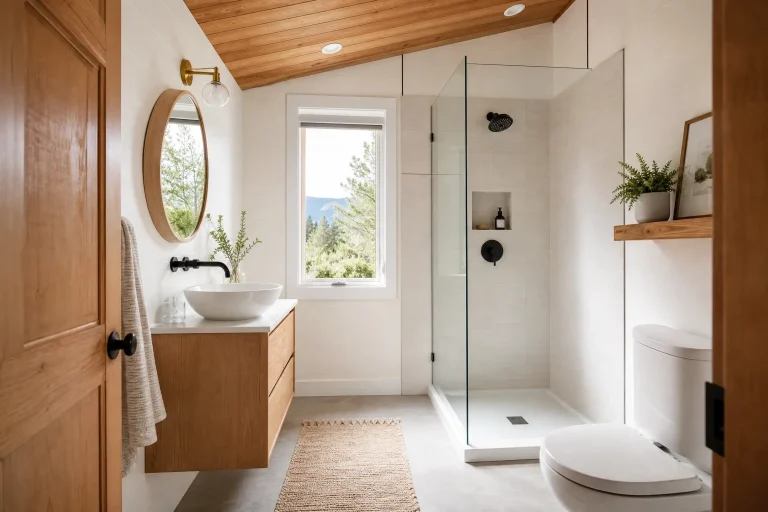
Mounting a wall-hung light dove grey vanity off the floor creates an airy, spacious bathroom layout that maximizes visible floor area. The pale grey cabinet paint provides a soft neutral base, while golden brass faucets and handles add warm metallic reflections. Illuminate underneath with warm LED strips.
QUICK TIP: Mount floating vanities thirty-four inches above floor level for comfortable ergonomic standing height.
Install Glossy White Zellige Backsplash Tiles Behind Dark Slate Grey Vanities

Lining the vanity backsplash with handcrafted glossy white Zellige tiles introduces dynamic surface texture behind dark slate grey cabinets. The irregular, hand-cut glazed ceramic tiles catch natural window light, reflecting soft shimmer across grey counter surfaces while protecting drywall.
QUICK TIP: Select light grey grout to highlight the handmade edge variations of Zellige tiles softly.
Pair Soft Greige Vanities with Natural Walnut Floating Shelves Overhead

Combining a soft greige (grey-beige) vanity cabinet with thick natural walnut floating wood shelves overhead establishes a cozy organic balance. The warm chocolate tones of natural walnut grain break up grey wall spaces, providing open display storage for folded linen towels and candles.
DESIGNER ADVICE: Display white ceramic bath jars on walnut shelves to create clean contrast against greige walls.
Add Matte Black Faucets and Handles to Slate Grey Vanity Drawers

Outfitting a slate grey vanity with matte black handles and widespread faucets introduces crisp, contemporary graphic contrast. The dark black metal lines ground medium grey paintwork, giving traditional shaker cabinetry a sleek modern industrial refresh. Hardware wipes clean easily.
MAINTENANCE RULE: Wipe matte black hardware with soft microfiber towels to prevent white water spots from mineral deposits.
Frame Dark Charcoal Vanities with Light Ash Hardwood Floor Planks

Setting a dark charcoal grey vanity over wide-plank light ash hardwood flooring creates a balanced timber visual foundation. The pale blonde ash floorboards reflect natural sunlight upward, illuminating dark charcoal drawers and keeping compact bathrooms feeling spacious.
MAINTENANCE RULE: Apply clear matte polyurethane to light ash floors to protect timber from daily bath moisture.
Install Taj Mahal Quartzite Countertops Over Medium Grey Shaker Cabinets

Selecting a Taj Mahal quartzite slab featuring warm cream tones and amber veining over medium grey shaker cabinets adds durable natural luxury. The hard quartzite stone offers marble-like elegance with superior scratch resistance, while beige stone tones temper cool grey wood paint.
MAINTENANCE RULE: Seal natural Taj Mahal quartzite counters annually with penetrating sealer to guard against oil stains.
Pair Soft Grey Vanities with Pale Blush Pink Painted Bathroom Walls

Coating bathroom walls in pale blush pink paint beside a soft grey vanity unit creates a delicate, romantic color pairing. The warm pastel pink paint tempers cool grey cabinetry, infusing compact bathing spaces with cheerful morning warmth. Add polished brass mirror frames.
STYLE SECRET: Use matte or eggshell paint finishes on blush pink walls to keep color soft and diffuse glare.
Add Clear Glass Vessel Sinks to Charcoal Grey Vanity Station Countertops

Mounting clear tempered glass vessel sinks atop charcoal grey vanity countertops creates an airy, sculptural washing station. Sunlight penetrates transparent glass basins, casting dancing light reflections across dark quartz counters and dark charcoal cabinet doors.
QUICK TIP: Clean glass vessel sinks with vinegar solutions to remove hard water mineral rings naturally.
Combine Light Grey Perimeter Vanities with a Dark Slate Linen Cabinet Base

Designing a custom bathroom layout featuring light grey vanity drawers paired with a tall dark slate grey linen storage tower builds visual depth. The dark slate tower anchors room corners, while light grey drawers bounce daylight across central sink prep areas.
DESIGNER ADVICE: Use matching hardware finishes across both light and dark grey cabinets to unify two-tone layouts.
Install Under-Vanity Warm 2700K LED Strip Lights Beneath Floating Grey Units

Mounting concealed warm 2700K LED strip lights under the lower edge of floating grey vanities casts a gentle golden pool of light across floor tiles. The hidden task lighting illuminates floorboards without glaring in dark morning hours, serving as a subtle nightlight.
QUICK TIP: Install motion-sensor switches on under-vanity lights for automatic illumination during night visits.
Pair Rich Charcoal Grey Vanities with White Carrara Marble Backsplashes

Lining vanity backsplashes with white Carrara marble tiles featuring subtle grey veining delivers classic stone luxury to charcoal grey cabinets. The bright white marble surface reflects vanity mirror lighting, while soft grey mineral veins echo charcoal cabinet paintwork.
MAINTENANCE RULE: Seal Carrara marble backsplashes every six months to protect natural stone from soap splatters.
Add Oil-Rubbed Bronze Knobs to Rustic Grey Barn-Door Vanity Drawers

Outfitting a rustic grey oak vanity featuring sliding barn-door panels with dark oil-rubbed bronze hardware adds craftsman character. The dark bronze metal grounds weathered grey wood stains, creating a durable grip while highlighting timber grain variations. The metal ages gracefully.
MAINTENANCE RULE: Wipe oil-rubbed bronze hardware with soft microfiber cloths to maintain protective wax coatings.
Combine Light Grey Vanities with a Slate Grey Quartz Waterfall Edge

Topping a light grey vanity unit with a slate grey quartz slab that cascades down the side in a waterfall edge creates a modern focal point. The dark matte grey stone waterfall sides extend to floor tiles, framing pale grey drawers in contemporary stone architecture.
DESIGNER ADVICE: Ensure quartz waterfall edges are precision-mitered for seamless grain alignment down cabinet sides.
Pair Greige Lime-Wash Accent Walls with Dark Grey Vanity Cabinets

Coating walls in a soft greige lime-wash plaster finish creates a chalky, textured backdrop around dark grey vanity cabinets. The subtle variegated tones in lime-wash paint absorb glare, creating a soft background that lets dark grey cabinet joinery stand out cleanly.
DESIGNER ADVICE: Apply lime-wash paint in light overlapping strokes to build multidimensional plaster texture.
Install Vertical Off-White Beadboard Paneling Below Medium Grey Vanities

Fitting vertical beadboard paneling painted in soft off-white behind counters introduces classic cottage texture beneath medium grey vanities. The vertical grooves draw subtle shadow lines that make vanities feel elevated, while off-white paint brightens grey timber shadows.
BUDGET HACK: Use semi-gloss water-resistant enamel on beadboard paneling so water splashes wipe clean easily.
Pair Dark Slate Grey Vanities with Light Beige Travertine Floor Tiles

Laying down unfilled light beige travertine stone floor tiles beneath dark slate grey vanities brings natural limestone texture underfoot. The pale tan stone variations lighten the heavy visual weight of dark slate paint, creating a warm Mediterranean-inspired foundation.
SAFETY WARNING: Apply non-slip sealers to natural travertine floor tiles to prevent slipping when wet.
Add Polished Chrome Handles to Flat-Panel Modern Grey Vanity Drawers

Fitting transitional flat-panel grey drawers with polished chrome handles introduces cool silver metallic shine that brightens grey wood. The high-gloss chrome metal reflects room light like a mirror, providing a crisp modern accent against neutral paintwork.
QUICK TIP: Wipe polished chrome handles regularly with microfiber cloths to remove water spots naturally.
Pair Grey Vanities with White Subway Backsplash Tiles and Charcoal Grout

Combining a light grey vanity with glossy white ceramic subway tiles set in dark charcoal grout offers a crisp, graphic backsplash layout. The dark charcoal grout lines echo grey cabinet paintwork, framing individual white subway tiles with bold geometric definition.
QUICK TIP: Use dark charcoal grout in backsplash grids to hide soap splatters and reduce cleaning effort.
Combine Charcoal Grey Vanities with a Custom Brushed Brass Mirror Frame

Hanging a custom rectangular mirror framed in brushed brass above a charcoal grey vanity brings warm golden metallic contrast. The golden brass metal frames gleam against dark charcoal paintwork, catching morning sunbeams to light up grooming stations elegantly.
STYLE SECRET: Match brass mirror frames to sink faucets to create a cohesive golden metallic theme.
Add Tan Leather Strap Drawer Pulls with Brass Studs to Light Grey Drawers

Fitting light grey vanity drawers with thick tan leather strap pulls secured by brass studs brings modern craftsman texture to cabinetry. The supple tan leather softens pale grey paintwork, introducing an equestrian-inspired hardware accent that ages gracefully.
BUDGET HACK: Craft DIY leather pulls using repurposed tan leather belts cut to size and punched with screw holes.
Frame Grey Bathroom Vanities with Off-White Linen Roman Window Blinds

Fitting bathroom windows with tailored Roman blinds in warm off-white linen softens the crisp lines of grey vanity cabinetry. The structured fabric folds filter glaring afternoon sunlight into a warm glow, providing a gentle light buffer next to grey wood. It adds textile softness.
MAINTENANCE RULE: Select moisture-resistant lined linen Roman blinds to protect fabric from bathroom humidity.
Install Fluted Glass Cabinet Doors on Tall Grey Bathroom Linen Towers

Fitting upper doors of tall grey linen storage towers with vertical fluted glass panels obscures stored towels while letting light filter out. The textured ribbed glass ridges create dynamic shadow lines that elevate tall cabinet boxes, adding vintage architectural charm.
QUICK TIP: Use warm LED strip lighting inside fluted glass cabinets to make ribbed glass panels glow at night.
Combine Dark Charcoal Vanities with Terracotta Floor Tiles for Warmth

Laying down handmade terracotta clay floor tiles beneath a dark charcoal grey vanity builds an earthy, Mediterranean-inspired foundation. The rusty red-orange clay tiles echo natural earth tones, tempering cool charcoal paintwork with rustic warmth. The clay handles foot traffic.
DESIGNER ADVICE: Incorporate white marble counter surfaces to keep red terracotta tiles and dark grey vanities feeling balanced.
Pair Light Dove Grey Vanities with Honed Black Soapstone Countertops

Pairing a light dove grey vanity unit with a smooth, honed black soapstone countertop creates a dramatic, craftsman-style washing station. The velvety matte grey-black soapstone features subtle white veining, offering superior heat and stain resistance while grounding pale grey drawers.
MAINTENANCE RULE: Apply mineral oil to soapstone tops monthly to deepen dark charcoal stone color and enhance white veining.
Add Woven Seagrass Laundry Baskets Beside Grey Vanity Stations

Placing natural tan woven seagrass storage baskets beside a grey vanity unit introduces casual plant-fiber texture for towels. The light tan seagrass weaving softens cool grey paintwork, providing an organized spot for dirty laundry or extra bath sheets.
BUDGET HACK: Use fabric-lined woven baskets to prevent damp towels from snagging on natural plant fibers.
Pair Dark Slate Grey Vanities with Off-White Shiplap Accent Paneling

Installing horizontal off-white shiplap wainscoting paneling behind a dark slate grey vanity creates a classic two-tone wall backdrop. The bright off-white wood paneling reflects daylight while protecting lower walls, highlighting dark slate grey cabinet doors.
BUDGET HACK: Install MDF shiplap panels on accent walls for an affordable wainscoting update behind grey vanities.
Three Questions Worth Answering Before You Buy
Before committing to a grey vanity, three questions make the rest of the decision much easier.
First: what is the existing floor colour? Grey vanities read very differently against white penny tile, dark slate, and warm terracotta. The floor is usually the fixed point in a bathroom renovation, so starting there narrows the grey palette considerably. A warm-toned grey vanity against terracotta tile creates cohesion. A cool grey against the same floor creates contrast. Neither is wrong, but they produce completely different rooms.
Second: how much natural light does the room get? A dark charcoal vanity in a windowless bathroom requires compensation: either a very pale wall colour, a well-placed mirror, or more artificial light sources than you think you need. In a bathroom with a south-facing window, the same charcoal reads as anchoring rather than heavy. Light is what determines whether a dark grey vanity works, not the vanity itself.
Third: what hardware finish have you chosen? This is where most grey bathroom decisions fall apart. Brushed brass on a cool grey looks mismatched. Polished chrome on a warm greige looks flat. The rule that holds up: warm greys go with brass, copper, and unlacquered finishes. Cool greys go with chrome, brushed nickel, and matte black.
Grey Vanity Sizing: The Mistake Most Bathrooms Make
The most common grey vanity error is not colour — it is sizing. Most people buy the largest vanity that physically fits the space, which leaves the room feeling like a fitted cabinet showroom rather than a bathroom. The counter-intuitive result is that a smaller vanity in a larger space often produces a more considered outcome, because it creates room for the other elements that make a bathroom feel inhabited rather than installed.
In bathrooms under 150 square feet, a 60cm vanity with a single basin creates more visual breathing room than a 90cm double. In bathrooms over 150 square feet, a 90cm or 120cm vanity with a floating design reads as intentional rather than space-filling.
The floating detail matters for grey specifically. Grounded vanities make grey feel heavier. Floating vanities at the right height, typically 85 to 90cm to the basin rim, make the same grey feel architectural. The floor line continuing beneath the vanity is doing significant perceptual work.
Pairing Grey With Colour: What Actually Holds Up
Grey works with almost any colour, but not all combinations age equally well. Grey and warm white is the most reliable pairing: it works in every bathroom size and every light condition. Grey and sage green is consistently underused — the muted tones sit in the same family, so the room feels coherent without feeling matchy. Grey and terracotta creates a temperature contrast that makes both colours more interesting. Grey and navy is the richest version of a grey bathroom, best when the navy appears in tiles or towels rather than on all four walls.
What the best grey bathrooms share is not any single colour pairing — it is restraint in the number of materials. Two or three surfaces done well always outperforms five or six that are each trying to be interesting.
Hardware, Mirrors, and Lighting: The Finishing Layer
Grey vanities that look unfinished almost always have one of three problems: the wrong mirror size, the wrong light position, or hardware that was chosen in a different decade from the vanity. Getting these right costs less than the vanity itself and has a disproportionate effect on the result.
Mirrors should be at least as wide as the vanity basin area. A narrow mirror above a wide vanity is the most common proportion error in bathrooms — it makes the room feel like the person who designed it ran out of budget at the end. A frameless mirror or one with a thin metal frame in the hardware finish of the taps tends to work better with grey vanities than heavy ornate frames, which can make the room feel like two different design decisions happened in the same space.
Lighting above the mirror is almost always better than a single ceiling light. A ceiling light alone creates shadows on the face, which is the one outcome a bathroom light should be designed to avoid. A wall light on either side of the mirror at eye height is the professional solution. A single bar above the mirror is a very close second and far easier to install. Either approach transforms the feel of a grey bathroom more than any other single change at a similar budget.
On hardware: the finish should appear on the taps, the cabinet handles, the towel ring, and the mirror frame if there is one. Mixing two metal finishes in a bathroom requires intention and a clear visual reason. Mixing three is almost always a mistake. Choose one and use it consistently across every piece of hardware in the room.
Grey Vanity and Tile: The Decision That Sets Everything Else
The tile choice in a grey bathroom is more important than most people expect, because tile covers more surface area than anything else in the room. The combinations that work consistently are large-format porcelain in a warm white for walls (which lightens without competing), encaustic or Zellige tile for a feature wall or floor (which adds pattern without a second colour), and natural stone for countertops where budget allows.
Grout colour is the detail that most bathroom renovations get wrong. White grout between dark tiles shows dirt within weeks. Dark grout between pale tiles can look harsh. The rule that holds up: choose grout one shade darker than the tile for light tiles, and the same shade as the tile for dark tiles. For grey vanity bathrooms specifically, a mid-tone warm grey grout between white or pale tiles ties the wall and the vanity together without making either look like it was chosen to match the other.
Style Directions: Five Grey Vanity Rooms That Actually Work
Knowing the rules is useful. Seeing how they apply to complete rooms is more useful. These are five distinct grey vanity bathroom directions, each with a specific material logic rather than a mood-board description.
Cool grey vanity, white metro tile, brushed chrome taps. The most widely reproduced version of the grey bathroom, and for good reason — it works at every budget and in every bathroom size. The version that rises above generic adds one element of warmth: a wooden bath mat, a linen roller blind, or a single potted plant on the windowsill. Without that element, the room reads as a hotel bathroom rather than a home one.
Warm greige vanity, terracotta penny tile floor, unlacquered brass taps. The warmest version of the grey bathroom and the one that photographs most distinctively. The unlacquered brass will age and develop patina, which most people find improves over time. The terracotta floor needs sealing annually. The result is one of the most characterful and least trend-dependent bathrooms available.
Dark charcoal vanity, large-format white porcelain walls, matte black taps. High contrast and high commitment. The charcoal vanity needs a well-lit mirror on the opposite wall to keep the room from feeling like it recedes at the far end. Matte black hardware here reads as intentional and modern. Polished chrome would look like a substitution. Keep towels white or ivory to hold the contrast without adding a third colour.
Mid-tone grey vanity, sage green painted walls, brushed brass taps. The combination that surprises people most. The two neutrals sitting in different temperature ranges create a room that feels quietly unusual without being difficult. The brass is essential here — silver hardware would make the room feel unresolved. One wooden element, a stool or a shelf, grounds it.
Pale dove grey vanity, navy painted ceiling, polished chrome taps. The most dramatic version and the most room-size-dependent. A navy ceiling in a small bathroom with no natural light is too much. In a bathroom with a skylight or high windows it is one of the most striking combinations available. The dove grey vanity stops the navy from overwhelming the room by providing a light horizontal element at waist height.
The Long View
A grey vanity is one of the few bathroom choices that works equally well in a newly renovated space and a room that has evolved gradually over several years. Its neutrality is not passivity. It is versatility — and in a room where the investment is high and the changes are infrequent, that versatility is worth considerably more than a bolder choice that might need revisiting in five years.