Small Bathroom Decorating Ideas That Add Storage Without Making the Room Feel Smaller
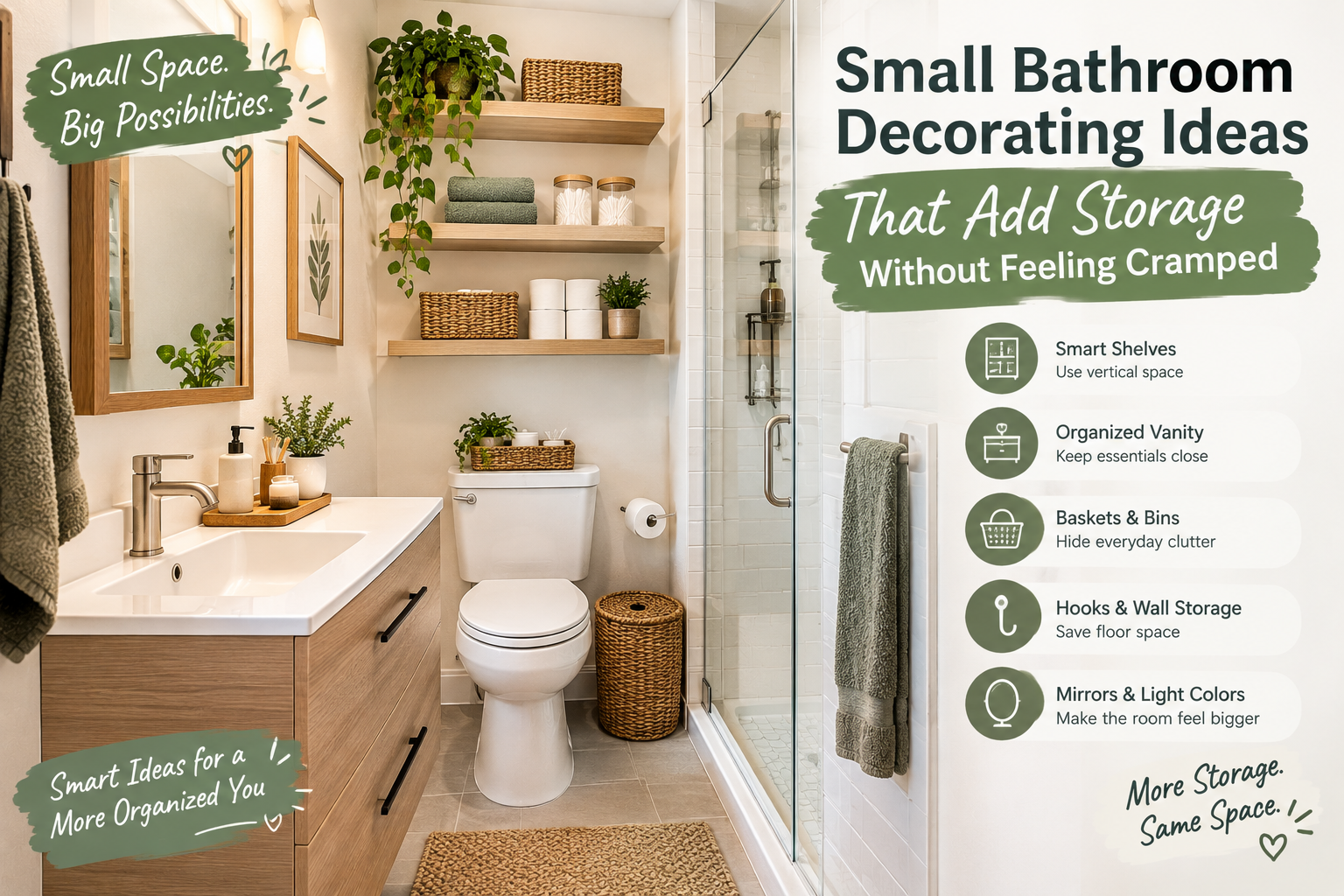
A small bathroom can become cluttered surprisingly quickly. One extra bottle of shampoo, a stack of towels, a hair dryer, and a few everyday skincare products can take over the countertop before you even realize it. Suddenly, the sink feels crowded, the shelves look messy, and the whole room seems smaller than it actually is.
The frustrating part is that most bathrooms need more storage, not less. You still need somewhere to keep toiletries, cleaning supplies, spare toilet paper, towels, and all the little things that make a bathroom functional. Simply removing everything from sight is not always realistic, especially when you share the space with other people.
The good news is that you can add useful storage to a small bathroom without making it feel cramped. The secret is to use overlooked areas, choose storage that fits the room’s proportions, and keep the visual design simple enough that the bathroom still feels open.
You do not necessarily need a larger vanity, custom cabinetry, or a complete renovation. Sometimes, a narrow shelf, a well-placed basket, or a better arrangement inside an existing cabinet can make a noticeable difference.
In this guide, we will explore practical small bathroom decorating ideas that add storage while keeping the room bright, organized, and comfortable. Whether you rent a small apartment, live in an older home, or simply have a bathroom with limited square footage, these ideas can help you make better use of the space you already have.
1. Start by Clearing the Countertop
Before buying storage containers or installing shelves, start with the bathroom countertop. It is often the first place where clutter becomes visible, and a crowded counter can make even a reasonably sized bathroom feel cramped.
Think about what currently sits around your sink. You might have a toothbrush holder, soap dispenser, skincare bottles, makeup, hair products, and a collection of items you use only occasionally.
Individually, these things may not seem like much. Together, they create a busy surface that draws attention away from the rest of the room.
Keep only the essentials within reach
Begin by removing everything from the countertop and sorting it into three groups:
- Items you use every day
- Items you use occasionally
- Items that can be stored somewhere else
Keep the everyday essentials close to the sink. Store backup products, extra cosmetics, and less frequently used items in a cabinet, drawer, or suitable basket.
This simple exercise often reveals that the problem is not a lack of storage alone. It is also the number of things competing for the same small surface.
Use one tray instead of several loose items
A small tray can make everyday bathroom products look more organized without requiring additional furniture.
Place your soap dispenser, a small moisturizer, and another frequently used item together on the tray. The grouped arrangement looks more intentional than bottles scattered across the counter.
Choose a tray that leaves plenty of room for washing your hands and using the sink. Waterproof or easy-to-clean materials are especially useful in a bathroom.
A light-colored tray can help a dark countertop feel less heavy, while a simple wood-look or stone-look tray may add warmth to a neutral bathroom.
The important thing is to avoid turning the tray into another place where clutter accumulates.
Give the sink some breathing room
You do not need a completely empty countertop. A few useful items are perfectly fine.
Try to leave a visible section of the counter clear, particularly around the faucet and the area where you wash your hands. That small patch of open space helps the bathroom feel less crowded.
If you share the bathroom, give each person a defined place for daily products instead of allowing everything to spread across the counter.
It is a simple change, but it makes the room easier to clean and more pleasant to use.
2. Use the Space Above the Toilet
The area above the toilet is often overlooked, even though it can provide valuable storage in a small bathroom.
Because this space is usually not needed for walking or standing, it offers an opportunity to store towels, toilet paper, baskets, and other bathroom essentials without taking up additional floor space.
Add a slim shelving unit
A narrow over-the-toilet shelving unit can be useful in a bathroom where there is no room for another cabinet.
Look for a design with open shelves, a slim frame, and enough clearance for the toilet tank and lid. A white, light wood, or metal finish can help it blend into the room rather than dominate the wall.
Use the shelves for items you actually need. For example, one shelf might hold folded towels, another could store spare toilet paper in a basket, and a third could contain a few neatly arranged bathroom supplies.
Before purchasing a unit, measure the available height and width carefully. Check the toilet’s position, the location of nearby pipes, and whether the shelving will interfere with the lid or your ability to clean behind the toilet.
Choose a stable design and follow the manufacturer’s installation instructions. Secure the unit as directed, particularly if it is tall or likely to be bumped.
Consider wall-mounted shelves instead
If a freestanding unit makes the toilet area feel crowded, one or two wall-mounted shelves may be a better option.
A single shelf above the tank can hold a small basket or a few folded hand towels. A second shelf higher up can store lighter, less frequently used items.
This arrangement leaves the floor clear and can look less bulky than a large storage tower.
Keep the shelves proportionate to the wall. A very deep shelf may protrude into the room and make a narrow bathroom feel tighter.
Style the shelves without overfilling them
Open shelves are useful, but they can easily become visually messy.
Try grouping smaller products in matching baskets or containers. Leave a little empty space between groups instead of filling every inch.
You can also mix practical storage with one simple decorative element, such as a small framed print or a suitable plant.
However, decoration should never take priority over storage that you genuinely need. If the bathroom is extremely small, use the shelves primarily for functional items and keep the arrangement simple.
3. Choose a Vanity With Smart Internal Storage
The vanity is one of the most important storage areas in a bathroom. Unfortunately, some vanities have a large-looking exterior but surprisingly little usable space inside.
Pipes, awkward corners, and deep shelves can make it difficult to organize everyday products. The result is often a crowded cabinet that becomes frustrating to use.
If you already have a vanity, improving its internal organization may be more practical than replacing it.
Use stackable organizers
Small stackable bins can help divide a cabinet into useful sections.
Use one container for skincare products, another for hair accessories, and a third for cleaning supplies, keeping household chemicals separate from personal-care products.
Choose bins that fit the cabinet dimensions and can be removed easily for cleaning. Clear containers make contents visible, while opaque bins create a calmer appearance when the cabinet is open.
Avoid buying organizers before measuring the space. A bin that is too tall or too wide can waste more room than it saves.
Work around the plumbing
The sink’s plumbing often takes up the middle of the vanity cabinet, but the space around it can still be useful.
Try arranging smaller containers on either side of the pipes. A shallow pull-out organizer may work well if there is enough clearance, while narrow bins can make use of otherwise awkward spaces.
Do not store heavy items where they could damage pipes, and avoid blocking access to plumbing connections or shutoff valves. Any organizer should be easy to move when maintenance is needed.
Add drawer dividers
If your vanity has drawers, use dividers to separate small products.
Without dividers, hair ties, razors, makeup, cotton pads, and other items tend to collect in one messy pile. Dividers make each category easier to find and prevent the drawer from becoming an unmanageable catch-all.
Adjustable dividers are especially useful because bathroom storage needs can change over time.
For deep drawers, consider using small containers that fit side by side. This creates separate compartments without requiring a permanent modification.
Keep frequently used products near the front
The best storage system is one you can maintain without much effort.
Place everyday items where they are easiest to reach. Store backups and occasional-use products farther back or on a higher shelf.
You should not have to remove six bottles to find the one you use every morning.
If your existing vanity is functional but poorly organized, these small changes may create more usable storage than you expect.
4. Install a Narrow Shelf Above the Door
The wall above the bathroom door is easy to overlook, yet it can be useful for items that you do not need every day.
In a particularly small bathroom, this area may provide storage without occupying any floor or countertop space.
Store lightweight, occasional-use items
A narrow shelf above the door can hold spare toilet paper, extra hand towels, or a small basket containing backup toiletries.
Because the shelf is high, it is better suited to lightweight items that you can reach safely with a step stool.
Avoid storing heavy glass bottles, large containers, or anything that could fall and cause injury.
Keep the shelf visually simple
A shelf above the door should not look like an extension of a cluttered closet.
Use one or two coordinated baskets to contain smaller items. Choose colors that work with the walls so the shelf does not become a strong visual distraction.
If the bathroom has a low ceiling, the shelf may not be practical. It should not make the doorway feel enclosed or interfere with ventilation, lighting, or door operation.
Check the wall and installation requirements
Before installing a shelf, confirm that the wall can support it and use suitable fixings for the wall material. If you are renting, check whether drilling is permitted.
If the wall is tiled, contains wiring, or has concealed plumbing, take extra care before drilling.
For a simpler alternative, consider whether an existing high cabinet can be reorganized to store the same items.
5. Make Better Use of the Inside of Cabinet Doors
The inside of a cabinet door can provide valuable storage without changing the outside appearance of your bathroom.
This is particularly useful when the vanity has limited drawer space or when small items keep getting lost in the back of a cabinet.
Add small organizers for everyday essentials
Depending on the door’s construction and available clearance, you might use a small organizer for hair accessories, toothbrush replacements, or compact personal-care items.
Some organizers attach with screws, while others use removable adhesive or hanging hooks. Choose a product that is suitable for the cabinet material and the weight of the items you intend to store.
Check that the organizer does not interfere with the cabinet hinges, drawers, plumbing, or anything stored inside.
Use hooks for lightweight items
Small hooks can hold items such as washcloths, hair accessories, or a compact cleaning cloth, depending on the location and moisture conditions.
If you use adhesive hooks, follow the manufacturer’s instructions carefully. Humidity and repeated exposure to water can weaken some adhesives, so they may not be suitable for heavier objects.
Do not hang heavy bottles or sharp tools on a door that may swing open unexpectedly.
Avoid overcrowding the door
It can be tempting to use every available inch, but too many organizers can prevent the door from closing properly.
Start with one useful storage solution and see how it works. The aim is to make the cabinet more functional, not turn the door into a second cluttered shelf.
A little hidden organization can make the entire bathroom feel tidier because fewer items need to remain on display.
6. Use the Space Beside the Sink
In many small bathrooms, the sink area is crowded while a narrow strip of wall or floor nearby remains unused.
That small gap can sometimes accommodate storage, provided it does not interfere with movement or access to the sink.
Try a slim rolling cart
A narrow rolling cart can be useful for storing toiletries, spare towels, or everyday products.
Choose a model that fits the available space with enough room to move comfortably around it. A tall, narrow cart may provide several storage levels without taking up much floor area.
Clear or light-colored designs can feel less visually heavy than solid, bulky cabinets.
However, measure carefully before purchasing. A cart that blocks a drawer, prevents the bathroom door from opening, or makes it difficult to stand at the sink will quickly become inconvenient.
Consider a narrow freestanding cabinet
If you prefer to hide items, a slim cabinet may work better than an open cart.
Look for a design with a small footprint and doors that can open without hitting the toilet, shower, or vanity.
A cabinet with adjustable shelves can accommodate different products as your storage needs change.
Make sure it is designed for bathroom conditions and can tolerate the humidity in the room. Secure tall furniture according to the manufacturer’s instructions.
Keep the walkway clear
The purpose of adding storage is to make the bathroom easier to use, not to squeeze another piece of furniture into every available gap.
If a cart or cabinet makes the room feel tight, consider using a wall-mounted organizer instead.
A few inches of clear walking space may be more valuable than another shelf of products.
7. Choose Light-Colored Storage to Keep the Room Feeling Open
Storage is not just about how much you can fit into a bathroom. Its visual appearance matters too.
A large, dark cabinet can feel heavy in a small room, especially if the walls, flooring, and vanity are already dark.
Lighter storage finishes can help the bathroom feel more open.
Look for white, pale wood, or soft neutral finishes
White shelving often blends into white walls, making the storage feel less noticeable.
Pale oak, light bamboo, soft beige, and muted gray can also work well, depending on the bathroom’s existing colors.
You do not need to make every item match exactly. Instead, choose a small group of related finishes that create a consistent appearance.
For example, a white over-the-toilet shelf, a pale wood tray, and two neutral storage baskets can look coordinated without feeling overly formal.
Use clear containers where they are practical
Clear containers are useful for items you want to identify quickly, such as cotton pads, hair ties, or spare toiletries.
They can also help shelves feel less visually solid than a row of opaque boxes.
However, clear containers are not ideal for every product. If the contents are colorful or the containers make the shelf look busy, opaque bins may create a cleaner appearance.
Choose based on the items you need to store, not simply on the idea that transparent storage is always better.
Keep bulky storage near the floor only when necessary
A tall cabinet may provide plenty of storage, but its size can dominate a small bathroom.
If you need a large storage unit, consider whether a visually lighter design or one with open space beneath it would work better.
Wall-mounted furniture can also leave more floor visible, which may help the room feel less crowded.
Still, practical storage should come first. If you need a closed cabinet to hide cleaning supplies or personal items, choose one that fits the room rather than sacrificing function for appearance.
8. Add Hooks Instead of Another Towel Rack
Traditional towel bars can take up a surprising amount of wall space, particularly when several towels need to hang in a small bathroom.
Hooks offer a flexible alternative and can be useful behind the door, beside the shower, or on an unused section of wall.
Use hooks for towels and robes
A row of hooks can hold bath towels, hand towels, and robes without requiring a long towel bar.
Hooks are especially helpful in shared bathrooms because each person can have a designated spot.
Choose a finish that complements the faucet or cabinet hardware, or use a simple neutral design that blends into the wall.
Place them where towels can dry properly
A towel that remains damp can develop an unpleasant smell, so placement matters.
Avoid squeezing too many towels into a small area. Leave enough room for air to circulate, and choose a location where the towels can dry between uses.
If the bathroom has poor ventilation, improving airflow may be just as important as adding storage.
Consider the back of the door
The back of the bathroom door is often useful for hooks, provided the door can still open fully and the items do not interfere with the handle or surrounding fixtures.
Over-the-door hooks can be convenient for renters because they may not require drilling.
Check the door thickness and clearance before buying one, and avoid hanging so many items that the door becomes difficult to operate.
Keep the arrangement consistent
A few well-placed hooks usually look better than hooks scattered around every wall.
Place them in a neat row where practical and use them for items that genuinely need to hang.
This gives towels a clear home and keeps them off the countertop, vanity, and other surfaces where clutter tends to collect.
9. Use Shower Storage That Keeps Bottles Off the Floor
The shower is another area where clutter can make a small bathroom feel crowded.
Shampoo bottles, conditioner, body wash, razors, and sponges often end up on the shower floor or along the edge of the bathtub. Besides looking messy, this arrangement can make cleaning more difficult and create obstacles underfoot.
The right shower storage can help keep everything accessible without adding bulky furniture.
Install a suitable shower caddy
A shower caddy can hold everyday products in one organized location.
Depending on your bathroom, you might choose a tension-pole caddy, a hanging caddy designed for the showerhead, or a wall-mounted unit.
Each option has limitations. A hanging caddy may not fit every showerhead, while a tension-pole model needs suitable floor and ceiling surfaces. Wall-mounted products must be compatible with the wall material and the conditions in the shower.
Before buying one, consider the amount of space available, the weight of your products, and how easy the caddy will be to clean.
Use a corner shelf where it makes sense
A corner shelf can make use of an area that would otherwise remain empty.
In a shower, a properly installed corner shelf can keep bottles off the floor and leave the main bathing area more open.
Choose a product designed for wet environments and install it according to the manufacturer’s instructions. If drilling into tiled walls, make sure you understand the wall construction and waterproofing requirements. Poorly sealed penetrations can allow moisture to enter the wall.
If you are renting or do not want to drill, look for a suitable removable or tension-based alternative.
Limit the number of products on display
Even a well-designed shower caddy can look crowded if it holds too many bottles.
Remove empty containers, store backup products elsewhere, and keep only the items you regularly use in the shower.
Where practical, choose containers that are easy to clean and store together neatly.
This is not about creating a perfectly styled shower. It is about making the space easier to use and maintain.
Keep the shower floor clear
A clear shower floor feels more open and is easier to clean.
Store products on a secure shelf or caddy rather than lining them along the floor or the bathtub edge.
Make sure the storage arrangement does not obstruct drainage, interfere with shower doors, or create a place where someone could trip.
10. Add a Recessed Niche if You Are Already Renovating
If you are planning a bathroom renovation, a recessed shower niche may be worth considering.
Unlike a protruding shelf, a niche sits inside the wall cavity. This can provide storage without taking up additional shower space.
It is a useful option for smaller bathrooms because it keeps shampoo and body wash off the floor while maintaining a relatively streamlined appearance.
Plan the niche around your actual needs
Consider the number and height of the products you use.
A niche that is too short may not accommodate taller bottles, while one that is too large may take up unnecessary wall space.
You should also think about whether you need one shelf or several sections. A simple horizontal niche with a shelf may be sufficient for most households.
Get the waterproofing right
A shower niche must be designed and installed with appropriate waterproofing. The wall cavity, niche surfaces, and transitions need to be protected according to the applicable building requirements and the waterproofing system being used.
This is not a good place to improvise with ordinary shelving materials or decorative boards that are not suitable for wet areas.
If you are not experienced with bathroom construction, use a qualified professional to plan and install the niche.
Match the niche to the bathroom’s overall design
A niche can blend into the surrounding tile or create a subtle contrast.
Matching the wall tile often creates a calm, continuous appearance. A contrasting tile can add interest, but a very busy pattern may make a small shower feel visually crowded.
Because the niche is recessed, it can offer practical storage without making the bathroom feel as if another object has been added to the room.
If you are not renovating, do not worry about missing this feature. A suitable shower caddy or corner shelf can provide similar everyday convenience without opening the wall.
11. Choose a Mirror Cabinet Instead of a Plain Mirror
A mirror is essential in most bathrooms, but a plain mirror does not provide storage.
If your bathroom lacks a medicine cabinet, a mirrored cabinet may be a useful upgrade because it combines two functions in one relatively compact feature.
Keep small items behind the mirror
A mirror cabinet can hold toothbrushes, skincare products, medication stored according to its labeling, and other small daily essentials.
This reduces the number of items that need to sit on the countertop.
Choose a cabinet deep enough for your needs but not so deep that it protrudes awkwardly into the room. Check its dimensions against the faucet, lighting fixture, and any nearby door or cabinet.
Look for adjustable shelves
Adjustable shelves allow you to accommodate products of different heights.
For example, you might use one shelf for toothbrushes and skincare, while another holds smaller containers or everyday personal-care supplies.
Avoid overcrowding the cabinet. Heavy items should be stored only where the cabinet is designed to support them, and the door should open and close without hitting other fixtures.
Consider the mirror’s proportions
A large mirror can help a bathroom feel more open by reflecting light and extending the visual space.
However, a mirror cabinet should fit the vanity and the available wall area. A unit that is too wide or deep may look bulky.
If you are replacing an existing mirror, check whether the wall can support the cabinet and whether plumbing or electrical components are hidden behind the installation area.
For renters, a freestanding countertop organizer or a small existing medicine cabinet may be a more practical alternative.
12. Use Baskets to Hide Everyday Bathroom Clutter
Baskets are among the simplest ways to organize a small bathroom because they group loose items together.
Instead of displaying several packages, bottles, and spare products individually, you can store them in a single container that fits neatly on a shelf or inside a cabinet.
The result is often calmer and easier to maintain.
Match the basket to its location
Choose baskets based on where they will be used.
For dry shelves, woven baskets can add texture and warmth. Inside a vanity or near the sink, plastic, coated metal, or other moisture-resistant materials may be easier to clean.
Natural materials can absorb moisture, so avoid placing them where they remain wet or poorly ventilated.
If you like the appearance of woven baskets, use them in a dry location and choose a washable liner when appropriate.
Assign each basket a purpose
A basket becomes less useful if it turns into a container for anything you do not know where to put.
Give each one a clear job, such as:
- Spare toilet paper
- Extra hand towels
- Hair accessories
- Backup toiletries
- Cleaning cloths
Keep household cleaning products separate from personal-care items, and store all products according to their safety labels.
If several people share the bathroom, a labeled basket for each person can help prevent products from spreading across the countertop.
Avoid buying too many baskets
It can be tempting to purchase a matching set and fill every shelf, but too many containers may create more visual bulk.
Start with the storage areas that need the most help. Measure the shelves, choose appropriately sized baskets, and leave some room for items that do not need to be contained.
The best basket is one that solves a specific problem, not simply one that looks attractive in a photograph.
13. Make a Small Bathroom Feel Bigger With the Right Color Palette
Color cannot create additional square footage, but it can influence how spacious a bathroom feels.
When the walls, floor, storage, and accessories are all very dark or strongly contrasting, the room may feel visually divided. A more coordinated palette can help the space appear calmer.
Choose a light base color
Soft white, warm ivory, pale beige, and light gray are popular choices for small bathrooms because they reflect available light and provide a neutral background for storage.
You do not have to use pure white. A slightly warm shade can make the room feel comfortable rather than clinical.
If your bathroom has beige tiles, a coordinated warm neutral may look more natural than a cool white. If the room has gray tile and chrome fixtures, a cleaner neutral might work better.
Use one or two accent colors
A limited palette can make a small bathroom feel more organized.
For example, you could combine white walls, pale wood storage, and muted green towels. Another option is soft gray with white accessories and brushed metal hardware.
Choose colors that complement the permanent elements you already have, particularly tiles, flooring, and the vanity.
You can introduce accent colors through towels, a bath mat, a small framed print, or a storage basket rather than buying new fixtures.
Do not assume dark colors are forbidden
A small bathroom can still look attractive with a dark accent wall or deep-colored accessories.
The key is to use darker tones intentionally rather than allowing every surface to compete for attention.
If you love navy, forest green, or charcoal, consider using those colors in a few details against a lighter background.
The bathroom should reflect your taste, not a rigid decorating rule.
14. Keep the Floor as Clear as Possible
Visible floor space can make a small bathroom feel more open. When baskets, bins, scales, laundry hampers, and storage cabinets occupy every available corner, the room can seem much smaller.
Whenever practical, move storage off the floor and onto walls or into existing cabinets.
Use wall-mounted storage
A wall-mounted toilet-paper holder, towel hook, or small shelf can keep useful items accessible without adding another object to the floor.
If you install wall-mounted items, use appropriate fixings and check for concealed plumbing or electrical wiring before drilling.
Choose locations that are convenient to reach without interfering with doors, fixtures, or the movement of people using the bathroom.
Consider a wall-mounted vanity
If you are planning a larger update, a wall-mounted vanity can leave the floor visible underneath.
This can create a lighter appearance because the room has fewer visual obstructions at floor level.
However, a floating vanity is not automatically the best choice for every small bathroom. It must be installed securely, may require appropriate wall reinforcement, and can have less internal storage than a floor-standing model of similar width.
If you already have a functional vanity, you may achieve a similar sense of openness by removing unnecessary floor clutter instead.
Choose a hamper carefully
Laundry hampers can take up valuable space in small bathrooms.
If you need one in the room, look for a narrow design that fits beside the vanity or in another unused area. A collapsible hamper may be useful when laundry is not being collected.
Do not place a hamper where it blocks the door, toilet, or access to the shower.
Sometimes the simplest solution is to move laundry storage to a bedroom or utility area, if one is available.
15. Use a Ladder Shelf for Vertical Storage
A ladder-style shelf can be useful in a small bathroom because it takes advantage of vertical space while maintaining a relatively open appearance.
Unlike a deep cabinet, many ladder shelves have a slim frame and open sides, so they may feel less bulky.
Choose the right size
Look for a shelf that fits the available wall without interfering with the toilet, shower, or doorway.
A narrow design may hold folded towels, baskets, and a few everyday items without occupying much floor space.
Before purchasing, measure the depth as well as the width. A shelf that projects too far into the room can make a narrow bathroom harder to navigate.
Store items in a practical order
Place lighter or less frequently used items on the upper shelves. Keep everyday essentials at a comfortable height.
Use baskets to contain small products that would otherwise look scattered.
If the shelf is tall, follow the manufacturer’s guidance for securing it against tipping. This is particularly important in households with children or pets.
Avoid making the shelf a display of everything
Open storage works best when it is edited.
Fold towels neatly, group products, and leave a little space between items. You can add one decorative element, but there is no need to fill every shelf with ornaments.
If you find that open shelves become messy quickly, a narrow cabinet with doors may suit your routine better.
16. Organize Towels Without Filling the Bathroom With Cabinets
Towels are bulky, and they can take up a surprising amount of space in a small bathroom.
If you keep every towel in the bathroom, they may fill shelves that could otherwise hold toiletries or cleaning supplies.
A better arrangement starts with deciding how many towels actually need to be stored in the room.
Keep only the towels you use regularly nearby
Store the towels used daily within easy reach, and keep extra sets in a linen closet or bedroom cupboard if you have one.
If bathroom storage is limited, you may not need to keep every spare towel in the same room.
This is particularly useful in small apartments where the bathroom has no linen closet.
Roll or fold towels according to the shelf
Rolling towels can work well in a basket or narrow open shelf. Folding them into consistent rectangles may make better use of a cabinet with fixed shelves.
Neither method is automatically superior. The best option is the one that fits the available space and makes it easy to remove a towel without disturbing the rest.
Avoid stacking towels so high that the pile becomes unstable.
Choose a consistent color palette
Towels in a few related colors can make open storage look more orderly.
White, cream, light gray, and muted earth tones are easy to coordinate with many bathroom styles.
You do not need to replace all your towels to achieve this effect. Start by grouping the ones you already own by color and placing the most coordinated sets on open shelves.
17. Make Use of Corners Without Overcrowding Them
Corners are often awkward spaces, but they can provide useful storage if the furniture or organizer is appropriately sized.
In a small bathroom, the challenge is to make use of the corner without creating a bulky obstacle.
Try a compact corner shelf
A corner shelf may fit beside the vanity, near the shower, or above the toilet, depending on the layout.
Choose a design that does not interfere with the door or make the walkway too narrow. If the shelf will be exposed to water, select a material and finish designed for that environment.
Corner shelves can hold small toiletries, folded washcloths, or a few useful accessories.
Consider a triangular or curved design
Traditional rectangular shelves may project too far into a narrow room. A triangular or curved shelf can sometimes fit more comfortably into a corner.
Measure the usable space carefully and consider how the shelf will look from the doorway.
A shelf that is technically small may still feel intrusive if it sits at shoulder height in a tight passage.
Keep the corner useful rather than decorative
Do not fill an awkward corner with a storage unit simply because there is room for one.
If you already have enough storage, the open space may be more valuable.
Use corner storage when it solves a real problem, such as holding toiletries or keeping towels accessible. Otherwise, leaving the corner clear can help the bathroom feel more spacious.
18. Improve Bathroom Lighting to Make Storage Feel Less Bulky
Lighting is often discussed as a way to improve the atmosphere of a room, but it can also influence how storage looks.
A dark corner filled with shelves may feel heavy and crowded. The same shelves can appear less imposing when the area is properly illuminated.
Improve the light around the mirror
Good mirror lighting makes daily tasks easier and helps the vanity area feel more welcoming.
If your bathroom has one overhead light that casts shadows on your face, consider whether a suitable light fixture beside or above the mirror would provide more even illumination.
Bathroom electrical work must comply with local requirements and the fixture’s safety rating for its location. If new wiring is needed, use a qualified electrician.
Avoid harsh shadows
A single bright bulb can create strong shadows underneath shelves and cabinets.
A combination of general lighting and suitable task lighting often produces a more balanced result.
Choose bulbs that render colors naturally and work well with the bathroom’s finishes. Extremely cool lighting may make warm materials look less inviting, while very warm lighting can change how paint and tile colors appear.
Keep the lighting simple
You do not need decorative lights in every corner.
Focus on adequate general illumination, useful mirror lighting, and safe lighting in areas where you need to see clearly.
Once the room is comfortably lit, the storage will be easier to use and the bathroom may feel less enclosed.
19. Keep Moisture and Ventilation in Mind
A small bathroom needs storage that works in a damp environment.
A basket that looks beautiful in a bedroom may not last long beside a shower. A wooden cabinet may deteriorate if water repeatedly collects around its base. Metal hardware may corrode if its finish is not suitable for the conditions.
Before choosing a storage product, consider where it will be placed and how much moisture it will encounter.
Choose materials suited to the location
For areas near a sink or shower, look for moisture-resistant materials and finishes.
Plastic, appropriately coated metal, and products specifically designed for bathroom use may be easier to maintain in wet areas.
Wood can also work, but it needs a suitable finish and proper care. Avoid leaving standing water on wooden surfaces.
Keep storage away from persistent dampness
Do not pack shelves so tightly that air cannot circulate around towels or stored items.
Allow damp towels to dry properly, and avoid keeping cardboard packaging or moisture-sensitive products in areas where condensation is common.
If the bathroom has an extractor fan, use it as recommended. Open a window when practical and safe, and address persistent condensation or mold rather than hiding the problem behind new storage.
Do not cover ventilation openings
When adding shelves or cabinets, make sure they do not block vents, fans, or other ventilation features.
Good ventilation helps protect both the bathroom and the items stored inside it.
Storage should make the room more functional, not interfere with its ability to stay dry and comfortable.
20. A Simple Weekend Plan for Organizing a Small Bathroom
If your bathroom currently feels crowded, it may be easier to make changes in stages rather than trying to reorganize everything at once.
Here is a practical weekend plan that starts with what you already own.
Step 1: Empty and sort
Choose one area, such as the vanity or countertop, and remove its contents.
Discard empty packaging and expired products according to their labels and local disposal guidance. Put aside items you no longer use, and group the remaining products by category.
Do not empty the entire bathroom at once if you have nowhere to place everything. Working one section at a time makes the process easier to manage.
Step 2: Decide where each category belongs
Choose a home for daily toiletries, backup products, towels, cleaning supplies, and hair tools.
Keep everyday items within easy reach. Store less frequently used products in higher cabinets or another suitable location.
If several people share the bathroom, assign each person a defined storage area where practical.
Step 3: Reorganize existing cabinets
Use containers or dividers you already own before purchasing new organizers.
A small box may work perfectly for hair accessories. A clean, washable basket may hold spare toilet paper. A drawer divider may prevent small items from getting mixed together.
Measure the cabinet before buying anything that does not fit.
Step 4: Use one overlooked space
Choose one area that is currently unused, such as the wall above the toilet, the inside of a cabinet door, or the back of the bathroom door.
Add one appropriate storage solution if needed.
Avoid installing several new organizers at once. You want to solve the main problem without filling the room with more objects.
Step 5: Finish with a simple visual refresh
Once the bathroom is organized, look at the room from the doorway.
Can you see more of the countertop? Is the floor clear? Are the towels neatly stored? Do the shelves look balanced?
If the room still feels busy, remove a few items rather than automatically adding more storage.
A small bathroom often feels best when everything has a place and the visible surfaces are not overloaded.
Frequently Asked Questions
1. How can I add storage to a small bathroom without making it look smaller?
Use vertical space, organize the inside of existing cabinets, and keep the floor and countertop as clear as practical. Wall-mounted shelves, hooks, mirror cabinets, and narrow organizers can provide storage without taking up much floor space. Choose sizes that suit the room and avoid filling every available surface.
2. What is the best storage solution for a very small bathroom?
The best option depends on the layout, but over-the-toilet shelving, a well-organized vanity, a mirrored cabinet, and wall hooks are often useful starting points. Measure your bathroom first and choose the solution that addresses your biggest storage problem without blocking movement.
3. How do I organize bathroom products when I have no drawers?
Use a small cabinet, suitable baskets, a mirror cabinet, or a narrow shelving unit. Group similar items together and store backup products away from the countertop. A tray can keep daily essentials organized if you have limited cabinet space.
4. Are open shelves a good idea in a small bathroom?
Yes, if they are not too deep and are kept organized. Open shelves work well for folded towels, a few baskets, and frequently used items. If you tend to accumulate products, closed cabinets may be more practical because they hide visual clutter.
5. How can I store towels in a bathroom with no linen closet?
Keep the towels you use regularly on a slim shelf, in a suitable basket, or on a compact towel rack. Store spare sets elsewhere if possible. Rolling or folding towels consistently can help you fit more into the space you have.
6. What colors make a small bathroom feel bigger?
Light neutrals such as soft white, ivory, pale beige, and light gray can help reflect available light and create a calmer appearance. Pale wood and a limited accent color can add warmth. You do not need to make the entire room white; a coordinated palette and less visual clutter are often more important.
7. Can I add bathroom storage without drilling holes?
Depending on the product and your bathroom, you may be able to use over-the-door hooks, suitable tension-pole organizers, freestanding carts, or adhesive organizers. Check the weight limits and surface requirements carefully. Adhesive products may not be suitable for heavy items or persistently wet areas.
8. How do I make a small bathroom vanity more organized?
Start by sorting products into categories and removing items you rarely use. Add drawer dividers, stackable bins, or narrow organizers that fit around the plumbing. Keep everyday products near the front and leave access to shutoff valves and pipes.
9. How do I keep a small bathroom from looking cluttered?
Limit the number of items displayed on the countertop, use baskets to group small products, and choose a consistent color palette. Store backup toiletries out of sight, keep the floor clear, and avoid decorating every shelf. A few useful, well-placed items usually look better than many scattered accessories.
10. Is a storage cabinet better than open shelving?
A cabinet is often better when you need to hide personal-care products, cleaning supplies, or other items that look messy when displayed. Open shelving is useful for towels and frequently used items. Many small bathrooms benefit from a combination of the two, as long as the storage remains proportionate to the room.
Final Thoughts: Make Every Inch Useful, but Leave Room to Breathe
A small bathroom does not need to be filled with cabinets and organizers to work well. In fact, adding too many storage pieces can make the room feel even more crowded.
The better approach is to look at the space you already have and identify where storage can be improved without getting in the way. A shelf above the toilet, a few hooks, a better-organized vanity, or a mirror cabinet may solve a problem that once seemed much bigger.
Start by clearing the countertop and organizing your existing cabinets. Then consider one or two additions that address your actual needs. Choose moisture-appropriate materials, measure carefully, and keep the floor and walkways as open as possible.
Most importantly, remember that storage and visual space need to work together. You want enough room for the things you use every day, but you also want the bathroom to feel comfortable rather than packed with belongings.
With a few thoughtful changes, even a tiny bathroom can feel more organized, more practical, and more inviting—without requiring a major renovation or sacrificing the space you have.
At DecorHeavenly.com, we believe that good decorating is not about fitting more things into a room. It is about making the space you have work beautifully for everyday life.