Baby Pink Kitchen Ideas That Look Grown-Up and Genuinely Beautiful

Baby pink in the kitchen sounds risky until you see it done right, and then it looks like the most obvious choice in the world. The risk is not the colour — it is using it on the wrong surface or in the wrong proportion. The key is knowing which surface to commit to, which shade to choose, and what to pair it with so the result reads as considered and confident rather than sweet or childish. These 26 ideas cover every level of commitment, from a single pink accessory to a fully pink kitchen that nobody would dare call girly.
1. Start with a Baby Pink KitchenAid or Smeg Appliance

If you want baby pink in your kitchen but are not ready to paint a single cabinet, a statement appliance is the most reversible way to test the water. A baby pink KitchenAid stand mixer on the counter or a pastel pink Smeg kettle and toaster set introduces the colour through an object you already own rather than a surface you have to commit to, and the effect is surprisingly strong given how little space it takes up.
**Quick Tip:** Group the appliance with a small potted plant and a wooden chopping board nearby; the green and natural wood stop the pink from reading as a single novelty item and make it look like part of a considered colour story.
2. Paint Only the Kitchen Island in Baby Pink

Painting the island a different colour from the perimeter cabinets is one of the oldest tricks in kitchen design, and baby pink is one of the most interesting choices you can make for it. It draws the eye immediately, gives the kitchen a focal point it probably did not have before, and because the surrounding cabinets stay neutral, the pink reads as bold and intentional rather than overwhelming.
**Designer Advice:** A matte or chalky finish on the island reads as more considered than gloss when baby pink is the colour; gloss can push toward retro while matte pulls toward modern and editorial.
3. Use Baby Pink Zellige or Handmade Tiles as a Backsplash

A backsplash in baby pink handmade or Zellige tiles behind the hob or across the whole splashback zone brings texture and colour together in a way that flat paint simply cannot. The irregular glaze on Zellige tiles means each one catches light slightly differently, so the pink shimmers and shifts throughout the day rather than sitting flat on the wall. Pair with white or cream cabinets and the result is effortlessly beautiful.
**Heads Up:** Zellige tiles are notoriously uneven in thickness, which makes grouting more time-consuming and requires an experienced tiler. Budget for professional installation and a non-sanded grout in white or warm cream.
4. Try Baby Pink Open Shelving Against White or Greige Walls
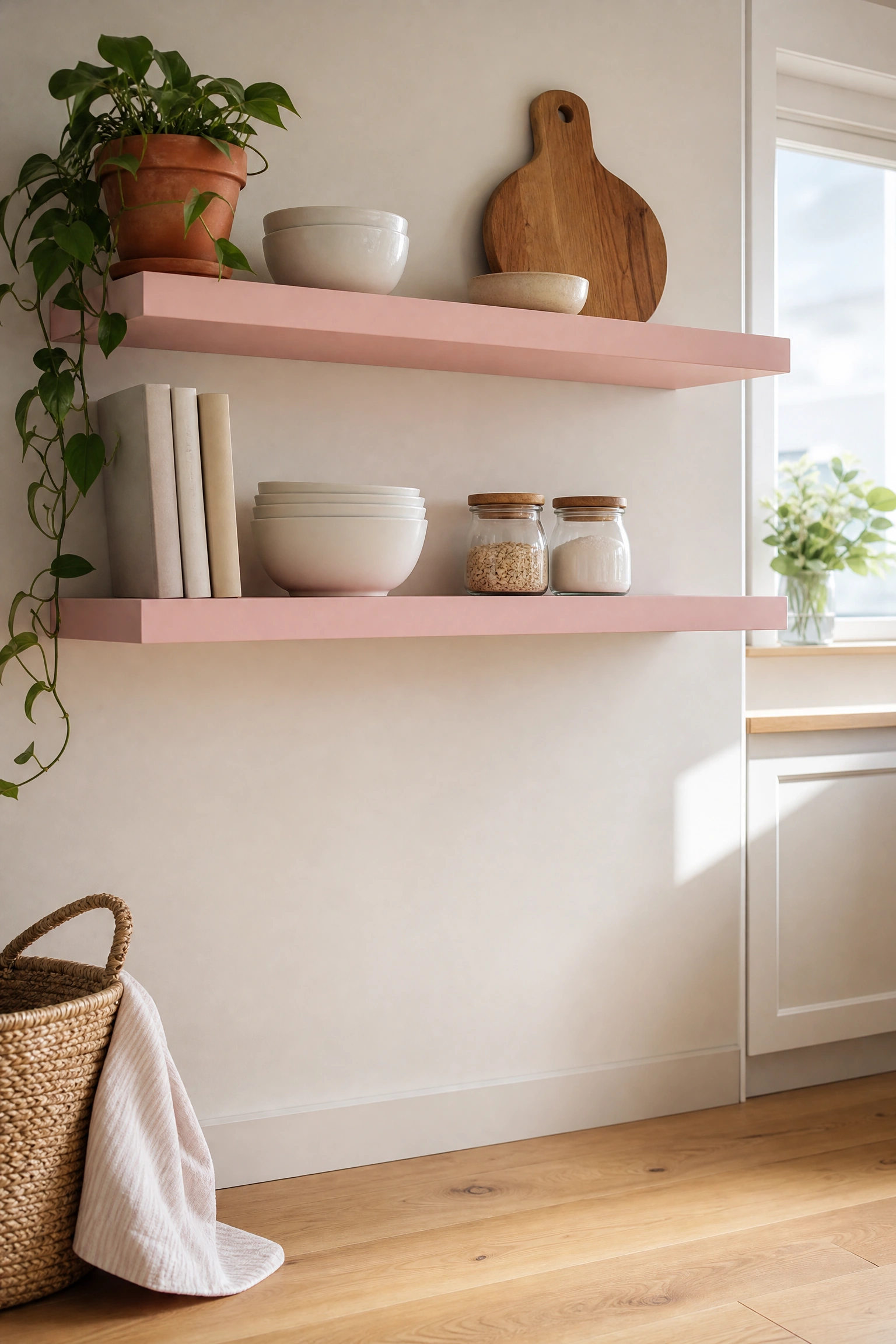
Floating shelves painted in baby pink against white or warm greige walls bring colour into the kitchen without touching the cabinetry at all. In practice, the shelves become both a design feature and a display opportunity, and the pink reads as charming and deliberate rather than loud, particularly when the items displayed on them include natural wood, ceramics in cream or earthy tones, and a plant or two.
**Pro Move:** Paint the inside back panel of any alcove or cabinet the same baby pink as the shelves for a layered, built-in effect that looks intentional from across the room.
5. Bring in Baby Pink Through Bar Stools at the Island

Upholstered bar stools in baby pink boucle, velvet, or linen at a kitchen island or breakfast bar are a low-commitment, high-impact way to introduce the colour. Because bar stools sit slightly back from the main visual field of the kitchen, the pink reads as an accent rather than a statement, which makes this approach work even in kitchens where the rest of the palette is quite neutral and restrained.
**Reality Check:** Light pink upholstery picks up grease and food marks faster than you might expect in a kitchen environment. Look for performance fabrics with stain-resistant finishes, or choose a wipeable faux leather in baby pink instead.
6. Paint the Ceiling Baby Pink and Leave Everything Else Neutral

Painting only the ceiling in baby pink is a move that professional designers have used in dining rooms for years and it works just as well in kitchens. When you look up, the rosy overhead light softens everything in the room and creates an atmosphere that is warm and unusual without requiring a single cabinet to change colour. It is an especially good idea in open-plan kitchens where you want to define the kitchen zone without using walls.
**Quick Tip:** Go one shade lighter on the ceiling than the pink you would use on the walls or cabinets; ceilings always read slightly darker than walls once the room is occupied and lit.
7. Choose Baby Pink Lower Cabinets with White Uppers

Two-tone cabinetry with baby pink on the lower cabinets and white or cream on the upper cabinets is one of the most practical and beautiful applications of pink in the kitchen. The lower cabinets ground the room with colour while the white uppers keep things light and airy above eye level. This arrangement also makes practical sense because lower cabinet doors take more daily wear and a painted finish holds up better below the worktop line where splashes and kicks are more common.
**Designer Advice:** Choose a white for the upper cabinets that has a warm rather than a cool undertone; pure strong white next to baby pink can look jarring, while an off-white or cream sits far more naturally alongside it.
8. Install Baby Pink Penny or Mosaic Tiles on the Kitchen Floor

Baby pink penny tiles or small-format mosaic tiles on the kitchen floor are a retro-informed, contemporary choice that adds colour from the ground up and pairs beautifully with white or cream cabinetry above. The small scale of the tiles means the pink reads as a texture rather than a block of colour, which makes it feel less committed than painting a wall and more interesting than a plain tile in any neutral shade.
**Heads Up:** Small-format floor tiles require more grout, which means more cleaning surface. Use a dark or mid-toned grout rather than white to keep the floor looking good between deep cleans.
9. Add a Baby Pink Roller or Roman Blind at the Kitchen Window

A roller blind or Roman blind in baby pink linen or cotton at the kitchen window is one of the cheapest and most removable ways to bring the colour into the room. The fabric filters light and tints it slightly pink on sunny mornings, which creates a rosy warmth in the whole kitchen that no paint colour can quite replicate. Paired with white walls and simple timber or white cabinetry, a pink blind punches well above its cost.
**Pro Move:** Choose a slightly textured or woven fabric rather than a plain cotton for the blind; texture makes the pink look richer and more intentional than a flat, smooth fabric that can read as cheap at window scale.
10. Use Baby Pink Grout with White or Cream Tiles

If you are retiling the kitchen backsplash or floor and want to introduce pink without using pink tiles, baby pink grout with white or cream subway tiles or metro tiles is a quietly good solution. The grout colour reads as an accent line rather than a block of colour, giving the whole tiled surface a personality it would not have in standard grey or white grout, and the effect is subtle enough to work in even quite conservative kitchens.
**Quick Tip:** Coloured grout fades faster than standard grey or white, particularly in areas near the hob where heat and steam are consistent. Use an epoxy grout rather than a cement-based one for better colour longevity.
11. Bring in Baby Pink Through a Kitchen Runner Rug

A runner rug in baby pink, blush, or a pattern that includes pink as a main colour on the kitchen floor gives the room softness underfoot and colour at eye-level simultaneously. In kitchens with hard tile or stone floors, a runner in front of the sink or along the cooking run makes the space feel warmer and more domestic, and because rugs are entirely removable, the commitment is zero.
**Reality Check:** Cotton flatweave rugs are the most practical choice for kitchen runners; they lie flat, tolerate frequent washing, and do not trap food debris the way a looped or shaggy pile would.
12. Install Baby Pink Shaker Cabinets Throughout for a Cottage Kitchen

A full kitchen in baby pink Shaker cabinets with a white stone worktop and brass hardware is one of the most consistently beautiful kitchen schemes in current interior design. The Shaker door profile softens the pink by giving it structure and depth, and the combination of the rosy cabinetry, warm brass, and white stone has a quality that reads as traditional and timeless rather than trendy. This is the version of baby pink that photographs best and ages best.
**Designer Advice:** Farrow and Ball Petal, Benjamin Moore First Light, or Little Greene Blush are three of the most flattering baby pink shades for Shaker kitchens at the moment; all sit in the warm, slightly earthy pink family that avoids the candy-bright end of the spectrum.
13. Add Baby Pink Through Pottery, Ceramics, and Kitchen Objects

A collection of baby pink ceramics on open shelves or on the counter, mixing different shapes and finishes in the same pale pink family, is the easiest possible entry point into pink kitchen decor. Mugs, bowls, a vase, a small jug, a soap dispenser, a canister set: none of these require any commitment and all of them contribute to a colour story that reads as deliberate and considered.
**Quick Tip:** Mix matte and glossy finishes within the same pink family; the contrast in surface quality makes a collection of similarly coloured objects look far more interesting than a matched set from the same range.
14. Use Baby Pink on a Kitchen Alcove or Dresser Unit

If your kitchen has a freestanding dresser, hutch, or built-in alcove unit, painting it in baby pink while leaving the rest of the kitchen in white or cream is a contained, deliberate way to introduce the colour. The dresser becomes the room’s focal point in a way that a wall colour never quite manages, and because it is a single piece of furniture or a defined architectural feature, the pink feels like a styling choice rather than a scheme.
**Pro Move:** Style the dresser shelves with a mix of baby pink, white, and natural wood objects; keeping the accessories within the same tonal family as the paint makes the whole unit look like it was planned by a designer.
15. Try Baby Pink and Brass for a Sophisticated, Grown-Up Kitchen

Baby pink cabinets with unlacquered or aged brass hardware, a brass tap, and brass pendant lights above the island or sink is a combination that looks more expensive than almost any other kitchen colour scheme at a similar price point. The warm metal draws out the warmth in the pink and stops the whole room from reading as sweet; instead it reads as editorial and considered in a way that chrome or black hardware rarely achieves with pink.
**Heads Up:** Unlacquered brass develops a patina over time, which most people find beautiful but some find inconvenient. If you want the warm brass look without the maintenance, brushed brass or satin brass hardware is a much lower-maintenance alternative.
Baby Pink Kitchen: Finish and Hardware Pairing Guide
| Baby Pink Finish | Best Hardware | Countertop That Works | Mood It Creates |
| Matte baby pink | Brushed brass | White quartz or pale marble | Warm, modern, understated |
| Gloss baby pink | Chrome or brushed nickel | Pale grey or white stone | Retro, clean, high-impact |
| Shaker baby pink | Antique brass or black | Butcher block or light oak | Cottage, nostalgic, cosy |
| Flat-front baby pink | Minimal recessed pulls | Concrete grey or white | Scandinavian, pared-back |
| Velvet-finish baby pink | Aged gold or unlacquered brass | Honed marble or quartz | Luxurious, editorial, grown-up |
16. Pair Baby Pink Cabinets with Dark Green for a Bold Contrast

Baby pink and deep green is one of the most striking two-tone cabinet combinations available right now, with the softness of the pink and the depth of the green creating a contrast that feels botanical and confident at the same time. In practice, baby pink lower cabinets with sage or forest green uppers, or a pink island against dark green perimeter cabinets, work equally well and both look genuinely beautiful with brushed brass hardware and a white stone worktop.
**Designer Advice:** Make sure the pink and green you choose share the same warm or cool undertone; a warm baby pink with a cool blue-green will feel slightly off, while a warm pink with a warm olive green sits together naturally.
17. Use Baby Pink Wallpaper in a Kitchen Eating Area or Breakfast Nook

If your kitchen has a dining area, breakfast nook, or banquette seating built into it, papering that zone in a baby pink wallpaper while keeping the kitchen cabinetry in white or cream creates a sense of two distinct spaces within one room. The pink in the eating zone is warm and inviting at mealtimes, and because it is separated from the cooking zone, it does not have to withstand the steam and splashing that would damage wallpaper near the hob.
**Quick Tip:** Choose a washable vinyl-coated wallpaper rather than a standard paper finish for any kitchen-adjacent area; even in a breakfast nook, steam and food splashes travel further than you would expect.
18. Install a Baby Pink Enamel Range Cooker as the Room’s Hero Piece

A baby pink enamel range cooker, from brands like Lacanche, Falcon, or Bertazzoni, is one of those kitchen choices that defines the entire room and makes every other design decision easier. Everything else in the kitchen can stay completely neutral and the pink range still gives the room enough personality, warmth, and character to feel designed rather than default. It is an investment, but it is also the single most impactful pink decision you can make in a kitchen.
**Reality Check:** Pink enamel range cookers are typically available through specialist retailers and have longer lead times than standard appliances. Factor in six to twelve weeks for delivery and confirm your kitchen fitter knows the exact dimensions before ordering.
19. Use Baby Pink Paint on Kitchen Walls with White Cabinetry

Painting the walls rather than the cabinets in baby pink is the approach that allows you to change your mind most easily, and it works particularly well in kitchens with white or off-white cabinetry where the walls are actually a significant visible surface. The pink walls give the white cabinets a warm, rosy backdrop that makes them look more deliberate and less like a default choice, and the whole room feels softer and more inviting than a standard white-on-white kitchen.
**Pro Move:** In a pink-walled kitchen, keep the worktop in a warm white, pale marble, or light oak; cool grey stone next to baby pink walls can make the whole room feel slightly cold and unresolved.
20. Combine Baby Pink with Natural Rattan and Wicker Accents

Baby pink cabinetry or walls paired with rattan pendant lights, wicker baskets for storage, and cane-fronted cabinet inserts creates a kitchen that sits at the intersection of the pink trend and the natural materials trend, which is exactly where the most current and considered kitchens are landing right now. The organic texture of the rattan warms the baby pink and stops it from feeling flat, while the natural tones of the wicker keep the room grounded and earthy.
**Quick Tip:** Rattan pendant lights above an island or dining table in a pink kitchen are one of the most effective single accessories you can add; the warm, dappled light they cast flatters the pink walls or cabinets in a way that a standard glass or metal pendant rarely does.
21. Try a Baby Pink and White Checkered or Gingham Tile Floor

A checkered or gingham floor tile in baby pink and white is a retro-inflected, joyful choice that works beautifully in kitchens that lean toward vintage, cottage, or maximalist styling. The two-colour floor contains the pink while giving the room enormous personality, and because both colours in the check are light, the floor does not make the room feel smaller the way a dark checkered tile would.
**Designer Advice:** Balance a patterned pink and white floor with very simple, flat-fronted cabinets in white or cream; if the cabinetry has heavy detailing or is also patterned, the floor and the cabinets will compete and the kitchen will feel busy.
22. Paint the Kitchen Ceiling and Walls the Same Baby Pink for a Colour-Drenched Effect

Colour drenching a kitchen in baby pink, painting the ceiling, walls, and even the window frames and door architraves all in the same shade, is a maximalist commitment that produces a kitchen unlike almost any other. The trick is to keep the cabinetry in white or a very pale neutral so the room does not become oppressive, and to make sure natural light is good because baby pink drenching in a dark room can quickly feel claustrophobic.
**Heads Up:** Colour drenching works best in kitchens with at least one large window or a skylight; in north-facing rooms with limited daylight, test the pink extensively before committing to ceilings and walls together.
23. Use Baby Pink Fluted or Reeded Cabinet Fronts

Fluted or reeded cabinet fronts, where the door surface has vertical grooves pressed or routed into it, are one of the most popular kitchen detailing trends right now and they look particularly beautiful in baby pink. The grooves break up the flat plane of the door and catch light differently throughout the day, giving the pink a shadow and depth that standard flat-fronted or Shaker doors cannot replicate.
**Pro Move:** Fluted cabinets in baby pink work best with minimal hardware, either a simple bar pull in brass or no hardware at all with a push-to-open mechanism; over-decorating fluted fronts with ornate knobs distracts from the texture that makes the style interesting.
24. Add Baby Pink Through Fresh Flowers and Botanicals on the Counter

A weekly bunch of peonies, ranunculus, or pale pink roses in a simple ceramic or glass vase on the kitchen counter costs very little and contributes more to the pink kitchen aesthetic than most people expect. Combined with one or two trailing plants on a shelf and a small herb pot, the pink flowers make even an entirely neutral kitchen feel like it has a colour story, and the effect changes slightly with every new bunch.
**Quick Tip:** Dried pink pampas grass or dried pink botanicals in a tall vase are a more permanent version of the same idea; they last for months, require no water, and maintain the pink colour story all year round without any weekly shopping.
25. Install Baby Pink Scalloped or Curved Tiles on the Splashback

Scalloped or fan-shaped tiles in baby pink on the splashback give the kitchen a feminine, vintage-informed detail that is genuinely distinctive compared to the standard subway or metro tile that most kitchens default to. The curved edges of the scallop tile create shadow lines that make the pink look three-dimensional, and the overall effect is closer to a decorative surface than a practical one, which is exactly the quality that makes kitchens feel special.
**Designer Advice:** Scallop tiles look most refined when laid with a very fine grout line in white or pale cream; wide grout lines interrupt the flowing curved pattern and undermine the elegance of the tile shape.
26. Go All-In with Baby Pink Flat-Front Cabinets from Floor to Ceiling

A full kitchen in handleless, flat-front baby pink cabinets from floor to ceiling is the most committed version of this colour and, when done correctly, one of the most beautiful kitchens you can create. The handleless design removes visual clutter and lets the pink speak entirely for itself, while the floor-to-ceiling height gives the room a seamless, architectural quality that instantly reads as high-end. Pair with a pale marble or quartz worktop, an integrated sink, and warm concealed lighting under the wall cabinets.
**Reality Check:** Handleless push-to-open mechanisms require precise installation to function smoothly; a poorly fitted push-to-open can be frustrating to use daily. Specify a reputable mechanism brand like Blum or Grass when discussing with your kitchen fitter.
Final Thoughts
Baby pink in the kitchen is one of those colour choices that feels slightly daring right up until you make it, and then feels completely obvious and right. The secret is not in the shade itself but in everything you put alongside it: the hardware, the worktop, the flooring, the textures, and the way the light moves through the room at different times of day. Start with the smallest commitment you feel comfortable with and you will almost certainly find yourself wanting more pink, not less.