Christmas Living Room Ideas That Feel Like Home, Not a Display
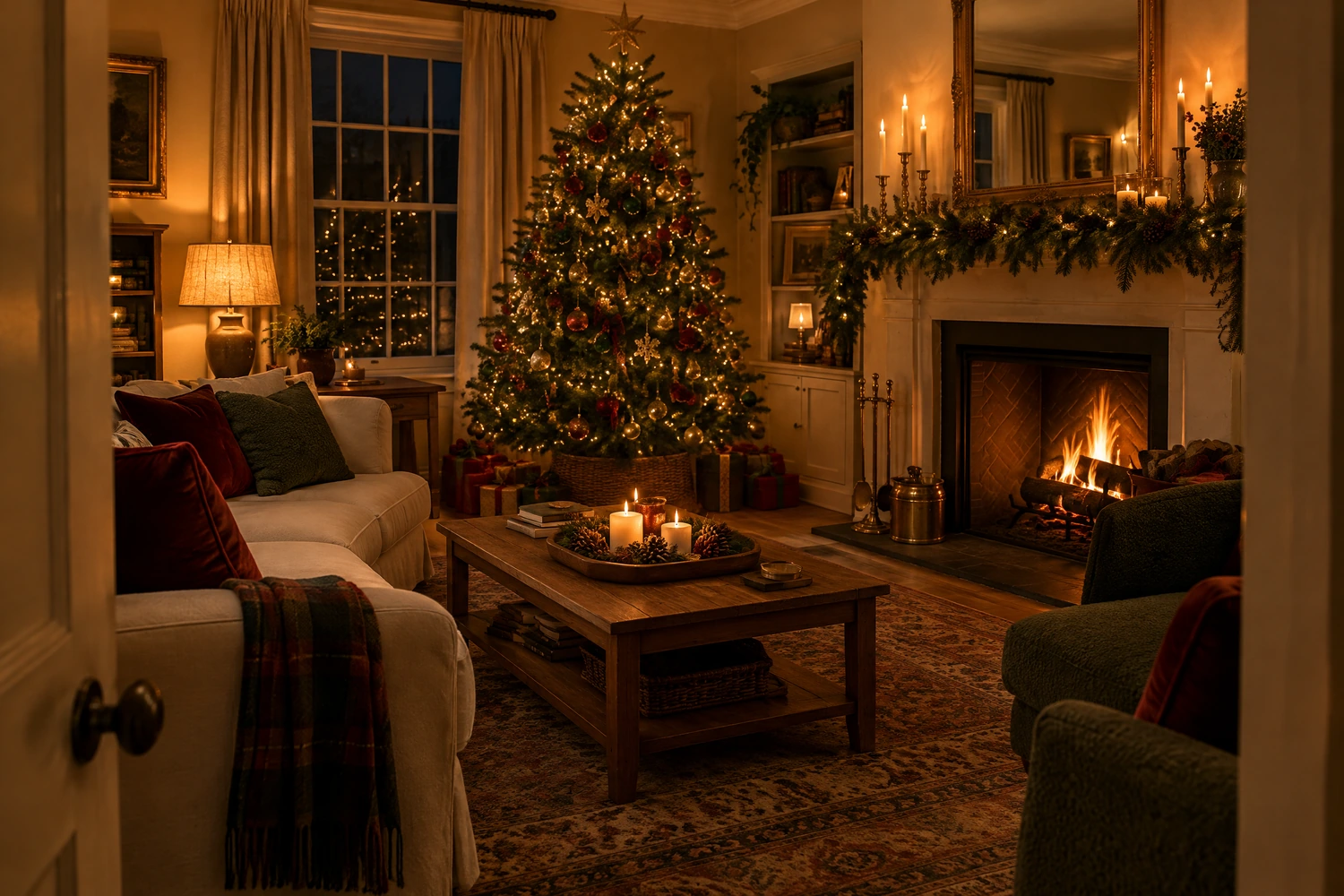
The living room Christmas decoration that looks genuinely beautiful rather than busy almost always starts with one decision made before a single ornament comes out of storage: choosing a palette and committing to it across every zone of the room. The reason most decorated living rooms feel cluttered rather than festive is not the quantity of decoration but the absence of a through-line connecting everything. Red velvet cushions beside gold tree ornaments beside a white-and-silver garland beside a natural pine wreath: individually attractive, collectively a competition. These ideas move through the living room zone by zone, from the palette decision through to the finishing atmospheric details, so every element you add belongs to the same visual story rather than fighting the one beside it. That coherence is what separates a Christmas living room that photographs well from one that actually feels worth being in.
CATEGORY ONE: CHOOSE THE PALETTE FIRST
1. The Classic: Rich Red, Evergreen, and Gold
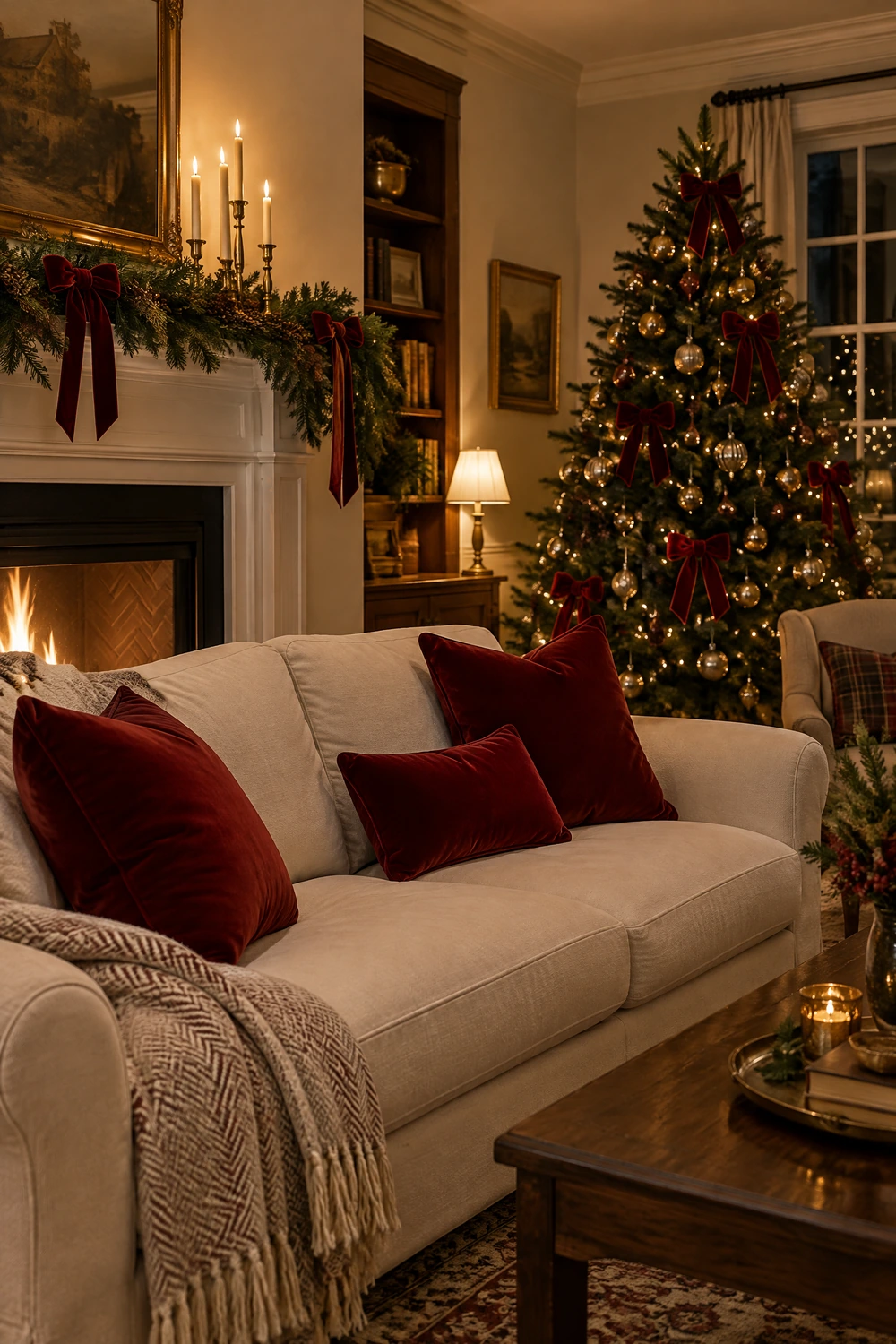
The traditional Christmas palette of deep red, evergreen, and warm gold is perennially effective because it is built around the colours of nature in winter, the red of holly berries, the green of pine and fir, and the gold of candlelight. In a living room this palette works through restraint rather than volume: a deep red velvet throw and two cushions on the sofa, a real or high-quality faux pine garland on the mantel with brass candlesticks, gold glass baubles on a dark-needled tree, and a wreath on the wall or door. The mistake with this palette is applying all three colors to every surface simultaneously. Instead, let the green anchor the large elements like the tree and garland, let the red appear in textiles and a few key accessories, and let gold be the metallic accent that connects them.
Designer Advice: Use only two of the three colours at any given surface. Green and gold on the mantel. Red and green on the sofa. Red and gold on the coffee table. When all three appear together on the same surface they compete rather than complement.
2. The Elegant Alternative: Cream, Gold, and Forest Green
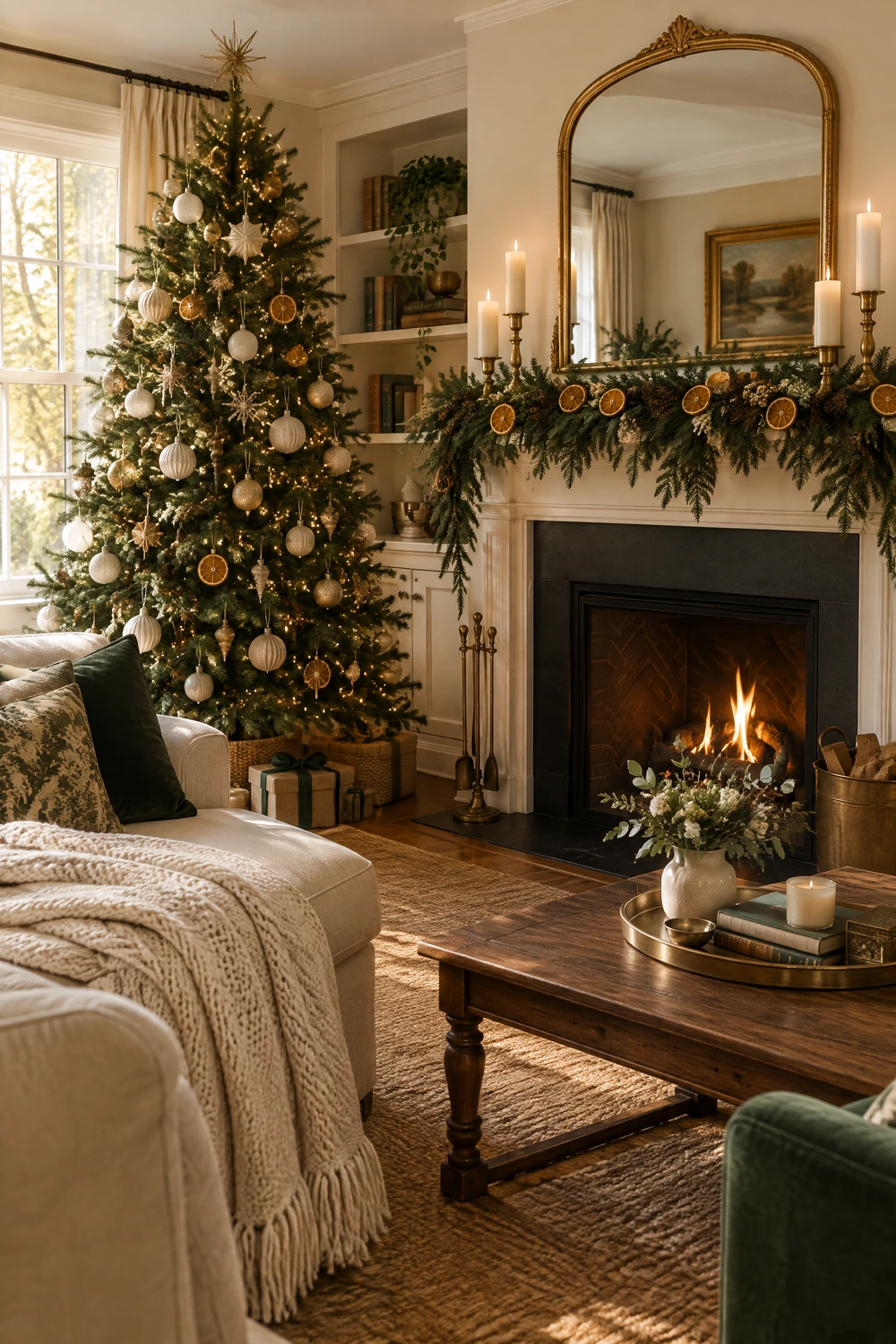
A Christmas palette built on cream, warm gold, and deep forest green rather than the primary red-and-green combination feels more considered and more aligned with current interior aesthetics, while remaining unmistakably festive. This palette suits rooms already decorated in neutrals and warm tones, because the cream and gold extend the room’s existing warmth rather than introducing a seasonal break from it. On the tree, cream and gold ornaments with velvet ribbon. On the mantel, cream pillar candles in warm brass holders flanked by dark evergreen garland. On the sofa, cream knit throw and cushions in deep forest green velvet. The result is a room that reads as festive and designed simultaneously.
Pro Move: Add dried orange slices, cinnamon sticks, and star anise to the mantel arrangement and garland. These natural additions bring a warm spiced quality to the cream and green palette that pure metallic and evergreen arrangements lack, and they fill the room with a scent that contributes to the Christmas atmosphere.
3. The Modern Approach: Dusty Blush, Champagne, and Sage
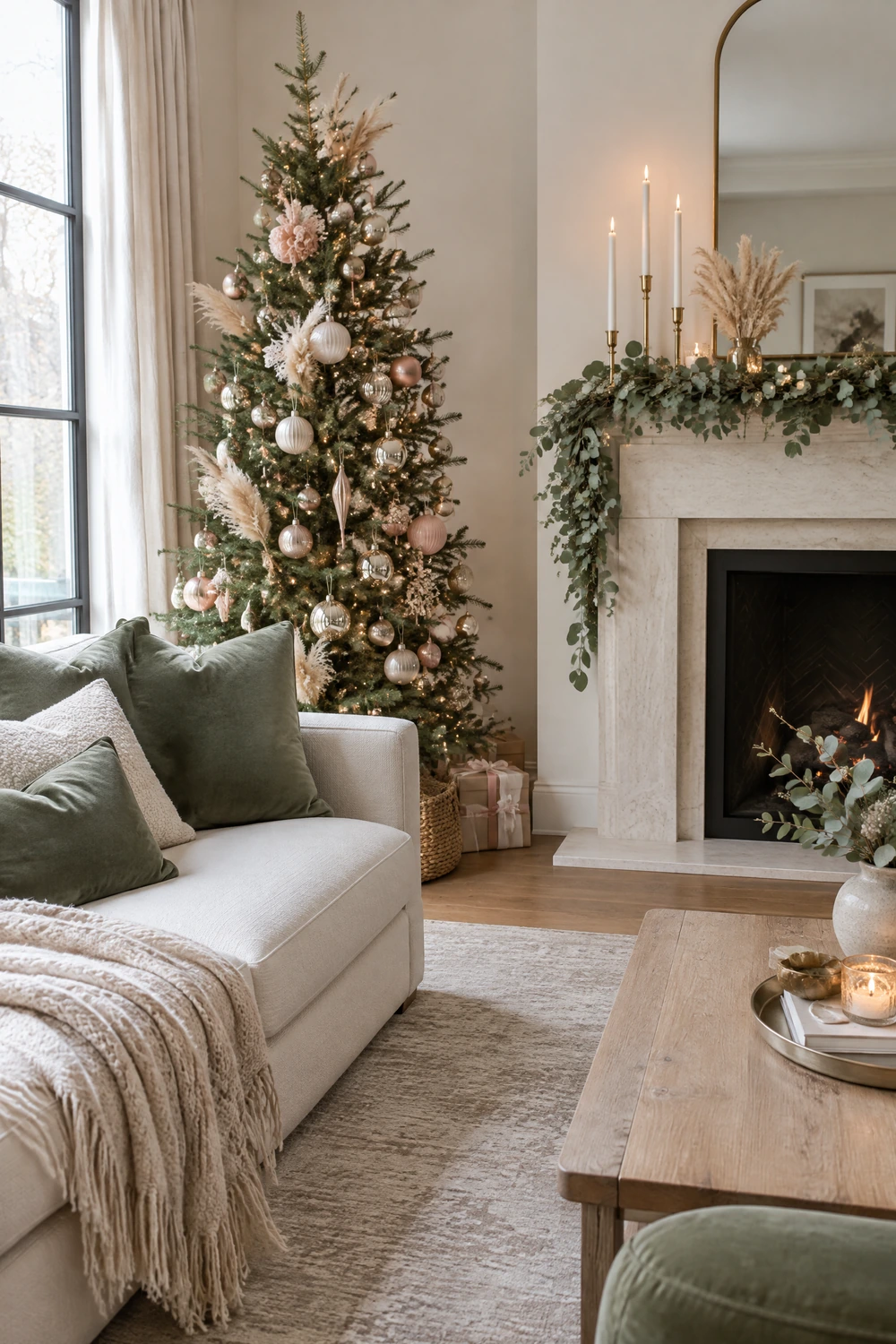
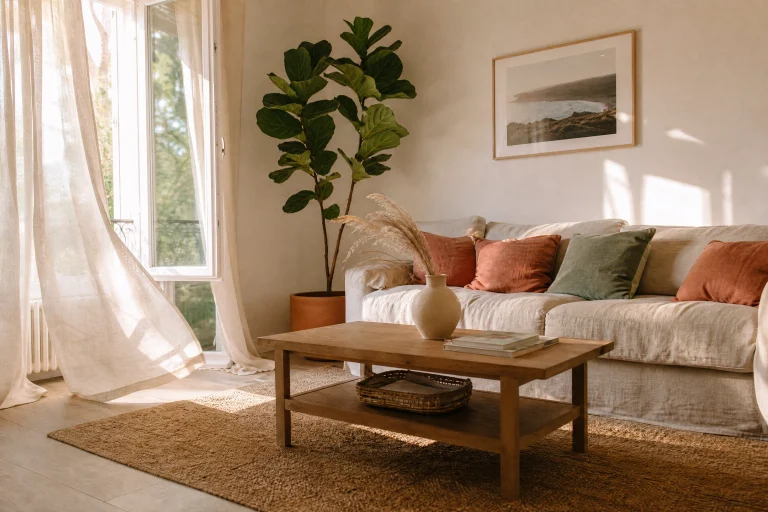
A softer, more muted Christmas palette in dusty blush, champagne, and sage green suits rooms with a contemporary or Scandinavian aesthetic where primary Christmas colours would feel jarring. Blush and champagne ornaments on a slim, airy tree, sage green velvet cushions on the sofa, cream tapers in a champagne metal holder on the mantel, and dried pampas stems mixed into a eucalyptus garland create a room that reads as festive without disrupting the room’s year-round aesthetic. This palette photographs beautifully and ages gracefully through the season without feeling dated.
Quick Tip: In a muted palette, the quality of the metallic finish matters more than in a bolder scheme. Choose champagne, warm gold, or aged brass rather than chrome or cool silver. Cool metallics push the palette toward grey and winter-bland rather than warm and celebratory.
4. The Dramatic Option: Deep Navy, Midnight Black, and Warm Gold
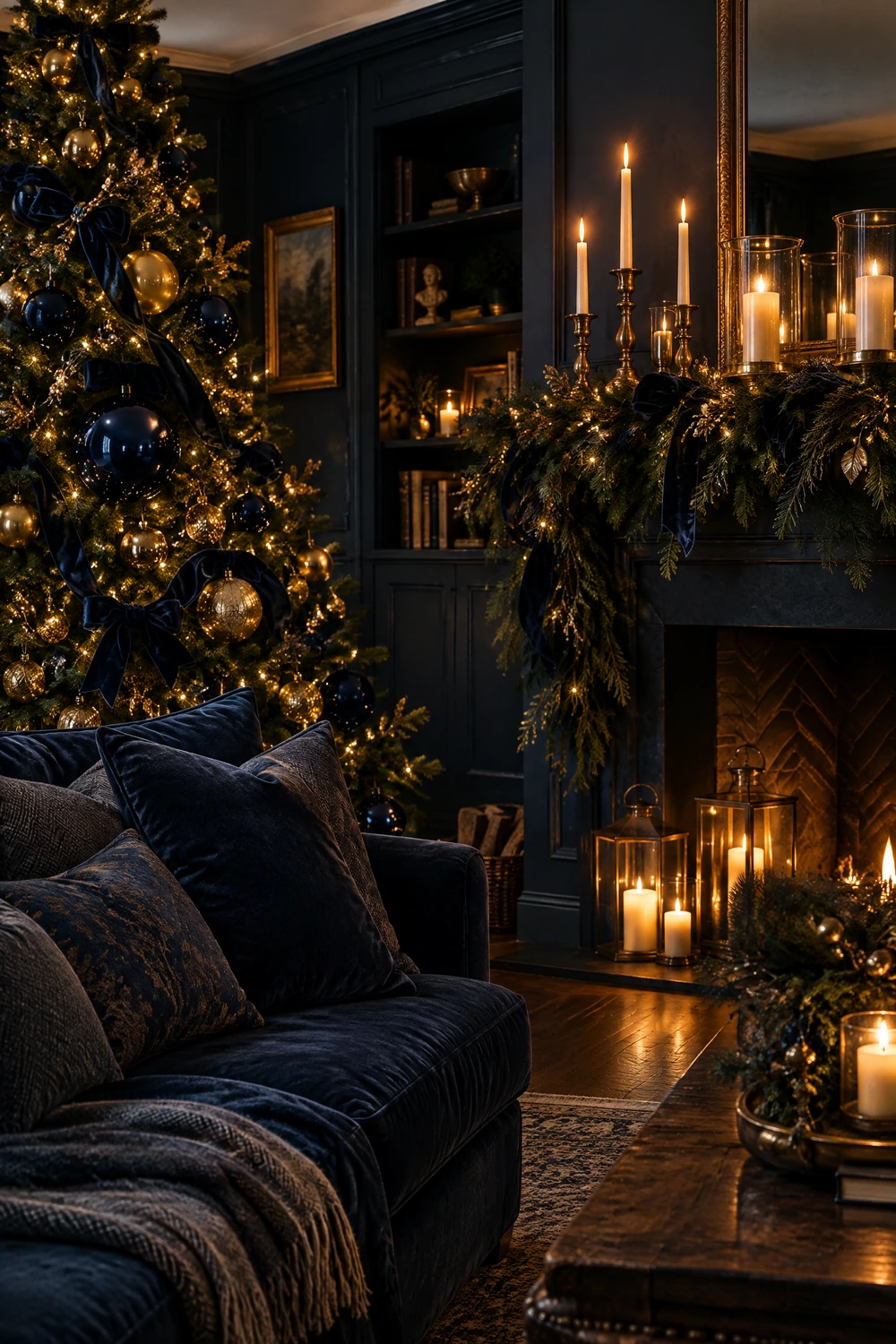
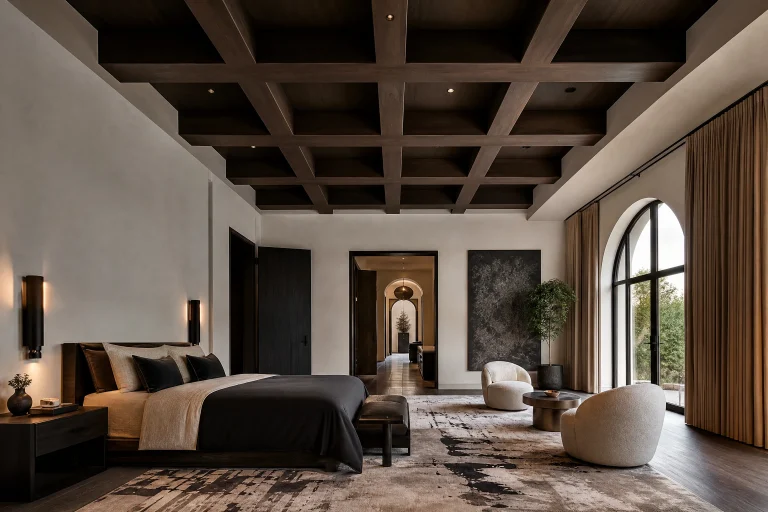
A deep, dramatic Christmas palette in navy, near-black, and warm gold creates a room that feels rich, grown-up, and deliberately different from the conventional Christmas aesthetic. This palette suits rooms with dark walls, deep-toned upholstery, or an existing commitment to richness and depth. A navy-and-gold tree with large glass baubles and deep blue velvet ribbon, a mantel in dark pine branches with aged gold candlesticks and hurricane lanterns, and the sofa dressed in navy and charcoal cushions with a black cashmere or velvet throw create a festive atmosphere that reads as genuinely designed rather than seasonally dressed. Warm candlelight is essential in this palette to prevent the dark tones from reading as cold.
Reality Check: This palette requires more light than a conventional Christmas scheme. Layer candles, lamps, and fairy lights at multiple heights throughout the room to counteract the light-absorbing quality of the dark tones. Without sufficient warm light sources, a navy and black Christmas scheme reads as gloomy rather than dramatic.
CATEGORY TWO: THE CHRISTMAS TREE
5. Position the Tree for Maximum Impact From the Most-Viewed Angle
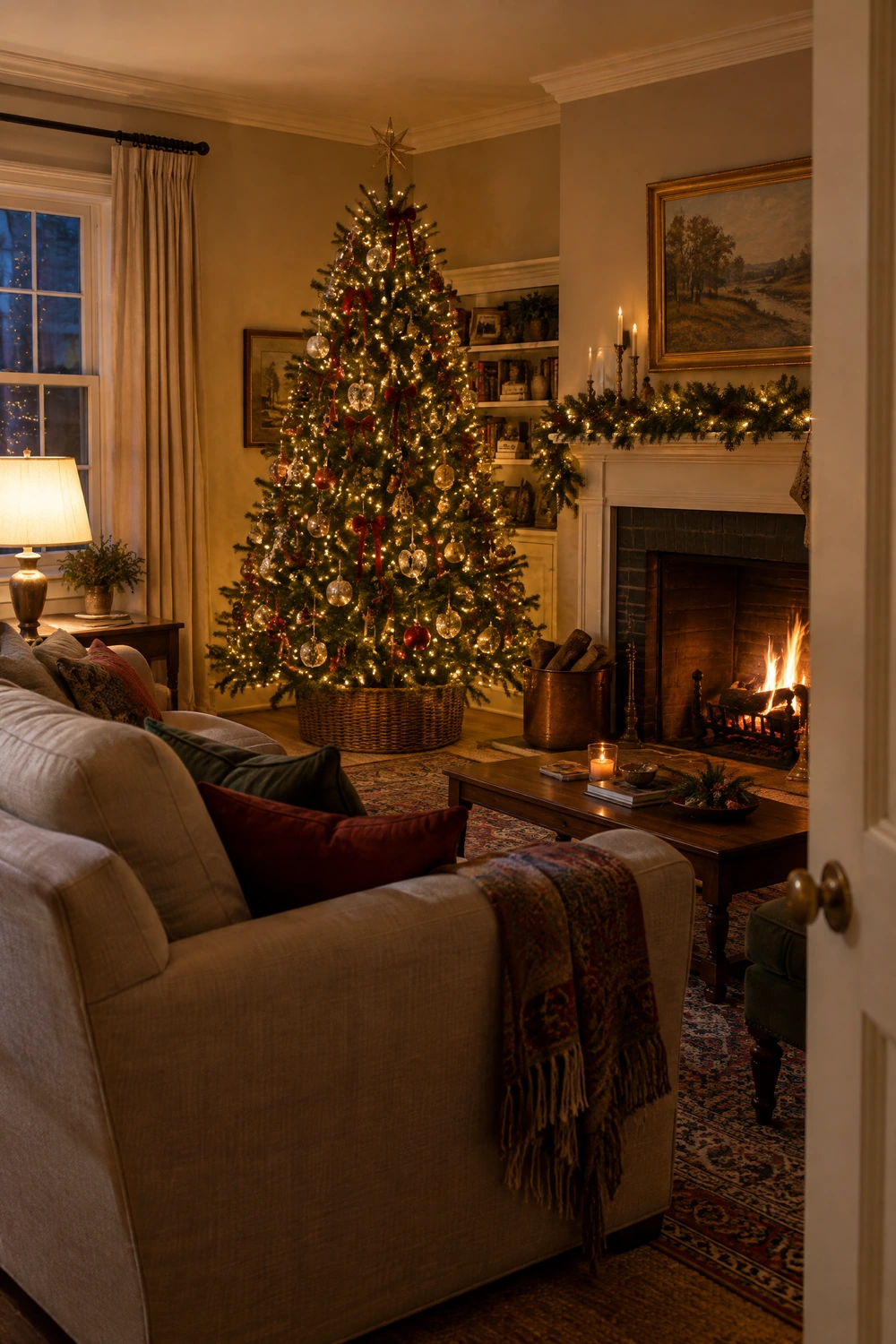
The position of the Christmas tree in the living room determines how the whole room reads during the season, and it is worth thinking through before the tree goes up rather than defaulting to wherever it went last year. The most impactful position is one that is visible from the room’s main seating area and, ideally, from the doorway on entering. A corner beside the fireplace or the window is the most classically effective position because the tree gains architectural context from the wall surfaces beside it and natural light from the window makes the ornaments visible during the day. A tree positioned in the centre of a wall with furniture arranged to face it creates the most formal, display-room effect. A tree in a corner reads as more lived-in and naturally integrated with the room.
Pro Move: Before positioning the tree, remove any existing furniture piece from the intended zone temporarily and assess how the room feels with that floor space open. A tree placed in a corner where a chair was removed often reads better than a tree squeezed beside existing furniture that was not moved to accommodate it.
6. Use a Consistent Ornament Approach Rather Than Every Bauble Owned
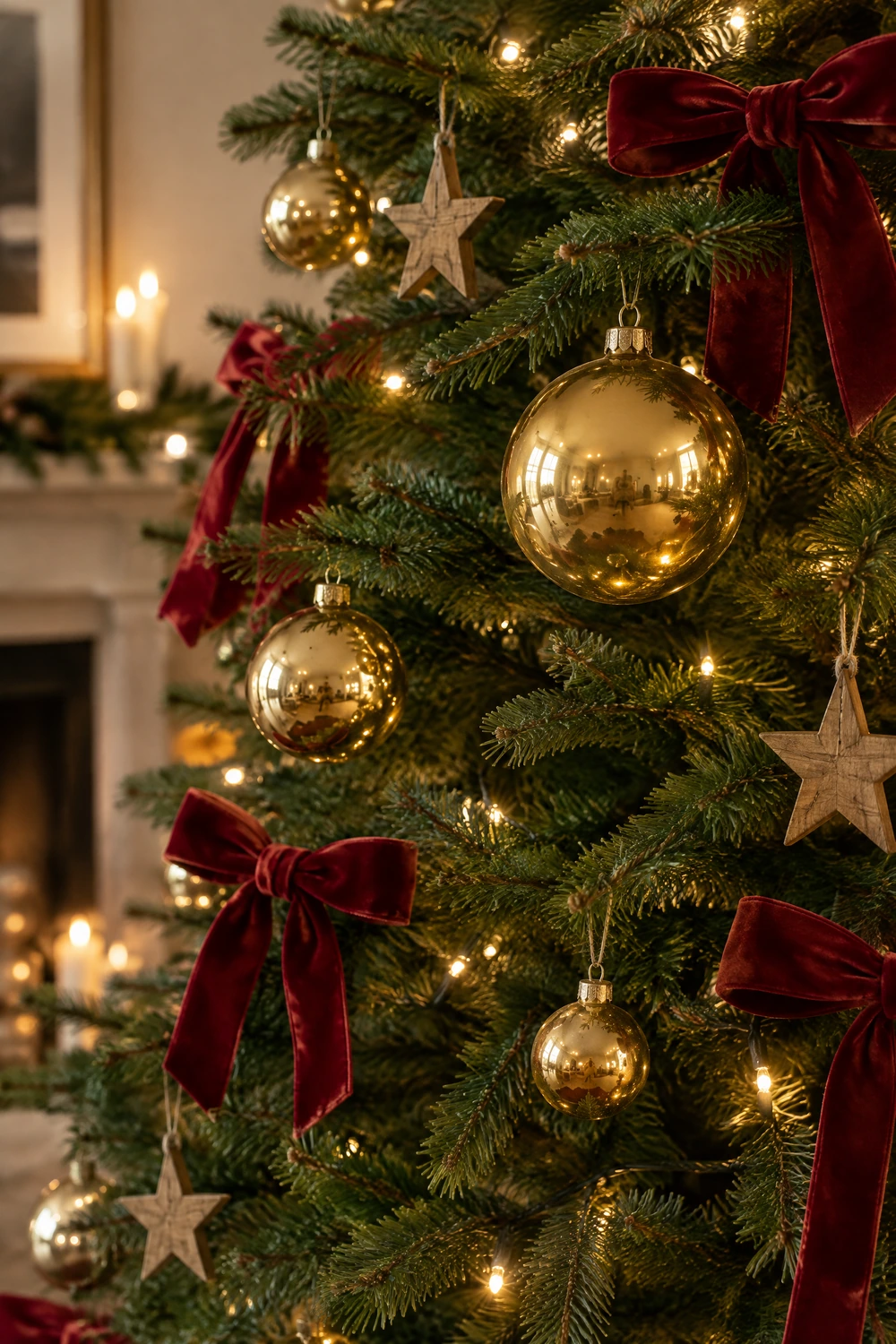
The most beautifully dressed Christmas trees are not necessarily the ones with the most ornaments, but the ones where the ornaments share a consistent visual language. Three sizes of the same glass bauble in two or three related tones, interspersed with one other type of ornament, a wooden shape, a velvet ribbon bow, a dried orange slice, creates a tree that reads as designed and cohesive. A tree hung with thirty years of accumulated ornaments in every colour, material, and scale can be deeply meaningful and personally rich, but it reads very differently from a well-planned tree in a specific palette. Both are valid approaches, but understanding which one you are going for helps you make decisions about what to add rather than simply adding everything available.
Designer Advice: Work from the inside out when hanging ornaments. Push the largest and most important pieces deep into the branches first, where the light catches them and they add depth. Fill the outer branches with the smaller pieces last. A tree dressed only on the outer branches looks flat. A tree with depth at every level looks full and rich.
7. Try the Velvet Ribbon Bow Trend for a rich Tree
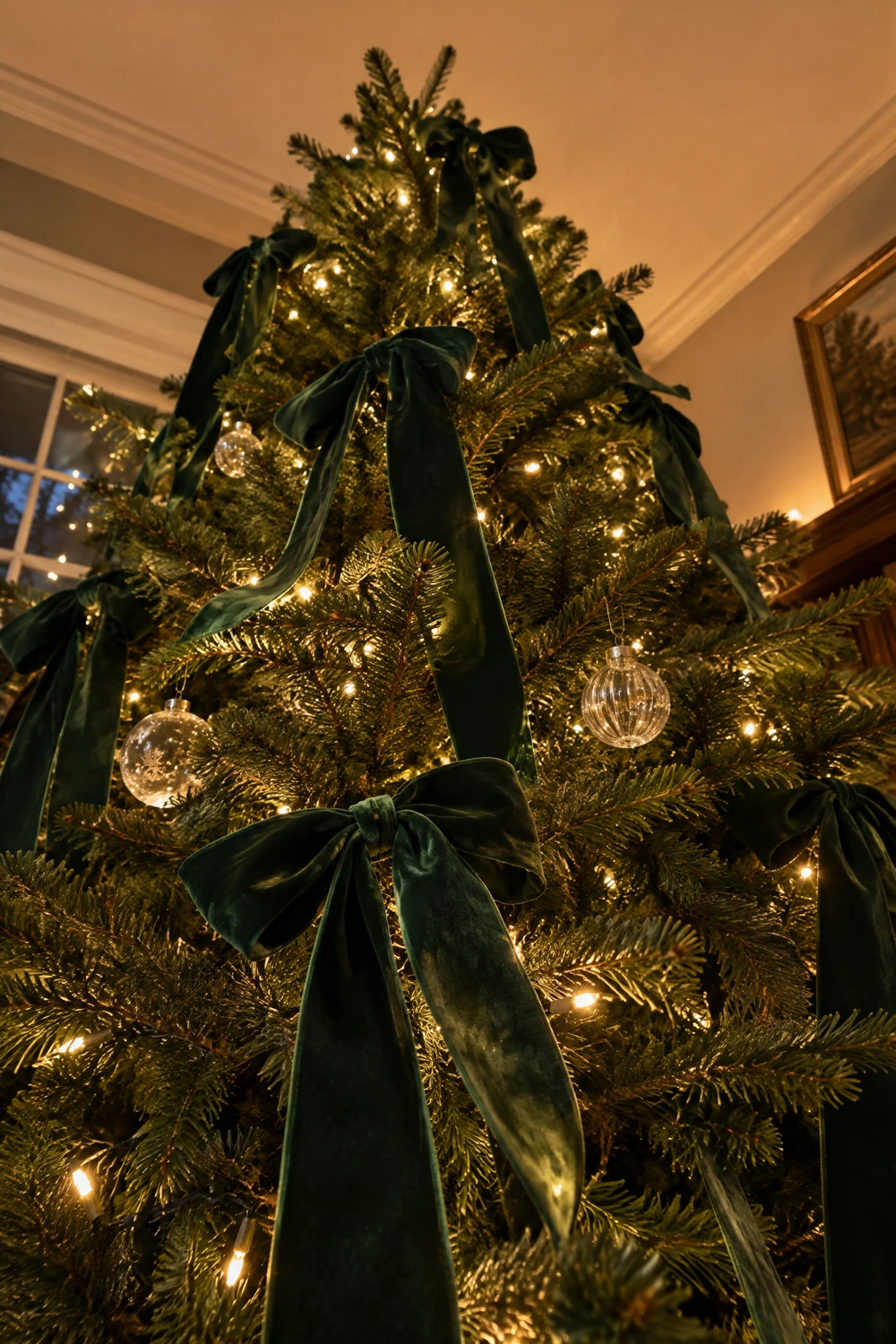
One of the most prominent Christmas decorating approaches of recent seasons is replacing or supplementing glass baubles with velvet ribbon bows tied directly to the tree branches. A tree dressed primarily in velvet bows, in one or two related tones of deep red, forest green, dusty blush, or champagne, with the ribbon tails left long so they drape down through the branches, creates a softer, more textile-rich look than a glass-bauble tree and photographs beautifully in warm light. The velvet catches the light differently from glass and moves slightly in the warmth of the room, giving the tree a quality of gentle movement that still ornaments cannot provide.
Quick Tip: Use a velvet ribbon with a slight sheen rather than a fully matte ribbon for better light interaction. A completely matte ribbon looks flat in photographs and in room lighting. A velvet with a subtle luster catches and reflects the fairy lights in a way that adds life to the bows.
8. Add a Tree Skirt That Relates to the Room’s Existing Palette

The tree skirt is one of the most overlooked elements of a Christmas tree arrangement and one that has a significant visual impact on how the base of the tree reads. A cheap, shiny, or mismatched tree skirt undermines the ornament styling above it by introducing a discordant note at the most grounded and most visible level of the arrangement. A tree skirt in a material and colour that belongs to the room’s Christmas palette, a linen skirt in cream or natural, a faux fur in white or warm grey, a plaid wool in the palette’s colours, or a jute and velvet combination, anchors the tree in the room’s aesthetic rather than marking it as a seasonal installation sitting on top of the room’s regular decor.
Heads Up: A deep basket or large terracotta pot used as a tree stand concealer is a more contemporary alternative to a traditional tree skirt. A wide rattan or wicker basket tall enough to conceal the stand reads as a designed element rather than a cover-up, and it suits modern and bohemian aesthetic rooms better than a fabric skirt.
CATEGORY THREE: THE MANTEL AND FIREPLACE
9. Build the Mantel Arrangement From Back to Front
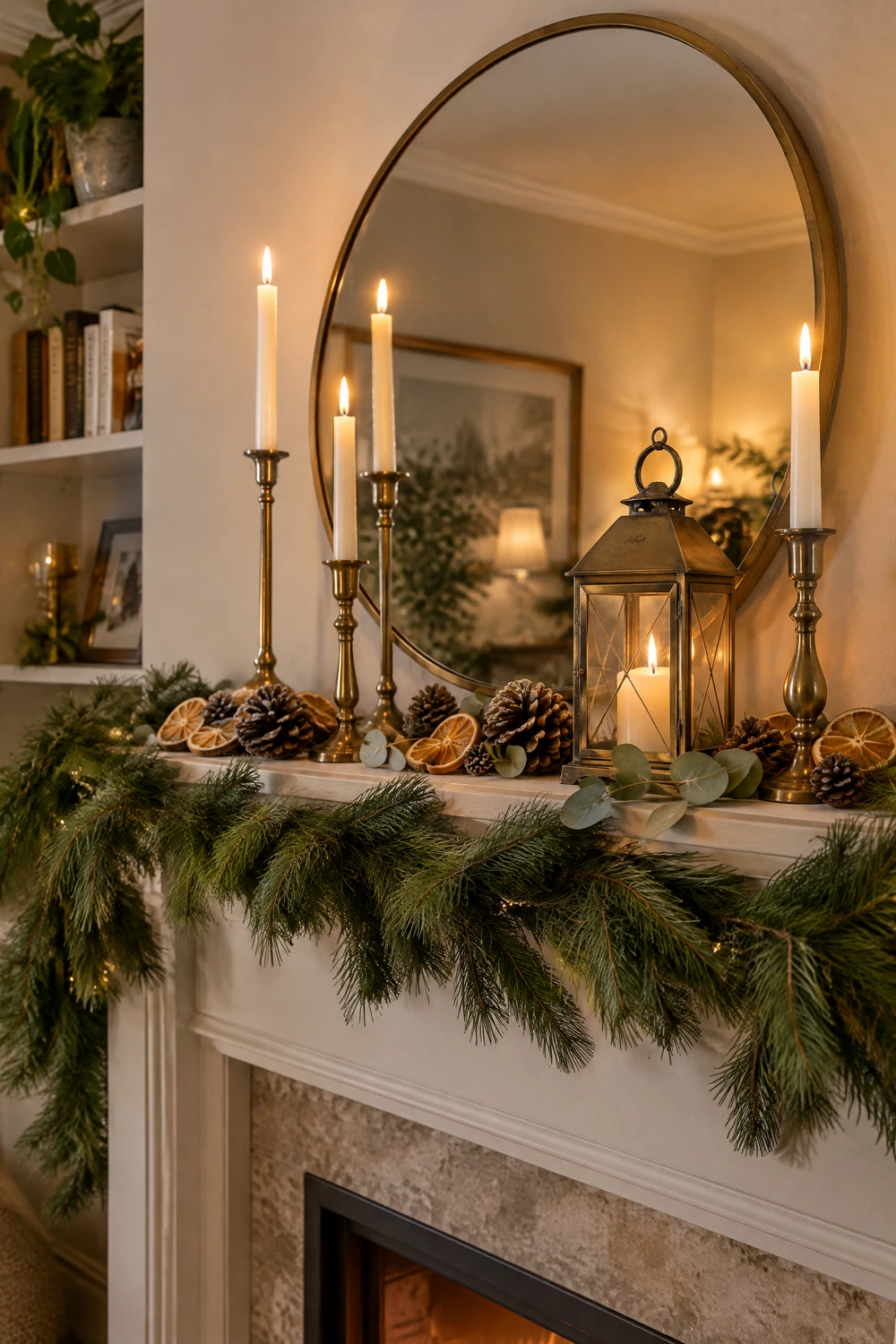
A Christmas mantel arrangement that looks professionally styled is almost always built from back to front in three layers: the back layer of the largest vertical elements against the chimney breast, a mirror or a large piece of art leaning back, or a wreath hung there; the middle layer of medium-height objects in front of that, candles, lanterns, small vases; and the front layer of the smallest and lowest objects at the mantel’s edge, loose greenery sprigs, small pine cones, cinnamon stick bundles, or a single stem in a narrow vase. This three-depth approach gives the arrangement a visual richness that a single flat layer of objects arranged side by side cannot achieve, because the eye reads the depth as space and scale.
Designer Advice: Leave the central section of the mantel relatively open, with the arrangement weighted to one side and a single contrasting element on the other. This asymmetrical balance reads as styled rather than symmetrically formal, and it allows the fireplace opening below to breathe rather than being visually overwhelmed by the display above it.
10. Use a Fresh or High-Quality Faux Garland as the Mantel’s Foundation
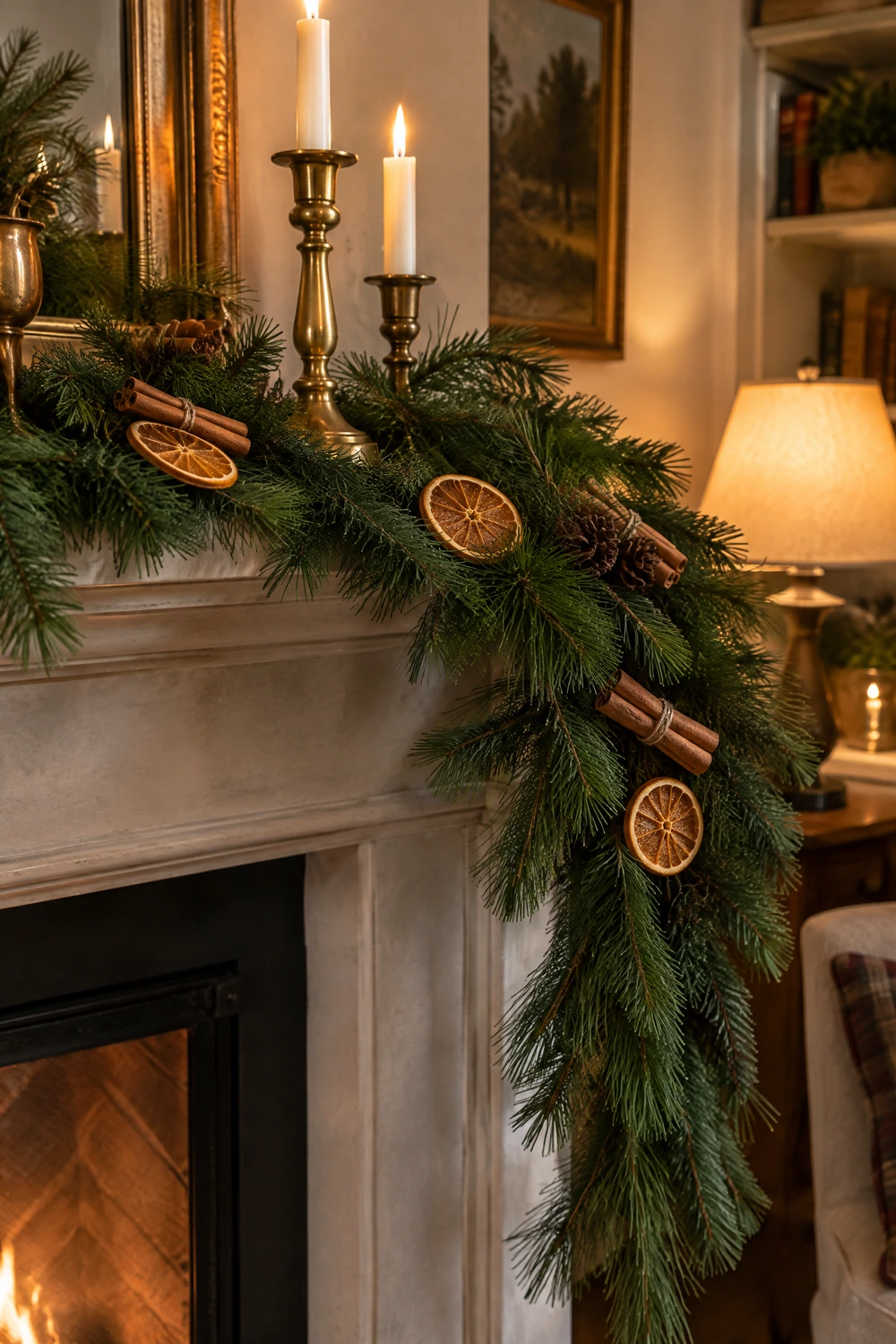
A garland of fresh pine, cedar, eucalyptus, or a high-quality faux alternative is the single most significant mantel addition in a Christmas living room because it brings organic material, real or convincingly simulated texture, and the green or silver-green tone that anchors the mantel in the season’s botanical palette. A fresh garland additionally fills the room with the real scent of pine or eucalyptus, which contributes more to the Christmas atmosphere in a living room than most decorative additions. Draped asymmetrically along the mantel edge with sprigs falling at either end, a garland of real pine or cedar is the foundation on which candles, lanterns, and smaller accessories can be layered above and between the branches.
Reality Check: A fresh garland needs moisture to stay looking good through the season. Mist it every two to three days with water and keep it away from direct heat sources like fire and radiators. A fresh garland that dries out and sheds needles within a week looks worse than a high-quality faux version that stays fresh for the entire season.
11. Hang Stockings in a Way That Looks Designed
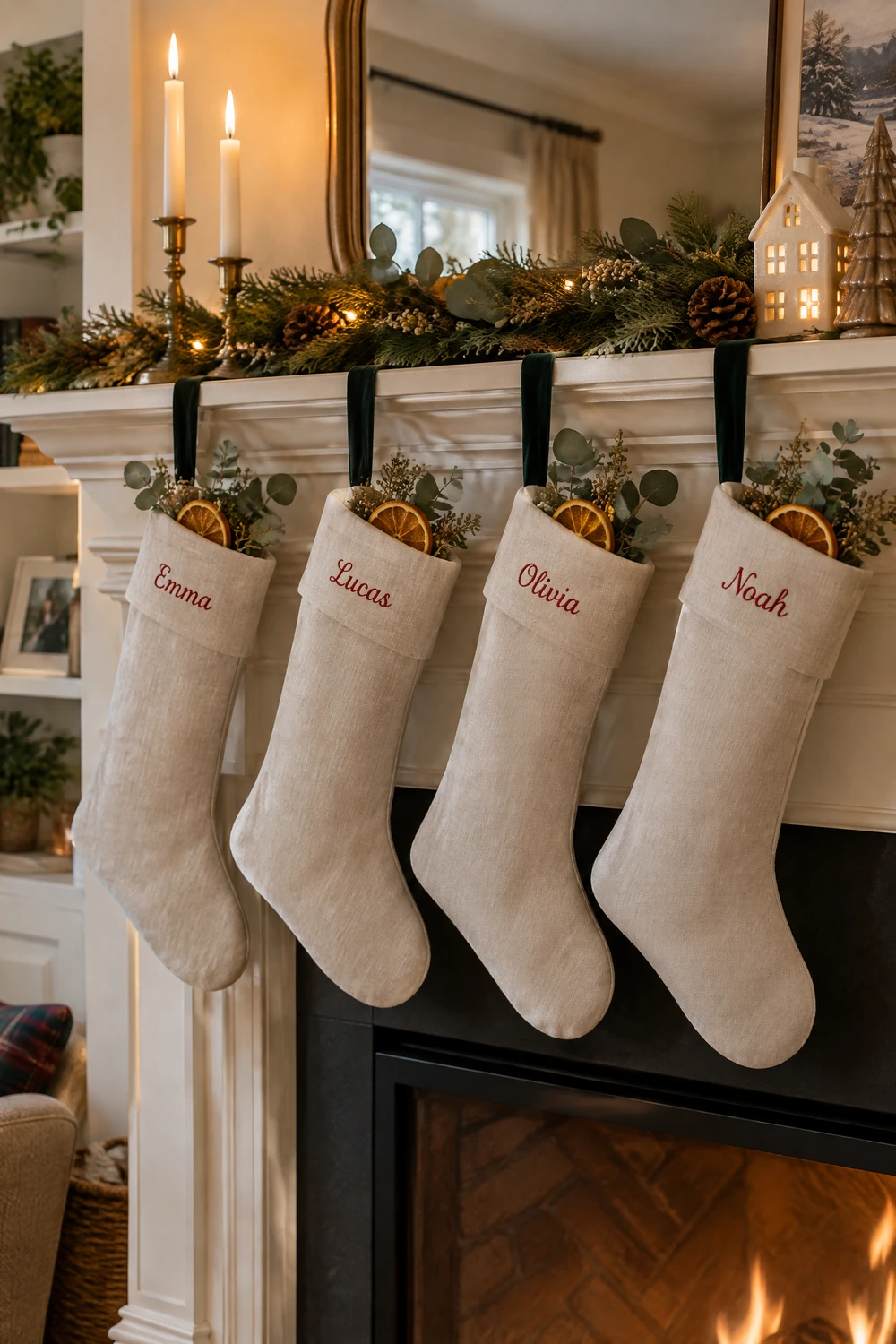
Stockings hung on a mantel are one of the most beloved Christmas traditions and one of the most consistently awkward-looking decorative moments if not handled carefully. A row of different stockings in different colours, sizes, and materials, each hung with a different hook in a different position, reads as accumulated rather than arranged. A set of matching or closely related stockings, in the same material family, hung at consistent heights with matching hooks or with velvet ribbon loops in the palette’s colour, reads as a considered display that functions as a decorative element rather than an add-on. Even personalisation, embroidered names or felt initials, looks better on a consistent set than on a collection of unrelated stockings.
Pro Move: Add a sprig of fresh eucalyptus, a dried orange slice, or a small bundle of cinnamon sticks tucked into the top of each hanging stocking. This small detail ties the stockings into the mantel’s botanical arrangement and makes the overall display feel cohesive rather than consisting of separate elements placed in the same zone.
12. Use Candles at Multiple Heights for Warm, Layered Light
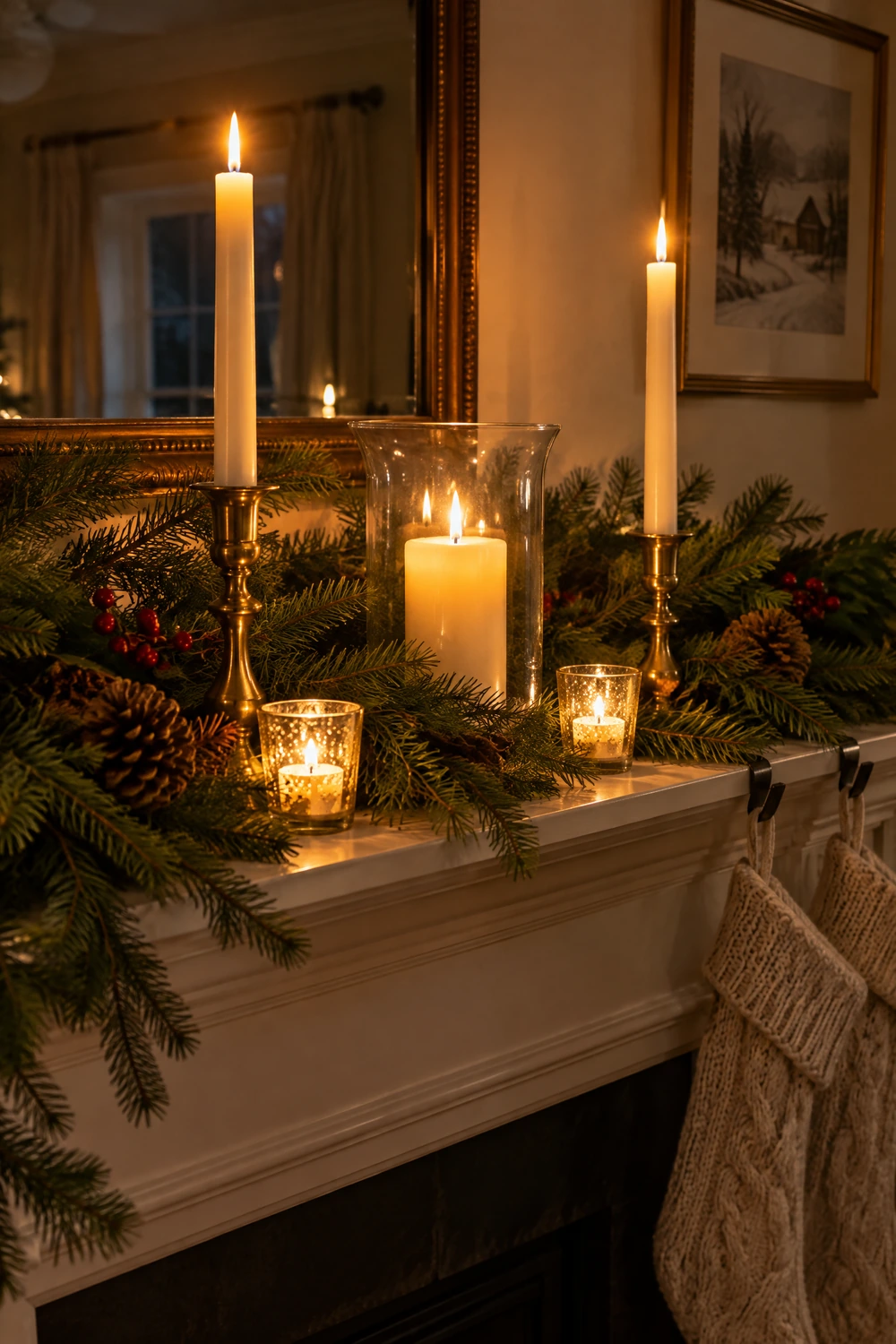
Candles on the Christmas mantel are not simply decorative objects but the primary source of the intimate, warm light that makes a Christmas living room feel genuinely festive rather than brightly lit. A cluster of candles at different heights, tall tapers in brass or aged metal holders beside medium pillar candles in a glass hurricane and low votives at the front of the mantel, creates layered light at the mantel level that enhances the entire room when the room’s other lights are dimmed. In the 2025 approach to Christmas decorating, which prioritises atmosphere over volume, a well-lit mantel with fewer decorative objects and more candlelight reads as more considered and more festive than a fully laden mantel under a bright overhead light.
Quick Tip: Never leave candles burning on a mantel unattended, particularly near a fresh garland. Use pillar candles in hurricane glass holders as the primary light source near the greenery, and reserve open tapers for areas where nothing flammable is within the radius of a tipping candle.
CATEGORY FOUR: THE SOFA AND FESTIVE TEXTILES
13. Swap the Sofa Cushions Into the Christmas Palette
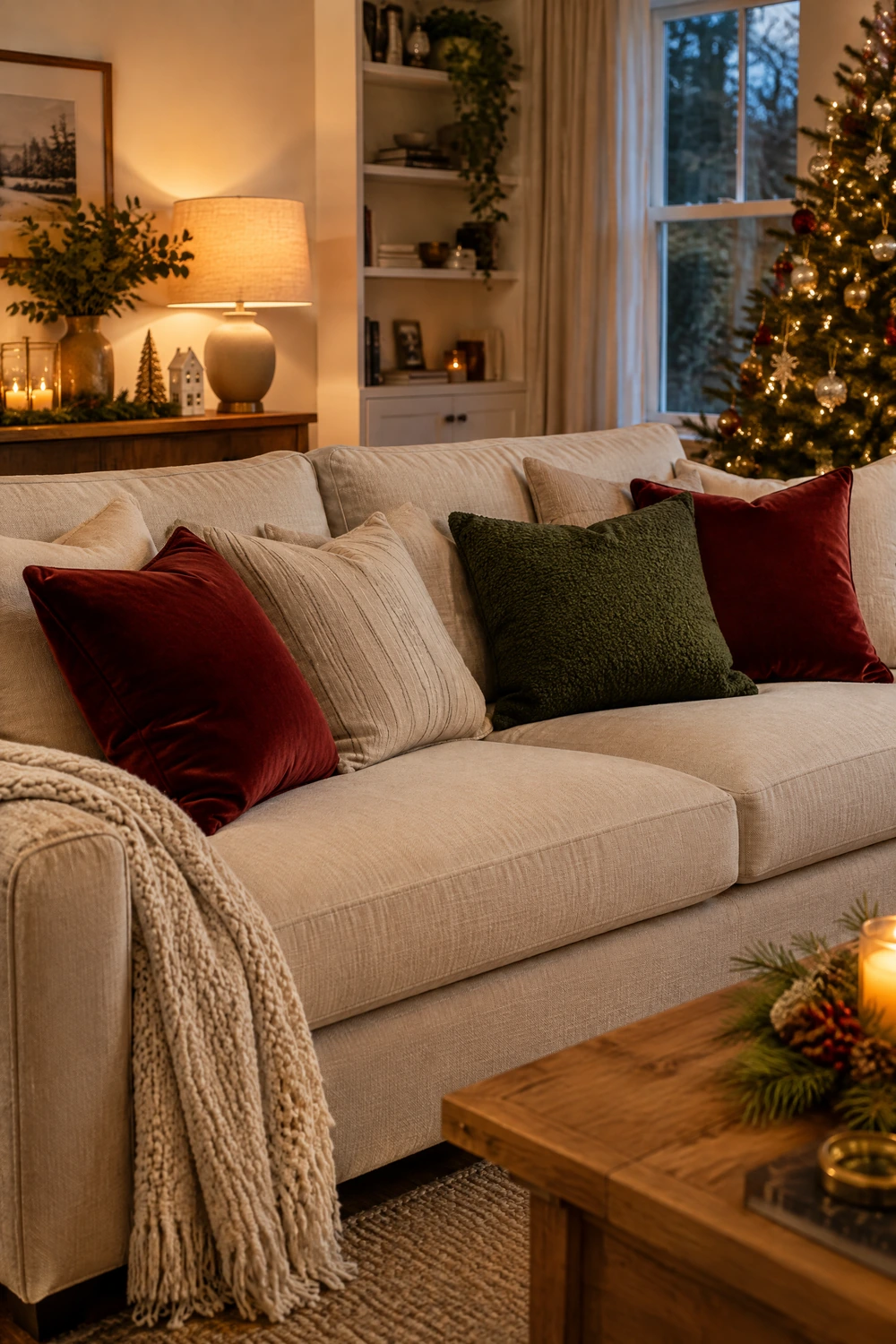
The sofa is the living room’s largest piece of furniture and its most dominant visual surface, which makes it the highest-priority textile zone in a Christmas decoration scheme. Swapping two or three cushion covers into the Christmas palette, a deep red velvet, a forest green boucle, a cream linen with an embroidered sprig, while keeping the rest in the room’s neutral year-round covers, introduces the seasonal palette at the most visible furniture level without overwhelming the room. The seasonal cushions should relate to the palette chosen in the first step, and they should sit alongside the existing neutral cushions rather than replacing all of them, which would make the sofa read as re-upholstered for Christmas rather than seasonally layered.
Reality Check: Resist the urge to add every Christmas cushion owned to the sofa simultaneously. Two to three seasonal cushions among the existing neutral ones read as a considered addition. Six or seven seasonal cushions with no neutrals between them read as a sofa that cannot be sat on.
14. Layer a Festive Throw Over the Sofa Arm
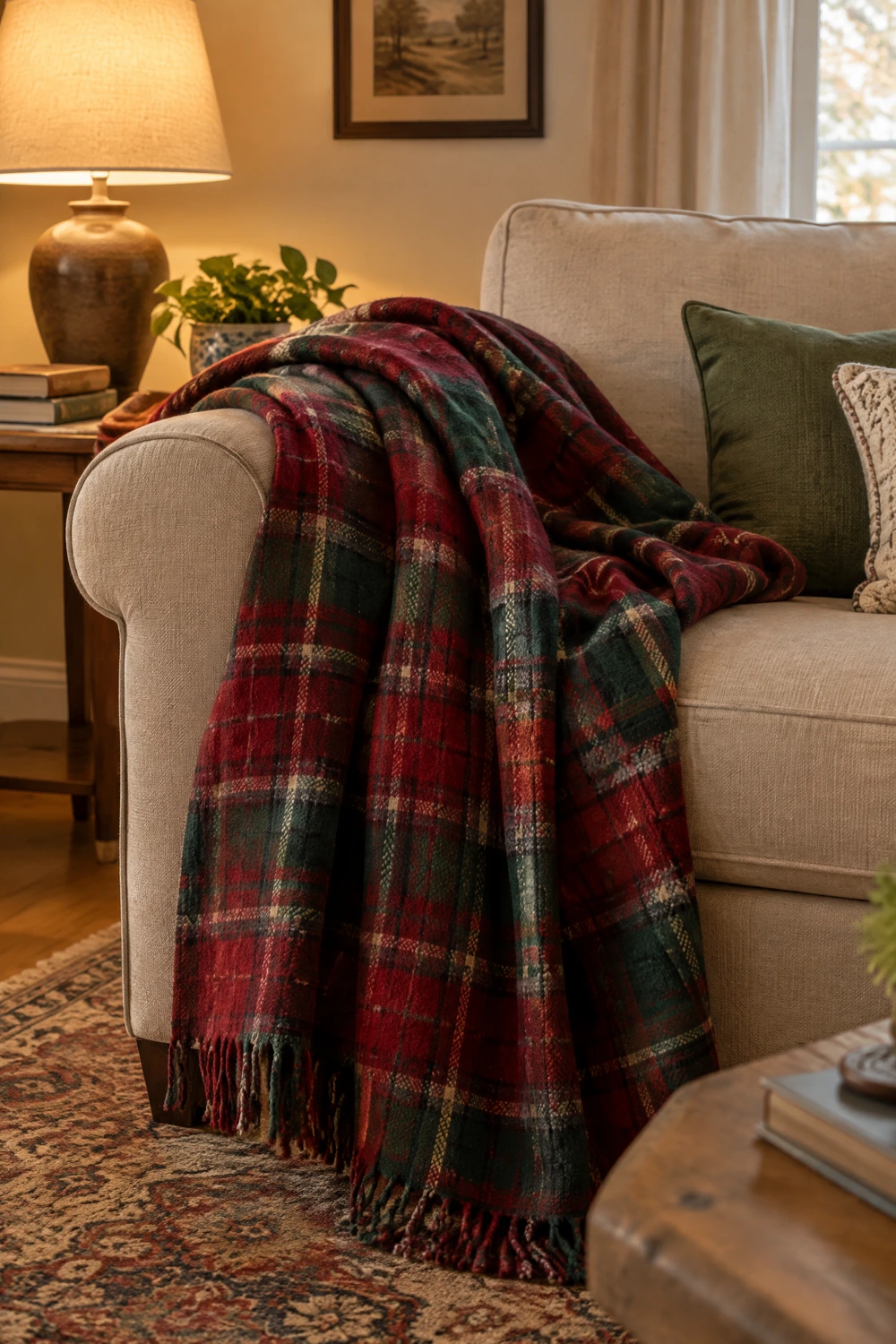
A throw draped over the sofa arm or back in a festive material, a deep red or forest green plaid, a cream chunky knit with a subtle lurex thread that catches the fairy light glow, a tartan in the palette’s colours, or a faux fur in white or warm grey, adds the seasonal textile layer to the sofa that cushions alone cannot achieve. The throw should be large enough to drape generously rather than perching on the sofa arm as a narrow strip. A throw that unfolds to show its pattern, casually loosened from a fold rather than neatly tucked, adds the lived-in quality that makes a Christmas living room feel genuinely warm rather than staged.
Designer Advice: A plaid or tartan throw is the most specifically Christmas-associated textile available and the one that most immediately signals the season without requiring any specific colour palette. A tartan in the room’s existing neutral tones, a grey and cream plaid, a navy and green tartan, introduces the festive textile quality while remaining compatible with any room’s existing colour scheme.
15. Bring in Extra Texture With a Faux Fur or Sheepskin
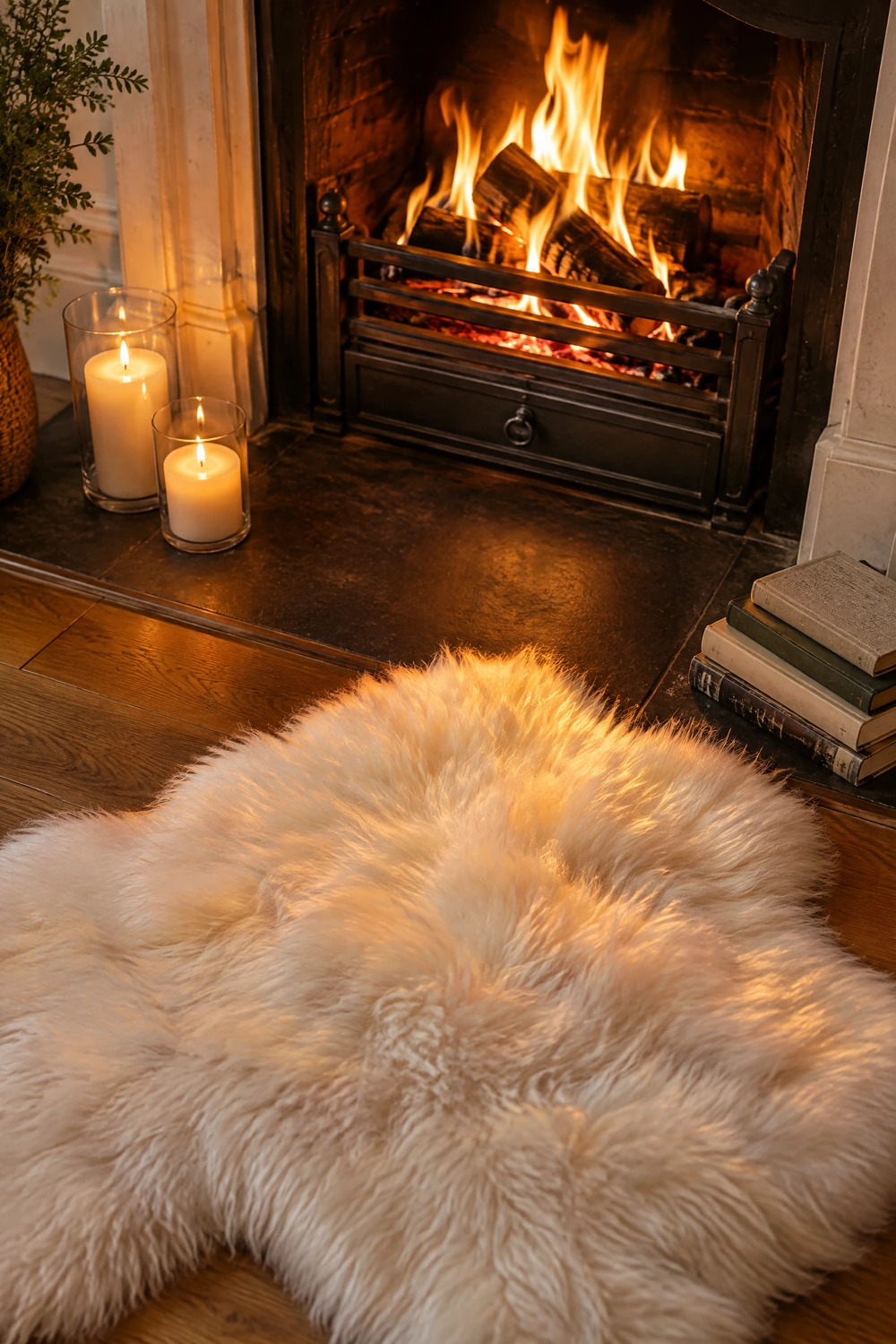
A faux fur or sheepskin placed over the seat of a reading chair, across the arm of the sofa, or on the floor beside the fireplace adds the tactile, sensory warmth that is at the heart of the 2025 Christmas decorating approach. This year’s trend moves decisively away from quantity of decoration toward quality of atmosphere, and a piece of faux fur or sheepskin delivers the cozy, tactile richness that epitomises that atmospheric quality. A white or cream faux fur in front of the fireplace creates the classic Christmas scene of warmth and comfort beside the fire, and it does so through a single textural addition that costs very little and stores compactly.
Quick Tip: A faux fur throw on the seat of a wooden or rattan chair instantly makes the chair look like the most comfortable seat in the room and the most inviting place to spend a Christmas evening. It requires no structural change to the room and costs under thirty dollars.
CATEGORY FIVE: THE COFFEE TABLE
16. Style a Christmas Coffee Table Vignette on a Tray
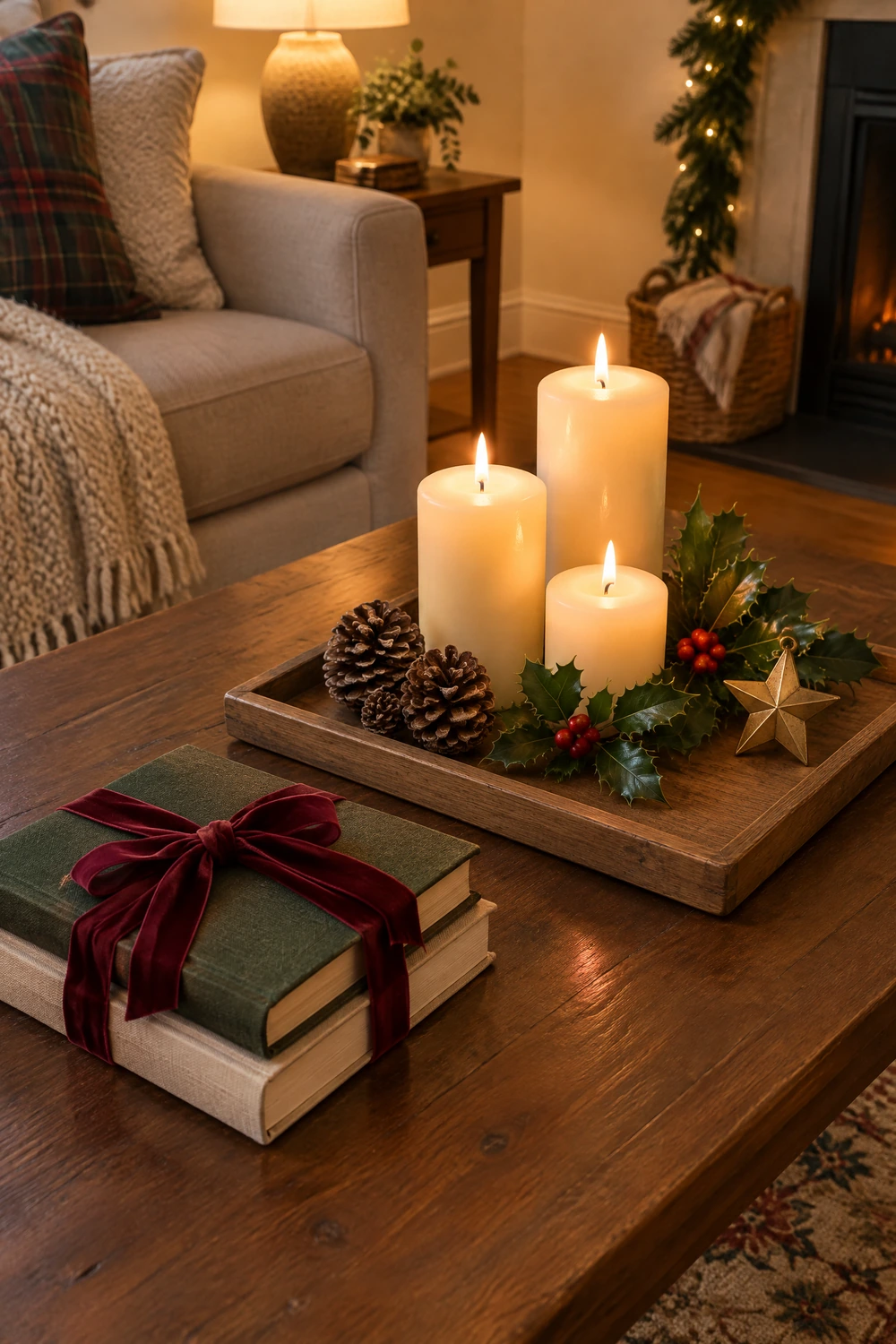
The coffee table Christmas vignette is the room’s most central and most visited decorative moment, and it benefits from the same tray-based structure that makes any coffee table arrangement read as intentional rather than accumulated. A large tray in a material that relates to the room’s aesthetic, a wooden board, a slate piece, a rattan tray, or a mirrored surface, corrals the seasonal objects and creates a clear visual boundary for the display. Inside the tray: two or three candles of different heights, a small pine cone arrangement or a sprig of evergreen, one or two small objects in the Christmas palette, a small ceramic reindeer, a brass star, a vintage mercury glass ornament. Outside the tray, one object of contrast, a small plant or a stack of books with a bow, gives the surface visual rhythm.
Pro Move: A simmer pot arrangement on the coffee table in a decorative bowl, dried orange slices, cinnamon sticks, star anise, and cloves arranged artfully, looks beautiful and, when transferred to the stovetop with water, fills the house with a natural Christmas scent. The bowl serves as both decoration and a practical source of the season’s most evocative fragrance.
17. Add a Christmas Book Stack as a Seasonal Detail
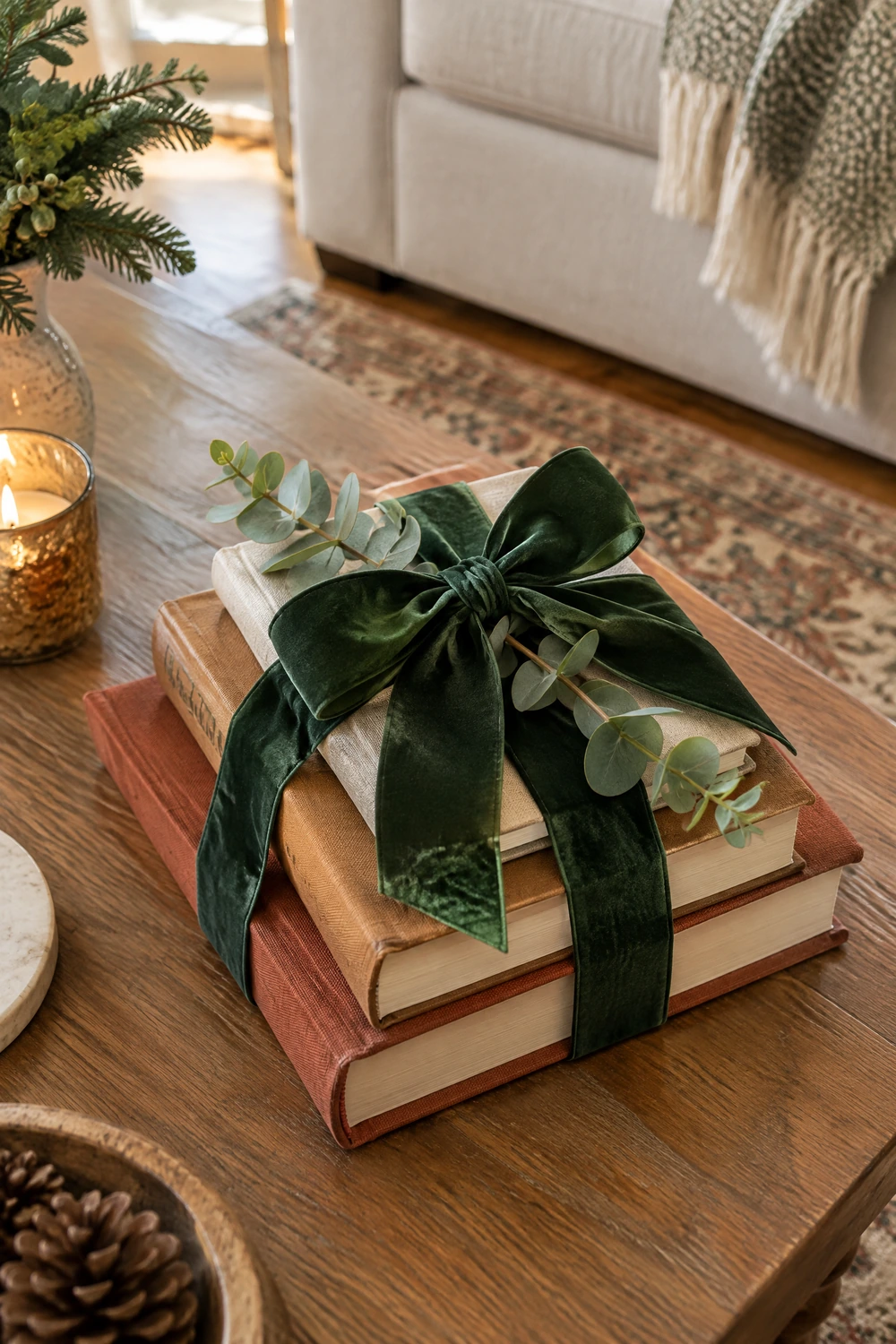
A stack of two or three books with Christmas-associated subjects or aesthetics, a vintage illustrated Christmas story, a baking book with a warm-toned cover, a gardening book with a botanical subject, tied with a velvet ribbon in the palette’s colour, is one of the simplest and most understated ways to introduce the season on the coffee table without a specifically Christmas-branded object. The stack reads as personal and considered rather than as a purchased Christmas decoration, and it contributes the seasonal mood through colour, material, and suggestion rather than through literal Christmas imagery. A small spray of fresh holly or eucalyptus tucked under the ribbon completes the detail.
Designer Advice: Choose books for the cover colour and texture rather than the title. A book with a deep red or forest green spine contributes to the Christmas palette even if its content is entirely unrelated to the season. The aesthetic contribution is what matters in a styled vignette.
18. Place a Bowl of Seasonal Naturals as a Centrepiece
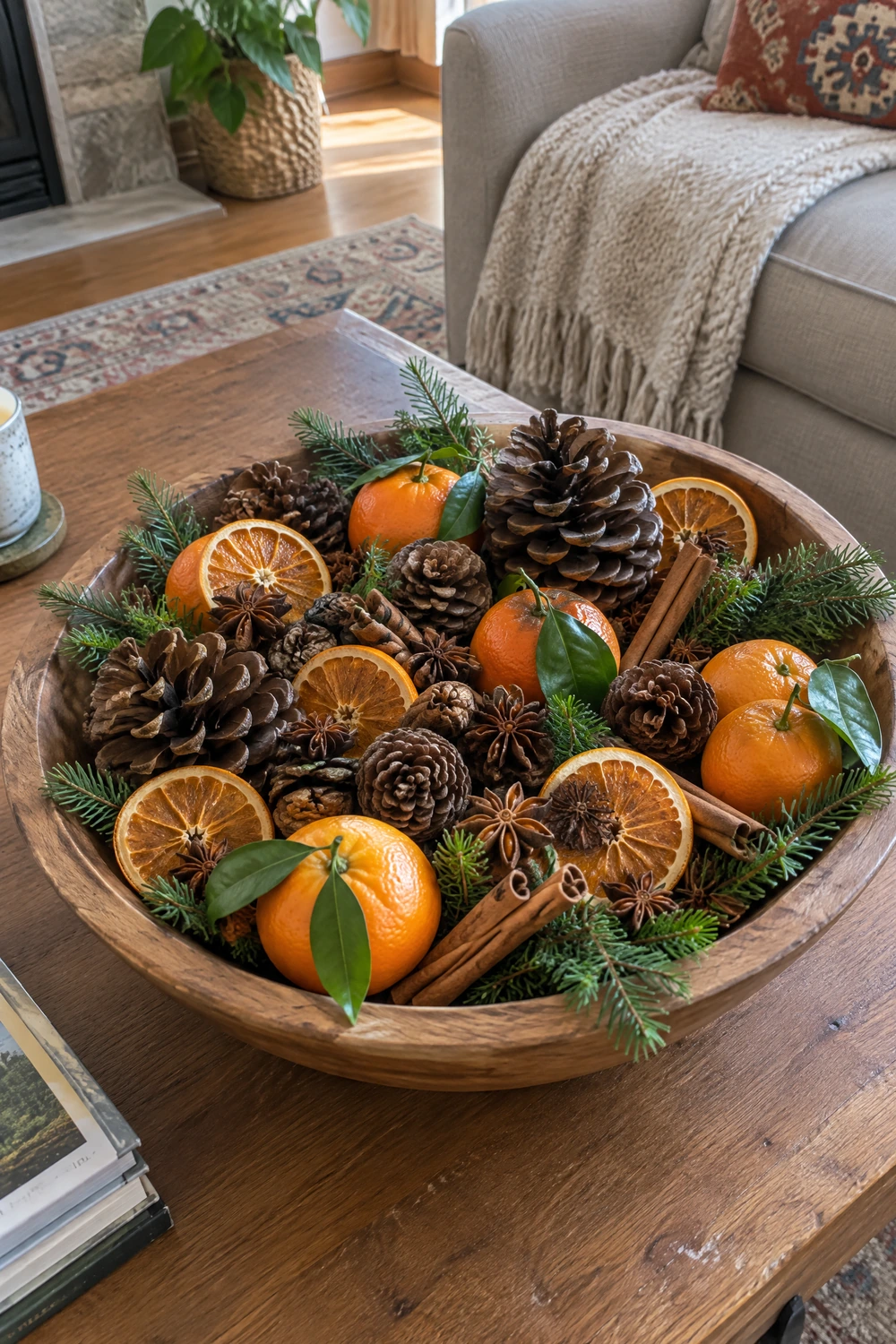
A wide, shallow bowl or a wooden tray filled with natural seasonal materials, pine cones of different sizes, clementines with their leaves still attached, cinnamon sticks, dried orange slices, star anise, small sprigs of evergreen, and a handful of walnuts or pecans in their shells, creates a centrepiece for the coffee table that is deeply fragrant, visually rich, and entirely biodegradable. The bowl’s contents can be refreshed mid-season as the clementines and fresh elements age, and the dried and hard elements last the full season without deteriorating. A wide wooden bowl, a large ceramic dish, or a flat-weave basket each suit the seasonal content and add the organic material quality that distinguishes a designed Christmas from a product-purchased one.
Reality Check: A bowl of seasonal naturals is one of the lowest-cost and most high-impact Christmas coffee table arrangements available. The total cost of the ingredients is under fifteen dollars, the arrangement takes ten minutes, the room smells extraordinary, and it reads as genuinely considered rather than purchased.
CATEGORY SIX: WINDOWS AND LIGHTING
19. Frame the Windows With Fairy Lights for Instant Atmosphere
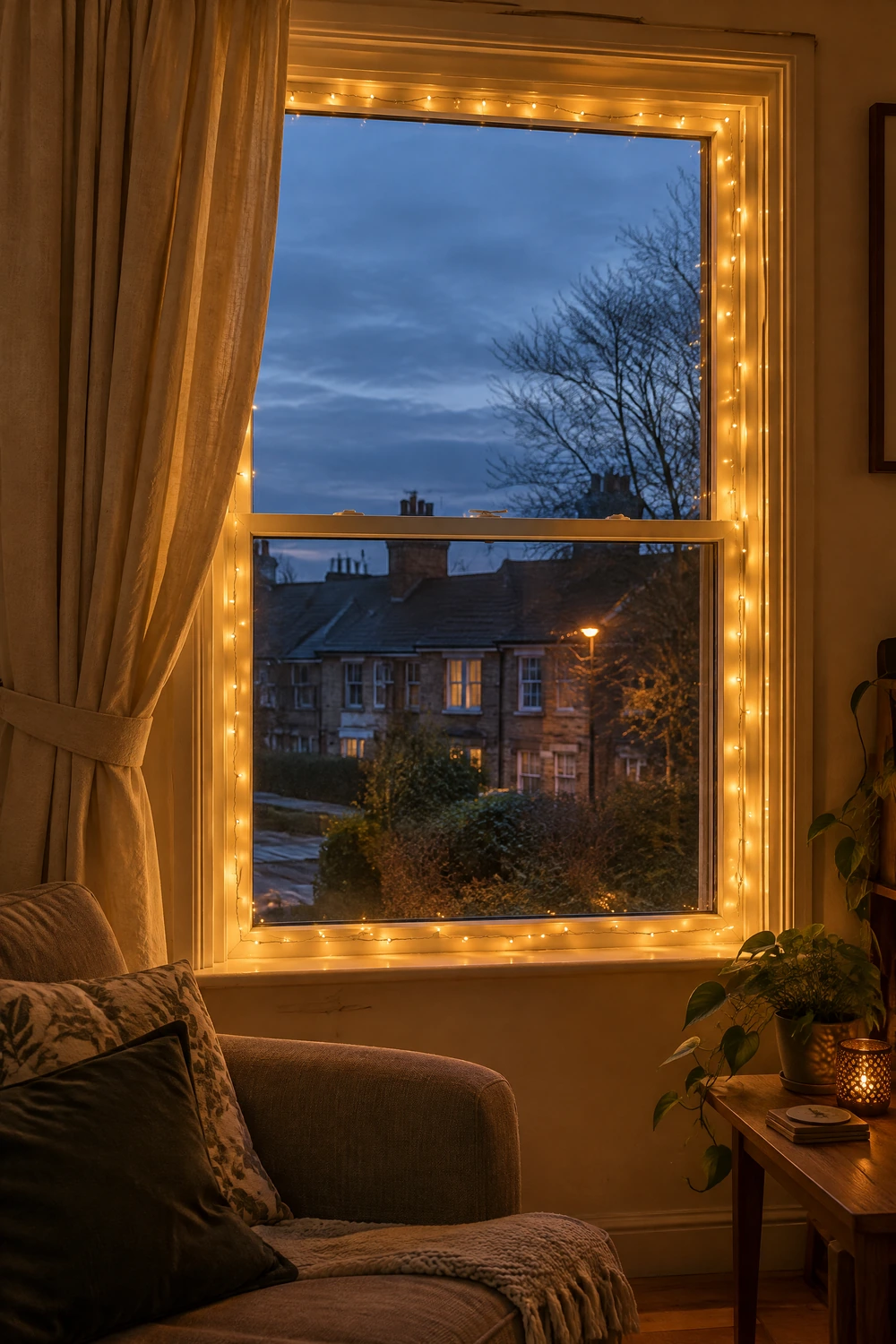
Warm white LED fairy lights run along the inside frame of a living room window, held in place with small adhesive hooks, create a warm, glowing frame that changes the room’s atmosphere immediately at dusk. The warm 2700K light of quality LED fairy lights at this cool-toned window position provides a halo of warmth that makes the window feel like a designed architectural feature of the Christmas room rather than a glass panel in a wall. The fairy lights should be warm white exclusively: cool white or multicoloured lights on a window frame read as kitsch rather than atmospheric. The cord should run neatly down the side of the window frame and be hidden behind the curtain.
Quick Tip: Use plug-in fairy lights with a timer function for window lights. Set the timer to switch on at dusk and off at midnight. This keeps the window display consistent without requiring anyone to remember to switch it on or off, and it creates a reliable visual moment every evening through the season.
20. Layer Multiple Warm Light Sources Throughout the Room
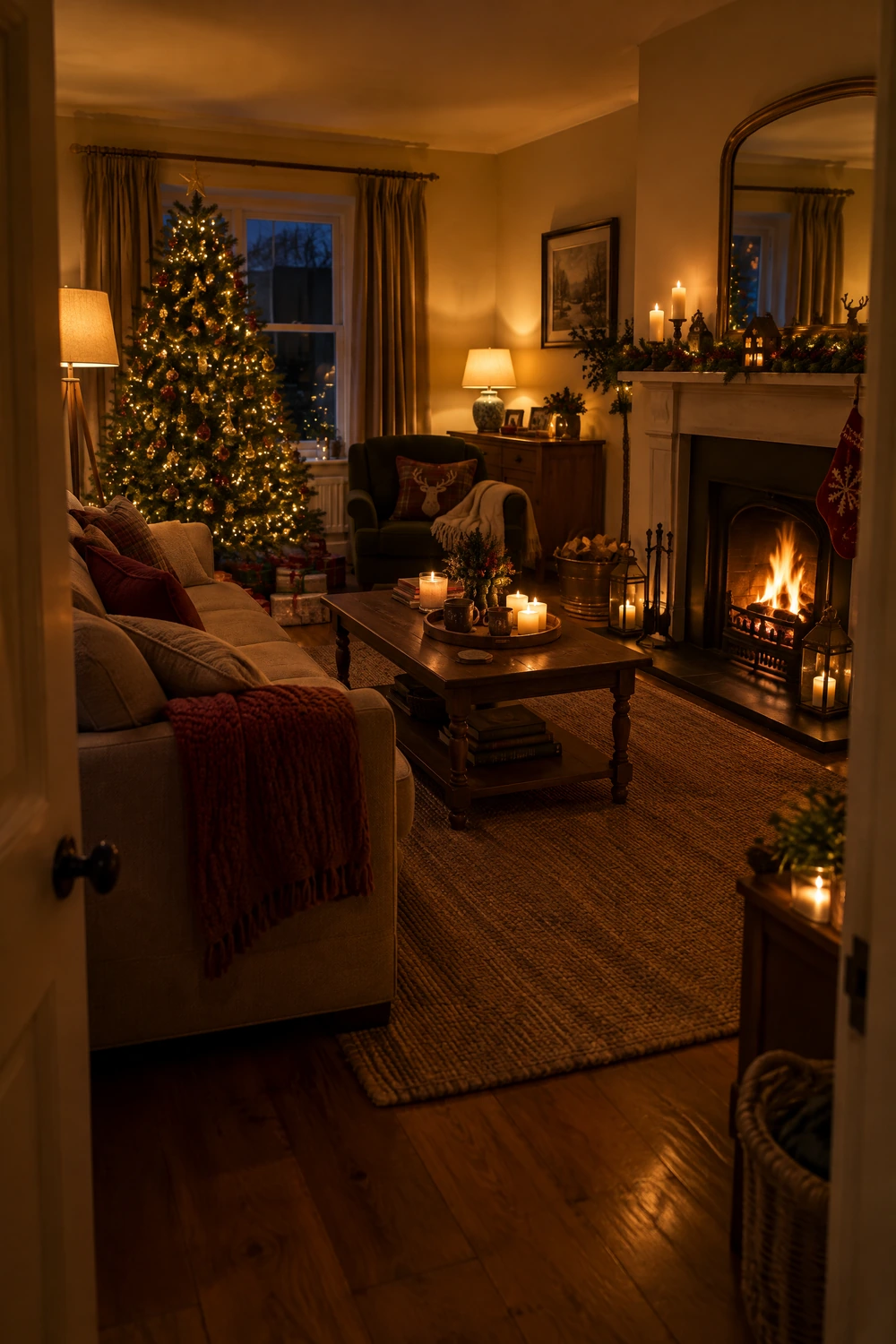
The atmosphere of a Christmas living room is determined more by its lighting than by any of its decorative objects, and the 2025 approach to Christmas decorating is built on this understanding. Turning off the overhead light and using only lamps, candles, firelight, and fairy lights to illuminate the room produces the warm, layered, atmospheric quality that defines the best Christmas interiors. A floor lamp in a corner, a table lamp behind the sofa, candles on the mantel and coffee table, fairy lights on the tree and around the window, and the fire in the grate together create a light quality that no overhead fixture can replicate. This approach requires no new purchases beyond candles and fairy lights, and it transforms the room more dramatically than any decorative addition.
Designer Advice: Switch off the living room overhead light from the first of December and rely entirely on lamps, candles, and the tree lights throughout the season. Most people who try this never want to go back to overhead lighting for Christmas, because the difference in how the room feels is immediately and dramatically better.
21. Dress the Window With a Seasonal Wreath or Garland
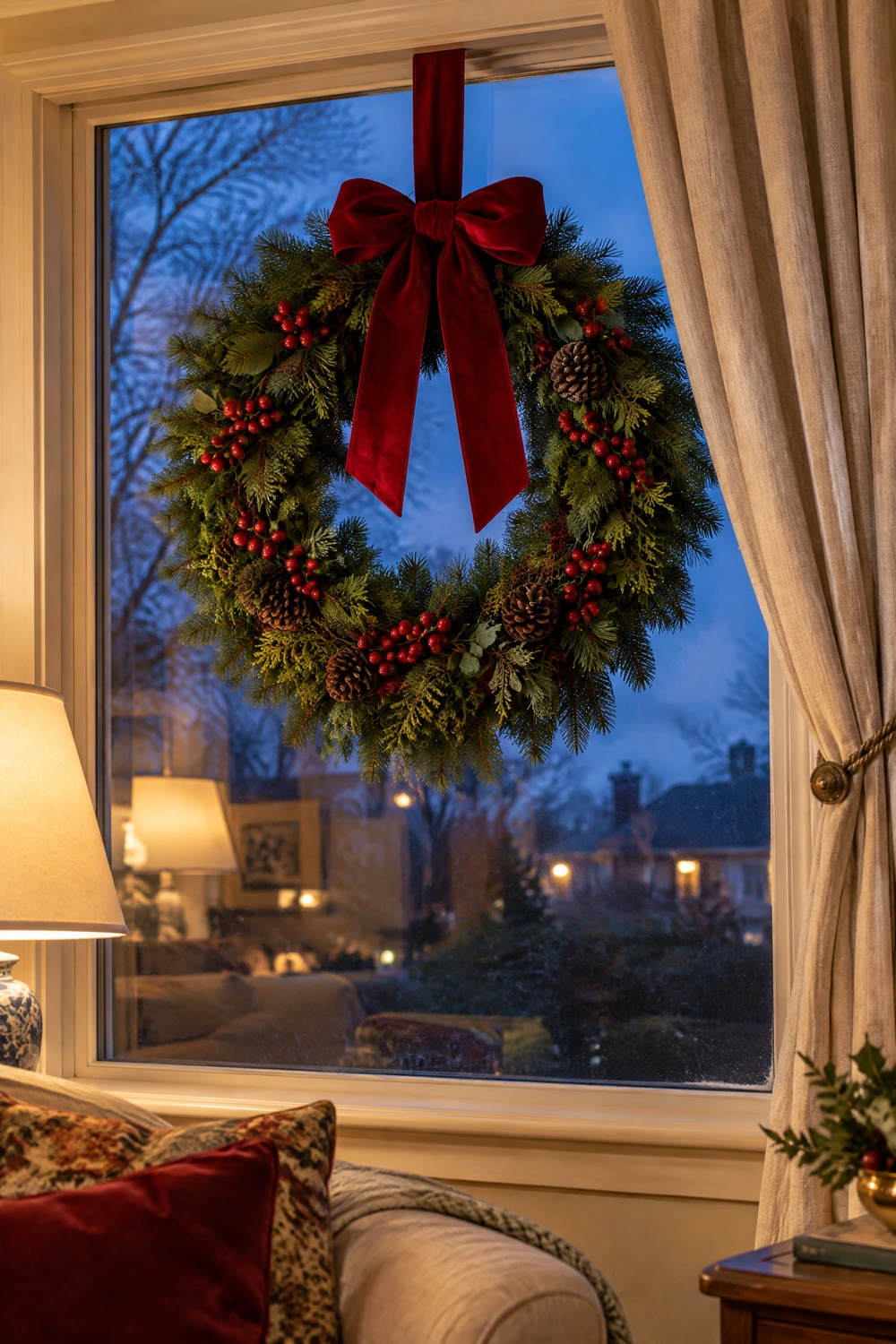
A wreath hung in the centre of a living room window, visible from the street and from the room simultaneously, is the Christmas decoration that most changes the room’s relationship with the exterior and creates the classic Christmas-house effect from both inside and outside the home. A fresh or high-quality faux wreath in the room’s chosen palette, a simple pine and red berry wreath for the traditional scheme, an eucalyptus and dried orange for the cream and gold aesthetic, or a dark pine and gold bauble wreath for the dramatic navy scheme, hung at the centre of the window with a velvet ribbon in the palette’s colour, is one of the most high-impact single additions available in any room. The hanging ribbon should be wide, at least two inches, and should form a generous bow at the top of the wreath where it meets the curtain rod.
Pro Move: A wreath on an interior window looks most effective when the curtains are drawn to one side to frame the wreath rather than drawn back fully. The curtain framing the window on one side, with the wreath centered and the view or evening darkness beyond it, creates a composition that reads like a painting in the evening.
CATEGORY SEVEN: SCENT AND ATMOSPHERE
22. Use Fresh Greenery for the Room’s Most Authentic Christmas Scent
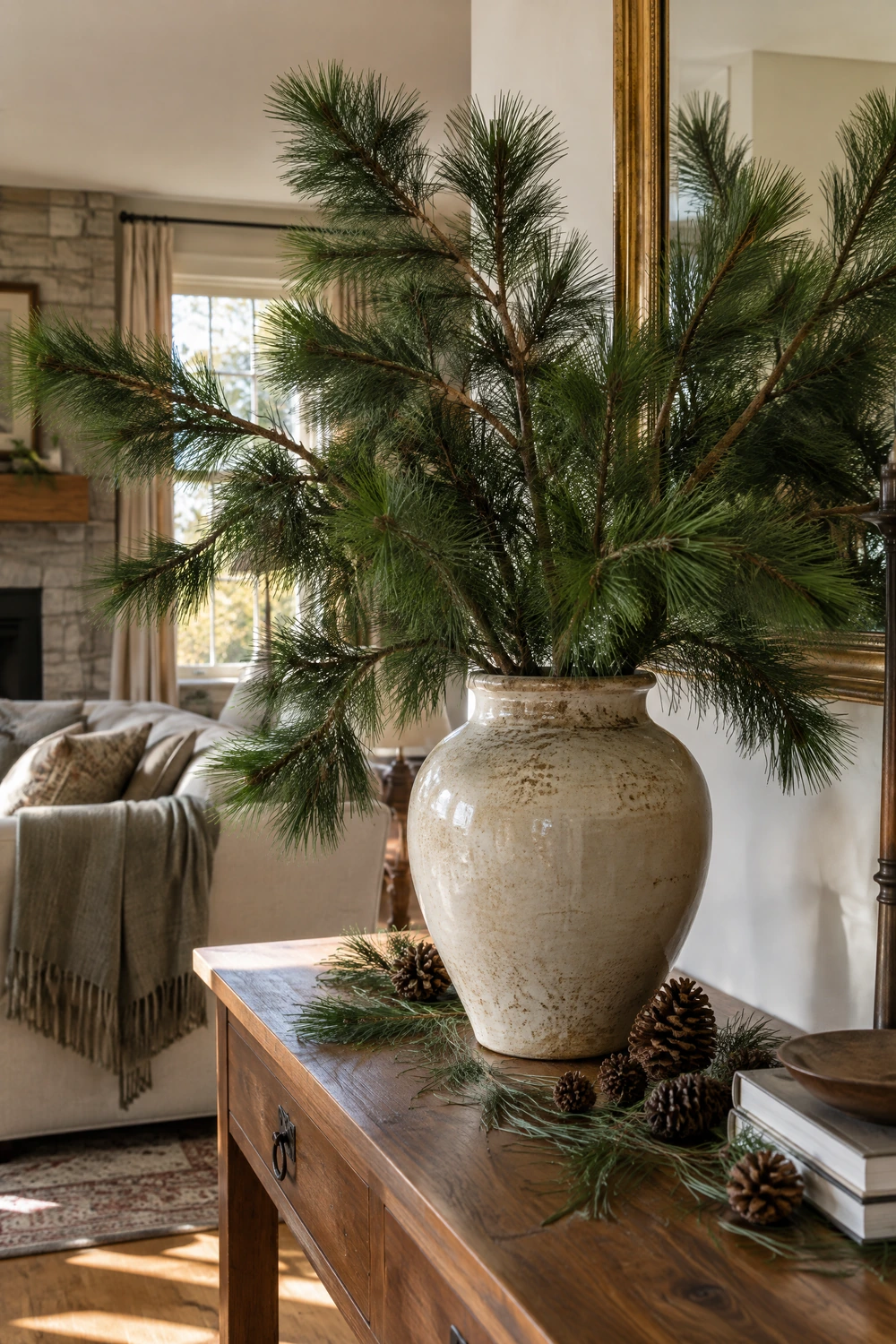
The scent of fresh pine, cedar, or eucalyptus in a living room is the Christmas atmosphere element that no candle or diffuser can fully replicate, because the real botanical scent is complex, layered, and specific in a way that synthetic versions are not. A real pine tree, a fresh garland on the mantel, a eucalyptus wreath, or even a small bunch of fresh pine branches in a large vase each release their natural oils into the room’s air and create the specific olfactory experience of Christmas that triggers the season’s associations more immediately than any visual decoration. Where fresh greenery is not possible, the highest-quality faux greenery combined with a pine or cedar essential oil diffuser running in the room creates a credible approximation.
Quick Tip: Place a handful of fresh pine needles or cedar sprigs in a small ceramic bowl on the coffee table beside the candles. The warmth of the candles gently releases the botanical oils from the needles without burning them, and the bowl contributes to the table’s seasonal arrangement while filling the immediate area with fragrance.
23. Choose Candles That Smell Like the Season, Not the Store
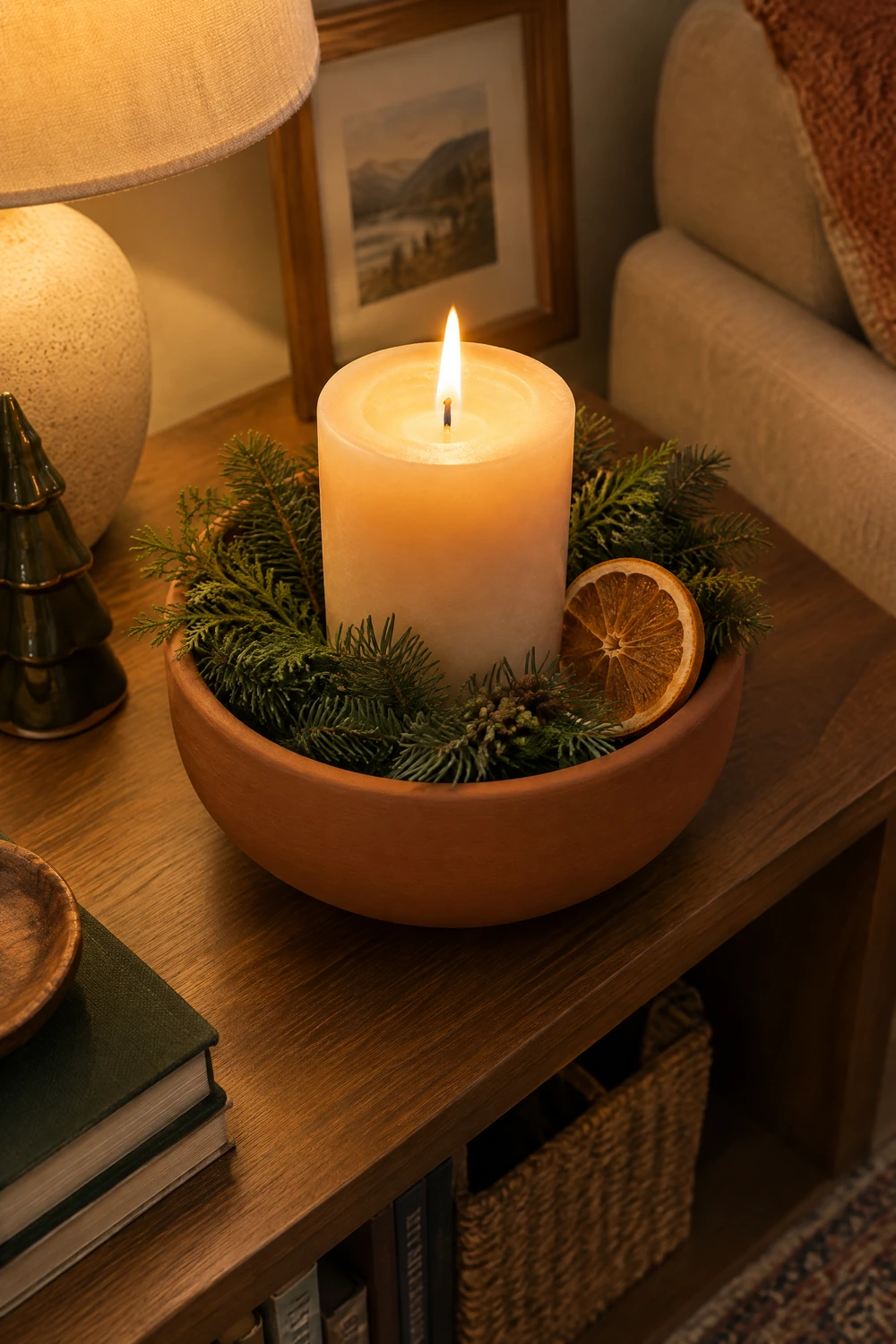
Christmas candle scents range from the genuinely evocative to the synthetic and headache-inducing, and the difference is usually in the quality and complexity of the fragrance. The most effective Christmas living room candles are those with warm, complex base notes that the room can sustain for an entire evening: cedarwood and orange, cinnamon and clove over a woody base, frankincense and myrrh, spiced mulled wine, or a dry pine with a hint of smoke. Sweet-dominant scents like candy cane, sugared cookies, or gingerbread work in a kitchen context but can become cloying in a living room over several hours. One well-chosen, high-quality candle in a warm base scent, lit consistently through the season, becomes the room’s scent signature for Christmas.
Reality Check: One quality candle in a large room burns more effectively and smells better than three cheaper candles in the same space competing with each other. Choose one signature Christmas candle for the living room and let it define the room’s scent throughout the season.
24. Create a Simmer Pot for the Most Evocative Christmas Scent
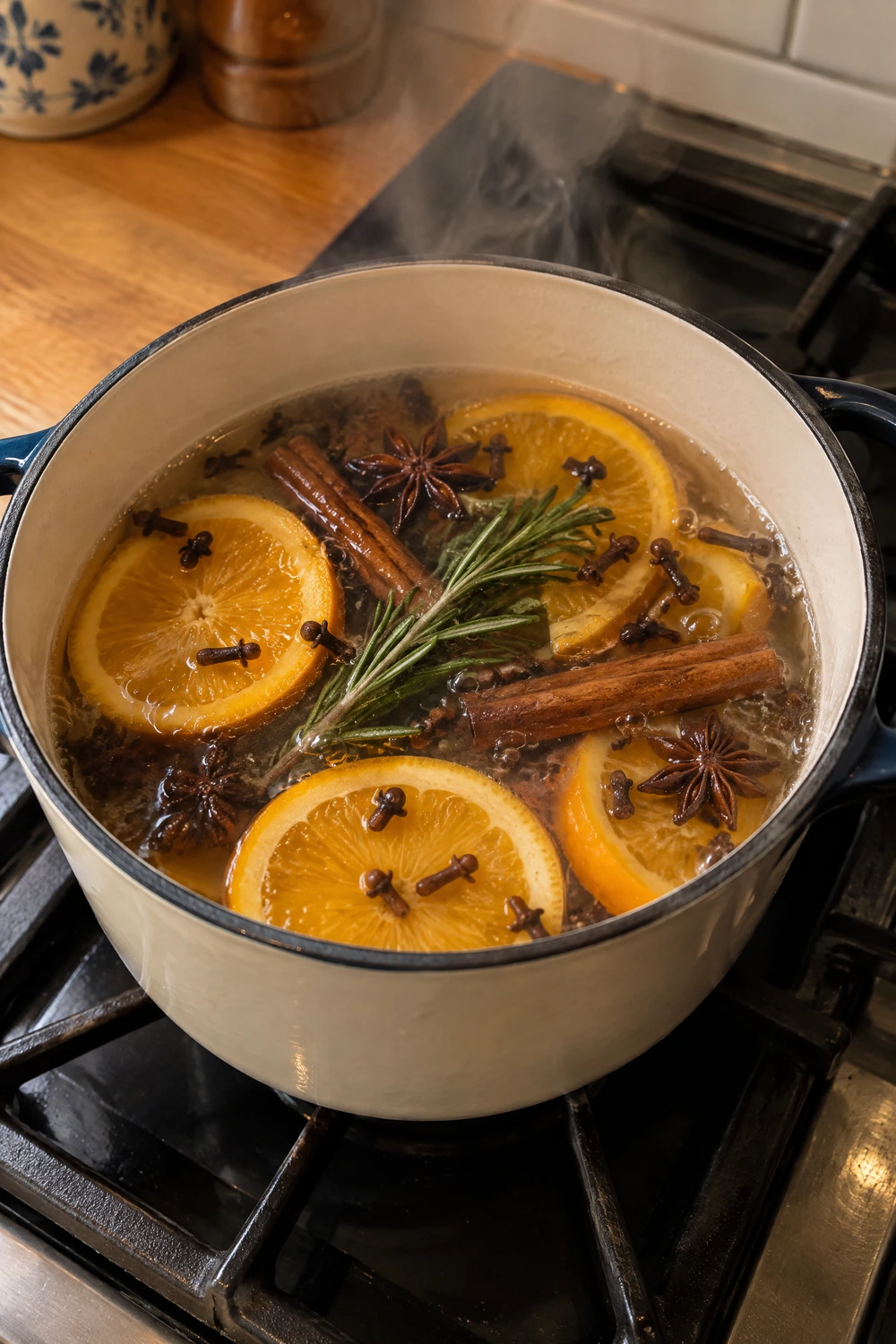
A simmer pot, a small pot of water on the lowest heat with cinnamon sticks, sliced orange, cloves, star anise, a vanilla pod, and a sprig of fresh rosemary, produces a Christmas scent that fills the entire ground floor of a home within minutes and lasts as long as the pot is running. The scent is warm, spiced, complex, and deeply associated with the season in a way that even the highest-quality Christmas candle rarely achieves, because it smells like real cooking and real warmth rather than fragrance technology. Starting a simmer pot thirty minutes before guests arrive for a Christmas gathering fills the home with exactly the kind of welcoming, sensory richness that makes people stop at the door and say “it smells like Christmas in here.”
Pro Move: Prepare a simmer pot kit as a hostess gift: cinnamon sticks, dried orange slices, cloves, a star anise or two, and a sprig of dried rosemary, tied together with a length of linen ribbon and a handwritten note with the instructions. It is one of the most genuinely useful and most appreciated small seasonal gifts available.
Christmas Living Room Palette Guide
| Palette | Primary Colours | Best For | Key Materials | Avoid |
| Classic Traditional | Deep red, evergreen, warm gold | Traditional and family homes, rooms with neutral year-round decor | Pine garland, glass baubles, velvet ribbon, brass | All three colours on the same surface at once |
| Elegant Neutral | Cream, warm gold, forest green | Contemporary rooms, open-plan spaces, neutral interiors | Linen, dried botanicals, aged brass, velvet | Cold metallics like chrome or cool silver |
| Modern Soft | Dusty blush, champagne, sage green | Scandinavian, minimalist, and light-filled rooms | Dried pampas, eucalyptus, pale linen, warm metal | High-contrast red or green that disrupts the muted palette |
| Dramatic Dark | Deep navy, midnight black, warm gold | Rooms with dark walls or rich existing colour, adult-only homes | Velvet, large glass baubles, hurricane lanterns, candlelight | Insufficient warm light sources; cool or blue-toned lighting |
The Room That Feels Like Christmas
The living rooms that feel most genuinely festive are almost never the ones with the most decoration. They are the ones where the overhead light is off and the lamps, candles, and fairy lights are on. Where the sofa is dressed in something soft and warm and the throw has been pulled across someone’s lap. Where the room smells like pine and cinnamon and the fire, if there is one, is lit. Where every surface has something on it that belongs to the same visual story rather than something that arrived from a different year’s shopping trip. Getting there requires fewer decisions than most people think: choose the palette, dress each zone consistently, and then turn off the overhead light. Everything else is atmosphere, and atmosphere is free.