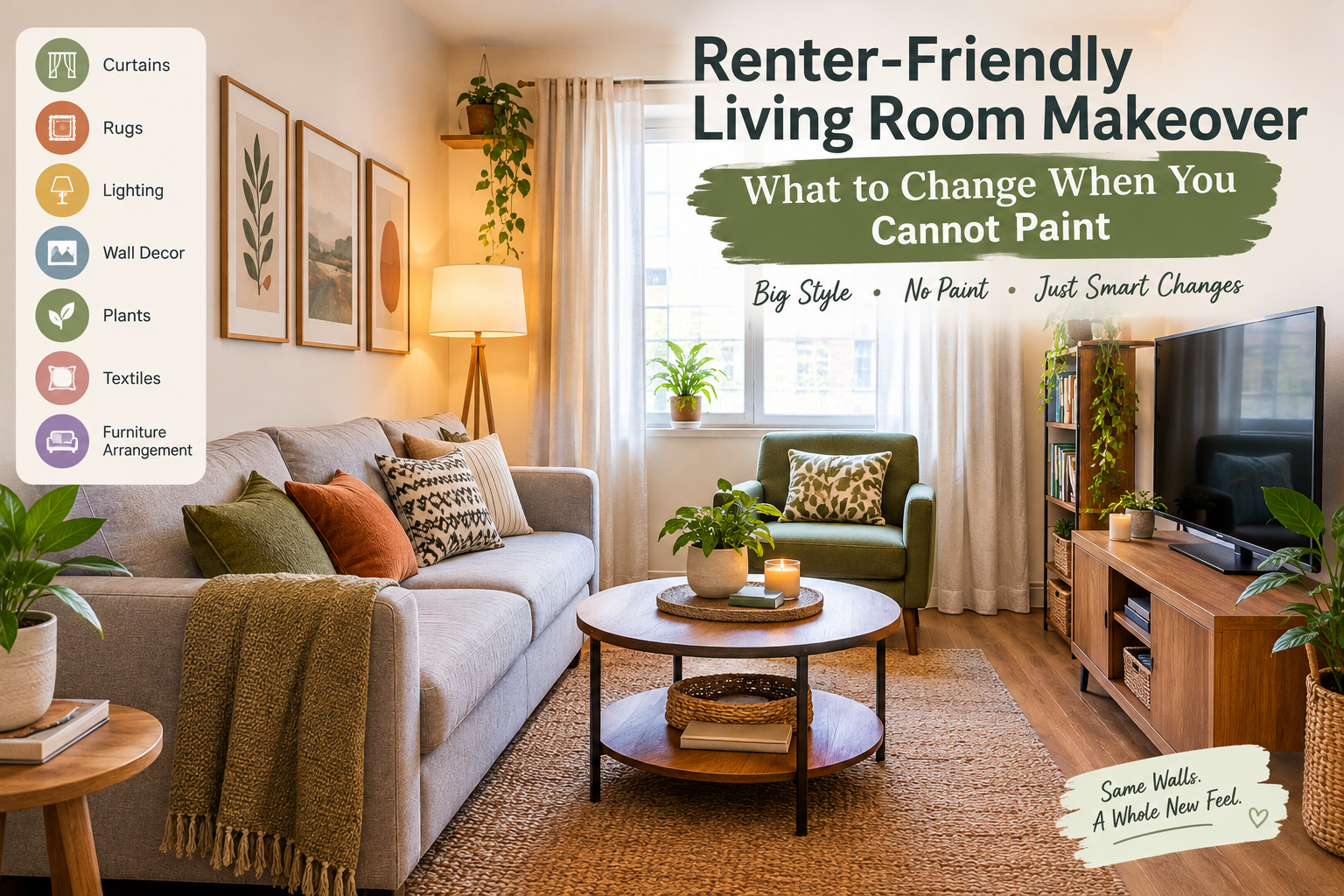
Renter-Friendly Living Room Makeover: What to Change When You Cannot Paint
You move into a new apartment, unpack your favorite cushions, arrange the sofa, and step back to admire your new living room. Then you notice the walls.
They’re plain white, perhaps a little yellowish, or painted in a shade of beige that makes every piece of furniture look slightly out of place. You might even be dealing with a rental where the walls have small marks, mismatched paint patches, or a finish that looks tired despite your best efforts to decorate around it.
Naturally, the first thought is to paint.
A warm sage green behind the sofa would look lovely. Maybe a soft cream would make the room feel brighter, or a deep blue would give the space some personality. But then reality kicks in. The lease says no painting, the landlord wants the original color preserved, or you simply don’t want the expense and trouble of repainting everything when it’s time to move out.
So, what can you do instead?
Quite a lot, actually.
A living room doesn’t get its character from wall color alone. Furniture, curtains, lighting, rugs, artwork, textiles, and even the way you arrange your belongings can completely change how a space feels. You can create a cozy, polished living room without permanently altering the walls or spending your entire decorating budget on temporary fixes.
The secret is to stop treating the walls as the only thing that needs attention. Instead, look at the room as a whole. Where does your eye go when you enter? Does the sofa look disconnected from the rest of the furniture? Is the lighting too harsh? Are the curtains too short? Does the room feel empty even though you have plenty of belongings?
These are the kinds of details that make a difference.
In this guide, we’ll explore renter-friendly living room makeover ideas that work when painting isn’t an option. You’ll learn how to use removable decor, curtains, lighting, rugs, furniture placement, and affordable accessories to make your apartment feel more like home. We’ll also cover what to check before using adhesive products, which decorating purchases are worth making, and how to avoid changes that could create problems when you move out.
The aim isn’t to make your rental look like an expensive show home. It’s to create a living room that feels comfortable, reflects your taste, and can be returned to its original condition when your lease ends.
Why You Don’t Need Paint to Transform a Rental Living Room
Paint is one of the most noticeable ways to change a room, but it isn’t the only way to make a space feel different.
Think about two living rooms with exactly the same wall color. In the first, there’s a bare sofa, a single overhead light, short curtains, and a coffee table with nothing around it. In the second, the sofa has coordinated cushions, a textured throw, a properly sized rug, layered lighting, and artwork that connects the colors throughout the room.
The walls might be identical, but the rooms will feel very different.
That is because our eyes don’t focus on one surface in isolation. We notice the relationship between furniture, light, color, texture, and the amount of empty space around objects.
A renter-friendly makeover works by improving those relationships.
Start with what you can actually change
In a rental, some things are usually outside your control. You may not be able to replace the flooring, change the kitchen cabinets, install built-in shelves, or repaint the walls.
But you can often make meaningful changes to:
- Furniture placement and layout.
- Curtains and window treatments.
- Rugs and floor coverings.
- Cushions, blankets, and other textiles.
- Freestanding lamps and lighting accessories.
- Artwork and decorative objects.
- Removable wallpaper or other temporary wall treatments, where permitted.
- Freestanding storage and shelving.
- Plants and decorative greenery.
These elements give you plenty of room to experiment without committing to permanent renovations.
Before starting, though, read your rental agreement and ask your landlord or property manager about anything that could affect the walls, windows, floors, or electrical fittings. Rental rules vary, and a product marketed as removable isn’t automatically suitable for every surface.
Decide what bothers you most about the room
It’s easy to browse decorating ideas and end up buying things that look attractive but don’t solve your actual problem.
Instead, identify the main reason the room feels unfinished.
Perhaps the walls look empty. Maybe the sofa is too small for the room, the lighting is uninviting, or the flooring feels cold. You might have plenty of decorative objects but no clear focal point tying everything together.
Choose one or two priorities first.
If the walls feel bare, artwork and textiles may offer the biggest improvement. If the room feels dark, lighting and window treatments might matter more. If everything looks scattered, a rug and a better furniture arrangement could make the greatest difference.
You don’t need to change every element at once. A focused makeover is usually easier to manage, less expensive, and more likely to produce a cohesive result.
1. Create a Color Scheme That Works With Your Existing Walls
One of the first challenges in a rental living room is working with a wall color you didn’t choose.
You might have cool white walls that make warm wooden furniture look slightly yellow, or beige walls that seem dull next to gray upholstery. Sometimes the walls themselves are perfectly fine, but the furniture and accessories haven’t been chosen with them in mind.
Rather than fighting the existing color, use it as the starting point for your decorating scheme.
Choose two or three supporting colors
A simple color palette makes it easier to coordinate furniture, cushions, curtains, rugs, and artwork.
For example, if your walls are warm white, you might build the room around:
- Warm white and beige.
- Natural wood tones.
- Olive green as an accent color.
Alternatively, a room with cool white walls might work well with soft blue, charcoal, and pale wood.
If the walls are beige, consider adding cream, muted green, terracotta, or darker brown accents. The exact combination depends on the undertone of the wall color, the flooring, and the amount of natural light.
You don’t have to use only neutral colors. A bright cushion, a patterned rug, or a colorful piece of artwork can give the room personality. The important thing is to repeat a few colors throughout the space so the accessories look connected rather than randomly collected.
Test colors in the room before buying
Colors can look very different under different lighting conditions.
A cushion that looks soft gray in a store may appear blue next to warm beige walls. A green curtain might look muted during the day but much darker in the evening.
Before purchasing larger accessories, bring home fabric samples where possible or use existing items to test the combination.
Place the samples beside the sofa, against the walls, and near the window. Check them in daylight and under your usual evening lighting.
If you use a phone app to explore palettes, treat the results as a starting point rather than a perfect representation of how colors will look in your home. Screens don’t always reproduce fabric, paint, or natural materials accurately.
Repeat accent colors in different places
One of the easiest ways to make a rental living room feel coordinated is to repeat an accent color at least a few times.
Imagine you choose olive green for your main accent. You could introduce it through two sofa cushions, a small plant pot, and a detail in the artwork.
The items don’t need to match exactly. Different shades and textures can make the arrangement more interesting.
For instance, a green velvet cushion, a leafy plant, and an abstract print with muted green details can feel related without looking like a matching set.
This approach is especially useful when your furniture has been collected over several years or came from different homes.
Work with unattractive wall colors instead of highlighting them
If you can’t change the wall color, avoid adding accessories that make the mismatch more noticeable.
Suppose your walls have a strong yellow undertone. Cool gray cushions and bright blue curtains might create a contrast that feels harsher than expected.
You could instead introduce warmer neutrals, natural wood, and a carefully chosen accent color.
This doesn’t mean you must decorate in beige or brown. It simply means choosing colors that work with the room’s existing undertones.
Sometimes, a single well-chosen rug or pair of curtains can help bring the wall color, flooring, and furniture together.
2. Use Curtains to Change the Entire Feel of the Room
Curtains are among the most useful tools for a renter-friendly living room makeover.
They soften hard edges, introduce color and texture, provide privacy, and help frame the windows. Depending on their placement, they can also make a room feel taller or more balanced.
Best of all, curtains can usually be changed without altering the walls permanently, although the installation method matters.
Choose curtains that suit the wall color
If your walls are plain white or beige, curtains can become one of the room’s main decorative features.
Light neutral curtains create a soft, understated look. Muted green, dusty blue, or warm terracotta can introduce color without requiring paint. A subtle stripe or woven texture adds interest when the rest of the room is relatively simple.
Consider the existing sofa and rug before choosing a pattern.
If the sofa has bold upholstery and the rug already contains several colors, plain curtains may create a better balance. If the furniture is simple, patterned curtains can become a feature without making the room feel too busy.
Make the windows look taller
In rooms where the layout permits, hanging curtains closer to the ceiling can create the impression of greater height.
The trick is to consider the window and the wall together rather than treating the curtain as a small covering directly above the glass.
Long curtains that reach close to the floor often look more intentional than short curtains that stop awkwardly above it.
However, don’t assume that every rental allows drilling into the wall or ceiling. Check your lease and ask permission before installing a new curtain rod.
If drilling isn’t permitted, look into suitable tension rods, existing curtain tracks, or other reversible systems designed for your window type.
Always check the manufacturer’s weight limits and installation instructions. A tension rod is not appropriate for every window or heavy curtain, and an improperly installed rod can fall.
Choose the right fabric weight
Lightweight curtains allow more daylight into the room and can help the window area feel airy.
Heavier curtains may provide better privacy, help reduce light at night, and make a room feel cozier. They can also visually dominate a small space if the fabric is very dark or bulky.
Consider how you use the room.
If your living room receives strong afternoon sunlight, a suitable light-filtering curtain may help reduce glare. If the windows face a busy street, you may need a different approach to privacy.
You can also combine a lightweight curtain with an existing blind, provided the arrangement fits the window and doesn’t interfere with its operation.
Avoid curtains that drag or bunch awkwardly
Floor-length curtains can look elegant, but excessive fabric gathering on the floor may become a tripping hazard or collect dust.
Measure from the actual curtain-rod or track position to the floor before ordering. If you are using an existing rod, check where the curtain hooks or rings will sit.
If the curtains are too long, consider adjusting the hem rather than leaving a large amount of fabric on the floor.
For a rental, temporary hemming methods may be an option, but test them on an inconspicuous section and follow the fabric manufacturer’s guidance. Some adhesives or tapes can leave marks or damage delicate materials.
A simple curtain makeover example
Imagine a living room with cream walls, a gray sofa, and medium-brown flooring.
The room feels a little cold, but you don’t want to buy a new sofa or replace the flooring.
Try introducing warm ivory curtains with a subtle woven texture. Add two cushions in muted olive green and a small wooden side table beside the sofa.
The walls remain unchanged, but the warmer textiles and repeated wood tones can make the room feel more connected.
The key is that the curtains don’t have to be dramatic. Their job is to help the existing pieces work together.
3. Decorate Blank Walls Without Damaging Them
Bare walls are often the most obvious problem in a rental living room.
A large empty wall behind the sofa can make the furniture look disconnected, while a blank wall beside the television may leave the entire room feeling unfinished.
Artwork is one of the simplest ways to address this. You can introduce color, personality, and visual balance without repainting the wall.
The challenge is choosing an installation method that suits both the artwork and the wall surface.
Start with the size of the wall
A small picture can disappear on a large wall, while an oversized piece may overwhelm a narrow area.
Before purchasing artwork, measure the available wall space and the furniture beneath it.
For artwork above a sofa, consider the sofa’s width and the proportions of the picture. A single larger piece can create a clear focal point, while a group of smaller prints can work well when arranged carefully.
You don’t need to cover the entire wall. Leaving empty space around the artwork helps it stand out.
Use removable picture-hanging products carefully
Adhesive picture strips and removable hooks can be useful alternatives to nails, but they aren’t suitable for every surface or every frame.
Before using them, check:
- The manufacturer’s stated weight limit.
- Whether the product is compatible with your wall finish.
- Whether the wall is painted, textured, dusty, or recently repaired.
- The recommended surface preparation.
- The waiting period before hanging anything.
- The correct removal method.
A product that works well on one smooth painted wall may perform poorly on textured paint, wallpaper, or a surface with loose paint.
Never assume that an adhesive product will leave no marks simply because its packaging uses the word “removable.”
If the landlord has strict requirements, confirm that the method is permitted before installing anything.
For valuable artwork or heavy frames, use a properly rated mounting system approved for the wall and the rental agreement rather than relying on a lightweight adhesive strip.
Consider leaning artwork instead of hanging it
If wall attachments aren’t allowed, leaning artwork can be a useful alternative.
A large framed print can sit on a sturdy console or shelf, provided it is stable and cannot easily be knocked over.
Smaller frames can be layered in front of larger pieces to create a relaxed arrangement.
However, this approach requires suitable furniture and a safe location. Don’t place a heavy frame where it could fall onto a child, pet, or walking route.
If you have limited table space, a narrow picture ledge may be an option only if you can install it with permission. Otherwise, a freestanding shelf can provide a similar display area without requiring permanent wall changes.
Create a gallery wall with a plan
A gallery wall can bring personality to a rental, but it is easy to make the arrangement look messy.
Before attaching anything, lay the frames on the floor or create a paper template.
Try different combinations of frame sizes, spacing, and artwork colors until the arrangement feels balanced.
You can use a consistent frame color for a more unified appearance or mix different frames if the artwork shares a similar palette.
A gallery wall doesn’t need to be perfectly symmetrical, but it should feel intentional.
If you cannot attach frames to the wall, consider displaying a smaller collection on a console or freestanding shelf instead.
Use artwork to connect the furniture
Artwork is especially useful when your rental has several furniture pieces that don’t match.
Suppose your sofa is gray, your rug contains beige and rust tones, and your side table is made from dark wood.
A print that includes a little gray, warm beige, and muted rust can help connect those elements.
This doesn’t require every color to appear equally. Even a small repeated detail can make the room feel more coordinated.
Choose art that you genuinely enjoy looking at rather than purchasing something solely because it matches the cushions.
A rental should still feel personal.
4. Try Removable Wallpaper, but Read the Fine Print
Removable wallpaper can be an appealing option when you want the visual impact of a feature wall without committing to permanent paint or traditional wallpaper.
It comes in a wide range of patterns, including subtle textures, botanical designs, geometric prints, and faux materials.
However, removable wallpaper is one of those products where the surface underneath matters enormously.
Check the wall before ordering
A smooth, clean, properly cured surface may be suitable for some removable wallpapers, while textured, dusty, damp, or poorly painted walls may cause problems.
The adhesive may not grip consistently, the edges may lift, or removal may pull away paint.
Before buying enough wallpaper for an entire wall, read the product specifications and check whether the manufacturer recommends testing a sample.
If your landlord has prohibited wallpaper or adhesive wall coverings, choose another decorating method instead.
Test in a discreet area
Even when a product claims to be renter-friendly, the result depends on the existing finish.
Test a small sample in an inconspicuous location and follow the manufacturer’s installation and removal instructions.
Observe whether the edges stay in place and whether the material can be removed as directed.
A brief test cannot guarantee that the product will cause no damage over several months, but it can help reveal obvious compatibility problems.
If the wall is already peeling or has loose paint, avoid applying an adhesive covering without professional advice or permission.
Use a small feature area rather than covering every wall
A removable wallpaper panel behind the sofa or within a suitable alcove may have more impact than covering the entire room.
A restrained pattern can introduce interest without competing with the furniture.
For example, a soft botanical print could work with neutral upholstery and natural wood. A geometric pattern may suit a more contemporary room with simple furniture.
If the living room is small, pay attention to the pattern scale. A very busy design can make the room feel visually crowded, particularly when combined with patterned curtains and a decorative rug.
Consider removable wallpaper alternatives
If you aren’t comfortable applying adhesive wallpaper, you still have options.
A large framed print, a freestanding screen, a fabric wall hanging, or a carefully arranged collection of artwork can create a focal point without covering the wall.
A freestanding screen can also help divide an open-plan living room from a workspace, although it will occupy floor space.
The best choice is the one that creates the look you want while remaining appropriate for the rental and the wall’s condition.
5. Bring in a Large Rug to Change the Room’s Appearance
Flooring is another feature renters often cannot change.
Perhaps the apartment has dated tile, scratched laminate, or a carpet color that doesn’t suit the furniture. Even if the floor is in good condition, it may not create the atmosphere you want.
A rug can help connect the furniture, introduce texture, and make the seating area feel more deliberate.
Choose a rug that relates to the furniture
A rug should do more than sit in the middle of the room.
It can visually connect the sofa, chairs, and coffee table so the seating area feels like one arrangement.
For many living rooms, a useful starting point is to place the front legs of the sofa and chairs on the rug. If the space allows, you might fit the entire seating group on it.
The right size depends on the furniture and the room’s dimensions.
Before buying, measure the seating area and use painter’s tape to mark the proposed rug dimensions on the floor. This helps you see whether the rug will extend far enough beneath the furniture and whether it interferes with doors or walking paths.
Use color to work with unattractive flooring
If you cannot replace the flooring, choose a rug that helps it fit into the overall palette.
For example, if the floor has a reddish-brown tone, a rug containing warm beige, muted green, or soft rust may create a more harmonious transition.
If the floor is cool gray, you might introduce warm cream, muted blue, or a mixture of neutral tones.
You don’t need to hide every inch of the existing floor. The aim is to create a combination that looks intentional.
Think about texture, not just color
Texture can add warmth without introducing another strong color.
A woven rug, a soft low-pile design, or a subtle patterned surface can make a living room feel more inviting.
Consider how the rug will be used. A high-pile rug may feel comfortable underfoot but can be harder to clean and less practical under some furniture.
If you have pets, children, or a busy household, look for a material that suits your cleaning routine.
Protect the original flooring
Check the rug manufacturer’s recommendations and your landlord’s rules before using an underlay.
Some rug pads or backing materials can discolor or mark certain floor finishes, particularly if moisture or heat becomes trapped.
Use a suitable underlay for the floor type and avoid products that could damage the surface.
If the rental already has carpet, a rug may still work, but make sure it lies flat and doesn’t create an unstable surface or a tripping hazard.
A rug can help disguise a dated room without hiding everything
Imagine a rental with plain white walls, an older laminate floor, and a neutral sofa.
Instead of replacing the floor or trying to cover every surface, choose a rug that coordinates with the sofa and curtains.
Add a wooden coffee table, a textured throw, and a floor lamp with a warm shade.
The room may feel much more complete, even though the original flooring and walls remain exactly as they were.
That is the advantage of decorating around what you already have rather than treating every existing feature as a problem.
6. Change the Lighting Before You Change the Furniture
If your rental living room feels dull, the problem might not be the furniture or wall color. It could be the lighting.
Many apartments rely on one overhead fixture that creates a bright patch in the middle of the room while leaving the corners dim. Others have cool, harsh lighting that makes neutral walls and inexpensive furniture look less inviting.
You may not be allowed to replace the ceiling fixture, but you can often improve the atmosphere with freestanding lamps and carefully chosen bulbs.
Build a few layers of light
Rather than relying on one light source, think about how different parts of the room are used.
A floor lamp beside the sofa can provide comfortable light for reading. A table lamp on a side table can make the seating area feel warmer in the evening. A small lamp on a console can illuminate a darker corner.
You don’t need a lamp on every surface. Start with the areas where you spend the most time, then add another light only if it serves a purpose.
The arrangement should feel balanced. If every light sits on one side of the room, the opposite side may still feel dark.
Choose bulbs for the atmosphere you want
Bulb color temperature is usually listed in kelvins, abbreviated as K.
Warm white bulbs, often around 2700K to 3000K, can create a relaxed atmosphere in a living room. Neutral or cooler bulbs may be useful for particular tasks, depending on the fixture and the amount of natural light.
These are starting points rather than strict rules. The best option depends on your preference, the room, and the bulb’s color-rendering qualities.
Check the lamp’s specifications before buying a replacement bulb. The bulb must be compatible with the fixture, and dimmable bulbs should only be used with suitable controls.
Use lamps to highlight the room’s best features
A lamp can help draw attention to a reading corner, an attractive plant, or a piece of artwork.
For example, a floor lamp with a simple shade can soften the area beside a sofa without requiring any wall attachments. A table lamp can make a small console feel more purposeful.
Avoid placing lamps where the light shines directly into your eyes or creates distracting reflections on a television screen.
Also keep cords away from walking routes, and avoid running them beneath rugs where they could be damaged or overheat.
Consider smart bulbs if you want flexible lighting
Smart bulbs from compatible lighting systems can let you adjust brightness or color temperature through a phone app or voice assistant.
They can be useful if you want brighter light for reading and softer light in the evening without changing lamps.
However, you don’t need smart lighting to create a comfortable room. A regular dimmable lamp or a well-chosen bulb may provide everything you need.
If you do use smart bulbs, check compatibility with your existing fixtures, Wi-Fi requirements, and any dimmer switches. Avoid installing incompatible bulbs in circuits designed for a different type of lighting control.
Keep the original fixtures intact
If your rental agreement doesn’t allow electrical modifications, don’t replace ceiling lights or alter wiring without permission and appropriate professional help.
Freestanding lamps are generally easier to move when you leave, provided they are used safely.
This is a good example of how a relatively small, reversible change can improve a room without involving the landlord’s fixtures.
7. Make the Sofa Look Better With Cushions and Throws
A sofa often occupies the largest visual area in a living room. If its color doesn’t suit the rest of the space, it can make the whole room feel mismatched.
Buying a new sofa isn’t always realistic, particularly when you’re renting and may move again within a year or two.
Cushions and throws offer a simpler way to change its appearance.
Start with the sofa’s existing color
If your sofa is gray, you can introduce warmth through cream, caramel, muted green, or rust-colored textiles.
If the sofa is beige, darker cushions can add contrast, while softer neutrals can create a calm, layered look.
A dark sofa might work well with lighter cushions and a throw that connects to the rug or curtains.
These combinations are examples rather than fixed rules. Consider the sofa’s undertone, the room’s natural light, and the colors already present.
Avoid buying a matching cushion set just because it’s easy
Matching cushions can look tidy, but a completely identical set may feel flat.
Instead, try combining different textures and a limited number of related colors.
For example, two plain cushions, one patterned cushion, and a textured throw can create interest without making the sofa look busy.
You might combine linen-like fabric, a soft woven texture, and a subtle pattern that repeats a color from the rug.
The proportions matter, too. Oversized cushions can overwhelm a small sofa, while very small cushions may look lost against a deep seat.
Use throws to disguise worn upholstery
If the sofa is structurally sound but has worn fabric, a throw can help refresh its appearance.
A neatly draped throw over one arm or the back can introduce color and texture without covering the entire sofa.
If you want to cover a larger area, choose a size and fabric that stays in place during normal use.
A slippery throw that constantly slides onto the floor may become more annoying than useful. Some people prefer a fitted cover or a washable sofa cover designed for their furniture’s dimensions.
Check the cleaning instructions, especially if the original upholstery requires specialist care.
Don’t cover every seat with accessories
Too many cushions can reduce the amount of usable seating.
If people have to move five cushions before sitting down, the arrangement may be more decorative than practical.
Start with the number of cushions you genuinely enjoy using. Add more only if the sofa still feels comfortable and the proportions work.
The same principle applies to throws. One or two well-placed textiles can be enough to soften the room.
A quick sofa refresh
Imagine you have a dark gray sofa that clashes with the cream walls and brown flooring in your rental.
Rather than buying a new sofa, try two cream cushions, one muted green cushion, and a warm beige throw.
Add a rug that contains some of those colors and repeat the green in a plant or small decorative object.
The sofa remains the same, but the surrounding details help it feel like part of a coordinated room.
8. Add Plants for Color and Texture
Plants are a useful way to bring life into a rental living room without changing the walls.
Their leaves introduce natural shapes that contrast with straight furniture edges, flat surfaces, and simple window treatments.
You don’t need to fill the room with greenery. A few well-placed plants can provide enough visual interest.
Choose plants that suit your lighting
Before buying a plant, consider how much daylight the room receives.
A bright window may suit plants that need stronger indirect light, while a darker corner may require a more shade-tolerant option.
Even shade-tolerant plants need appropriate light, and no plant will thrive indefinitely in a completely dark room.
If you are unsure, ask a local nursery about plants suitable for your specific light conditions.
Consider maintenance, too. If you travel frequently or tend to forget watering, choose a plant that suits your routine rather than buying something that requires daily attention.
Use plant height to balance the room
A tall plant can help fill an empty corner, while a smaller plant can sit on a side table or shelf.
Try to balance the plants with the furniture around them.
A large plant beside a compact sofa can create a pleasing vertical element, provided it doesn’t block the window or obstruct the walking route.
Smaller plants can soften a television unit or console, but avoid filling every shelf with greenery.
Choose pots that connect to the decor
Plant pots are another opportunity to introduce texture and color.
Natural ceramic, woven-look planters, muted green pots, and simple neutral containers can work well in many living rooms.
If your rental has a strict color scheme, the pot can provide a small accent without requiring a larger purchase.
You don’t need identical pots throughout the room. A few related materials or colors are enough to create a sense of continuity.
Be careful with water and flooring
Use suitable saucers or waterproof plant trays to protect the original floor and furniture.
Water spills, damp soil, and leaking pots can leave marks or damage some surfaces. Don’t assume that a decorative basket or cachepot is waterproof.
If a plant is placed on a wooden side table, check it regularly for moisture underneath the pot.
Artificial plants are an option, too
If the room has limited natural light or you don’t want the responsibility of caring for live plants, artificial greenery can still introduce color and shape.
Choose pieces that look appropriate for the room rather than filling the space with large, unrealistic plants.
Keep them clean and place them where they look natural, such as beside a sofa or on a shelf.
The goal is to make the room feel more considered, not to create a crowded indoor garden.
9. Use Freestanding Shelves Instead of Built-In Storage
Built-in shelves can make a living room look polished, but renters may not be allowed to install them.
Freestanding shelving offers a flexible alternative. You can use it for books, storage baskets, framed photographs, and a few decorative pieces, then take it with you when you move.
The important thing is to choose the right size and avoid making the room feel crowded.
Choose a shelf that fits the available wall space
Measure the wall and the floor area before buying a shelving unit.
A tall, narrow unit may offer useful storage without occupying much width. A lower bookcase may be better if you want to keep the room visually open.
Consider the depth as well as the width. A shelving unit that extends too far into the room may interfere with the walking route.
If you already have a console or television cabinet, you might not need another large storage piece.
Keep the shelves from becoming a dumping ground
Open shelving looks attractive when the items are arranged with some breathing room.
It can look messy when every shelf is packed with unrelated objects, loose cables, boxes, and decorative accessories.
Group similar items together and leave some empty space. Use a few baskets or boxes to conceal small items that don’t need to remain visible.
For example, books can occupy one section, a small collection of framed prints can sit on another, and a plant or decorative object can provide a little contrast.
You don’t need to arrange everything perfectly. The goal is to make the shelves useful without adding visual noise.
Check stability and anchoring requirements
Freestanding doesn’t mean risk-free.
Tall shelving units can tip, especially if their weight is concentrated near the top. Follow the manufacturer’s instructions and use appropriate anti-tip measures where required.
If anchoring the shelf to the wall is necessary, check your lease and obtain permission before drilling.
If you cannot secure a tall unit safely under the rental’s restrictions, choose a lower, more stable design or a different storage option.
Place heavier items on lower shelves and avoid overloading the unit.
Use shelves to create a focal point
A freestanding bookcase can provide structure on a blank wall, particularly if the room lacks a natural focal point.
You can style the shelves with a mixture of books, framed photographs, plants, and storage baskets.
Try repeating two or three colors from the rest of the room rather than introducing an entirely new palette.
This helps the shelves look connected to the sofa, rug, and curtains.
10. Give Old Furniture a New Purpose
A renter-friendly makeover doesn’t always require new purchases.
Sometimes, the most useful changes come from looking at the furniture you already own and asking whether it could work better in a different location.
A side table from the bedroom might serve as a lamp table beside the sofa. A small bookcase could become a television-side storage unit. A bench might provide extra seating near the entrance if the layout allows.
Shop your own home first
Before browsing furniture stores, walk through the rest of your home.
Look for pieces that are useful but underused. Consider whether they could serve a different purpose without creating a problem in their current location.
This approach can help you avoid buying several small items that ultimately crowd the living room.
It also makes your decorating budget go further.
Rearrange before replacing
If the room feels unbalanced, try moving the furniture before deciding that it doesn’t belong.
A side table may look too small beside a large sofa but work perfectly beside an accent chair. A cabinet that feels bulky against one wall may fit better in a corner.
The important thing is to test the arrangement rather than assume that the furniture itself is the problem.
Refresh accessories instead of the whole piece
If a table or cabinet looks dated but is still functional, consider whether changing the accessories around it would help.
A simple lamp, a small tray, or a framed print can make a surface feel more intentional.
Avoid sanding, painting, or applying adhesive coverings to rented furniture or built-in items without the owner’s permission.
If you own the furniture, you have more freedom to change its finish, but you should still consider whether the result will work in your next home.
Keep useful furniture rather than decorating for a photograph
It’s easy to remove practical furniture in pursuit of a minimal look.
But if you need a place to put drinks, store blankets, or keep frequently used items, removing every functional piece may make the room less comfortable.
A successful makeover balances appearance with daily use.
The goal isn’t to create an empty room. It’s to make the existing furniture feel purposeful.
11. Try a Removable Room Divider in an Open-Plan Rental
If your living room shares space with a dining area, entryway, or work-from-home setup, you may want to create a little separation without building a wall.
A room divider can help define the living area while preserving flexibility.
However, it needs to be chosen carefully because dividers occupy physical space and can make a small room feel even smaller if they’re too bulky.
Consider a lightweight folding screen
A folding screen can create a visual boundary behind a sofa or beside a desk.
Because it can be moved, it offers more flexibility than a permanent partition.
Choose a design that fits the room’s proportions. A very tall, dark screen may feel imposing, while a lighter design with an open pattern may preserve a sense of space.
Make sure the screen stands securely and doesn’t block an entrance or create a tipping hazard.
Use furniture as a natural divider
You might not need a separate screen at all.
A sofa placed with its back toward the dining area can define the living zone, provided there is sufficient room to walk behind it.
A low console can also mark the boundary between activities without creating a full-height barrier.
This approach is often useful in small apartments because it makes the furniture serve more than one purpose.
Keep natural light in mind
A divider that blocks the only window can make the room feel dark and enclosed.
Before adding one, consider how daylight travels through the space and whether the divider will obstruct it.
If the room is already dim, a low piece of furniture or an open shelving unit may be more suitable than a solid screen.
Avoid over-dividing the room
Not every activity needs a separate zone.
If the living room is very small, trying to create a distinct area for every activity can make the layout unnecessarily complicated.
Sometimes, a simple rug, a different lamp, or a change in furniture orientation is enough to distinguish the seating area from a nearby desk or dining table.
Choose the least intrusive solution that meets your needs.