What to Do With a Living Room Alcove (Ideas That Actually Work)

Most living room alcoves sit empty for months while their owners stare at them wondering what to do. Almost every alcove has an obvious answer once you stop treating the recess as a problem and start treating it as the most interesting part of the wall. The answer is almost always the same: stop treating it like dead space and start treating it like the best feature in the room.
Floor-to-Ceiling Built-In Shelving

Built-in shelves that run from the floor all the way up to the ceiling turn an awkward recessed space into the most functional and visually impressive wall in the room, adding storage, display space, and genuine architectural character that no freestanding unit can replicate. The key is to paint the shelves and the alcove back wall in the same color, ideally something deeper than the main wall, so the whole unit reads as one cohesive built element rather than furniture that was shoved into a gap.
Pro Move: Paint the inside back of the alcove in a contrasting or deeper tone than the shelves themselves to make displayed objects pop and give the whole unit a layered, designed quality.
A Cozy Built-In Reading Nook

A cushioned bench seat built directly into the base of an alcove with shelves wrapping up and around it on both sides creates a reading nook that looks purposefully designed rather than improvised, and in a living room it gives the space a destination quality that a sofa arrangement alone never quite achieves. Add a wall-mounted reading light on one side and a small side table on the other and the nook becomes genuinely usable rather than just photogenic.
Designer Advice: Build the bench seat at 18 to 20 inches high rather than a standard seat height of 17 inches, since the slightly raised position makes it easier to get in and out while keeping the cushion looking fuller and more upholstered.
Alcove TV Unit With Concealed Storage Below

Recessing the television into an alcove rather than hanging it on a flat wall gives the TV a frame and context that makes it look deliberately positioned rather than just mounted wherever the cable point happened to be, and building storage cabinets beneath it keeps the living room floor clear while hiding everything from games consoles to extra cushions behind closed doors. Choose flat-panel cabinet fronts in the same color as the alcove walls and the TV appears to float in a unified recess rather than sitting in front of separate furniture pieces.
Quick Tip: Run the TV cable and all power points inside the alcove wall during the build so no cords are ever visible, since visible cabling is the single thing most likely to undermine an otherwise well-executed built-in TV unit.
| Alcove Use | Best For | Budget Level | Biggest Win |
| Floor-to-ceiling shelves | Book lovers, collectors | Mid to high | Storage and display combined |
| Built-in reading nook | Cozy, character-led rooms | Mid | Lifestyle and atmosphere |
| TV unit with storage | Family living rooms | Mid to high | Clean, clutter-free look |
| Home bar | Entertaining spaces | Mid to high | High impact, unique feature |
| Home office alcove | Work-from-home households | Low to mid | Space-saving function |
A Dramatic Dark-Painted Alcove

Painting the inside of an alcove in a deep, saturated color, whether a near-black charcoal, a rich forest green, a moody navy, or a warm chocolate brown, while leaving the surrounding walls in a lighter tone creates one of the most effective and low-effort design moves in a living room. The dark paint makes the alcove recede visually, which adds depth to the room, and any objects displayed inside the recess appear to glow against the dark backdrop in a way that a pale background simply cannot achieve.
Reality Check: Dark alcove paint works best with warm artificial lighting inside the recess. Without a wall light, picture light, or LED strip inside, the dark color will just look gloomy rather than intentional.
An Alcove Home Bar

A home bar built into a living room alcove is one of the highest-impact uses of a recessed space, turning what would otherwise be a shelving unit into a genuine feature that guests notice and remember. Open shelves above for glassware and bottles, a small counter surface at the base, and a bold back-painted wall or mirrored back panel give the bar presence and visual depth, and it costs significantly less than a freestanding bar cabinet that does less to earn its floor space.
Pro Move: Install a mirrored back panel inside the alcove bar to reflect the glassware and bottles and make the whole space feel twice as deep and twice as well-stocked as it actually is.
Floating Shelves at Varied Heights

Not every alcove needs built-in cabinetry, and floating shelves at deliberately varied heights, rather than evenly spaced rows, give a living room alcove a lighter, more contemporary feel that suits smaller spaces and minimalist interiors particularly well. The irregular spacing allows you to accommodate objects of different heights without forced arrangements, and the visible wall between shelves means the recess never feels packed or claustrophobic.
Heads Up: Floating shelves in an alcove need to be fixed into the side walls rather than just the back wall for proper load-bearing strength, particularly if you plan to store books or heavy ceramics.
Alcove Fireplace Flanked by Symmetrical Cupboards

The classic British living room alcove arrangement of a central chimney breast flanked by two symmetrical alcoves is most elegantly resolved by fitting matching full-height cupboards in both recesses, with open shelves above and closed storage below divided by a middle shelf at roughly waist height. Symmetry creates a sense of calm and order that asymmetric arrangements struggle to achieve, and when both cupboards are painted the same tone as the wall they disappear into the architecture rather than reading as added furniture.
Designer Advice: Use the closed lower cupboards for anything you want hidden, such as children’s toys, extra blankets, or media equipment, and reserve the open upper shelves for considered display only, since mixing storage and display on the same shelf level always looks messy.
An Alcove Gallery Wall

Rather than filling an alcove with furniture or shelves, treating the recessed wall as a dedicated picture-hanging zone turns the alcove itself into the art installation. A grid arrangement of same-size frames in a matching finish looks museum-like and precise, while a more organic salon-style arrangement of mixed frames and sizes feels collected and personal, and either approach benefits enormously from the natural frame that the alcove walls and ceiling provide.
Quick Tip: The alcove walls on the left and right sides give you three anchoring points for art hanging rather than just one, which makes a gallery arrangement far more stable and easier to level than a flat-wall installation.
Wallpaper the Alcove Back Wall

Applying wallpaper only to the back wall of an alcove rather than throughout the entire room is one of the most cost-effective ways to introduce pattern, texture, or a bold print into a living room without the commitment or cost of papering four walls. The recess acts as a natural frame for the wallpaper, containing it so it reads as a deliberate design decision rather than a decorating project that got halfway done, and a single roll is often enough to cover a standard alcove back.
Pro Move: A large-scale botanical or geometric print on the alcove back wall with plain painted walls throughout the rest of the room creates a focal moment that draws the eye without overwhelming the space.
A Built-In Window Seat in a Bay Alcove

Bay window alcoves in living rooms are consistently underused as flat wall space when their real potential is as a built-in window seat with storage drawers underneath, creating a seating area that makes the bay feel genuinely inhabited rather than just architecturally interesting. A cushion that runs the full width of the bay, flanked by two upright bolster cushions on each side, turns the seat into a proper lounge spot that the sofa cannot replicate.
Reality Check: A window seat cushion should be at least four inches thick, ideally foam with a feather topper, to be genuinely comfortable rather than just decorative. Anything thinner and people stop using it after the first week.
Alcove Desk and Home Office Zone

A living room alcove is the ideal location for a compact home office setup because the three-sided enclosure provides a sense of separation from the rest of the room without requiring a separate door or a dividing wall. A built-in desk surface at the correct working height, shelves above for files and equipment, and a pendant or wall-mounted task light make the alcove a fully functional workspace that closes down visually with a Roman blind or a pair of curtains when work is done.
Heads Up: Run power sockets, USB ports, and ethernet cabling inside the alcove at desk height during any building work, since retrofitting cabling into a finished built-in is expensive and disruptive.
| Alcove Width | Best Use | Avoid |
| Under 60cm | Display shelves, wallpapered feature | Seating, desk, bar |
| 60cm to 90cm | Desk nook, narrow shelving, log store | Full bar, window seat |
| 90cm to 120cm | Reading nook, TV unit, home office | Overcrowding with both seating and shelves |
| 120cm and above | Any use, bar, large built-in, sofa nook | Leaving it empty |
Color-Drench the Alcove in the Same Shade as the Walls

Color drenching, where the alcove walls, shelving, and any built-in furniture are all painted in exactly the same tone as the surrounding walls, creates a cocooning, immersive quality that makes the living room feel larger and more architecturally considered than it actually is. The lack of contrast between the alcove and its surroundings makes the recess feel like a deliberate extension of the room rather than an afterthought, and it is particularly effective in smaller living rooms where you want everything to read as unified.
Designer Advice: Color drenching in a warm mid-tone, such as a terracotta, sage green, or dusty blue, works better than using pure white since the slight depth of a mid-tone gives the whole room a richness that a flat white drench never quite achieves.
A Log Store in a Fireplace Alcove

In a living room with a working fireplace or log-burning stove, converting one of the flanking alcoves into an open log store brings a genuinely beautiful natural element into the room while solving a practical storage problem. Stacked logs from floor to mid-height with a display shelf above are a look that is widely admired in Scandinavian and rustic-modern interior design precisely because it combines function and texture in a way that mass-produced furniture cannot.
Quick Tip: Line the interior of the log store alcove with a natural stone tile or a sheet of zinc or steel to protect the wall from moisture, sap, and the rough edges of firewood.
Alcove Lighting With LED Strips

Installing LED strip lighting along the inner edges of an alcove, particularly behind shelving or along the back panel, turns a plain recess into one of the most atmospheric features in the living room with very little construction work required. Warm white or amber LEDs create a glow that makes the alcove feel genuinely designed, and the effect is especially powerful in the evening when the rest of the room’s overhead lighting is dimmed.
Pro Move: Warm white LEDs at around 2700K rather than cool daylight tones are the standard for living room alcoves since they produce the amber glow that reads as warm rather than the blue-white tone that reads as clinical.
Mirrored Alcove for Light and Depth
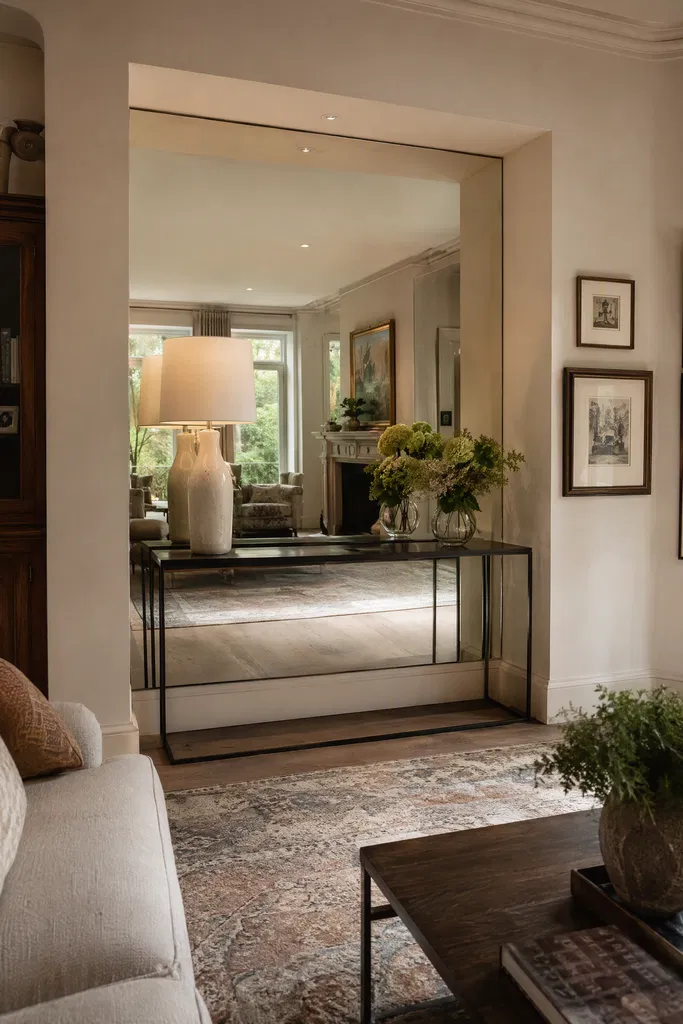
Lining the back wall and sides of an alcove with mirror is one of the oldest tricks in interior design and it remains one of the most effective, particularly in darker living rooms or rooms where natural light is limited, since the mirror reflects both artificial and natural light deep into the space and visually doubles whatever is placed in front of it. A large single mirror panel looks cleaner and more contemporary than a grid of small mirror tiles, and it makes the alcove feel like a deliberate architectural decision rather than a budget fix.
Heads Up: A mirrored alcove positioned opposite a window will reflect the window view and fill the room with natural light during the day but will also reflect any clutter or mess on the shelves directly across from it, so keep the shelving tidy or keep the display selective.
An Arched Alcove Opening

Softening the top of an alcove opening into an arch, either by reshaping an existing square recess or by adding a plasterboard arch at the entrance, immediately gives the whole feature a more architectural, European quality that reads as period character in older homes and as a considered design decision in newer ones. The arch does not require deep structural work in most cases and the visual payoff, particularly when the inside of the arch is painted in a contrasting tone, is significant relative to the investment.
Designer Advice: A semicircular arch works best in rooms with higher ceilings while a shallower elliptical arch suits standard-height rooms better, since a full circle in a low ceiling creates a compressed, awkward proportion.
Plants and a Grow-Light Feature Alcove

An alcove dedicated to indoor plants, fitted with a discreet grow light mounted at the top of the recess and shelves at different heights for plants of varying sizes, creates one of the most visually striking and genuinely alive features a living room can have. The key is to group plants of different leaf shapes, textures, and heights within the recess so the arrangement has depth and variety, and to choose a darker back wall color, deep green, terracotta, or charcoal, so the foliage contrasts vividly.
Quick Tip: A spectrum grow light disguised as a slim warm white LED strip keeps the plants thriving in lower natural light conditions without the clinical appearance of a standard purple-spectrum horticultural bulb.
Fabric-Backed Shelving for a Warm, Boutique Feel

Lining the back wall of a shelving alcove with fabric rather than paint or wallpaper, stretched over a thin board and fitted behind the shelves, adds a soft, textured depth to the recess that no paint finish can achieve. Linen, velvet, or a tightly woven stripe in a tone that complements the room create a boutique quality that looks genuinely custom even when the rest of the shelving is from a flat-pack source.
Pro Move: Use a fabric with enough texture to be interesting from a distance but neutral enough to function as a background rather than competing with whatever is displayed in front of it. A natural linen or a tonal stripe are the safest starting points.
A Concealed Alcove Bar Behind Bi-Fold Doors

Fitting the entrance to an alcove with bi-fold or pocket doors that close flush with the surrounding wall creates a home bar or drinks storage area that completely disappears when not in use, keeping the living room looking clean and uncluttered while concealing everything behind a surface that appears to be part of the wall. This is a feature associated with high-end interior design projects and is more achievable as a DIY or small carpentry job than most people assume.
Heads Up: Bi-fold doors into an alcove need to be precisely measured and hung to sit flush with the surrounding wall when closed. Even a small gap or misalignment makes the whole feature look unfinished, so invest in a skilled carpenter for the door installation if not for the rest of the build.
Contrasting Paneling Inside the Alcove

Adding a different wall treatment inside the alcove than the surrounding room, whether shiplap, tongue and groove vertical paneling, brick slips, or textured plaster, gives the recessed space a material richness and depth that paint alone cannot deliver. The contrast between the alcove treatment and the main walls defines the recess as a deliberate design zone rather than just a structural gap in the wall, and it works particularly well in living rooms that are otherwise relatively plain and would benefit from one strong textural moment.
Designer Advice: Brick slips inside a fireplace alcove are the most widely admired contrast material and also the most forgiving DIY option, since they require no specialized tools and adhere directly to a plastered wall surface with tile adhesive.
A Picture Light or Statement Sconce Inside the Alcove

A wall-mounted picture light or a pair of decorative sconces fitted inside an alcove serves two functions simultaneously: it lights whatever is displayed in the recess and it adds a layer of hardware detail that makes the whole feature feel finished and considered. A single picture light above a console table or a shelf inside the alcove is one of the most affordable upgrades available for a living room feature wall and it changes the atmosphere of the room significantly after dark.
Quick Tip: Hardwiring a sconce or picture light inside an alcove during any renovation phase is far cleaner than using a plug-in version, but a good quality plug-in picture light with the cord running neatly down the back of the shelf is a perfectly acceptable solution if rewiring is not possible.
A Statement Sofa Positioned Into the Alcove

Pushing a sofa or chaise into a deep alcove rather than filling the recess with shelves creates one of the most inviting and architecturally considered living room arrangements possible, using the three walls of the alcove to create a sense of enclosure and comfort around the seating that a sofa positioned in the middle of a room can never quite replicate. This works particularly well with a deep wing-back sofa or a curved chaise that fills the alcove width properly, making the seat feel genuinely fitted rather than just pushed to one side.
Reality Check: A sofa in an alcove needs at least 80cm of depth to sit comfortably without feeling wedged in. Measure the alcove depth against the sofa depth before committing, and leave enough clearance at the front for a coffee table without the room feeling blocked.
Alcove Bookshelves With a Library Ladder

Floor-to-ceiling bookshelves that are tall enough to require a library ladder are one of the most universally admired and aspirational living room features, and a deep alcove is the ideal structural home for them since the recess provides the back wall and side walls needed to anchor the shelving at every level without requiring freestanding supports. A sliding brass or black metal ladder rail running the full width of the shelves makes the whole setup genuinely usable rather than decorative, and adds a quality of a private members’ library that no other living room element can approximate.
Pro Move: Mix books with objects, art, and plants across the shelves rather than filling every inch with spines, since a densely packed floor-to-ceiling bookshelf can feel oppressive in a living room while a considered mix of books and objects feels rich and personal.
A Deep Display Alcove With Accent Lighting

Treating an alcove purely as a display space, with no shelves in the conventional sense but instead a series of different-height plinths or blocks inside the recess to position sculpture, ceramics, and art objects at considered heights, creates a gallery-like installation that strengthens the living room to a level of design confidence that most interiors never achieve. Accent spotlights recessed into the ceiling directly above the alcove opening, angled downward into the recess, complete the gallery effect and make displayed pieces appear genuinely lit rather than just illuminated.
Designer Advice: A display alcove with proper accent lighting and three to five carefully chosen objects will always read as better than an overcrowded shelving unit with forty. Restraint and intention are the defining qualities of a well-considered alcove.
A Recessed Fireplace Alcove With Fluted Paneling

Fitting fluted timber or MDF paneling to the side walls of a fireplace alcove, painted in the same tone as the chimney breast, gives the whole fireplace wall a level of architectural detail and texture that turns an ordinary living room wall into something that looks professionally designed. Fluted paneling has been one of the most consistently popular interior design details across the last three years and it works particularly well in alcove applications because the vertical lines of the fluting draw the eye upward and make standard ceiling heights feel taller.
Heads Up: Ready-made fluted MDF panels are available from most large timber merchants and are significantly easier to fit than cutting individual flutes from scratch. Paint them in the same color as the surrounding walls for a tonal effect or in a contrasting tone for maximum definition.
Alcove Curtains for a Soft, Dramatic Reveal
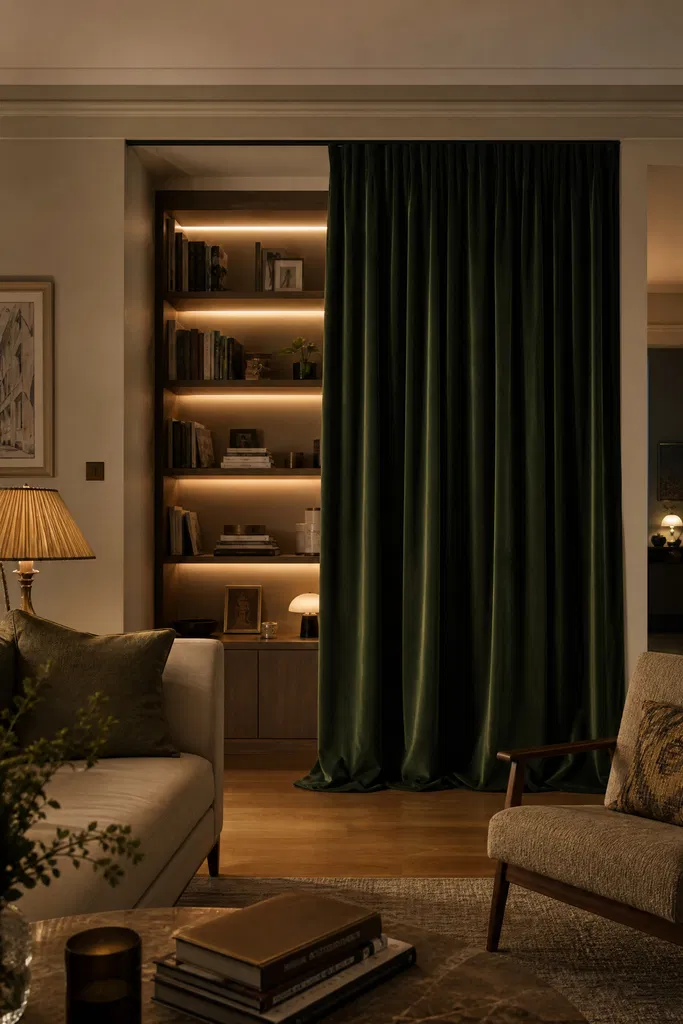
Hanging a curtain or a pair of curtains across the front of an alcove rather than leaving it open gives the recess a sense of mystery and warmth, particularly when the curtain fabric is something rich and textured like velvet, aged linen, or a heavyweight cotton in a deep tone. This treatment works whether the alcove contains shelving, a home bar, a home office, or simply storage, and the act of drawing the curtain back to reveal what is inside gives the feature a theatrical quality that an open alcove can never quite produce.
Quick Tip: Ceiling-mounted curtain track rather than a pole with rings produces the cleanest result for an alcove curtain, since it allows the fabric to sit close to the ceiling and eliminates the visible gap between the pole and the top of the recess.
A Tiled Alcove Back Panel

Replacing the painted or plastered back wall of an alcove with a decorative tile, whether handmade terracotta, encaustic cement tile, zellige, or a bold geometric ceramic, introduces a material and color quality that paint simply cannot produce and immediately makes the recess feel like a considered architectural element rather than an empty space with shelves in front of it. The tile works particularly well in an alcove that contains a drinks console or a bar since it suggests a permanence and craftsmanship that matches the quality of the function.
Designer Advice: Zellige tiles in a warm tone, such as dusty green, off-white, or terracotta, are the most versatile choice for a living room alcove since their handmade variation catches light differently across the day and the colour reads differently in morning and evening light.
An Alcove With Integrated Speaker Cabinetry

Building audio speakers directly into alcove cabinetry, with grille-fronted panels that conceal the drivers while allowing sound to pass through freely, solves the problem of where to put good speakers in a living room without sacrificing the appearance of the room to black plastic boxes on stands or shelves. A carpenter can build speaker housings into the lower section of an alcove cabinet with openings sized precisely to the speaker drivers, and a fabric grille stretched over a timber frame covers the opening in a way that reads as a cabinet detail rather than a technical component.
Pro Move: Run speaker cables inside the wall cavity before plastering or during any building work so the finished cabinetry has no visible wiring whatsoever. Retrofitting cables after the fact is always more expensive and less tidy than planning for them in advance.
An Alcove Mudroom Zone Near the Living Room Entry

In open-plan homes or living rooms near the front entry, an alcove can be converted into a compact mudroom zone with hooks at two heights for coats and bags, a narrow bench at the base, and a shelf above for keys, post, and everyday essentials. This is one of the most practical living room alcove uses available and it removes the clutter that typically accumulates near a front door from the visible floor area, concentrating it inside the recess where it is both accessible and contained.
Heads Up: A mudroom alcove needs a solid hook system rated for the weight of heavy coats and bags, not standard picture hooks or adhesive strips. Screw hooks directly into a horizontal timber batten fixed to the back wall for a system that will hold without pulling free.
An Alcove With a Painted Mural

Commissioning a painted mural for the back wall of a living room alcove, whether a botanical illustration, a landscape, a geometric abstract, or a trompe l’oeil architectural scene, turns the recess into the most distinctive and personal feature in the house. The contained scale of an alcove makes it the perfect mural format since the back wall is typically small enough to be executed quickly and affordably by a local artist, and the surrounding walls of the alcove frame the painting in the same way an oversized frame would.
Designer Advice: A trompe l’oeil mural inside an alcove that depicts a window, a doorway, or a receding landscape plays deliberately with the sense of depth that the recess already creates and gives the living room a quality of wit and originality that no product can replicate.